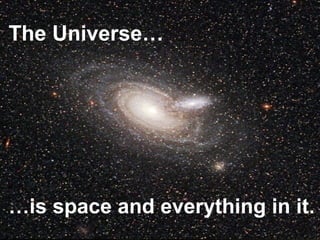
The Universe…


…is space and everything in it.
Galaxies
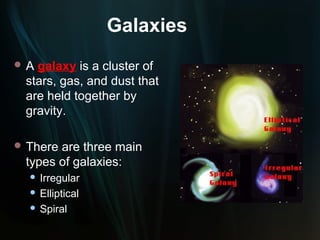
A galaxy is a cluster of
 stars, gas, and dust that
 are held together by
 gravity.

 Thereare three main
 types of galaxies:
   Irregular
   Elliptical

   Spiral
Types of Galaxies – Irregular…

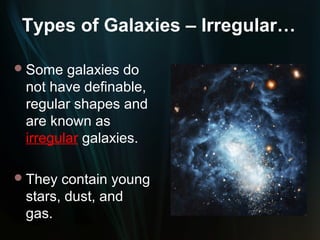
 Some  galaxies do
 not have definable,
 regular shapes and
 are known as
 irregular galaxies.

 They contain young
 stars, dust, and
 gas.
Types of Galaxies – Elliptical...
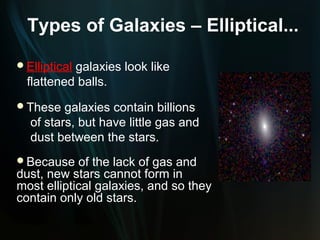
Ellipticalgalaxies look like
  flattened balls.
These   galaxies contain billions
  of stars, but have little gas and
  dust between the stars.
Because    of the lack of gas and
dust, new stars cannot form in
most elliptical galaxies, and so they
contain only old stars.
Types of Galaxies –Spiral…
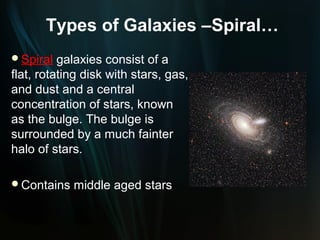
Spiral   galaxies consist of a
flat, rotating disk with stars, gas,
and dust and a central
concentration of stars, known
as the bulge. The bulge is
surrounded by a much fainter
halo of stars.

Contains   middle aged stars
Types of Galaxies – Barred Spiral…

Our   Milky Way galaxy has
recently (in the 1990s) been
confirmed to be a type of
spiral galaxy known as a
barred spiral galaxy.

Our  Sun is located at the
edge of the Milky Way
galaxy.
Nebulae (plural for Nebula)
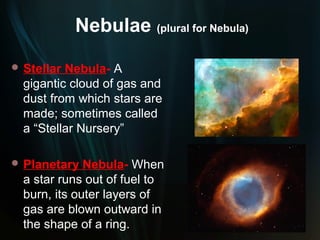
 Stellar Nebula- A
  gigantic cloud of gas and
  dust from which stars are
  made; sometimes called
  a “Stellar Nursery”

 Planetary   Nebula- When
  a star runs out of fuel to
  burn, its outer layers of
  gas are blown outward in
  the shape of a ring.
Stars
A   star contains hydrogen gas that forms helium
  through a process known as nuclear fusion. Stars
  form when gravity pulls together gas and dust
  from stellar nebula.

 Itreleases enormous amounts of energy which
  causes the star to become very hot and glow.

 Vary   in mass, size, and temperature

 Held   together by gravity.
A Star is Born…
A   star is made up of a large amount of gas,
  in a relatively small volume.
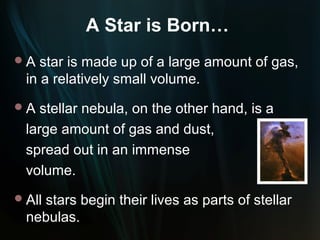
A   stellar nebula, on the other hand, is a
  large amount of gas and dust,
  spread out in an immense
  volume.
 All
    stars begin their lives as parts of stellar
  nebulas.
A Star is Born…

 Gravitycan pull some of the gas and dust
 in a nebula together.
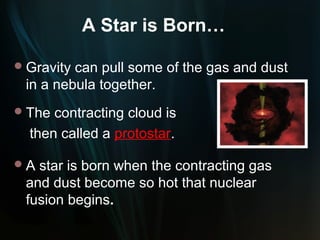
 The contracting cloud is
  then called a protostar.

A star is born when the contracting gas
 and dust become so hot that nuclear
 fusion begins.
Lifetimes of Stars…
 Beforethey can tell how old a star is,
 astronomers must determine its mass.

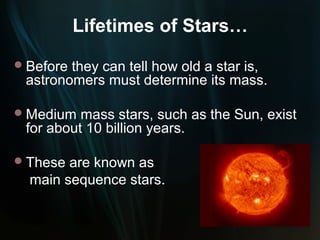
 Medium  mass stars, such as the Sun, exist
 for about 10 billion years.

 These are known as
  main sequence stars.
Lifetimes of Stars…

 Starswith more mass have shorter lives
 than those with less mass.

 Small stars use up their fuel more slowly
 than large stars, so they have much longer
 lives, about 200 billion years.
Lifetimes of Stars…
Stars form in a stellar
nebula, from collapsing
clouds of interstellar gas
and dust. This is called a
protostar.                     The rest of the life
                               cycle depends on
                               the mass of the
When a star runs out of        star.
fuel, it will become a white
dwarf, neutron star, or
black hole.
Main Sequence Stars…
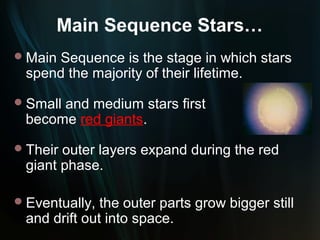
 Main
     Sequence is the stage in which stars
 spend the majority of their lifetime.
 Small
      and medium stars first
 become red giants.
 Theirouter layers expand during the red
 giant phase.

 Eventually, the outer parts grow bigger still
 and drift out into space.
Main Sequence Stars...

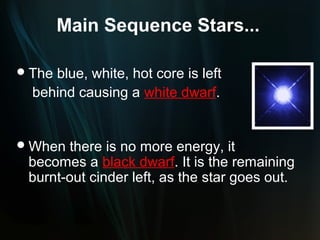
 Theblue, white, hot core is left
  behind causing a white dwarf.


 When there is no more energy, it
 becomes a black dwarf. It is the remaining
 burnt-out cinder left, as the star goes out.
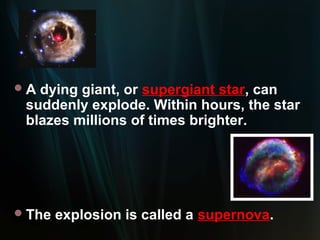
A dying giant, or supergiant star, can
 suddenly explode. Within hours, the star
 blazes millions of times brighter.


 The   explosion is called a supernova.
Neutron Stars…
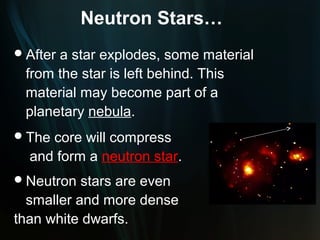
 After
      a star explodes, some material
 from the star is left behind. This
 material may become part of a
 planetary nebula.
 Thecore will compress
  and form a neutron star.
 Neutron  stars are even
  smaller and more dense
than white dwarfs.
Black Holes…
 Themost massive stars may have more
 than 40 times the mass of the Sun. One
 might have more than five times the
 mass of the Sun left, after it becomes a
 supernova.

 The gravity of this mass is so strong that
 the gas is pulled inward, packing it into a
 smaller and smaller space. These
 massive stars become black holes when
 they die.

Galaxies and stars

  • 1.
    The Universe… …is spaceand everything in it.
  • 2.
    Galaxies A galaxy isa cluster of stars, gas, and dust that are held together by gravity.  Thereare three main types of galaxies:  Irregular  Elliptical  Spiral
  • 3.
    Types of Galaxies– Irregular…  Some galaxies do not have definable, regular shapes and are known as irregular galaxies.  They contain young stars, dust, and gas.
  • 4.
    Types of Galaxies– Elliptical... Ellipticalgalaxies look like flattened balls. These galaxies contain billions of stars, but have little gas and dust between the stars. Because of the lack of gas and dust, new stars cannot form in most elliptical galaxies, and so they contain only old stars.
  • 5.
    Types of Galaxies–Spiral… Spiral galaxies consist of a flat, rotating disk with stars, gas, and dust and a central concentration of stars, known as the bulge. The bulge is surrounded by a much fainter halo of stars. Contains middle aged stars
  • 6.
    Types of Galaxies– Barred Spiral… Our Milky Way galaxy has recently (in the 1990s) been confirmed to be a type of spiral galaxy known as a barred spiral galaxy. Our Sun is located at the edge of the Milky Way galaxy.
  • 7.
    Nebulae (plural forNebula)  Stellar Nebula- A gigantic cloud of gas and dust from which stars are made; sometimes called a “Stellar Nursery”  Planetary Nebula- When a star runs out of fuel to burn, its outer layers of gas are blown outward in the shape of a ring.
  • 8.
    Stars A star contains hydrogen gas that forms helium through a process known as nuclear fusion. Stars form when gravity pulls together gas and dust from stellar nebula.  Itreleases enormous amounts of energy which causes the star to become very hot and glow.  Vary in mass, size, and temperature  Held together by gravity.
  • 9.
    A Star isBorn… A star is made up of a large amount of gas, in a relatively small volume. A stellar nebula, on the other hand, is a large amount of gas and dust, spread out in an immense volume.  All stars begin their lives as parts of stellar nebulas.
  • 10.
    A Star isBorn…  Gravitycan pull some of the gas and dust in a nebula together.  The contracting cloud is then called a protostar. A star is born when the contracting gas and dust become so hot that nuclear fusion begins.
  • 11.
    Lifetimes of Stars… Beforethey can tell how old a star is, astronomers must determine its mass.  Medium mass stars, such as the Sun, exist for about 10 billion years.  These are known as main sequence stars.
  • 12.
    Lifetimes of Stars… Starswith more mass have shorter lives than those with less mass.  Small stars use up their fuel more slowly than large stars, so they have much longer lives, about 200 billion years.
  • 13.
    Lifetimes of Stars… Starsform in a stellar nebula, from collapsing clouds of interstellar gas and dust. This is called a protostar. The rest of the life cycle depends on the mass of the When a star runs out of star. fuel, it will become a white dwarf, neutron star, or black hole.
  • 14.
    Main Sequence Stars… Main Sequence is the stage in which stars spend the majority of their lifetime.  Small and medium stars first become red giants.  Theirouter layers expand during the red giant phase.  Eventually, the outer parts grow bigger still and drift out into space.
  • 15.
    Main Sequence Stars... Theblue, white, hot core is left behind causing a white dwarf.  When there is no more energy, it becomes a black dwarf. It is the remaining burnt-out cinder left, as the star goes out.
  • 16.
    A dying giant,or supergiant star, can suddenly explode. Within hours, the star blazes millions of times brighter.  The explosion is called a supernova.
  • 17.
    Neutron Stars…  After a star explodes, some material from the star is left behind. This material may become part of a planetary nebula.  Thecore will compress and form a neutron star.  Neutron stars are even smaller and more dense than white dwarfs.
  • 18.
    Black Holes…  Themostmassive stars may have more than 40 times the mass of the Sun. One might have more than five times the mass of the Sun left, after it becomes a supernova.  The gravity of this mass is so strong that the gas is pulled inward, packing it into a smaller and smaller space. These massive stars become black holes when they die.

Editor's Notes

  • #2 http://commons.wikimedia.org/wiki/File:2MASX_J00482185-2507365_by_HST.jpg
  • #3 http://starchild.gsfc.nasa.gov/docs/StarChild/universe_level1/galaxies.html
  • #4 http://commons.wikimedia.org/wiki/File:I_Zwicky_18a.jpg
  • #5 http://commons.wikimedia.org/wiki/File:I_Zwicky_18a.jpg
  • #6 http://commons.wikimedia.org/wiki/File:2MASX_J00482185-2507365_by_HST.jpg
  • #7 http://www.nasa.gov/mission_pages/hubble/science/hstimg_ngc6217.html
  • #8 http://www.nasa.gov/multimedia/imagegallery/image_feature_768.html http://www.nasa.gov/multimedia/imagegallery/image_feature_77.html
  • #11 http://www.nasa.gov/mission_pages/spitzer/multimedia/spitzer20091123-b.html
  • #12 http://www.nasa.gov/multimedia/imagegallery/image_feature_21.html
  • #15 http://www.nasa.gov/audience/foreducators/topnav/materials/listbytype/Lifecycle_of_a_Star.html
  • #16 http://www.nasa.gov/multimedia/imagegallery/image_feature_468.html
  • #17 http://www.nasa.gov/multimedia/imagegallery/image_feature_219.html
  • #18 http://commons.wikimedia.org/wiki/File:M51_CHANDRA2.jpg