Natural disasters
EARTHQUAKES
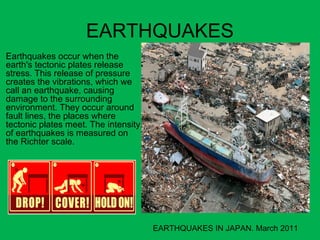
Earthquakes occur when the
earth's tectonic plates release
stress. This release of pressure
creates the vibrations, which we
call an earthquake, causing
damage to the surrounding
environment. They occur around
fault lines, the places where
tectonic plates meet. The intensity
of earthquakes is measured on
the Richter scale.
EARTHQUAKES IN JAPAN. March 2011
3
TSUNAMI
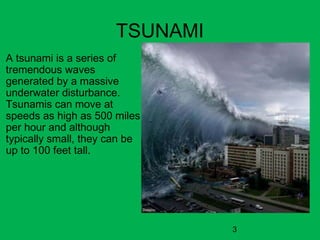
A tsunami is a series of
tremendous waves
generated by a massive
underwater disturbance.
Tsunamis can move at
speeds as high as 500 miles
per hour and although
typically small, they can be
up to 100 feet tall.
4
HURRICANE
A hurricane is a destructive
tropical cyclone in the western
Atlantic Ocean with winds
exceding 74 miles per hour.
Hurricanes are usually
accompanied by electrical storms
and typically occur during
summer and early autumn. In a
mere day, a hurricane can
release the amount of energy
necessary to satisfy the electrical
needs of the entire United States
for about six months.
5
TORNADO
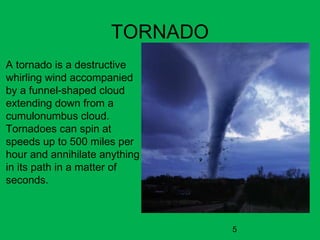
A tornado is a destructive
whirling wind accompanied
by a funnel-shaped cloud
extending down from a
cumulonumbus cloud.
Tornadoes can spin at
speeds up to 500 miles per
hour and annihilate anything
in its path in a matter of
seconds.
6
FLOODS
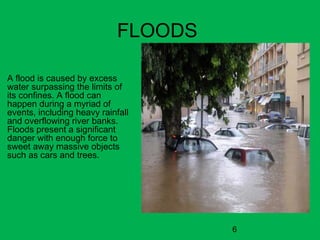
A flood is caused by excess
water surpassing the limits of
its confines. A flood can
happen during a myriad of
events, including heavy rainfall
and overflowing river banks.
Floods present a significant
danger with enough force to
sweet away massive objects
such as cars and trees.
7
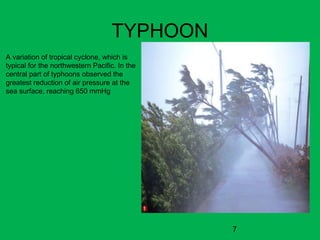
TYPHOON
A variation of tropical cyclone, which is
typical for the northwestern Pacific. In the
central part of typhoons observed the
greatest reduction of air pressure at the
sea surface, reaching 650 mmHg
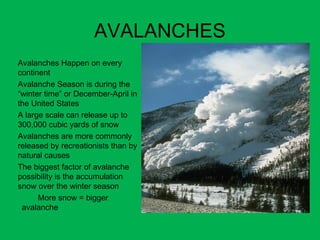
AVALANCHES
•
Avalanches Happen on every
continent
•
Avalanche Season is during the
“winter time” or December-April in
the United States
•
A large scale can release up to
300,000 cubic yards of snow
•
Avalanches are more commonly
released by recreationists than by
natural causes
•
The biggest factor of avalanche
possibility is the accumulation
snow over the winter season
–
More snow = bigger
avalanche
THUNDER STORMS
•
Every Thunderstorm produces
lightning
•
There is wet thunder and dry
thunder, the difference being
whether or not rain in
produced
•
Warm humid conditions favor
thunderstorms
•
Only 10% of thunderstorms
are classified as severe
•
Your chance of being struck by
lightning is 1 in 600,000
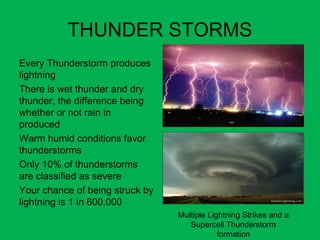
Multiple Lightning Strikes and a
Supercell Thunderstorm
formation
LANDSLIDES
•
Landslides are the movement of
land down a slope by gravity
•
Landslides are mother nature’s
way of redistributing land
•
They can be triggered by rain,
floods, and earthquakes as well
as man-made factors such as
slope grading or mining
•
Landslides have the potential to
happen anywhere a steep slope
is present
THANKS FOR WATHCHING

Natural disasters

  • 1.
  • 2.
    EARTHQUAKES Earthquakes occur whenthe earth's tectonic plates release stress. This release of pressure creates the vibrations, which we call an earthquake, causing damage to the surrounding environment. They occur around fault lines, the places where tectonic plates meet. The intensity of earthquakes is measured on the Richter scale. EARTHQUAKES IN JAPAN. March 2011
  • 3.
    3 TSUNAMI A tsunami isa series of tremendous waves generated by a massive underwater disturbance. Tsunamis can move at speeds as high as 500 miles per hour and although typically small, they can be up to 100 feet tall.
  • 4.
    4 HURRICANE A hurricane isa destructive tropical cyclone in the western Atlantic Ocean with winds exceding 74 miles per hour. Hurricanes are usually accompanied by electrical storms and typically occur during summer and early autumn. In a mere day, a hurricane can release the amount of energy necessary to satisfy the electrical needs of the entire United States for about six months.
  • 5.
    5 TORNADO A tornado isa destructive whirling wind accompanied by a funnel-shaped cloud extending down from a cumulonumbus cloud. Tornadoes can spin at speeds up to 500 miles per hour and annihilate anything in its path in a matter of seconds.
  • 6.
    6 FLOODS A flood iscaused by excess water surpassing the limits of its confines. A flood can happen during a myriad of events, including heavy rainfall and overflowing river banks. Floods present a significant danger with enough force to sweet away massive objects such as cars and trees.
  • 7.
    7 TYPHOON A variation of tropicalcyclone, which is typical for the northwestern Pacific. In the central part of typhoons observed the greatest reduction of air pressure at the sea surface, reaching 650 mmHg
  • 8.
    AVALANCHES • Avalanches Happen onevery continent • Avalanche Season is during the “winter time” or December-April in the United States • A large scale can release up to 300,000 cubic yards of snow • Avalanches are more commonly released by recreationists than by natural causes • The biggest factor of avalanche possibility is the accumulation snow over the winter season – More snow = bigger avalanche
  • 9.
    THUNDER STORMS • Every Thunderstormproduces lightning • There is wet thunder and dry thunder, the difference being whether or not rain in produced • Warm humid conditions favor thunderstorms • Only 10% of thunderstorms are classified as severe • Your chance of being struck by lightning is 1 in 600,000 Multiple Lightning Strikes and a Supercell Thunderstorm formation
  • 10.
    LANDSLIDES • Landslides are themovement of land down a slope by gravity • Landslides are mother nature’s way of redistributing land • They can be triggered by rain, floods, and earthquakes as well as man-made factors such as slope grading or mining • Landslides have the potential to happen anywhere a steep slope is present
  • 11.