Human Body Systems
Test Review
Structure and Function
of
Living Systems
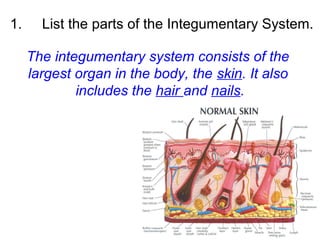
1. List the parts of the Integumentary System.
The integumentary system consists of the
largest organ in the body, the skin. It also
includes the hair and nails.
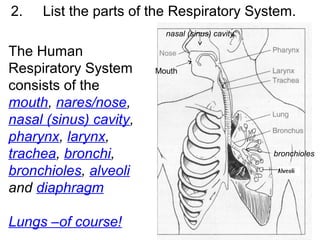
2. List the parts of the Respiratory System.
The Human
Respiratory System
consists of the
mouth, nares/nose,
nasal (sinus) cavity,
pharynx, larynx,
trachea, bronchi,
bronchioles, alveoli
and diaphragm
Lungs –of course!
Mouth
nasal (sinus) cavity
bronchioles
3. List the functions and structures of the
following systems:
Mnemonic:
Circulatory
Function:
Structures (major organs):
MICE R NERDS
heart - veins - arteries - capillaries
this system is responsible for
the movement of blood, nutrients, and
gases throughout every cell in the body.
Muscular
Function:
Structures (major organs):
working with the bones
and joints, this system provides
movement for the body and
maintains the body’s vertical
posture.
- skeletal muscles (like biceps)
-cardiac muscle (the heart)
- smooth muscles (like stomach)
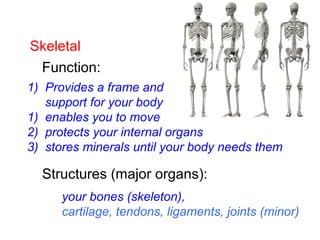
Skeletal
Function:
Structures (major organs):
1) Provides a frame and
support for your body
1) enables you to move
2) protects your internal organs
3) stores minerals until your body needs them
your bones (skeleton),
cartilage, tendons, ligaments, joints (minor)
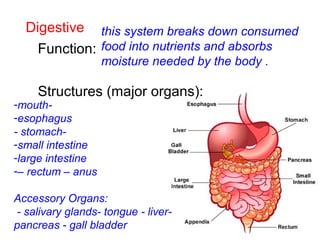
Digestive
Function:
Structures (major organs):
this system breaks down consumed
food into nutrients and absorbs
moisture needed by the body .
-mouth-
-esophagus
- stomach-
-small intestine
-large intestine
-– rectum – anus
Accessory Organs:
- salivary glands- tongue - liver-
pancreas - gall bladder
Endocrine
Function:
Structures (major organs):
this system is a series of glands that excrete
chemicals called hormones that regulate
cell activity or organs
-pituitary gland (regulates growth)
-thyroid gland (regulates metabolism)
-adrenal gland (regulates stress hormones)
- testes and ovaries
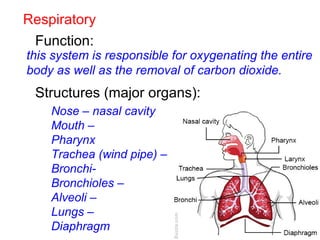
Respiratory
Function:
Structures (major organs):
this system is responsible for oxygenating the entire
body as well as the removal of carbon dioxide.
Nose – nasal cavity
Mouth –
Pharynx
Trachea (wind pipe) –
Bronchi-
Bronchioles –
Alveoli –
Lungs –
Diaphragm
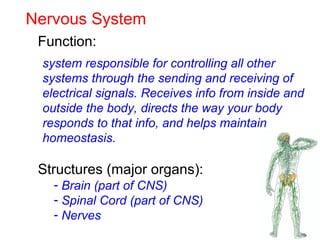
Nervous System
Function:
Structures (major organs):
system responsible for controlling all other
systems through the sending and receiving of
electrical signals. Receives info from inside and
outside the body, directs the way your body
responds to that info, and helps maintain
homeostasis.
- Brain (part of CNS)
- Spinal Cord (part of CNS)
- Nerves
Integumentary System
Function:
Structures (major organs):
this system includes the hair, skin, and nails and
is the bodies first line of defense against harmful
micro-organisms and trauma
1) Covers body and prevents water loss
2) Protects body from injury and infection
3) Regulates Body Temperature
4) Eliminates waste
5) Gathers info about the environment
6) Produces Vitamin D
- Skin
- Hair
- Nails
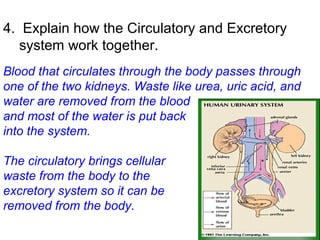
4. Explain how the Circulatory and Excretory
system work together.
Blood that circulates through the body passes through
one of the two kidneys. Waste like urea, uric acid, and
water are removed from the blood
and most of the water is put back
into the system.
The circulatory brings cellular
waste from the body to the
excretory system so it can be
removed from the body.
5. Explain how the Respiratory and
Circulatory system work together.
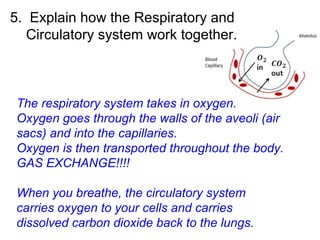
The respiratory system takes in oxygen.
Oxygen goes through the walls of the aveoli (air
sacs) and into the capillaries.
Oxygen is then transported throughout the body.
GAS EXCHANGE!!!!
When you breathe, the circulatory system
carries oxygen to your cells and carries
dissolved carbon dioxide back to the lungs.
6. Name the largest organ in the body. It is
part of what system?
The skin is the largest organ in the body:
12-15% of body weight, with a surface
area of 1-2 meters.
It is part of the Integumentary system.
7. Name the 3 basic kinds of joints in the body
and give an example of each.
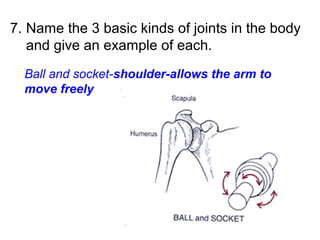
Ball and socket-shoulder-allows the arm to
move freely
7. Name the 3 basic kinds of joints in the body
and give an example of each.
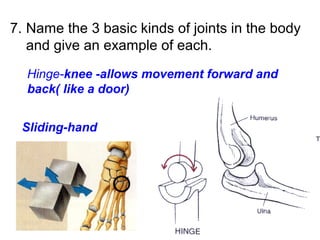
Hinge-knee -allows movement forward and
back( like a door)
Sliding-hand
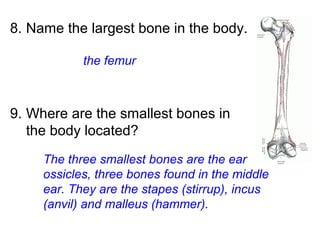
8. Name the largest bone in the body.
9. Where are the smallest bones in
the body located?
the femur
The three smallest bones are the ear
ossicles, three bones found in the middle
ear. They are the stapes (stirrup), incus
(anvil) and malleus (hammer).
10. Name the 3 types of muscle tissue found in
the body and tell where each is found.
Smooth muscles are found in your
digestive tract and blood vessels
Cardiac muscles are found in the walls of
the heart
Skeletal muscles are found in muscles
which are attached to the skeleton
11.Put the following in order from smallest to
largest:
organs, tissues, organism, cells, organ system
Cells
Tissues
Organs
Organ System
Organism
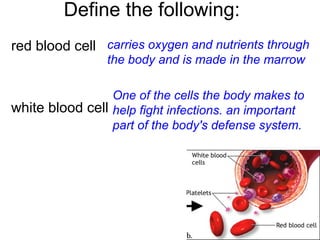
Define the following:
red blood cell
white blood cell
carries oxygen and nutrients through
the body and is made in the marrow
One of the cells the body makes to
help fight infections. an important
part of the body's defense system.
Define the following:
Tendon
Cartilage
Ligament
connects muscle to bone
soft, connective tissue
used for protection
found in joints ,and
between bones.
connects bone to bone
Define the following:
Homeostasis
Oxygenate
process which helps the body
maintain a stable internal condition
To combine or mix with oxygen. Blood
is oxygenated in the lungs.
Define the following:
Respiration
The act or process of inhaling and
exhaling; breathing. Taking in oxygen –
releasing carbon dioxide.
In air-breathing vertebrates, respiration
takes place in the lungs.
In fish and many invertebrates,
respiration takes place through the gills.
Respiration in green plants occurs
during photosynthesis.
Not Cellular
Respiration
Define the following:
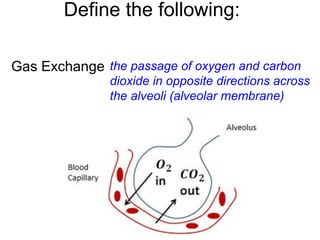
Gas Exchange the passage of oxygen and carbon
dioxide in opposite directions across
the alveoli (alveolar membrane)
Define the following:
Artery
Vein
Capillary
a blood vessel that conveys blood from
the heart to any part of the body
(AWAY)
A blood vessel that carries blood
that is low in oxygen content from
the body back to the heart. (INTO)
are the smallest blood vessels in the
body, connecting the
smallest arteries (arterioles) to the
smallest veins (venules)
Define the following:
Involuntary
(autonomic)
Voluntary
(somatic)
muscles that you do not have control
over.
Example –heart, digestive
muscle you have control over.
Example-would be skeletal
14. Name and define the 2 ways food is
broken down by the digestive system.
• Mechanical digestion breaks
food down physically.
• Chemical digestion uses
enzymes (digestive juices) to
breaks food down.
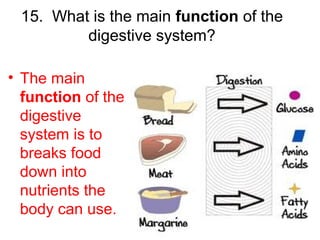
15. What is the main function of the
digestive system?
• The main
function of the
digestive
system is to
breaks food
down into
nutrients the
body can use.
16. What elements are found in organic
compounds?
• Mnemonic --- CHONPS
• Carbon
• Hydrogen
• Oxygen
• Nitrogen
• Phosphorous
• Sulfur
17. List the forms of energy.
• Radiant (light) energy
• Chemical energy
• Thermal (heat) energy
• Mechanical energy
• Kinetic energy
• Potential energy
18. Name the type of energy conversion
occurring in each of the following:
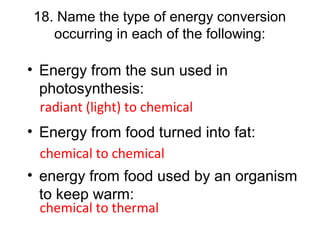
• Energy from the sun used in
photosynthesis:
• Energy from food turned into fat:
• energy from food used by an organism
to keep warm:
radiant (light) to chemical
chemical to chemical
chemical to thermal
19. The body breaks down carbohydrates
into what substance?
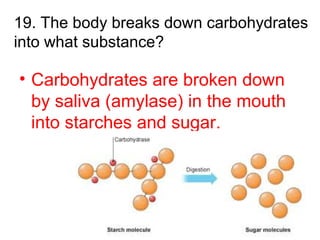
• Carbohydrates are broken down
by saliva (amylase) in the mouth
into starches and sugar.
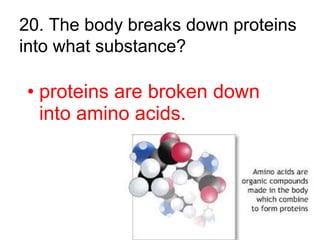
20. The body breaks down proteins
into what substance?
• proteins are broken down
into amino acids.
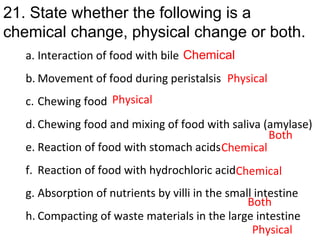
a. Interaction of food with bile
b. Movement of food during peristalsis
c. Chewing food
d. Chewing food and mixing of food with saliva (amylase)
e. Reaction of food with stomach acids
f. Reaction of food with hydrochloric acid
g. Absorption of nutrients by villi in the small intestine
h. Compacting of waste materials in the large intestine
21. State whether the following is a
chemical change, physical change or both.
Chemical
Physical
Physical
Both
Chemical
Chemical
Both
Physical
22. What is homeostasis?
23. How does your body maintain
a stable internal temperature?
• Homeostasis is the process used
by the body to maintain a stable
internal environment.
• Your body maintains a stable internal
temperature through the process of
Homeostasis.
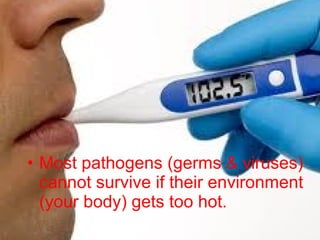
24. Why do you get a fever when
you get sick?
• Most pathogens (germs & viruses)
cannot survive if their environment
(your body) gets too hot.
25. What are your 5 senses?
What body system do your senses
belong to?
• Your 5 senses belong to the nervous
system
• hearing, seeing, tasting, touching,
smelling
26. What is the name of the nerve that
carries impulses from your eye to your
brain?
• nerve that carries impulses from your
eye to your brain is the optic nerve
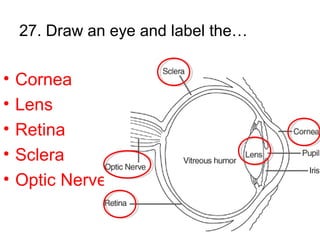
27. Draw an eye and label the…
• Cornea
• Lens
• Retina
• Sclera
• Optic Nerve
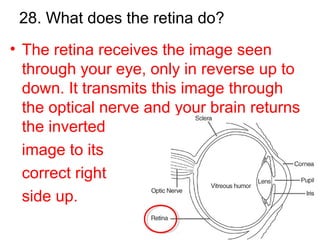
28. What does the retina do?
• The retina receives the image seen
through your eye, only in reverse up to
down. It transmits this image through
the optical nerve and your brain returns
the inverted
image to its
correct right
side up.
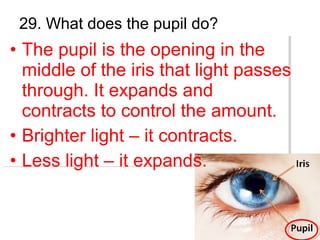
29. What does the pupil do?
• The pupil is the opening in the
middle of the iris that light passes
through. It expands and
contracts to control the amount.
• Brighter light – it contracts.
• Less light – it expands.
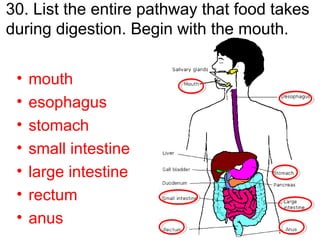
30. List the entire pathway that food takes
during digestion. Begin with the mouth.
• mouth
• esophagus
• stomach
• small intestine
• large intestine
• rectum
• anus

Human Body Systems Test Review

  • 1.
    Human Body Systems TestReview Structure and Function of Living Systems
  • 2.
    1. List theparts of the Integumentary System. The integumentary system consists of the largest organ in the body, the skin. It also includes the hair and nails.
  • 3.
    2. List theparts of the Respiratory System. The Human Respiratory System consists of the mouth, nares/nose, nasal (sinus) cavity, pharynx, larynx, trachea, bronchi, bronchioles, alveoli and diaphragm Lungs –of course! Mouth nasal (sinus) cavity bronchioles
  • 4.
    3. List thefunctions and structures of the following systems: Mnemonic: Circulatory Function: Structures (major organs): MICE R NERDS heart - veins - arteries - capillaries this system is responsible for the movement of blood, nutrients, and gases throughout every cell in the body.
  • 5.
    Muscular Function: Structures (major organs): workingwith the bones and joints, this system provides movement for the body and maintains the body’s vertical posture. - skeletal muscles (like biceps) -cardiac muscle (the heart) - smooth muscles (like stomach)
  • 6.
    Skeletal Function: Structures (major organs): 1)Provides a frame and support for your body 1) enables you to move 2) protects your internal organs 3) stores minerals until your body needs them your bones (skeleton), cartilage, tendons, ligaments, joints (minor)
  • 7.
    Digestive Function: Structures (major organs): thissystem breaks down consumed food into nutrients and absorbs moisture needed by the body . -mouth- -esophagus - stomach- -small intestine -large intestine -– rectum – anus Accessory Organs: - salivary glands- tongue - liver- pancreas - gall bladder
  • 8.
    Endocrine Function: Structures (major organs): thissystem is a series of glands that excrete chemicals called hormones that regulate cell activity or organs -pituitary gland (regulates growth) -thyroid gland (regulates metabolism) -adrenal gland (regulates stress hormones) - testes and ovaries
  • 9.
    Respiratory Function: Structures (major organs): thissystem is responsible for oxygenating the entire body as well as the removal of carbon dioxide. Nose – nasal cavity Mouth – Pharynx Trachea (wind pipe) – Bronchi- Bronchioles – Alveoli – Lungs – Diaphragm
  • 10.
    Nervous System Function: Structures (majororgans): system responsible for controlling all other systems through the sending and receiving of electrical signals. Receives info from inside and outside the body, directs the way your body responds to that info, and helps maintain homeostasis. - Brain (part of CNS) - Spinal Cord (part of CNS) - Nerves
  • 11.
    Integumentary System Function: Structures (majororgans): this system includes the hair, skin, and nails and is the bodies first line of defense against harmful micro-organisms and trauma 1) Covers body and prevents water loss 2) Protects body from injury and infection 3) Regulates Body Temperature 4) Eliminates waste 5) Gathers info about the environment 6) Produces Vitamin D - Skin - Hair - Nails
  • 12.
    4. Explain howthe Circulatory and Excretory system work together. Blood that circulates through the body passes through one of the two kidneys. Waste like urea, uric acid, and water are removed from the blood and most of the water is put back into the system. The circulatory brings cellular waste from the body to the excretory system so it can be removed from the body.
  • 13.
    5. Explain howthe Respiratory and Circulatory system work together. The respiratory system takes in oxygen. Oxygen goes through the walls of the aveoli (air sacs) and into the capillaries. Oxygen is then transported throughout the body. GAS EXCHANGE!!!! When you breathe, the circulatory system carries oxygen to your cells and carries dissolved carbon dioxide back to the lungs.
  • 14.
    6. Name thelargest organ in the body. It is part of what system? The skin is the largest organ in the body: 12-15% of body weight, with a surface area of 1-2 meters. It is part of the Integumentary system.
  • 15.
    7. Name the3 basic kinds of joints in the body and give an example of each. Ball and socket-shoulder-allows the arm to move freely
  • 16.
    7. Name the3 basic kinds of joints in the body and give an example of each. Hinge-knee -allows movement forward and back( like a door) Sliding-hand
  • 17.
    8. Name thelargest bone in the body. 9. Where are the smallest bones in the body located? the femur The three smallest bones are the ear ossicles, three bones found in the middle ear. They are the stapes (stirrup), incus (anvil) and malleus (hammer).
  • 18.
    10. Name the3 types of muscle tissue found in the body and tell where each is found. Smooth muscles are found in your digestive tract and blood vessels Cardiac muscles are found in the walls of the heart Skeletal muscles are found in muscles which are attached to the skeleton
  • 19.
    11.Put the followingin order from smallest to largest: organs, tissues, organism, cells, organ system Cells Tissues Organs Organ System Organism
  • 20.
    Define the following: redblood cell white blood cell carries oxygen and nutrients through the body and is made in the marrow One of the cells the body makes to help fight infections. an important part of the body's defense system.
  • 21.
    Define the following: Tendon Cartilage Ligament connectsmuscle to bone soft, connective tissue used for protection found in joints ,and between bones. connects bone to bone
  • 22.
    Define the following: Homeostasis Oxygenate processwhich helps the body maintain a stable internal condition To combine or mix with oxygen. Blood is oxygenated in the lungs.
  • 23.
    Define the following: Respiration Theact or process of inhaling and exhaling; breathing. Taking in oxygen – releasing carbon dioxide. In air-breathing vertebrates, respiration takes place in the lungs. In fish and many invertebrates, respiration takes place through the gills. Respiration in green plants occurs during photosynthesis. Not Cellular Respiration
  • 24.
    Define the following: GasExchange the passage of oxygen and carbon dioxide in opposite directions across the alveoli (alveolar membrane)
  • 25.
    Define the following: Artery Vein Capillary ablood vessel that conveys blood from the heart to any part of the body (AWAY) A blood vessel that carries blood that is low in oxygen content from the body back to the heart. (INTO) are the smallest blood vessels in the body, connecting the smallest arteries (arterioles) to the smallest veins (venules)
  • 26.
    Define the following: Involuntary (autonomic) Voluntary (somatic) musclesthat you do not have control over. Example –heart, digestive muscle you have control over. Example-would be skeletal
  • 27.
    14. Name anddefine the 2 ways food is broken down by the digestive system. • Mechanical digestion breaks food down physically. • Chemical digestion uses enzymes (digestive juices) to breaks food down.
  • 28.
    15. What isthe main function of the digestive system? • The main function of the digestive system is to breaks food down into nutrients the body can use.
  • 29.
    16. What elementsare found in organic compounds? • Mnemonic --- CHONPS • Carbon • Hydrogen • Oxygen • Nitrogen • Phosphorous • Sulfur
  • 30.
    17. List theforms of energy. • Radiant (light) energy • Chemical energy • Thermal (heat) energy • Mechanical energy • Kinetic energy • Potential energy
  • 31.
    18. Name thetype of energy conversion occurring in each of the following: • Energy from the sun used in photosynthesis: • Energy from food turned into fat: • energy from food used by an organism to keep warm: radiant (light) to chemical chemical to chemical chemical to thermal
  • 32.
    19. The bodybreaks down carbohydrates into what substance? • Carbohydrates are broken down by saliva (amylase) in the mouth into starches and sugar.
  • 33.
    20. The bodybreaks down proteins into what substance? • proteins are broken down into amino acids.
  • 34.
    a. Interaction offood with bile b. Movement of food during peristalsis c. Chewing food d. Chewing food and mixing of food with saliva (amylase) e. Reaction of food with stomach acids f. Reaction of food with hydrochloric acid g. Absorption of nutrients by villi in the small intestine h. Compacting of waste materials in the large intestine 21. State whether the following is a chemical change, physical change or both. Chemical Physical Physical Both Chemical Chemical Both Physical
  • 35.
    22. What ishomeostasis? 23. How does your body maintain a stable internal temperature? • Homeostasis is the process used by the body to maintain a stable internal environment. • Your body maintains a stable internal temperature through the process of Homeostasis.
  • 36.
    24. Why doyou get a fever when you get sick? • Most pathogens (germs & viruses) cannot survive if their environment (your body) gets too hot.
  • 37.
    25. What areyour 5 senses? What body system do your senses belong to? • Your 5 senses belong to the nervous system • hearing, seeing, tasting, touching, smelling
  • 38.
    26. What isthe name of the nerve that carries impulses from your eye to your brain? • nerve that carries impulses from your eye to your brain is the optic nerve
  • 39.
    27. Draw aneye and label the… • Cornea • Lens • Retina • Sclera • Optic Nerve
  • 40.
    28. What doesthe retina do? • The retina receives the image seen through your eye, only in reverse up to down. It transmits this image through the optical nerve and your brain returns the inverted image to its correct right side up.
  • 41.
    29. What doesthe pupil do? • The pupil is the opening in the middle of the iris that light passes through. It expands and contracts to control the amount. • Brighter light – it contracts. • Less light – it expands.
  • 42.
    30. List theentire pathway that food takes during digestion. Begin with the mouth. • mouth • esophagus • stomach • small intestine • large intestine • rectum • anus