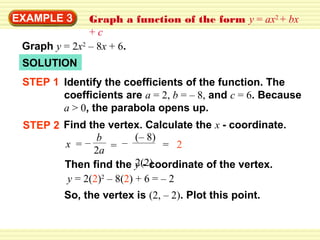
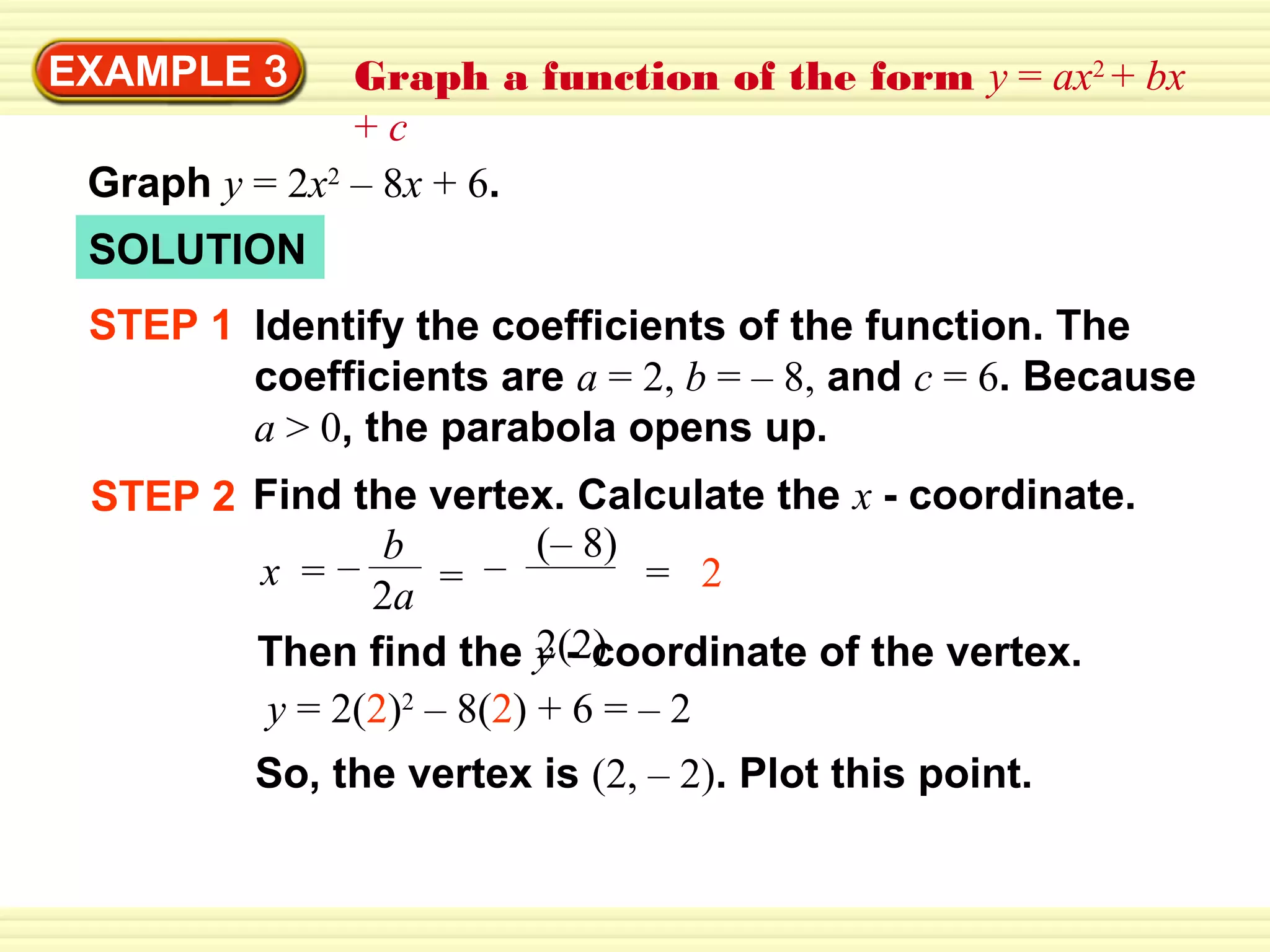
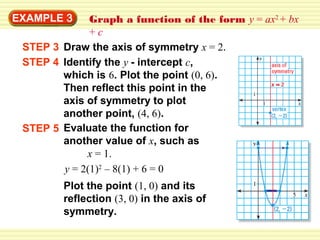
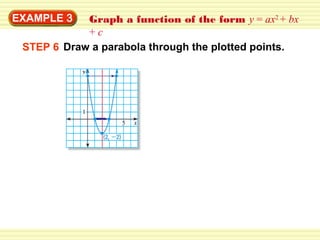
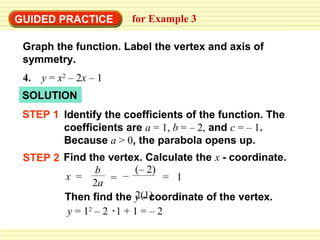
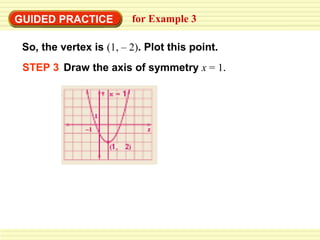
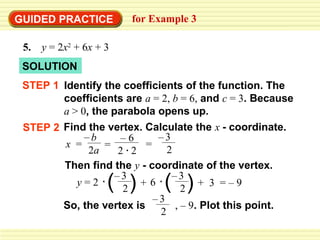
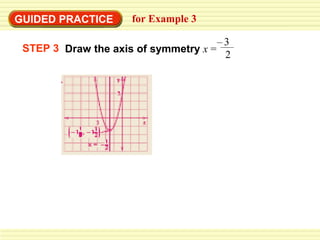
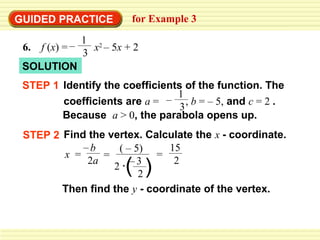
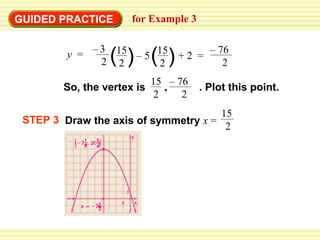
This document provides steps to graph functions of the form y = ax^2 + bx + c. It works through an example problem, graphing y = 2x^2 - 8x + 6. The steps are to: 1) identify the coefficients a, b, and c, 2) find the vertex by calculating x from b/2a and the corresponding y-value, 3) draw the axis of symmetry at x, 4) plot other points and 5) draw the parabola through the points. It then provides guided practice problems for students to practice graphing quadratic functions using the same steps.