Different types of galaxiesBy: Samantha Derzay
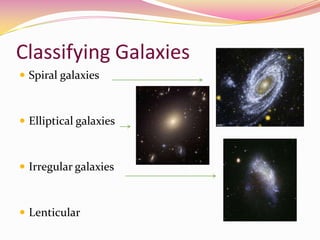
Classifying GalaxiesSpiral galaxiesElliptical galaxiesIrregular galaxies Lenticular
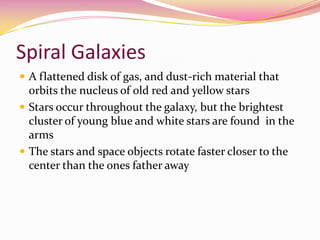
Spiral Galaxies A flattened disk of gas, and dust-rich material that orbits the nucleus of old red and yellow starsStars occur throughout the galaxy, but the brightest cluster of young blue and white stars are found  in the armsThe stars and space objects rotate faster closer to the center than the ones father away
Spiral Galaxies Classification They are classified for how tightly together the arms of the galaxy are The scale is Sa- Sd Sa, is the most tight Sd, is very loose If the galaxy has a bar through the galaxy, the scale is SBa-SBd
Elliptical Galaxies They range from being the biggest to smallest galaxies Scientist believe that there must be a lot of Dark Matter holding the stars together Show little structure other than a simple sphere Almost all of the stars yellow and red Rarely any sign of star-forming gas and dust
Elliptical Galaxies Classification They are classified according to their shape The scale is E0- E7 E0 having the shape of a sphere E7 having the shape of an oval They are also classifies by their sizeGiant Elliptical: located at the center of a galaxy clustersIntermediate GalaxyDwarf Elliptical
Lenticular Galaxies At first they look like Elliptical, however around the nucleus there is gasThe gas would link them to Spiral galaxies, but the nucleus is considerably larger  The overall shape looks like a lens, which is the root word for Lenticular If you were to look at a Lenticular galaxy face on, it could be mistakenly classified as a Elliptical galaxy If you look at a Spiral galaxy with a large nucleus edge on, it could look like a Lenticular galaxy
Irregular Galaxies Galaxies  that do not fit into Spiral, Elliptical, or LenticularThese galaxies contain a lot of gas, dust, and blue starsMany Irregular galaxies typically have great waves of star formation sweeping through the galaxy called “starbursts”They frequently have vast, pink, hydrogen-emission nebulae where star formation is taking placeSome Irregular galaxies are colliding with other galaxies or being pulled apart by neighboring galaxies gravity
The Milky Way ComparisonClassified as a SBc (barred spiral galaxy) Diameter: 100,000 light years Thickness: 1,000 light years Mass: 700,000,000,000 M (M= solar mass) Number of Stars: 100-400 billion Oldest known star: 13.2 billion years Andromeda is classified as a SAb Number of stars: 1 trillion Larger than the Milky Way
Andromeda Galaxy Classified as a SAb

Different types of galaxies

  • 1.
    Different types ofgalaxiesBy: Samantha Derzay
  • 2.
    Classifying GalaxiesSpiral galaxiesEllipticalgalaxiesIrregular galaxies Lenticular
  • 3.
    Spiral Galaxies Aflattened disk of gas, and dust-rich material that orbits the nucleus of old red and yellow starsStars occur throughout the galaxy, but the brightest cluster of young blue and white stars are found in the armsThe stars and space objects rotate faster closer to the center than the ones father away
  • 4.
    Spiral Galaxies ClassificationThey are classified for how tightly together the arms of the galaxy are The scale is Sa- Sd Sa, is the most tight Sd, is very loose If the galaxy has a bar through the galaxy, the scale is SBa-SBd
  • 5.
    Elliptical Galaxies Theyrange from being the biggest to smallest galaxies Scientist believe that there must be a lot of Dark Matter holding the stars together Show little structure other than a simple sphere Almost all of the stars yellow and red Rarely any sign of star-forming gas and dust
  • 6.
    Elliptical Galaxies ClassificationThey are classified according to their shape The scale is E0- E7 E0 having the shape of a sphere E7 having the shape of an oval They are also classifies by their sizeGiant Elliptical: located at the center of a galaxy clustersIntermediate GalaxyDwarf Elliptical
  • 7.
    Lenticular Galaxies Atfirst they look like Elliptical, however around the nucleus there is gasThe gas would link them to Spiral galaxies, but the nucleus is considerably larger The overall shape looks like a lens, which is the root word for Lenticular If you were to look at a Lenticular galaxy face on, it could be mistakenly classified as a Elliptical galaxy If you look at a Spiral galaxy with a large nucleus edge on, it could look like a Lenticular galaxy
  • 8.
    Irregular Galaxies Galaxies that do not fit into Spiral, Elliptical, or LenticularThese galaxies contain a lot of gas, dust, and blue starsMany Irregular galaxies typically have great waves of star formation sweeping through the galaxy called “starbursts”They frequently have vast, pink, hydrogen-emission nebulae where star formation is taking placeSome Irregular galaxies are colliding with other galaxies or being pulled apart by neighboring galaxies gravity
  • 9.
    The Milky WayComparisonClassified as a SBc (barred spiral galaxy) Diameter: 100,000 light years Thickness: 1,000 light years Mass: 700,000,000,000 M (M= solar mass) Number of Stars: 100-400 billion Oldest known star: 13.2 billion years Andromeda is classified as a SAb Number of stars: 1 trillion Larger than the Milky Way
  • 10.