-Aneesh Ukidve
V Shardadevi
Roll no #31

1
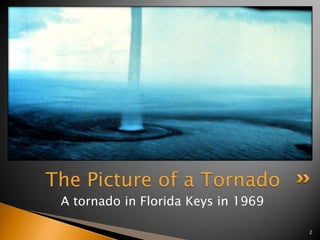
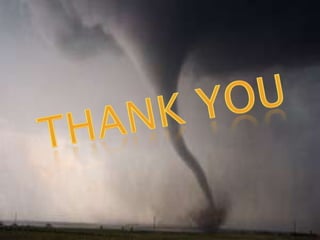
The Picture of a Tornado
A tornado in Florida Keys in 1969
2
•

•

•

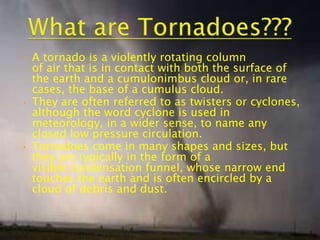
A tornado is a violently rotating column
of air that is in contact with both the surface of
the earth and a cumulonimbus cloud or, in rare
cases, the base of a cumulus cloud.
They are often referred to as twisters or cyclones,
although the word cyclone is used in
meteorology, in a wider sense, to name any
closed low pressure circulation.
Tornadoes come in many shapes and sizes, but
they are typically in the form of a
visible condensation funnel, whose narrow end
touches the earth and is often encircled by a
cloud of debris and dust.

3




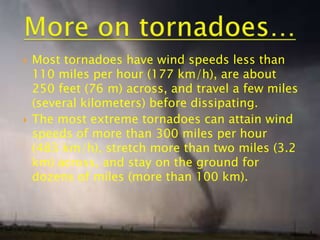
Most tornadoes have wind speeds less than
110 miles per hour (177 km/h), are about
250 feet (76 m) across, and travel a few miles
(several kilometers) before dissipating.
The most extreme tornadoes can attain wind
speeds of more than 300 miles per hour
(483 km/h), stretch more than two miles (3.2
km) across, and stay on the ground for
dozens of miles (more than 100 km).

4
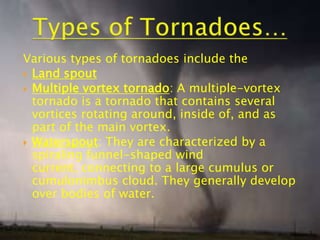
Various types of tornadoes include the
 Land spout
 Multiple vortex tornado: A multiple-vortex
tornado is a tornado that contains several
vortices rotating around, inside of, and as
part of the main vortex.
 Waterspout: They are characterized by a
spiraling funnel-shaped wind
current, connecting to a large cumulus or
cumulonimbus cloud. They generally develop
over bodies of water.
5







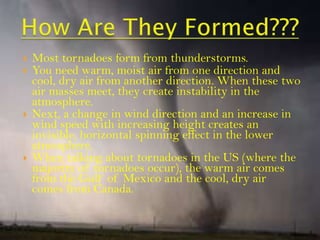
Most tornadoes form from thunderstorms.
You need warm, moist air from one direction and
cool, dry air from another direction. When these two
air masses meet, they create instability in the
atmosphere.
Next, a change in wind direction and an increase in
wind speed with increasing height creates an
invisible, horizontal spinning effect in the lower
atmosphere.
When talking about tornadoes in the US (where the
majority of tornadoes occur), the warm air comes
from the Gulf of Mexico and the cool, dry air
comes from Canada.

6
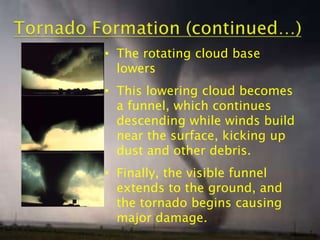
• The rotating cloud base
lowers

• This lowering cloud becomes
a funnel, which continues
descending while winds build
near the surface, kicking up
dust and other debris.
• Finally, the visible funnel
extends to the ground, and
the tornado begins causing
major damage.
7
8
9

Tornadoes

  • 1.
  • 2.
    The Picture ofa Tornado A tornado in Florida Keys in 1969 2
  • 3.
    • • • A tornado isa violently rotating column of air that is in contact with both the surface of the earth and a cumulonimbus cloud or, in rare cases, the base of a cumulus cloud. They are often referred to as twisters or cyclones, although the word cyclone is used in meteorology, in a wider sense, to name any closed low pressure circulation. Tornadoes come in many shapes and sizes, but they are typically in the form of a visible condensation funnel, whose narrow end touches the earth and is often encircled by a cloud of debris and dust. 3
  • 4.
      Most tornadoes havewind speeds less than 110 miles per hour (177 km/h), are about 250 feet (76 m) across, and travel a few miles (several kilometers) before dissipating. The most extreme tornadoes can attain wind speeds of more than 300 miles per hour (483 km/h), stretch more than two miles (3.2 km) across, and stay on the ground for dozens of miles (more than 100 km). 4
  • 5.
    Various types oftornadoes include the  Land spout  Multiple vortex tornado: A multiple-vortex tornado is a tornado that contains several vortices rotating around, inside of, and as part of the main vortex.  Waterspout: They are characterized by a spiraling funnel-shaped wind current, connecting to a large cumulus or cumulonimbus cloud. They generally develop over bodies of water. 5
  • 6.
        Most tornadoes formfrom thunderstorms. You need warm, moist air from one direction and cool, dry air from another direction. When these two air masses meet, they create instability in the atmosphere. Next, a change in wind direction and an increase in wind speed with increasing height creates an invisible, horizontal spinning effect in the lower atmosphere. When talking about tornadoes in the US (where the majority of tornadoes occur), the warm air comes from the Gulf of Mexico and the cool, dry air comes from Canada. 6
  • 7.
    • The rotatingcloud base lowers • This lowering cloud becomes a funnel, which continues descending while winds build near the surface, kicking up dust and other debris. • Finally, the visible funnel extends to the ground, and the tornado begins causing major damage. 7
  • 8.
  • 9.