Atmosphere &
Climate
Change
Chapter 13, Section 1:
Climate & Climate Change
Standards: SCSh2a,b, 3c,
4a, 6a, d
What is the difference
between weather & climate?
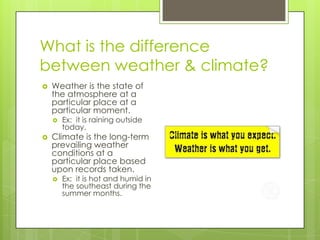
 Weather is the state of
the atmosphere at a
particular place at a
particular moment.
 Ex: it is raining outside
today.
 Climate is the long-term
prevailing weather
conditions at a
particular place based
upon records taken.
 Ex: it is hot and humid in
the southeast during the
summer months.
What factors determine
climate?
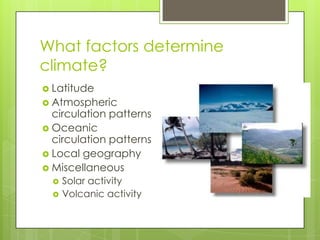
 Latitude
 Atmospheric
circulation patterns
 Oceanic
circulation patterns
 Local geography
 Miscellaneous
 Solar activity
 Volcanic activity
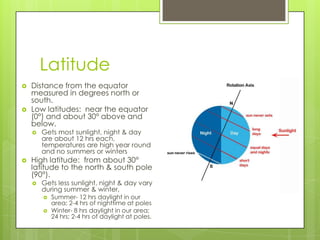
Latitude
 Distance from the equator
measured in degrees north or
south.
 Low latitudes: near the equator
(0°) and about 30° above and
below.
 Gets most sunlight, night & day
are about 12 hrs each,
temperatures are high year round
and no summers or winters
 High latitude: from about 30°
latitude to the north & south pole
(90°).
 Gets less sunlight, night & day vary
during summer & winter,
 Summer- 12 hrs daylight in our
area; 2-4 hrs of nighttime at poles
 Winter- 8 hrs daylight in our area;
24 hrs; 2-4 hrs of daylight at poles.
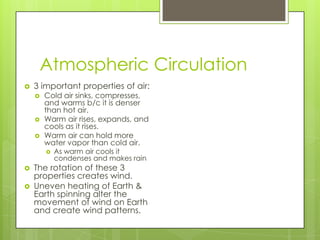
Atmospheric Circulation
 3 important properties of air:
 Cold air sinks, compresses,
and warms b/c it is denser
than hot air.
 Warm air rises, expands, and
cools as it rises.
 Warm air can hold more
water vapor than cold air.
 As warm air cools it
condenses and makes rain
 The rotation of these 3
properties creates wind.
 Uneven heating of Earth &
Earth spinning alter the
movement of wind on Earth
and create wind patterns.
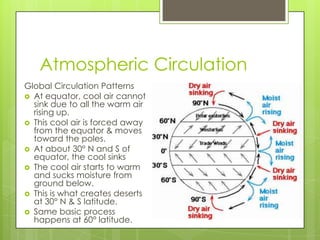
Atmospheric Circulation
Global Circulation Patterns
 At equator, cool air cannot
sink due to all the warm air
rising up.
 This cool air is forced away
from the equator & moves
toward the poles.
 At about 30° N and S of
equator, the cool sinks
 The cool air starts to warm
and sucks moisture from
ground below.
 This is what creates deserts
at 30° N & S latitude.
 Same basic process
happens at 60° latitude.
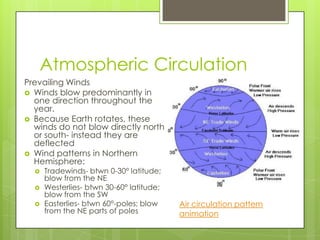
Atmospheric Circulation
Prevailing Winds
 Winds blow predominantly in
one direction throughout the
year.
 Because Earth rotates, these
winds do not blow directly north
or south- instead they are
deflected
 Wind patterns in Northern
Hemisphere:
 Tradewinds- btwn 0-30° latitude;
blow from the NE
 Westerlies- btwn 30-60° latitude;
blow from the SW
 Easterlies- btwn 60°-poles; blow
from the NE parts of poles
Air circulation pattern
animation
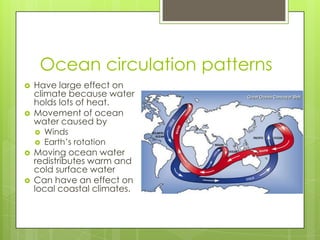
Ocean circulation patterns
 Have large effect on
climate because water
holds lots of heat.
 Movement of ocean
water caused by
 Winds
 Earth’s rotation
 Moving ocean water
redistributes warm and
cold surface water
 Can have an effect on
local coastal climates.
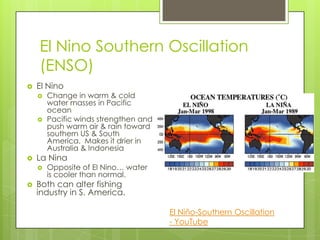
El Nino Southern Oscillation
(ENSO)
 El Nino
 Change in warm & cold
water masses in Pacific
ocean
 Pacific winds strengthen and
push warm air & rain toward
southern US & South
America. Makes it drier in
Australia & Indonesia
 La Nina
 Opposite of El Nino… water
is cooler than normal.
 Both can alter fishing
industry in S. America.
El Niño-Southern Oscillation
- YouTube
Topography
 Height above sea level
influences climate.
 Temperatures fall 11°F for
every ½ mile increase in
elevation.
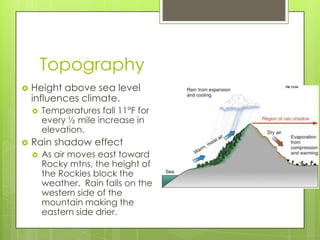
 Rain shadow effect
 As air moves east toward
Rocky mtns, the height of
the Rockies block the
weather. Rain falls on the
western side of the
mountain making the
eastern side drier.
Miscellaneous Influences
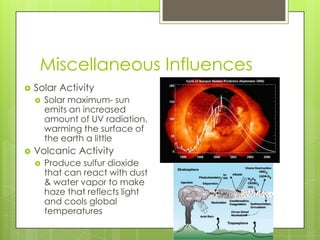
 Solar Activity
 Solar maximum- sun
emits an increased
amount of UV radiation,
warming the surface of
the earth a little
 Volcanic Activity
 Produce sulfur dioxide
that can react with dust
& water vapor to make
haze that reflects light
and cools global
temperatures
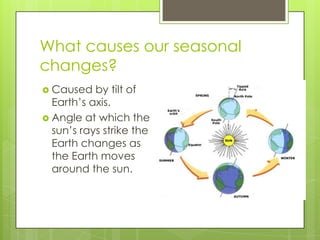
What causes our seasonal
changes?
 Caused by tilt of
Earth’s axis.
 Angle at which the
sun’s rays strike the
Earth changes as
the Earth moves
around the sun.
You should be able to:
 Explain the difference between weather
and climate.
 Name four factors that determine
climate.
 Explain why different parts of the Earth
have different climates
 Explain what causes the seasons.

Unit 5 b ch 13 s1 climate & climate change

  • 1.
    Atmosphere & Climate Change Chapter 13,Section 1: Climate & Climate Change Standards: SCSh2a,b, 3c, 4a, 6a, d
  • 2.
    What is thedifference between weather & climate?  Weather is the state of the atmosphere at a particular place at a particular moment.  Ex: it is raining outside today.  Climate is the long-term prevailing weather conditions at a particular place based upon records taken.  Ex: it is hot and humid in the southeast during the summer months.
  • 3.
    What factors determine climate? Latitude  Atmospheric circulation patterns  Oceanic circulation patterns  Local geography  Miscellaneous  Solar activity  Volcanic activity
  • 4.
    Latitude  Distance fromthe equator measured in degrees north or south.  Low latitudes: near the equator (0°) and about 30° above and below.  Gets most sunlight, night & day are about 12 hrs each, temperatures are high year round and no summers or winters  High latitude: from about 30° latitude to the north & south pole (90°).  Gets less sunlight, night & day vary during summer & winter,  Summer- 12 hrs daylight in our area; 2-4 hrs of nighttime at poles  Winter- 8 hrs daylight in our area; 24 hrs; 2-4 hrs of daylight at poles.
  • 5.
    Atmospheric Circulation  3important properties of air:  Cold air sinks, compresses, and warms b/c it is denser than hot air.  Warm air rises, expands, and cools as it rises.  Warm air can hold more water vapor than cold air.  As warm air cools it condenses and makes rain  The rotation of these 3 properties creates wind.  Uneven heating of Earth & Earth spinning alter the movement of wind on Earth and create wind patterns.
  • 6.
    Atmospheric Circulation Global CirculationPatterns  At equator, cool air cannot sink due to all the warm air rising up.  This cool air is forced away from the equator & moves toward the poles.  At about 30° N and S of equator, the cool sinks  The cool air starts to warm and sucks moisture from ground below.  This is what creates deserts at 30° N & S latitude.  Same basic process happens at 60° latitude.
  • 7.
    Atmospheric Circulation Prevailing Winds Winds blow predominantly in one direction throughout the year.  Because Earth rotates, these winds do not blow directly north or south- instead they are deflected  Wind patterns in Northern Hemisphere:  Tradewinds- btwn 0-30° latitude; blow from the NE  Westerlies- btwn 30-60° latitude; blow from the SW  Easterlies- btwn 60°-poles; blow from the NE parts of poles Air circulation pattern animation
  • 8.
    Ocean circulation patterns Have large effect on climate because water holds lots of heat.  Movement of ocean water caused by  Winds  Earth’s rotation  Moving ocean water redistributes warm and cold surface water  Can have an effect on local coastal climates.
  • 9.
    El Nino SouthernOscillation (ENSO)  El Nino  Change in warm & cold water masses in Pacific ocean  Pacific winds strengthen and push warm air & rain toward southern US & South America. Makes it drier in Australia & Indonesia  La Nina  Opposite of El Nino… water is cooler than normal.  Both can alter fishing industry in S. America. El Niño-Southern Oscillation - YouTube
  • 10.
    Topography  Height abovesea level influences climate.  Temperatures fall 11°F for every ½ mile increase in elevation.  Rain shadow effect  As air moves east toward Rocky mtns, the height of the Rockies block the weather. Rain falls on the western side of the mountain making the eastern side drier.
  • 11.
    Miscellaneous Influences  SolarActivity  Solar maximum- sun emits an increased amount of UV radiation, warming the surface of the earth a little  Volcanic Activity  Produce sulfur dioxide that can react with dust & water vapor to make haze that reflects light and cools global temperatures
  • 12.
    What causes ourseasonal changes?  Caused by tilt of Earth’s axis.  Angle at which the sun’s rays strike the Earth changes as the Earth moves around the sun.
  • 13.
    You should beable to:  Explain the difference between weather and climate.  Name four factors that determine climate.  Explain why different parts of the Earth have different climates  Explain what causes the seasons.