Technical Seminar 
A 
SEMINAR REPORT ON 
ASYNCHRONOUS TRANSFER MODE(ATM) 
Under the Guidance of 
Mr R.K.Shial 
By 
Sangram Sekhar Choudhuri 
CS200118218 
Presented by :- Sangram Sekhar Choudhuri(CS200118218)1
Technical Seminar 
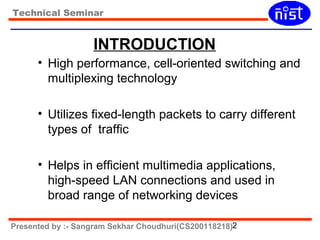
INTRODUCTION 
• High performance, cell-oriented switching and 
multiplexing technology 
• Utilizes fixed-length packets to carry different 
types of traffic 
• Helps in efficient multimedia applications, 
high-speed LAN connections and used in 
broad range of networking devices 
Presented by :- Sangram Sekhar Choudhuri(CS200118218)2
Technical Seminar 
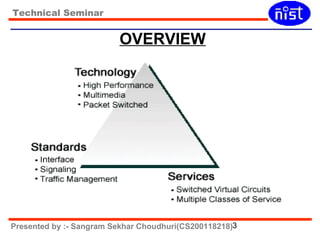
OVERVIEW 
Presented by :- Sangram Sekhar Choudhuri(CS200118218)3
Technical Seminar 
BENEFITS OF ATM 
• high performance via hardware switching 
• dynamic bandwidth for bursty traffic 
• class-of-service support for multimedia 
• scalability in speed and network size 
• common LAN/WAN architecture 
• opportunities for simplification via VC 
architecture 
• international standards compliance 
Presented by :- Sangram Sekhar Choudhuri(CS200118218)4
Technical Seminar 
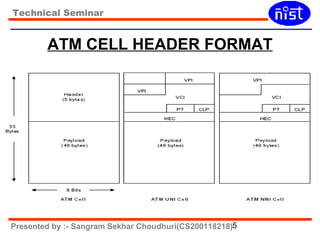
ATM CELL HEADER FORMAT 
Presented by :- Sangram Sekhar Choudhuri(CS200118218)5
Technical Seminar 
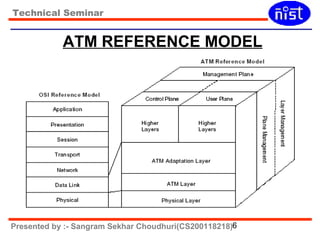
ATM REFERENCE MODEL 
Presented by :- Sangram Sekhar Choudhuri(CS200118218)6
Technical Seminar 
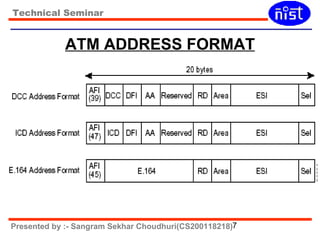
ATM ADDRESS FORMAT 
Presented by :- Sangram Sekhar Choudhuri(CS200118218)7
Technical Seminar 
ATM SERVICE CLASSES 
• constant bit rate (CBR) 
• variable bit rate–non-real time (VBR–NRT) 
• variable bit rate–real time (VBR–RT) 
• available bit rate (ABR) 
• unspecified bit rate (UBR) 
Presented by :- Sangram Sekhar Choudhuri(CS200118218)8
Technical Seminar 
ATM TECHNICAL PARAMETERS 
• cell loss ratio (CLR) 
• cell transfer delay (CTD) 
• cell delay variation (CDV) 
• peak cell rate (PCR) 
• burst tolerance (BT) 
• sustained cell rate (SCR) 
Presented by :- Sangram Sekhar Choudhuri(CS200118218)9
Technical Seminar 
ATM STANDARDS 
• A cohesive set of specifications that provide a 
stable ATM framework. 
• Provide the end-to-end service definitions 
• An important ATM standard is interworking 
between ATM and frame relay 
• Two ATM networking standards 
1)broadband intercarrier interface (B–ICI) 
2)public network-to-network interface (P–NNI) 
Presented by :- Sangram Sekhar Choudhuri(CS200118218)10
Technical Seminar 
DATA INSERTION SCHEMES 
• RFC1483-specifies how interrouter traffic is 
encapsulated into ATM 
• LANEMPOA- support dynamic use of ATM 
SVCs 
• voice and video adaptation schemes-for efficient 
traffic that no natural breaks, such as a circuit 
carrying bits at a fixed rate 
Presented by :- Sangram Sekhar Choudhuri(CS200118218)11
Technical Seminar 
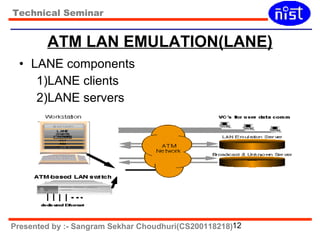
ATM LAN EMULATION(LANE) 
• LANE components 
1)LANE clients 
2)LANE servers 
Presented by :- Sangram Sekhar Choudhuri(CS200118218)12
Technical Seminar 
VIDEO OVER ATM 
• Handled by VBR–RT VCs using AAL–5 for 
MPEG2 on ATM for video-on-demand 
applications 
• MPEG2 coding can result in two modes: 
1. program streams—variable-length packets 
carrying single or multiple programs 
2. transport streams—188-byte packets that 
contain multiple programs 
• Time stamps are inserted into MPEG2 packets 
during the encoding and multiplexing process to 
make better use of networking resources. 
Presented by :- Sangram Sekhar Choudhuri(CS200118218)13
Technical Seminar 
VOICE OVER ATM 
• VBR–RT connections is used over ATM which 
uses silence period. 
• Various dynamic compression techniques are 
used to free bandwidth and alleviate congestion 
• A further enhancement is to support voice 
switching over SVCs which interprets PBX 
(private branch exchange) signaling and routing 
voice calls to the appropriate destination PBX 
Presented by :- Sangram Sekhar Choudhuri(CS200118218)14
Technical Seminar 
NETWORK TRAFFIC MANAGEMENT 
• objectives :To deliver quality-of-service (QoS) 
for multimedia applications and provide overall 
optimization of network resources. 
• categorized into three distinct elements 
1. nodal-level controls that operate in real time 
2. network-level controls operate in near real time 
3. network engineering capabilities operating in 
non real time 
Presented by :- Sangram Sekhar Choudhuri(CS200118218)15
Technical Seminar 
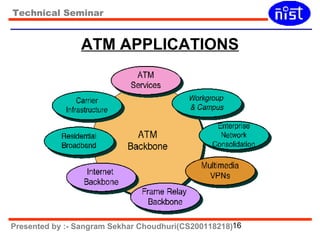
ATM APPLICATIONS 
Presented by :- Sangram Sekhar Choudhuri(CS200118218)16
Technical Seminar 
ATM AND IP INTERWORKING 
• ATM and IP offer: Scalability, traffic engineering, 
service differentiation, high availability, value-added 
applications such as Virtual Private 
Networks (VPNs) 
• Some specifications of ATM and IP 
1. Multi-Protocol over ATM (MPOA) as addition to 
LAN Emulation (LANE) 
2. Additions to ATM's superior routing protocol 
PNNI 
3. adoption of Frame-based ATM over Sonet/SDH 
(FAST) 
Presented by :- Sangram Sekhar Choudhuri(CS200118218)17
Technical Seminar 
CONCLUSION 
• ATM technology is the only technology that can 
guarantee a certain and predefined quality of 
service. 
• The growth of the Internet, need for broadband 
access and e-commerce are spurring the need 
for a reliable, flexible, scalable, predictable, 
versatile transport system and that is given by 
ATM Technology. 
• For voice, video, data and images together, the 
next generation network depends on ATM. 
Presented by :- Sangram Sekhar Choudhuri(CS200118218)18
Technical Seminar 
Presented by :- Sangram Sekhar Choudhuri(CS200118218)19

Asynchronous transfer mode (atm)

  • 1.
    Technical Seminar A SEMINAR REPORT ON ASYNCHRONOUS TRANSFER MODE(ATM) Under the Guidance of Mr R.K.Shial By Sangram Sekhar Choudhuri CS200118218 Presented by :- Sangram Sekhar Choudhuri(CS200118218)1
  • 2.
    Technical Seminar INTRODUCTION • High performance, cell-oriented switching and multiplexing technology • Utilizes fixed-length packets to carry different types of traffic • Helps in efficient multimedia applications, high-speed LAN connections and used in broad range of networking devices Presented by :- Sangram Sekhar Choudhuri(CS200118218)2
  • 3.
    Technical Seminar OVERVIEW Presented by :- Sangram Sekhar Choudhuri(CS200118218)3
  • 4.
    Technical Seminar BENEFITSOF ATM • high performance via hardware switching • dynamic bandwidth for bursty traffic • class-of-service support for multimedia • scalability in speed and network size • common LAN/WAN architecture • opportunities for simplification via VC architecture • international standards compliance Presented by :- Sangram Sekhar Choudhuri(CS200118218)4
  • 5.
    Technical Seminar ATMCELL HEADER FORMAT Presented by :- Sangram Sekhar Choudhuri(CS200118218)5
  • 6.
    Technical Seminar ATMREFERENCE MODEL Presented by :- Sangram Sekhar Choudhuri(CS200118218)6
  • 7.
    Technical Seminar ATMADDRESS FORMAT Presented by :- Sangram Sekhar Choudhuri(CS200118218)7
  • 8.
    Technical Seminar ATMSERVICE CLASSES • constant bit rate (CBR) • variable bit rate–non-real time (VBR–NRT) • variable bit rate–real time (VBR–RT) • available bit rate (ABR) • unspecified bit rate (UBR) Presented by :- Sangram Sekhar Choudhuri(CS200118218)8
  • 9.
    Technical Seminar ATMTECHNICAL PARAMETERS • cell loss ratio (CLR) • cell transfer delay (CTD) • cell delay variation (CDV) • peak cell rate (PCR) • burst tolerance (BT) • sustained cell rate (SCR) Presented by :- Sangram Sekhar Choudhuri(CS200118218)9
  • 10.
    Technical Seminar ATMSTANDARDS • A cohesive set of specifications that provide a stable ATM framework. • Provide the end-to-end service definitions • An important ATM standard is interworking between ATM and frame relay • Two ATM networking standards 1)broadband intercarrier interface (B–ICI) 2)public network-to-network interface (P–NNI) Presented by :- Sangram Sekhar Choudhuri(CS200118218)10
  • 11.
    Technical Seminar DATAINSERTION SCHEMES • RFC1483-specifies how interrouter traffic is encapsulated into ATM • LANEMPOA- support dynamic use of ATM SVCs • voice and video adaptation schemes-for efficient traffic that no natural breaks, such as a circuit carrying bits at a fixed rate Presented by :- Sangram Sekhar Choudhuri(CS200118218)11
  • 12.
    Technical Seminar ATMLAN EMULATION(LANE) • LANE components 1)LANE clients 2)LANE servers Presented by :- Sangram Sekhar Choudhuri(CS200118218)12
  • 13.
    Technical Seminar VIDEOOVER ATM • Handled by VBR–RT VCs using AAL–5 for MPEG2 on ATM for video-on-demand applications • MPEG2 coding can result in two modes: 1. program streams—variable-length packets carrying single or multiple programs 2. transport streams—188-byte packets that contain multiple programs • Time stamps are inserted into MPEG2 packets during the encoding and multiplexing process to make better use of networking resources. Presented by :- Sangram Sekhar Choudhuri(CS200118218)13
  • 14.
    Technical Seminar VOICEOVER ATM • VBR–RT connections is used over ATM which uses silence period. • Various dynamic compression techniques are used to free bandwidth and alleviate congestion • A further enhancement is to support voice switching over SVCs which interprets PBX (private branch exchange) signaling and routing voice calls to the appropriate destination PBX Presented by :- Sangram Sekhar Choudhuri(CS200118218)14
  • 15.
    Technical Seminar NETWORKTRAFFIC MANAGEMENT • objectives :To deliver quality-of-service (QoS) for multimedia applications and provide overall optimization of network resources. • categorized into three distinct elements 1. nodal-level controls that operate in real time 2. network-level controls operate in near real time 3. network engineering capabilities operating in non real time Presented by :- Sangram Sekhar Choudhuri(CS200118218)15
  • 16.
    Technical Seminar ATMAPPLICATIONS Presented by :- Sangram Sekhar Choudhuri(CS200118218)16
  • 17.
    Technical Seminar ATMAND IP INTERWORKING • ATM and IP offer: Scalability, traffic engineering, service differentiation, high availability, value-added applications such as Virtual Private Networks (VPNs) • Some specifications of ATM and IP 1. Multi-Protocol over ATM (MPOA) as addition to LAN Emulation (LANE) 2. Additions to ATM's superior routing protocol PNNI 3. adoption of Frame-based ATM over Sonet/SDH (FAST) Presented by :- Sangram Sekhar Choudhuri(CS200118218)17
  • 18.
    Technical Seminar CONCLUSION • ATM technology is the only technology that can guarantee a certain and predefined quality of service. • The growth of the Internet, need for broadband access and e-commerce are spurring the need for a reliable, flexible, scalable, predictable, versatile transport system and that is given by ATM Technology. • For voice, video, data and images together, the next generation network depends on ATM. Presented by :- Sangram Sekhar Choudhuri(CS200118218)18
  • 19.
    Technical Seminar Presentedby :- Sangram Sekhar Choudhuri(CS200118218)19