GSM Air Interface
(𝑈 𝑚)
PRESENTED BY:
NAVEEN JAKHAR, ITS
ABHISHEK SINGH, ITS
Introduction
 The Air-interface is the central interface of every
mobile system and typically the only one to which a
customer is exposed.
 The physical characteristics of the Air-interface are
particularly important for the quality and success of
a new mobile standard.
RF Spectrum
 GSM 900
 Mobile to BS (UP-LINK) -890 to 915 MHz
 BS to Mobile (DOWN -LINK) -935 to 960 MHz
 Bandwidth - 25 MHz
 GSM 1800 or PCS 1800
 Mobile to Cell (UP-LINK) -1710 to 1785 MHz
 Cell to Mobile (DOWN -LINK) -1805 to 1880 MHz
 Bandwidth - 75 MHz
GSM SPECIFICATIONS
 Carrier Separation - 200 kHz
 Duplex Distance - 45 MHz
 No. of RF Carriers - 124
 Access Method - TDMA/FDMA
 Modulation Method - GMSK
 Transmission Rate - 270.833 Kbps
 Speech Coding - Full rate 13 Kbps
Half rate 6.5 Kbps
GSM Air Interface structure
(FDMA/TDMA)
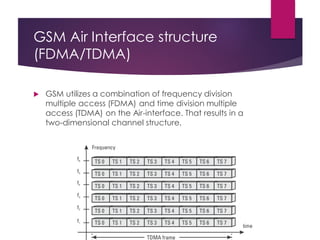
 GSM utilizes a combination of frequency division
multiple access (FDMA) and time division multiple
access (TDMA) on the Air-interface. That results in a
two-dimensional channel structure,
WHY FDMA and TDMA?
 In a pure FDMA system, one specific frequency is
allocated for every user during a call. That quickly
leads to overload situations in cases of high
demand.
 In fullrate configuration, eight time slots (TSs) are
mapped on every frequency; in a halfrate
configuration there are 16 TSs per frequency.
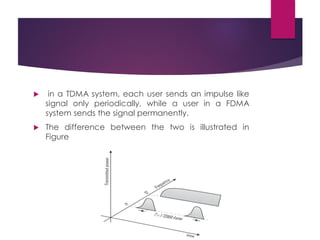
 in a TDMA system, each user sends an impulse like
signal only periodically, while a user in a FDMA
system sends the signal permanently.
 The difference between the two is illustrated in
Figure
DIGITAL VOICE TRANSMISSION
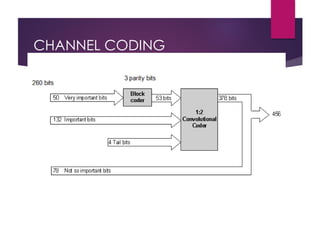
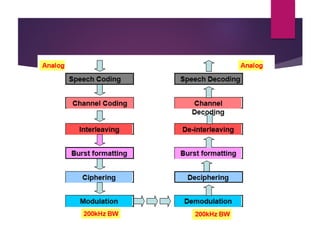
 Speech Coding
 In GSM speech coding a block of 20 ms is
encoded in one set of 260 bits.
 This calculates as 50X 260 = 13 kbps. Thus GSM
speech coder produces a bit rate of 13 kbps per
subscriber.
 This provides speech quality which is acceptable for
mobile telephony and comparable with wire-line
PSTN phones.
CHANNEL CODING
Interleaving
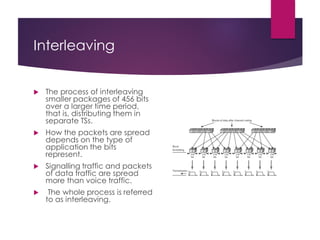
 The process of interleaving
smaller packages of 456 bits
over a larger time period,
that is, distributing them in
separate TSs.
 How the packets are spread
depends on the type of
application the bits
represent.
 Signalling traffic and packets
of data traffic are spread
more than voice traffic.
 The whole process is referred
to as interleaving.
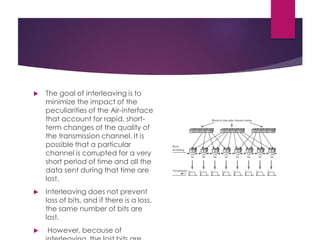
 The goal of interleaving is to
minimize the impact of the
peculiarities of the Air-interface
that account for rapid, short-
term changes of the quality of
the transmission channel. It is
possible that a particular
channel is corrupted for a very
short period of time and all the
data sent during that time are
lost.
 Interleaving does not prevent
loss of bits, and if there is a loss,
the same number of bits are
lost.
 However, because of
BURST FORMATTING
 Adds training sequence that helps in the working
equalizer to assist in countering the effects of radio
channel on the signal.
 Total of 136 bits added, bringing overall total to 592
bits.
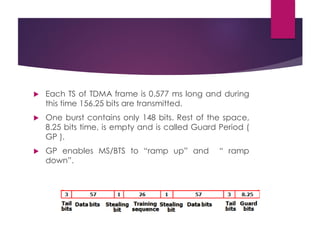
 Each TS of TDMA frame is 0.577 ms long and during
this time 156.25 bits are transmitted.
 One burst contains only 148 bits. Rest of the space,
8.25 bits time, is empty and is called Guard Period (
GP ).
 GP enables MS/BTS to “ramp up” and “ ramp
down”.
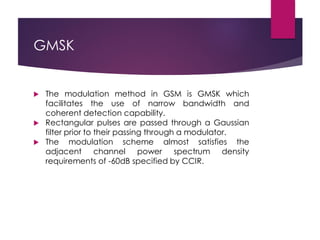
GMSK
 The modulation method in GSM is GMSK which
facilitates the use of narrow bandwidth and
coherent detection capability.
 Rectangular pulses are passed through a Gaussian
filter prior to their passing through a modulator.
 The modulation scheme almost satisfies the
adjacent channel power spectrum density
requirements of -60dB specified by CCIR.
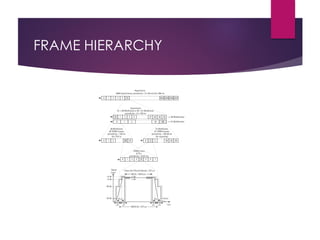
FRAME HIERARCHY
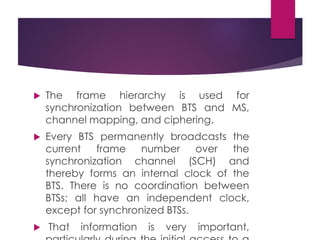
 The frame hierarchy is used for
synchronization between BTS and MS,
channel mapping, and ciphering.
 Every BTS permanently broadcasts the
current frame number over the
synchronization channel (SCH) and
thereby forms an internal clock of the
BTS. There is no coordination between
BTSs; all have an independent clock,
except for synchronized BTSs.
 That information is very important,
Physical Versus Logical
Channels
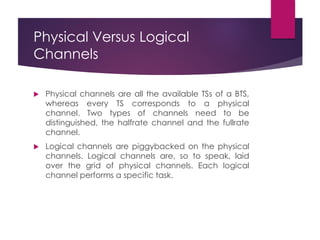
 Physical channels are all the available TSs of a BTS,
whereas every TS corresponds to a physical
channel. Two types of channels need to be
distinguished, the halfrate channel and the fullrate
channel.
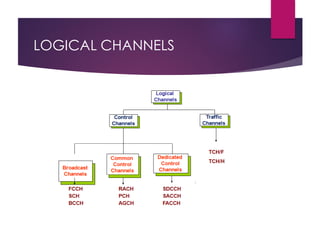
 Logical channels are piggybacked on the physical
channels. Logical channels are, so to speak, laid
over the grid of physical channels. Each logical
channel performs a specific task.
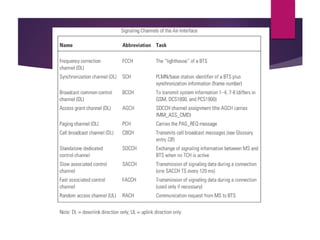
LOGICAL CHANNELS
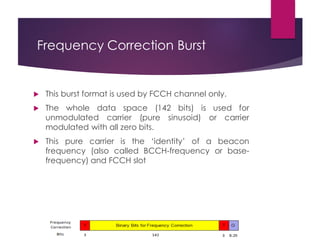
Frequency Correction Burst
 This burst format is used by FCCH channel only.
 The whole data space (142 bits) is used for
unmodulated carrier (pure sinusoid) or carrier
modulated with all zero bits.
 This pure carrier is the ‘identity’ of a beacon
frequency (also called BCCH-frequency or base-
frequency) and FCCH slot
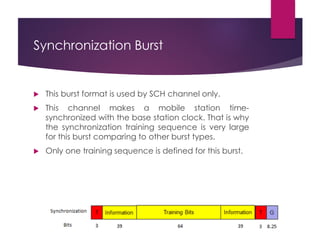
Synchronization Burst
 This burst format is used by SCH channel only.
 This channel makes a mobile station time-
synchronized with the base station clock. That is why
the synchronization training sequence is very large
for this burst comparing to other burst types.
 Only one training sequence is defined for this burst.
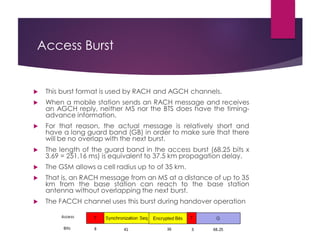
Access Burst
 This burst format is used by RACH and AGCH channels.
 When a mobile station sends an RACH message and receives
an AGCH reply, neither MS nor the BTS does have the timing-
advance information.
 For that reason, the actual message is relatively short and
have a long guard band (GB) in order to make sure that there
will be no overlap with the next burst.
 The length of the guard band in the access burst (68.25 bits x
3.69 = 251.16 ms) is equivalent to 37.5 km propagation delay.
 The GSM allows a cell radius up to of 35 km.
 That is, an RACH message from an MS at a distance of up to 35
km from the base station can reach to the base station
antenna without overlapping the next burst.
 The FACCH channel uses this burst during handover operation
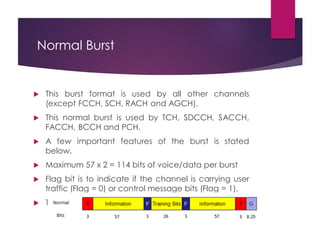
Normal Burst
 This burst format is used by all other channels
(except FCCH, SCH, RACH and AGCH).
 This normal burst is used by TCH, SDCCH, SACCH,
FACCH, BCCH and PCH.
 A few important features of the burst is stated
below.
 Maximum 57 x 2 = 114 bits of voice/data per burst
 Flag bit is to indicate if the channel is carrying user
traffic (Flag = 0) or control message bits (Flag = 1).
 That is the flag is 0 for TCH and 1 for others.
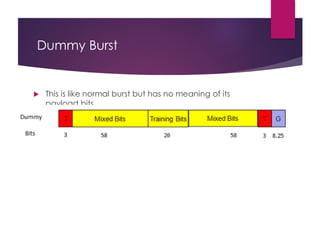
Dummy Burst
 This is like normal burst but has no meaning of its
payload bits
CONTROL MULTIFRAME
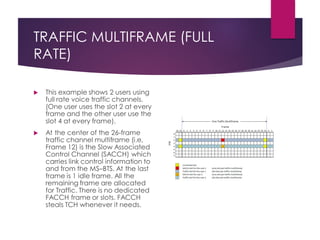
TRAFFIC MULTIFRAME (FULL
RATE)
 This example shows 2 users using
full rate voice traffic channels.
(One user uses the slot 2 at every
frame and the other user use the
slot 4 at every frame).
 At the center of the 26-frame
traffic channel multiframe (i.e,
Frame 12) is the Slow Associated
Control Channel (SACCH) which
carries link control information to
and from the MS–BTS. At the last
frame is 1 idle frame. All the
remaining frame are allocated
for Traffic. There is no dedicated
FACCH frame or slots. FACCH
steals TCH whenever it needs.
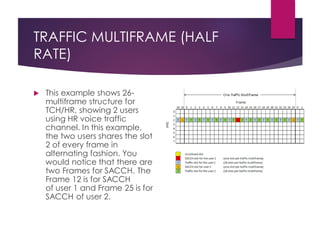
TRAFFIC MULTIFRAME (HALF
RATE)
 This example shows 26-
multiframe structure for
TCH/HR, showing 2 users
using HR voice traffic
channel. In this example,
the two users shares the slot
2 of every frame in
alternating fashion. You
would notice that there are
two Frames for SACCH. The
Frame 12 is for SACCH
of user 1 and Frame 25 is for
SACCH of user 2.
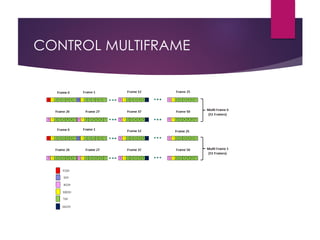
CONTROL MULTIFRAME
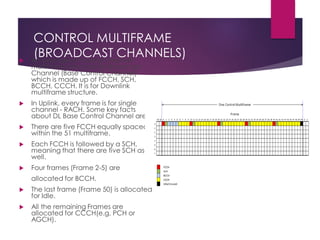
(BROADCAST CHANNELS) An example of control channel
multiframe structure for Broadcast
Channel (Base Control Channel)
which is made up of FCCH, SCH,
BCCH, CCCH. It is for Downlink
multiframe structure.
 In Uplink, every frame is for single
channel - RACH. Some key facts
about DL Base Control Channel are
 There are five FCCH equally spaced
within the 51 multiframe.
 Each FCCH is followed by a SCH,
meaning that there are five SCH as
well.
 Four frames (Frame 2-5) are
allocated for BCCH.
 The last frame (Frame 50) is allocated

for Idle.
 All the remaining Frames are
allocated for CCCH(e.g, PCH or
AGCH).
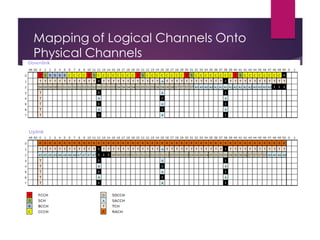
Mapping of Logical Channels Onto
Physical Channels
OPERATIONAL ASPECTS
 Subscribers are not allocated dedicated channels
 TCH allocated to users only when needed
 Hence IDLE MODE & DEDICATED MODE
IDLE MODE
 When MS is powered on (active) without being in
dedicated mode
 MS stays continuously in touch with BS
 Listens to transmissions from BS to intercept Paging
Messages ( for incoming calls)
• Monitors Radio Environment in order to evaluate
Channel Quality & choose the most suitable BS
• Listens to BS to avail short message broadcast
service
ACCESS PROCEDURE
 Access to system ( switch over from IDLE to
DEDICATED Mode)
 MS indicates to BS that it needs a connection
 BS accepts the request & indicates which traffic
channel it may use
 For above purpose specific transmission is done over
“ Common Channels”
OTHER FEATURES
 Discontinuous Transmission
 Synchronization between uplink and downlink
 Diversity
Discontinuous Transmission
 Speech activity only 40% of time.
 Needs Voice activity detection.
 Annoying clicks/inefficient DTX.
 Generation of Comfort Noise at receiver to avoid
the feeling of the set being dead.
SYNCHRONIZATION BETWEEN
UPLINK AND DOWNLINK
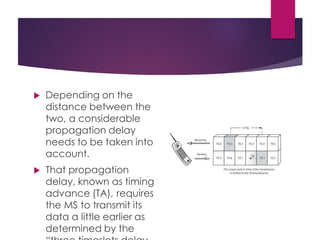
 For technical reasons, it is necessary that the MS and
the BTS do not transmit simultaneously. Therefore,
the MS Is transmitting three timeslots after the BTS.
 The time between sending and receiving data is
used by the MS to perform various measurements on
the signal quality of the receivable neighbour cells.
 Depending on the
distance between the
two, a considerable
propagation delay
needs to be taken into
account.
 That propagation
delay, known as timing
advance (TA), requires
the MS to transmit its
data a little earlier as
determined by the
DIVERSITY
 Space Diversity
 Mounting two receiver antenna physically
separated a distance.
- Probability of both of them being affected by a
deep fading dip at same time is low.
THANK YOU!

GSM Air Interface

  • 1.
    GSM Air Interface (𝑈𝑚) PRESENTED BY: NAVEEN JAKHAR, ITS ABHISHEK SINGH, ITS
  • 2.
    Introduction  The Air-interfaceis the central interface of every mobile system and typically the only one to which a customer is exposed.  The physical characteristics of the Air-interface are particularly important for the quality and success of a new mobile standard.
  • 3.
    RF Spectrum  GSM900  Mobile to BS (UP-LINK) -890 to 915 MHz  BS to Mobile (DOWN -LINK) -935 to 960 MHz  Bandwidth - 25 MHz  GSM 1800 or PCS 1800  Mobile to Cell (UP-LINK) -1710 to 1785 MHz  Cell to Mobile (DOWN -LINK) -1805 to 1880 MHz  Bandwidth - 75 MHz
  • 4.
    GSM SPECIFICATIONS  CarrierSeparation - 200 kHz  Duplex Distance - 45 MHz  No. of RF Carriers - 124  Access Method - TDMA/FDMA  Modulation Method - GMSK  Transmission Rate - 270.833 Kbps  Speech Coding - Full rate 13 Kbps Half rate 6.5 Kbps
  • 5.
    GSM Air Interfacestructure (FDMA/TDMA)  GSM utilizes a combination of frequency division multiple access (FDMA) and time division multiple access (TDMA) on the Air-interface. That results in a two-dimensional channel structure,
  • 6.
    WHY FDMA andTDMA?  In a pure FDMA system, one specific frequency is allocated for every user during a call. That quickly leads to overload situations in cases of high demand.  In fullrate configuration, eight time slots (TSs) are mapped on every frequency; in a halfrate configuration there are 16 TSs per frequency.
  • 7.
     in aTDMA system, each user sends an impulse like signal only periodically, while a user in a FDMA system sends the signal permanently.  The difference between the two is illustrated in Figure
  • 8.
    DIGITAL VOICE TRANSMISSION Speech Coding  In GSM speech coding a block of 20 ms is encoded in one set of 260 bits.  This calculates as 50X 260 = 13 kbps. Thus GSM speech coder produces a bit rate of 13 kbps per subscriber.  This provides speech quality which is acceptable for mobile telephony and comparable with wire-line PSTN phones.
  • 9.
  • 10.
    Interleaving  The processof interleaving smaller packages of 456 bits over a larger time period, that is, distributing them in separate TSs.  How the packets are spread depends on the type of application the bits represent.  Signalling traffic and packets of data traffic are spread more than voice traffic.  The whole process is referred to as interleaving.
  • 11.
     The goalof interleaving is to minimize the impact of the peculiarities of the Air-interface that account for rapid, short- term changes of the quality of the transmission channel. It is possible that a particular channel is corrupted for a very short period of time and all the data sent during that time are lost.  Interleaving does not prevent loss of bits, and if there is a loss, the same number of bits are lost.  However, because of
  • 12.
    BURST FORMATTING  Addstraining sequence that helps in the working equalizer to assist in countering the effects of radio channel on the signal.  Total of 136 bits added, bringing overall total to 592 bits.
  • 13.
     Each TSof TDMA frame is 0.577 ms long and during this time 156.25 bits are transmitted.  One burst contains only 148 bits. Rest of the space, 8.25 bits time, is empty and is called Guard Period ( GP ).  GP enables MS/BTS to “ramp up” and “ ramp down”.
  • 14.
    GMSK  The modulationmethod in GSM is GMSK which facilitates the use of narrow bandwidth and coherent detection capability.  Rectangular pulses are passed through a Gaussian filter prior to their passing through a modulator.  The modulation scheme almost satisfies the adjacent channel power spectrum density requirements of -60dB specified by CCIR.
  • 16.
  • 17.
     The framehierarchy is used for synchronization between BTS and MS, channel mapping, and ciphering.  Every BTS permanently broadcasts the current frame number over the synchronization channel (SCH) and thereby forms an internal clock of the BTS. There is no coordination between BTSs; all have an independent clock, except for synchronized BTSs.  That information is very important,
  • 18.
    Physical Versus Logical Channels Physical channels are all the available TSs of a BTS, whereas every TS corresponds to a physical channel. Two types of channels need to be distinguished, the halfrate channel and the fullrate channel.  Logical channels are piggybacked on the physical channels. Logical channels are, so to speak, laid over the grid of physical channels. Each logical channel performs a specific task.
  • 19.
  • 21.
    Frequency Correction Burst This burst format is used by FCCH channel only.  The whole data space (142 bits) is used for unmodulated carrier (pure sinusoid) or carrier modulated with all zero bits.  This pure carrier is the ‘identity’ of a beacon frequency (also called BCCH-frequency or base- frequency) and FCCH slot
  • 22.
    Synchronization Burst  Thisburst format is used by SCH channel only.  This channel makes a mobile station time- synchronized with the base station clock. That is why the synchronization training sequence is very large for this burst comparing to other burst types.  Only one training sequence is defined for this burst.
  • 23.
    Access Burst  Thisburst format is used by RACH and AGCH channels.  When a mobile station sends an RACH message and receives an AGCH reply, neither MS nor the BTS does have the timing- advance information.  For that reason, the actual message is relatively short and have a long guard band (GB) in order to make sure that there will be no overlap with the next burst.  The length of the guard band in the access burst (68.25 bits x 3.69 = 251.16 ms) is equivalent to 37.5 km propagation delay.  The GSM allows a cell radius up to of 35 km.  That is, an RACH message from an MS at a distance of up to 35 km from the base station can reach to the base station antenna without overlapping the next burst.  The FACCH channel uses this burst during handover operation
  • 24.
    Normal Burst  Thisburst format is used by all other channels (except FCCH, SCH, RACH and AGCH).  This normal burst is used by TCH, SDCCH, SACCH, FACCH, BCCH and PCH.  A few important features of the burst is stated below.  Maximum 57 x 2 = 114 bits of voice/data per burst  Flag bit is to indicate if the channel is carrying user traffic (Flag = 0) or control message bits (Flag = 1).  That is the flag is 0 for TCH and 1 for others.
  • 25.
    Dummy Burst  Thisis like normal burst but has no meaning of its payload bits
  • 26.
  • 27.
    TRAFFIC MULTIFRAME (FULL RATE) This example shows 2 users using full rate voice traffic channels. (One user uses the slot 2 at every frame and the other user use the slot 4 at every frame).  At the center of the 26-frame traffic channel multiframe (i.e, Frame 12) is the Slow Associated Control Channel (SACCH) which carries link control information to and from the MS–BTS. At the last frame is 1 idle frame. All the remaining frame are allocated for Traffic. There is no dedicated FACCH frame or slots. FACCH steals TCH whenever it needs.
  • 28.
    TRAFFIC MULTIFRAME (HALF RATE) This example shows 26- multiframe structure for TCH/HR, showing 2 users using HR voice traffic channel. In this example, the two users shares the slot 2 of every frame in alternating fashion. You would notice that there are two Frames for SACCH. The Frame 12 is for SACCH of user 1 and Frame 25 is for SACCH of user 2.
  • 29.
    CONTROL MULTIFRAME (BROADCAST CHANNELS)An example of control channel multiframe structure for Broadcast Channel (Base Control Channel) which is made up of FCCH, SCH, BCCH, CCCH. It is for Downlink multiframe structure.  In Uplink, every frame is for single channel - RACH. Some key facts about DL Base Control Channel are  There are five FCCH equally spaced within the 51 multiframe.  Each FCCH is followed by a SCH, meaning that there are five SCH as well.  Four frames (Frame 2-5) are allocated for BCCH.  The last frame (Frame 50) is allocated for Idle.  All the remaining Frames are allocated for CCCH(e.g, PCH or AGCH).
  • 30.
    Mapping of LogicalChannels Onto Physical Channels
  • 31.
    OPERATIONAL ASPECTS  Subscribersare not allocated dedicated channels  TCH allocated to users only when needed  Hence IDLE MODE & DEDICATED MODE
  • 32.
    IDLE MODE  WhenMS is powered on (active) without being in dedicated mode  MS stays continuously in touch with BS  Listens to transmissions from BS to intercept Paging Messages ( for incoming calls) • Monitors Radio Environment in order to evaluate Channel Quality & choose the most suitable BS • Listens to BS to avail short message broadcast service
  • 33.
    ACCESS PROCEDURE  Accessto system ( switch over from IDLE to DEDICATED Mode)  MS indicates to BS that it needs a connection  BS accepts the request & indicates which traffic channel it may use  For above purpose specific transmission is done over “ Common Channels”
  • 34.
    OTHER FEATURES  DiscontinuousTransmission  Synchronization between uplink and downlink  Diversity
  • 35.
    Discontinuous Transmission  Speechactivity only 40% of time.  Needs Voice activity detection.  Annoying clicks/inefficient DTX.  Generation of Comfort Noise at receiver to avoid the feeling of the set being dead.
  • 36.
    SYNCHRONIZATION BETWEEN UPLINK ANDDOWNLINK  For technical reasons, it is necessary that the MS and the BTS do not transmit simultaneously. Therefore, the MS Is transmitting three timeslots after the BTS.  The time between sending and receiving data is used by the MS to perform various measurements on the signal quality of the receivable neighbour cells.
  • 37.
     Depending onthe distance between the two, a considerable propagation delay needs to be taken into account.  That propagation delay, known as timing advance (TA), requires the MS to transmit its data a little earlier as determined by the
  • 38.
    DIVERSITY  Space Diversity Mounting two receiver antenna physically separated a distance. - Probability of both of them being affected by a deep fading dip at same time is low.
  • 39.