
PRESENTED BY
Debadarshi mishra
Adm No: 21-mca/05
Chairman
prof. Avimanyu Das
HOD, Dept . Of MCA
SEMINAR
ON
INTRODUCTION
DNA computer is a molecular computer that
works biochemically.
It computes using enzymes that react with DNA
strands causing chain reaction.
The chain reaction act as a kind of stimulus
computing or parallel processing
The field was initially developed by Leanard
Aldman who 1994 demonstrated a proof of concept
use of DNA as form of computation which was used
to solve the seven point hemilton path problem.
On april 28 2004 Ehud Sharpiro and researchers at
Weizmann institute announced in the journal Nature
that they constructed aDNA computer
How DNA works as a
computer
Electronic computers store data in binary form
then resemble and interpret the information in
meaningful way.
A DNA computer has the same basic abilities
to store information and compute solutions .But
its working method is different. It works off
molecular automations and preset reactions.
DNA computer as a
part of nanoscience
A DNA can monitor blood in vitro. IF a
chemical imbalance is detected, the DNA
computer can synthesize the needed
replacement and release it into the blood to
restore equilibrium.
It can also eliminate the unwanted
chemicals by disabling them at molecular
level
Micro biotech DNA
double helix
Micro biotech DNA
structure
Micro biotech DNA
molecule
DNA computing
In terms of speed and size however DNA
computers surpass conventional computer.
While scientist say silicon chips cannot further
scaled down much further, the DNA molecule
found in the nucleus of all cells can hold more
information in a cubic centimeter than a trillion
music cds.
A spoonful of DNA contain 15000 trillion
computers and energy sufficiency is more than a
million times that of a pc.
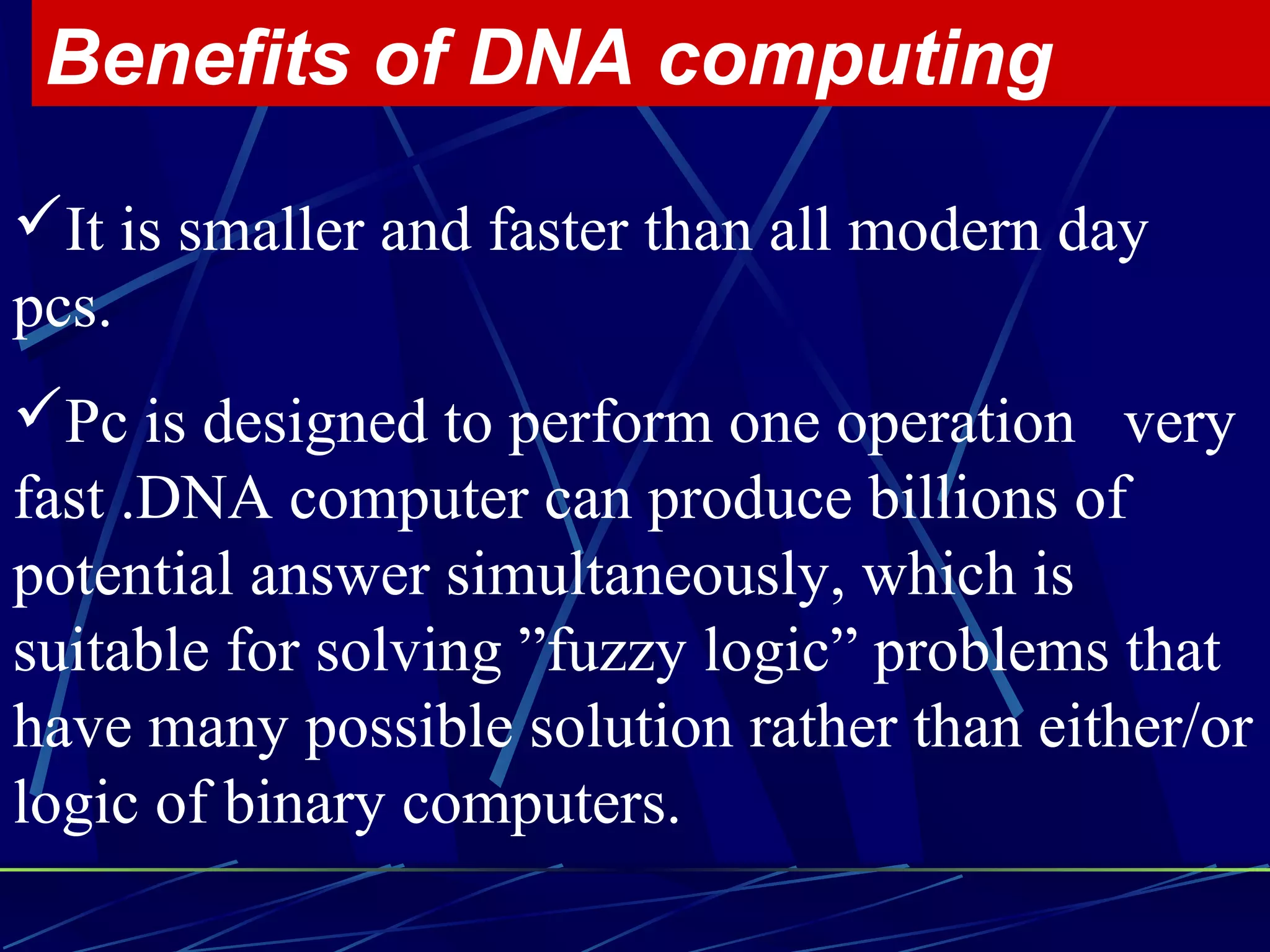
Israeli scientists have devised a computer
composed of DNA and enzymes. The enzyme
breaks bonds in the DNA double helix, causing the
release of enough energy for the system to be self-
It is smaller and faster than all modern day
pcs.
Pc is designed to perform one operation very
fast .DNA computer can produce billions of
potential answer simultaneously, which is
suitable for solving ”fuzzy logic” problems that
have many possible solution rather than either/or
logic of binary computers.
Benefits of DNA computing
It is a revolution in the field of pharmaceutical
and biomedical fields.it can recognize cancerous
cells when injected into body and generate drugs
for it .Not only for cancer it can work for
different diseases and will give quick remedy.
cont’s….
DNA chip
conclusion
Think of DNA as software and enzyme as
hardware when put into a beaker the molecules
undergo chemical reactions with each other
allows simple operations to be performed as a
byproduct of the reaction. it is completely
different approach to passing electrons around
a dry circuit in a conventional computer.
So scientists are trying to make a hybrid
computer which use traditional silicon chips for
normal processing tasks but have DNA co-
processors that can take over specific tasks.
LITU

Dna computing

  • 1.
    PRESENTED BY Debadarshi mishra AdmNo: 21-mca/05 Chairman prof. Avimanyu Das HOD, Dept . Of MCA SEMINAR ON
  • 3.
    INTRODUCTION DNA computer isa molecular computer that works biochemically. It computes using enzymes that react with DNA strands causing chain reaction. The chain reaction act as a kind of stimulus computing or parallel processing
  • 4.
    The field wasinitially developed by Leanard Aldman who 1994 demonstrated a proof of concept use of DNA as form of computation which was used to solve the seven point hemilton path problem. On april 28 2004 Ehud Sharpiro and researchers at Weizmann institute announced in the journal Nature that they constructed aDNA computer
  • 5.
    How DNA worksas a computer Electronic computers store data in binary form then resemble and interpret the information in meaningful way. A DNA computer has the same basic abilities to store information and compute solutions .But its working method is different. It works off molecular automations and preset reactions.
  • 6.
    DNA computer asa part of nanoscience A DNA can monitor blood in vitro. IF a chemical imbalance is detected, the DNA computer can synthesize the needed replacement and release it into the blood to restore equilibrium. It can also eliminate the unwanted chemicals by disabling them at molecular level
  • 7.
  • 8.
  • 9.
  • 10.
    DNA computing In termsof speed and size however DNA computers surpass conventional computer. While scientist say silicon chips cannot further scaled down much further, the DNA molecule found in the nucleus of all cells can hold more information in a cubic centimeter than a trillion music cds. A spoonful of DNA contain 15000 trillion computers and energy sufficiency is more than a million times that of a pc.
  • 11.
    Israeli scientists havedevised a computer composed of DNA and enzymes. The enzyme breaks bonds in the DNA double helix, causing the release of enough energy for the system to be self-
  • 12.
    It is smallerand faster than all modern day pcs. Pc is designed to perform one operation very fast .DNA computer can produce billions of potential answer simultaneously, which is suitable for solving ”fuzzy logic” problems that have many possible solution rather than either/or logic of binary computers. Benefits of DNA computing
  • 13.
    It is arevolution in the field of pharmaceutical and biomedical fields.it can recognize cancerous cells when injected into body and generate drugs for it .Not only for cancer it can work for different diseases and will give quick remedy. cont’s….
  • 14.
  • 15.
    conclusion Think of DNAas software and enzyme as hardware when put into a beaker the molecules undergo chemical reactions with each other allows simple operations to be performed as a byproduct of the reaction. it is completely different approach to passing electrons around a dry circuit in a conventional computer. So scientists are trying to make a hybrid computer which use traditional silicon chips for normal processing tasks but have DNA co- processors that can take over specific tasks.
  • 16.