Team Members: Piyush Bujade, Sudhanshu
Mishra, Aditya Dubey
• NIST is the abbreviated name of the National Institute of Standards
and Technology.
About NIST
• NIST was originally founded to enable greater industrial
competitiveness in the United States.
• Its focus stems from the mantra, “One cannot manage what is not
measured.”
• Over the years the agency has worked to develop and formalize a wide range
of commercial and industrial standards.
• According to a recent survey of 750 corporations using cloud
computing, 87 percent of them use more than one cloud.
NIST
On Cloud Computing
• The report also states that 96 percent rely on a public cloud, either as
part of a hybrid approach or as the only source.
• Despite that prevalence, however, cloud computing can be a confusing
concept. To ease that confusion, the National Institute of Standards and
Technology (NIST) offered a definition of cloud computing in its NIST
Special Publication 800-145:
“A model for enabling ubiquitous, convenient, on-demand
network access to a shared pool of configurable computing
resources that can be rapidly provisioned and released
with minimal management effort or service provider
interaction. This cloud model comprises five essential
characteristics, three service, and four deployment
models.”
• Five essential characteristics.
• Three service.
• Four deployment models.
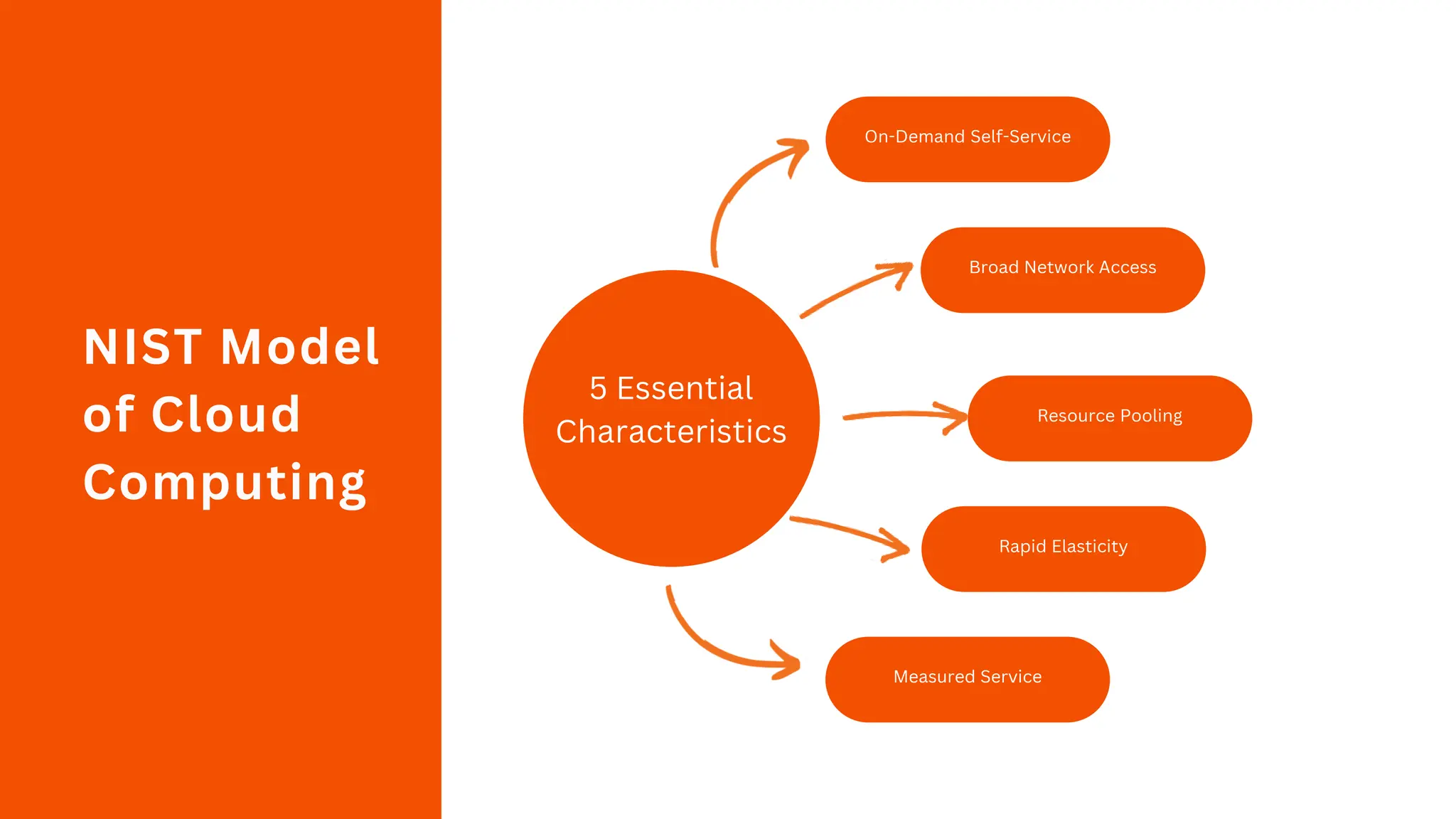
5 Essential
Characteristics
On-Demand Self-Service
Broad Network Access
Resource Pooling
Rapid Elasticity
Measured Service
NIST Model
of Cloud
Computing
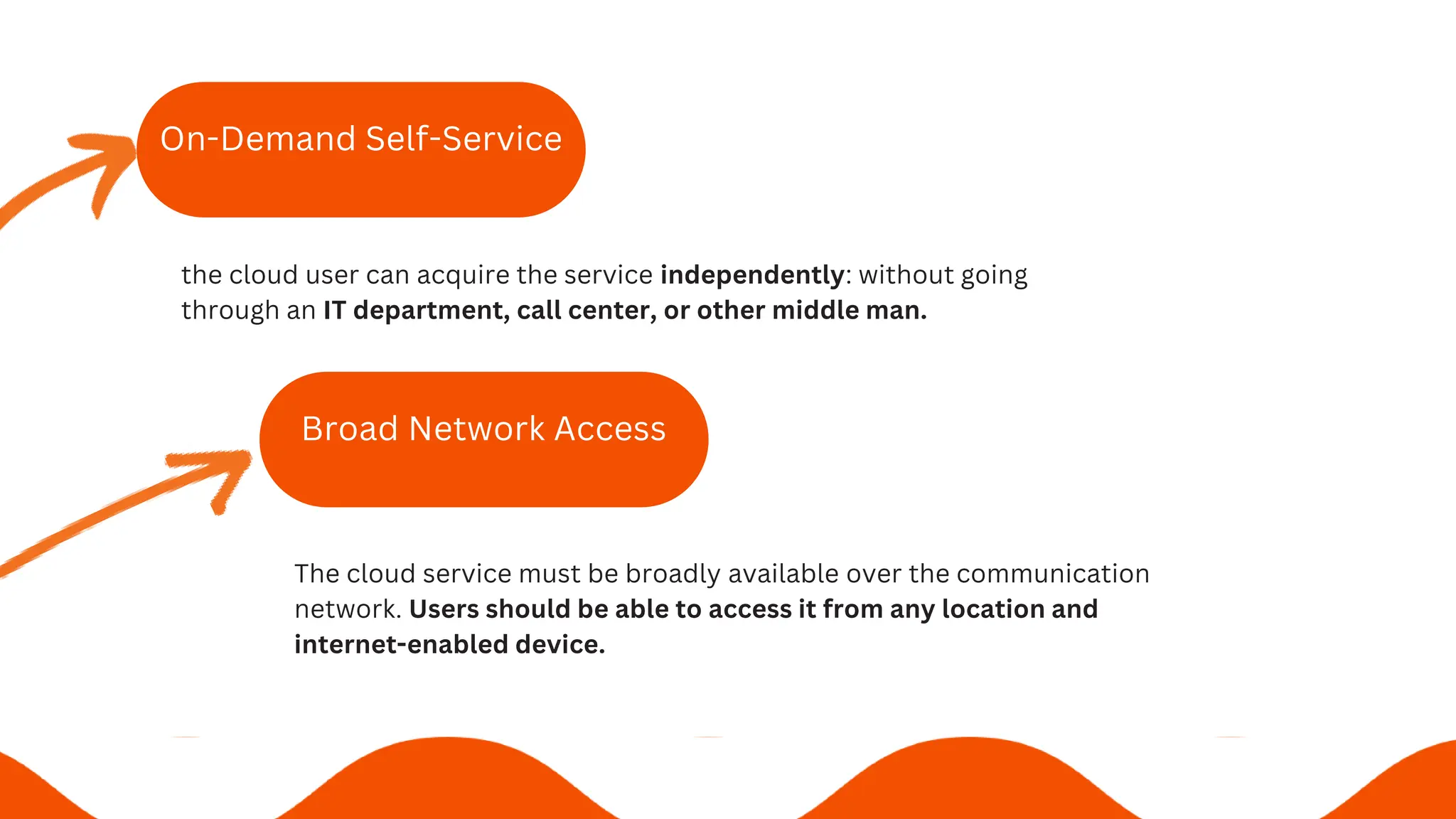
On-Demand Self-Service
the cloud user can acquire the service independently: without going
through an IT department, call center, or other middle man.
Broad Network Access
The cloud service must be broadly available over the communication
network. Users should be able to access it from any location and
internet-enabled device.
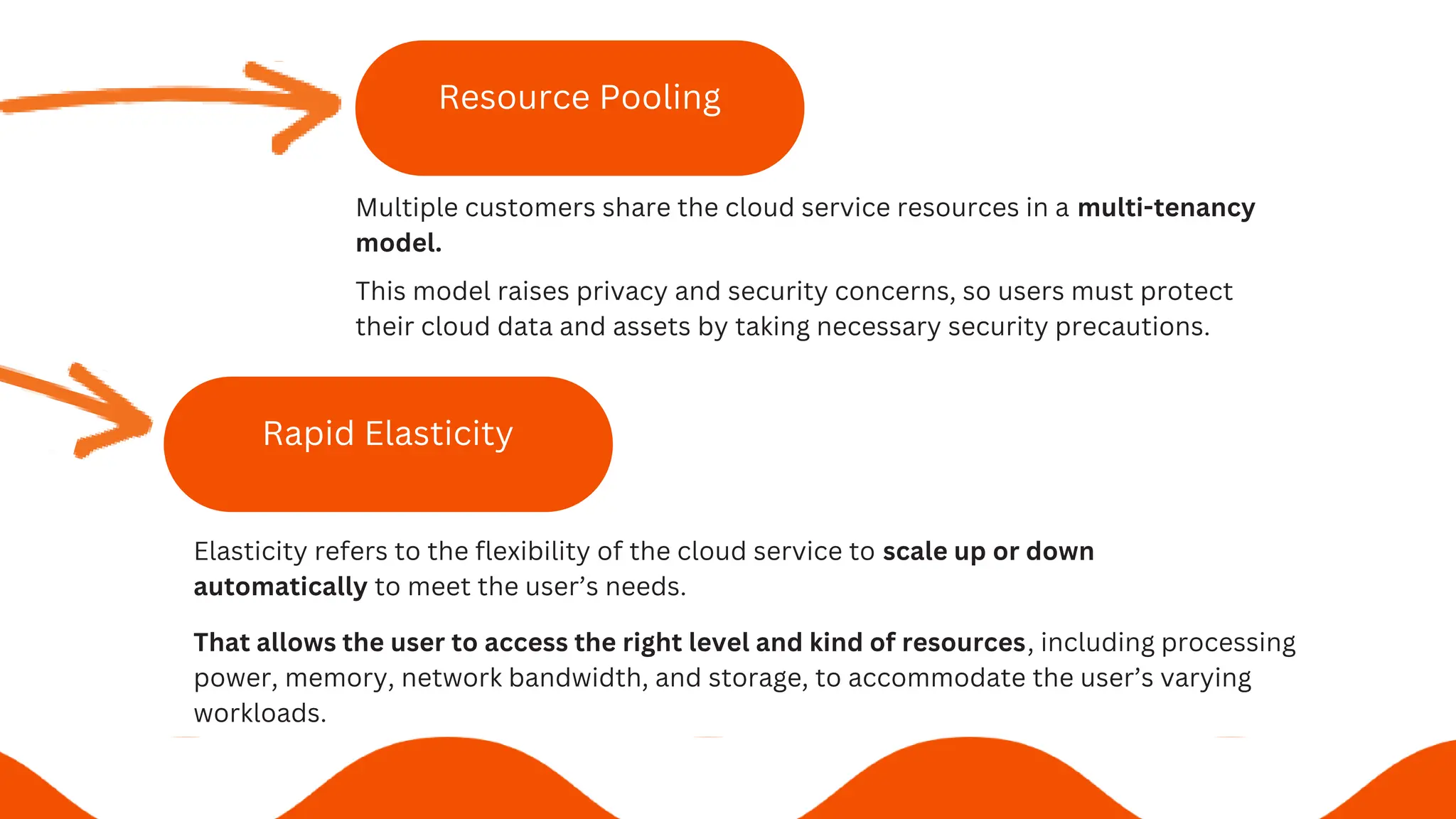
Resource Pooling
Multiple customers share the cloud service resources in a multi-tenancy
model.
Rapid Elasticity
Elasticity refers to the flexibility of the cloud service to scale up or down
automatically to meet the user’s needs.
This model raises privacy and security concerns, so users must protect
their cloud data and assets by taking necessary security precautions.
That allows the user to access the right level and kind of resources, including processing
power, memory, network bandwidth, and storage, to accommodate the user’s varying
workloads.
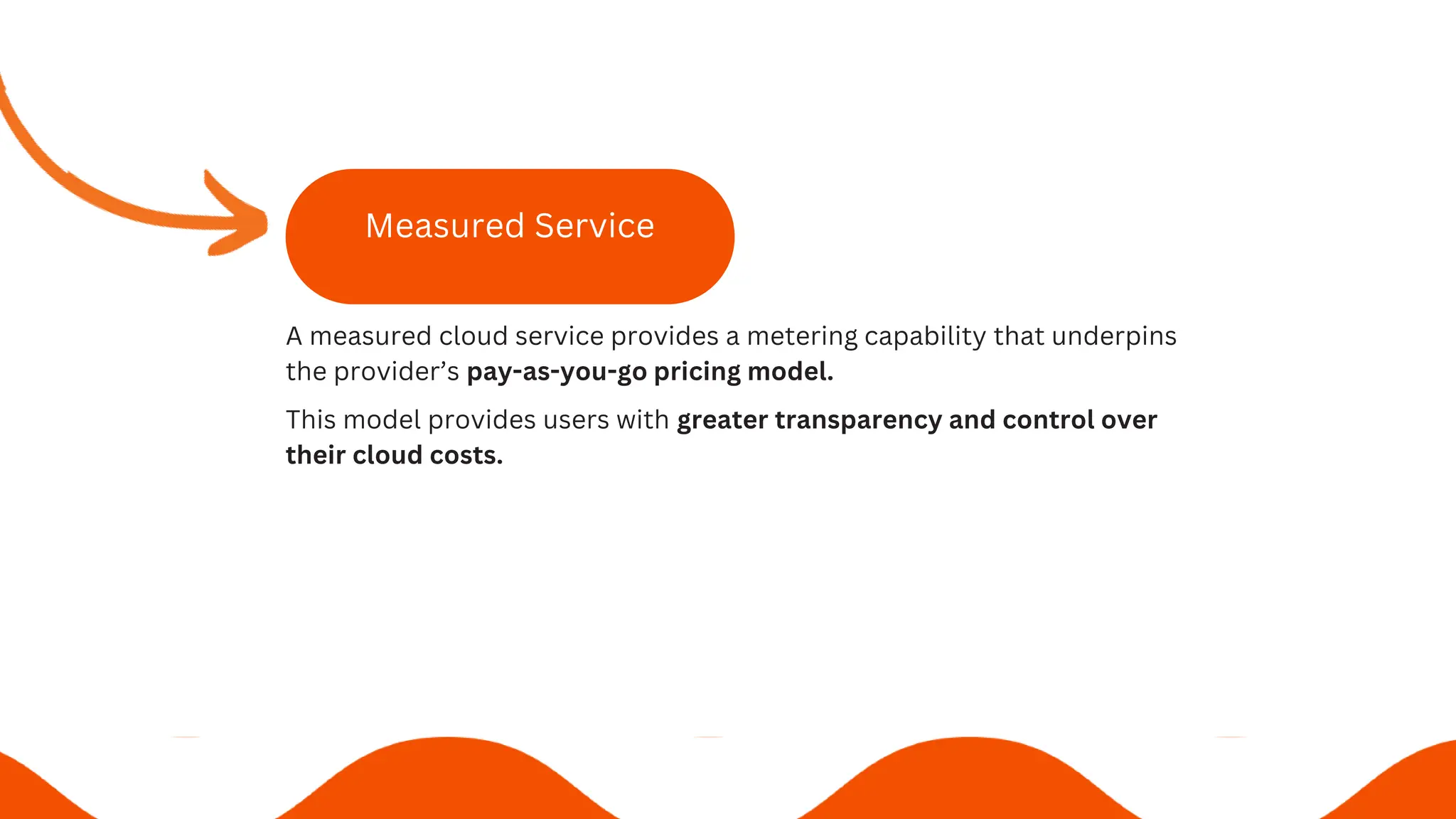
Measured Service
A measured cloud service provides a metering capability that underpins
the provider’s pay-as-you-go pricing model.
This model provides users with greater transparency and control over
their cloud costs.
• Five essential characteristics.
• Three service.
• Four deployment models.
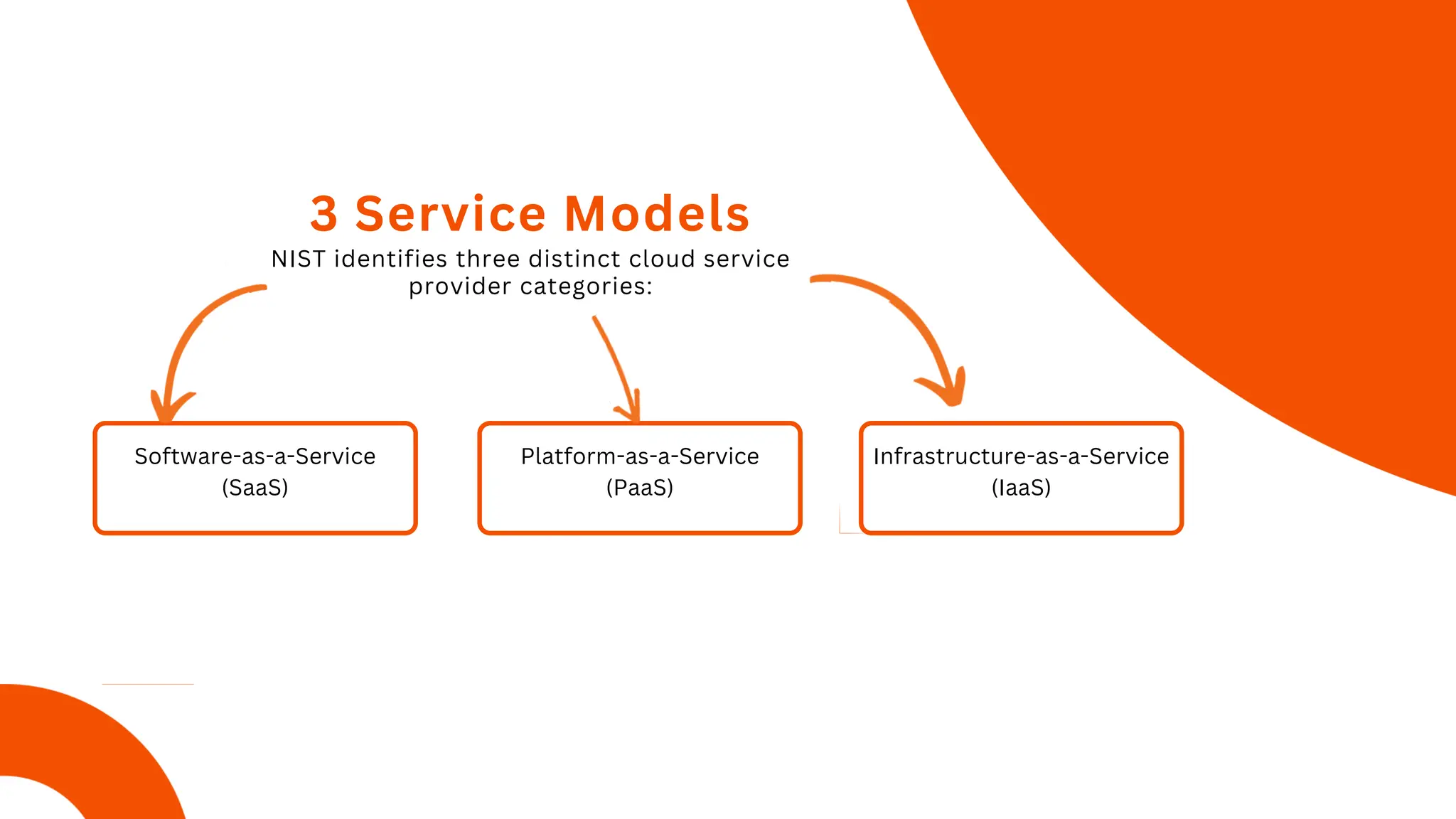
Software-as-a-Service
(SaaS)
Platform-as-a-Service
(PaaS)
Infrastructure-as-a-Service
(IaaS)
NIST identifies three distinct cloud service
provider categories:
3 Service Models
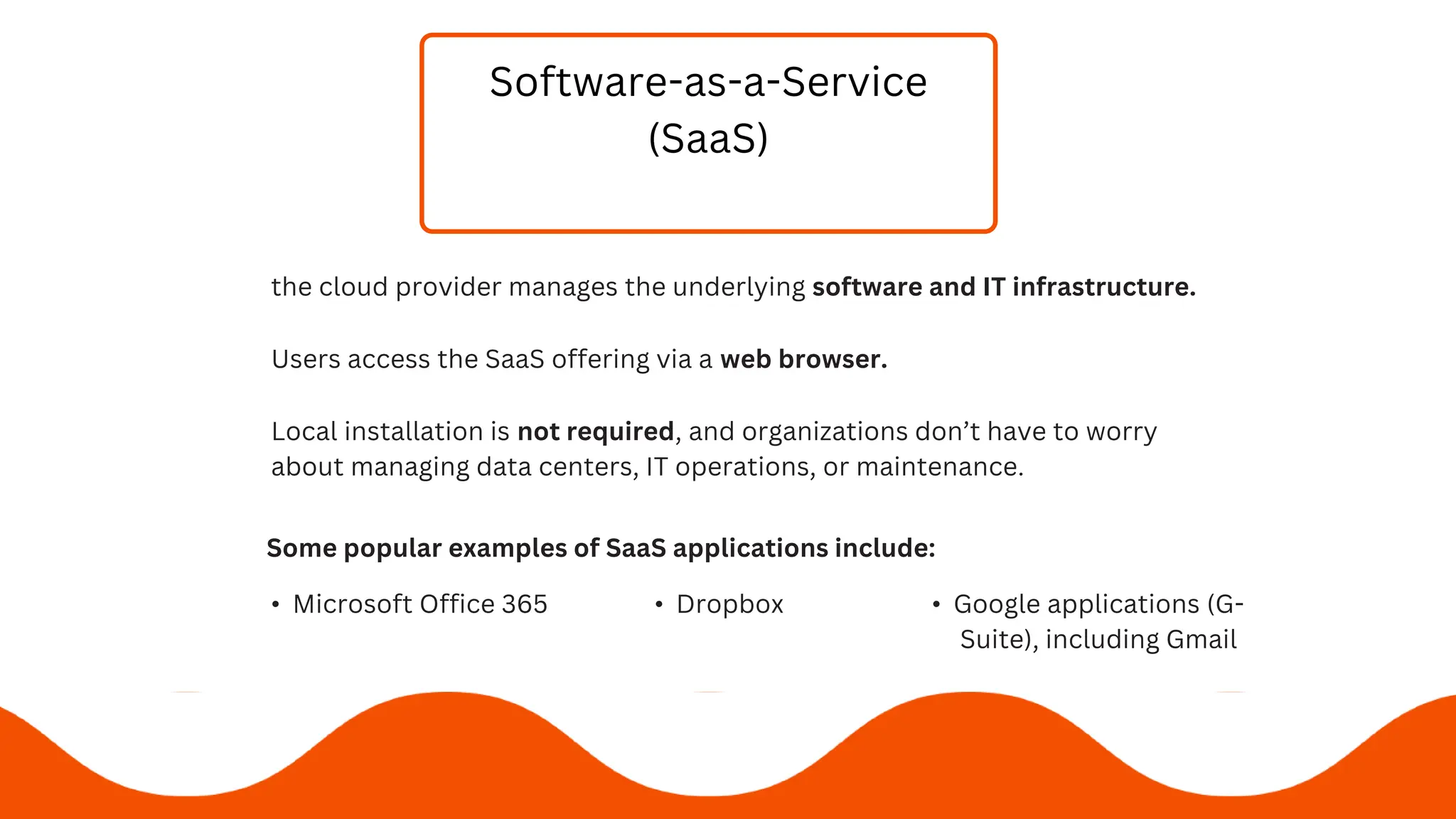
Software-as-a-Service
(SaaS)
the cloud provider manages the underlying software and IT infrastructure.
Users access the SaaS offering via a web browser.
Local installation is not required, and organizations don’t have to worry
about managing data centers, IT operations, or maintenance.
Some popular examples of SaaS applications include:
• Microsoft Office 365 • Dropbox • Google applications (G-
Suite), including Gmail
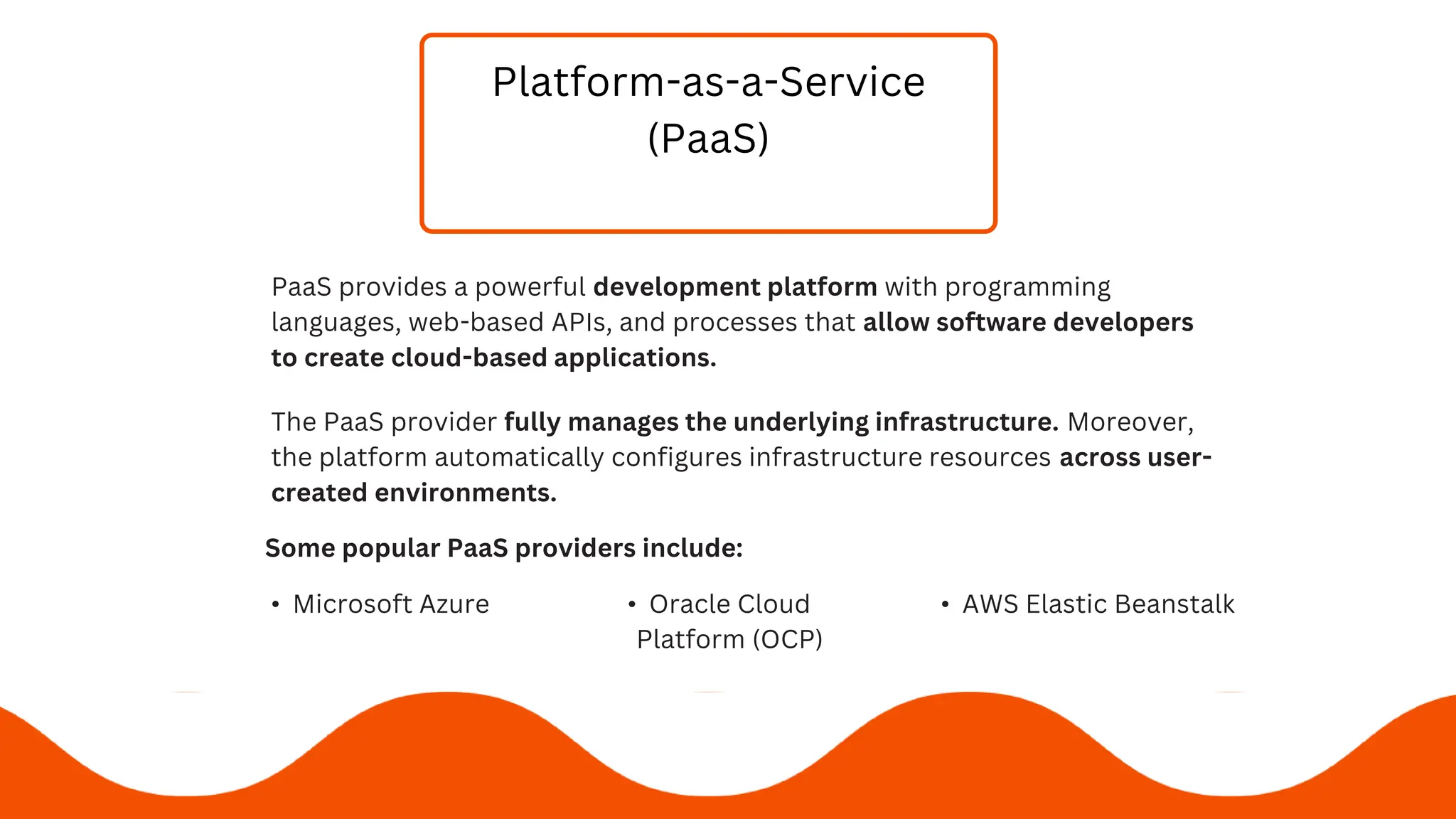
Platform-as-a-Service
(PaaS)
PaaS provides a powerful development platform with programming
languages, web-based APIs, and processes that allow software developers
to create cloud-based applications.
Some popular PaaS providers include:
• Microsoft Azure • Oracle Cloud
Platform (OCP)
• AWS Elastic Beanstalk
The PaaS provider fully manages the underlying infrastructure. Moreover,
the platform automatically configures infrastructure resources across user-
created environments.
Infrastructure-as-a-Service
(IaaS)
Users can rent the cloud IT infrastructure, such as servers, networking, and
storage, from an IaaS provider on a pay-as-you-go basis.
Some popular IaaS providers include:
• AWS EC2 • Microsoft Azure • Google Compute Engine
so the user doesn’t incur the cost of on-premises installation or
maintenance.
• Five essential characteristics.
• Three service.
• Four deployment models.
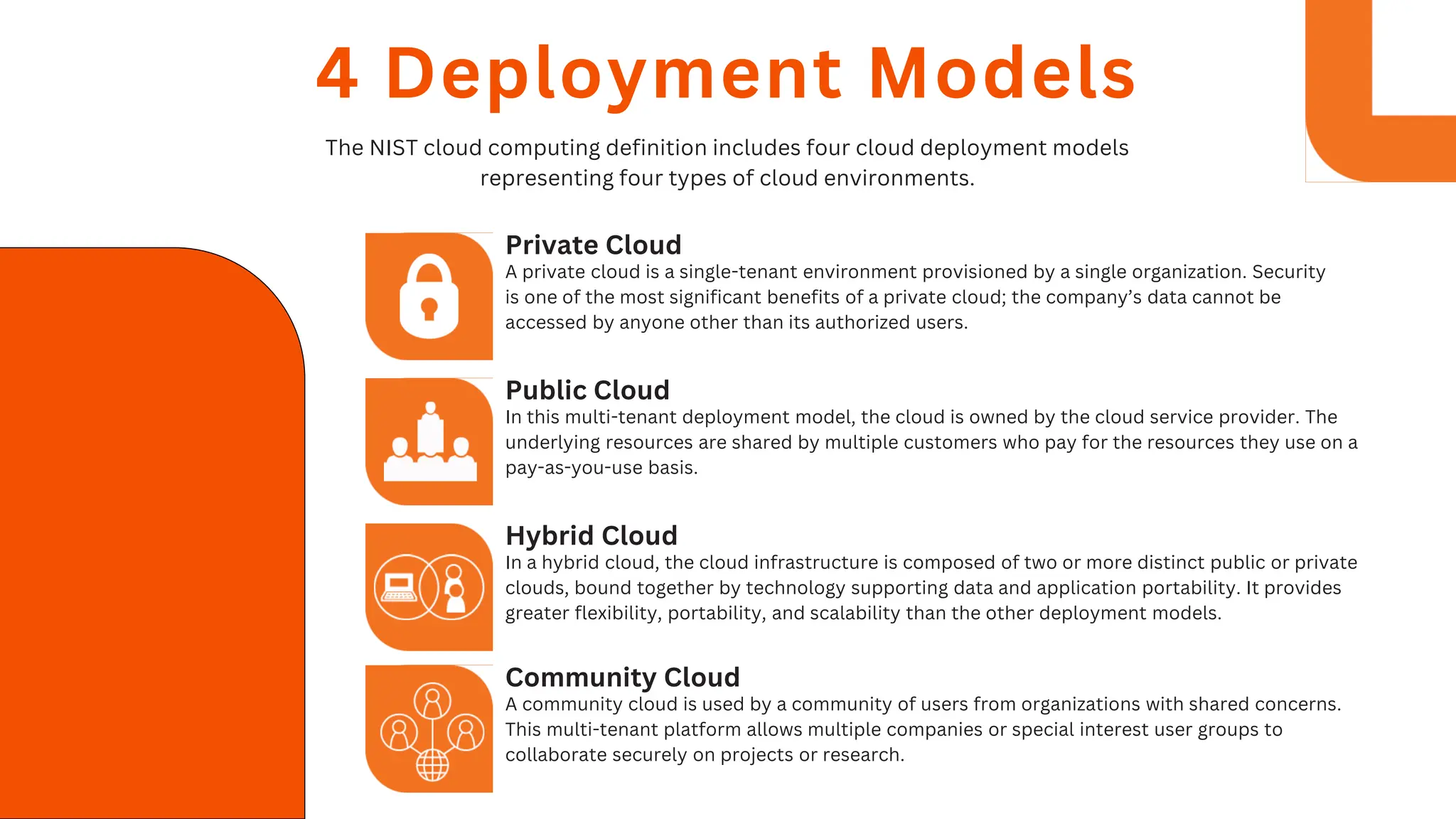
A private cloud is a single-tenant environment provisioned by a single organization. Security
is one of the most significant benefits of a private cloud; the company’s data cannot be
accessed by anyone other than its authorized users.
Private Cloud
In this multi-tenant deployment model, the cloud is owned by the cloud service provider. The
underlying resources are shared by multiple customers who pay for the resources they use on a
pay-as-you-use basis.
Public Cloud
In a hybrid cloud, the cloud infrastructure is composed of two or more distinct public or private
clouds, bound together by technology supporting data and application portability. It provides
greater flexibility, portability, and scalability than the other deployment models.
Hybrid Cloud
4 Deployment Models
The NIST cloud computing definition includes four cloud deployment models
representing four types of cloud environments.
A community cloud is used by a community of users from organizations with shared concerns.
This multi-tenant platform allows multiple companies or special interest user groups to
collaborate securely on projects or research.
Community Cloud
NIST Model of Cloud Computing by Piyush Bujade.pptx

NIST Model of Cloud Computing by Piyush Bujade.pptx

  • 1.
    Team Members: PiyushBujade, Sudhanshu Mishra, Aditya Dubey
  • 2.
    • NIST isthe abbreviated name of the National Institute of Standards and Technology. About NIST • NIST was originally founded to enable greater industrial competitiveness in the United States. • Its focus stems from the mantra, “One cannot manage what is not measured.” • Over the years the agency has worked to develop and formalize a wide range of commercial and industrial standards.
  • 3.
    • According toa recent survey of 750 corporations using cloud computing, 87 percent of them use more than one cloud. NIST On Cloud Computing • The report also states that 96 percent rely on a public cloud, either as part of a hybrid approach or as the only source. • Despite that prevalence, however, cloud computing can be a confusing concept. To ease that confusion, the National Institute of Standards and Technology (NIST) offered a definition of cloud computing in its NIST Special Publication 800-145:
  • 4.
    “A model forenabling ubiquitous, convenient, on-demand network access to a shared pool of configurable computing resources that can be rapidly provisioned and released with minimal management effort or service provider interaction. This cloud model comprises five essential characteristics, three service, and four deployment models.”
  • 5.
    • Five essentialcharacteristics. • Three service. • Four deployment models.
  • 6.
    5 Essential Characteristics On-Demand Self-Service BroadNetwork Access Resource Pooling Rapid Elasticity Measured Service NIST Model of Cloud Computing
  • 7.
    On-Demand Self-Service the clouduser can acquire the service independently: without going through an IT department, call center, or other middle man. Broad Network Access The cloud service must be broadly available over the communication network. Users should be able to access it from any location and internet-enabled device.
  • 8.
    Resource Pooling Multiple customersshare the cloud service resources in a multi-tenancy model. Rapid Elasticity Elasticity refers to the flexibility of the cloud service to scale up or down automatically to meet the user’s needs. This model raises privacy and security concerns, so users must protect their cloud data and assets by taking necessary security precautions. That allows the user to access the right level and kind of resources, including processing power, memory, network bandwidth, and storage, to accommodate the user’s varying workloads.
  • 9.
    Measured Service A measuredcloud service provides a metering capability that underpins the provider’s pay-as-you-go pricing model. This model provides users with greater transparency and control over their cloud costs.
  • 10.
    • Five essentialcharacteristics. • Three service. • Four deployment models.
  • 11.
  • 12.
    Software-as-a-Service (SaaS) the cloud providermanages the underlying software and IT infrastructure. Users access the SaaS offering via a web browser. Local installation is not required, and organizations don’t have to worry about managing data centers, IT operations, or maintenance. Some popular examples of SaaS applications include: • Microsoft Office 365 • Dropbox • Google applications (G- Suite), including Gmail
  • 13.
    Platform-as-a-Service (PaaS) PaaS provides apowerful development platform with programming languages, web-based APIs, and processes that allow software developers to create cloud-based applications. Some popular PaaS providers include: • Microsoft Azure • Oracle Cloud Platform (OCP) • AWS Elastic Beanstalk The PaaS provider fully manages the underlying infrastructure. Moreover, the platform automatically configures infrastructure resources across user- created environments.
  • 14.
    Infrastructure-as-a-Service (IaaS) Users can rentthe cloud IT infrastructure, such as servers, networking, and storage, from an IaaS provider on a pay-as-you-go basis. Some popular IaaS providers include: • AWS EC2 • Microsoft Azure • Google Compute Engine so the user doesn’t incur the cost of on-premises installation or maintenance.
  • 15.
    • Five essentialcharacteristics. • Three service. • Four deployment models.
  • 16.
    A private cloudis a single-tenant environment provisioned by a single organization. Security is one of the most significant benefits of a private cloud; the company’s data cannot be accessed by anyone other than its authorized users. Private Cloud In this multi-tenant deployment model, the cloud is owned by the cloud service provider. The underlying resources are shared by multiple customers who pay for the resources they use on a pay-as-you-use basis. Public Cloud In a hybrid cloud, the cloud infrastructure is composed of two or more distinct public or private clouds, bound together by technology supporting data and application portability. It provides greater flexibility, portability, and scalability than the other deployment models. Hybrid Cloud 4 Deployment Models The NIST cloud computing definition includes four cloud deployment models representing four types of cloud environments. A community cloud is used by a community of users from organizations with shared concerns. This multi-tenant platform allows multiple companies or special interest user groups to collaborate securely on projects or research. Community Cloud