
Università degli Studi di Trento
            Facoltà di Economia
Corso di Laurea Specialistica in Net-Economy
         Corso di Telecomunicazioni

               Nicola Cerami
Index
  What is P2P and    Security and
   History             Privacy issues
  Architecture of    Economic issues
   P2P systems        Applications of
  Advantages and      use
   weaknesses of      Future
   P2P Networks        developments
  Legal issues
18/04/2010                               2
What is Peer-to-Peer-1
 Is any distribuited network architecture
    composed of partecipants that make a portion
    of their resources, such as:

              Processing power
              Disk storage

              Network bandwith


 Directly available to other network
    partecipants
18/04/2010                                         3
What is Peer-to-Peer-2
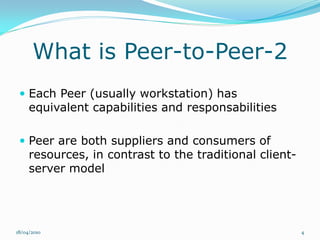
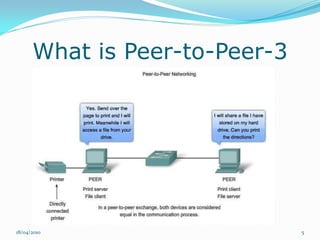
  Each Peer (usually workstation) has
     equivalent capabilities and responsabilities

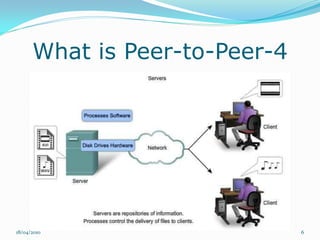
  Peer are both suppliers and consumers of
     resources, in contrast to the traditional client-
     server model


18/04/2010                                               4
What is Peer-to-Peer-3


18/04/2010                     5
What is Peer-to-Peer-4


18/04/2010                     6
History
  1999: first software dedicated to P2P is
     Napster (Fanning)

  Spread broadband and ADSL Flat increasingly
     accessible

  A growing success


  Today, huge numer of P2P Systems

18/04/2010                                       7
Architecture of P2P
                   systems

 1. Centralized architecture


 2. Distributed architecture, or pure


 3. Mixed or hybrid architecture

18/04/2010                              8
Centralized
 Networks
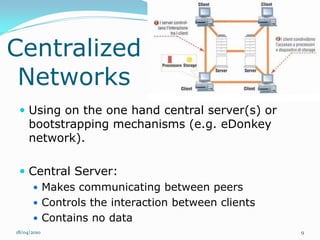
  Using on the one hand central server(s) or
     bootstrapping mechanisms (e.g. eDonkey
     network).

  Central Server:
     Makes communicating between peers
     Controls the interaction between clients
     Contains no data
18/04/2010                                       9
Distributed
  Architecture
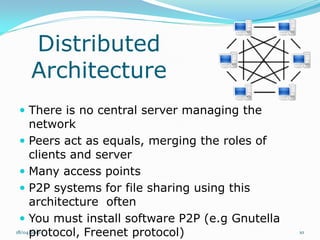
 There is no central server managing the
     network
   Peers act as equals, merging the roles of
     clients and server
   Many access points
   P2P systems for file sharing using this
     architecture often
   You must install software P2P (e.g Gnutella
     protocol, Freenet protocol)
18/04/2010                                        10
Hybrid P2P Networks
 Mix of centralized architecture and decentralized
  architecture
 Distribute their clients into two groups:


    Clients nodes
    Overlay nodes


 Tipically, each client is able to act according to the
     momentary need of the network and can become
     part of the respective overlay network used to
     coordinate the P2P structure (e.g. Gnutella
     protocol).
18/04/2010                                         11
Advantages and weaknesses
      of P2P Networks
             Advantages            Weaknesses
  All clients provide       Not guarantee the
   resources (Bandwidth,        quality of service
   Storage space,              It is not easy to
   Computing power)             retrieve information of
  Ease of administration       interest
  Not require major           Reliability Data
   infrastructure              Security
  Extreme tolerance in        Legal issues
   the event of failure

18/04/2010                                                12
Legal issues-1
  The legal framework of reference is appointed
     to regulate the c.d. copyright

  Italian law:
     Act 22 Aprile 1941, n. 633 amended several
      times
     Dilemma law not legal P2P systems
     Art. 171: “anyone who is punisched does not
      qualify, for any purpose and in any form”

  Limit of the law illegal file sharing
18/04/2010                                          13
Legal issues-2
 European level
    Directive 2001/29/CE of the European
     Parlament and Council (May 2001)
    Telecom package approved by the European
     Parlament (Nov 2009)
    Sarkozy’s Doctrine


   United States
        Copyright: Title 17 of the Unites States Code
        Violations  Federal crimes
        Exceptions  educational and scientific
18/04/2010
           purposes                                      14
Security issues
  Fundamental use of antivirus, firewall,
     cleaning log files and removal of infectious
     agents (virus, spyware, trojan, malware).

  Attacks that a client can be, for example:

       Using file sharing systems
       Sharing an area of your disk
       It allows free access to certain ports on your
             computer
18/04/2010                                               15
Privacy issues
  Protecting sensitive data (personal, business)
     throught the adoption of:

       A network of anonymous
       Install SW such as PeerGuardian
       Encryption and obfuscation protocol
       A proxy for connection of the client’s real IP
        mask
       ect..

18/04/2010                                               16
Economic issues -1
  New ways to access resources SW and HW
  Strongly dependent on the market that
   produces use-value
  A study commissioned by the Dutch
   goverment(2009):

    “P2P Systems are good for the economy”


18/04/2010                                   17
Economic issues -2
  New ethnic workers (knowledge workers)
  Used to solve management problems, improve
   communication between companies but also
   within the same
  Greater sharing of know-how
  Faster data trasmission than traditional
   networks (client-server)
  Less server overload


18/04/2010
              COMPETITIVE ADVANTAGE           18
Applications of use
 Often used for file sharing:
   More Applications: Napster, Gnutella, FastTrack,
    BitTorrent, Direct Connect, eDonkey, Kademila,
    etc.
   Also widely used on mobile technology:
    SymTorrent, Direct Connect Torrent, MobileDC,
    etc.

   Sharing computational power:
        HW mainly shared resources for problem
           solving or complex calculations
        Examples: SETI@Home, GIMPS,
18/04/2010 Distributed.net, FightAIDS@Home.            19
Future developments -1
Use innovative P2P  P2P TV

    For the diffusion of high data streams generated in
     real time

    Using trasmission bandwidth of individual users


    Not require server performance


    Requires that individual users are provided with
           high bandwidth connections in both reception and
           trasmission (saturation bandwidth provided by the
18/04/2010 server)                                             20
Future developments -2
  The Server serves as the index, synchronizes the
     various users sharing the bandwidth and provides
     the data flow and initial users share

  So, although in practice a server, after supplying
     the initial data flow and have put in
     communication the various users, the server is
     not interested in the communication becomes
     totally P2P systems

  Large companies are experimenting with the
     possibility of offering paid content
18/04/2010                                              21
Future developments -3
      Limits on the dissemination P2PTV
       Systems are:

       Technical problems (diffusion
       asymmetrical Internet lines, ADSL)
       Reliability problems
       Legal issues


18/04/2010                                  22
Future developments -4
 Simulator epidemic protocols

  University of Bologna is experimenting with
     new P2P applications simulator edpidemic
     protocols for the study of issues of scale and
     dynamism that characterize the moderm
     information systems


18/04/2010                                            23
Future developments -5
  There      protocols are able to put in
     communication      between     their   various
     terminals. Such protocols are characterized by
     large scale and high dynamics.

  The simulator is built from components that
     enable rapid prototyping of communication
     protocols by combining different data blocks


18/04/2010                                          24
Future developments -6
 Using P2P Networks for mobile technologies

  System devised by TerraNet AB (Swedish
   company)
  Allows:
     Local phone calls and send messages (2-20
      km)
     Make calls to anyone with Internet access
      TerraNet
     VoIP calls free long distance

18/04/2010                                        25
Future developments -7
  TerraNet integrated with technology every
   type of mobile device becomes a wireless
     communication

  It works via P2P wireless network (mesh
     network) and no need for base stations,
     antenna installations or infrastructure


18/04/2010                                     26
Future developments -8
             Benefits               Weaknesses


  For areas of the world     Phone companies
   where you make              obviously do not like
   expensive trasmission       the idea
   infrastructure (Africa,    Political issues
   South America, etc)
  Elimination
   communications costs
  Greater privacy

18/04/2010                                             27
Conclusions -1
 Network congestion and bandwidth
  throlling

  Phenomenon increasingly attributed to P2P
   systems
  Many provider have chosen to use the
   bandwidth throlling:
                System that cuts the available bandwidth, especially
                 when using P2P systems
                Often the users knows nothing!
                For example Fastweb, Vodafone (mobile), Alice e
                 Tiscali
18/04/2010      Less opposed P2P systems  Libero e Tele2            28
Conclusions -2
  But the new version of uTorrent apparently
   meets the needs of the ISP.
  uTorrent :
       Limiting network congestion, thus helping
        Internet Provider
       The concept consists of a uTP: magnification
        Bittorrent protocol
       uTP allow clients to automatically find any
        blocks of the network (rule bandwidth
        requirements and improves the connections)

18/04/2010                                             29
Conclusions -3
  Version of uTorrent with uTP is still in beta (Nov,
     2009) but already is showing positive results

  Good thing for us users


  Providers would no longer decide on the bandwidth
     limitation!


18/04/2010                                               30
Web Bibliography
 1.     http://en.wikipedia.org/wiki/Peer_to_peer
 2.     http://it.wikipedia.org/wiki/P2P_TV
 3.     http://it.wikipedia.org/wiki/Legge_italiana_sul_peer-to-peer
 4.     http://www.p2pitalia.com/
 5.     http://www.lastampa.it/redazione/cmsSezioni/economia/200805articoli/32454gira
        ta.asp
 6.     http://www.megalab.it/4061/il-peer-to-peer-fa-bene-all-economia
 7.     http://setiathome.berkeley.edu/
 8.     http://www.mersenne.org/
 9.     http://www.distributed.net/
 10.    http://fightaidsathome.scripps.edu/
 11.    http://www.cs.unibo.it/bison/
 12.    http://www.terranet.se/index.php?option=com_content&task=category&sectionid
        =9&id=18&Itemid=51
18/04/2010                                                                              31
Bibliography
  G. Pascuzzi, Il diritto dell’era digitale. Tecnologie
   informatiche e regole privatistiche, II edizione, Il
   Mulino, Bologna, 2006
  Shapiro e Varian, Information Rules. A strategic Guide
   to the Network Economy. I edizione, Etas, Novembre
   1999.
  Slide Corso Telecomunicazioni (dott. Zorat)
  Slide Corso Diritto Privato dell’Informatica (dott.
   Caso)

18/04/2010                                                  32
Peer to peer Networks

Peer to peer Networks

  • 1.
    Università degli Studidi Trento Facoltà di Economia Corso di Laurea Specialistica in Net-Economy Corso di Telecomunicazioni Nicola Cerami
  • 2.
    Index  Whatis P2P and  Security and History Privacy issues  Architecture of  Economic issues P2P systems  Applications of  Advantages and use weaknesses of  Future P2P Networks developments  Legal issues 18/04/2010 2
  • 3.
    What is Peer-to-Peer-1 Is any distribuited network architecture composed of partecipants that make a portion of their resources, such as:  Processing power  Disk storage  Network bandwith  Directly available to other network partecipants 18/04/2010 3
  • 4.
    What is Peer-to-Peer-2  Each Peer (usually workstation) has equivalent capabilities and responsabilities  Peer are both suppliers and consumers of resources, in contrast to the traditional client- server model 18/04/2010 4
  • 5.
  • 6.
  • 7.
    History  1999:first software dedicated to P2P is Napster (Fanning)  Spread broadband and ADSL Flat increasingly accessible  A growing success  Today, huge numer of P2P Systems 18/04/2010 7
  • 8.
    Architecture of P2P systems 1. Centralized architecture 2. Distributed architecture, or pure 3. Mixed or hybrid architecture 18/04/2010 8
  • 9.
    Centralized Networks Using on the one hand central server(s) or bootstrapping mechanisms (e.g. eDonkey network).  Central Server:  Makes communicating between peers  Controls the interaction between clients  Contains no data 18/04/2010 9
  • 10.
    Distributed Architecture There is no central server managing the network  Peers act as equals, merging the roles of clients and server  Many access points  P2P systems for file sharing using this architecture often  You must install software P2P (e.g Gnutella protocol, Freenet protocol) 18/04/2010 10
  • 11.
    Hybrid P2P Networks Mix of centralized architecture and decentralized architecture  Distribute their clients into two groups:  Clients nodes  Overlay nodes  Tipically, each client is able to act according to the momentary need of the network and can become part of the respective overlay network used to coordinate the P2P structure (e.g. Gnutella protocol). 18/04/2010 11
  • 12.
    Advantages and weaknesses of P2P Networks Advantages Weaknesses  All clients provide  Not guarantee the resources (Bandwidth, quality of service Storage space,  It is not easy to Computing power) retrieve information of  Ease of administration interest  Not require major  Reliability Data infrastructure  Security  Extreme tolerance in  Legal issues the event of failure 18/04/2010 12
  • 13.
    Legal issues-1 The legal framework of reference is appointed to regulate the c.d. copyright  Italian law:  Act 22 Aprile 1941, n. 633 amended several times  Dilemma law not legal P2P systems  Art. 171: “anyone who is punisched does not qualify, for any purpose and in any form”  Limit of the law illegal file sharing 18/04/2010 13
  • 14.
    Legal issues-2  Europeanlevel  Directive 2001/29/CE of the European Parlament and Council (May 2001)  Telecom package approved by the European Parlament (Nov 2009)  Sarkozy’s Doctrine  United States  Copyright: Title 17 of the Unites States Code  Violations  Federal crimes  Exceptions  educational and scientific 18/04/2010 purposes 14
  • 15.
    Security issues Fundamental use of antivirus, firewall, cleaning log files and removal of infectious agents (virus, spyware, trojan, malware).  Attacks that a client can be, for example:  Using file sharing systems  Sharing an area of your disk  It allows free access to certain ports on your computer 18/04/2010 15
  • 16.
    Privacy issues Protecting sensitive data (personal, business) throught the adoption of:  A network of anonymous  Install SW such as PeerGuardian  Encryption and obfuscation protocol  A proxy for connection of the client’s real IP mask  ect.. 18/04/2010 16
  • 17.
    Economic issues -1  New ways to access resources SW and HW  Strongly dependent on the market that produces use-value  A study commissioned by the Dutch goverment(2009): “P2P Systems are good for the economy” 18/04/2010 17
  • 18.
    Economic issues -2  New ethnic workers (knowledge workers)  Used to solve management problems, improve communication between companies but also within the same  Greater sharing of know-how  Faster data trasmission than traditional networks (client-server)  Less server overload 18/04/2010 COMPETITIVE ADVANTAGE 18
  • 19.
    Applications of use Often used for file sharing:  More Applications: Napster, Gnutella, FastTrack, BitTorrent, Direct Connect, eDonkey, Kademila, etc.  Also widely used on mobile technology: SymTorrent, Direct Connect Torrent, MobileDC, etc.  Sharing computational power:  HW mainly shared resources for problem solving or complex calculations  Examples: SETI@Home, GIMPS, 18/04/2010 Distributed.net, FightAIDS@Home. 19
  • 20.
    Future developments -1 Useinnovative P2P  P2P TV  For the diffusion of high data streams generated in real time  Using trasmission bandwidth of individual users  Not require server performance  Requires that individual users are provided with high bandwidth connections in both reception and trasmission (saturation bandwidth provided by the 18/04/2010 server) 20
  • 21.
    Future developments -2  The Server serves as the index, synchronizes the various users sharing the bandwidth and provides the data flow and initial users share  So, although in practice a server, after supplying the initial data flow and have put in communication the various users, the server is not interested in the communication becomes totally P2P systems  Large companies are experimenting with the possibility of offering paid content 18/04/2010 21
  • 22.
    Future developments -3 Limits on the dissemination P2PTV Systems are:  Technical problems (diffusion asymmetrical Internet lines, ADSL)  Reliability problems  Legal issues 18/04/2010 22
  • 23.
    Future developments -4 Simulator epidemic protocols  University of Bologna is experimenting with new P2P applications simulator edpidemic protocols for the study of issues of scale and dynamism that characterize the moderm information systems 18/04/2010 23
  • 24.
    Future developments -5  There protocols are able to put in communication between their various terminals. Such protocols are characterized by large scale and high dynamics.  The simulator is built from components that enable rapid prototyping of communication protocols by combining different data blocks 18/04/2010 24
  • 25.
    Future developments -6 Using P2P Networks for mobile technologies  System devised by TerraNet AB (Swedish company)  Allows:  Local phone calls and send messages (2-20 km)  Make calls to anyone with Internet access TerraNet  VoIP calls free long distance 18/04/2010 25
  • 26.
    Future developments -7  TerraNet integrated with technology every type of mobile device becomes a wireless communication  It works via P2P wireless network (mesh network) and no need for base stations, antenna installations or infrastructure 18/04/2010 26
  • 27.
    Future developments -8 Benefits Weaknesses  For areas of the world  Phone companies where you make obviously do not like expensive trasmission the idea infrastructure (Africa,  Political issues South America, etc)  Elimination communications costs  Greater privacy 18/04/2010 27
  • 28.
    Conclusions -1 Networkcongestion and bandwidth throlling  Phenomenon increasingly attributed to P2P systems  Many provider have chosen to use the bandwidth throlling:  System that cuts the available bandwidth, especially when using P2P systems  Often the users knows nothing!  For example Fastweb, Vodafone (mobile), Alice e Tiscali 18/04/2010  Less opposed P2P systems  Libero e Tele2 28
  • 29.
    Conclusions -2 But the new version of uTorrent apparently meets the needs of the ISP.  uTorrent :  Limiting network congestion, thus helping Internet Provider  The concept consists of a uTP: magnification Bittorrent protocol  uTP allow clients to automatically find any blocks of the network (rule bandwidth requirements and improves the connections) 18/04/2010 29
  • 30.
    Conclusions -3 Version of uTorrent with uTP is still in beta (Nov, 2009) but already is showing positive results  Good thing for us users  Providers would no longer decide on the bandwidth limitation! 18/04/2010 30
  • 31.
    Web Bibliography 1. http://en.wikipedia.org/wiki/Peer_to_peer 2. http://it.wikipedia.org/wiki/P2P_TV 3. http://it.wikipedia.org/wiki/Legge_italiana_sul_peer-to-peer 4. http://www.p2pitalia.com/ 5. http://www.lastampa.it/redazione/cmsSezioni/economia/200805articoli/32454gira ta.asp 6. http://www.megalab.it/4061/il-peer-to-peer-fa-bene-all-economia 7. http://setiathome.berkeley.edu/ 8. http://www.mersenne.org/ 9. http://www.distributed.net/ 10. http://fightaidsathome.scripps.edu/ 11. http://www.cs.unibo.it/bison/ 12. http://www.terranet.se/index.php?option=com_content&task=category&sectionid =9&id=18&Itemid=51 18/04/2010 31
  • 32.
    Bibliography  G.Pascuzzi, Il diritto dell’era digitale. Tecnologie informatiche e regole privatistiche, II edizione, Il Mulino, Bologna, 2006  Shapiro e Varian, Information Rules. A strategic Guide to the Network Economy. I edizione, Etas, Novembre 1999.  Slide Corso Telecomunicazioni (dott. Zorat)  Slide Corso Diritto Privato dell’Informatica (dott. Caso) 18/04/2010 32