Asynchronous Transfer Mode (ATM) By- Agreeta Sharma A1000810010 AMITY INSTITUTE OF INFORMATION TECHNOLOGY
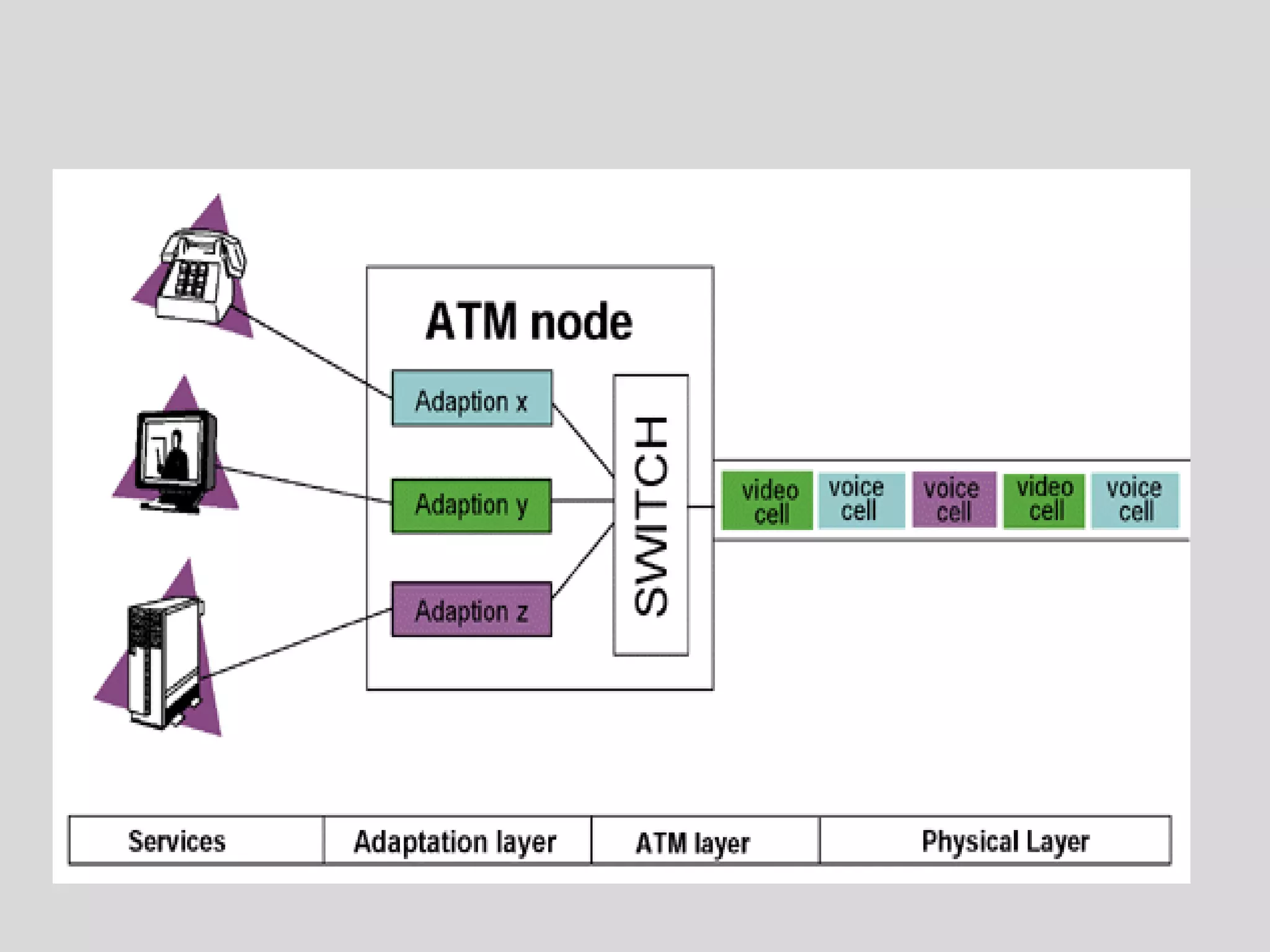
Asynchronous Transfer Mode (ATM) is a switching technique for telecommunication networks. It uses asynchronous  time-division multiplexing , [1] [2]  and it encodes data into small, fixed-sized  cells .  ATM differs from networks such as the  Internet  or  Ethernet LANs  that use variable sized  packets  or  frames .  ATM provides  data link layer  services that run over  OSI   Layer 1  physical links. ATM has functional similarity with both  circuit  switched networking and small packet switched networking.  This makes it a good choice for a network that must handle both traditional high-speed data traffic (e.g., file transfers), and  real-time ,  low-latency  content such as voice and video .  Asynchronous Transfer Mode
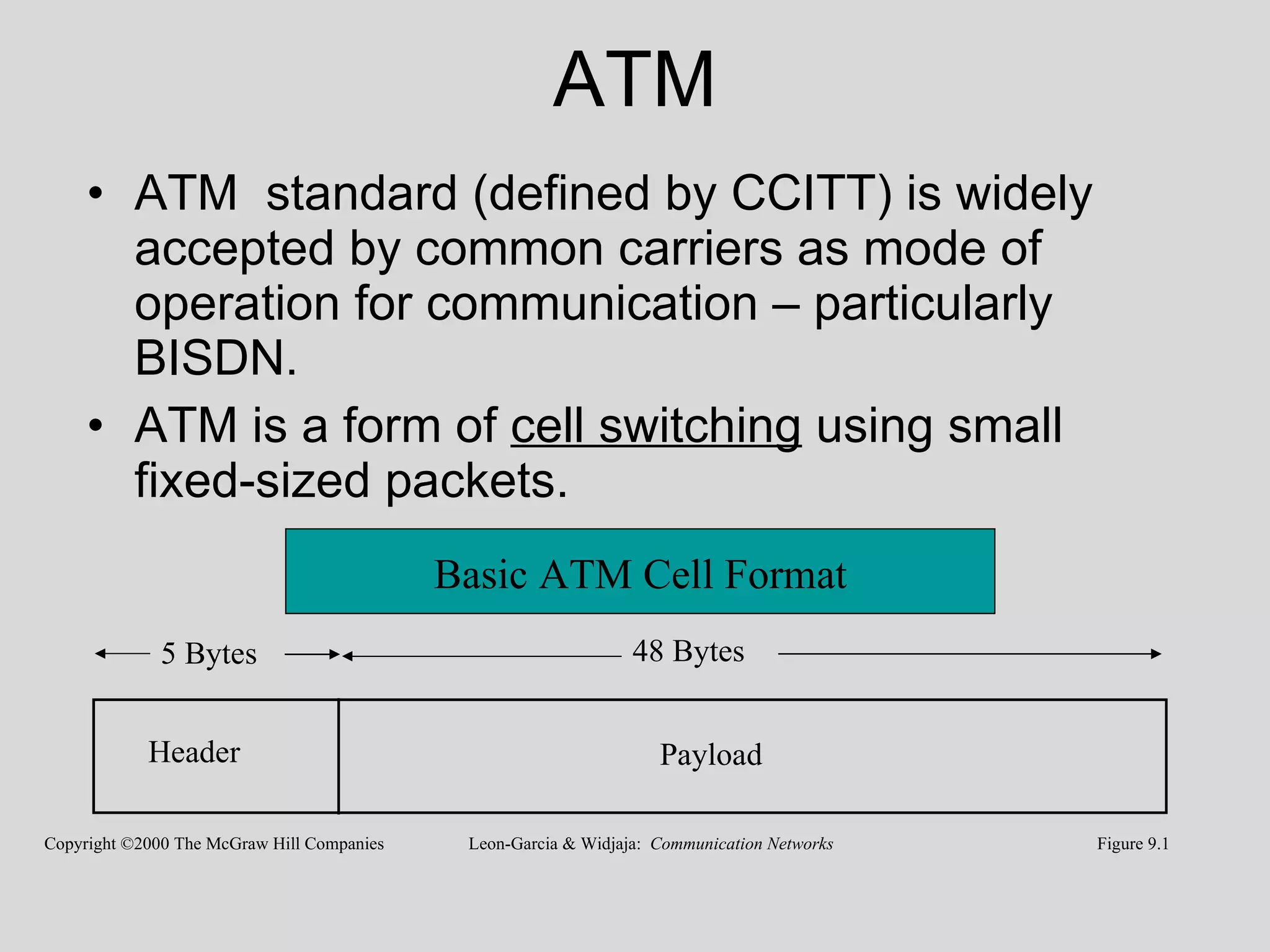
ATM ATM  standard (defined by CCITT) is widely accepted by common carriers as mode of operation for communication – particularly BISDN. ATM is a form of  cell switching  using small fixed-sized packets.  Header Payload 5 Bytes 48 Bytes Figure 9.1 Basic ATM Cell Format Leon-Garcia & Widjaja:  Communication Networks Copyright ©2000 The McGraw Hill Companies
Asynchronous Transfer Mode is a set of  protocols  used for  computer networks . It is mostly used for  Wide Area Networks . It splits the data, and encodes it into packets of a fixed size. Each packet can be routed differently, along virtual paths set up in the network. ATM has been very successful in WANs, as well as in  LANs . Today, many  ADSL  implementations use ATM technology.
 
  permanent virtual circuit ,  a  virtual circuit  that is permanently available. The only difference between a PVC and a  switched virtual circuit (SVC)  is that an SVC must be reestablished each time data is to be sent. Once the data has been sent, the SVC disappears. PVCs are more efficient for connections between  hosts  that communicate frequently  switched virtual circuit ,  a temporary  virtual circuit  that is set up and used only as long as data is being transmitted. Once the communication between the two  hosts  is complete, the SVC disappears. In contrast, a permanent virtual circuit (PVC)  remains available at all times.
 
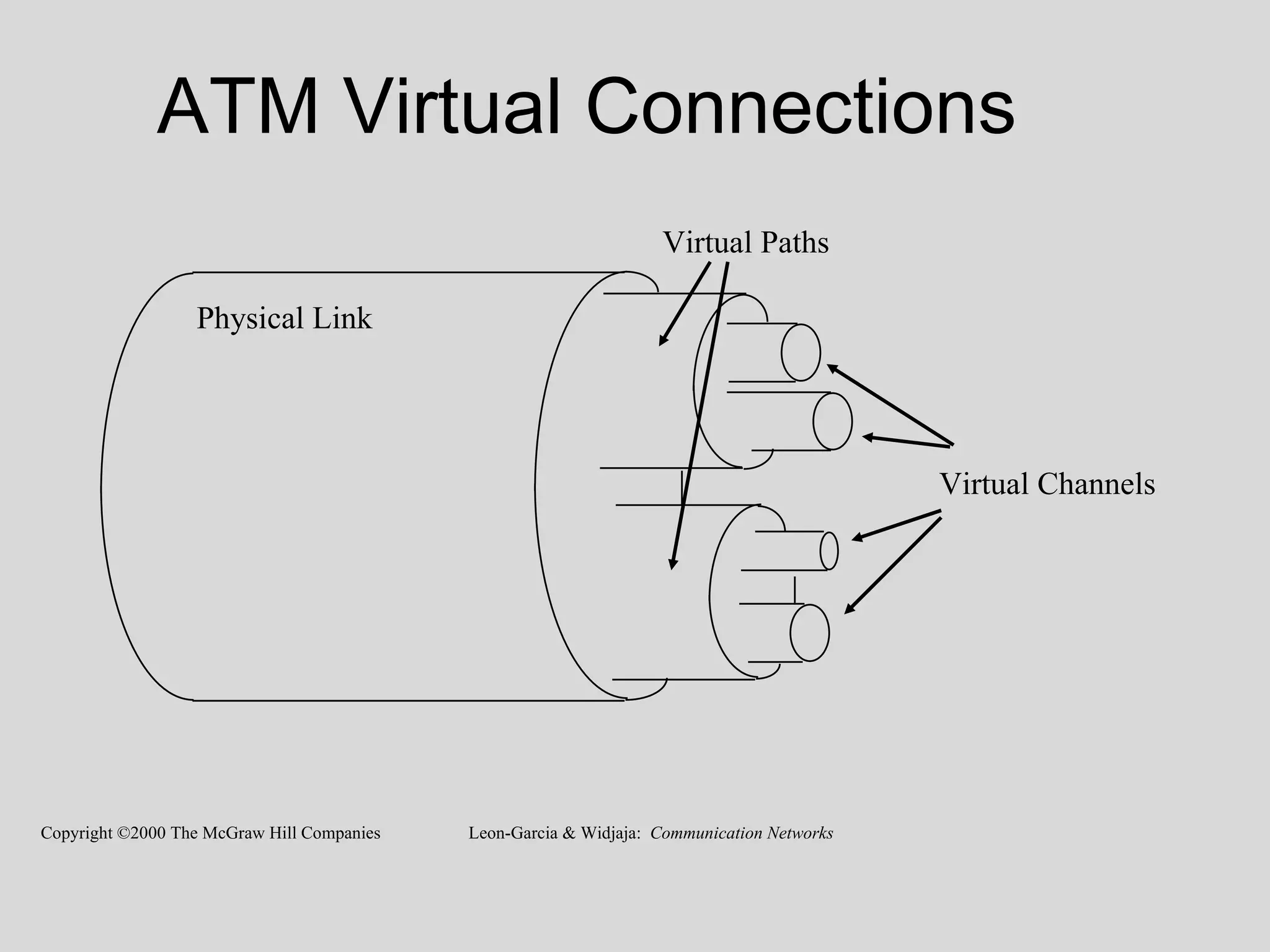
ATM Virtual Connections  Physical Link Virtual Paths Virtual Channels Leon-Garcia & Widjaja:  Communication Networks Copyright ©2000 The McGraw Hill Companies
ATM is more complex, but this complexity allows to give guarantees as to  data rate , maximum delay, and  jitter .  These are usually called  Quality of Service .    Quality of Service  or QoS is a method of providing better service for selected traffic types over various types of packet-switched networks.
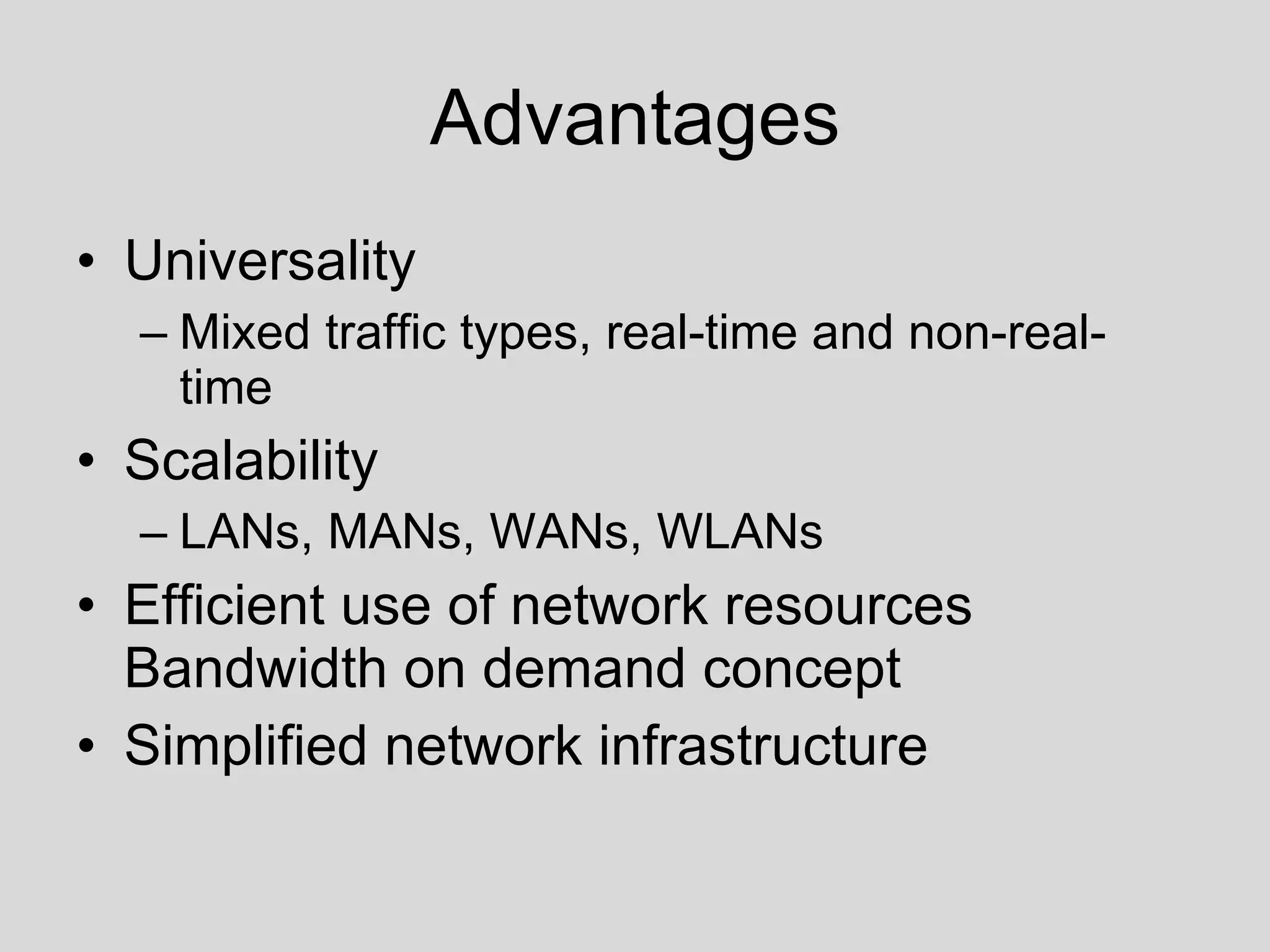
Advantages Universality Mixed traffic types, real-time and non-real-time Scalability LANs, MANs, WANs, WLANs Efficient use of network resources Bandwidth on demand concept Simplified network infrastructure
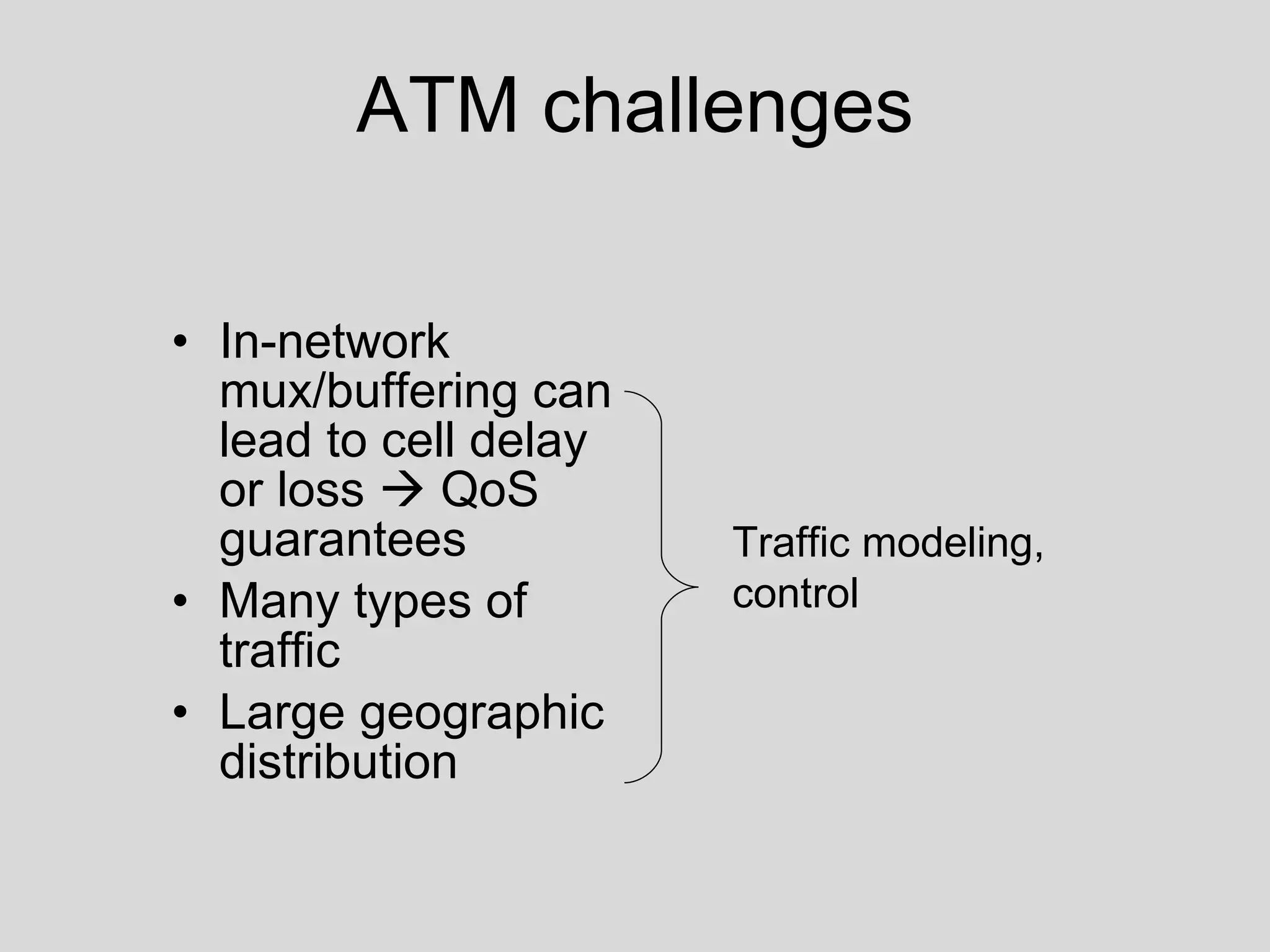
ATM challenges In-network mux/buffering can lead to cell delay or loss    QoS guarantees Many types of traffic Large geographic distribution Traffic modeling, control
THANKING YOU! Agreeta Sharma M.Sc  Networking  Management’12 Amity University

Asynchronous Transfer Mode (ATM)

  • 1.
    Asynchronous Transfer Mode(ATM) By- Agreeta Sharma A1000810010 AMITY INSTITUTE OF INFORMATION TECHNOLOGY
  • 2.
    Asynchronous Transfer Mode (ATM)is a switching technique for telecommunication networks. It uses asynchronous  time-division multiplexing , [1] [2]  and it encodes data into small, fixed-sized  cells . ATM differs from networks such as the  Internet  or  Ethernet LANs  that use variable sized  packets  or  frames .  ATM provides  data link layer  services that run over  OSI   Layer 1  physical links. ATM has functional similarity with both  circuit  switched networking and small packet switched networking. This makes it a good choice for a network that must handle both traditional high-speed data traffic (e.g., file transfers), and  real-time ,  low-latency  content such as voice and video . Asynchronous Transfer Mode
  • 3.
    ATM ATM standard (defined by CCITT) is widely accepted by common carriers as mode of operation for communication – particularly BISDN. ATM is a form of cell switching using small fixed-sized packets. Header Payload 5 Bytes 48 Bytes Figure 9.1 Basic ATM Cell Format Leon-Garcia & Widjaja: Communication Networks Copyright ©2000 The McGraw Hill Companies
  • 4.
    Asynchronous Transfer Mode isa set of  protocols  used for  computer networks . It is mostly used for  Wide Area Networks . It splits the data, and encodes it into packets of a fixed size. Each packet can be routed differently, along virtual paths set up in the network. ATM has been very successful in WANs, as well as in  LANs . Today, many  ADSL  implementations use ATM technology.
  • 5.
  • 6.
      permanent virtual circuit , a  virtual circuit  that is permanently available. The only difference between a PVC and a  switched virtual circuit (SVC)  is that an SVC must be reestablished each time data is to be sent. Once the data has been sent, the SVC disappears. PVCs are more efficient for connections between  hosts  that communicate frequently switched virtual circuit ,  a temporary  virtual circuit  that is set up and used only as long as data is being transmitted. Once the communication between the two  hosts  is complete, the SVC disappears. In contrast, a permanent virtual circuit (PVC)  remains available at all times.
  • 7.
  • 8.
    ATM Virtual Connections Physical Link Virtual Paths Virtual Channels Leon-Garcia & Widjaja: Communication Networks Copyright ©2000 The McGraw Hill Companies
  • 9.
    ATM is morecomplex, but this complexity allows to give guarantees as to  data rate , maximum delay, and  jitter . These are usually called  Quality of Service .   Quality of Service  or QoS is a method of providing better service for selected traffic types over various types of packet-switched networks.
  • 10.
    Advantages Universality Mixedtraffic types, real-time and non-real-time Scalability LANs, MANs, WANs, WLANs Efficient use of network resources Bandwidth on demand concept Simplified network infrastructure
  • 11.
    ATM challenges In-networkmux/buffering can lead to cell delay or loss  QoS guarantees Many types of traffic Large geographic distribution Traffic modeling, control
  • 12.
    THANKING YOU! AgreetaSharma M.Sc Networking Management’12 Amity University