By :
Ashutosh Buxi
Reg. No.: 0305203031
e-mail: a_buxi@mail.com
Has everyone noticed that all letters of the
word database are typed with left hand?
Now the layout of the QWERTY
typewriter keyboard was designed, among
other things, to facilitate the even use of
both hands. It follows, therefore, that
writing about databases is not only
unnatural, but a lot harder than it appears.
 Tight control of data redundancy.
 Enforces user-defined rules to ensure the integrity
of table data.
 Has a centralized data dictionary for the storage
of information pertaining to data and its
manipulation.
 Ensures that the data can be shared across
applications.
 Enforces data access authorization.
 Has automatic, intelligent backup and recovery
procedure for data.
 Have different interfaces via which users can
manipulate data.
Data redundancy and inconsistency
Difficulty in accessing data
Data isolation
Integrity problems
Atomicity problems
Concurrent-access anomalies
Security problems
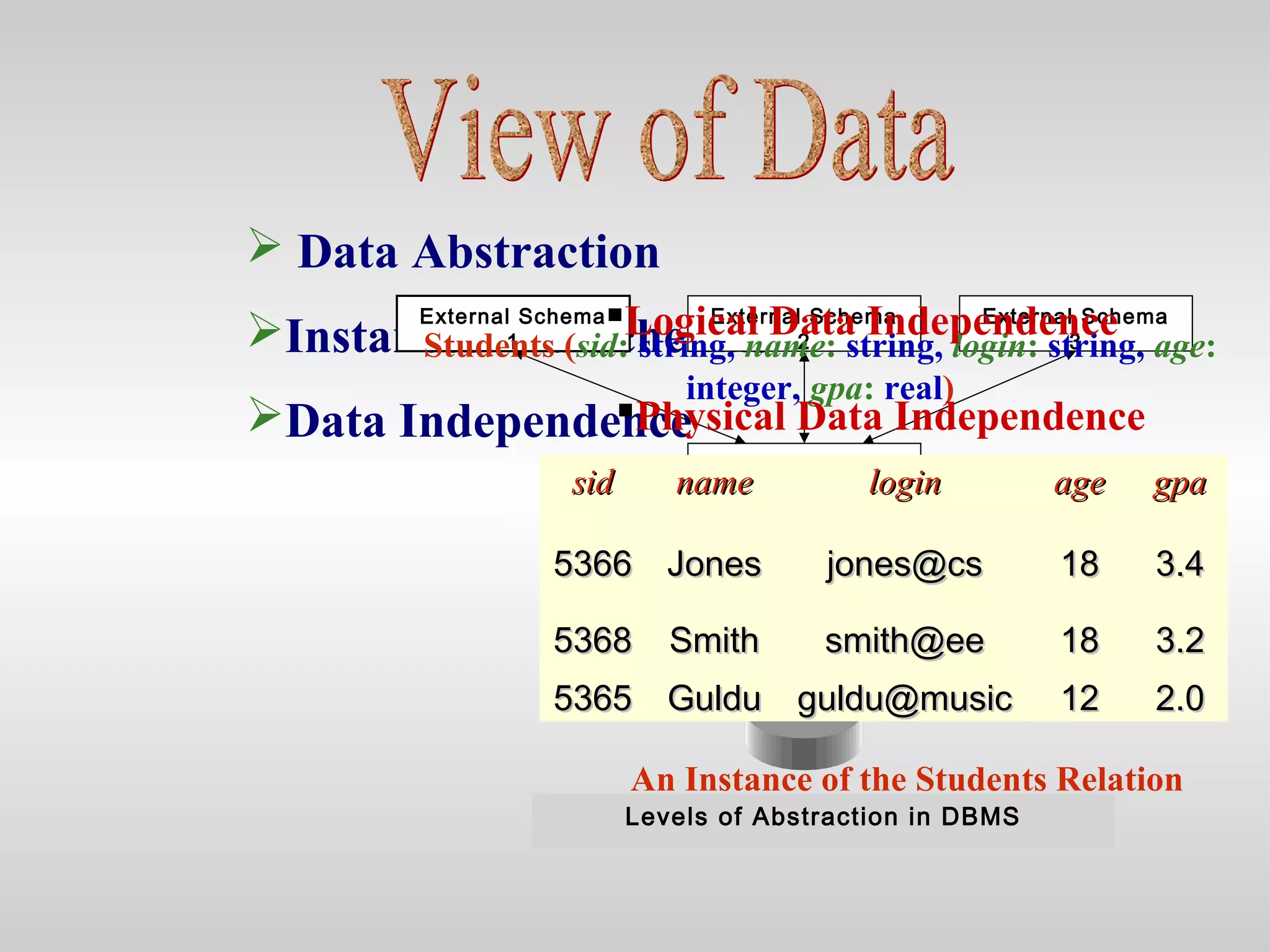
 Data Abstraction
Instances and Schemas
Data Independence
External Schema
1
External Schema
2
External Schema
3
Conceptual Schema
Physical Schema
Disk
Levels of Abstraction in DBMS
sidsid namename loginlogin ageage gpagpa
53665366 JonesJones jones@csjones@cs 1818 3.43.4
53685368 SmithSmith smith@eesmith@ee 1818 3.23.2
53655365 GulduGuldu guldu@musicguldu@music 1212 2.02.0
Students (sid: string, name: string, login: string, age:
integer, gpa: real)
An Instance of the Students Relation
Logical Data Independence
Physical Data Independence
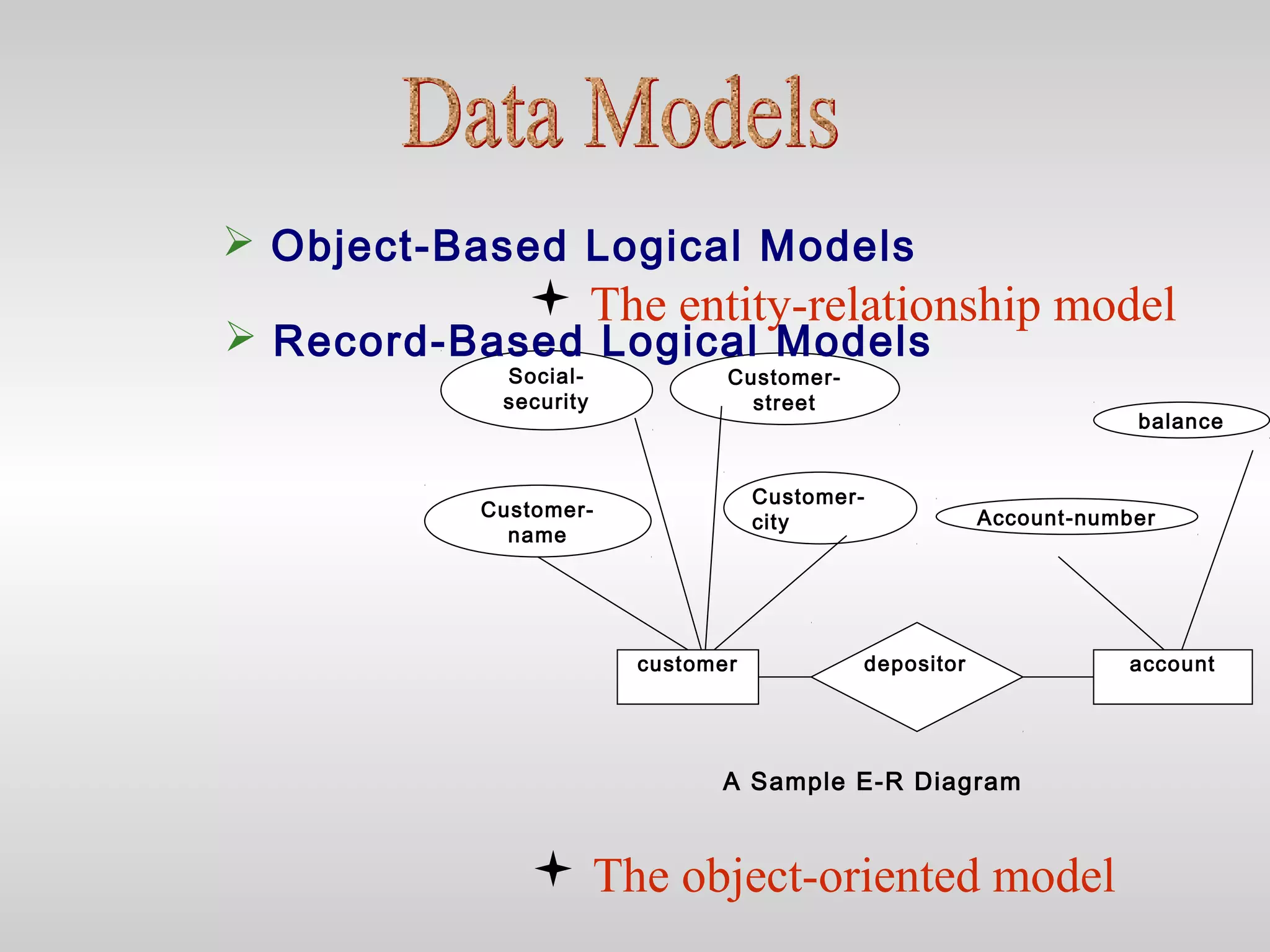
 Object-Based Logical Models
Social-
security
Customer-
name
Customer-
street
Customer-
city Account-number
balance
customer accountdepositor
A Sample E-R Diagram
 Record-Based Logical Models
 The entity-relationship model
 The object-oriented model
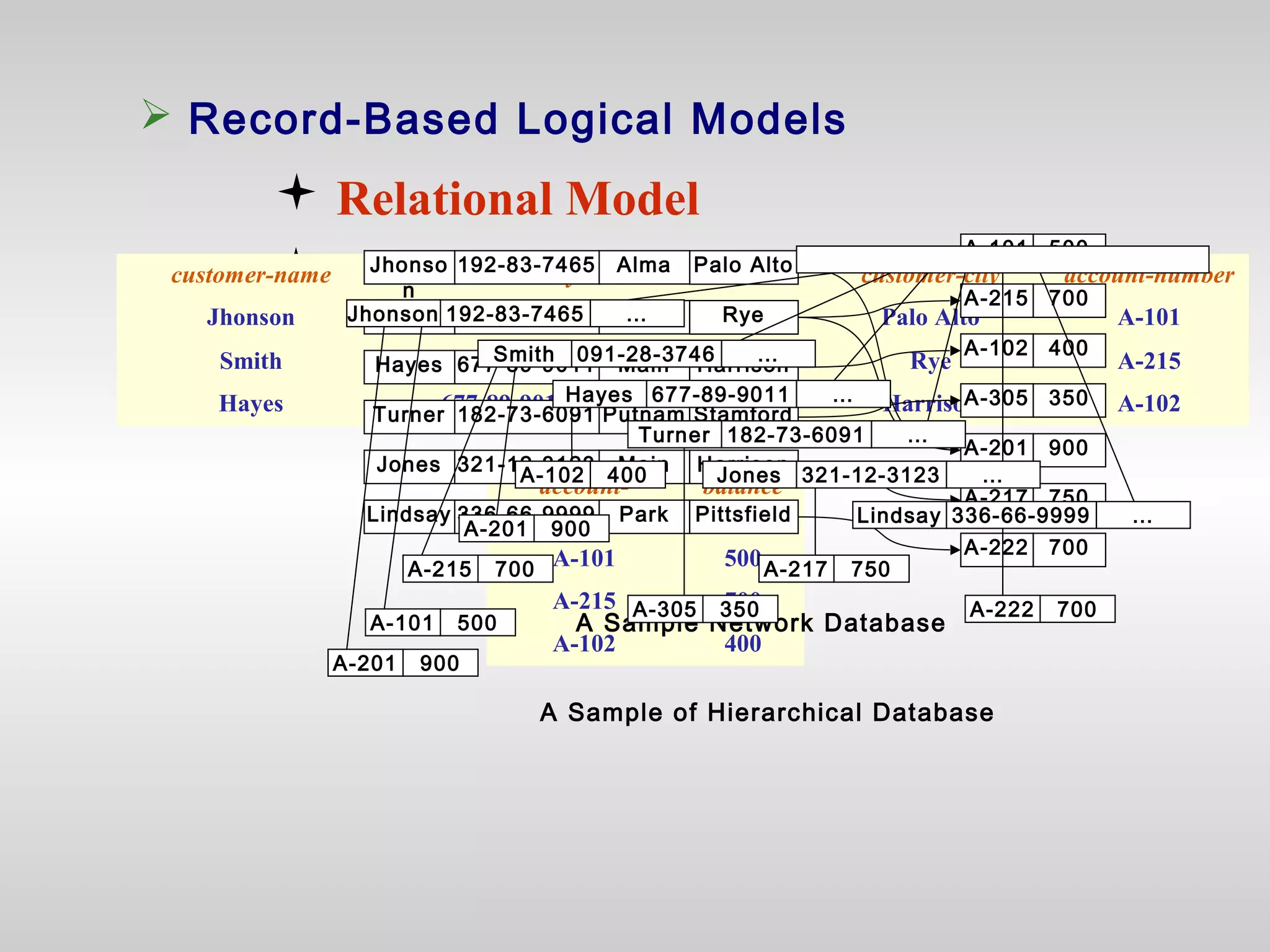
 Relational Model
 Network Model
 Hierarchical Model
 Record-Based Logical Models
customer-name social-security customer-street customer-city account-number
Jhonson 912-83-7465 Alma Palo Alto A-101
Smith 019-28-3746 North Rye A-215
Hayes 677-89-9011 Main Harrison A-102
account-
number
balance
A-101 500
A-215 700
A-102 400
Jhonso
n
192-83-7465 Palo AltoAlma
Smith
Hayes
Lindsay
Turner
Jones
091-28-3746
677-89-9011
182-73-6091
321-12-3123
336-66-9999
North
Main
Putnam
Main
Park
Rye
Harrison
Stamford
Harrison
Pittsfield
A-101
A-222
A-215
A-102
A-305
A-201
A-217
500
700
400
350
900
750
700
A Sample Network Database
Jhonson 192-83-7465 …
Smith
Hayes
Lindsay
Turner
Jones
091-28-3746
677-89-9011
182-73-6091
321-12-3123
336-66-9999
…
…
…
…
…
A-101
A-222
A-215
A-102
A-305
A-201
A-217
500
700
400
350
900
750
700
A-201 900
A Sample of Hierarchical Database
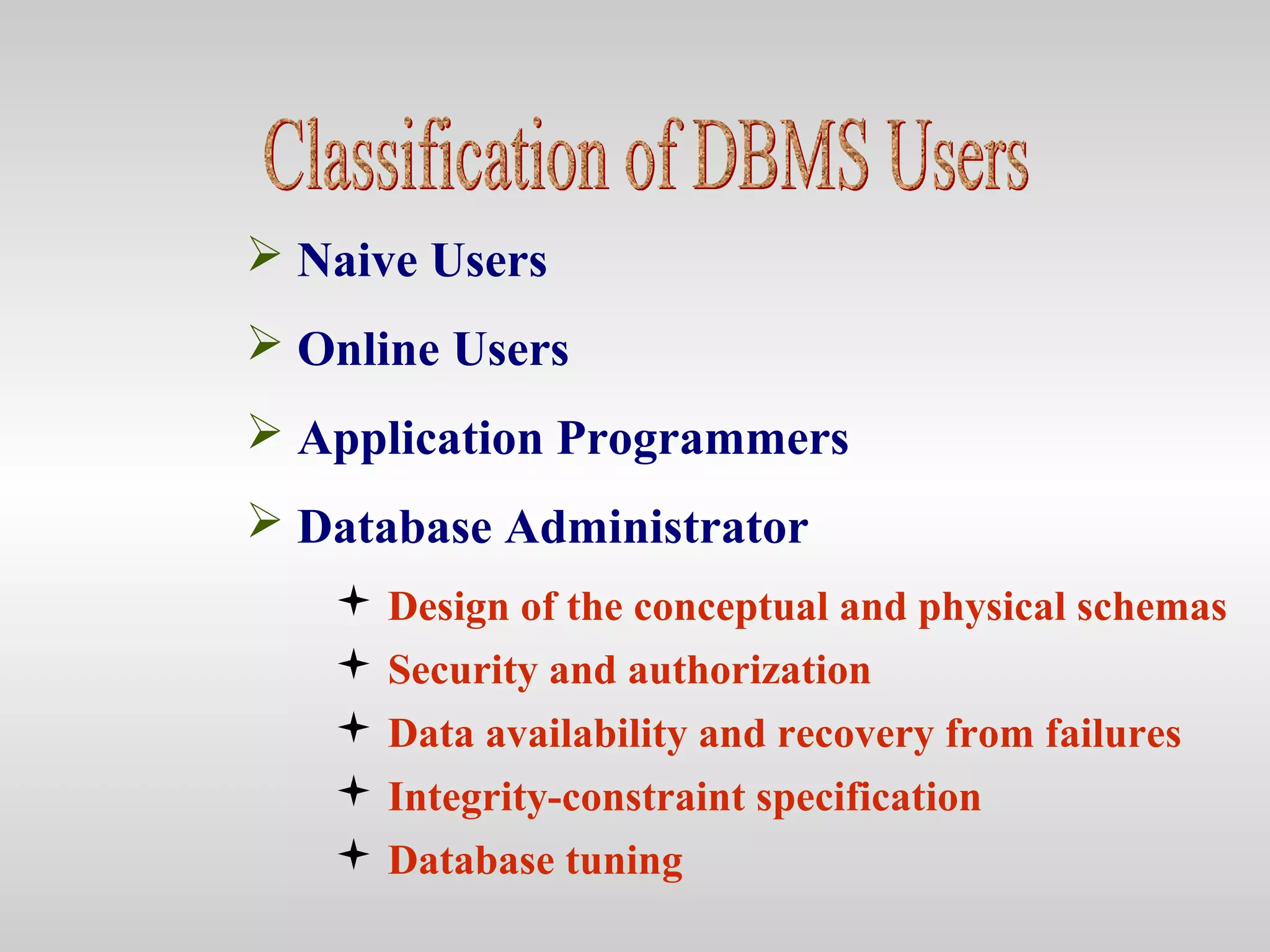
 Naive Users
 Online Users
 Application Programmers
 Database Administrator
 Design of the conceptual and physical schemas
 Security and authorization
 Data availability and recovery from failures
 Integrity-constraint specification
 Database tuning
 Data Definition Language
 Data Manipulation Language
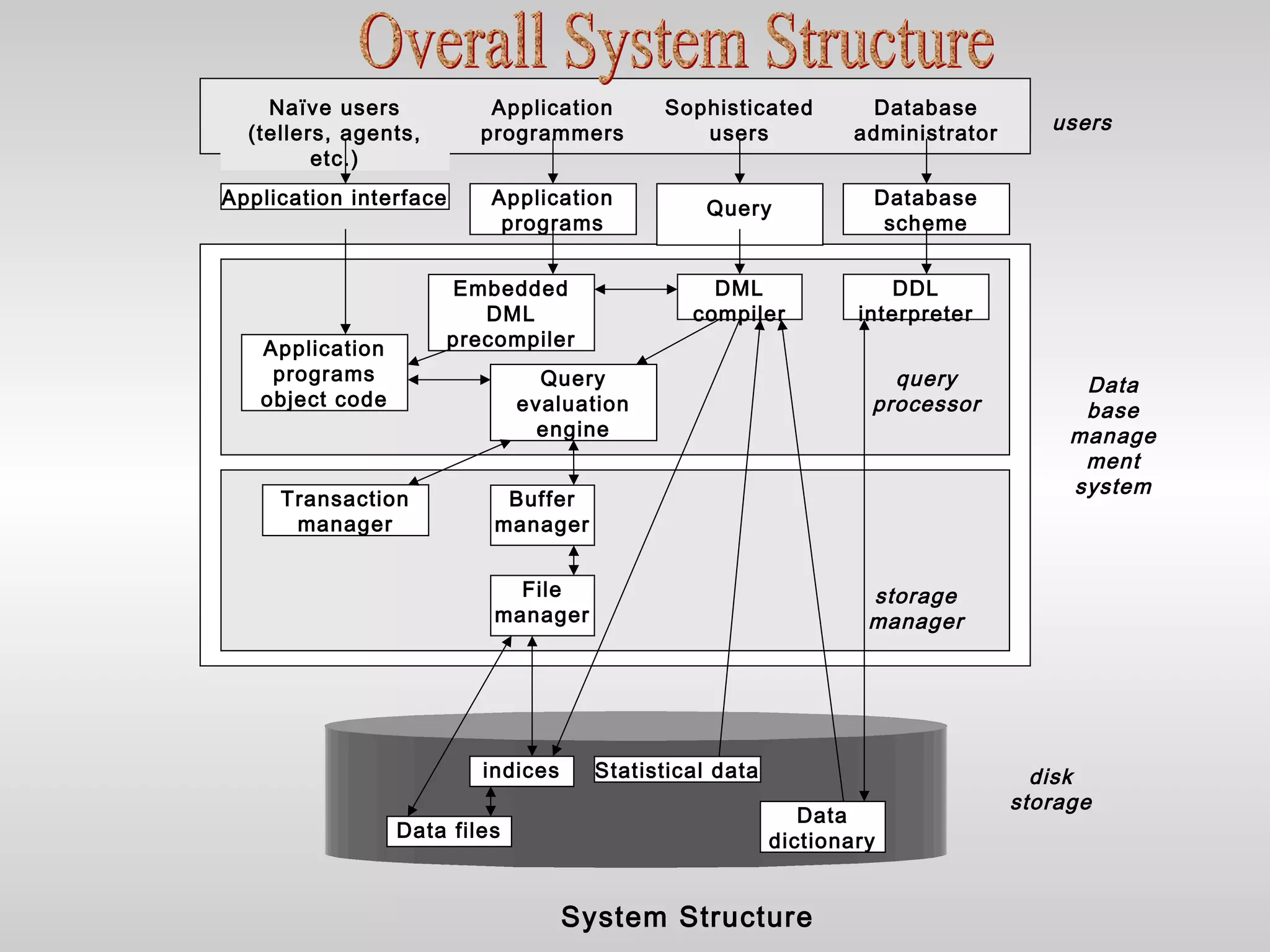
Naïve users
(tellers, agents,
etc.)
Application
programmers
Sophisticated
users
Database
administrator
Application interface Application
programs
Query
Database
scheme
indices Statistical data
Data
dictionaryData files
Application
programs
object code
Embedded
DML
precompiler
Query
evaluation
engine
DML
compiler
DDL
interpreter
Transaction
manager
Buffer
manager
File
manager
users
disk
storage
Data
base
manage
ment
system
query
processor
storage
manager
System Structure
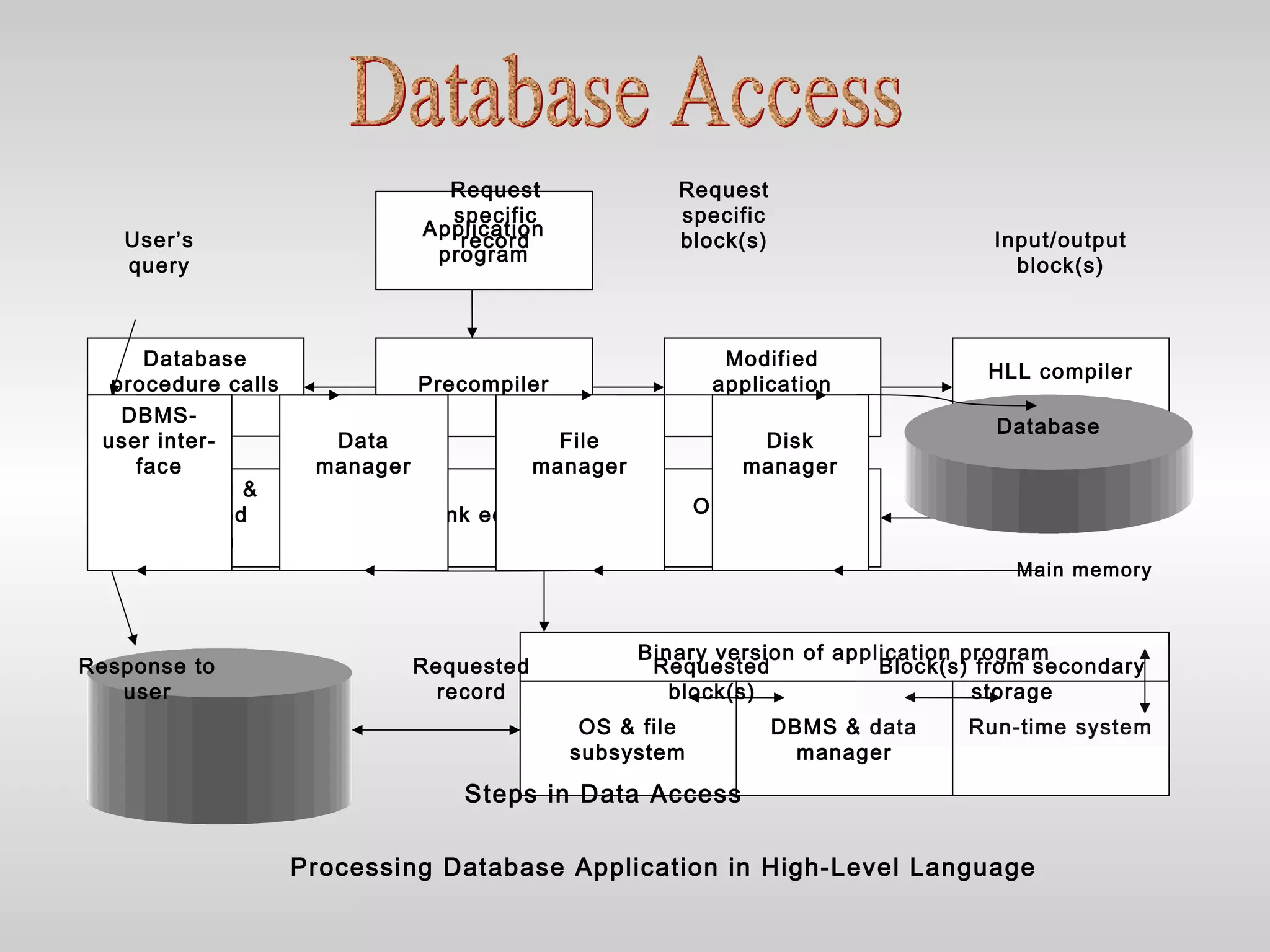
Database
procedure calls Precompiler
Modified
application
program
HLL compiler
Application
program
Compiled &
optimized
version
Link editor Object module
Binary version of application program
OS & file
subsystem
DBMS & data
manager
Run-time system
Main memory
Processing Database Application in High-Level Language
Database
DBMS-
user inter-
face
Data
manager
File
manager
Disk
manager
Response to
user
Requested
record
Requested
block(s)
Block(s) from secondary
storage
User’s
query
Request
specific
record
Request
specific
block(s) Input/output
block(s)
Steps in Data Access
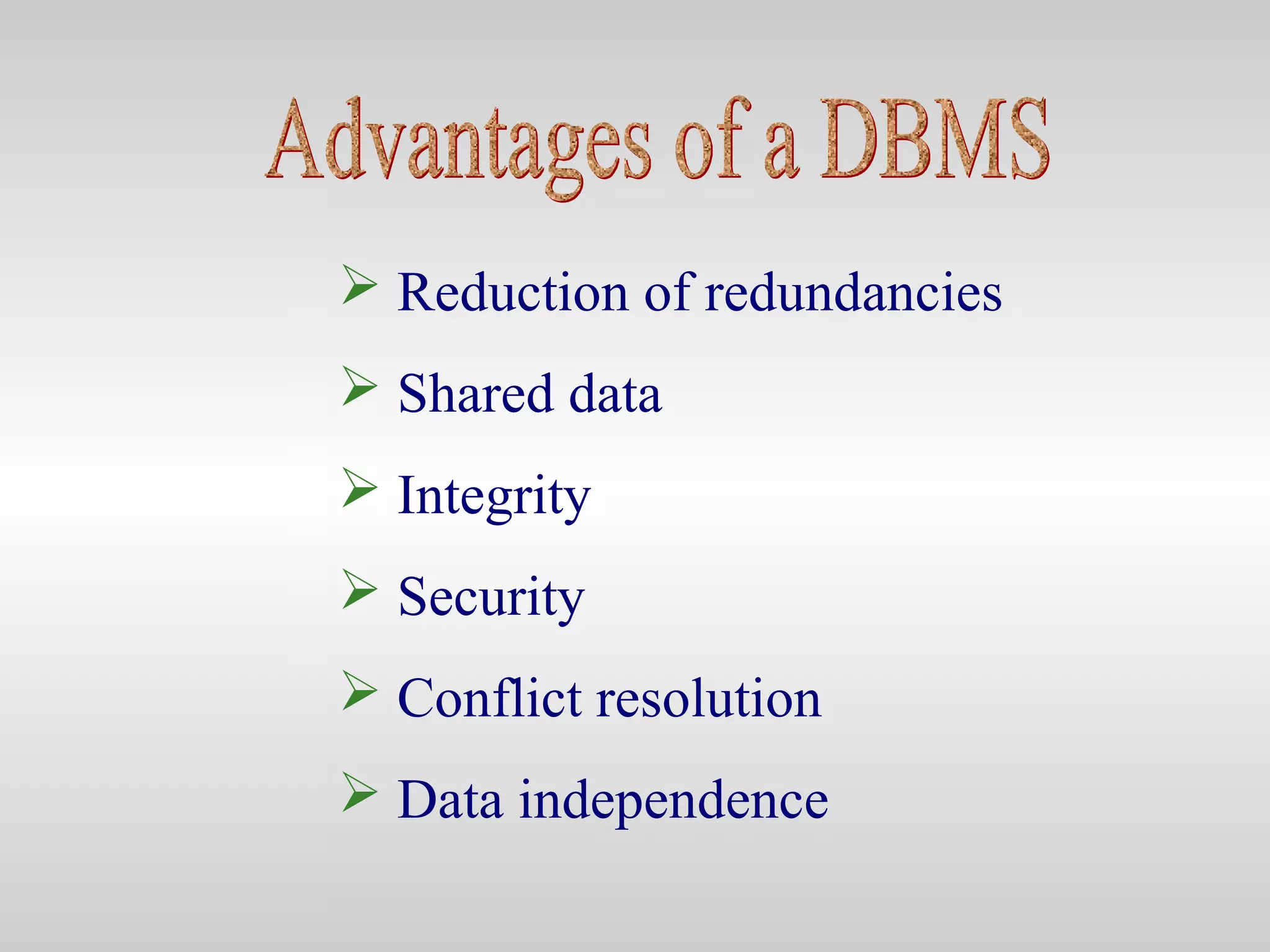
 Reduction of redundancies
 Shared data
 Integrity
 Security
 Conflict resolution
 Data independence
 Problems associated with centralization
 Cost of software/hardware and migration
 Complexity of backup and recovery
Database system

Database system

  • 1.
    By : Ashutosh Buxi Reg.No.: 0305203031 e-mail: a_buxi@mail.com
  • 2.
    Has everyone noticedthat all letters of the word database are typed with left hand? Now the layout of the QWERTY typewriter keyboard was designed, among other things, to facilitate the even use of both hands. It follows, therefore, that writing about databases is not only unnatural, but a lot harder than it appears.
  • 4.
     Tight controlof data redundancy.  Enforces user-defined rules to ensure the integrity of table data.  Has a centralized data dictionary for the storage of information pertaining to data and its manipulation.  Ensures that the data can be shared across applications.  Enforces data access authorization.  Has automatic, intelligent backup and recovery procedure for data.  Have different interfaces via which users can manipulate data.
  • 5.
    Data redundancy andinconsistency Difficulty in accessing data Data isolation Integrity problems Atomicity problems Concurrent-access anomalies Security problems
  • 6.
     Data Abstraction Instancesand Schemas Data Independence External Schema 1 External Schema 2 External Schema 3 Conceptual Schema Physical Schema Disk Levels of Abstraction in DBMS sidsid namename loginlogin ageage gpagpa 53665366 JonesJones jones@csjones@cs 1818 3.43.4 53685368 SmithSmith smith@eesmith@ee 1818 3.23.2 53655365 GulduGuldu guldu@musicguldu@music 1212 2.02.0 Students (sid: string, name: string, login: string, age: integer, gpa: real) An Instance of the Students Relation Logical Data Independence Physical Data Independence
  • 7.
     Object-Based LogicalModels Social- security Customer- name Customer- street Customer- city Account-number balance customer accountdepositor A Sample E-R Diagram  Record-Based Logical Models  The entity-relationship model  The object-oriented model
  • 8.
     Relational Model Network Model  Hierarchical Model  Record-Based Logical Models customer-name social-security customer-street customer-city account-number Jhonson 912-83-7465 Alma Palo Alto A-101 Smith 019-28-3746 North Rye A-215 Hayes 677-89-9011 Main Harrison A-102 account- number balance A-101 500 A-215 700 A-102 400 Jhonso n 192-83-7465 Palo AltoAlma Smith Hayes Lindsay Turner Jones 091-28-3746 677-89-9011 182-73-6091 321-12-3123 336-66-9999 North Main Putnam Main Park Rye Harrison Stamford Harrison Pittsfield A-101 A-222 A-215 A-102 A-305 A-201 A-217 500 700 400 350 900 750 700 A Sample Network Database Jhonson 192-83-7465 … Smith Hayes Lindsay Turner Jones 091-28-3746 677-89-9011 182-73-6091 321-12-3123 336-66-9999 … … … … … A-101 A-222 A-215 A-102 A-305 A-201 A-217 500 700 400 350 900 750 700 A-201 900 A Sample of Hierarchical Database
  • 9.
     Naive Users Online Users  Application Programmers  Database Administrator  Design of the conceptual and physical schemas  Security and authorization  Data availability and recovery from failures  Integrity-constraint specification  Database tuning
  • 10.
     Data DefinitionLanguage  Data Manipulation Language
  • 11.
    Naïve users (tellers, agents, etc.) Application programmers Sophisticated users Database administrator Applicationinterface Application programs Query Database scheme indices Statistical data Data dictionaryData files Application programs object code Embedded DML precompiler Query evaluation engine DML compiler DDL interpreter Transaction manager Buffer manager File manager users disk storage Data base manage ment system query processor storage manager System Structure
  • 12.
    Database procedure calls Precompiler Modified application program HLLcompiler Application program Compiled & optimized version Link editor Object module Binary version of application program OS & file subsystem DBMS & data manager Run-time system Main memory Processing Database Application in High-Level Language Database DBMS- user inter- face Data manager File manager Disk manager Response to user Requested record Requested block(s) Block(s) from secondary storage User’s query Request specific record Request specific block(s) Input/output block(s) Steps in Data Access
  • 13.
     Reduction ofredundancies  Shared data  Integrity  Security  Conflict resolution  Data independence
  • 14.
     Problems associatedwith centralization  Cost of software/hardware and migration  Complexity of backup and recovery

Editor's Notes