Impact Factor (JCC): 1.1947- This article can be downloaded from www.bestjournals.in
ASSERTIVE COMMUNICATION
V. HEMAVATHY1
& S. SARADHA DEVI2
1
Principal, Sree Balaji College of Nursing, Bharath University, India
2
Assistant Professor, Sree Balaji College of Nursing, Bharath University, India
ABSTRACT
Communication is a dynamic, two-way circular process in which all types of information are stared between two
or more people and their environment. Communication is the most powerful tool a psychiatric nurse can have. It is the
basic component of therapeutic nurse-client relationship and the medium through which nursing process occurs. Nurse
assumes many roles during therapeutic communication with clients, such as the professional role and model role.
KEYWORDS: Assertive Communication Psychiatric Nurse, Professional Role and Model Role, Therapeutic
Nurse-client Relationship and the Medium Through which Nursing Process Occurs
INTRODUCTION
Assertiveness
It includes expressing one’s feelings, needs and ideas and standing up for one’s rights, while considering the
rights of others.
Aggressiveness
Aggressiveness can be described as expressing one’s feelings, needs and expense of another person. Assertiveness
behaviours is reactionary and impulsive behaviour that often results in breaking households rules or the law. Aggressive
behaiour is violent and unpredictable (Baylon). Aggression behaviour can be either physical or verbal behavior that
accidently causes harm or pain is not aggression. Property damage and other destructive behaviour may fall under the
definition of aggression (Steadman).
Passiveness
Passiveness can be described as lack of expressing proper feelings and needs of another person. Passive behaviour
is apparently compliant behaviour, with instrinsic obstructive or stubborn qualities, to cover deeply felt aggressive feelings
that cannot be more directly expressed (Steadman).
Assertive Communication
Assertive communication is the straightforward and open expression of one’s needs, desires, thoughts and
feelings. It is the ability to express positive and negative ideas and feelings in an open, honest and direct way. It recognizes
our rights whilst still respecting the rights of others. It allows us to take responsibility for ourselves and out actions without
judging or blaming other people. It allows us to constructively confront and find a mutually satisfying solution where
conflict exists.
BEST: International Journal of Humanities, Arts,
Medicine and Sciences (BEST: IJHAMS)
ISSN (P): 2348-0521, ISSN (E): 2454-4728
Vol. 4, Issue 1, Jan 2016, 119-126
© BEST Journals
120 V. Hemavathy & S. Saradha Devi
Index Copernicus Value: 3.0 – Articles can be sent to editor.bestjournals@gmail.com
Assertiveness
Assertiveness can be viewed on as a continuum. A leader’s behaviour may be classified as non-assertive, assertive
or aggressive. An important aspect of assertiveness is maintenance of both one’s own integrity and the integrity of the
other person. Assertive persons establish close relationships, protect themselves from being used by others, make their own
life decisions and choices, identify and meet many of their own life decisions and choices, identify and meet many of their
interpersonal needs and express positive and negative feelings both verbally and non-verbally. Assertive persons generally
feel good about themselves and others.
Non-Assertiveness
Non-assertiveness can be described as denying one’s own feelings, needs and ideas, ignoring one’s own rights or
permitting others to infringe on one’s rights. Non-assertive persons to put themselves down and let others make choices
and decisions for them. People who are non-assertive usually behave in this way to avoid conflict, however, they usually
end up being angry – with others and with themselves.
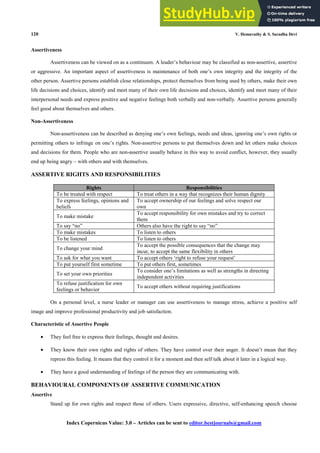
ASSERTIVE RIGHTS AND RESPONSIBILITIES
Rights Responsibilities
To be treated with respect To treat others in a way that recognizes their human dignity
To express feelings, opinions and
beliefs
To accept ownership of our feelings and solve respect our
own
To make mistake
To accept responsibility for own mistakes and try to correct
them
To say “no” Others also have the right to say “no”
To make mistakes To listen to others
To be listened To listen to others
To change your mind
To accept the possible consequences that the change may
incur, to accept the same flexibility in others
To ask for what you want To accept others ‘right to refuse your request’
To put yourself first sometime To put others first, sometimes
To set your own priorities
To consider one’s limitations as well as strengths in directing
independent activities
To refuse justification for own
feelings or behavior
To accept others without requiring justifications
On a personal level, a nurse leader or manager can use assertiveness to manage stress, achieve a positive self
image and improve professional productivity and job satisfaction.
Characteristic of Assertive People
• They feel free to express their feelings, thought and desires.
• They know their own rights and rights of others. They have control over their anger. It doesn’t mean that they
repress this feeling. It means that they control it for a moment and then self talk about it later in a logical way.
• They have a good understanding of feelings of the person they are communicating with.
BEHAVIOURAL COMPONENTS OF ASSERTIVE COMMUNICATION
Assertive
Stand up for own rights and respect those of others. Users expressive, directive, self-enhancing speech choose
Assertive Communication 121
Impact Factor (JCC): 1.1947- This article can be downloaded from www.bestjournals.in
appropriate words and actions.
Aggressive
Stands up for own rights but abuse those of others. Speaks in demanding or attacking manner. Fails to monitor or
control words or actions.
Passive
Does not stand up for own rights and accepts the domination and bullying of others. Performs unwanted tasks and
feels victimized.
Example of Assertive Behavior
“I” messages (eg: I need, I feel, I will). Eye contact (eg: looking directly into the eyes of the person while making
or refusing a request).
Congruent verbal and facial expressions (eg: making of the spoken message): a serious massage accompanied by
laughter could negate the credibility of the message.
Characteristics of Assertive Communication
There are six main characteristics of assertive communication.
A useful pneumonic to teach assertive communication skills is the word “SOFTEN”
S – Smile
O – Open posture
F – Forward Lean
T – Touch
E – Eye contact
N – Nod
Smile
The significant of a smile can be emphasized by suggesting that just as group members feel fragile in social
interactions so too, but to a lesser and more manageable extent, do remember of the general public. Consequently all
people are seeking approval in interactions. The most common and useful vehicle for conveying approval is a smile or nod.
Those who rarely smile or give others positive feedback by nodding are likely to be avoided.
Open Posture
To illustrate the role of posture, the co-leader adopts three postures in turn while the therapist talks to him/her.
• Head down, shoulders dropped
• Sitting back with arms folded
• Leaning forward, making eye contact but pulling each finger in turn.
122 V. Hemavathy & S. Saradha Devi
Index Copernicus Value: 3.0 – Articles can be sent to editor.bestjournals@gmail.com
The group is then asked message the co-leader was sending out at each of the three stages. The correct responses
are obviously depression/sadness, aloofness and anxiety. Group members are then asked their likely response to each of the
three signals. Typically the response these signals evoke is withdrawn.
Touch
Touching and moving closer to someone are powerful vehicle for signaling increasing intimacy. However to use
such strategies if there is any doubt about the recipients positive regard is likely to have precisely the opposite effect to the
one intended. Moving closer than three effect is usually taken to a signal a close personal relationship. To move within
three feet of a relative stranger or someone with whom there is a formal relationship may be resented as an invasion of
personal space. At the other extreme, moving beyond six feet usually effectively sabotages.
PERSONAL DISCUSSIONS
Forward Lean
A forward lean in discussion when seated is usually taken by the recipient as indicating a particular interest in
what is being said:
E – Eye Contact
Failure to make adequate eye contact is usually the social skill deficit that people notice most readily in the
socially unskilled. As a general rule the socially skilled person might make eye contact about 90 percent of the time when
speaking and 60 percent of the time when listening. Many socially anxious clients seen unaware in others, yet an
appreciation of this is often a precondition for rectifying the deficit. This lack of awareness reflect the socially anxious
clients pre occupational with their own internal dialogue.
Voice
A level, well modulated tone is more convincing and acceptable and is not intimidating.
Five ways of Assertive Communication
There are five ways for the nurse to act assertively:
Basic Assertion
It is a simple statement of one’s feelings, needs ideas. For this, no special communications skills are necessary.
Basic assertion could be a simple “yes” or “no”. in response to a request from a patient, the nurse could say. “I will
consider your request and let you know tomorrow”.
Empathetic Assertion
It is the second type of assertive behavior. When using empathetic assertion, the leader first gives recognition to
the other persons feelings or situation and then makes a statement about his or her own position. A nurse might say to the
patient, when they have not quite completed a task but their work time is over. “I know you would really like to finish this
today, but we cannot afford to give you over time pay, so you will have to stop. We can finish it tomorrow.
Escalating Assertion
The third type of assertive behavior is escalating assertion. Escalating is used when the other person fails to
Assertive Communication 123
Impact Factor (JCC): 1.1947- This article can be downloaded from www.bestjournals.in
respond. It involves making successive assertive statements that gradually become more and more firm. The sentence may
also become shorter and more blunt.
An example for basic assertion, an empathetic assertion and basic assertion.
Patient: I need someone to help me fix the work schedule for this week end
Nurse: would you please get someone else to help you? I need to finish my requirements.
Patient: everybody else is busy
Nurse: I know you need help, but I can’t do it right now
Patient: come on we can do it fast together
Nurse: no, ask someone else.
When using escalating assertion, it must be remembered that end point must come.
Confrontive Assertion
The fourth type of assertiveness is confrontive association. When a person’s words contradictions his or her
actions, confrontive assertion may be used. The nurse describes objectively what the other person agreed to do, what
actually was alone and then what the nurse wants.
For example
You told me that you would have that audit done on Friday. It is now Monday, and its not done. I expect you to
have it completed before you leave tomorrow.
Language Assertion
Language assertion is the fifth type of assertive behavior. The nurse makes a four part statement that includes,
when you do, the effect on me are, I feel, I would prefer.
The purpose of this type of assertion is for the person to state his or her own feelings and expectations. It is often
used when the leader feels hurt or irritated; if a member of the group consistently comes late to staff meetings.
It is not always necessary or appropriate to use the “I feel” and “I would prefer” pats of the assertion. When they
are not used, this is similar to a basic situation, which may lead to the other person identifying a solution to the problem or
to both persons solving problems together.
Techniques of Assertive Communication
There are six technique of assertive communication.
Behavior Reherseal
Which is literally practicing how you want to look and sound. It is a very useful technique when you first want to
use”
I, statement as it helps dissipate any emotion associated with an experience and allows you to accurately identify
the behavior you wish to confront.
124 V. Hemavathy & S. Saradha Devi
Index Copernicus Value: 3.0 – Articles can be sent to editor.bestjournals@gmail.com
Repeated Assertion
This technique allows you to feel comfortable by ignoring manipulative verbal side traps, argumentative waiting
and irrelevant logic while sticking to your point. To must effectively use this technique use calm repetition, and say what
you want and stay focused on the issue. We will find that there is no need to rehearse this technique and no need to “hype
yourself up” to deal with others.
Example
“I would like to show you of our products”
“no thank you, I’m not interested”
“I really have a great range to offer you”
“That may be true, but I’m not interested at the moment”
“Is there someone else here who would be interested?”
Fogging
This technique allows you to receive criticism comfortably, without getting anxious or defensive, agree that there
may be some truth to what they say, but remain the judge of your choice of action. An example of this could be,”I agree
that there are probably times when, don’t give you answers to your questions”.
Negative Enquiry
This technique seeks out criticism about yourself in close relationships by prompting the expression of honest,
negative feelings to improve communication. To use if effectively you need to listen for clinical comments, clarify your
under standing of those criticisms, use the information if it will be helpful or ignore the information if it is manipulative.
An example of this technique would be, “so you think believe that I am not interested?”.
Negative Assertion
This technique lets you look more comfortably at negative in your own behavior or personality without feeling
defense or anxious, this also reuses your critics positively. You should accept your errors or faults, but should not
apologise. Instead, tentatively and sympathetically agree with hostile criticism of your negative qualities. An example
would be, “Yes, You are right. I don’t always listen closely to what you have to say”.
Workable Compromise
When you feel that your self-respect is not in question, consider a workable compromise with the other person.
We can always bargain for your material goals unless the compromise affects your personal feelings of self – respect.
There can be no compromise. An example of this technique would be, “ I understand that you have a need to talk and, need
to finish what I’m doing. So what about.
Advantage of Assertive Communication
• It helps us feel good about ourselves and others
• It lead to the development of mutual respect with others
Assertive Communication 125
Impact Factor (JCC): 1.1947- This article can be downloaded from www.bestjournals.in
• It increase our self-esteem
• It helps us achieve our goals
• It minimize hurting and alleviating other people
• It protects us from being taken advantage of by other
• It enables us to make decisions and free choice of life
• It enables us to express both verbally and non verbally
REFERENCES
1. Gail W. Staurt, (2007) “Principles and practice of psychiatric Nursing”, Elsevier’s company, Mosby, 9th
edition,
P. No: 580 – 582.
2. Katherine M. Fortinash, “Psychiatric Mental Health Nursing”, Elsevier’s company, Mosby, third Edition, P. NO:
124 – 126.
3. Stuart and Sundeen, “Principles and Practice of psychiatric Nursing”, Elseviers Company, Lippincott, Sixth
edition, P. No: 213 – 218.
4. Rawbins, “Mental health-psychiatric Nursing”(A Holistic Life Cycle Approach),Mosby Publications, third
edition, P.No: 117 – 118.
5. Dr. Mike Scott, “A cognitive approach to clients problems”, Billing and sons’ Ltd, Second edition, P. No: 141 -
148.
6. Linda Anne Bernhard, “Leadership” Jaypee brothers and publications, P. No: 19 – 20.
ASSERTIVE COMMUNICATION

ASSERTIVE COMMUNICATION

  • 1.
    Impact Factor (JCC):1.1947- This article can be downloaded from www.bestjournals.in ASSERTIVE COMMUNICATION V. HEMAVATHY1 & S. SARADHA DEVI2 1 Principal, Sree Balaji College of Nursing, Bharath University, India 2 Assistant Professor, Sree Balaji College of Nursing, Bharath University, India ABSTRACT Communication is a dynamic, two-way circular process in which all types of information are stared between two or more people and their environment. Communication is the most powerful tool a psychiatric nurse can have. It is the basic component of therapeutic nurse-client relationship and the medium through which nursing process occurs. Nurse assumes many roles during therapeutic communication with clients, such as the professional role and model role. KEYWORDS: Assertive Communication Psychiatric Nurse, Professional Role and Model Role, Therapeutic Nurse-client Relationship and the Medium Through which Nursing Process Occurs INTRODUCTION Assertiveness It includes expressing one’s feelings, needs and ideas and standing up for one’s rights, while considering the rights of others. Aggressiveness Aggressiveness can be described as expressing one’s feelings, needs and expense of another person. Assertiveness behaviours is reactionary and impulsive behaviour that often results in breaking households rules or the law. Aggressive behaiour is violent and unpredictable (Baylon). Aggression behaviour can be either physical or verbal behavior that accidently causes harm or pain is not aggression. Property damage and other destructive behaviour may fall under the definition of aggression (Steadman). Passiveness Passiveness can be described as lack of expressing proper feelings and needs of another person. Passive behaviour is apparently compliant behaviour, with instrinsic obstructive or stubborn qualities, to cover deeply felt aggressive feelings that cannot be more directly expressed (Steadman). Assertive Communication Assertive communication is the straightforward and open expression of one’s needs, desires, thoughts and feelings. It is the ability to express positive and negative ideas and feelings in an open, honest and direct way. It recognizes our rights whilst still respecting the rights of others. It allows us to take responsibility for ourselves and out actions without judging or blaming other people. It allows us to constructively confront and find a mutually satisfying solution where conflict exists. BEST: International Journal of Humanities, Arts, Medicine and Sciences (BEST: IJHAMS) ISSN (P): 2348-0521, ISSN (E): 2454-4728 Vol. 4, Issue 1, Jan 2016, 119-126 © BEST Journals
  • 2.
    120 V. Hemavathy& S. Saradha Devi Index Copernicus Value: 3.0 – Articles can be sent to editor.bestjournals@gmail.com Assertiveness Assertiveness can be viewed on as a continuum. A leader’s behaviour may be classified as non-assertive, assertive or aggressive. An important aspect of assertiveness is maintenance of both one’s own integrity and the integrity of the other person. Assertive persons establish close relationships, protect themselves from being used by others, make their own life decisions and choices, identify and meet many of their own life decisions and choices, identify and meet many of their interpersonal needs and express positive and negative feelings both verbally and non-verbally. Assertive persons generally feel good about themselves and others. Non-Assertiveness Non-assertiveness can be described as denying one’s own feelings, needs and ideas, ignoring one’s own rights or permitting others to infringe on one’s rights. Non-assertive persons to put themselves down and let others make choices and decisions for them. People who are non-assertive usually behave in this way to avoid conflict, however, they usually end up being angry – with others and with themselves. ASSERTIVE RIGHTS AND RESPONSIBILITIES Rights Responsibilities To be treated with respect To treat others in a way that recognizes their human dignity To express feelings, opinions and beliefs To accept ownership of our feelings and solve respect our own To make mistake To accept responsibility for own mistakes and try to correct them To say “no” Others also have the right to say “no” To make mistakes To listen to others To be listened To listen to others To change your mind To accept the possible consequences that the change may incur, to accept the same flexibility in others To ask for what you want To accept others ‘right to refuse your request’ To put yourself first sometime To put others first, sometimes To set your own priorities To consider one’s limitations as well as strengths in directing independent activities To refuse justification for own feelings or behavior To accept others without requiring justifications On a personal level, a nurse leader or manager can use assertiveness to manage stress, achieve a positive self image and improve professional productivity and job satisfaction. Characteristic of Assertive People • They feel free to express their feelings, thought and desires. • They know their own rights and rights of others. They have control over their anger. It doesn’t mean that they repress this feeling. It means that they control it for a moment and then self talk about it later in a logical way. • They have a good understanding of feelings of the person they are communicating with. BEHAVIOURAL COMPONENTS OF ASSERTIVE COMMUNICATION Assertive Stand up for own rights and respect those of others. Users expressive, directive, self-enhancing speech choose
  • 3.
    Assertive Communication 121 ImpactFactor (JCC): 1.1947- This article can be downloaded from www.bestjournals.in appropriate words and actions. Aggressive Stands up for own rights but abuse those of others. Speaks in demanding or attacking manner. Fails to monitor or control words or actions. Passive Does not stand up for own rights and accepts the domination and bullying of others. Performs unwanted tasks and feels victimized. Example of Assertive Behavior “I” messages (eg: I need, I feel, I will). Eye contact (eg: looking directly into the eyes of the person while making or refusing a request). Congruent verbal and facial expressions (eg: making of the spoken message): a serious massage accompanied by laughter could negate the credibility of the message. Characteristics of Assertive Communication There are six main characteristics of assertive communication. A useful pneumonic to teach assertive communication skills is the word “SOFTEN” S – Smile O – Open posture F – Forward Lean T – Touch E – Eye contact N – Nod Smile The significant of a smile can be emphasized by suggesting that just as group members feel fragile in social interactions so too, but to a lesser and more manageable extent, do remember of the general public. Consequently all people are seeking approval in interactions. The most common and useful vehicle for conveying approval is a smile or nod. Those who rarely smile or give others positive feedback by nodding are likely to be avoided. Open Posture To illustrate the role of posture, the co-leader adopts three postures in turn while the therapist talks to him/her. • Head down, shoulders dropped • Sitting back with arms folded • Leaning forward, making eye contact but pulling each finger in turn.
  • 4.
    122 V. Hemavathy& S. Saradha Devi Index Copernicus Value: 3.0 – Articles can be sent to editor.bestjournals@gmail.com The group is then asked message the co-leader was sending out at each of the three stages. The correct responses are obviously depression/sadness, aloofness and anxiety. Group members are then asked their likely response to each of the three signals. Typically the response these signals evoke is withdrawn. Touch Touching and moving closer to someone are powerful vehicle for signaling increasing intimacy. However to use such strategies if there is any doubt about the recipients positive regard is likely to have precisely the opposite effect to the one intended. Moving closer than three effect is usually taken to a signal a close personal relationship. To move within three feet of a relative stranger or someone with whom there is a formal relationship may be resented as an invasion of personal space. At the other extreme, moving beyond six feet usually effectively sabotages. PERSONAL DISCUSSIONS Forward Lean A forward lean in discussion when seated is usually taken by the recipient as indicating a particular interest in what is being said: E – Eye Contact Failure to make adequate eye contact is usually the social skill deficit that people notice most readily in the socially unskilled. As a general rule the socially skilled person might make eye contact about 90 percent of the time when speaking and 60 percent of the time when listening. Many socially anxious clients seen unaware in others, yet an appreciation of this is often a precondition for rectifying the deficit. This lack of awareness reflect the socially anxious clients pre occupational with their own internal dialogue. Voice A level, well modulated tone is more convincing and acceptable and is not intimidating. Five ways of Assertive Communication There are five ways for the nurse to act assertively: Basic Assertion It is a simple statement of one’s feelings, needs ideas. For this, no special communications skills are necessary. Basic assertion could be a simple “yes” or “no”. in response to a request from a patient, the nurse could say. “I will consider your request and let you know tomorrow”. Empathetic Assertion It is the second type of assertive behavior. When using empathetic assertion, the leader first gives recognition to the other persons feelings or situation and then makes a statement about his or her own position. A nurse might say to the patient, when they have not quite completed a task but their work time is over. “I know you would really like to finish this today, but we cannot afford to give you over time pay, so you will have to stop. We can finish it tomorrow. Escalating Assertion The third type of assertive behavior is escalating assertion. Escalating is used when the other person fails to
  • 5.
    Assertive Communication 123 ImpactFactor (JCC): 1.1947- This article can be downloaded from www.bestjournals.in respond. It involves making successive assertive statements that gradually become more and more firm. The sentence may also become shorter and more blunt. An example for basic assertion, an empathetic assertion and basic assertion. Patient: I need someone to help me fix the work schedule for this week end Nurse: would you please get someone else to help you? I need to finish my requirements. Patient: everybody else is busy Nurse: I know you need help, but I can’t do it right now Patient: come on we can do it fast together Nurse: no, ask someone else. When using escalating assertion, it must be remembered that end point must come. Confrontive Assertion The fourth type of assertiveness is confrontive association. When a person’s words contradictions his or her actions, confrontive assertion may be used. The nurse describes objectively what the other person agreed to do, what actually was alone and then what the nurse wants. For example You told me that you would have that audit done on Friday. It is now Monday, and its not done. I expect you to have it completed before you leave tomorrow. Language Assertion Language assertion is the fifth type of assertive behavior. The nurse makes a four part statement that includes, when you do, the effect on me are, I feel, I would prefer. The purpose of this type of assertion is for the person to state his or her own feelings and expectations. It is often used when the leader feels hurt or irritated; if a member of the group consistently comes late to staff meetings. It is not always necessary or appropriate to use the “I feel” and “I would prefer” pats of the assertion. When they are not used, this is similar to a basic situation, which may lead to the other person identifying a solution to the problem or to both persons solving problems together. Techniques of Assertive Communication There are six technique of assertive communication. Behavior Reherseal Which is literally practicing how you want to look and sound. It is a very useful technique when you first want to use” I, statement as it helps dissipate any emotion associated with an experience and allows you to accurately identify the behavior you wish to confront.
  • 6.
    124 V. Hemavathy& S. Saradha Devi Index Copernicus Value: 3.0 – Articles can be sent to editor.bestjournals@gmail.com Repeated Assertion This technique allows you to feel comfortable by ignoring manipulative verbal side traps, argumentative waiting and irrelevant logic while sticking to your point. To must effectively use this technique use calm repetition, and say what you want and stay focused on the issue. We will find that there is no need to rehearse this technique and no need to “hype yourself up” to deal with others. Example “I would like to show you of our products” “no thank you, I’m not interested” “I really have a great range to offer you” “That may be true, but I’m not interested at the moment” “Is there someone else here who would be interested?” Fogging This technique allows you to receive criticism comfortably, without getting anxious or defensive, agree that there may be some truth to what they say, but remain the judge of your choice of action. An example of this could be,”I agree that there are probably times when, don’t give you answers to your questions”. Negative Enquiry This technique seeks out criticism about yourself in close relationships by prompting the expression of honest, negative feelings to improve communication. To use if effectively you need to listen for clinical comments, clarify your under standing of those criticisms, use the information if it will be helpful or ignore the information if it is manipulative. An example of this technique would be, “so you think believe that I am not interested?”. Negative Assertion This technique lets you look more comfortably at negative in your own behavior or personality without feeling defense or anxious, this also reuses your critics positively. You should accept your errors or faults, but should not apologise. Instead, tentatively and sympathetically agree with hostile criticism of your negative qualities. An example would be, “Yes, You are right. I don’t always listen closely to what you have to say”. Workable Compromise When you feel that your self-respect is not in question, consider a workable compromise with the other person. We can always bargain for your material goals unless the compromise affects your personal feelings of self – respect. There can be no compromise. An example of this technique would be, “ I understand that you have a need to talk and, need to finish what I’m doing. So what about. Advantage of Assertive Communication • It helps us feel good about ourselves and others • It lead to the development of mutual respect with others
  • 7.
    Assertive Communication 125 ImpactFactor (JCC): 1.1947- This article can be downloaded from www.bestjournals.in • It increase our self-esteem • It helps us achieve our goals • It minimize hurting and alleviating other people • It protects us from being taken advantage of by other • It enables us to make decisions and free choice of life • It enables us to express both verbally and non verbally REFERENCES 1. Gail W. Staurt, (2007) “Principles and practice of psychiatric Nursing”, Elsevier’s company, Mosby, 9th edition, P. No: 580 – 582. 2. Katherine M. Fortinash, “Psychiatric Mental Health Nursing”, Elsevier’s company, Mosby, third Edition, P. NO: 124 – 126. 3. Stuart and Sundeen, “Principles and Practice of psychiatric Nursing”, Elseviers Company, Lippincott, Sixth edition, P. No: 213 – 218. 4. Rawbins, “Mental health-psychiatric Nursing”(A Holistic Life Cycle Approach),Mosby Publications, third edition, P.No: 117 – 118. 5. Dr. Mike Scott, “A cognitive approach to clients problems”, Billing and sons’ Ltd, Second edition, P. No: 141 - 148. 6. Linda Anne Bernhard, “Leadership” Jaypee brothers and publications, P. No: 19 – 20.