MINDFULNESS
Group Task:
-Your understanding of what mindfulness is
-OR-
-What is on your mind
right now in this present
moment
“Reality, mostly, is not what it is, but what we have
decided it is”
(de Mello, 1988)
“First we make our conclusions’ –then we find some
way to arrive at them”
(de Mello, 1988)
“Compared to what we ought to be we are
only half awake” (William James,1924)
“The ultimate value of life depends
upon awareness and the power of
contemplation rather than upon
mere survival." (Aristotle, n.d)
“Problems cannot be solved at
the same level of awareness that
created them” (Einstein, n.d)
AWARENESS, CONSCIOUSNESS AND MENTAL
PROCESSING
 Consciousness has been distinguished from other
modes of mental processing—namely, cognition,
motives, and emotions.
 Consciousness encompasses both awareness and
attention.
(Brown & Ryan, 2003)
DEFINITION OF MINDFULNESS
 “Paying attention in a particular way: on purpose, in the
present moment, and non-judgementally” (Kabat-Zinn,
1994)
 “Mindfulness involves intentionally bringing one’s
attention to the internal and external experiences
occurring in the present moment” (Baer, 2003)
 “In a state of mindfulness, thoughts and feelings are
observed as events in the mind, without over-identifying
with them and without reacting to them in in an
automatic, habitual pattern of reactivity” (Bishop, Lau,
Shapiro et al, 2004)
FACETS OF MINDFULNESS
Self-Regulation of attention
“so that it is maintained on immediate experience,
thereby allowing for increased recognition of mental
events in the present moment”
Orientation to Experience
“orientation that is characterized by curiosity
openness, and acceptance”
(Bishop et al, 2004)
APPLIED MINDFULNESS
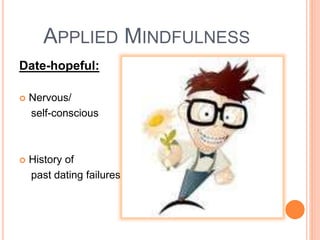
Date-hopeful:
 Nervous/
self-conscious
 History of
past dating failures
 Self-regulation of
Attention
 Orientation to
Experience
APPLIED MINDFULNESS
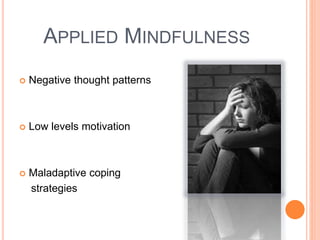
 Negative thought patterns
 Low levels motivation
 Maladaptive coping
strategies
 Self-Regulation of
Attention
 Orientation to
Experience
FROM ORIGINS TO SCIENTIFIC
INVESTIGATION
ORIGINS
Buddhism
 Mindfulness is central to the Buddhism tradition
 “The primary interest of this tradition is the quality of
consciousness in the present moment”, (Didonna,
2009)
 Sati (mindfulness) – awareness, attention and
remembering
 Used to alleviate suffering
MINDFULNESS IN THE SCIENTIFIC DOMAIN
“largely unconsidered outside the
fields of philosophical and religious
studies” (Dane, 2011)
“as being ‘seen as’ too mystical or
‘Zen-like’ to merit systematic
investigation” (Dane, 2011)
MINDFULNESS IN THE SCIENTIFIC DOMAIN
 Operational Definition
“no systematic efforts to establish the defining criteria of
it’s various components”
“general descriptions of mindfulness have not been
entirely consistent across investigators”
Bishop et. al, 2004
 Empirical Measure
“provides new opportunities for empirical investigations of
the nature of mindfulness and it’s relationships with other
psychological constructs”
Baer et. al, 2006
MINDFULNESS MEASURES
 The Toronto Mindfulness Scale (TMS: Lau, Bishop, Segal, Buis, Anderson, Carlson, Shapiro &
Carmody, 2006)
 Mindfulness Attention Awareness Scale (MAAS: Brown & Ryan, 2003)
 The Philadelphia Mindfulness Scale (PHLMS: Cardaciotto, Herbert, Forman et. al. 2008)
 The Cognitive and Affective Mindfulness Scale (CAMS: Feldman, Hawes, Kumar, Greeson &
Laurenceau, 2007)
 The Kentucky Inventory of Mindfulness Skills (KIMS: Baer et al. 2003)
 The Five-Facet Mindfulness Questionnare (FMMQ: Baer, Smith, Hopkins, Krietemeyer & Toney,
2006)
 The Frieburg Mindfulness Inventory (FMI: Buchheld, Grossman & Walach, 2001)
 The Mindfulness Questionnaire (MQ: Chadwick, Hember, Mead, Lilley & Dagnan, 2005)
TMS
 Curiosity
“reflects awareness or present moment experience
with a quality of curiosity”
 Decentering
“emphasising awareness of ones experience with
some distance and this identification rather than
being carried away by ones thoughts and feelings”
TMS
 You will now be handed out the Toronto
Mindfulness Scale
 This should just take a few minutes to
complete
TMS SCORING
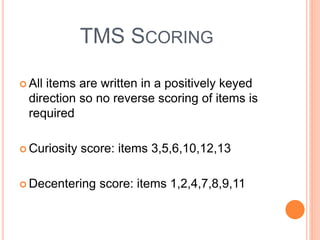
 All items are written in a positively keyed
direction so no reverse scoring of items is
required
 Curiosity score: items 3,5,6,10,12,13
 Decentering score: items 1,2,4,7,8,9,11
YOUR MINDFULNESS SCORE
If you have a high mindfulness score
well done
If, however, you do not don’t worry
It is possible to improve your
mindfulness (i.e. meditation)
MINDFULNESS
INTERVENTIONS
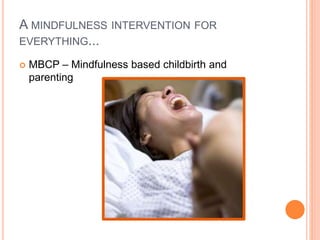
A MINDFULNESS INTERVENTION FOR
EVERYTHING...
 MBCP – Mindfulness based childbirth and
parenting
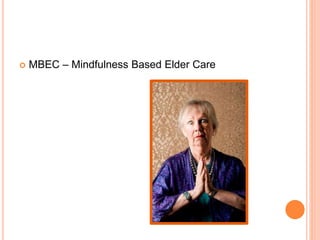
 MBEC – Mindfulness Based Elder Care
INTERVENTIONS
1. Mindfulness- Based Stress Reduction
2. Mindfulness- Based Cognitive Behavioural
Therapy
3. Mindfulness-Based Approaches to Eating
Disorders
4. Mindfulness- Based Relationship Enhancement
Training Program.
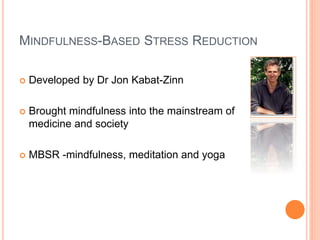
MINDFULNESS-BASED STRESS REDUCTION
 Developed by Dr Jon Kabat-Zinn
 Brought mindfulness into the mainstream of
medicine and society
 MBSR -mindfulness, meditation and yoga
AIM OF MBRS
 The mind is known to be a factor of stress and
stress related disorders
 Consciously and systematically working with stress,
pain, illness and demands of everyday life.
 Ignite inner capacity and infuse your life with
moment-to-moment awareness
 Such mindfulness helps patients use their inner
resources to achieve good health and well being
REASONS FOR JOINING:
 Stress
 Chronic pain and illness
 Anxiety and panic
 GI distress
 Sleep disturbances
 Fatigue
 High blood pressure
 Headaches
WHAT THE COURSE CONSISTS OF:
 8 weekly classes and 1 day long class that includes
-
 Guided instruction in mindfulness meditation
classes
 Gentle stretching and mindful yoga
 Group dialogue/discussions
 Individually tailored instruction
 Daily home assignments
RESULTS AFTER COMPLETION:
 Decrease in physical and psychological symptoms
 Increased ability to relax
 Reduction in pain levels
 Enhanced ability to cope with pain
 Greater energy and enthusiasm for life
 Improved self esteem
 Ability to cope better in stressful situations
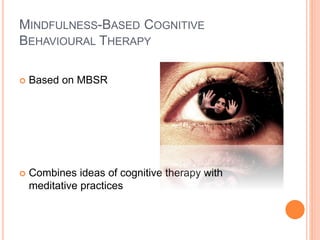
MINDFULNESS-BASED COGNITIVE
BEHAVIOURAL THERAPY
 Based on MBSR
 Combines ideas of cognitive therapy with
meditative practices
AIMS OF MBCBT
 Helps to understand depression
 Discover what makes one vulnerable to staying at
the end of the downward spiral
 Connection to downward spiral and what makes
like worth living
REASONS FOR JOINING:
 Chronic pain
 Hypertension
 Heart disease
 Cancer
 Anxiety and panic
 Depression (reduces relapse 50%)
WHAT THE COURSE CONSISTS OF:
 Meeting with instructor prior to commencing
 8 weekly 2 hour classes
 One all day session between week 5 and 7
 Main work is done at home with CD’s
RESULTS AFTER COMPLETION:
 To recognise and disengage from mind states
characterised by negative thought
 See thoughts as negative events rather than facts
MINDFULNESS-BASED APPROACHES TO
EATING DISORDERS
 Alexithymia
 A change from externally oriented concrete thinking
style to internal orientation
 Tend to use eating as a way to avoid or escape
negative emotional states
AIMS OF MB-EAT
 Learn to approach eating in a more relaxed, non
judgemental way
 Improve registration of appetite regulation
 Reduce misappraisal of internal physical states
 More attuned to utilizing physiological appetite cues
for initiating and ending eating periods
 Offers a strong opportunity to improve emotion
regulation
 Recognise that thoughts are just thoughts
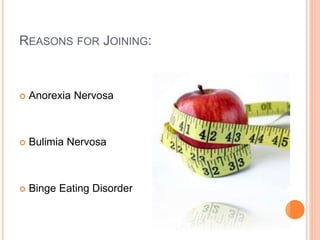
REASONS FOR JOINING:
 Anorexia Nervosa
 Bulimia Nervosa
 Binge Eating Disorder
WHAT THE COURSE CONSISTS OF:
Four Mindfulness-based programs combined:
1. Dialectical Behaviour Therapy
2. Acceptance and Commitment Therapy
3. Mindfulness-Based Cognitive Therapy
4. Mindfulness-Based Eating Awareness Training
EMPOWER APPROACH
Nine Core Skill Sets:
1. Nonjudgmental observation of reactivity
2. Separating out emotions
3. Separating out thoughts
4. Separation & tolerance of behavioural urges
5. Recognition of hunger and satiety
6. Recognition of taste
7. Discernment of appetite cues from other internal
events
8. Identification of true needs
9. Addressing true needs
MINDFULNESS-BASED RELATIONSHIP
ENHANCEMENT TRAINING PROGRAM
 Foster greater awareness, ease and fresh
discovery of life’s experiences
 Enhances access to innate resources of joy,
compassion and connectedness
AIMS OF MBRE:
 Enrich the relationships of the relatively happy, non-
distressed couples
 Beneficially affecting individuals:
 Optimism
 Spirituality
 Relaxation
 Psychological distress
 Favourably impacting couples levels of:
 Relationship satisfaction
 Autonomy
 Relatedness
 Closeness
 Acceptance of one another
 Relationship distress
WHAT THE COURSE CONSISTS OF:
 8 weekly 150mins group sessions & 1 full day
retreat
 Sample Session (week 3) -
 Sitting meditation
 Group discussion on practices and homework with
focus on pleasant experiences
 Individual yoga
 Homework assignments
RESULTS AFTER COMPLETION:
 Enriching of current relationship functioning
 Improvement of individual psychological well being
CASE STUDY
 44 participants – married or cohabitating for at least
12 months
 Completed questionnaires prior to course and after
course
 Kept daily diaries of:
Relationship happiness Relationship distress
Stress Coping Overall Stress
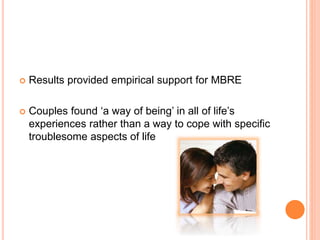
 Results provided empirical support for MBRE
 Couples found ‘a way of being’ in all of life’s
experiences rather than a way to cope with specific
troublesome aspects of life
MINDFULNESS
EXERCISE
MINDFULNESS MEDITATION
Stage 1:Mindfulness of Breath
Stage 2: Mindfulness of Thoughts
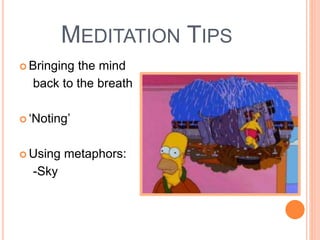
MEDITATION TIPS
 Bringing the mind
back to the breath
 ‘Noting’
 Using metaphors:
-Sky
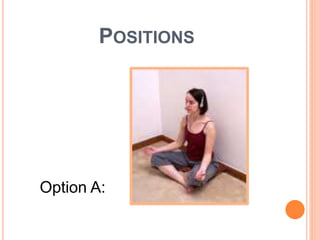
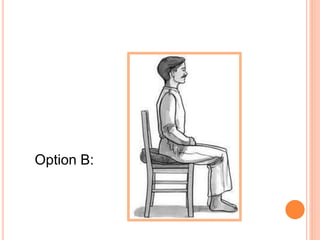
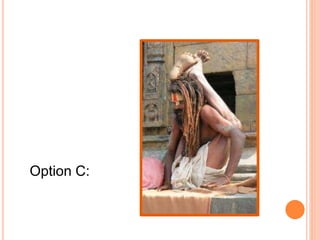
POSITIONS
Option A:
Option B:
Option C:
REFERENCES
Carson, J. W., Carson, K. M., Gil, K. M., & Baucom,
D. H. (2004). Mindfulness-based relationship
enhancement. Behaviour Therapy, 35, 471-494.
Mindful Living Programs (2011). What is Mindfulness-
Based Stress Reduction? Retrieved from:
www.mindfullivingprograms.com/whatMBSR.php
UMASS (2011). Stress Reduction Program. Retrieved
from: www.umassmed.edu
Baer, R. A. (2003).Mindfulness training as a clinical
intervention: A conceptual and empirical review.
Clinical Psychology: Science and Practice, 10,
125–143.
Bishop, S.R., Lau, M., Shapiro, S., Carlson, L.,
Anderson, N.D., Carmody, J., Segal, Z.V., Abbey,
S., Speca, M., Velting, D., Devins, G. (2004).
Mindfulness: A Proposed Operational Definition.
Clinical Psychology: Science and Practice, 11 (3),
230-240.
Kabat-Zinn, J. (1994). Wherever you go, there you
are: mindfulness meditation in everyday life. New
York: Hyperion.
James, W. (1924). Memories and studies. New York:
Longmans, Green, & Co. (Original work published
1911)
De Mello, A. (1988). The Prayer of the Frog: Vol 1: A
book of story Meditations.
Didonna, F. (Ed.), The Clinical Handbook of
Mindfulness (221-243). New York: Springer.
Dane (2011). Paying Attention to Mindfulness and Its
Effects on Task Performance in the Workplace.
Journal of Management, 37(4), 997-1018.
Baer, R. A., Smith, G. T., Hopkins, J., Krietemeyer, J.,
& Toney, L. (2006). Using self-report assessment
methods to explore facets of mindfulness.
Assessment, 13, 27–45.
EXTRA RESOURCES
 Kabat-Zinn: Intro to mindfulness
http://www.youtube.com/watch?v=3nwwKbM_vJc
 Cognitive Neuroscience of Mindfulness Meditation
http://www.youtube.com/watch?v=sf6Q0G1iHBI
 Malcom Huxter, Guided Meditation: Body Scan
http://www.youtube.com/watch?v=GJjafJouvt4

Mindfulness Seminar

  • 1.
  • 2.
    Group Task: -Your understandingof what mindfulness is -OR- -What is on your mind right now in this present moment
  • 3.
    “Reality, mostly, isnot what it is, but what we have decided it is” (de Mello, 1988)
  • 4.
    “First we makeour conclusions’ –then we find some way to arrive at them” (de Mello, 1988)
  • 5.
    “Compared to whatwe ought to be we are only half awake” (William James,1924) “The ultimate value of life depends upon awareness and the power of contemplation rather than upon mere survival." (Aristotle, n.d) “Problems cannot be solved at the same level of awareness that created them” (Einstein, n.d)
  • 6.
    AWARENESS, CONSCIOUSNESS ANDMENTAL PROCESSING  Consciousness has been distinguished from other modes of mental processing—namely, cognition, motives, and emotions.  Consciousness encompasses both awareness and attention. (Brown & Ryan, 2003)
  • 7.
    DEFINITION OF MINDFULNESS “Paying attention in a particular way: on purpose, in the present moment, and non-judgementally” (Kabat-Zinn, 1994)  “Mindfulness involves intentionally bringing one’s attention to the internal and external experiences occurring in the present moment” (Baer, 2003)  “In a state of mindfulness, thoughts and feelings are observed as events in the mind, without over-identifying with them and without reacting to them in in an automatic, habitual pattern of reactivity” (Bishop, Lau, Shapiro et al, 2004)
  • 8.
    FACETS OF MINDFULNESS Self-Regulationof attention “so that it is maintained on immediate experience, thereby allowing for increased recognition of mental events in the present moment” Orientation to Experience “orientation that is characterized by curiosity openness, and acceptance” (Bishop et al, 2004)
  • 9.
  • 10.
     Self-regulation of Attention Orientation to Experience
  • 11.
    APPLIED MINDFULNESS  Negativethought patterns  Low levels motivation  Maladaptive coping strategies
  • 12.
     Self-Regulation of Attention Orientation to Experience
  • 13.
    FROM ORIGINS TOSCIENTIFIC INVESTIGATION
  • 14.
    ORIGINS Buddhism  Mindfulness iscentral to the Buddhism tradition  “The primary interest of this tradition is the quality of consciousness in the present moment”, (Didonna, 2009)  Sati (mindfulness) – awareness, attention and remembering  Used to alleviate suffering
  • 15.
    MINDFULNESS IN THESCIENTIFIC DOMAIN “largely unconsidered outside the fields of philosophical and religious studies” (Dane, 2011) “as being ‘seen as’ too mystical or ‘Zen-like’ to merit systematic investigation” (Dane, 2011)
  • 16.
    MINDFULNESS IN THESCIENTIFIC DOMAIN  Operational Definition “no systematic efforts to establish the defining criteria of it’s various components” “general descriptions of mindfulness have not been entirely consistent across investigators” Bishop et. al, 2004  Empirical Measure “provides new opportunities for empirical investigations of the nature of mindfulness and it’s relationships with other psychological constructs” Baer et. al, 2006
  • 17.
    MINDFULNESS MEASURES  TheToronto Mindfulness Scale (TMS: Lau, Bishop, Segal, Buis, Anderson, Carlson, Shapiro & Carmody, 2006)  Mindfulness Attention Awareness Scale (MAAS: Brown & Ryan, 2003)  The Philadelphia Mindfulness Scale (PHLMS: Cardaciotto, Herbert, Forman et. al. 2008)  The Cognitive and Affective Mindfulness Scale (CAMS: Feldman, Hawes, Kumar, Greeson & Laurenceau, 2007)  The Kentucky Inventory of Mindfulness Skills (KIMS: Baer et al. 2003)  The Five-Facet Mindfulness Questionnare (FMMQ: Baer, Smith, Hopkins, Krietemeyer & Toney, 2006)  The Frieburg Mindfulness Inventory (FMI: Buchheld, Grossman & Walach, 2001)  The Mindfulness Questionnaire (MQ: Chadwick, Hember, Mead, Lilley & Dagnan, 2005)
  • 18.
    TMS  Curiosity “reflects awarenessor present moment experience with a quality of curiosity”  Decentering “emphasising awareness of ones experience with some distance and this identification rather than being carried away by ones thoughts and feelings”
  • 19.
    TMS  You willnow be handed out the Toronto Mindfulness Scale  This should just take a few minutes to complete
  • 20.
    TMS SCORING  Allitems are written in a positively keyed direction so no reverse scoring of items is required  Curiosity score: items 3,5,6,10,12,13  Decentering score: items 1,2,4,7,8,9,11
  • 21.
    YOUR MINDFULNESS SCORE Ifyou have a high mindfulness score well done If, however, you do not don’t worry It is possible to improve your mindfulness (i.e. meditation)
  • 22.
  • 23.
    A MINDFULNESS INTERVENTIONFOR EVERYTHING...  MBCP – Mindfulness based childbirth and parenting
  • 24.
     MBEC –Mindfulness Based Elder Care
  • 25.
    INTERVENTIONS 1. Mindfulness- BasedStress Reduction 2. Mindfulness- Based Cognitive Behavioural Therapy 3. Mindfulness-Based Approaches to Eating Disorders 4. Mindfulness- Based Relationship Enhancement Training Program.
  • 26.
    MINDFULNESS-BASED STRESS REDUCTION Developed by Dr Jon Kabat-Zinn  Brought mindfulness into the mainstream of medicine and society  MBSR -mindfulness, meditation and yoga
  • 27.
    AIM OF MBRS The mind is known to be a factor of stress and stress related disorders  Consciously and systematically working with stress, pain, illness and demands of everyday life.
  • 28.
     Ignite innercapacity and infuse your life with moment-to-moment awareness  Such mindfulness helps patients use their inner resources to achieve good health and well being
  • 29.
    REASONS FOR JOINING: Stress  Chronic pain and illness  Anxiety and panic  GI distress  Sleep disturbances  Fatigue  High blood pressure  Headaches
  • 30.
    WHAT THE COURSECONSISTS OF:  8 weekly classes and 1 day long class that includes -  Guided instruction in mindfulness meditation classes  Gentle stretching and mindful yoga  Group dialogue/discussions  Individually tailored instruction  Daily home assignments
  • 31.
    RESULTS AFTER COMPLETION: Decrease in physical and psychological symptoms  Increased ability to relax  Reduction in pain levels  Enhanced ability to cope with pain  Greater energy and enthusiasm for life  Improved self esteem  Ability to cope better in stressful situations
  • 32.
    MINDFULNESS-BASED COGNITIVE BEHAVIOURAL THERAPY Based on MBSR  Combines ideas of cognitive therapy with meditative practices
  • 33.
    AIMS OF MBCBT Helps to understand depression  Discover what makes one vulnerable to staying at the end of the downward spiral  Connection to downward spiral and what makes like worth living
  • 34.
    REASONS FOR JOINING: Chronic pain  Hypertension  Heart disease  Cancer  Anxiety and panic  Depression (reduces relapse 50%)
  • 35.
    WHAT THE COURSECONSISTS OF:  Meeting with instructor prior to commencing  8 weekly 2 hour classes  One all day session between week 5 and 7  Main work is done at home with CD’s
  • 36.
    RESULTS AFTER COMPLETION: To recognise and disengage from mind states characterised by negative thought  See thoughts as negative events rather than facts
  • 37.
    MINDFULNESS-BASED APPROACHES TO EATINGDISORDERS  Alexithymia  A change from externally oriented concrete thinking style to internal orientation  Tend to use eating as a way to avoid or escape negative emotional states
  • 38.
    AIMS OF MB-EAT Learn to approach eating in a more relaxed, non judgemental way  Improve registration of appetite regulation  Reduce misappraisal of internal physical states
  • 39.
     More attunedto utilizing physiological appetite cues for initiating and ending eating periods  Offers a strong opportunity to improve emotion regulation  Recognise that thoughts are just thoughts
  • 40.
    REASONS FOR JOINING: Anorexia Nervosa  Bulimia Nervosa  Binge Eating Disorder
  • 41.
    WHAT THE COURSECONSISTS OF: Four Mindfulness-based programs combined: 1. Dialectical Behaviour Therapy 2. Acceptance and Commitment Therapy 3. Mindfulness-Based Cognitive Therapy 4. Mindfulness-Based Eating Awareness Training
  • 42.
    EMPOWER APPROACH Nine CoreSkill Sets: 1. Nonjudgmental observation of reactivity 2. Separating out emotions 3. Separating out thoughts 4. Separation & tolerance of behavioural urges
  • 43.
    5. Recognition ofhunger and satiety 6. Recognition of taste 7. Discernment of appetite cues from other internal events 8. Identification of true needs 9. Addressing true needs
  • 44.
    MINDFULNESS-BASED RELATIONSHIP ENHANCEMENT TRAININGPROGRAM  Foster greater awareness, ease and fresh discovery of life’s experiences  Enhances access to innate resources of joy, compassion and connectedness
  • 45.
    AIMS OF MBRE: Enrich the relationships of the relatively happy, non- distressed couples  Beneficially affecting individuals:  Optimism  Spirituality  Relaxation  Psychological distress
  • 46.
     Favourably impactingcouples levels of:  Relationship satisfaction  Autonomy  Relatedness  Closeness  Acceptance of one another  Relationship distress
  • 47.
    WHAT THE COURSECONSISTS OF:  8 weekly 150mins group sessions & 1 full day retreat  Sample Session (week 3) -  Sitting meditation  Group discussion on practices and homework with focus on pleasant experiences  Individual yoga  Homework assignments
  • 48.
    RESULTS AFTER COMPLETION: Enriching of current relationship functioning  Improvement of individual psychological well being
  • 49.
    CASE STUDY  44participants – married or cohabitating for at least 12 months  Completed questionnaires prior to course and after course  Kept daily diaries of: Relationship happiness Relationship distress Stress Coping Overall Stress
  • 50.
     Results providedempirical support for MBRE  Couples found ‘a way of being’ in all of life’s experiences rather than a way to cope with specific troublesome aspects of life
  • 51.
  • 52.
    MINDFULNESS MEDITATION Stage 1:Mindfulnessof Breath Stage 2: Mindfulness of Thoughts
  • 53.
    MEDITATION TIPS  Bringingthe mind back to the breath  ‘Noting’  Using metaphors: -Sky
  • 54.
  • 55.
  • 56.
  • 57.
    REFERENCES Carson, J. W.,Carson, K. M., Gil, K. M., & Baucom, D. H. (2004). Mindfulness-based relationship enhancement. Behaviour Therapy, 35, 471-494. Mindful Living Programs (2011). What is Mindfulness- Based Stress Reduction? Retrieved from: www.mindfullivingprograms.com/whatMBSR.php UMASS (2011). Stress Reduction Program. Retrieved from: www.umassmed.edu
  • 58.
    Baer, R. A.(2003).Mindfulness training as a clinical intervention: A conceptual and empirical review. Clinical Psychology: Science and Practice, 10, 125–143. Bishop, S.R., Lau, M., Shapiro, S., Carlson, L., Anderson, N.D., Carmody, J., Segal, Z.V., Abbey, S., Speca, M., Velting, D., Devins, G. (2004). Mindfulness: A Proposed Operational Definition. Clinical Psychology: Science and Practice, 11 (3), 230-240. Kabat-Zinn, J. (1994). Wherever you go, there you are: mindfulness meditation in everyday life. New York: Hyperion.
  • 59.
    James, W. (1924).Memories and studies. New York: Longmans, Green, & Co. (Original work published 1911) De Mello, A. (1988). The Prayer of the Frog: Vol 1: A book of story Meditations. Didonna, F. (Ed.), The Clinical Handbook of Mindfulness (221-243). New York: Springer. Dane (2011). Paying Attention to Mindfulness and Its Effects on Task Performance in the Workplace. Journal of Management, 37(4), 997-1018.
  • 60.
    Baer, R. A.,Smith, G. T., Hopkins, J., Krietemeyer, J., & Toney, L. (2006). Using self-report assessment methods to explore facets of mindfulness. Assessment, 13, 27–45.
  • 61.
    EXTRA RESOURCES  Kabat-Zinn:Intro to mindfulness http://www.youtube.com/watch?v=3nwwKbM_vJc  Cognitive Neuroscience of Mindfulness Meditation http://www.youtube.com/watch?v=sf6Q0G1iHBI  Malcom Huxter, Guided Meditation: Body Scan http://www.youtube.com/watch?v=GJjafJouvt4