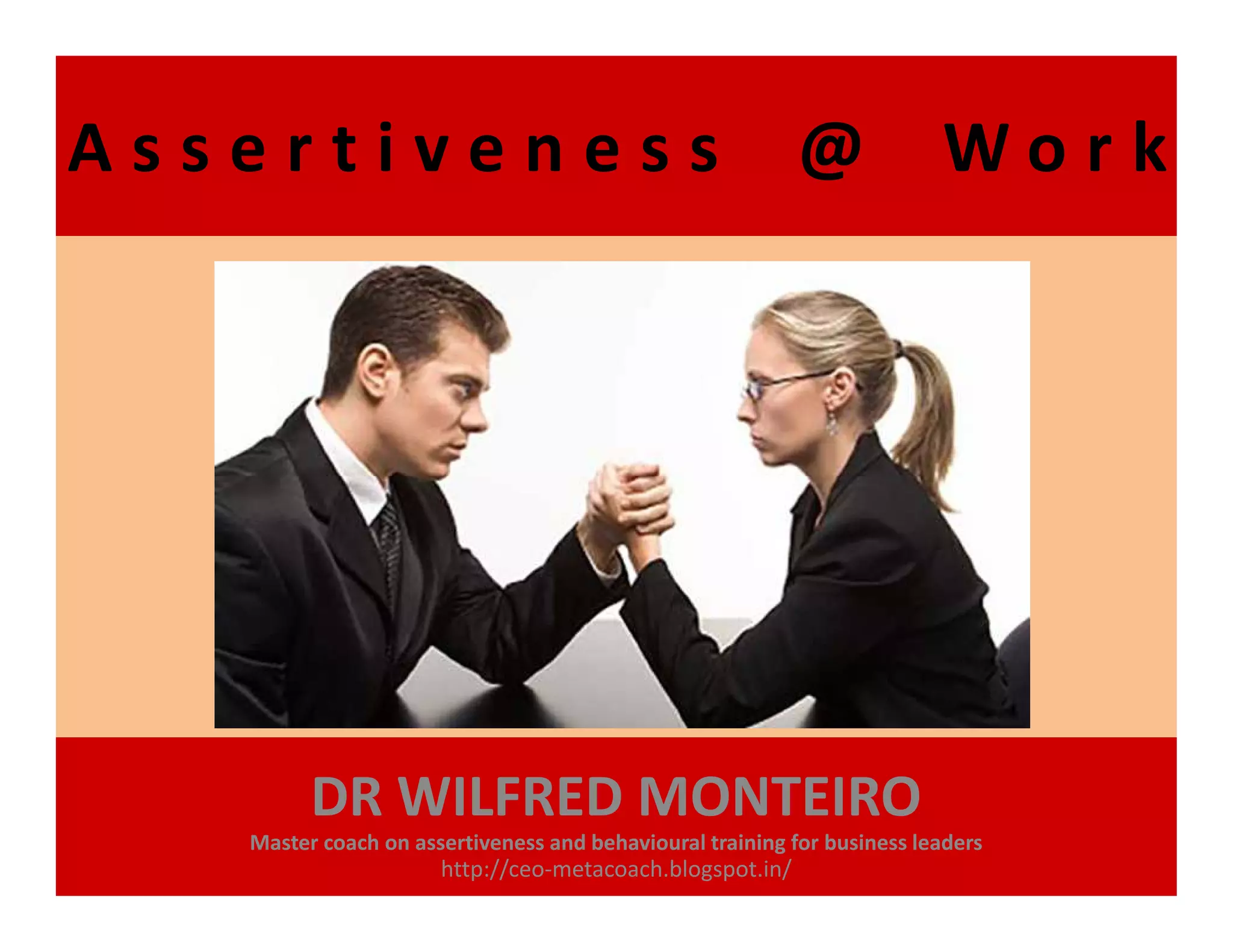
A s s e r t i v e n e s s @ W o r k
DR WILFRED MONTEIRO
Master coach on assertiveness and behavioural training for business leaders
http://ceo-metacoach.blogspot.in/
Test Your Assertiveness (1 of 3)
 Can you express negative feelings about
other people and their behaviors without
using abusive language?
 Are you able to exercise and express your
strengths?
 Can you easily recognize and compliment
other people’s achievements?
 Can you express negative feelings about
other people and their behaviors without
using abusive language?
 Are you able to exercise and express your
strengths?
 Can you easily recognize and compliment
other people’s achievements?
Test Your Assertiveness (2 of 3)
 Do you have the confidence to ask for
what is rightfully yours?
 Can you accept criticism without being
defensive?
 Do you feel comfortable accepting
compliments?
 Are you able to stand up for your
rights?
 Do you have the confidence to ask for
what is rightfully yours?
 Can you accept criticism without being
defensive?
 Do you feel comfortable accepting
compliments?
 Are you able to stand up for your
rights?
Test Your Assertiveness (3 of 3)
 Are you able to refuse unreasonable
requests from friends, family, or co-
workers?
 Can you comfortably start and carry on a
conversation with others?
 Do you ask for assistance when you
need it ?
 Are you able to refuse unreasonable
requests from friends, family, or co-
workers?
 Can you comfortably start and carry on a
conversation with others?
 Do you ask for assistance when you
need it ?
A “yes” response to the questions
indicates an assertive approach.
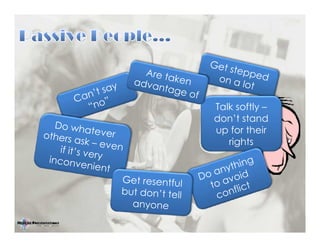
Talk softly –
don’t stand
up for their
rights
Talk softly –
don’t stand
up for their
rights
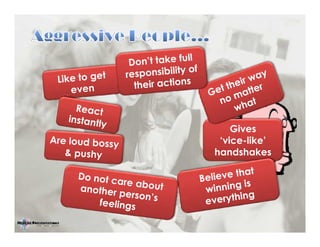
Gives
‘vice-like’
handshakes
Gives
‘vice-like’
handshakes
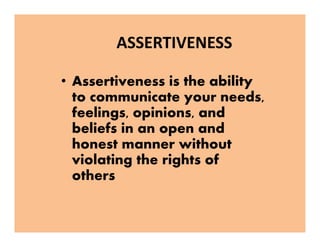
ASSERTIVENESS
• Assertiveness is the ability
to communicate your needs,
feelings, opinions, and
beliefs in an open and
honest manner without
violating the rights of
others
• Assertiveness is the ability
to communicate your needs,
feelings, opinions, and
beliefs in an open and
honest manner without
violating the rights of
others
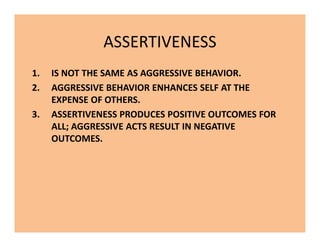
ASSERTIVENESS
1. IS NOT THE SAME AS AGGRESSIVE BEHAVIOR.
2. AGGRESSIVE BEHAVIOR ENHANCES SELF AT THE
EXPENSE OF OTHERS.
3. ASSERTIVENESS PRODUCES POSITIVE OUTCOMES FOR
ALL; AGGRESSIVE ACTS RESULT IN NEGATIVE
OUTCOMES.
1. IS NOT THE SAME AS AGGRESSIVE BEHAVIOR.
2. AGGRESSIVE BEHAVIOR ENHANCES SELF AT THE
EXPENSE OF OTHERS.
3. ASSERTIVENESS PRODUCES POSITIVE OUTCOMES FOR
ALL; AGGRESSIVE ACTS RESULT IN NEGATIVE
OUTCOMES.
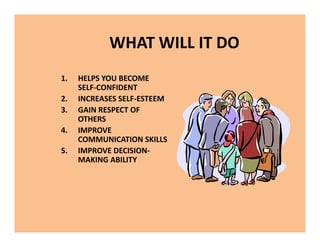
WHAT WILL IT DO
1. HELPS YOU BECOME
SELF-CONFIDENT
2. INCREASES SELF-ESTEEM
3. GAIN RESPECT OF
OTHERS
4. IMPROVE
COMMUNICATION SKILLS
5. IMPROVE DECISION-
MAKING ABILITY
1. HELPS YOU BECOME
SELF-CONFIDENT
2. INCREASES SELF-ESTEEM
3. GAIN RESPECT OF
OTHERS
4. IMPROVE
COMMUNICATION SKILLS
5. IMPROVE DECISION-
MAKING ABILITY
UNDERSTANDING ASSERTIVE BEHAVIOR
Mottoes and Beliefs
– Believes self and others are valuable
– Knowing that assertiveness doesn't mean you always win, but that you
handled the situation as effectively as possible
– "I have rights and so do others."
Communication Style
– Effective, active listener
– States limits, expectations
– States observations, no labels or judgments
– Expresses self directly, honestly, and as soon as possible about feelings
and wants
– Checks on others feelings
Mottoes and Beliefs
– Believes self and others are valuable
– Knowing that assertiveness doesn't mean you always win, but that you
handled the situation as effectively as possible
– "I have rights and so do others."
Communication Style
– Effective, active listener
– States limits, expectations
– States observations, no labels or judgments
– Expresses self directly, honestly, and as soon as possible about feelings
and wants
– Checks on others feelings
Characteristics
– Non-judgmental
– Observes behavior rather than labeling it
– Trusts self and others
– Confident
– Self-aware
– Open, flexible, versatile
– Playful, sense of humor
– Decisive
– Proactive, initiating
Behavior
– Operates from choice
– Knows what it is needed and develops a plan to get it
– Action-oriented
– Firm
– Realistic in her expectations
– Fair, just
– Consistent
– Takes appropriate action toward getting what she wants without denying rights of
others
Characteristics
– Non-judgmental
– Observes behavior rather than labeling it
– Trusts self and others
– Confident
– Self-aware
– Open, flexible, versatile
– Playful, sense of humor
– Decisive
– Proactive, initiating
Behavior
– Operates from choice
– Knows what it is needed and develops a plan to get it
– Action-oriented
– Firm
– Realistic in her expectations
– Fair, just
– Consistent
– Takes appropriate action toward getting what she wants without denying rights of
others
Nonverbal Cues
– Open, natural gestures
– Attentive, interested facial expression
– Direct eye contact
– Confident or relaxed posture
– Vocal volume appropriate, expressive
– Varied rate of speech
Verbal Cues
– "I choose to..."
– "What are my options?"
– "What alternatives do we have?"
Confrontation and Problem Solving
– Negotiates, bargains, trades off, compromises
– Confronts problems at the time they happen
– Doesn't let negative feelings build up
Nonverbal Cues
– Open, natural gestures
– Attentive, interested facial expression
– Direct eye contact
– Confident or relaxed posture
– Vocal volume appropriate, expressive
– Varied rate of speech
Verbal Cues
– "I choose to..."
– "What are my options?"
– "What alternatives do we have?"
Confrontation and Problem Solving
– Negotiates, bargains, trades off, compromises
– Confronts problems at the time they happen
– Doesn't let negative feelings build up
Feelings Felt
– Enthusiasm
– Well being
– Even tempered
Effects
– Increased self-esteem and self-confidence
– Increased self-esteem of others
– Feels motivated and understood
– Others know where they stand
Feelings Felt
– Enthusiasm
– Well being
– Even tempered
Effects
– Increased self-esteem and self-confidence
– Increased self-esteem of others
– Feels motivated and understood
– Others know where they stand
HOW TO BE ASSERTIVE
1. BE HONEST AND DIRECT ABOUT YOUR
FEELINGS, NEEDS, BELIEFS.
2. EXPRESS YOURSELF FIRMLY AND DIRECTLY
TO SPECIFIC INDIVIDUALS.
3. BE REASONABLE IN YOUR REQUESTS
1. BE HONEST AND DIRECT ABOUT YOUR
FEELINGS, NEEDS, BELIEFS.
2. EXPRESS YOURSELF FIRMLY AND DIRECTLY
TO SPECIFIC INDIVIDUALS.
3. BE REASONABLE IN YOUR REQUESTS
HOW TO BE ASSERTIVE
4. STATE YOUR VIEWPOINT WITHOUT BEING HESITANT OR
APOLOGETIC.
5. BE HONEST WHEN GIVING OR RECEIVING FEEDBACK.
6. LEARN TO SAY “NO” TO UNREASONABLE EXPECTATIONS.
7. PARAPHRASE WHAT OTHERS HAVE STATED TO YOU.
4. STATE YOUR VIEWPOINT WITHOUT BEING HESITANT OR
APOLOGETIC.
5. BE HONEST WHEN GIVING OR RECEIVING FEEDBACK.
6. LEARN TO SAY “NO” TO UNREASONABLE EXPECTATIONS.
7. PARAPHRASE WHAT OTHERS HAVE STATED TO YOU.
HOW TO BE ASSERTIVE
8. REGOGNIZE AND RESPECT THE RIGHTS OF THOSE
AROUND YOU.
9. USE APPROPRIATE TONE OF VOICE.
10. BE AWARE OF BODY POSTURE/LANGUAGE
11. MAINTAIN EYE CONTACT.
12. USE “I” STATEMENTS TO EXPRESS SELF
8. REGOGNIZE AND RESPECT THE RIGHTS OF THOSE
AROUND YOU.
9. USE APPROPRIATE TONE OF VOICE.
10. BE AWARE OF BODY POSTURE/LANGUAGE
11. MAINTAIN EYE CONTACT.
12. USE “I” STATEMENTS TO EXPRESS SELF
HOW TO BE ASSERTIVE
13. DON’T LET OTHERS
IMPOSE THEIR
VALUES/IDEAS ON YOU
14. ENCOURAGE OTHERS
TO BE CLEAR AND
DIRECT
15. TAKE OWNERSHIP
13. DON’T LET OTHERS
IMPOSE THEIR
VALUES/IDEAS ON YOU
14. ENCOURAGE OTHERS
TO BE CLEAR AND
DIRECT
15. TAKE OWNERSHIP
Dr WILFRED MONTEIRO
• is a nationally acclaimed stalwart in the field of
business management with an illustrious career
spanning over 25 years
• He is a consultant and advisor to Board of Directors
of leading companies & Chambers of Commerce;
• a management trainer of high repute who has
conducted over 1250 seminars in India and abroad
in areas of business strategy, marketing &
organization development.
• a Visiting Professor to premier management
institutes and staff training colleges throughout
India.
• is a nationally acclaimed stalwart in the field of
business management with an illustrious career
spanning over 25 years
• He is a consultant and advisor to Board of Directors
of leading companies & Chambers of Commerce;
• a management trainer of high repute who has
conducted over 1250 seminars in India and abroad
in areas of business strategy, marketing &
organization development.
• a Visiting Professor to premier management
institutes and staff training colleges throughout
India.
website: www.synergymanager.netwebsite: www.synergymanager.net
CONTACT US
Dr Wilfred Monteiro
TELE : 91 22 9819843927
EMAIL: wm@synergymanager.net
website:
www.synergymanager.net
SYNERGY MANAGEMENT ASSOCIATES
since 1993
HR Systems Design
Policy Deployment
Talent Management innovations
Best Practices enablement
Competency based HRM
H R Systems Metrics & Audit

Assertiveness @ work

  • 1.
    A s se r t i v e n e s s @ W o r k DR WILFRED MONTEIRO Master coach on assertiveness and behavioural training for business leaders http://ceo-metacoach.blogspot.in/
  • 2.
    Test Your Assertiveness(1 of 3)  Can you express negative feelings about other people and their behaviors without using abusive language?  Are you able to exercise and express your strengths?  Can you easily recognize and compliment other people’s achievements?  Can you express negative feelings about other people and their behaviors without using abusive language?  Are you able to exercise and express your strengths?  Can you easily recognize and compliment other people’s achievements?
  • 3.
    Test Your Assertiveness(2 of 3)  Do you have the confidence to ask for what is rightfully yours?  Can you accept criticism without being defensive?  Do you feel comfortable accepting compliments?  Are you able to stand up for your rights?  Do you have the confidence to ask for what is rightfully yours?  Can you accept criticism without being defensive?  Do you feel comfortable accepting compliments?  Are you able to stand up for your rights?
  • 4.
    Test Your Assertiveness(3 of 3)  Are you able to refuse unreasonable requests from friends, family, or co- workers?  Can you comfortably start and carry on a conversation with others?  Do you ask for assistance when you need it ?  Are you able to refuse unreasonable requests from friends, family, or co- workers?  Can you comfortably start and carry on a conversation with others?  Do you ask for assistance when you need it ? A “yes” response to the questions indicates an assertive approach.
  • 5.
    Talk softly – don’tstand up for their rights Talk softly – don’t stand up for their rights
  • 6.
  • 7.
    ASSERTIVENESS • Assertiveness isthe ability to communicate your needs, feelings, opinions, and beliefs in an open and honest manner without violating the rights of others • Assertiveness is the ability to communicate your needs, feelings, opinions, and beliefs in an open and honest manner without violating the rights of others
  • 8.
    ASSERTIVENESS 1. IS NOTTHE SAME AS AGGRESSIVE BEHAVIOR. 2. AGGRESSIVE BEHAVIOR ENHANCES SELF AT THE EXPENSE OF OTHERS. 3. ASSERTIVENESS PRODUCES POSITIVE OUTCOMES FOR ALL; AGGRESSIVE ACTS RESULT IN NEGATIVE OUTCOMES. 1. IS NOT THE SAME AS AGGRESSIVE BEHAVIOR. 2. AGGRESSIVE BEHAVIOR ENHANCES SELF AT THE EXPENSE OF OTHERS. 3. ASSERTIVENESS PRODUCES POSITIVE OUTCOMES FOR ALL; AGGRESSIVE ACTS RESULT IN NEGATIVE OUTCOMES.
  • 9.
    WHAT WILL ITDO 1. HELPS YOU BECOME SELF-CONFIDENT 2. INCREASES SELF-ESTEEM 3. GAIN RESPECT OF OTHERS 4. IMPROVE COMMUNICATION SKILLS 5. IMPROVE DECISION- MAKING ABILITY 1. HELPS YOU BECOME SELF-CONFIDENT 2. INCREASES SELF-ESTEEM 3. GAIN RESPECT OF OTHERS 4. IMPROVE COMMUNICATION SKILLS 5. IMPROVE DECISION- MAKING ABILITY
  • 10.
    UNDERSTANDING ASSERTIVE BEHAVIOR Mottoesand Beliefs – Believes self and others are valuable – Knowing that assertiveness doesn't mean you always win, but that you handled the situation as effectively as possible – "I have rights and so do others." Communication Style – Effective, active listener – States limits, expectations – States observations, no labels or judgments – Expresses self directly, honestly, and as soon as possible about feelings and wants – Checks on others feelings Mottoes and Beliefs – Believes self and others are valuable – Knowing that assertiveness doesn't mean you always win, but that you handled the situation as effectively as possible – "I have rights and so do others." Communication Style – Effective, active listener – States limits, expectations – States observations, no labels or judgments – Expresses self directly, honestly, and as soon as possible about feelings and wants – Checks on others feelings
  • 11.
    Characteristics – Non-judgmental – Observesbehavior rather than labeling it – Trusts self and others – Confident – Self-aware – Open, flexible, versatile – Playful, sense of humor – Decisive – Proactive, initiating Behavior – Operates from choice – Knows what it is needed and develops a plan to get it – Action-oriented – Firm – Realistic in her expectations – Fair, just – Consistent – Takes appropriate action toward getting what she wants without denying rights of others Characteristics – Non-judgmental – Observes behavior rather than labeling it – Trusts self and others – Confident – Self-aware – Open, flexible, versatile – Playful, sense of humor – Decisive – Proactive, initiating Behavior – Operates from choice – Knows what it is needed and develops a plan to get it – Action-oriented – Firm – Realistic in her expectations – Fair, just – Consistent – Takes appropriate action toward getting what she wants without denying rights of others
  • 12.
    Nonverbal Cues – Open,natural gestures – Attentive, interested facial expression – Direct eye contact – Confident or relaxed posture – Vocal volume appropriate, expressive – Varied rate of speech Verbal Cues – "I choose to..." – "What are my options?" – "What alternatives do we have?" Confrontation and Problem Solving – Negotiates, bargains, trades off, compromises – Confronts problems at the time they happen – Doesn't let negative feelings build up Nonverbal Cues – Open, natural gestures – Attentive, interested facial expression – Direct eye contact – Confident or relaxed posture – Vocal volume appropriate, expressive – Varied rate of speech Verbal Cues – "I choose to..." – "What are my options?" – "What alternatives do we have?" Confrontation and Problem Solving – Negotiates, bargains, trades off, compromises – Confronts problems at the time they happen – Doesn't let negative feelings build up
  • 13.
    Feelings Felt – Enthusiasm –Well being – Even tempered Effects – Increased self-esteem and self-confidence – Increased self-esteem of others – Feels motivated and understood – Others know where they stand Feelings Felt – Enthusiasm – Well being – Even tempered Effects – Increased self-esteem and self-confidence – Increased self-esteem of others – Feels motivated and understood – Others know where they stand
  • 14.
    HOW TO BEASSERTIVE 1. BE HONEST AND DIRECT ABOUT YOUR FEELINGS, NEEDS, BELIEFS. 2. EXPRESS YOURSELF FIRMLY AND DIRECTLY TO SPECIFIC INDIVIDUALS. 3. BE REASONABLE IN YOUR REQUESTS 1. BE HONEST AND DIRECT ABOUT YOUR FEELINGS, NEEDS, BELIEFS. 2. EXPRESS YOURSELF FIRMLY AND DIRECTLY TO SPECIFIC INDIVIDUALS. 3. BE REASONABLE IN YOUR REQUESTS
  • 15.
    HOW TO BEASSERTIVE 4. STATE YOUR VIEWPOINT WITHOUT BEING HESITANT OR APOLOGETIC. 5. BE HONEST WHEN GIVING OR RECEIVING FEEDBACK. 6. LEARN TO SAY “NO” TO UNREASONABLE EXPECTATIONS. 7. PARAPHRASE WHAT OTHERS HAVE STATED TO YOU. 4. STATE YOUR VIEWPOINT WITHOUT BEING HESITANT OR APOLOGETIC. 5. BE HONEST WHEN GIVING OR RECEIVING FEEDBACK. 6. LEARN TO SAY “NO” TO UNREASONABLE EXPECTATIONS. 7. PARAPHRASE WHAT OTHERS HAVE STATED TO YOU.
  • 16.
    HOW TO BEASSERTIVE 8. REGOGNIZE AND RESPECT THE RIGHTS OF THOSE AROUND YOU. 9. USE APPROPRIATE TONE OF VOICE. 10. BE AWARE OF BODY POSTURE/LANGUAGE 11. MAINTAIN EYE CONTACT. 12. USE “I” STATEMENTS TO EXPRESS SELF 8. REGOGNIZE AND RESPECT THE RIGHTS OF THOSE AROUND YOU. 9. USE APPROPRIATE TONE OF VOICE. 10. BE AWARE OF BODY POSTURE/LANGUAGE 11. MAINTAIN EYE CONTACT. 12. USE “I” STATEMENTS TO EXPRESS SELF
  • 17.
    HOW TO BEASSERTIVE 13. DON’T LET OTHERS IMPOSE THEIR VALUES/IDEAS ON YOU 14. ENCOURAGE OTHERS TO BE CLEAR AND DIRECT 15. TAKE OWNERSHIP 13. DON’T LET OTHERS IMPOSE THEIR VALUES/IDEAS ON YOU 14. ENCOURAGE OTHERS TO BE CLEAR AND DIRECT 15. TAKE OWNERSHIP
  • 18.
    Dr WILFRED MONTEIRO •is a nationally acclaimed stalwart in the field of business management with an illustrious career spanning over 25 years • He is a consultant and advisor to Board of Directors of leading companies & Chambers of Commerce; • a management trainer of high repute who has conducted over 1250 seminars in India and abroad in areas of business strategy, marketing & organization development. • a Visiting Professor to premier management institutes and staff training colleges throughout India. • is a nationally acclaimed stalwart in the field of business management with an illustrious career spanning over 25 years • He is a consultant and advisor to Board of Directors of leading companies & Chambers of Commerce; • a management trainer of high repute who has conducted over 1250 seminars in India and abroad in areas of business strategy, marketing & organization development. • a Visiting Professor to premier management institutes and staff training colleges throughout India. website: www.synergymanager.netwebsite: www.synergymanager.net
  • 19.
    CONTACT US Dr WilfredMonteiro TELE : 91 22 9819843927 EMAIL: wm@synergymanager.net website: www.synergymanager.net SYNERGY MANAGEMENT ASSOCIATES since 1993 HR Systems Design Policy Deployment Talent Management innovations Best Practices enablement Competency based HRM H R Systems Metrics & Audit