Cloning
Vector
Objectives
After the end of the presentation we’ll know -
• What is cloning vector?
• Why cloning vector?
• History
• Features of a cloning vector
• Types of cloning vector
– Plasmid
– Bacteriophage
– Cosmid
– BacterialArtificial Chromosome (BAC)
– YeastArtificial Chromosome (BAC)
– HumanArtificial Chromosome (HAC)
– Retroviral Vectors
• What determines choice of vector?
• Vector in molecular gene cloning
Cloning Vector
• The molecular analysis of DNA has been made possible by the cloning of
DNA. The two molecules that are required for cloning are the DNA to be
cloned and a cloning vector.
• Acloning vector is a small piece of DNA taken from a virus, a plasmid
or the cell of a higher organism, that can be stably maintained in an
organism and into which a foreign DNA fragment can be inserted for
cloning purposes.
• Most vectors are genetically engineered.
• The cloning vector is chosen according to the size and type of DNA to be
cloned.
Cloning Vector
• The vector therefore contains features that allow for the convenient insertion
or removal of DNA fragment in or out of the vector, for example by treating
the vector and the foreign DNA with a restriction enzyme and then ligating
the fragments together.
• After a DNA fragment has been cloned into a cloning vector, it may be
further subcloned into another vector designed for more specific use.
Why Cloning Vector?
• Cloning vector is used as a vehicle to artificially carry foreign genetic
material into another cell, where it can be replicated and expressed.
• It is used to amplify a single molecule of DNA into many copes.
• Cloning vectors are DNA molecules that are used to "transport" cloned
sequences between biological hosts and the test tube.
• Without Cloning Vector, Molecular Gene Cloning is totally
impossible.
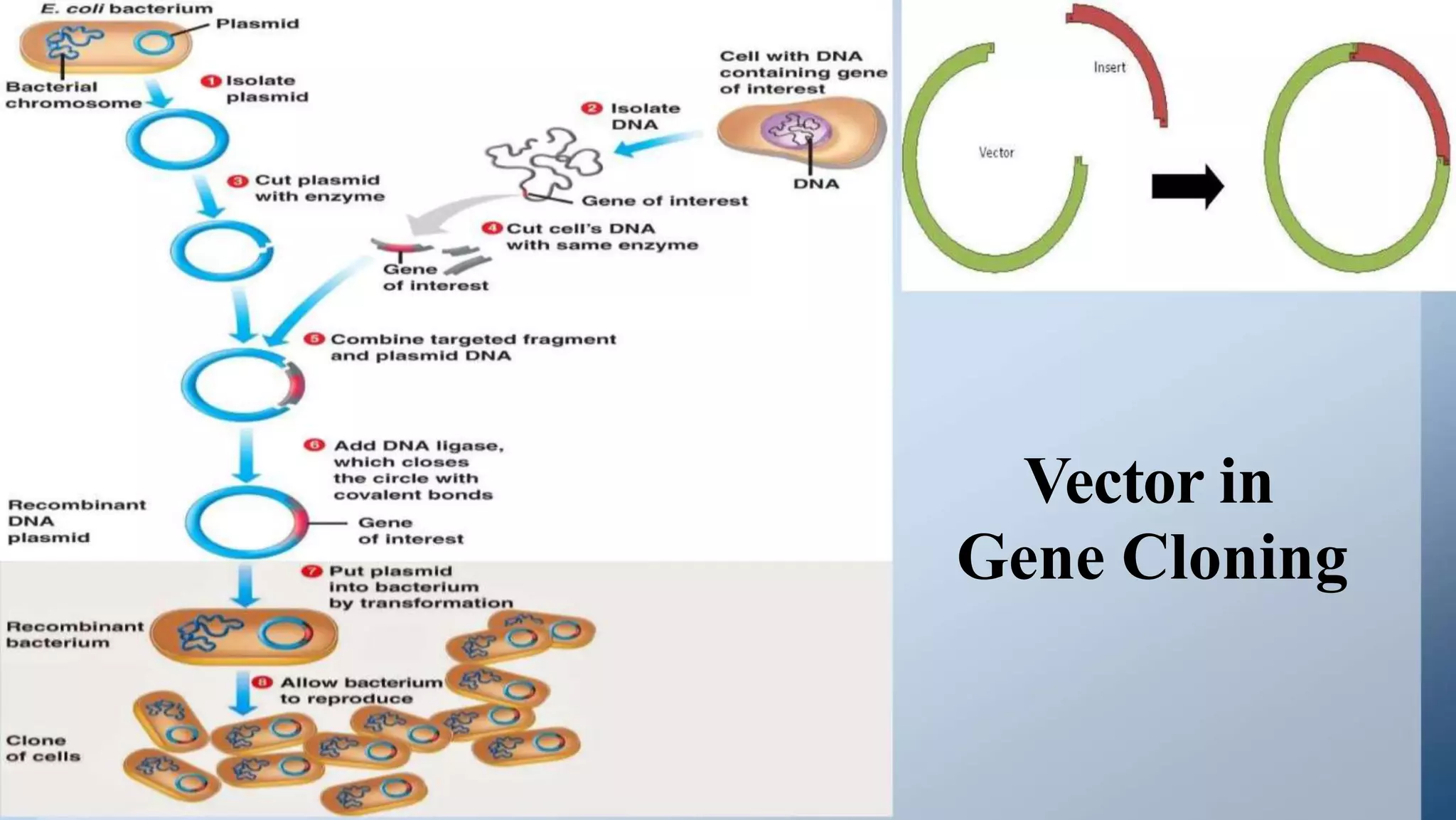
Vector in
Gene Cloning
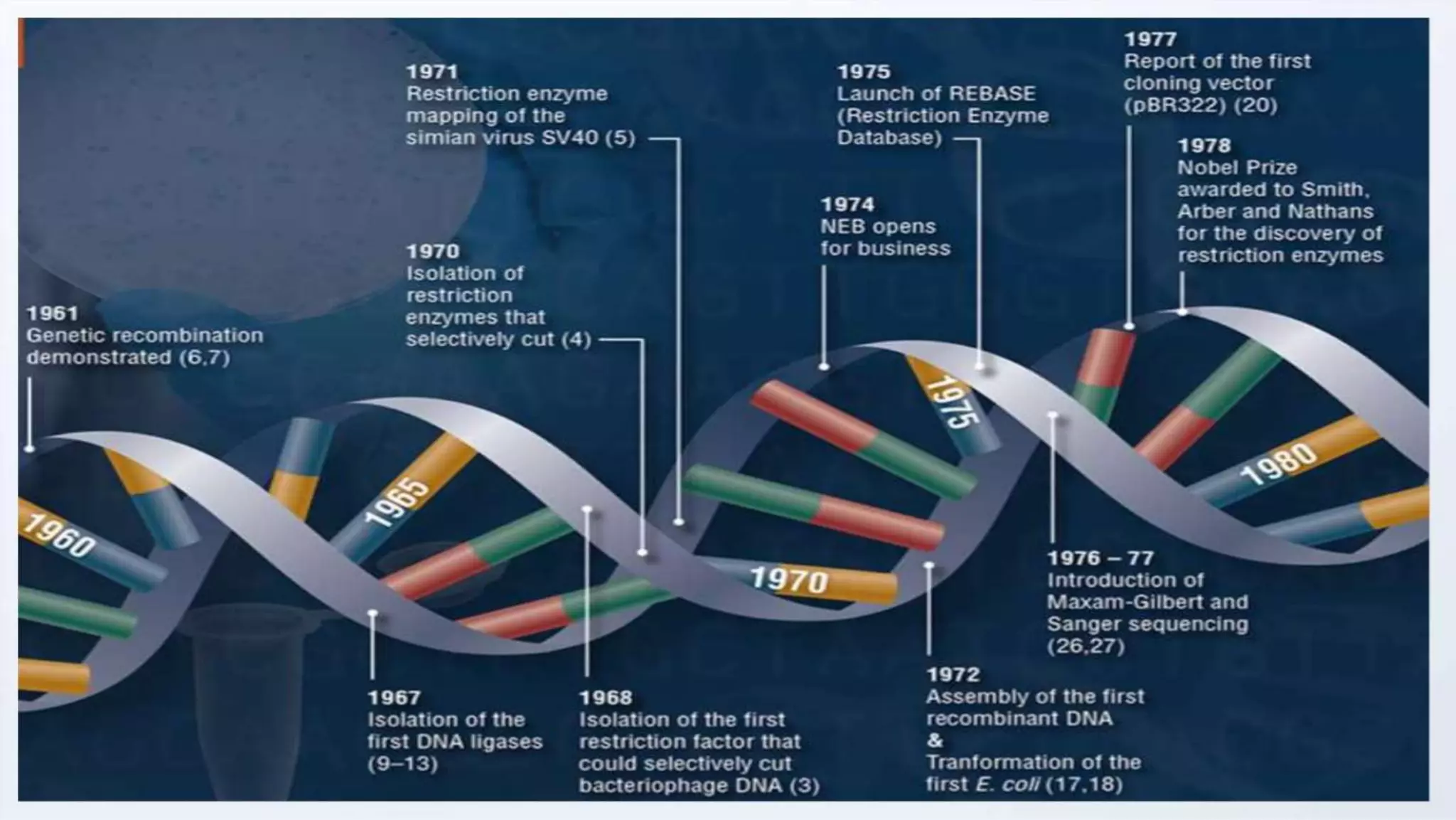
History
• Scientists (Herbert Boyer, Keiichi Itakura and Arthur Riggs)
working in Boyer’s lab (University of California) recognized a
general cloning vector with unique restriction sites for cloning in
foreign DNA and the expression of antibiotic resistance genes for
selection of transformed bacteria.
• In 1977, they described the first vector designed for cloning
purposes, pBR322 – a plasmid.
• This vector was small, ~4 kb in size, and had two antibiotic
resistance genes for selection.
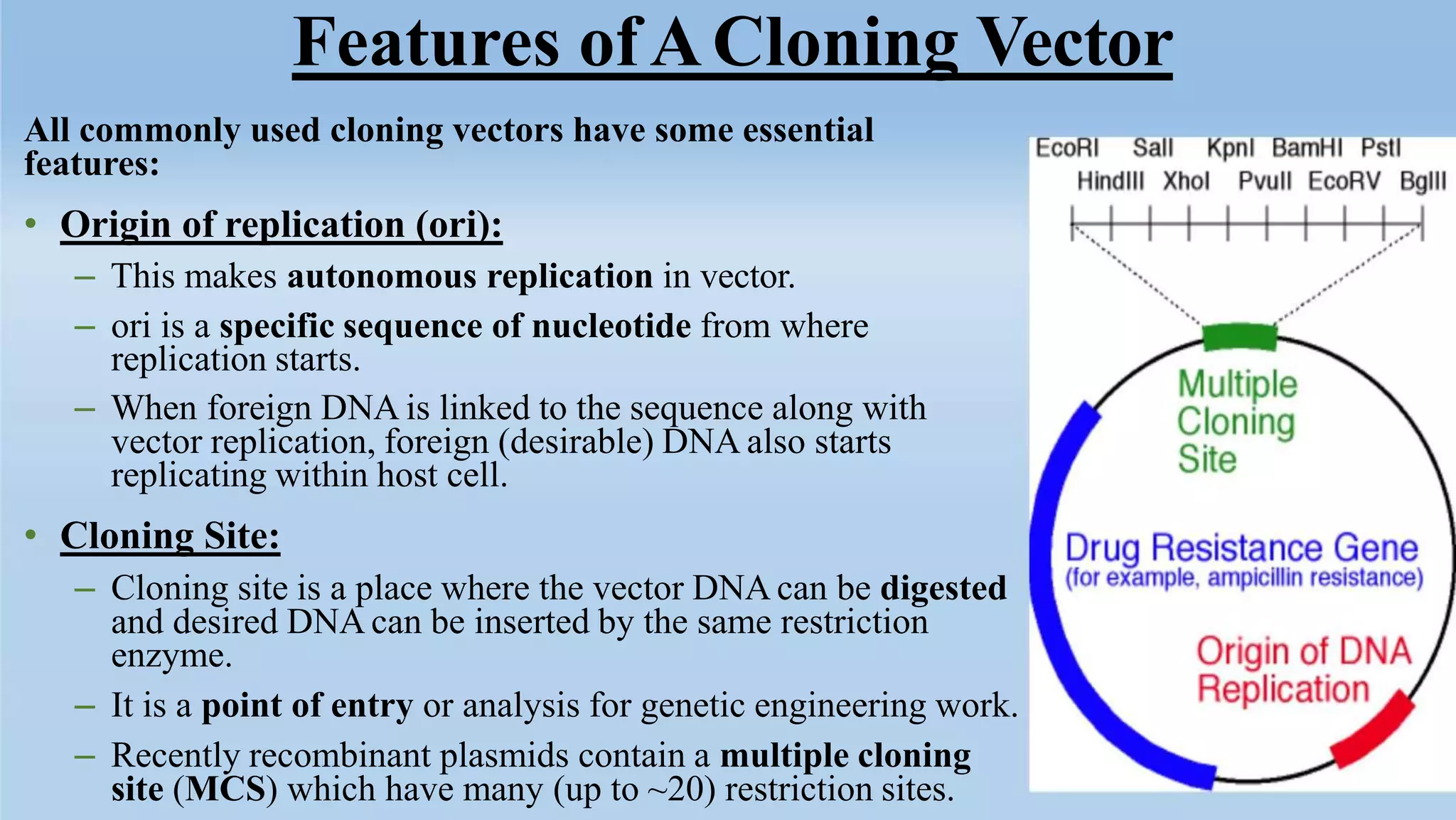
Features ofACloning Vector
All commonly used cloning vectors have some essential
features:
• Origin of replication (ori):
– This makes autonomous replication in vector.
– ori is a specific sequence of nucleotide from where
replication starts.
– When foreign DNA is linked to the sequence along with
vector replication, foreign (desirable) DNA also starts
replicating within host cell.
• Cloning Site:
– Cloning site is a place where the vector DNA can be digested
and desired DNA can be inserted by the same restriction
enzyme.
– It is a point of entry or analysis for genetic engineering work.
– Recently recombinant plasmids contain a multiple cloning
site (MCS) which have many (up to ~20) restriction sites.
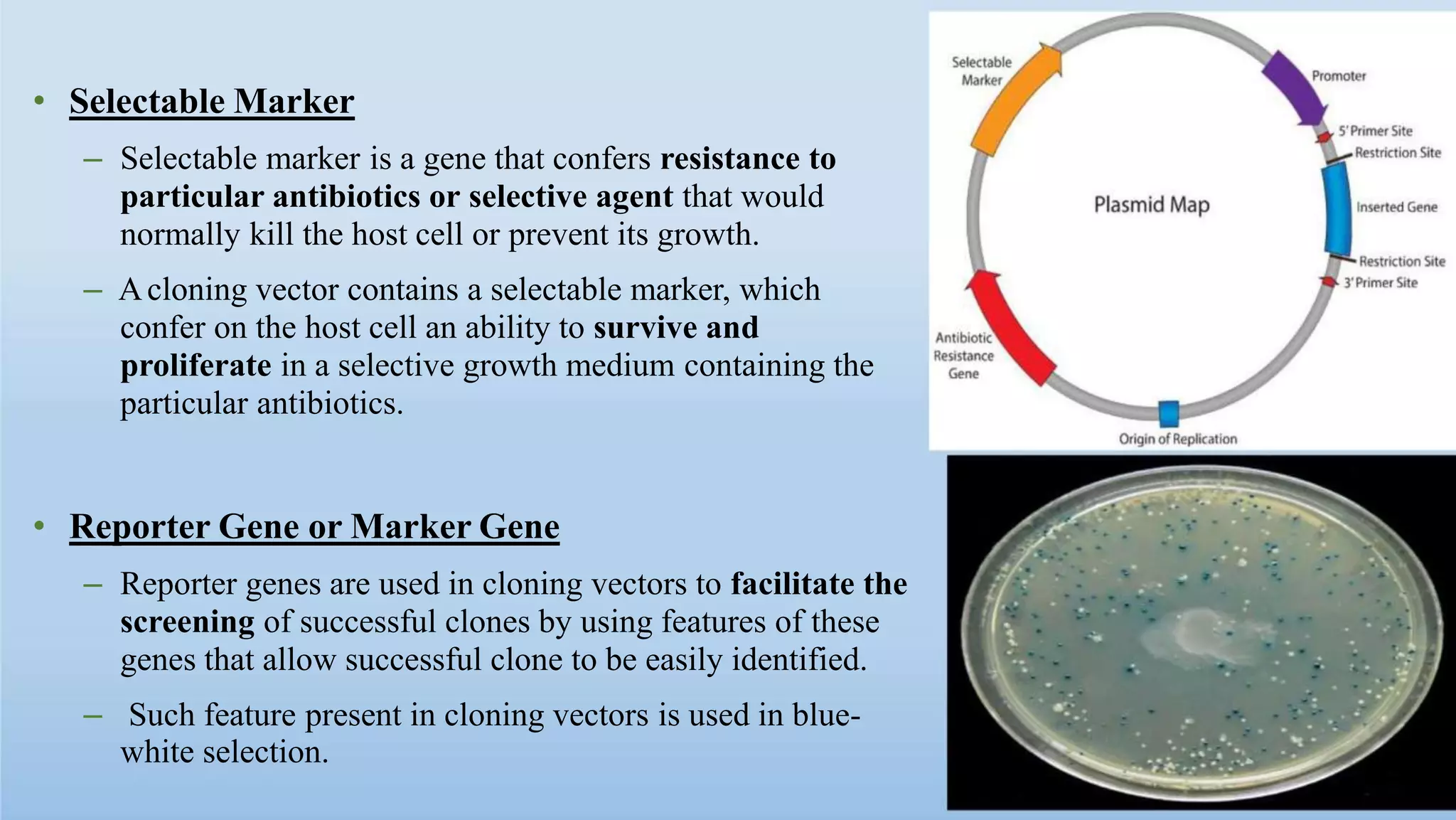
• Selectable Marker
– Selectable marker is a gene that confers resistance to
particular antibiotics or selective agent that would
normally kill the host cell or prevent its growth.
– Acloning vector contains a selectable marker, which
confer on the host cell an ability to survive and
proliferate in a selective growth medium containing the
particular antibiotics.
• Reporter Gene or Marker Gene
– Reporter genes are used in cloning vectors to facilitate the
screening of successful clones by using features of these
genes that allow successful clone to be easily identified.
– Such feature present in cloning vectors is used in blue-
white selection.
• Additional Properties of Vectors:
─ It should be short, small.
─ Compatible with host cell.
─ Incompatible with other vector.
─ Should become high in copy number.
─ It should able to express itself utilizing the
host machinery.
─ It should be able to move under two
system (Prokaryote and Eukaryote
system).
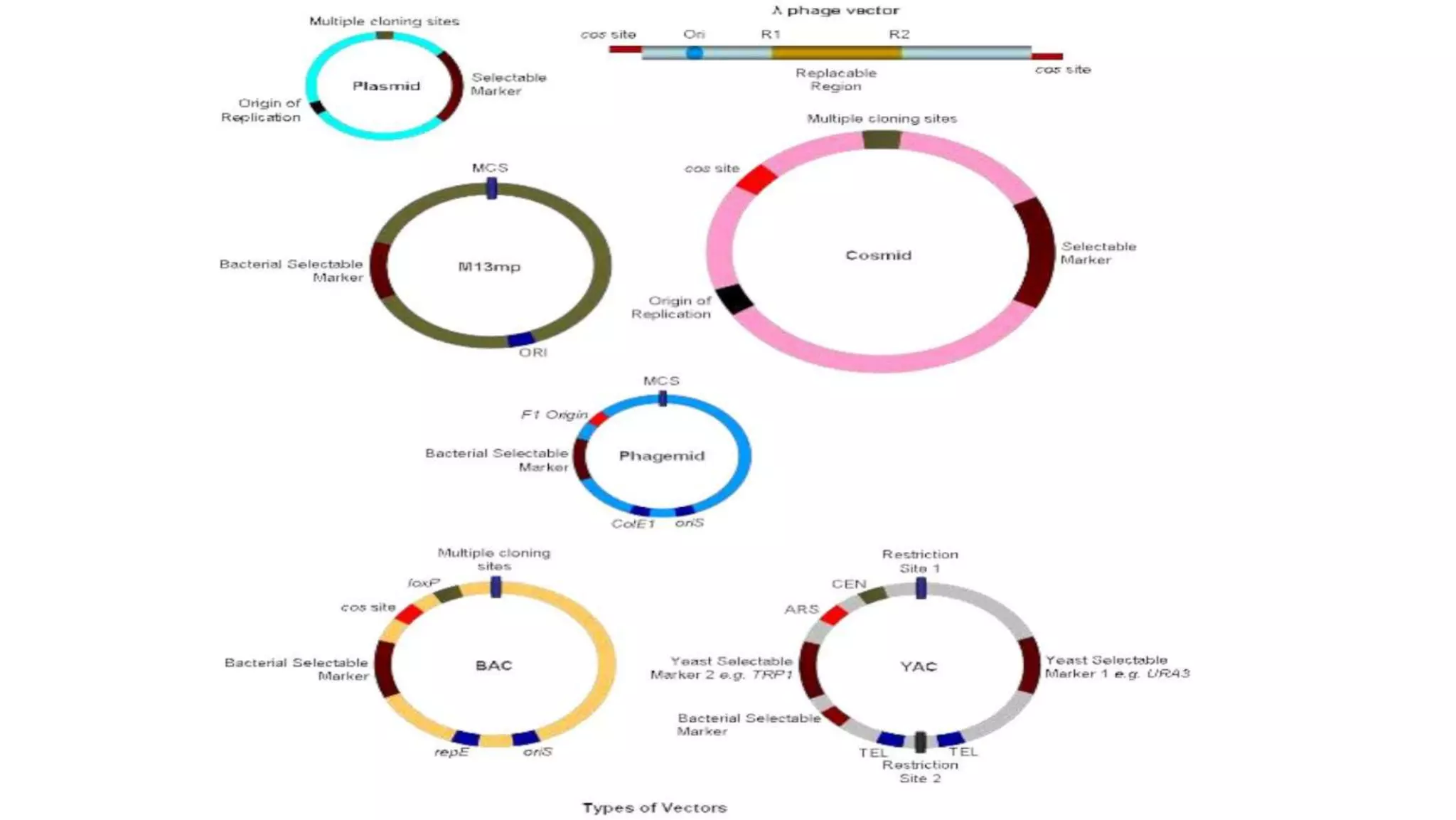
Types of Cloning Vectors
• Plasmid
• Bacteriophage
• Cosmid
• BacterialArtificial Chromosome (BAC)
• YeastArtificial Chromosome (BAC)
• HumanArtificial Chromosome (HAC)
• Retroviral Vectors
Plasmid
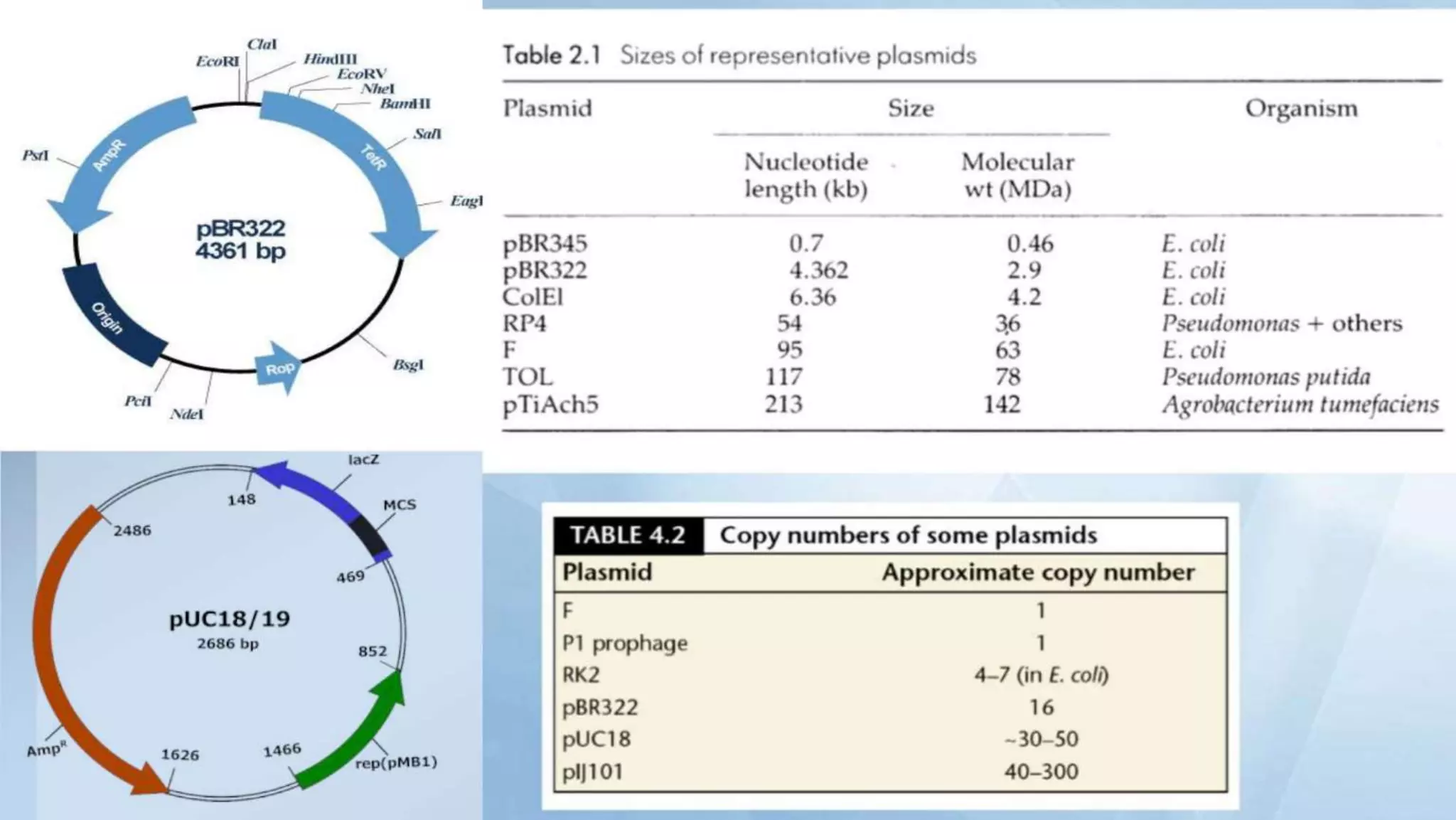
• Plasmid is an autonomously replicating circular double stranded extra-
chromosomal DNA which is physically separated from a chromosomal DNA and can
replicate independently.
• They are most commonly found in bacteria, sometimes they are present in archaea and
eukaryotic organisms.
• The size of the plasmid varies from 1 to over 200 kb.
• Most general plasmids may be used to clone DNA insert of up to 10 kb in size.
• Many plasmids have high copy number and high copy number is useful as it produces
greater yield of recombinant plasmid for subsequent manipulation
• However low copy number plasmids may be preferably used in certain circumstances,
for example, when the protein from the cloned gene is toxic to the cells.
• Example: pBR322, pUC18, F plasmid, Col Plasmid etc.
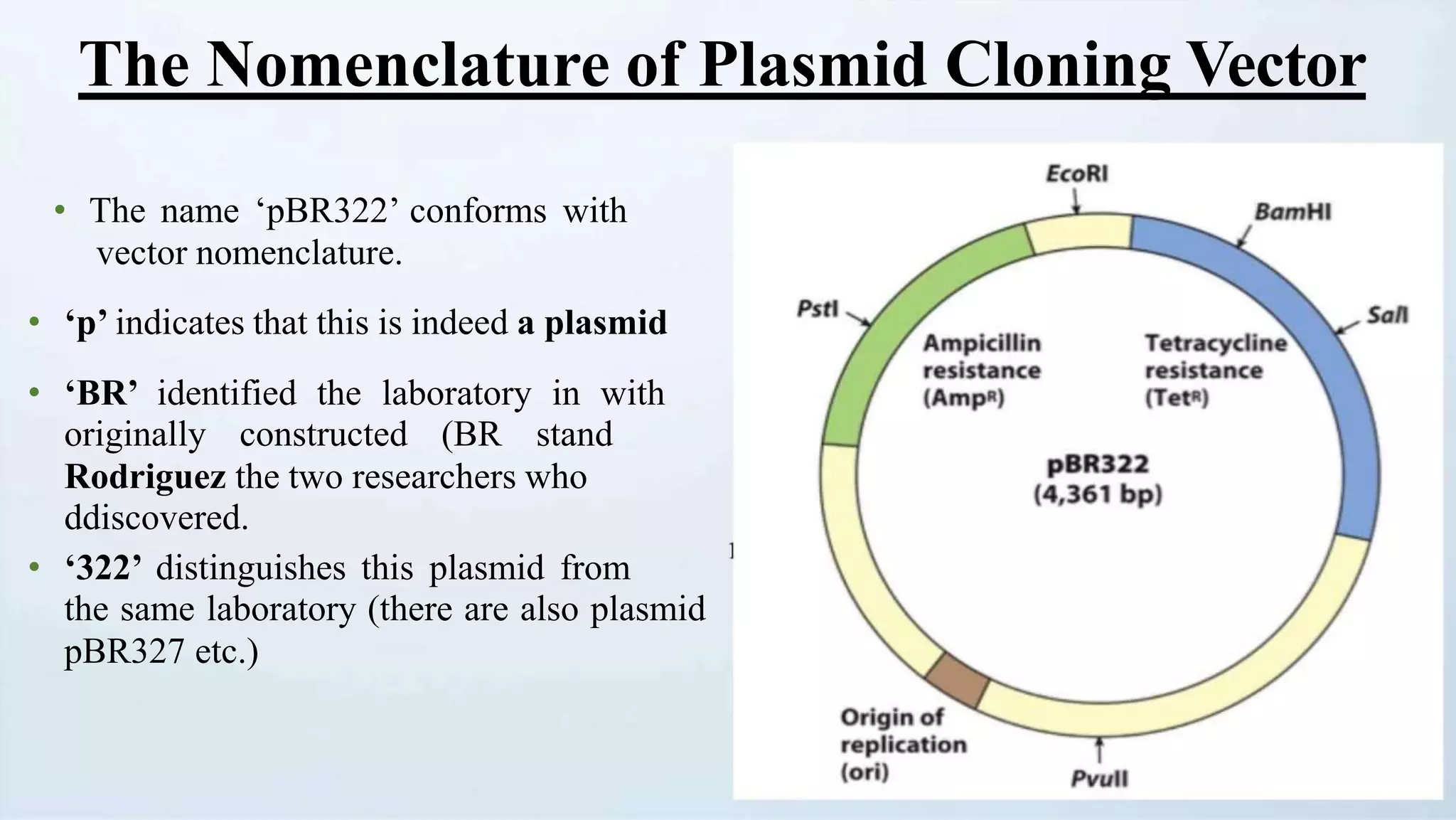
The Nomenclature of Plasmid Cloning Vector
• The name ‘pBR322’ conforms with
vector nomenclature.
• ‘p’ indicates that this is indeed a plasmid
• ‘BR’ identified the laboratory in with
originally constructed (BR stand
Rodriguez the two researchers who
ddiscovered.
• ‘322’ distinguishes this plasmid from
the same laboratory (there are also plasmid
pBR327 etc.)
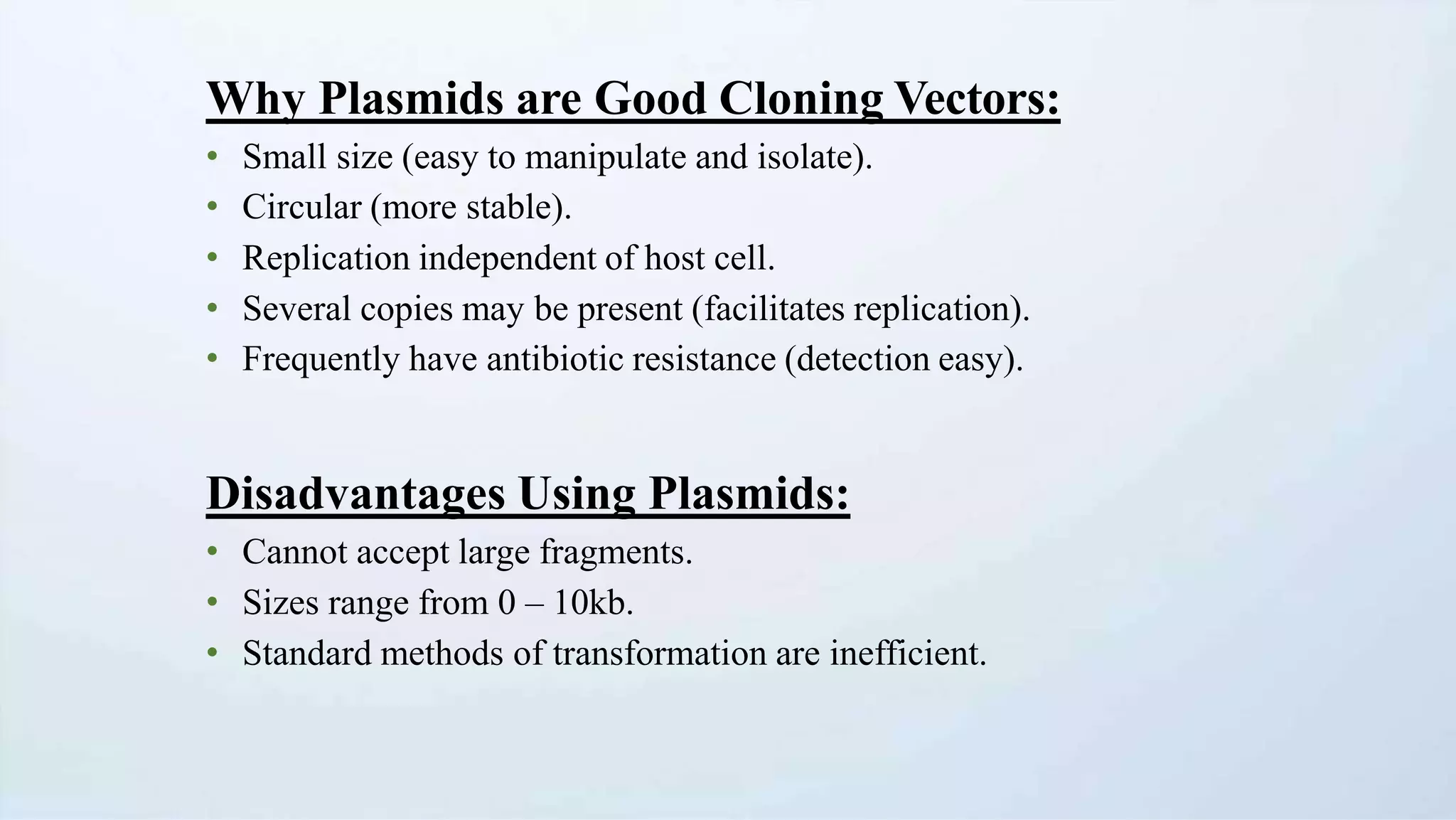
Why Plasmids are Good Cloning Vectors:
• Small size (easy to manipulate and isolate).
• Circular (more stable).
• Replication independent of host cell.
• Several copies may be present (facilitates replication).
• Frequently have antibiotic resistance (detection easy).
Disadvantages Using Plasmids:
• Cannot accept large fragments.
• Sizes range from 0 – 10kb.
• Standard methods of transformation are inefficient.
Bacteriophage
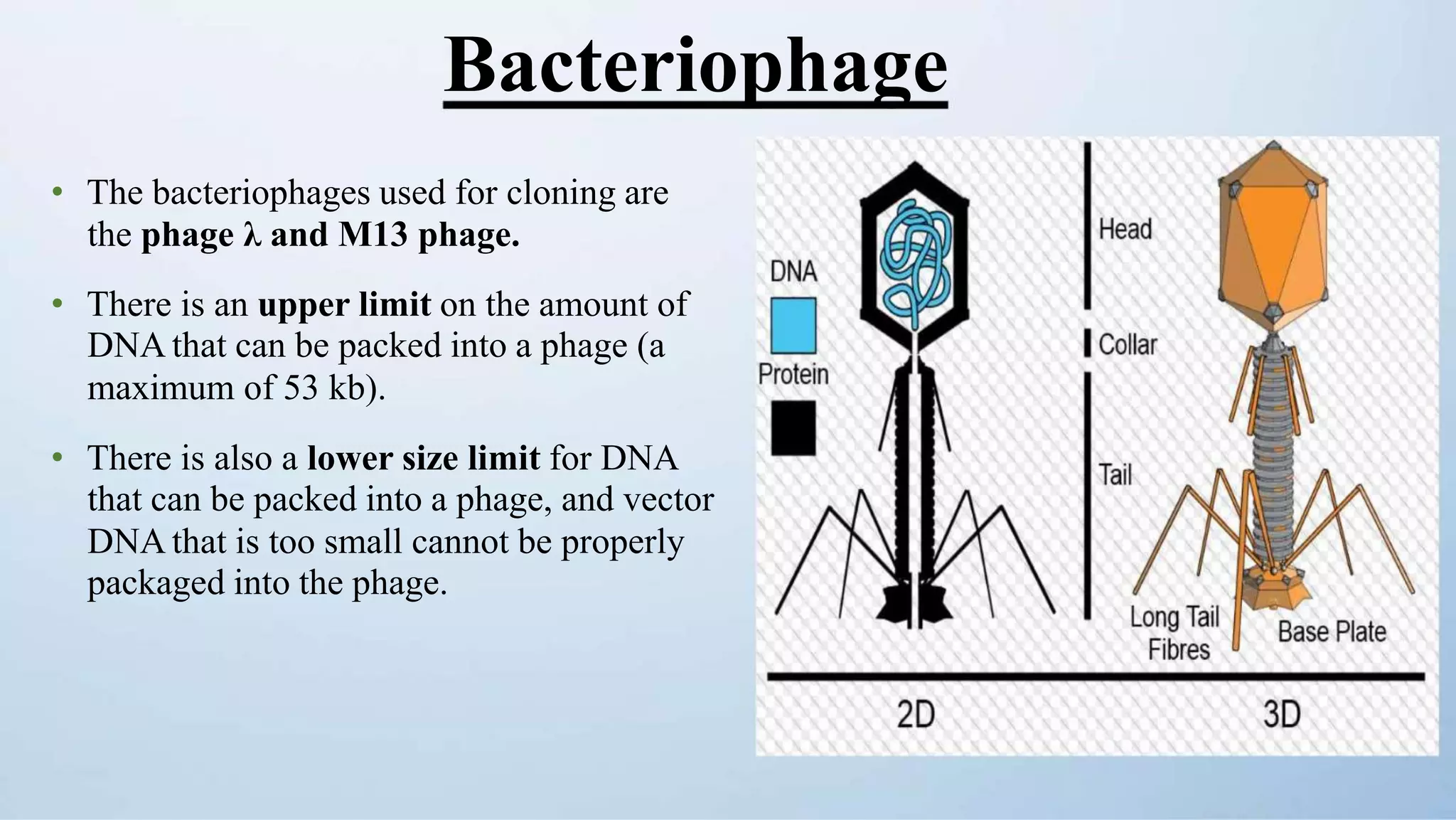
• The bacteriophages used for cloning are
the phage λ and M13 phage.
• There is an upper limit on the amount of
DNA that can be packed into a phage (a
maximum of 53 kb).
• There is also a lower size limit for DNA
that can be packed into a phage, and vector
DNA that is too small cannot be properly
packaged into the phage.
Phage Lambda
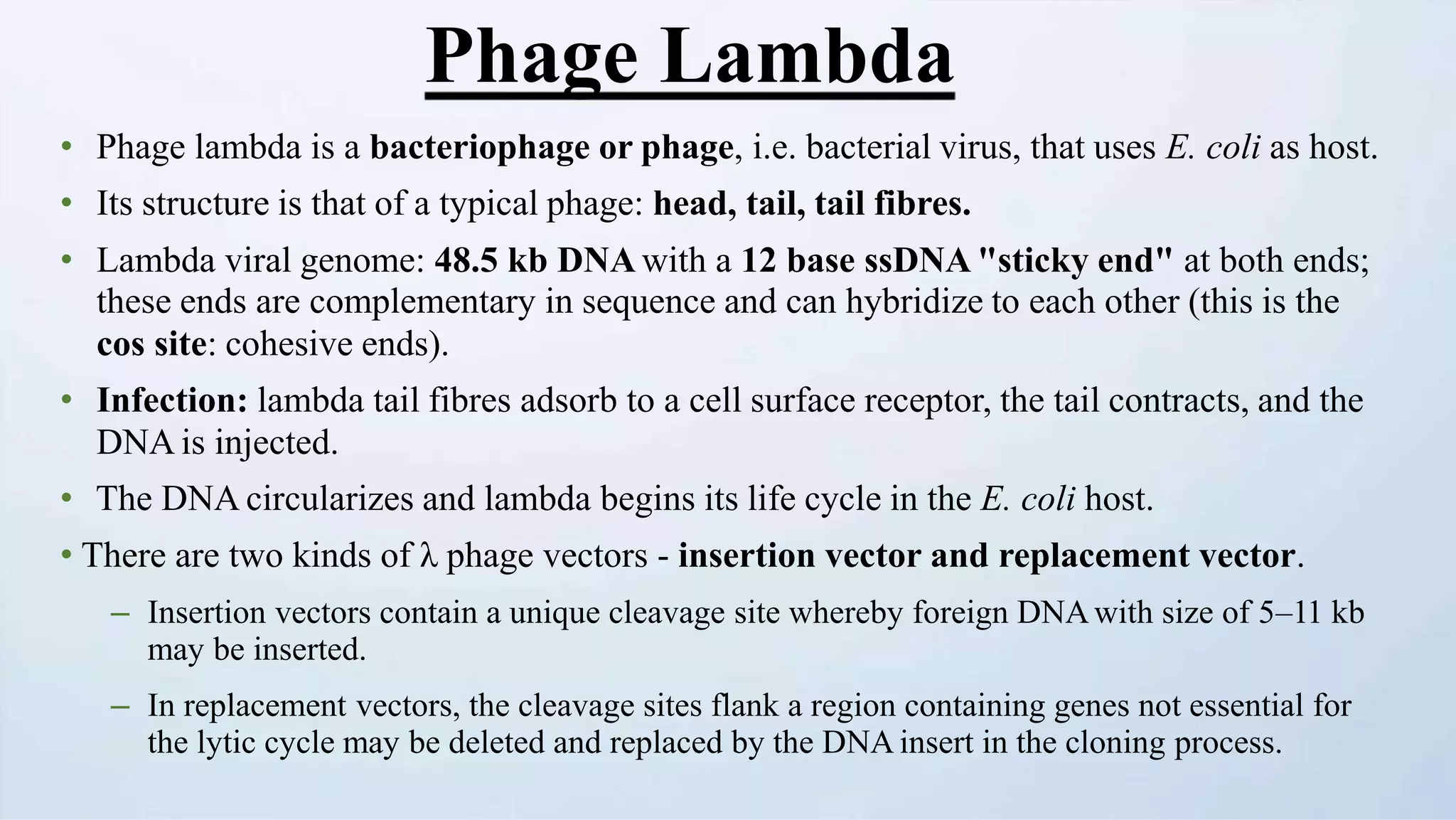
• Phage lambda is a bacteriophage or phage, i.e. bacterial virus, that uses E. coli as host.
• Its structure is that of a typical phage: head, tail, tail fibres.
• Lambda viral genome: 48.5 kb DNA with a 12 base ssDNA "sticky end" at both ends;
these ends are complementary in sequence and can hybridize to each other (this is the
cos site: cohesive ends).
• Infection: lambda tail fibres adsorb to a cell surface receptor, the tail contracts, and the
DNA is injected.
• The DNA circularizes and lambda begins its life cycle in the E. coli host.
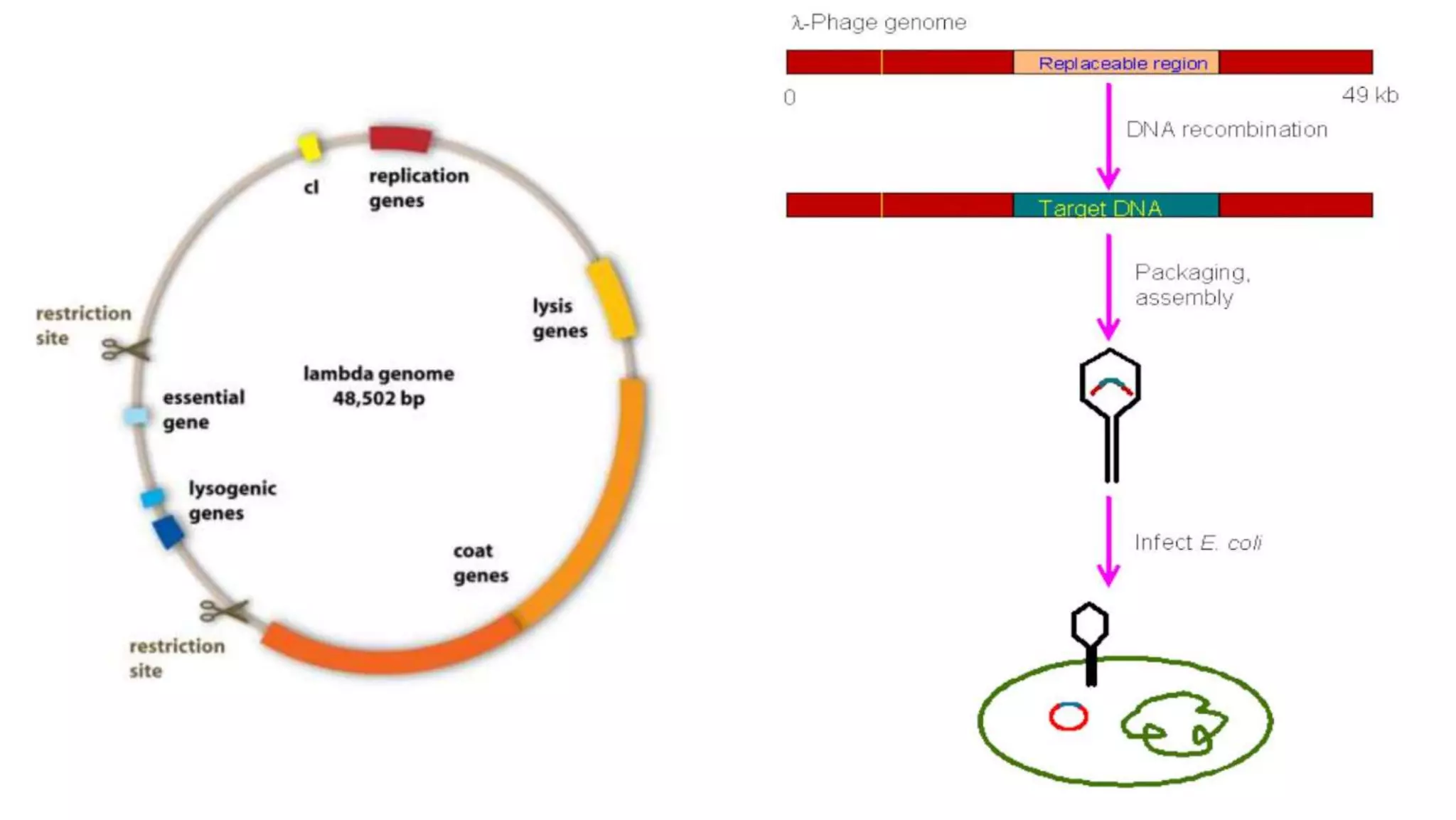
• There are two kinds of λ phage vectors - insertion vector and replacement vector.
– Insertion vectors contain a unique cleavage site whereby foreign DNAwith size of 5–11 kb
may be inserted.
– In replacement vectors, the cleavage sites flank a region containing genes not essential for
the lytic cycle may be deleted and replaced by the DNA insert in the cloning process.
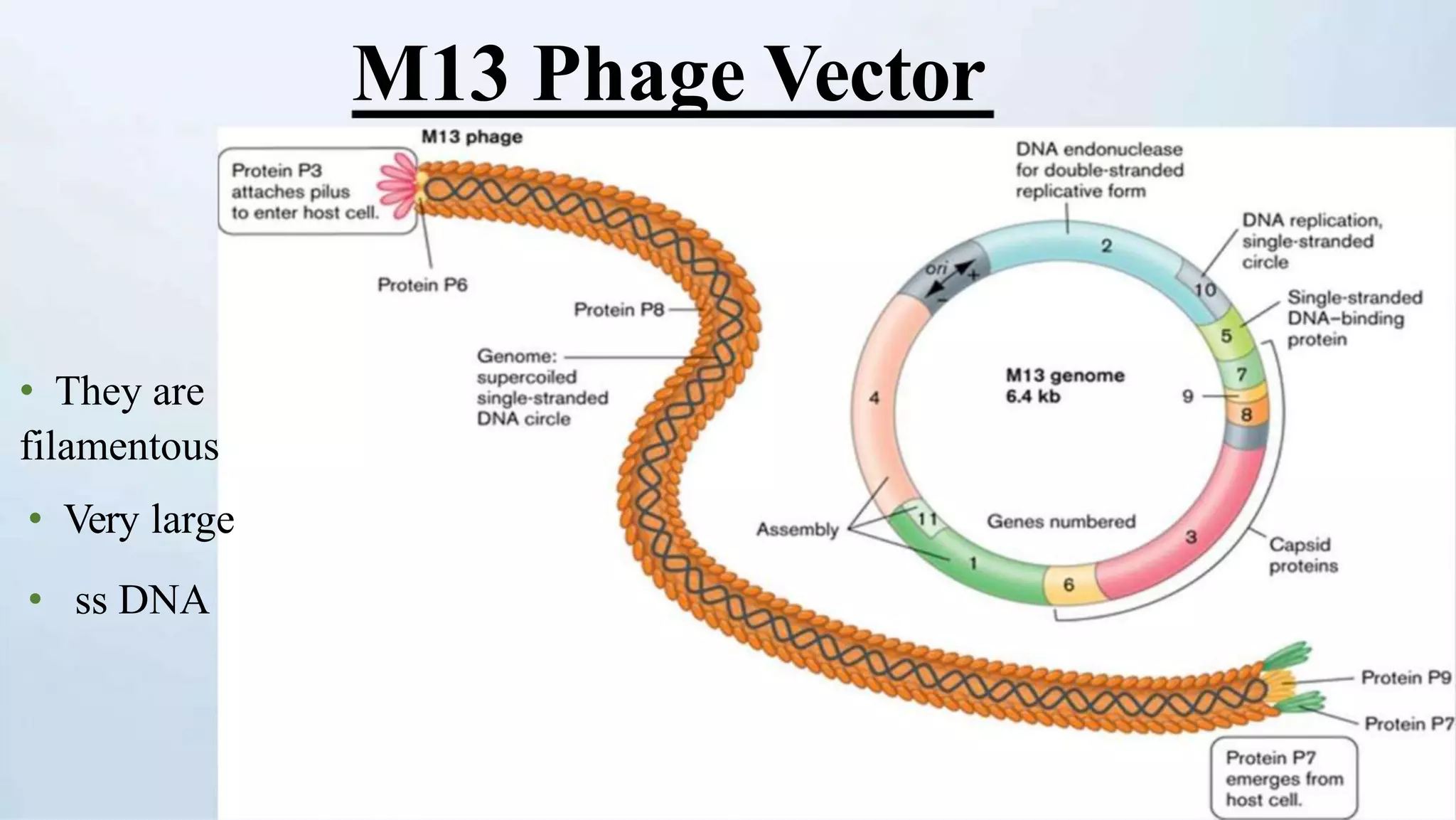
M13 Phage Vector
• They are
filamentous
• Very large
• ss DNA
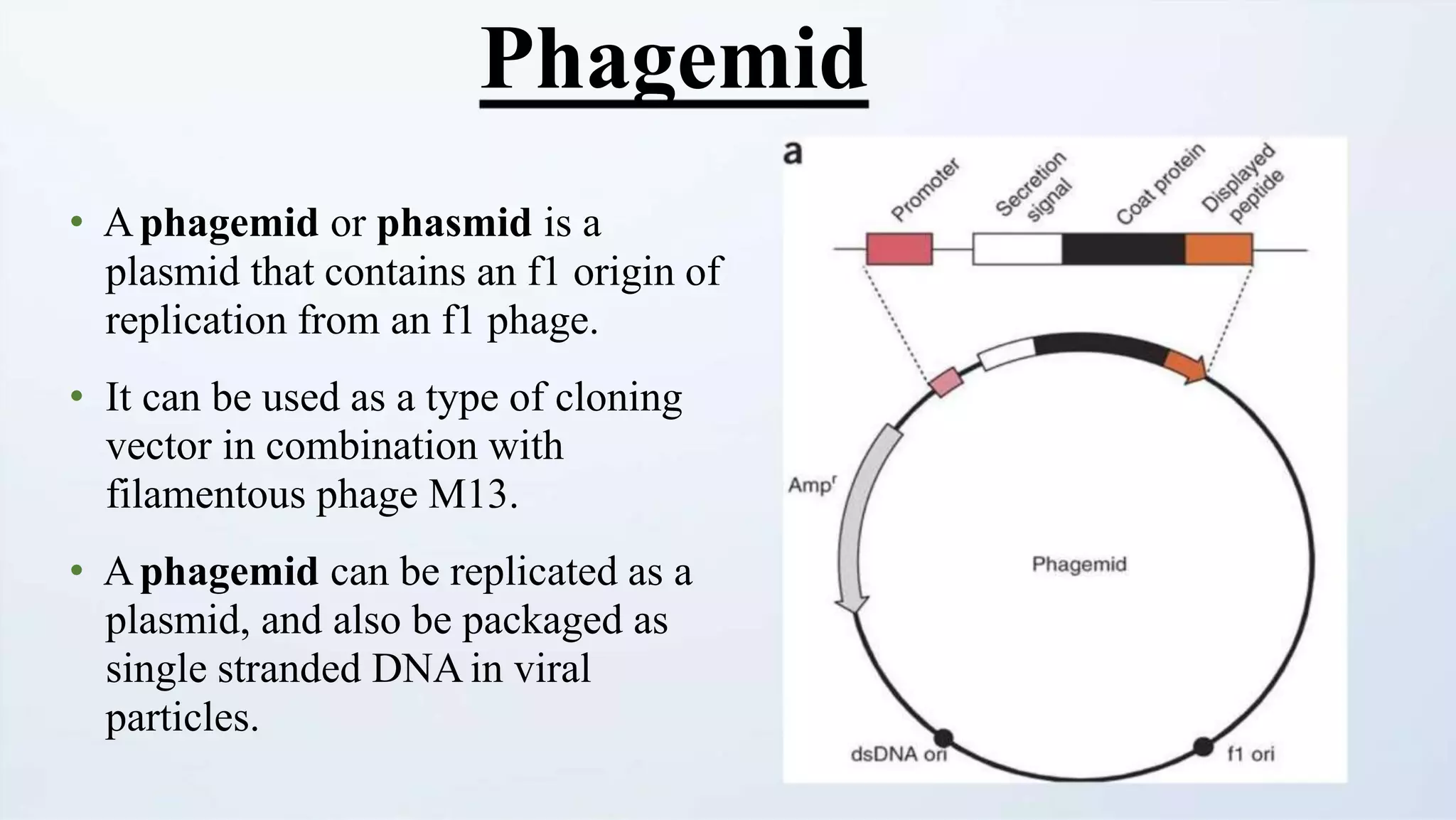
Phagemid
• Aphagemid or phasmid is a
plasmid that contains an f1 origin of
replication from an f1 phage.
• It can be used as a type of cloning
vector in combination with
filamentous phage M13.
• Aphagemid can be replicated as a
plasmid, and also be packaged as
single stranded DNA in viral
particles.
Phage Vectors Present TwoAdvantages Over Plasmid Vectors-
1. They are more efficient than plasmids for cloning of large DNA
fragments; the largest cloned insert in lambda phage is 24 kb,
while for plasmid vector it is less than 15 kb.
2. It is easier to screen a large number of phage plaques than
bacterial colonies for identification of recombinant vectors.
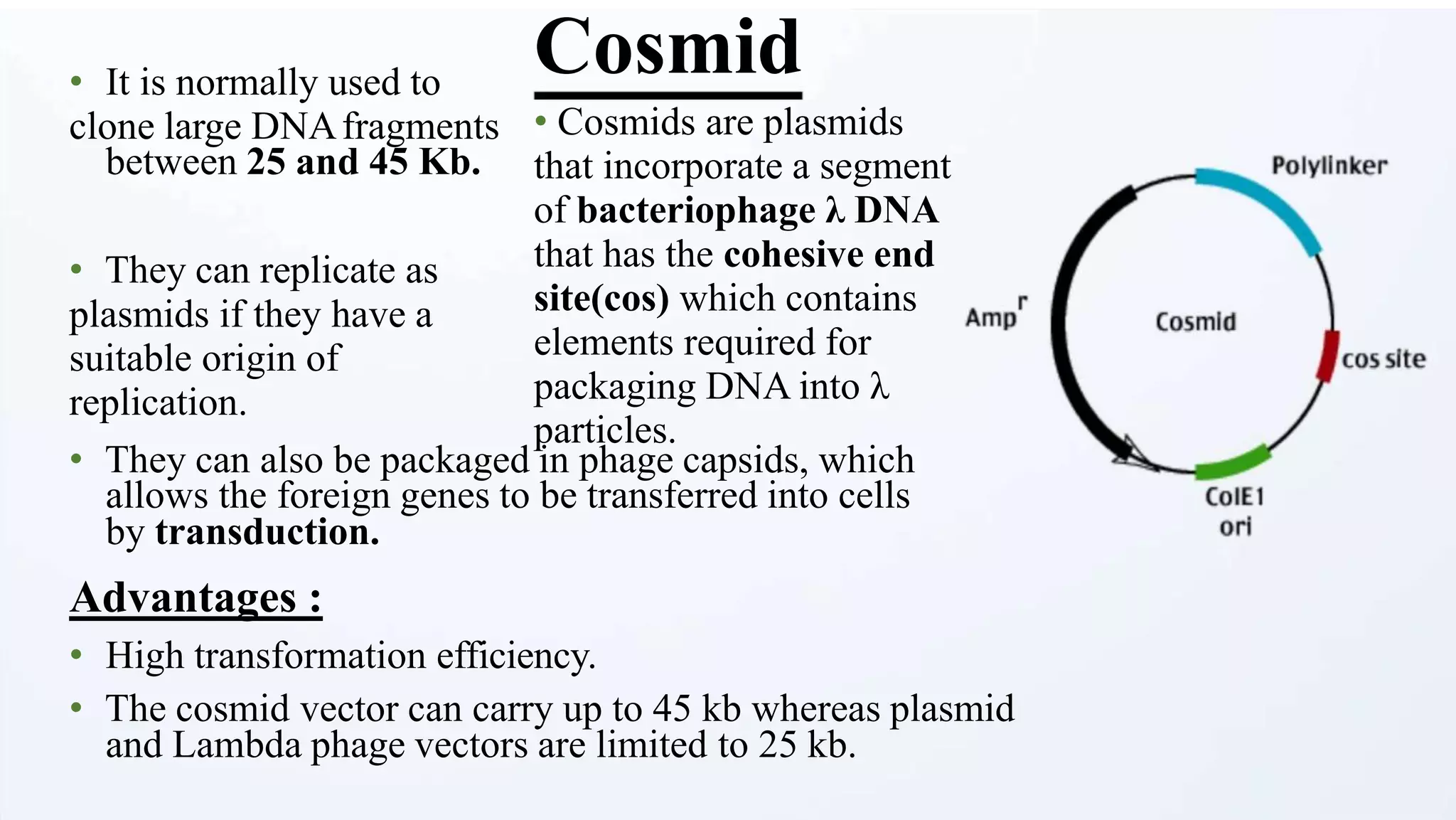
Cosmid
• Cosmids are plasmids
that incorporate a segment
of bacteriophage λ DNA
that has the cohesive end
site(cos) which contains
elements required for
packaging DNA into λ
particles.
• It is normally used to
clone large DNAfragments
between 25 and 45 Kb.
• They can replicate as
plasmids if they have a
suitable origin of
replication.
• They can also be packaged in phage capsids, which
allows the foreign genes to be transferred into cells
by transduction.
Advantages :
• High transformation efficiency.
• The cosmid vector can carry up to 45 kb whereas plasmid
and Lambda phage vectors are limited to 25 kb.
YeastArtificial C
• The yeast artificial chromosome (YAC
capable of carrying a large DNAfragm
Kb), but its transformation efficienc
• Cloning vehicles that propogate in
hosts as eukaryotic chromosomes.
• Final chimeric DNA is a linear DNA
telomeric ends: Artificial
Chromosome
• YAC cloning vehicles often have a bacterial DNA
replication (ori) and a selection propogation of the
YAC through yeast and bacteria.
• The YAC can use both yeast and
bacteria
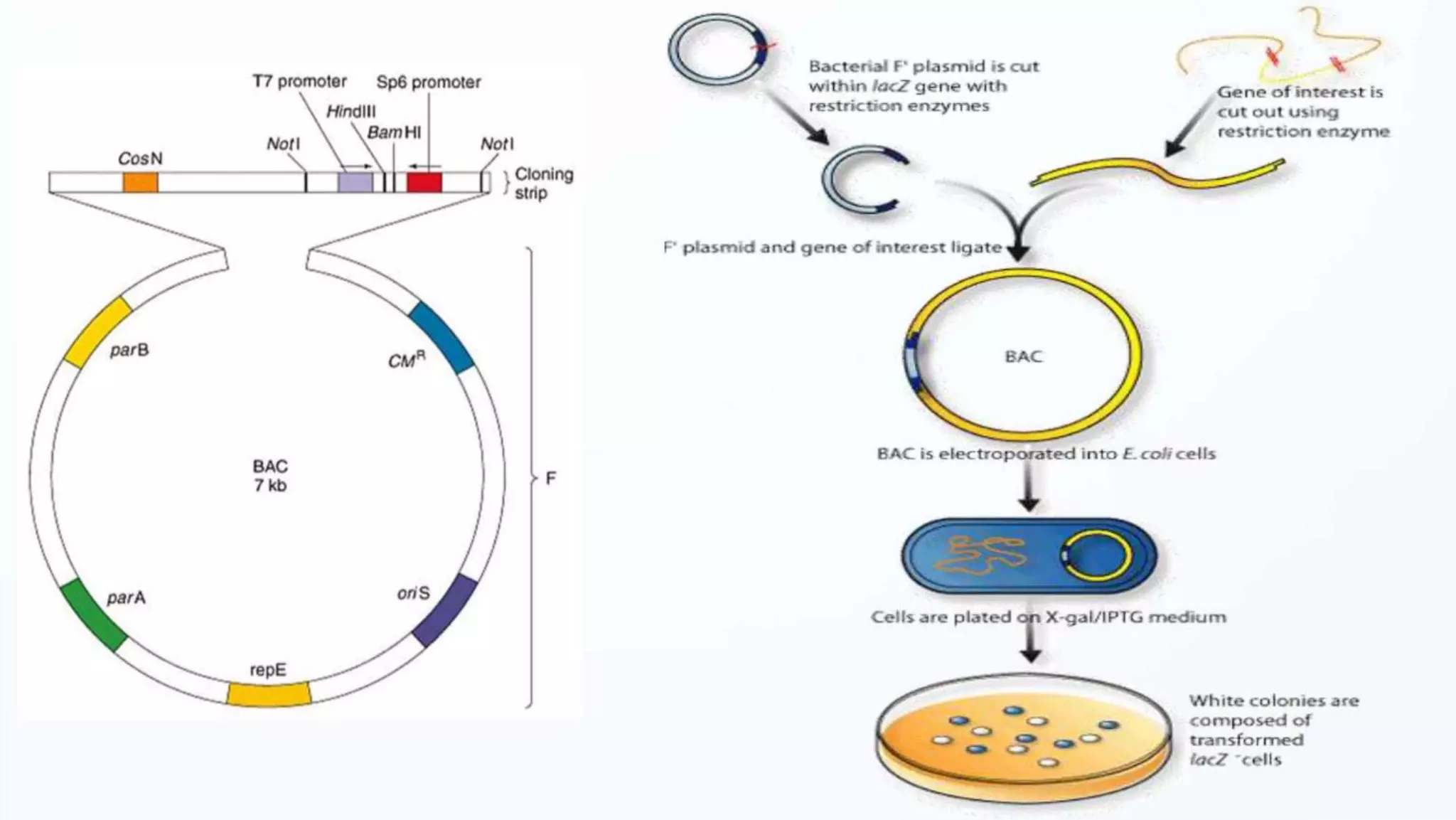
BacterialArtificial Chromosome (BAC)
• BAC vectors are similar to standard E. coli plasmid vectors.
• Contain the origin and genes encoding the ori binding proteins required for
plasmid replication.
• Derived from a naturally occurring large plasmid, the Fʹ plasmid.
• Low copy number (1-2 copies per cell)
• The bacterial artificial chromosome's usual insert size is 150-350 kb.
• BACs are preferred for different kind of genetic studies of inherited or
infectious diseases because they accommodate much larger sequences
without the risk of rearrangement, and are therefore more stable than
other types of cloning vectors.
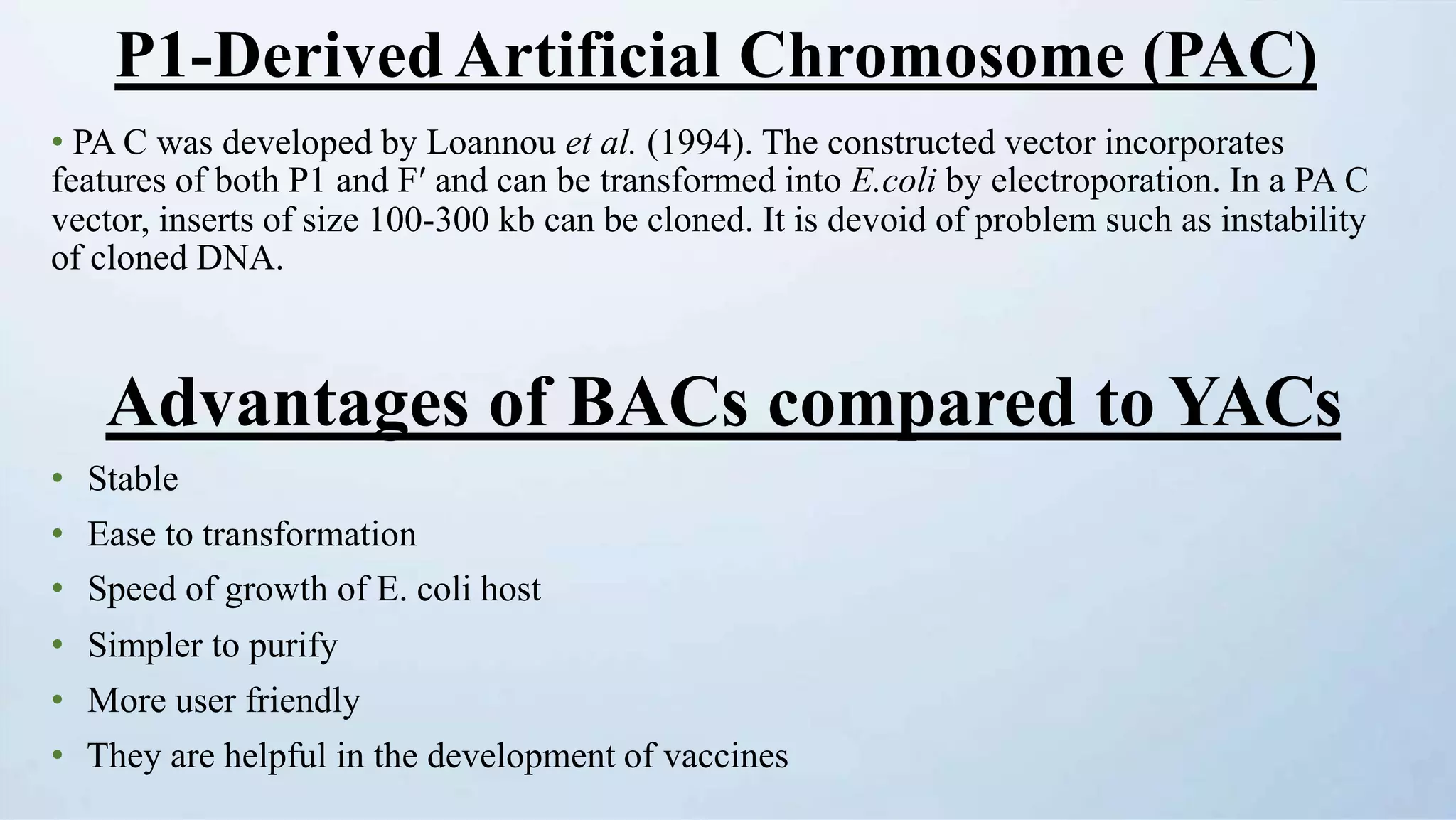
P1-Derived Artificial Chromosome (PAC)
• PA C was developed by Loannou et al. (1994). The constructed vector incorporates
features of both P1 and Fʹ and can be transformed into E.coli by electroporation. In a PA C
vector, inserts of size 100-300 kb can be cloned. It is devoid of problem such as instability
of cloned DNA.
Advantages of BACs compared to YACs
• Stable
• Ease to transformation
• Speed of growth of E. coli host
• Simpler to purify
• More user friendly
• They are helpful in the development of vaccines
HumanArtificial Chromosome (HAC)
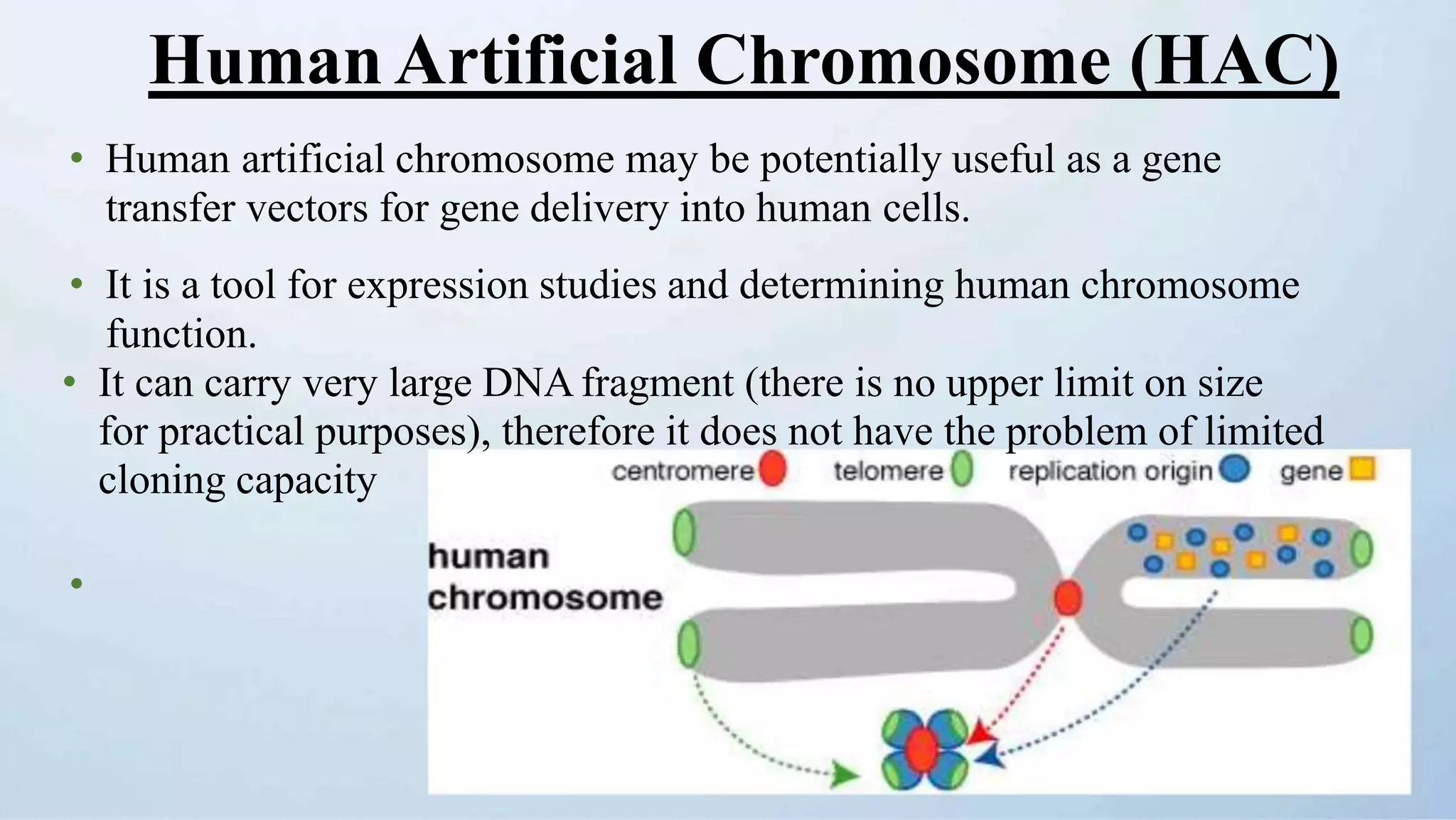
• Human artificial chromosome may be potentially useful as a gene
transfer vectors for gene delivery into human cells.
• It is a tool for expression studies and determining human chromosome
function.
• It can carry very large DNA fragment (there is no upper limit on size
for practical purposes), therefore it does not have the problem of limited
cloning capacity
•
Retroviral Vectors
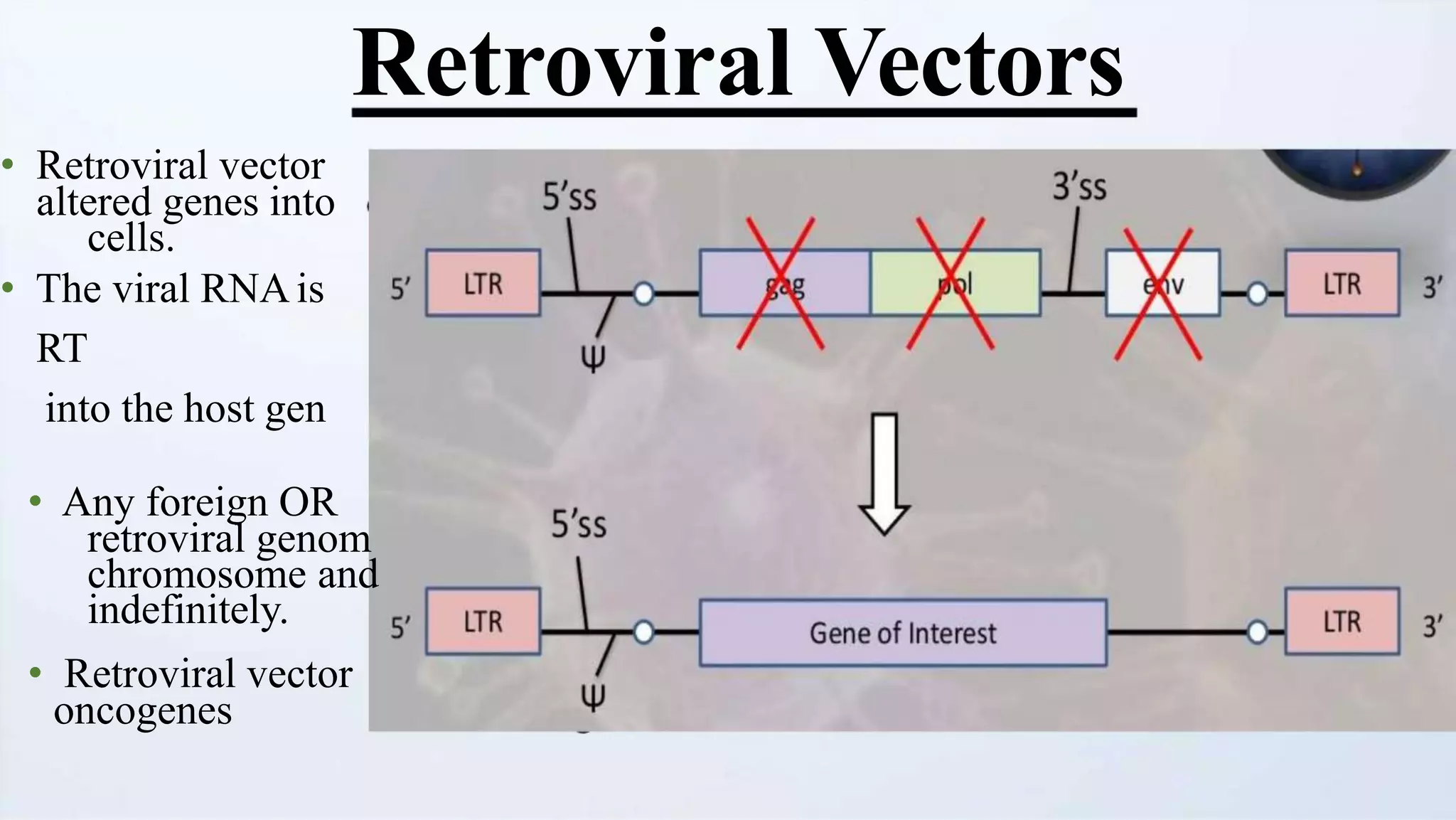
• Retroviral vector
altered genes into
cells.
• The viral RNAis
RT
into the host gen
• Any foreign OR
retroviral genom
chromosome and
indefinitely.
• Retroviral vector
oncogenes
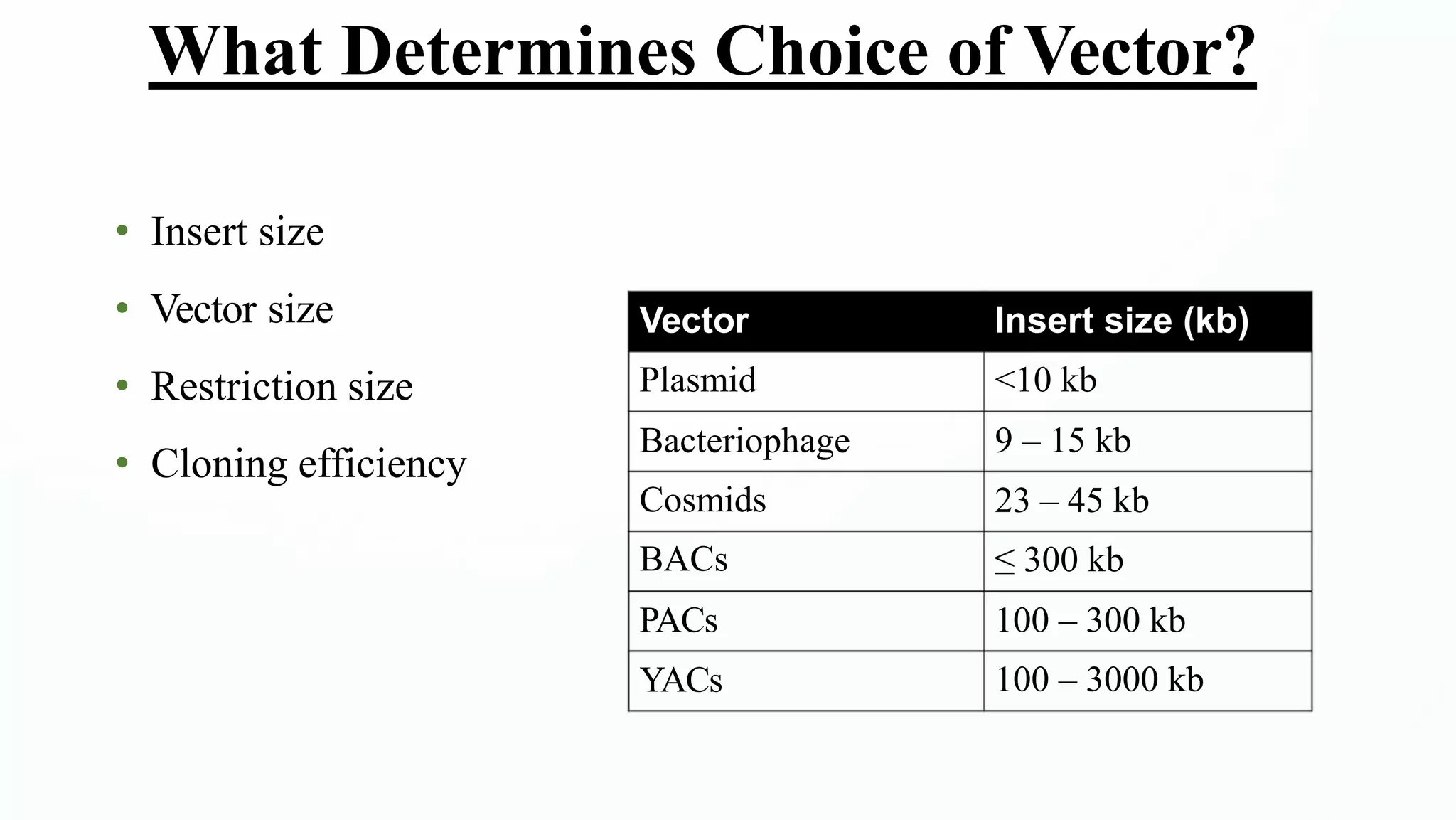
What Determines Choice of Vector?
• Insert size
• Vector size Vector
Plasmid
Bacteriophage
Cosmids
BACs
Insert size (kb)
<10 kb
• Restriction size
9 – 15 kb
• Cloning efficiency
23 – 45 kb
≤ 300 kb
PACs 100 – 300 kb
100 – 3000 kb
YACs
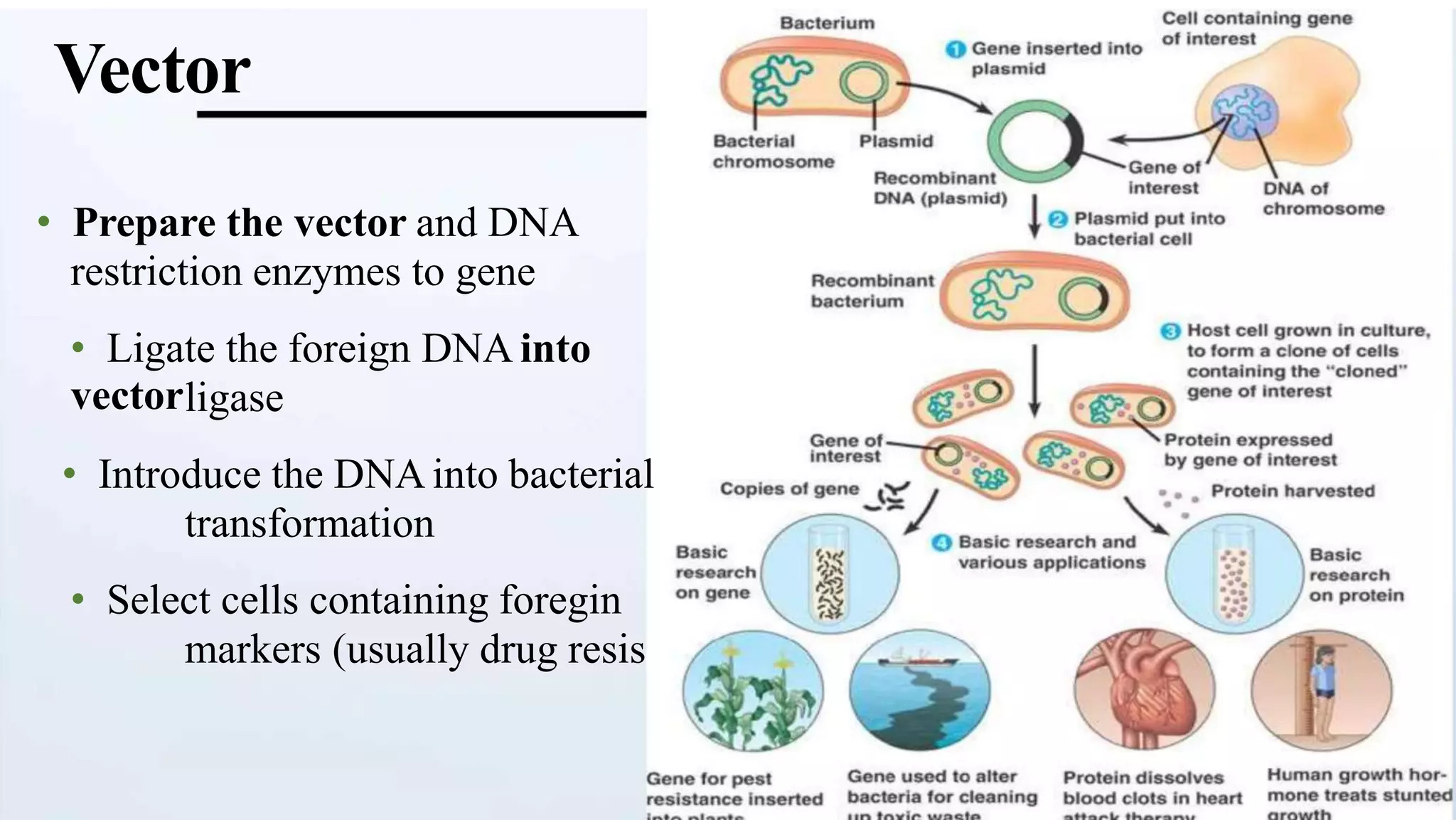
Vector
• Prepare the vector and DNA
restriction enzymes to gene
• Ligate the foreign DNA into
vectorligase
• Introduce the DNA into bacterial
transformation
• Select cells containing foregin
markers (usually drug resis
cloning vectors.ppt

cloning vectors.ppt

  • 1.
  • 2.
    Objectives After the endof the presentation we’ll know - • What is cloning vector? • Why cloning vector? • History • Features of a cloning vector • Types of cloning vector – Plasmid – Bacteriophage – Cosmid – BacterialArtificial Chromosome (BAC) – YeastArtificial Chromosome (BAC) – HumanArtificial Chromosome (HAC) – Retroviral Vectors • What determines choice of vector? • Vector in molecular gene cloning
  • 3.
    Cloning Vector • Themolecular analysis of DNA has been made possible by the cloning of DNA. The two molecules that are required for cloning are the DNA to be cloned and a cloning vector. • Acloning vector is a small piece of DNA taken from a virus, a plasmid or the cell of a higher organism, that can be stably maintained in an organism and into which a foreign DNA fragment can be inserted for cloning purposes. • Most vectors are genetically engineered. • The cloning vector is chosen according to the size and type of DNA to be cloned.
  • 4.
    Cloning Vector • Thevector therefore contains features that allow for the convenient insertion or removal of DNA fragment in or out of the vector, for example by treating the vector and the foreign DNA with a restriction enzyme and then ligating the fragments together. • After a DNA fragment has been cloned into a cloning vector, it may be further subcloned into another vector designed for more specific use.
  • 5.
    Why Cloning Vector? •Cloning vector is used as a vehicle to artificially carry foreign genetic material into another cell, where it can be replicated and expressed. • It is used to amplify a single molecule of DNA into many copes. • Cloning vectors are DNA molecules that are used to "transport" cloned sequences between biological hosts and the test tube. • Without Cloning Vector, Molecular Gene Cloning is totally impossible.
  • 6.
  • 7.
    History • Scientists (HerbertBoyer, Keiichi Itakura and Arthur Riggs) working in Boyer’s lab (University of California) recognized a general cloning vector with unique restriction sites for cloning in foreign DNA and the expression of antibiotic resistance genes for selection of transformed bacteria. • In 1977, they described the first vector designed for cloning purposes, pBR322 – a plasmid. • This vector was small, ~4 kb in size, and had two antibiotic resistance genes for selection.
  • 9.
    Features ofACloning Vector Allcommonly used cloning vectors have some essential features: • Origin of replication (ori): – This makes autonomous replication in vector. – ori is a specific sequence of nucleotide from where replication starts. – When foreign DNA is linked to the sequence along with vector replication, foreign (desirable) DNA also starts replicating within host cell. • Cloning Site: – Cloning site is a place where the vector DNA can be digested and desired DNA can be inserted by the same restriction enzyme. – It is a point of entry or analysis for genetic engineering work. – Recently recombinant plasmids contain a multiple cloning site (MCS) which have many (up to ~20) restriction sites.
  • 10.
    • Selectable Marker –Selectable marker is a gene that confers resistance to particular antibiotics or selective agent that would normally kill the host cell or prevent its growth. – Acloning vector contains a selectable marker, which confer on the host cell an ability to survive and proliferate in a selective growth medium containing the particular antibiotics. • Reporter Gene or Marker Gene – Reporter genes are used in cloning vectors to facilitate the screening of successful clones by using features of these genes that allow successful clone to be easily identified. – Such feature present in cloning vectors is used in blue- white selection.
  • 11.
    • Additional Propertiesof Vectors: ─ It should be short, small. ─ Compatible with host cell. ─ Incompatible with other vector. ─ Should become high in copy number. ─ It should able to express itself utilizing the host machinery. ─ It should be able to move under two system (Prokaryote and Eukaryote system).
  • 12.
    Types of CloningVectors • Plasmid • Bacteriophage • Cosmid • BacterialArtificial Chromosome (BAC) • YeastArtificial Chromosome (BAC) • HumanArtificial Chromosome (HAC) • Retroviral Vectors
  • 14.
    Plasmid • Plasmid isan autonomously replicating circular double stranded extra- chromosomal DNA which is physically separated from a chromosomal DNA and can replicate independently. • They are most commonly found in bacteria, sometimes they are present in archaea and eukaryotic organisms. • The size of the plasmid varies from 1 to over 200 kb. • Most general plasmids may be used to clone DNA insert of up to 10 kb in size. • Many plasmids have high copy number and high copy number is useful as it produces greater yield of recombinant plasmid for subsequent manipulation • However low copy number plasmids may be preferably used in certain circumstances, for example, when the protein from the cloned gene is toxic to the cells. • Example: pBR322, pUC18, F plasmid, Col Plasmid etc.
  • 16.
    The Nomenclature ofPlasmid Cloning Vector • The name ‘pBR322’ conforms with vector nomenclature. • ‘p’ indicates that this is indeed a plasmid • ‘BR’ identified the laboratory in with originally constructed (BR stand Rodriguez the two researchers who ddiscovered. • ‘322’ distinguishes this plasmid from the same laboratory (there are also plasmid pBR327 etc.)
  • 17.
    Why Plasmids areGood Cloning Vectors: • Small size (easy to manipulate and isolate). • Circular (more stable). • Replication independent of host cell. • Several copies may be present (facilitates replication). • Frequently have antibiotic resistance (detection easy). Disadvantages Using Plasmids: • Cannot accept large fragments. • Sizes range from 0 – 10kb. • Standard methods of transformation are inefficient.
  • 18.
    Bacteriophage • The bacteriophagesused for cloning are the phage λ and M13 phage. • There is an upper limit on the amount of DNA that can be packed into a phage (a maximum of 53 kb). • There is also a lower size limit for DNA that can be packed into a phage, and vector DNA that is too small cannot be properly packaged into the phage.
  • 19.
    Phage Lambda • Phagelambda is a bacteriophage or phage, i.e. bacterial virus, that uses E. coli as host. • Its structure is that of a typical phage: head, tail, tail fibres. • Lambda viral genome: 48.5 kb DNA with a 12 base ssDNA "sticky end" at both ends; these ends are complementary in sequence and can hybridize to each other (this is the cos site: cohesive ends). • Infection: lambda tail fibres adsorb to a cell surface receptor, the tail contracts, and the DNA is injected. • The DNA circularizes and lambda begins its life cycle in the E. coli host. • There are two kinds of λ phage vectors - insertion vector and replacement vector. – Insertion vectors contain a unique cleavage site whereby foreign DNAwith size of 5–11 kb may be inserted. – In replacement vectors, the cleavage sites flank a region containing genes not essential for the lytic cycle may be deleted and replaced by the DNA insert in the cloning process.
  • 21.
    M13 Phage Vector •They are filamentous • Very large • ss DNA
  • 22.
    Phagemid • Aphagemid orphasmid is a plasmid that contains an f1 origin of replication from an f1 phage. • It can be used as a type of cloning vector in combination with filamentous phage M13. • Aphagemid can be replicated as a plasmid, and also be packaged as single stranded DNA in viral particles.
  • 23.
    Phage Vectors PresentTwoAdvantages Over Plasmid Vectors- 1. They are more efficient than plasmids for cloning of large DNA fragments; the largest cloned insert in lambda phage is 24 kb, while for plasmid vector it is less than 15 kb. 2. It is easier to screen a large number of phage plaques than bacterial colonies for identification of recombinant vectors.
  • 24.
    Cosmid • Cosmids areplasmids that incorporate a segment of bacteriophage λ DNA that has the cohesive end site(cos) which contains elements required for packaging DNA into λ particles. • It is normally used to clone large DNAfragments between 25 and 45 Kb. • They can replicate as plasmids if they have a suitable origin of replication. • They can also be packaged in phage capsids, which allows the foreign genes to be transferred into cells by transduction. Advantages : • High transformation efficiency. • The cosmid vector can carry up to 45 kb whereas plasmid and Lambda phage vectors are limited to 25 kb.
  • 25.
    YeastArtificial C • Theyeast artificial chromosome (YAC capable of carrying a large DNAfragm Kb), but its transformation efficienc • Cloning vehicles that propogate in hosts as eukaryotic chromosomes. • Final chimeric DNA is a linear DNA telomeric ends: Artificial Chromosome • YAC cloning vehicles often have a bacterial DNA replication (ori) and a selection propogation of the YAC through yeast and bacteria. • The YAC can use both yeast and bacteria
  • 26.
    BacterialArtificial Chromosome (BAC) •BAC vectors are similar to standard E. coli plasmid vectors. • Contain the origin and genes encoding the ori binding proteins required for plasmid replication. • Derived from a naturally occurring large plasmid, the Fʹ plasmid. • Low copy number (1-2 copies per cell) • The bacterial artificial chromosome's usual insert size is 150-350 kb. • BACs are preferred for different kind of genetic studies of inherited or infectious diseases because they accommodate much larger sequences without the risk of rearrangement, and are therefore more stable than other types of cloning vectors.
  • 28.
    P1-Derived Artificial Chromosome(PAC) • PA C was developed by Loannou et al. (1994). The constructed vector incorporates features of both P1 and Fʹ and can be transformed into E.coli by electroporation. In a PA C vector, inserts of size 100-300 kb can be cloned. It is devoid of problem such as instability of cloned DNA. Advantages of BACs compared to YACs • Stable • Ease to transformation • Speed of growth of E. coli host • Simpler to purify • More user friendly • They are helpful in the development of vaccines
  • 29.
    HumanArtificial Chromosome (HAC) •Human artificial chromosome may be potentially useful as a gene transfer vectors for gene delivery into human cells. • It is a tool for expression studies and determining human chromosome function. • It can carry very large DNA fragment (there is no upper limit on size for practical purposes), therefore it does not have the problem of limited cloning capacity •
  • 30.
    Retroviral Vectors • Retroviralvector altered genes into cells. • The viral RNAis RT into the host gen • Any foreign OR retroviral genom chromosome and indefinitely. • Retroviral vector oncogenes
  • 31.
    What Determines Choiceof Vector? • Insert size • Vector size Vector Plasmid Bacteriophage Cosmids BACs Insert size (kb) <10 kb • Restriction size 9 – 15 kb • Cloning efficiency 23 – 45 kb ≤ 300 kb PACs 100 – 300 kb 100 – 3000 kb YACs
  • 32.
    Vector • Prepare thevector and DNA restriction enzymes to gene • Ligate the foreign DNA into vectorligase • Introduce the DNA into bacterial transformation • Select cells containing foregin markers (usually drug resis