Vectors are DNA molecules that can deliver foreign DNA into host cells. The main types of vectors are plasmids, bacteriophages, cosmids, and phagemids. Plasmids are circular, self-replicating DNA molecules that are commonly used as vectors. Key plasmid vectors include pBR322, which contains antibiotic resistance genes, and pUC18/19, which are smaller and contain an ampicillin resistance gene. Bacteriophage vectors like lambda phage and M13 phage can incorporate larger DNA fragments. Cosmids are hybrid vectors that contain phage and plasmid elements, allowing them to replicate like plasmids. Shuttle vectors contain origins of replication from different species, allowing replication in multiple host
Vectors
Introduction
Propertiesof good vector
Types of vector
Plasmid vector
Cosmids
Phagemids
Phage vector or Bacteriophage vector
Shuttle vector
2.
Vector
It isa biological tool in rDNA technology.
It is used for the delivery of desired
foreign DNA into the host cell.
Vectors are the DNA molecules, which
can carry a foreign DNA fragment to be
cloned. They are selfreplicating in an
appropriate host cell.
The most important vectors are plasmids,
bacteriophages, cosmids and phasmids.
3.
1. Capable ofreplicating inside the host.
2. Compatible restriction site for insertion of
DNA molecule (insert).
3. Capable of autonomous replication inside the
host (ori site).
4. Smaller in size with low molecular weight and
able to incorporate larger insert size.
5. Have a selectable marker for screening of
recombinant organism.
Characteristics Of An Ideal Vectors
4.
Classification of vectors
Basedon the nature and sources, the vectors are
categorized into following classes:
1. Plasmids
2. Bacteriophages
3. Cosmids
4. Phagemids
5. Shuttle vectors
5.
Plasmid
• Plasmids areextrachromosomal, double
stranded, circular, self-replicating DNA molecules.
• almost all the bacteria have plasmids containing a low
copy number (1-4 per cell) or a high copy number
(10-100 per cell).
• The size of plasmids varies from 1 to 500 kb. Usually
plasmids contribute to about 0.5 to 5.0% of the total
DNA of bacteria.
O Examples of plasmid vectors are:
O pBR322
O pUC 18/19
6.
Plasmids have thefollowing advantages
as cloning vehicle
1.It can be readily isolated from the cells.
2.It possesses a single restriction site for one or more
restriction enzymes.
3. Insertion of foreign DNA does not alter the
replication properties.
4.It can be reintroduced into cell.
5.Selective marker is present.
6. Transformants can be selected easily by using
selective medium.
7. Multiple copy numbers are present in a cell.
7.
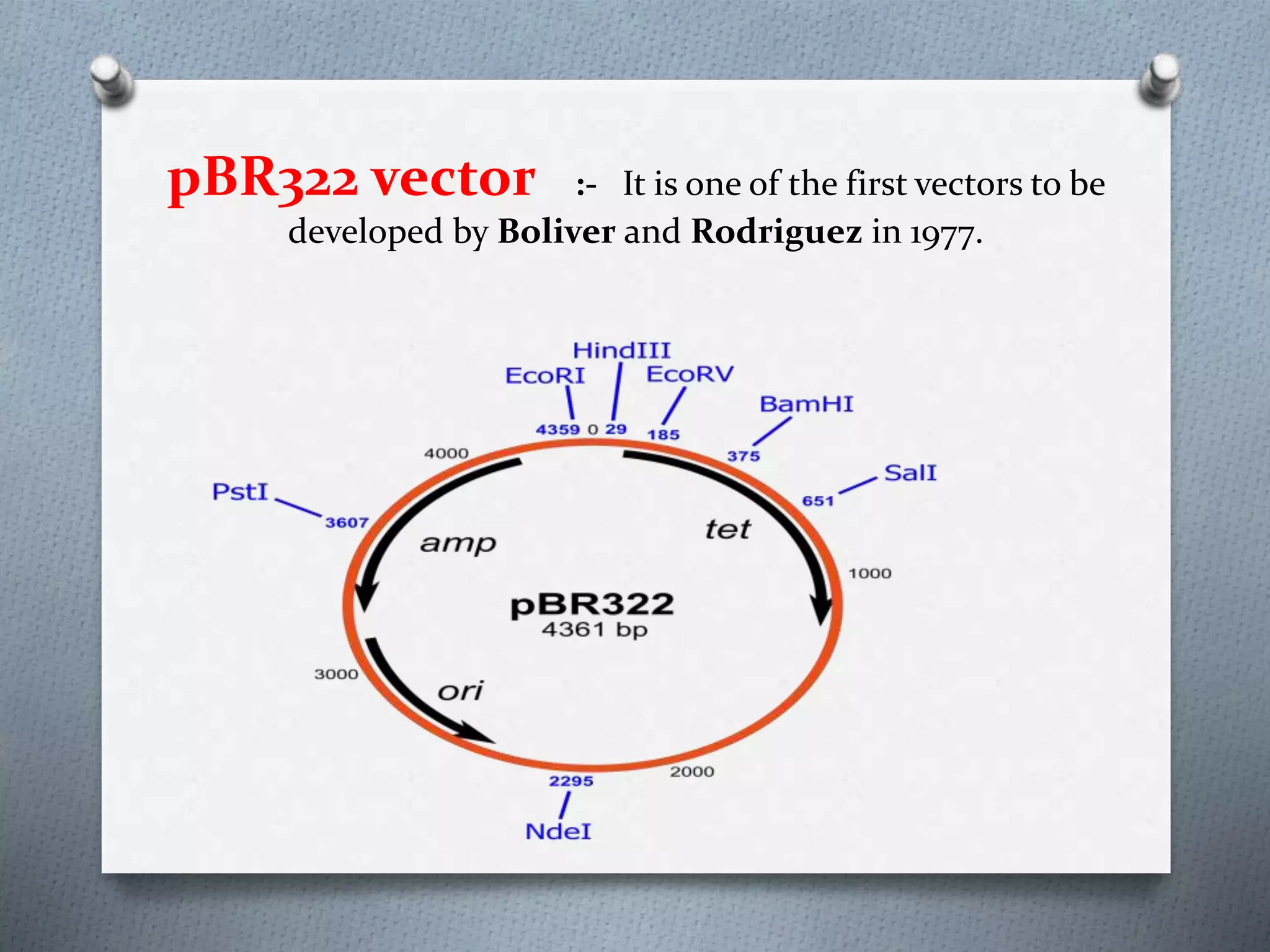
pBR322 vector :-It is one of the first vectors to be
developed by Boliver and Rodriguez in 1977.
8.
The namepBR322 denotes the following:
P- plasmid
B- Boliver
R- Rodriguez
322- Differentiate it from the other plasmid produced in
the same laboratory E.g. – pBR325, pBR327, etc.
It is 4363 base pair long.
It carries two sets of antibiotic resistance gene:
Ampicilli
Tetracycline
It contains only single or unique recognition site
for 12 different restriction enzymes:
Pst I
Sac I
Pvu I
9.
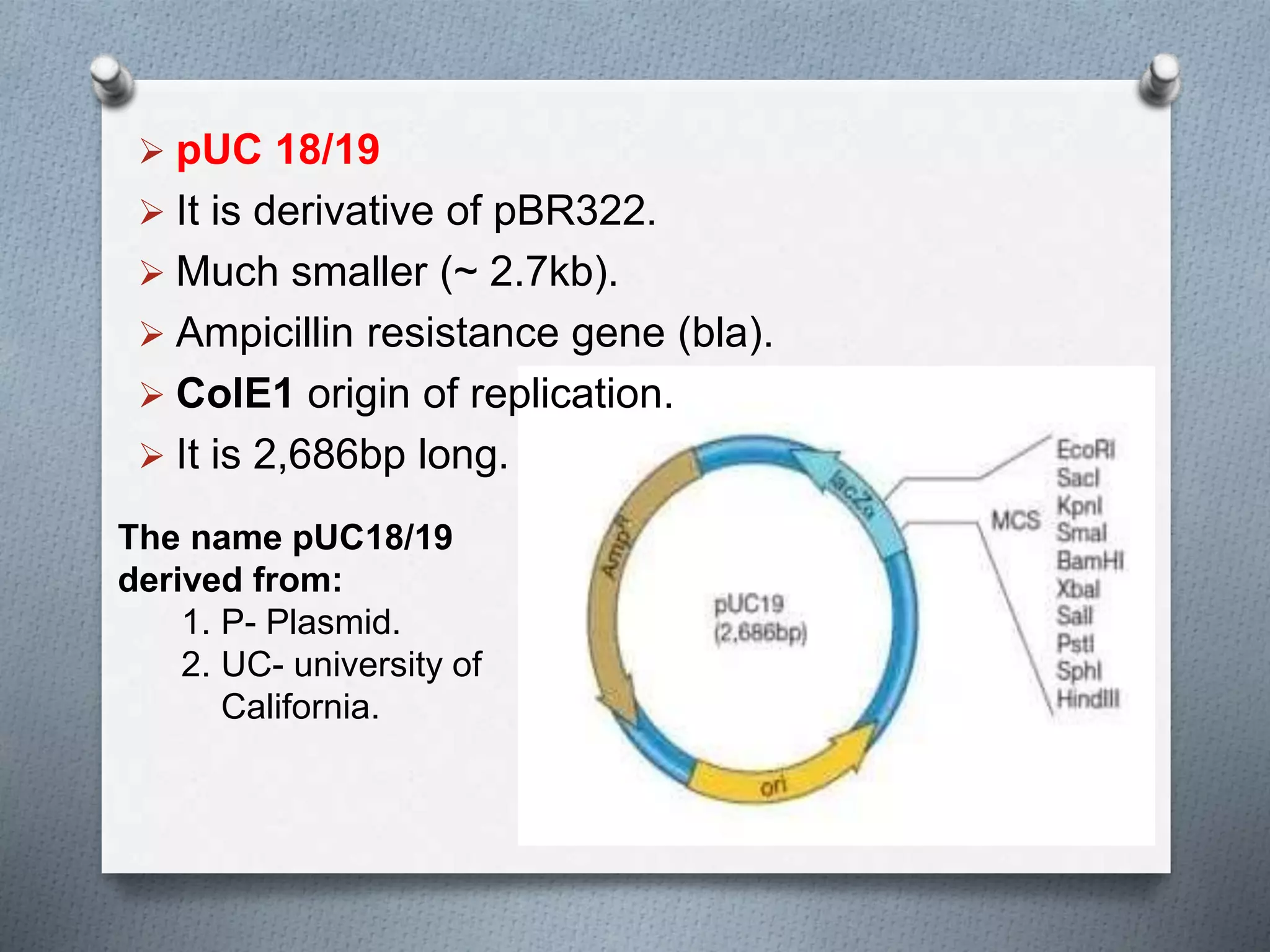
pUC 18/19
It is derivative of pBR322.
Much smaller (~ 2.7kb).
Ampicillin resistance gene (bla).
ColE1 origin of replication.
It is 2,686bp long.
The name pUC18/19
derived from:
1. P- Plasmid.
2. UC- university of
California.
10.
BACTERIOPHAGES
• Bacteriophages orsimply phages are the viruses
that replicate within the bacteria. ln case of certain
phages, their DNA gets incorporated into the
bacterial chromosome and remains there
permanently.
• Phage vectors can accept short fragments of
foreign DNA into their genomes.
• The advantage with phages is that they can take
up Iarger DNA segments than plasmids. Hence
phage vectors are preferred for working with
genomes of human cells.
11.
On the basisof structure bacteria phases are of two types:
Head and Tail Phages- E.g.: lambda phage.
Filamentous phage- E.g.: M13 phage.
Lambda phage vectors
• Its genome size is about 48,502 bp.
• It contains origin of replication, genes for head
and tail protein and enzymes for DNA
replication
• It has more than one recognition sequence for
almost all the restriction enzymes.
• It should be larger than 38 kb and smaller
than 52 kb to packaged into phage particles.
13.
O M13 phagevectors
• M13 vectors are used to obtain single- stranded
copies of cloned DNA.
• It is 6407 nucleotides long.
• It is circular and 6.4kb in size.
• It is used to produce several copies of M13 mp
series of vectors.
• Example- M13mp8, M13mp9 etc.
15.
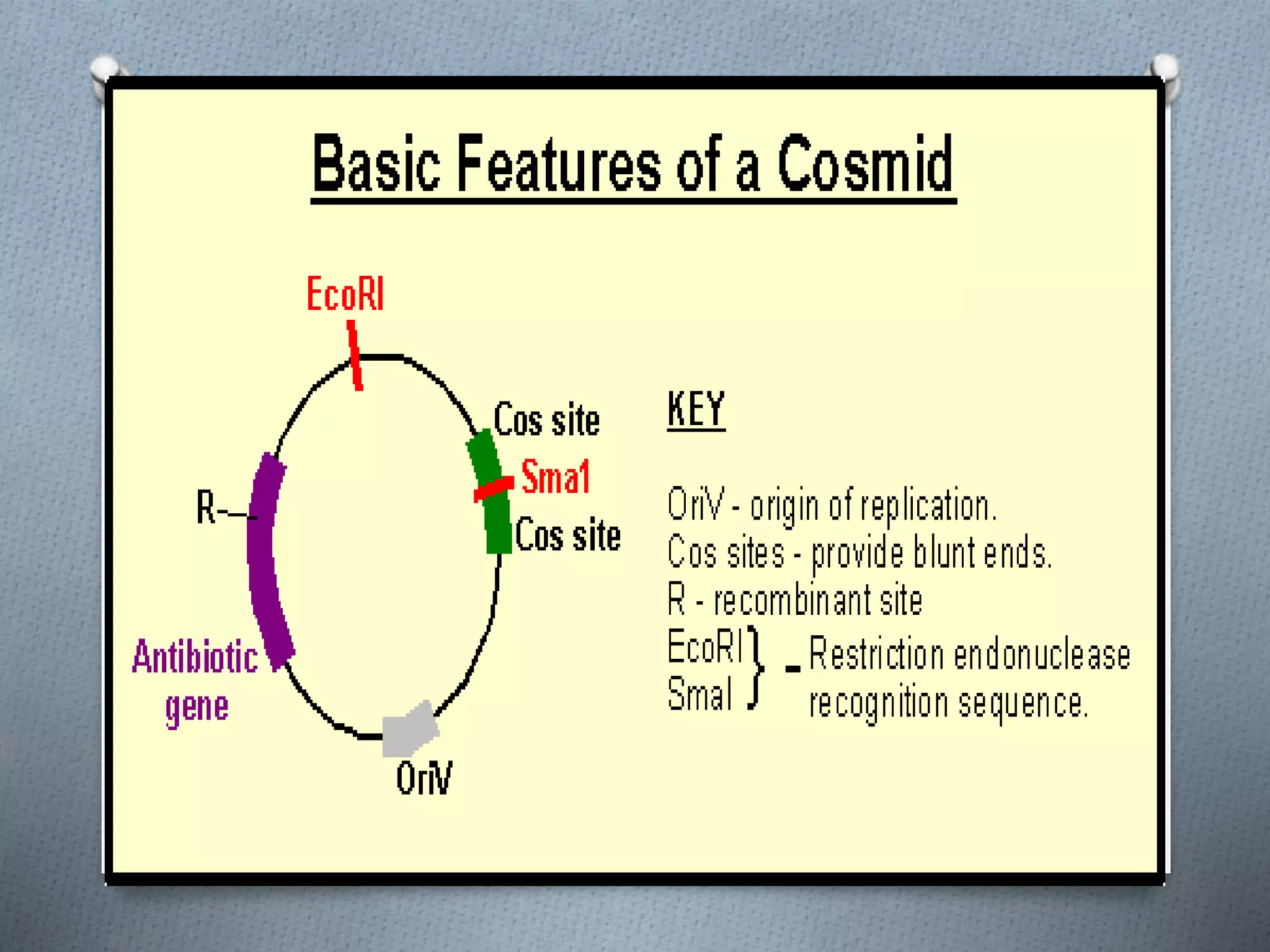
Cosmids vector
•It is a type of hybrid plasmid.
• It contains lambda phage cos sequence.
• Cosmids = cos sites + plasmid.
• Genomic size of cosmids is about 30 to 52 kb.
• If they have suitable origin of replication than they
can replicate as Plasmid within the host cells, E.g.-
SV40 Ori, ColE1 ori.
• It also contains selectable marker such as
Ampicillin resistance gene.
• Collins and Hohn in 1978 was first to described
cosmids.
17.
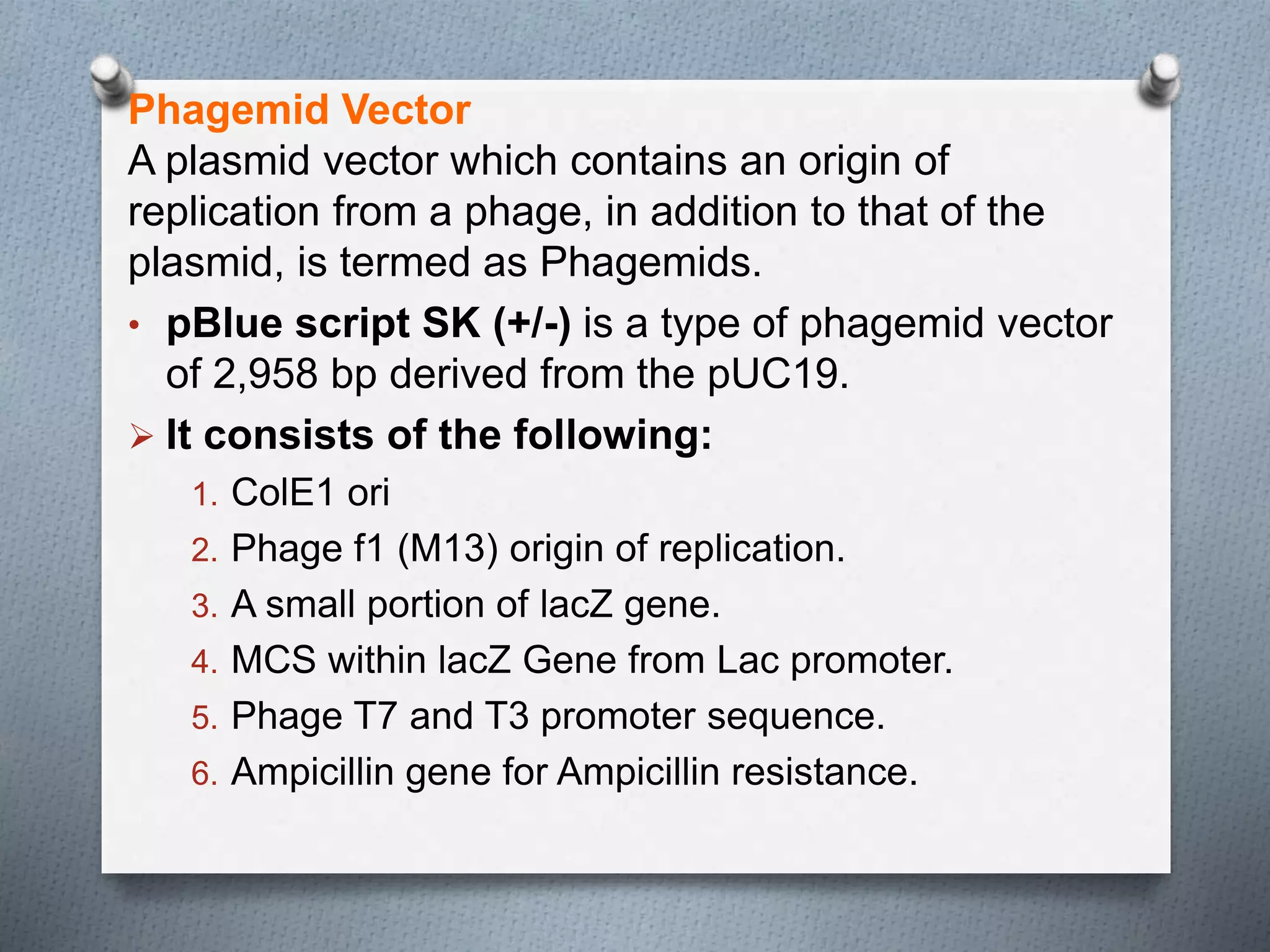
Phagemid Vector
A plasmidvector which contains an origin of
replication from a phage, in addition to that of the
plasmid, is termed as Phagemids.
• pBlue script SK (+/-) is a type of phagemid vector
of 2,958 bp derived from the pUC19.
It consists of the following:
1. ColE1 ori
2. Phage f1 (M13) origin of replication.
3. A small portion of lacZ gene.
4. MCS within lacZ Gene from Lac promoter.
5. Phage T7 and T3 promoter sequence.
6. Ampicillin gene for Ampicillin resistance.
18.
Shuttle vector
• Shuttlevectors are created to replicates in cell of
different type of species.
• They contain two origin of replication, in which
one is particular for each host species, also
those genes required for their replication and not
provided by the host cell.
• This type of vectors are developed by
recombinant techniques.