
M.Kamil khan
Microbiologist
Introduction
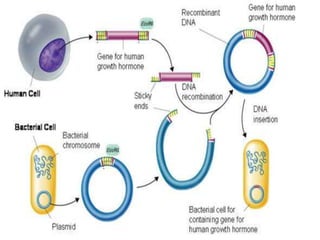
• In molecular cloning, a vector is a DNA molecule used
as a vehicle to artificially carry foreign genetic material
(target DNA having gene of interest into another cell,
(host cell i.e E.coli) where it can be replicated and
expressed.
• A vector containing foreign DNA is
termed recombinant DNA.
Property of vectors
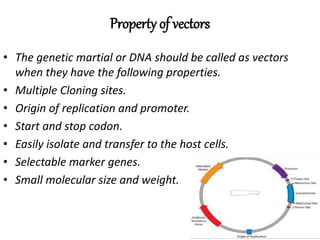
• The genetic martial or DNA should be called as vectors
when they have the following properties.
• Multiple Cloning sites.
• Origin of replication and promoter.
• Start and stop codon.
• Easily isolate and transfer to the host cells.
• Selectable marker genes.
• Small molecular size and weight.
Types of vectors
I. Expression vectors.
II. Cloning vectors.
1. Plasmid.
2. Cosmid.
3. Phage vector.
4. Bacterial artificial chromosomes (BAC).
5. Yeast artificial chromosomes (YAC).
Cloning vectors
• A cloning vector is a small piece of DNA that can be
stably maintained in an organism, and into which a
foreign DNA fragment can be inserted
for cloning purposes.
1. Plasmid
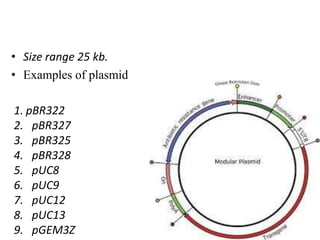
• Plasmids are double-stranded extra chromosomal and
generally circular DNA sequences that are capable of
replication using the host cell's replication machinery.
• Plasmid vectors minimalistically consist of an origin of
replication that allows for semi-independent replication
of the plasmid in the host.
• Plasmids vectors are natural and found in many
bacteria, for example in E. coli, a few eukaryotes, for
example in yeast such as Saccharomyces cerevisiae.
• Size range 25 kb.
• Examples of plasmid
1. pBR322
2. pBR327
3. pBR325
4. pBR328
5. pUC8
6. pUC9
7. pUC12
8. pUC13
9. pGEM3Z
THREE TYPES OF PLASMID
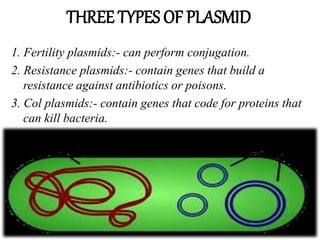
1. Fertility plasmids:- can perform conjugation.
2. Resistance plasmids:- contain genes that build a
resistance against antibiotics or poisons.
3. Col plasmids:- contain genes that code for proteins that
can kill bacteria.
Advantages of plasmid
• Present in a high number inside cells
• Having already selectable markers
• Fastly replicate
• Having small size and can be handle
• Easily isolate and manipulate
• Easy purified
Disadvantages of plasmid
• Only 12 kb size foreign DNA can be cloned
• Require competency
• Expensive
• Self anneal
2. Bacteriophage lemda
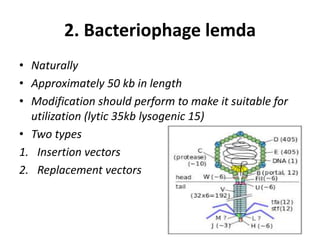
• Naturally
• Approximately 50 kb in length
• Modification should perform to make it suitable for
utilization (lytic 35kb lysogenic 15)
• Two types
1. Insertion vectors
2. Replacement vectors
Advantages
• Having cos site due to which it can package the DNA in
phage head
• Can prepare cDNA and gene libraries
• Use to clone large fragment of DNA(10-20kb).
Disadvantages
• Only carry 20 kb foreign DNA
• Less use to handle
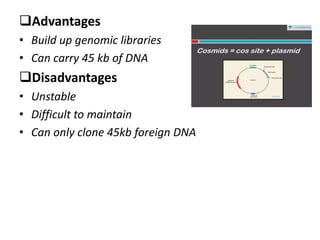
3. Cosmid
• Modified and artificial version of vectors.
• Hybrid vectors because it contain lemda
phage sequences (cos site +plasmid= cosmid).
• Can carry 45 kb target DNA.
• Having cos site for packaging the DNA .
Advantages
• Build up genomic libraries
• Can carry 45 kb of DNA
Disadvantages
• Unstable
• Difficult to maintain
• Can only clone 45kb foreign DNA
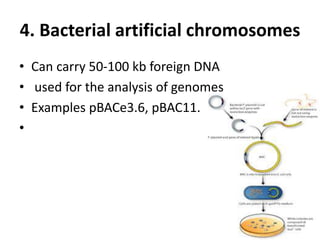
4. Bacterial artificial chromosomes
• Can carry 50-100 kb foreign DNA
• used for the analysis of genomes
• Examples pBACe3.6, pBAC11.
•
• Advantages
• Easily manipulate
• can diagnose genetic disease due to transgenic mice
experimentation
• Can also diagnose neurological disease like Alzheimer
disease
• Disadvantages
• Can only carry 50-100kb foreign DNA
• Mutation
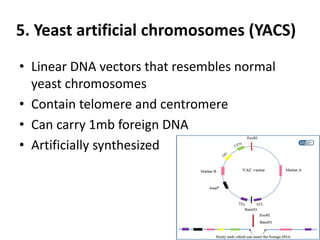
5. Yeast artificial chromosomes (YACS)
• Linear DNA vectors that resembles normal
yeast chromosomes
• Contain telomere and centromere
• Can carry 1mb foreign DNA
• Artificially synthesized
Advantages
• Can clone large fragment of DNA i.e 500kb to 1mb
Disadvantages
• Very fragile and prone to breakage
• Difficult to separate from the other host cell
• Unstable and sometime the foreign DNA deleted
Expression vectors
• A plasmid or virus designed for gene expression in cells.
• The vector is used to introduce a specific gene into a target cell,
and can commandeer the cell's mechanism for protein synthesis to
produce the protein encoded by the gene.
• Expression vectors are the basic tools biotechnology for
the production of proteins.
• The vector is engineered to contain regulatory sequences that act
as enhancer and promoter regions and lead to efficient
transcription of the gene carried on the expression vector.
• The goal of a well-designed expression vector is the efficient
production of protein, and this may be achieved by the production
of significant amount of stable messenger RNA, which can then
be translated into protein.
• The expression of a protein may be tightly controlled, and the
protein is only produced in significant quantity when necessary
through the use of an inducer, in some systems however the
protein may be expressed constitutively.
• Escherichia coli is commonly used as the host for protein
production, but other cell types may also be used.
• An example of the use of expression vector is the production
of insulin, which is used for medical treatments of diabetes.
Elements in expression vectors
• The expression vector should have all cloning vector
properties and they have also the following elements for
protein expression.
1. Strong promoter
2. Translation initiation sequences ( having ribosomal
subunit site and start codon)
3. Translation termination sequences (having stop codon)
4. Tag sequences i.e histadine
•Thanks

Vectors in Recombenant DNA technology

  • 1.
  • 3.
    Introduction • In molecularcloning, a vector is a DNA molecule used as a vehicle to artificially carry foreign genetic material (target DNA having gene of interest into another cell, (host cell i.e E.coli) where it can be replicated and expressed. • A vector containing foreign DNA is termed recombinant DNA.
  • 4.
    Property of vectors •The genetic martial or DNA should be called as vectors when they have the following properties. • Multiple Cloning sites. • Origin of replication and promoter. • Start and stop codon. • Easily isolate and transfer to the host cells. • Selectable marker genes. • Small molecular size and weight.
  • 5.
    Types of vectors I.Expression vectors. II. Cloning vectors. 1. Plasmid. 2. Cosmid. 3. Phage vector. 4. Bacterial artificial chromosomes (BAC). 5. Yeast artificial chromosomes (YAC).
  • 6.
    Cloning vectors • Acloning vector is a small piece of DNA that can be stably maintained in an organism, and into which a foreign DNA fragment can be inserted for cloning purposes.
  • 7.
    1. Plasmid • Plasmidsare double-stranded extra chromosomal and generally circular DNA sequences that are capable of replication using the host cell's replication machinery. • Plasmid vectors minimalistically consist of an origin of replication that allows for semi-independent replication of the plasmid in the host. • Plasmids vectors are natural and found in many bacteria, for example in E. coli, a few eukaryotes, for example in yeast such as Saccharomyces cerevisiae.
  • 8.
    • Size range25 kb. • Examples of plasmid 1. pBR322 2. pBR327 3. pBR325 4. pBR328 5. pUC8 6. pUC9 7. pUC12 8. pUC13 9. pGEM3Z
  • 9.
    THREE TYPES OFPLASMID 1. Fertility plasmids:- can perform conjugation. 2. Resistance plasmids:- contain genes that build a resistance against antibiotics or poisons. 3. Col plasmids:- contain genes that code for proteins that can kill bacteria.
  • 10.
    Advantages of plasmid •Present in a high number inside cells • Having already selectable markers • Fastly replicate • Having small size and can be handle • Easily isolate and manipulate • Easy purified Disadvantages of plasmid • Only 12 kb size foreign DNA can be cloned • Require competency • Expensive • Self anneal
  • 11.
    2. Bacteriophage lemda •Naturally • Approximately 50 kb in length • Modification should perform to make it suitable for utilization (lytic 35kb lysogenic 15) • Two types 1. Insertion vectors 2. Replacement vectors
  • 12.
    Advantages • Having cossite due to which it can package the DNA in phage head • Can prepare cDNA and gene libraries • Use to clone large fragment of DNA(10-20kb). Disadvantages • Only carry 20 kb foreign DNA • Less use to handle
  • 13.
    3. Cosmid • Modifiedand artificial version of vectors. • Hybrid vectors because it contain lemda phage sequences (cos site +plasmid= cosmid). • Can carry 45 kb target DNA. • Having cos site for packaging the DNA .
  • 14.
    Advantages • Build upgenomic libraries • Can carry 45 kb of DNA Disadvantages • Unstable • Difficult to maintain • Can only clone 45kb foreign DNA
  • 15.
    4. Bacterial artificialchromosomes • Can carry 50-100 kb foreign DNA • used for the analysis of genomes • Examples pBACe3.6, pBAC11. •
  • 16.
    • Advantages • Easilymanipulate • can diagnose genetic disease due to transgenic mice experimentation • Can also diagnose neurological disease like Alzheimer disease • Disadvantages • Can only carry 50-100kb foreign DNA • Mutation
  • 17.
    5. Yeast artificialchromosomes (YACS) • Linear DNA vectors that resembles normal yeast chromosomes • Contain telomere and centromere • Can carry 1mb foreign DNA • Artificially synthesized
  • 18.
    Advantages • Can clonelarge fragment of DNA i.e 500kb to 1mb Disadvantages • Very fragile and prone to breakage • Difficult to separate from the other host cell • Unstable and sometime the foreign DNA deleted
  • 19.
    Expression vectors • Aplasmid or virus designed for gene expression in cells. • The vector is used to introduce a specific gene into a target cell, and can commandeer the cell's mechanism for protein synthesis to produce the protein encoded by the gene. • Expression vectors are the basic tools biotechnology for the production of proteins. • The vector is engineered to contain regulatory sequences that act as enhancer and promoter regions and lead to efficient transcription of the gene carried on the expression vector.
  • 20.
    • The goalof a well-designed expression vector is the efficient production of protein, and this may be achieved by the production of significant amount of stable messenger RNA, which can then be translated into protein. • The expression of a protein may be tightly controlled, and the protein is only produced in significant quantity when necessary through the use of an inducer, in some systems however the protein may be expressed constitutively. • Escherichia coli is commonly used as the host for protein production, but other cell types may also be used. • An example of the use of expression vector is the production of insulin, which is used for medical treatments of diabetes.
  • 21.
    Elements in expressionvectors • The expression vector should have all cloning vector properties and they have also the following elements for protein expression. 1. Strong promoter 2. Translation initiation sequences ( having ribosomal subunit site and start codon) 3. Translation termination sequences (having stop codon) 4. Tag sequences i.e histadine
  • 22.