A SEMINAR ON    GENE CLONING VECTORS PRESENTED BY  NASREEN SULTAN M.Sc BIOTECHNOLOGY 3 RD  SEMESTER
INTRODUCTION A  cloning vector  is a DNA molecule in which foreign DNA can be inserted or integrated and which is further capable of replicating within host cell to produce multiple clones of recombinant DNA. Examples:  Plasmids,phage or virus
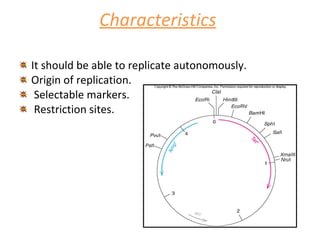
Characteristics   It should be able to replicate autonomously. Origin of replication.  Selectable markers. Restriction sites.
Types Plasmid  as vector . Bacteriophage  as vector.  Cosmid  as vector Phagemid  as vector.
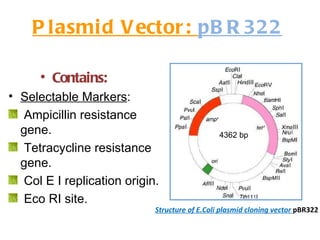
Plasmid Vector:  pBR322 Contains:   Selectable Markers :  Ampicillin resistance gene. Tetracycline resistance gene. Col E I replication origin. Eco RI site. Structure of E.Coli plasmid cloning vector  pBR322 4362 bp
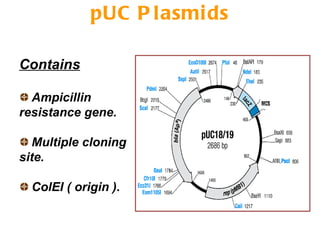
pUC Plasmids Contains Ampicillin resistance gene. Multiple cloning site. ColEI ( origin ).
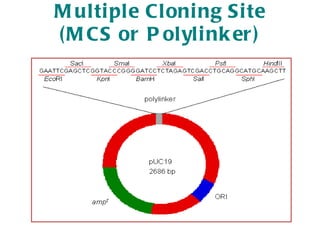
Multiple Cloning Site (MCS or Polylinker) .
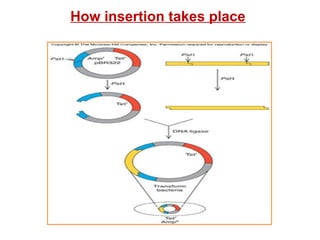
How insertion takes place
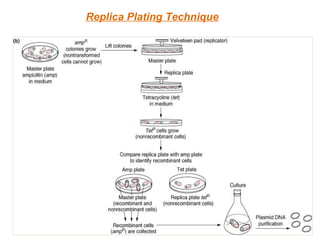
Screening procedure of cloning vector Blue/White selection. replica plating technique.
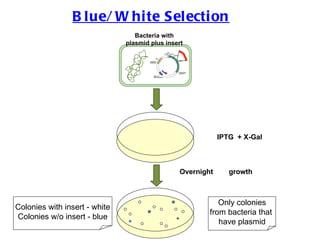
Blue/White Selection Only colonies from bacteria that  have plasmid IPTG  + X-Gal Overnight  growth Bacteria with plasmid plus insert Colonies with insert - white Colonies w/o insert - blue
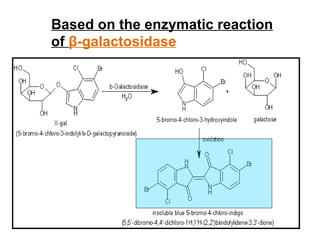
Based on the enzymatic reaction of  β -galactosidase
Replica Plating Technique
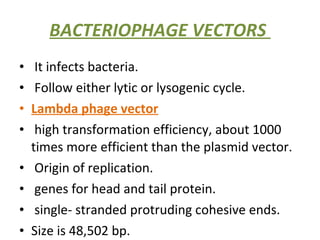
BACTERIOPHAGE VECTORS  It infects bacteria. Follow either lytic or lysogenic cycle. Lambda phage vector high transformation efficiency, about 1000 times more efficient than the plasmid vector. Origin of replication. genes for head and tail protein. single- stranded protruding cohesive ends. Size is 48,502 bp.
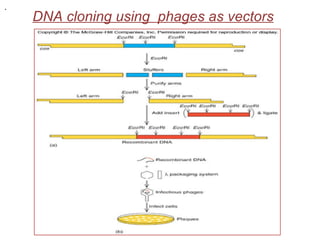
. DNA cloning using  phages as vectors
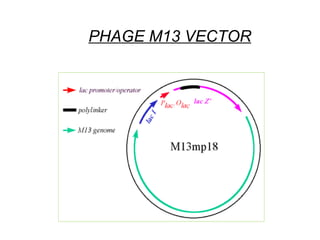
PHAGE M13 VECTOR
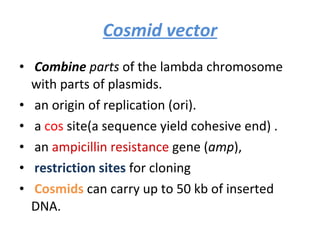
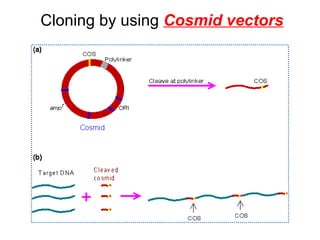
Cosmid vector Combine  parts  of the lambda chromosome with parts of plasmids. an origin of replication (ori). a  cos  site(a sequence yield cohesive end) . an  ampicillin resistance  gene ( amp ),  restriction sites   for cloning  Cosmids  can carry up to 50 kb of inserted DNA.
Cloning by using  Cosmid vectors
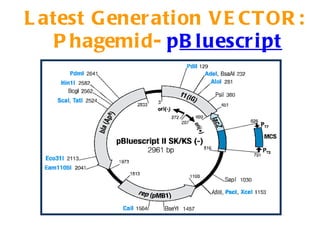
Latest Generation VECTOR:  Phagemid-  p Bluescript
APPLICATION A particular gene can be isolated and its nucleotide sequence determined Control sequences of DNA can be identified & analyzed Protein/enzyme/RNA function can be investigated Mutations can be identified, e.g. gene defects related to specific diseases Organisms can be ‘engineered’ for specific purposes, e.g. insulin production.
THANK YOU
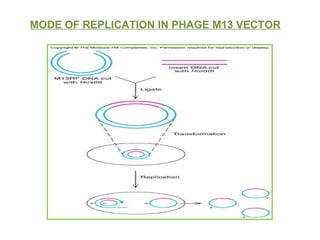
MODE OF REPLICATION IN PHAGE M13 VECTOR
 

Cloning Vector

  • 1.
    A SEMINAR ON GENE CLONING VECTORS PRESENTED BY NASREEN SULTAN M.Sc BIOTECHNOLOGY 3 RD SEMESTER
  • 2.
    INTRODUCTION A cloning vector is a DNA molecule in which foreign DNA can be inserted or integrated and which is further capable of replicating within host cell to produce multiple clones of recombinant DNA. Examples: Plasmids,phage or virus
  • 3.
    Characteristics It should be able to replicate autonomously. Origin of replication. Selectable markers. Restriction sites.
  • 4.
    Types Plasmid as vector . Bacteriophage as vector. Cosmid as vector Phagemid as vector.
  • 5.
    Plasmid Vector: pBR322 Contains: Selectable Markers : Ampicillin resistance gene. Tetracycline resistance gene. Col E I replication origin. Eco RI site. Structure of E.Coli plasmid cloning vector pBR322 4362 bp
  • 6.
    pUC Plasmids ContainsAmpicillin resistance gene. Multiple cloning site. ColEI ( origin ).
  • 7.
    Multiple Cloning Site(MCS or Polylinker) .
  • 8.
  • 9.
    Screening procedure ofcloning vector Blue/White selection. replica plating technique.
  • 10.
    Blue/White Selection Onlycolonies from bacteria that have plasmid IPTG + X-Gal Overnight growth Bacteria with plasmid plus insert Colonies with insert - white Colonies w/o insert - blue
  • 11.
    Based on theenzymatic reaction of β -galactosidase
  • 12.
  • 13.
    BACTERIOPHAGE VECTORS It infects bacteria. Follow either lytic or lysogenic cycle. Lambda phage vector high transformation efficiency, about 1000 times more efficient than the plasmid vector. Origin of replication. genes for head and tail protein. single- stranded protruding cohesive ends. Size is 48,502 bp.
  • 14.
    . DNA cloningusing phages as vectors
  • 15.
  • 16.
    Cosmid vector Combine parts of the lambda chromosome with parts of plasmids. an origin of replication (ori). a cos site(a sequence yield cohesive end) . an ampicillin resistance gene ( amp ), restriction sites for cloning Cosmids can carry up to 50 kb of inserted DNA.
  • 17.
    Cloning by using Cosmid vectors
  • 18.
    Latest Generation VECTOR: Phagemid- p Bluescript
  • 19.
    APPLICATION A particulargene can be isolated and its nucleotide sequence determined Control sequences of DNA can be identified & analyzed Protein/enzyme/RNA function can be investigated Mutations can be identified, e.g. gene defects related to specific diseases Organisms can be ‘engineered’ for specific purposes, e.g. insulin production.
  • 20.
  • 21.
    MODE OF REPLICATIONIN PHAGE M13 VECTOR
  • 22.

Editor's Notes

  • #2 CTOES
  • #6 4362 bp
  • #9 How insertion takes place
  • #13 Replica Plating Technique
  • #15 DNA cloning using
  • #16 PHAGE M13 VECTOR
  • #21 THANKYOU
  • #22 MODE OF REPLICATION IN PHAGE M13 VECTOR