Biotechnology
b.Pharma 6th semester unit-2nd
Mr. Bulet Kumar Gupta
Assistant Professor
Sai College of Pharmacy, Mau
CLONING VECTOR
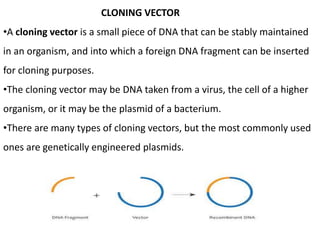
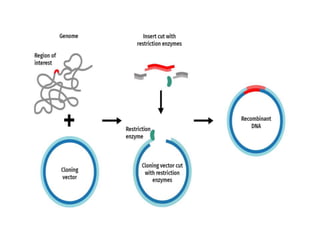
•A cloning vector is a small piece of DNA that can be stably maintained
in an organism, and into which a foreign DNA fragment can be inserted
for cloning purposes.
•The cloning vector may be DNA taken from a virus, the cell of a higher
organism, or it may be the plasmid of a bacterium.
•There are many types of cloning vectors, but the most commonly used
ones are genetically engineered plasmids.
Depending on this basis the vectors are classified as under-
1. Vectors for Bacteria: These are special bacterial origin of replication
and antibiotic resistance selectable markers.
Bacteria support different kinds of vectors
Ex- Plasmid vectors, Bacteriophages vectors, Cosmids, Phasmids, or
Phagemids, etc.
2. Vectors for Yeast: They have special origin of replication called as
autonomously replicating sequences (ARS).
Ex- Yeast replicative plasmid vectors (YRp) etc.
3. Vectors for Animals: These vectors are needed in biotechnology for
the synthesis of recombinant protein from genes that are not expressed
correctly when cloned in E. coli or yeast, and methods for cloning in
humans are being sought by clinical molecular biologists attempting to
device techniques for gene therapy, in which a disease is treated by
introduction of a cloned gene into the patient.
Ex- P-element, SV40 etc.
4. Vectors for Plants: The production of genetically modified plants has
become possible due to successful use of plant vectors.
Ex- Ti-plasmid, Ri-plasmid etc.
The cloning vector must possess following of the general
characters-
•It should be small in size.
•It must have an origin of replication(Ori).
•It should have multiple cloning sites(MCS).
•It contains a selectable markers.
•It must also be compatible with host organisms.
•It must possess a restriction sites.
•Incompatible with another vector.
•It should become higher no. of copy.
•It should be able to move under eukaryotic and prokaryotic cell.
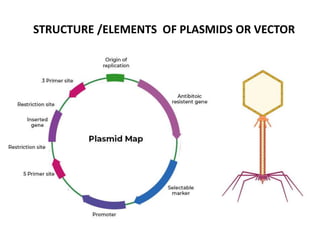
STRUCTURE /ELEMENTS OF PLASMIDS OR VECTOR
•Origin of Replication- DNA sequence which encode initiation of
plasmid replication.
•Antibiotic resistance Gene- These gene provide a survival advantage to
bacterial host, that allow for selection of plasmid containing bacteria.
•Multiple cloning sites- Short segment containing several restriction
enzyme sites enable to easy insertion of foreign DNA
•Promoter region- it drive the transcription of foreign inserts.
•Selectable Marker- used to select for cells that has successfully taken
up plasmid for the purpose of expression of insert DNA.
•Primer Binding Sites- used as an initiation points for amplification and
sequencing of the plasmids.
•Inserted Gene- Desired DNA.
•There are many types of cloning vectors, but the most commonly used
ones are genetically engineered plasmids.
•Cloning is generally first performed using Escherichia coli.
Plasmid
Bacteriophage
Phasmids
Cosmids
Artificial chromosomes
Bacterial artificial chromosomes (BACs)
Human artificial chromosomes (HACs)
Yeast artificial chromosomes (YACs)
Retroviral
Plasmid Vectors
•These are the most common vectors for the prokaryotic host cells.
Bacteria are able to express foreign genes inserted into plasmids.
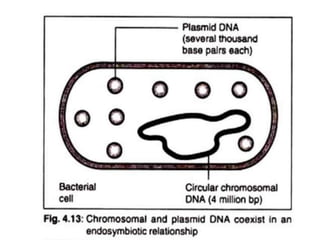
Plasmids are small, circular, double- stranded DNA molecules lacking
protein coat that naturally exists in the cytoplasm of many strains of
bacteria.
•Some of the examples of naturally occurring plasmids are Ti plasmids,
F-factors, R-factors, Co/E1 plasmid, etc.
•Plasmids are independent of the chromosome of bacterial cell and
range in size from 1000 to 20000 base pairs(10kb). Using the enzymes
and 70s ribosome's that the bacterial cell houses, DNA contained in
plasmids can be replicated and expressed.
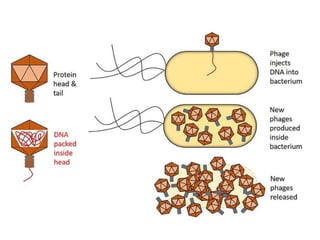
Bacteriophage Derived Vectors:
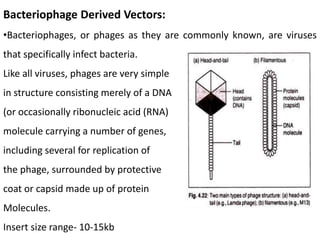
•Bacteriophages, or phages as they are commonly known, are viruses
that specifically infect bacteria.
Like all viruses, phages are very simple
in structure consisting merely of a DNA
(or occasionally ribonucleic acid (RNA)
molecule carrying a number of genes,
including several for replication of
the phage, surrounded by protective
coat or capsid made up of protein
Molecules.
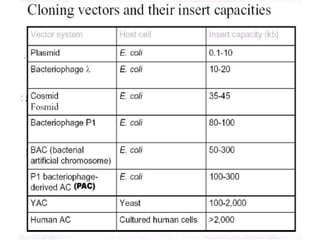
Insert size range- 10-15kb
The following are different types of Bacteriophage vectors:
Bacteriophage M13 vectors-
• it is one of the Ff phages a member of the family filamentous
bacteriophage.
•Ff phages are composed of circular single-stranded DNA (ssDNA), which
in the case of the m13 phage is 6407 nucleotides long.
•M13 plasmids are used for many recombinant DNA processes, and the
virus has also been used for phage display, directed
evolution, nanostructures and nanotechnology applications
Lamda Phage Vectors
•This is a widely used vector for the cloning of very large pieces of
genes.
Cosmid Vectors
•It is the most sophisticated type of lambda based vector.
•Cosmids are the hybrids between the phage DNA molecule and
bacterial plasmid. Their design centres on the fact that the enzymes that
package the lambda DNA molecule into the phage protein coat need
only the cos sites in order to function.
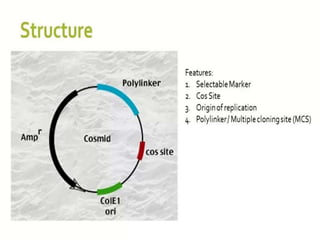
•A cosmid is basically a plasmid that carries a cos site. It also needs a
selectable marker, such as ampicillin resistant gene, and a plasmid origin
of replication.
•Cosmids are used for construction of genomic libraries of eukaryotes
since these can be used for cloning large fragments of DNA.
Insert size range- 30-50kb
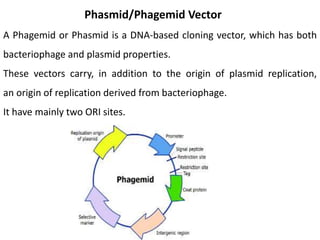
Phasmid/Phagemid Vector
A Phagemid or Phasmid is a DNA-based cloning vector, which has both
bacteriophage and plasmid properties.
These vectors carry, in addition to the origin of plasmid replication,
an origin of replication derived from bacteriophage.
It have mainly two ORI sites.
Artificial Chromosomes
•Artificial chromosomes are synthetically designed DNA molecules of
known structure, which are assembled in vitro (in the laboratory) from
specific DNA sequences that acts like a natural chromosome. Artificial
chromosomes are circular or linear vectors that are stably maintained in,
usually, 1-2 copies per cell.
Following are the types of artificial chromosomes:
•Human Artificial Chromosomes (HAC)
•Bacterial Artificial Chromosomes (BAC)
•Yeast Artificial Chromosomes (YAC)
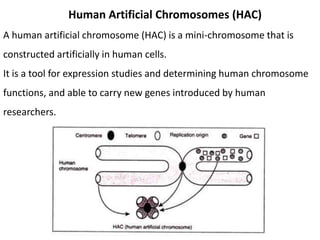
Human Artificial Chromosomes (HAC)
A human artificial chromosome (HAC) is a mini-chromosome that is
constructed artificially in human cells.
It is a tool for expression studies and determining human chromosome
functions, and able to carry new genes introduced by human
researchers.
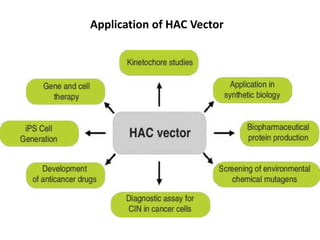
Application of HAC Vector
Bacterial Artificial Chromosomes (BAC)
•Bacterial Artificial Chromosomes (BACs) are cloning vectors based on
the extra-chromosomal plasmids of E.coli, called F factor or fertility
factor. These vectors enable the construction of artificial chromosomes,
which can be cloned in E.coli.
•This vector is useful for cloning DNA fragments up to 350 kb, and is very
useful for sequencing large stretches of chromosomal DNA.
•BACs contain ori sequences derived from E. coli plasmid F factor,
multiple cloning sites (MCS) having unique restriction sites, and suitable
selectable markers. The genomes of several large DNA viruses and RNA
viruses have been cloned as BACs.
•Examples of BAC are pBACe3.6, pBeloBAC11 etc.
Yeast Artificial Chromosomes (YAC)
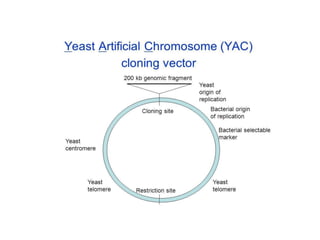
•A YAC can be considered as a functional artificial chromosome, since it
includes three specific DNA sequences that enable it to propagate from
one yeast cell to its offspring.
•Yeast artificial Chromosomes cloning system enable the cloning of DNA
of 50 to 2000 kb.
•Up to 1 millions base pairs in length of an organism DNA can be
inserted into YACs.
•YAC cloning system can take DNA insert greater than l00kb.
•Yeast artificial chromosomes are very helpful in the production of gene
libraries.
•Example of YAC is pYACs.
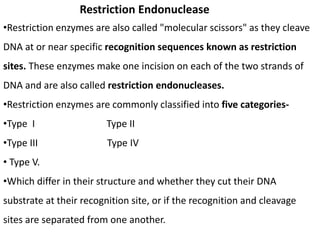
Restriction Endonuclease
•Restriction enzymes are also called "molecular scissors" as they cleave
DNA at or near specific recognition sequences known as restriction
sites. These enzymes make one incision on each of the two strands of
DNA and are also called restriction endonucleases.
•Restriction enzymes are commonly classified into five categories-
•Type I Type II
•Type III Type IV
• Type V.
•Which differ in their structure and whether they cut their DNA
substrate at their recognition site, or if the recognition and cleavage
sites are separated from one another.
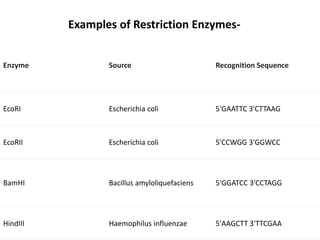
Enzyme Source Recognition Sequence
EcoRI Escherichia coli 5'GAATTC 3'CTTAAG
EcoRII Escherichia coli 5'CCWGG 3'GGWCC
BamHI Bacillus amyloliquefaciens 5'GGATCC 3'CCTAGG
HindIII Haemophilus influenzae 5'AAGCTT 3'TTCGAA
Examples of Restriction Enzymes-
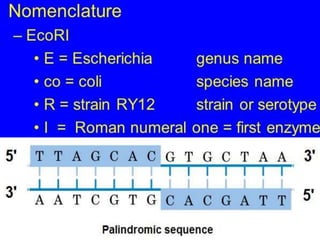
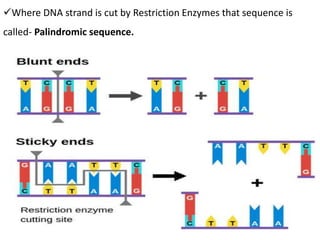
Where DNA strand is cut by Restriction Enzymes that sequence is
called- Palindromic sequence.
DNA Ligase
•DNA ligase is a type of enzyme that facilitates the joining
of DNA strands together by catalyzing the formation of
a Phosphodiester bond.
•DNA ligase creating the final Phosphodiester bond to fully repair the
DNA.
•DNA ligase is used in both DNA repair and DNA replication.
•DNA ligase has extensive use in molecular biology laboratories
for recombinant DNA experiments.
•Purified DNA ligase is used in gene cloning to join DNA molecules
together .
And form recombinant DNA.
•It is isolated from bacteria and Viruses
•They joined covalently.
•Formation of Phosphodiester bond.
•Required ATP, NAD+ and Cofactors.
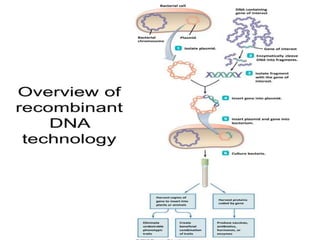
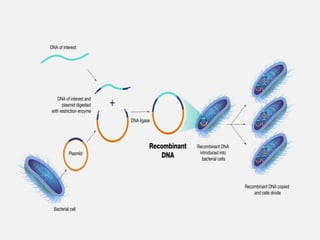
Recombinant DNA technology
•Recombinant DNA technology involves using enzymes and various
laboratory techniques to manipulate and isolate DNA segments of
interest. This method can be used to combine (or splice) DNA from
different species or to create genes with new functions. The resulting
copies are often referred to as recombinant DNA. Such work typically
involves propagating the recombinant DNA in a bacterial or yeast cell,
whose cellular machinery copies the engineered DNA along with its
own.
•Recombinant DNA technology has been successfully applied to make
important proteins used in the treatment of human diseases, such as
insulin and growth hormone.
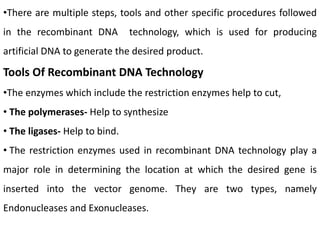
•There are multiple steps, tools and other specific procedures followed
in the recombinant DNA technology, which is used for producing
artificial DNA to generate the desired product.
Tools Of Recombinant DNA Technology
•The enzymes which include the restriction enzymes help to cut,
• The polymerases- Help to synthesize
• The ligases- Help to bind.
• The restriction enzymes used in recombinant DNA technology play a
major role in determining the location at which the desired gene is
inserted into the vector genome. They are two types, namely
Endonucleases and Exonucleases.
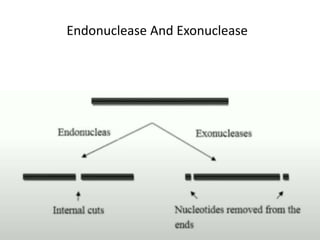
Endonuclease And Exonuclease
•The Endonucleases cut within the DNA strand whereas the
Exonucleases remove the nucleotides from the ends of the strands. The
restriction endonucleases are sequence-specific which are usually
palindrome sequences and cut the DNA at specific points. They
scrutinize the length of DNA and make the cut at the specific site called
the restriction site.
•The vectors – help in carrying and integrating the desired gene. These
form a very important part of the tools of recombinant DNA technology
as they are the ultimate vehicles that carry forward the desired gene
into the host organism.
•Origin of replication- This is a sequence of nucleotides from where the
replication starts.
A selectable marker – Constitute genes which show resistance to
certain Antibiotics like Ampicillin.
Cloning sites – the sites recognized by the restriction enzymes where
desired DNAs are inserted.
Host organism – into which the recombinant DNA is introduced.
Process of Recombinant DNA Technology
The complete process of recombinant DNA technology includes multiple
steps, maintained in a specific sequence to generate the desired
product.
Step-1. Isolation of Genetic Material.
The first and the initial step in Recombinant DNA technology is to isolate
the desired DNA in its pure form i.e. free from other macromolecules.
Step-2.Cutting the gene at the recognition sites.
The restriction enzymes play a major role in determining the location at
which the desired gene is inserted into the vector genome. These
reactions are called ‘restriction enzyme digestions’.
Step-3. Amplifying the gene copies through Polymerase chain
reaction (PCR).
It is a process to amplify a single copy of DNA into thousands to millions
of copies once the proper gene of interest has been cut using restriction
enzymes.
Step-4. Ligation of DNA Molecules.
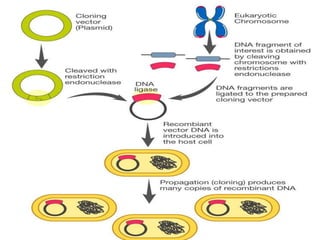
In this step of Ligation, the joining of the two pieces – a cut fragment of
DNA and the vector together with the help of the enzyme DNA ligase.
Step-5. Insertion of Recombinant DNA Into Host.
In this step, the recombinant DNA is introduced into a recipient host
cell. This process is termed as Transformation. Once the recombinant
DNA is inserted into the host cell, it gets multiplied and is expressed in
the form of the manufactured protein under optimal conditions.
Step-6. Culture of Bacteria.
Microbial culture, is a method of multiplying microbial organisms by
letting them reproduce in predetermined culture medium under
controlled laboratory conditions. Microbial cultures are foundational
and basic diagnostic methods used as a research tool in molecular
biology.
Application of Recombinant DNA Technology
DNA technology is also used to detect the presence of HIV in a person.
Gene Therapy – It is used as an attempt to correct the gene defects
which give rise to heredity diseases.
Clinical diagnosis – ELISA is an example where the application of
recombinant.
Recombinant DNA technology is widely used in Agriculture to produce
genetically-modified organisms such as FlavrSavr tomatoes, golden rice
rich in proteins, and Bt-cotton to protect the plant against ball worms
and a lot more.
In the field of medicines, Recombinant DNA technology is used for the
production of Insulin.
DNA Cloning
A clone is a cluster of individual entities or cells that are descended from
one progenitor. Clones are genetically identical as the cell simply
replicates producing identical daughter cells every time. Scientists are
able to generate multiple copies of a single fragment of DNA, a gene
which can be used to create identical copies constituting a DNA clone.
DNA cloning takes place through the insertion of DNA fragments into a
tiny DNA molecule. This molecule is made to replicate within a living
cell, for instance, a bacterium. The tiny replicating molecule is known as
the carrier of the DNA vector.
Yeast cells, viruses, and Plasmids are the most commonly used vectors.
Plasmids are circular DNA molecules that are introduced from bacteria
Applications Of Gene Cloning
• Gene Cloning plays an important role in the medicinal field.
• It is used in the production of hormones, vitamins and antibiotics.
• Gene cloning finds its applications in the agricultural field.
• Nitrogen fixation is carried out by cyanobacteria wherein desired
genes can be used to enhance the productivity of crops and
improvement of health. This practice reduces the use of fertilizer.
• It can be applied to the science of identifying and detecting a clone
containing a particular gene which can be manipulated by growing in
a controlled environment.
• Medical ailments such as leukaemia and sickle cell anaemia can be
treated with this principle.
Application of Genetic engineering in Medicine:
•G.E has vast applications in the medical field.
•G.E is used for therapeutic, diagnostic, scientific investigations for
forensic studies, production of vaccines, antibiotics and various drugs.
•Production of antibiotics, vaccines, enzymes and proteins
•Using recombinant DNA technology, many safe and therapeutic drugs
have been produced.
•These drugs do not induce an allergic reaction, which may be the case
if the same product is isolated from any animal source.
•Production of antibiotics and vaccines: Antibiotics are produced
using plants.
• Desired genes are incorporated in plants and targeted proteins are
produced.
•Edible vaccines have already been manufactured for some diseases,
e.g. hepatitis B, measles, cholera.
•Genetically Engineered Insulin: Insulin is used for the treatment of
diabetes.
•Earlier insulin was extracted from the pancreas of cattle and pigs, which
has shown to induce allergic reactions.
•Using recombinant DNA technology, genes coding for human insulin
were incorporated in the plasmid of non-pathogenic strains of E. coli.
•The recombinant human insulin is known as Humulin. It is widely used
to treat diabetic patients.
•Digestive enzymes: Microorganisms can be modified to produce
digestive enzymes.
•These microorganisms can be colonized in the digestive tract to suffice
for the insufficient enzymes.
•Hirudin Protein: The gene coding for hirudin protein, which prevents
blood clotting is transferred into Brassica napus.
•The protein gets accumulated in the seeds, which can be purified and
used medicinally.
•Single Cell Protein (SCP): It is a microbial protein, which has high-
quality protein and less fat. It is used as a protein-rich supplement for
the human diet.
•Gene Therapy: Gene therapy is used in correcting genetic defects in
embryo and child.
•Elisa (enzyme-linked immunosorbent assay): Presence of antibodies
Synthesized as a result of reaction with the antigen of the pathogen can
be detected by this technique.
•Transgenic Animals: Transgenic animals are those animals whose genes
are manipulated to express a foreign gene.
•These transgenic animals are useful in many ways, e.g. • Study gene
regulation during normal growth and development.
•In Agriculture sector: Using genetic engineering and recombinant DNA
technology, genes for the desired trait are introduced in the species.
This type of genetically modified plant species is known as GM crop.
PCR (Polymerase Chain Reaction)
•PCR or Polymerase Chain Reaction is a technique used in molecular
biology to create several copies of a certain DNA segment. This
technique was developed in 1983 by Kary Mullis, an American
biochemist.
•PCR has made it possible to generate millions of copies of a small
segment of DNA.
•This tool is commonly used in the molecular biology and biotechnology
labs.
Principle of PCR
The PCR technique is based on the enzymatic replication of DNA. In PCR,
a short segment of DNA is amplified using primer mediated enzymes.
DNA Polymerase synthesizes new strands of DNA complementary to the
template DNA. The DNA polymerase can add a nucleotide to the pre-
existing 3’-OH group only. Therefore, a primer is required. Thus, more
nucleotides are added to the 3’ prime end of the DNA polymerase.
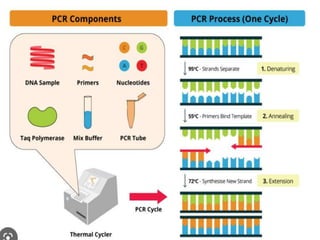
Components Of PCR
Components Of PCR constitutes the following:
DNA Template– The DNA of interest from the sample.
DNA Polymerase– Taq Polymerase is used.
• It is thermostable and does not denature at very high temperatures.
Oligonucleotide Primers- These are the short stretches of single-
stranded DNA complementary to the 3’ ends of sense and anti-sense
strands.
Deoxyribonucleotide triphosphate– These provide energy for
polymerization and are the building blocks for the synthesis of DNA.
These are single units of bases.
Buffer System– Magnesium and Potassium provide optimum conditions
for DNA denaturation and renaturation. It is also important for fidelity,
polymerase activity, and stability.
Types of PCR
Real-time PCR
In this type, the DNA amplification is detected in real-time with the help
of a fluorescent reporter. The signal strength of the fluorescent reporter
is directly proportional to the number of amplified DNA molecules.
Nested PCR
This was designed to improve sensitivity and specificity. They reduce the
non-specific binding of products due to the amplification of unexpected
primer binding sites.
Multiplex PCR
This is used for the amplification of multiple targets in a single PCR
experiment. It amplifies many different DNA sequences simultaneously.
Quantitative PCR
It uses the DNA amplification linearity to detect, characterize and
quantify a known sequence in a sample.
Arbitrary Primed PCR
It is a DNA fingerprinting technique based on PCR. It uses primers the
DNA sequence of which is chosen arbitrarily.
PCR Steps
The PCR involves three major cyclic reactions:
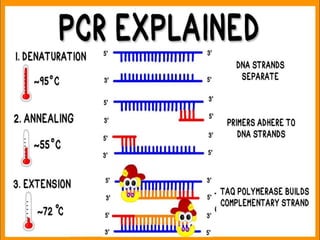
1-Denaturation
Denaturation occurs when the reaction mixture is heated to 94℃ for
about 0.5 to 2 minutes. This breaks the hydrogen bonds between the
two strands of DNA and converts it into a single-stranded DNA.
The single strands now act as a template for the production of new
strands of DNA. The temperature should be provided for a longer time
to ensure the separation of the two strands.
2-Annealing
The reaction temperature is lowered to 54-60℃ for around 20-40
seconds. Here, the primers bind to their complementary sequences on
the template DNA.
Primers are single-strand sequences of DNA or RNA around 20 to 30
bases in length.
They serve as the starting point for the synthesis of DNA.
The two separated strands run in the opposite direction and
consequently there are two primers- a forward primer and a reverse
primer.
3-Elongation
At this step, the temperature is raised to 72-80℃. The bases are added
to the 3’ end of the primer by the Taq polymerase enzyme.
This elongates the DNA in the 5’ to 3’ direction.
The DNA polymerase adds about 1000bp/minute under optimum
conditions.
Taq Polymerase can tolerate very high temperatures. It attaches to the
primer and adds DNA bases to the single strand. As a result, a double-
stranded DNA molecule is obtained.
These three steps are repeated 20-40 times in order to obtain a number
of sequences of DNA of interest in a very short time period.
Applications of PCR
•The following are the applications of PCR :
Medicine
•Testing of genetic disease mutations.
•Monitoring the gene in gene therapy.
•Detecting disease-causing genes in the parents.
Forensic Science
•Used as a tool in genetic fingerprinting.
•Identifying the criminal from millions of people.
•Paternity tests
Research and Genetics
•Compare the genome of two organisms in genomic studies.
•In the phylogenetic analysis of DNA from any source such as fossils.
•Analysis of gene expression.
•Gene Mapping.
unit-2 cloning vector, r-DNA Technology, PCR.pptx

unit-2 cloning vector, r-DNA Technology, PCR.pptx

  • 1.
    Biotechnology b.Pharma 6th semesterunit-2nd Mr. Bulet Kumar Gupta Assistant Professor Sai College of Pharmacy, Mau
  • 2.
    CLONING VECTOR •A cloningvector is a small piece of DNA that can be stably maintained in an organism, and into which a foreign DNA fragment can be inserted for cloning purposes. •The cloning vector may be DNA taken from a virus, the cell of a higher organism, or it may be the plasmid of a bacterium. •There are many types of cloning vectors, but the most commonly used ones are genetically engineered plasmids.
  • 3.
    Depending on thisbasis the vectors are classified as under- 1. Vectors for Bacteria: These are special bacterial origin of replication and antibiotic resistance selectable markers. Bacteria support different kinds of vectors Ex- Plasmid vectors, Bacteriophages vectors, Cosmids, Phasmids, or Phagemids, etc. 2. Vectors for Yeast: They have special origin of replication called as autonomously replicating sequences (ARS). Ex- Yeast replicative plasmid vectors (YRp) etc.
  • 4.
    3. Vectors forAnimals: These vectors are needed in biotechnology for the synthesis of recombinant protein from genes that are not expressed correctly when cloned in E. coli or yeast, and methods for cloning in humans are being sought by clinical molecular biologists attempting to device techniques for gene therapy, in which a disease is treated by introduction of a cloned gene into the patient. Ex- P-element, SV40 etc. 4. Vectors for Plants: The production of genetically modified plants has become possible due to successful use of plant vectors. Ex- Ti-plasmid, Ri-plasmid etc.
  • 5.
    The cloning vectormust possess following of the general characters- •It should be small in size. •It must have an origin of replication(Ori). •It should have multiple cloning sites(MCS). •It contains a selectable markers. •It must also be compatible with host organisms. •It must possess a restriction sites. •Incompatible with another vector. •It should become higher no. of copy. •It should be able to move under eukaryotic and prokaryotic cell.
  • 6.
    STRUCTURE /ELEMENTS OFPLASMIDS OR VECTOR
  • 7.
    •Origin of Replication-DNA sequence which encode initiation of plasmid replication. •Antibiotic resistance Gene- These gene provide a survival advantage to bacterial host, that allow for selection of plasmid containing bacteria. •Multiple cloning sites- Short segment containing several restriction enzyme sites enable to easy insertion of foreign DNA •Promoter region- it drive the transcription of foreign inserts. •Selectable Marker- used to select for cells that has successfully taken up plasmid for the purpose of expression of insert DNA. •Primer Binding Sites- used as an initiation points for amplification and sequencing of the plasmids. •Inserted Gene- Desired DNA.
  • 8.
    •There are manytypes of cloning vectors, but the most commonly used ones are genetically engineered plasmids. •Cloning is generally first performed using Escherichia coli. Plasmid Bacteriophage Phasmids Cosmids Artificial chromosomes Bacterial artificial chromosomes (BACs) Human artificial chromosomes (HACs) Yeast artificial chromosomes (YACs) Retroviral
  • 9.
    Plasmid Vectors •These arethe most common vectors for the prokaryotic host cells. Bacteria are able to express foreign genes inserted into plasmids. Plasmids are small, circular, double- stranded DNA molecules lacking protein coat that naturally exists in the cytoplasm of many strains of bacteria. •Some of the examples of naturally occurring plasmids are Ti plasmids, F-factors, R-factors, Co/E1 plasmid, etc. •Plasmids are independent of the chromosome of bacterial cell and range in size from 1000 to 20000 base pairs(10kb). Using the enzymes and 70s ribosome's that the bacterial cell houses, DNA contained in plasmids can be replicated and expressed.
  • 12.
    Bacteriophage Derived Vectors: •Bacteriophages,or phages as they are commonly known, are viruses that specifically infect bacteria. Like all viruses, phages are very simple in structure consisting merely of a DNA (or occasionally ribonucleic acid (RNA) molecule carrying a number of genes, including several for replication of the phage, surrounded by protective coat or capsid made up of protein Molecules. Insert size range- 10-15kb
  • 14.
    The following aredifferent types of Bacteriophage vectors: Bacteriophage M13 vectors- • it is one of the Ff phages a member of the family filamentous bacteriophage. •Ff phages are composed of circular single-stranded DNA (ssDNA), which in the case of the m13 phage is 6407 nucleotides long. •M13 plasmids are used for many recombinant DNA processes, and the virus has also been used for phage display, directed evolution, nanostructures and nanotechnology applications Lamda Phage Vectors •This is a widely used vector for the cloning of very large pieces of genes.
  • 15.
    Cosmid Vectors •It isthe most sophisticated type of lambda based vector. •Cosmids are the hybrids between the phage DNA molecule and bacterial plasmid. Their design centres on the fact that the enzymes that package the lambda DNA molecule into the phage protein coat need only the cos sites in order to function. •A cosmid is basically a plasmid that carries a cos site. It also needs a selectable marker, such as ampicillin resistant gene, and a plasmid origin of replication. •Cosmids are used for construction of genomic libraries of eukaryotes since these can be used for cloning large fragments of DNA. Insert size range- 30-50kb
  • 17.
    Phasmid/Phagemid Vector A Phagemidor Phasmid is a DNA-based cloning vector, which has both bacteriophage and plasmid properties. These vectors carry, in addition to the origin of plasmid replication, an origin of replication derived from bacteriophage. It have mainly two ORI sites.
  • 18.
    Artificial Chromosomes •Artificial chromosomesare synthetically designed DNA molecules of known structure, which are assembled in vitro (in the laboratory) from specific DNA sequences that acts like a natural chromosome. Artificial chromosomes are circular or linear vectors that are stably maintained in, usually, 1-2 copies per cell. Following are the types of artificial chromosomes: •Human Artificial Chromosomes (HAC) •Bacterial Artificial Chromosomes (BAC) •Yeast Artificial Chromosomes (YAC)
  • 19.
    Human Artificial Chromosomes(HAC) A human artificial chromosome (HAC) is a mini-chromosome that is constructed artificially in human cells. It is a tool for expression studies and determining human chromosome functions, and able to carry new genes introduced by human researchers.
  • 20.
  • 21.
    Bacterial Artificial Chromosomes(BAC) •Bacterial Artificial Chromosomes (BACs) are cloning vectors based on the extra-chromosomal plasmids of E.coli, called F factor or fertility factor. These vectors enable the construction of artificial chromosomes, which can be cloned in E.coli. •This vector is useful for cloning DNA fragments up to 350 kb, and is very useful for sequencing large stretches of chromosomal DNA. •BACs contain ori sequences derived from E. coli plasmid F factor, multiple cloning sites (MCS) having unique restriction sites, and suitable selectable markers. The genomes of several large DNA viruses and RNA viruses have been cloned as BACs. •Examples of BAC are pBACe3.6, pBeloBAC11 etc.
  • 23.
    Yeast Artificial Chromosomes(YAC) •A YAC can be considered as a functional artificial chromosome, since it includes three specific DNA sequences that enable it to propagate from one yeast cell to its offspring. •Yeast artificial Chromosomes cloning system enable the cloning of DNA of 50 to 2000 kb. •Up to 1 millions base pairs in length of an organism DNA can be inserted into YACs. •YAC cloning system can take DNA insert greater than l00kb. •Yeast artificial chromosomes are very helpful in the production of gene libraries. •Example of YAC is pYACs.
  • 26.
    Restriction Endonuclease •Restriction enzymesare also called "molecular scissors" as they cleave DNA at or near specific recognition sequences known as restriction sites. These enzymes make one incision on each of the two strands of DNA and are also called restriction endonucleases. •Restriction enzymes are commonly classified into five categories- •Type I Type II •Type III Type IV • Type V. •Which differ in their structure and whether they cut their DNA substrate at their recognition site, or if the recognition and cleavage sites are separated from one another.
  • 27.
    Enzyme Source RecognitionSequence EcoRI Escherichia coli 5'GAATTC 3'CTTAAG EcoRII Escherichia coli 5'CCWGG 3'GGWCC BamHI Bacillus amyloliquefaciens 5'GGATCC 3'CCTAGG HindIII Haemophilus influenzae 5'AAGCTT 3'TTCGAA Examples of Restriction Enzymes-
  • 29.
    Where DNA strandis cut by Restriction Enzymes that sequence is called- Palindromic sequence.
  • 31.
    DNA Ligase •DNA ligaseis a type of enzyme that facilitates the joining of DNA strands together by catalyzing the formation of a Phosphodiester bond. •DNA ligase creating the final Phosphodiester bond to fully repair the DNA. •DNA ligase is used in both DNA repair and DNA replication. •DNA ligase has extensive use in molecular biology laboratories for recombinant DNA experiments. •Purified DNA ligase is used in gene cloning to join DNA molecules together . And form recombinant DNA.
  • 32.
    •It is isolatedfrom bacteria and Viruses •They joined covalently. •Formation of Phosphodiester bond. •Required ATP, NAD+ and Cofactors.
  • 33.
    Recombinant DNA technology •RecombinantDNA technology involves using enzymes and various laboratory techniques to manipulate and isolate DNA segments of interest. This method can be used to combine (or splice) DNA from different species or to create genes with new functions. The resulting copies are often referred to as recombinant DNA. Such work typically involves propagating the recombinant DNA in a bacterial or yeast cell, whose cellular machinery copies the engineered DNA along with its own. •Recombinant DNA technology has been successfully applied to make important proteins used in the treatment of human diseases, such as insulin and growth hormone.
  • 35.
    •There are multiplesteps, tools and other specific procedures followed in the recombinant DNA technology, which is used for producing artificial DNA to generate the desired product. Tools Of Recombinant DNA Technology •The enzymes which include the restriction enzymes help to cut, • The polymerases- Help to synthesize • The ligases- Help to bind. • The restriction enzymes used in recombinant DNA technology play a major role in determining the location at which the desired gene is inserted into the vector genome. They are two types, namely Endonucleases and Exonucleases.
  • 36.
  • 37.
    •The Endonucleases cutwithin the DNA strand whereas the Exonucleases remove the nucleotides from the ends of the strands. The restriction endonucleases are sequence-specific which are usually palindrome sequences and cut the DNA at specific points. They scrutinize the length of DNA and make the cut at the specific site called the restriction site. •The vectors – help in carrying and integrating the desired gene. These form a very important part of the tools of recombinant DNA technology as they are the ultimate vehicles that carry forward the desired gene into the host organism. •Origin of replication- This is a sequence of nucleotides from where the replication starts.
  • 38.
    A selectable marker– Constitute genes which show resistance to certain Antibiotics like Ampicillin. Cloning sites – the sites recognized by the restriction enzymes where desired DNAs are inserted. Host organism – into which the recombinant DNA is introduced. Process of Recombinant DNA Technology The complete process of recombinant DNA technology includes multiple steps, maintained in a specific sequence to generate the desired product. Step-1. Isolation of Genetic Material. The first and the initial step in Recombinant DNA technology is to isolate the desired DNA in its pure form i.e. free from other macromolecules.
  • 39.
    Step-2.Cutting the geneat the recognition sites. The restriction enzymes play a major role in determining the location at which the desired gene is inserted into the vector genome. These reactions are called ‘restriction enzyme digestions’. Step-3. Amplifying the gene copies through Polymerase chain reaction (PCR). It is a process to amplify a single copy of DNA into thousands to millions of copies once the proper gene of interest has been cut using restriction enzymes. Step-4. Ligation of DNA Molecules. In this step of Ligation, the joining of the two pieces – a cut fragment of DNA and the vector together with the help of the enzyme DNA ligase.
  • 40.
    Step-5. Insertion ofRecombinant DNA Into Host. In this step, the recombinant DNA is introduced into a recipient host cell. This process is termed as Transformation. Once the recombinant DNA is inserted into the host cell, it gets multiplied and is expressed in the form of the manufactured protein under optimal conditions. Step-6. Culture of Bacteria. Microbial culture, is a method of multiplying microbial organisms by letting them reproduce in predetermined culture medium under controlled laboratory conditions. Microbial cultures are foundational and basic diagnostic methods used as a research tool in molecular biology.
  • 42.
    Application of RecombinantDNA Technology DNA technology is also used to detect the presence of HIV in a person. Gene Therapy – It is used as an attempt to correct the gene defects which give rise to heredity diseases. Clinical diagnosis – ELISA is an example where the application of recombinant. Recombinant DNA technology is widely used in Agriculture to produce genetically-modified organisms such as FlavrSavr tomatoes, golden rice rich in proteins, and Bt-cotton to protect the plant against ball worms and a lot more. In the field of medicines, Recombinant DNA technology is used for the production of Insulin.
  • 43.
    DNA Cloning A cloneis a cluster of individual entities or cells that are descended from one progenitor. Clones are genetically identical as the cell simply replicates producing identical daughter cells every time. Scientists are able to generate multiple copies of a single fragment of DNA, a gene which can be used to create identical copies constituting a DNA clone. DNA cloning takes place through the insertion of DNA fragments into a tiny DNA molecule. This molecule is made to replicate within a living cell, for instance, a bacterium. The tiny replicating molecule is known as the carrier of the DNA vector. Yeast cells, viruses, and Plasmids are the most commonly used vectors. Plasmids are circular DNA molecules that are introduced from bacteria
  • 44.
    Applications Of GeneCloning • Gene Cloning plays an important role in the medicinal field. • It is used in the production of hormones, vitamins and antibiotics. • Gene cloning finds its applications in the agricultural field. • Nitrogen fixation is carried out by cyanobacteria wherein desired genes can be used to enhance the productivity of crops and improvement of health. This practice reduces the use of fertilizer. • It can be applied to the science of identifying and detecting a clone containing a particular gene which can be manipulated by growing in a controlled environment. • Medical ailments such as leukaemia and sickle cell anaemia can be treated with this principle.
  • 45.
    Application of Geneticengineering in Medicine: •G.E has vast applications in the medical field. •G.E is used for therapeutic, diagnostic, scientific investigations for forensic studies, production of vaccines, antibiotics and various drugs. •Production of antibiotics, vaccines, enzymes and proteins •Using recombinant DNA technology, many safe and therapeutic drugs have been produced. •These drugs do not induce an allergic reaction, which may be the case if the same product is isolated from any animal source. •Production of antibiotics and vaccines: Antibiotics are produced using plants.
  • 46.
    • Desired genesare incorporated in plants and targeted proteins are produced. •Edible vaccines have already been manufactured for some diseases, e.g. hepatitis B, measles, cholera. •Genetically Engineered Insulin: Insulin is used for the treatment of diabetes. •Earlier insulin was extracted from the pancreas of cattle and pigs, which has shown to induce allergic reactions. •Using recombinant DNA technology, genes coding for human insulin were incorporated in the plasmid of non-pathogenic strains of E. coli. •The recombinant human insulin is known as Humulin. It is widely used to treat diabetic patients.
  • 47.
    •Digestive enzymes: Microorganismscan be modified to produce digestive enzymes. •These microorganisms can be colonized in the digestive tract to suffice for the insufficient enzymes. •Hirudin Protein: The gene coding for hirudin protein, which prevents blood clotting is transferred into Brassica napus. •The protein gets accumulated in the seeds, which can be purified and used medicinally. •Single Cell Protein (SCP): It is a microbial protein, which has high- quality protein and less fat. It is used as a protein-rich supplement for the human diet.
  • 48.
    •Gene Therapy: Genetherapy is used in correcting genetic defects in embryo and child. •Elisa (enzyme-linked immunosorbent assay): Presence of antibodies Synthesized as a result of reaction with the antigen of the pathogen can be detected by this technique. •Transgenic Animals: Transgenic animals are those animals whose genes are manipulated to express a foreign gene. •These transgenic animals are useful in many ways, e.g. • Study gene regulation during normal growth and development. •In Agriculture sector: Using genetic engineering and recombinant DNA technology, genes for the desired trait are introduced in the species. This type of genetically modified plant species is known as GM crop.
  • 49.
    PCR (Polymerase ChainReaction) •PCR or Polymerase Chain Reaction is a technique used in molecular biology to create several copies of a certain DNA segment. This technique was developed in 1983 by Kary Mullis, an American biochemist. •PCR has made it possible to generate millions of copies of a small segment of DNA. •This tool is commonly used in the molecular biology and biotechnology labs.
  • 50.
    Principle of PCR ThePCR technique is based on the enzymatic replication of DNA. In PCR, a short segment of DNA is amplified using primer mediated enzymes. DNA Polymerase synthesizes new strands of DNA complementary to the template DNA. The DNA polymerase can add a nucleotide to the pre- existing 3’-OH group only. Therefore, a primer is required. Thus, more nucleotides are added to the 3’ prime end of the DNA polymerase. Components Of PCR Components Of PCR constitutes the following: DNA Template– The DNA of interest from the sample. DNA Polymerase– Taq Polymerase is used. • It is thermostable and does not denature at very high temperatures.
  • 51.
    Oligonucleotide Primers- Theseare the short stretches of single- stranded DNA complementary to the 3’ ends of sense and anti-sense strands. Deoxyribonucleotide triphosphate– These provide energy for polymerization and are the building blocks for the synthesis of DNA. These are single units of bases. Buffer System– Magnesium and Potassium provide optimum conditions for DNA denaturation and renaturation. It is also important for fidelity, polymerase activity, and stability.
  • 53.
    Types of PCR Real-timePCR In this type, the DNA amplification is detected in real-time with the help of a fluorescent reporter. The signal strength of the fluorescent reporter is directly proportional to the number of amplified DNA molecules. Nested PCR This was designed to improve sensitivity and specificity. They reduce the non-specific binding of products due to the amplification of unexpected primer binding sites. Multiplex PCR This is used for the amplification of multiple targets in a single PCR experiment. It amplifies many different DNA sequences simultaneously.
  • 54.
    Quantitative PCR It usesthe DNA amplification linearity to detect, characterize and quantify a known sequence in a sample. Arbitrary Primed PCR It is a DNA fingerprinting technique based on PCR. It uses primers the DNA sequence of which is chosen arbitrarily.
  • 55.
    PCR Steps The PCRinvolves three major cyclic reactions: 1-Denaturation Denaturation occurs when the reaction mixture is heated to 94℃ for about 0.5 to 2 minutes. This breaks the hydrogen bonds between the two strands of DNA and converts it into a single-stranded DNA. The single strands now act as a template for the production of new strands of DNA. The temperature should be provided for a longer time to ensure the separation of the two strands. 2-Annealing The reaction temperature is lowered to 54-60℃ for around 20-40 seconds. Here, the primers bind to their complementary sequences on
  • 56.
    the template DNA. Primersare single-strand sequences of DNA or RNA around 20 to 30 bases in length. They serve as the starting point for the synthesis of DNA. The two separated strands run in the opposite direction and consequently there are two primers- a forward primer and a reverse primer. 3-Elongation At this step, the temperature is raised to 72-80℃. The bases are added to the 3’ end of the primer by the Taq polymerase enzyme. This elongates the DNA in the 5’ to 3’ direction.
  • 57.
    The DNA polymeraseadds about 1000bp/minute under optimum conditions. Taq Polymerase can tolerate very high temperatures. It attaches to the primer and adds DNA bases to the single strand. As a result, a double- stranded DNA molecule is obtained. These three steps are repeated 20-40 times in order to obtain a number of sequences of DNA of interest in a very short time period.
  • 59.
    Applications of PCR •Thefollowing are the applications of PCR : Medicine •Testing of genetic disease mutations. •Monitoring the gene in gene therapy. •Detecting disease-causing genes in the parents. Forensic Science •Used as a tool in genetic fingerprinting. •Identifying the criminal from millions of people. •Paternity tests
  • 60.
    Research and Genetics •Comparethe genome of two organisms in genomic studies. •In the phylogenetic analysis of DNA from any source such as fossils. •Analysis of gene expression. •Gene Mapping.