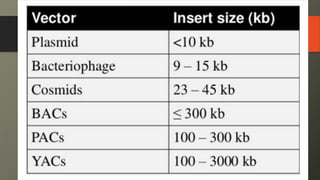
Vectors
Cosmid vector
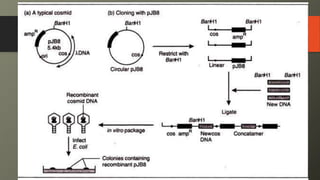
• Most sophisticated type of lambda based vector.
• Cosmids are hybrids between the phage DNA molecule and bacterial
plasmid.
• Their design centers on the fact that the enzymes that package the
lambda DNA molecule into the phage protein coat need only the cos sites
in order to functions.
• Large DNA fragments of size varying from 25 to 45 kb can be cloned.
• They are also packaged into λ This permits the foreign DNA fragment or
genes to be introduced into the host organism by the mechanism of
transduction.
Construction of Cosmid vectors
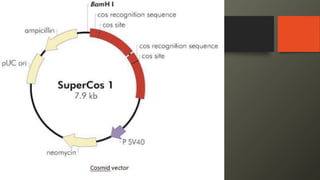
• A cosmid is basically a plasmid that carries a cos site.
• It also needs a selectable marker, such as ampicillin resistant
gene, a plasmid origin of replication.
• Cosmid lacks all the lambda genes, so at does not produce
plaques, instead colonies are formed on the selective media just
as with plasmid vectors.
Advantages of Cosmids:
•These can be used to clone gene of interest up
to 40 kb.
•As the lambda phage will insert the
recombinant DNA into the host cell, an extra
step of inserting the recombinant DNA into the
host cell is not performed.
•Easy screening method is found.
Phagemids
• They are prepared artificially.
• Phasmid contains the F1 origin of replication from F1
phage.
• They are generally used as a cloning vector in
combination with M13 phage.
• It replicates as a plasmid and gets packaged in the form
of single-stranded DNA in viral particles.
• Although M13 vectors are very useful for the
production of single-stranded
• versions of cloned genes they do have one
disadvantage. There is a limit to the
• size of DNA fragment that can be cloned with an
M13 vector, with 1500bp generally being looked
on as the maxi mum capacity.
• Examples of phagemids are the vectors pUC118,
119 and 120.
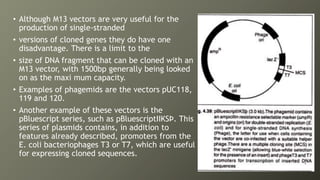
• Another example of these vectors is the
pBluescript series, such as pBluescriptIIKSÞ. This
series of plasmids contains, in addition to
features already described, promoters from the
E. coli bacteriophages T3 or T7, which are useful
for expressing cloned sequences.
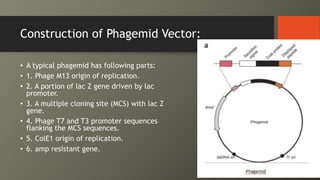
Construction of Phagemid Vector:
• A typical phagemid has following parts:
• 1. Phage M13 origin of replication.
• 2. A portion of lac Z gene driven by lac
promoter.
• 3. A multiple cloning site (MCS) with lac Z
gene.
• 4. Phage T7 and T3 promoter sequences
flanking the MCS sequences.
• 5. ColE1 origin of replication.
• 6. amp resistant gene.
Uses of Phagemid Vectors
• This vector is a multipurpose vector as it can serve as following:
• 1. A cloning vector.
• 2. An expression vector
• 3. A sequencing vector.
• Advantages of Phagemid Vectors:
• The main advantage of the phagemid system is that it can be used to provide
• single-or double-stranded material without any re-cloning.
Phasmid Vectors:
• Phasmids are truly plasmids with phage genes.
• These are linear duplex DNAs whose ends are lambda segments
that contain all the genes required for a lytic infection and whose
middle-portion is linearized.
• Both the lambda and the plasmid replication functions are intact.
Artificial Chromosomes
• Artificial chromosomes are synthetically de signed DNA molecules of known
structure, which are assembled in vitro (in the laboratory) from specific DNA
sequences that acts like a natural chromosome.
• Artificial chromosomes are circular or linear vectors that are stably maintained in,
usually, 1-2 copies per cell.
• They are huge in size in comparison to other vectors but can clone very large
segments of chromosomes (even an entire chromosome).
• artificial chromosomes the three key components of an eukaryotic chromosomes
can be seen which are necessary for its stable maintenance inside a cell.
• 1. The centromere, which is required for the chromosome to be distributed
correctly to daughter cells during cell division.
• 2. Two telomeres, the structures at the ends of a chromosome, which are needed
for the ends to be replicated correctly in order and which also prevent the chromo
some from being nibbled away by exonucleases.
• 3. The origin of replication, which are the positions along the chromosome at which
DNA replication initiates, similar to the origin of replication of a plasmid.
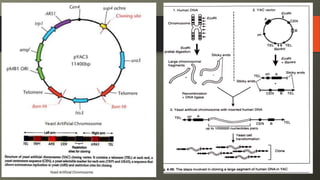
Yeast Artificial Chromosomes (YACs)
• A YAC can be considered as a functional artificial chromosome, since it includes
three specific DNA sequences that enable it to propagate from one yeast cell to its
offspring:
1.The Telomere (TEL): The telomere which is located at each chromosome end,
protects the linear DNA from degradation by Nucleases.
2. The Centromere(CEN): The centromere which is the attachment site for mitotic
spindle fibres, “pulls” one copy of each duplicated chromosome into each new
daughter cell.
3. Origin of Replication(OriR): Replication origin sequences which are specific DNA
sequences that allow the DNA replication machinery to assemble on the DNA and
move at the replication forks.
4. A and B: Selectable markers that allow easy isolation of yeast cells that have
taken up artificial chromosome.
5. Recognition Site: Recognition Site for two restriction en zymes EcoRI and BamHl.
Uses of YAC Vectors:
• YAC can be used to study various aspects of chromosome structure and behaviour; for
instance, to examine the segregation of chromosomes during meiosis.
• YAC cloning system can take DNA insert greater than l00kb. Due to this they can be
used to study the functions and modes of expression of genes that had previously
been intractable to analysis by recombinant DNA techniques.
• YACs can be propagated in mammalian cells, enabling the functional analysis to be
carried out in the organism in which the gene normally resides. Thus by using them
we can learn about the true form of gene expression in vivo conditions.
• Yeast artificial chromosomes are very helpful in the production of gene libraries. E.
coli vectors can take DNA insert maxi mum up to 300kb. Due to this some 30000
clones are needed for a human gene library if we use them as cloning vector.
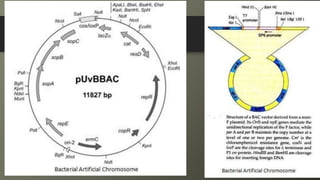
Bacterial Artificial Chromosomes (BACs)
• Bacterial artificial chromosomes are similar to E. coli plasmid
vectors.
• They contain ori and genes which encode ori binding proteins.
These proteins are critical for BAC replication.
• It is derived from naturally occurring F’ plasmid.
• The DNA insert size varies between 150 to 350 kb.
Advantages and disadvantages of BACs:
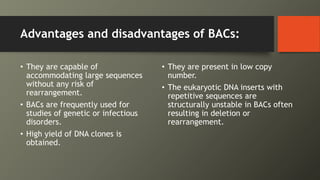
• They are capable of
accommodating large sequences
without any risk of
rearrangement.
• BACs are frequently used for
studies of genetic or infectious
disorders.
• High yield of DNA clones is
obtained.
• They are present in low copy
number.
• The eukaryotic DNA inserts with
repetitive sequences are
structurally unstable in BACs often
resulting in deletion or
rearrangement.
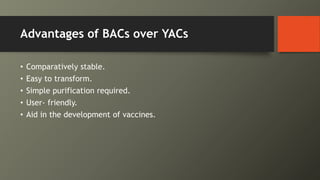
Advantages of BACs over YACs
• Comparatively stable.
• Easy to transform.
• Simple purification required.
• User- friendly.
• Aid in the development of vaccines.
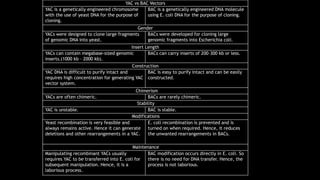
YAC vs BAC Vectors
YAC is a genetically engineered chromosome
with the use of yeast DNA for the purpose of
cloning.
BAC is a genetically engineered DNA molecule
using E. coli DNA for the purpose of cloning.
Gender
YACs were designed to clone large fragments
of genomic DNA into yeast.
BACs were developed for cloning large
genomic fragments into Escherichia coli.
Insert Length
YACs can contain megabase-sized genomic
inserts.(1000 kb – 2000 kb).
BACs can carry inserts of 200–300 kb or less.
Construction
YAC DNA is difficult to purify intact and
requires high concentration for generating YAC
vector system.
BAC is easy to purify intact and can be easily
constructed.
Chimerism
YACs are often chimeric. BACs are rarely chimeric.
Stability
YAC is unstable. BAC is stable.
Modifications
Yeast recombination is very feasible and
always remains active. Hence it can generate
deletions and other rearrangements in a YAC.
E. coli recombination is prevented and is
turned on when required. Hence, it reduces
the unwanted rearrangements in BACs.
Maintenance
Manipulating recombinant YACs usually
requires YAC to be transferred into E. coli for
subsequent manipulation. Hence, it is a
laborious process.
BAC modification occurs directly in E. coli. So
there is no need for DNA transfer. Hence, the
process is not laborious.
Vectors.pptx

Vectors.pptx

  • 1.
  • 2.
    Cosmid vector • Mostsophisticated type of lambda based vector. • Cosmids are hybrids between the phage DNA molecule and bacterial plasmid. • Their design centers on the fact that the enzymes that package the lambda DNA molecule into the phage protein coat need only the cos sites in order to functions. • Large DNA fragments of size varying from 25 to 45 kb can be cloned. • They are also packaged into λ This permits the foreign DNA fragment or genes to be introduced into the host organism by the mechanism of transduction.
  • 3.
    Construction of Cosmidvectors • A cosmid is basically a plasmid that carries a cos site. • It also needs a selectable marker, such as ampicillin resistant gene, a plasmid origin of replication. • Cosmid lacks all the lambda genes, so at does not produce plaques, instead colonies are formed on the selective media just as with plasmid vectors.
  • 6.
    Advantages of Cosmids: •Thesecan be used to clone gene of interest up to 40 kb. •As the lambda phage will insert the recombinant DNA into the host cell, an extra step of inserting the recombinant DNA into the host cell is not performed. •Easy screening method is found.
  • 7.
    Phagemids • They areprepared artificially. • Phasmid contains the F1 origin of replication from F1 phage. • They are generally used as a cloning vector in combination with M13 phage. • It replicates as a plasmid and gets packaged in the form of single-stranded DNA in viral particles.
  • 8.
    • Although M13vectors are very useful for the production of single-stranded • versions of cloned genes they do have one disadvantage. There is a limit to the • size of DNA fragment that can be cloned with an M13 vector, with 1500bp generally being looked on as the maxi mum capacity. • Examples of phagemids are the vectors pUC118, 119 and 120. • Another example of these vectors is the pBluescript series, such as pBluescriptIIKSÞ. This series of plasmids contains, in addition to features already described, promoters from the E. coli bacteriophages T3 or T7, which are useful for expressing cloned sequences.
  • 9.
    Construction of PhagemidVector: • A typical phagemid has following parts: • 1. Phage M13 origin of replication. • 2. A portion of lac Z gene driven by lac promoter. • 3. A multiple cloning site (MCS) with lac Z gene. • 4. Phage T7 and T3 promoter sequences flanking the MCS sequences. • 5. ColE1 origin of replication. • 6. amp resistant gene.
  • 10.
    Uses of PhagemidVectors • This vector is a multipurpose vector as it can serve as following: • 1. A cloning vector. • 2. An expression vector • 3. A sequencing vector. • Advantages of Phagemid Vectors: • The main advantage of the phagemid system is that it can be used to provide • single-or double-stranded material without any re-cloning.
  • 11.
    Phasmid Vectors: • Phasmidsare truly plasmids with phage genes. • These are linear duplex DNAs whose ends are lambda segments that contain all the genes required for a lytic infection and whose middle-portion is linearized. • Both the lambda and the plasmid replication functions are intact.
  • 12.
    Artificial Chromosomes • Artificialchromosomes are synthetically de signed DNA molecules of known structure, which are assembled in vitro (in the laboratory) from specific DNA sequences that acts like a natural chromosome. • Artificial chromosomes are circular or linear vectors that are stably maintained in, usually, 1-2 copies per cell. • They are huge in size in comparison to other vectors but can clone very large segments of chromosomes (even an entire chromosome). • artificial chromosomes the three key components of an eukaryotic chromosomes can be seen which are necessary for its stable maintenance inside a cell. • 1. The centromere, which is required for the chromosome to be distributed correctly to daughter cells during cell division. • 2. Two telomeres, the structures at the ends of a chromosome, which are needed for the ends to be replicated correctly in order and which also prevent the chromo some from being nibbled away by exonucleases. • 3. The origin of replication, which are the positions along the chromosome at which DNA replication initiates, similar to the origin of replication of a plasmid.
  • 13.
    Yeast Artificial Chromosomes(YACs) • A YAC can be considered as a functional artificial chromosome, since it includes three specific DNA sequences that enable it to propagate from one yeast cell to its offspring: 1.The Telomere (TEL): The telomere which is located at each chromosome end, protects the linear DNA from degradation by Nucleases. 2. The Centromere(CEN): The centromere which is the attachment site for mitotic spindle fibres, “pulls” one copy of each duplicated chromosome into each new daughter cell. 3. Origin of Replication(OriR): Replication origin sequences which are specific DNA sequences that allow the DNA replication machinery to assemble on the DNA and move at the replication forks. 4. A and B: Selectable markers that allow easy isolation of yeast cells that have taken up artificial chromosome. 5. Recognition Site: Recognition Site for two restriction en zymes EcoRI and BamHl.
  • 14.
    Uses of YACVectors: • YAC can be used to study various aspects of chromosome structure and behaviour; for instance, to examine the segregation of chromosomes during meiosis. • YAC cloning system can take DNA insert greater than l00kb. Due to this they can be used to study the functions and modes of expression of genes that had previously been intractable to analysis by recombinant DNA techniques. • YACs can be propagated in mammalian cells, enabling the functional analysis to be carried out in the organism in which the gene normally resides. Thus by using them we can learn about the true form of gene expression in vivo conditions. • Yeast artificial chromosomes are very helpful in the production of gene libraries. E. coli vectors can take DNA insert maxi mum up to 300kb. Due to this some 30000 clones are needed for a human gene library if we use them as cloning vector.
  • 16.
    Bacterial Artificial Chromosomes(BACs) • Bacterial artificial chromosomes are similar to E. coli plasmid vectors. • They contain ori and genes which encode ori binding proteins. These proteins are critical for BAC replication. • It is derived from naturally occurring F’ plasmid. • The DNA insert size varies between 150 to 350 kb.
  • 18.
    Advantages and disadvantagesof BACs: • They are capable of accommodating large sequences without any risk of rearrangement. • BACs are frequently used for studies of genetic or infectious disorders. • High yield of DNA clones is obtained. • They are present in low copy number. • The eukaryotic DNA inserts with repetitive sequences are structurally unstable in BACs often resulting in deletion or rearrangement.
  • 19.
    Advantages of BACsover YACs • Comparatively stable. • Easy to transform. • Simple purification required. • User- friendly. • Aid in the development of vaccines.
  • 20.
    YAC vs BACVectors YAC is a genetically engineered chromosome with the use of yeast DNA for the purpose of cloning. BAC is a genetically engineered DNA molecule using E. coli DNA for the purpose of cloning. Gender YACs were designed to clone large fragments of genomic DNA into yeast. BACs were developed for cloning large genomic fragments into Escherichia coli. Insert Length YACs can contain megabase-sized genomic inserts.(1000 kb – 2000 kb). BACs can carry inserts of 200–300 kb or less. Construction YAC DNA is difficult to purify intact and requires high concentration for generating YAC vector system. BAC is easy to purify intact and can be easily constructed. Chimerism YACs are often chimeric. BACs are rarely chimeric. Stability YAC is unstable. BAC is stable. Modifications Yeast recombination is very feasible and always remains active. Hence it can generate deletions and other rearrangements in a YAC. E. coli recombination is prevented and is turned on when required. Hence, it reduces the unwanted rearrangements in BACs. Maintenance Manipulating recombinant YACs usually requires YAC to be transferred into E. coli for subsequent manipulation. Hence, it is a laborious process. BAC modification occurs directly in E. coli. So there is no need for DNA transfer. Hence, the process is not laborious.