Yeast artificial chromosome & YAC VECTOR
Manish raj
WHAT IS
YACs
Vector?
Yeast artificial chromosomes (YACs) are genetically
engineered chromosomes derived from the DNA of the
yeast, Saccharomyces cerevisiae, which is then ligated
into a bacterial plasmid.
First described in1983 by Murray and Szostak
YACs are the largest capacity Yeast vectors,
accommodating megabase range (0.2 to 2 Mb) foreign
DNA fragments within Yeast Cell.
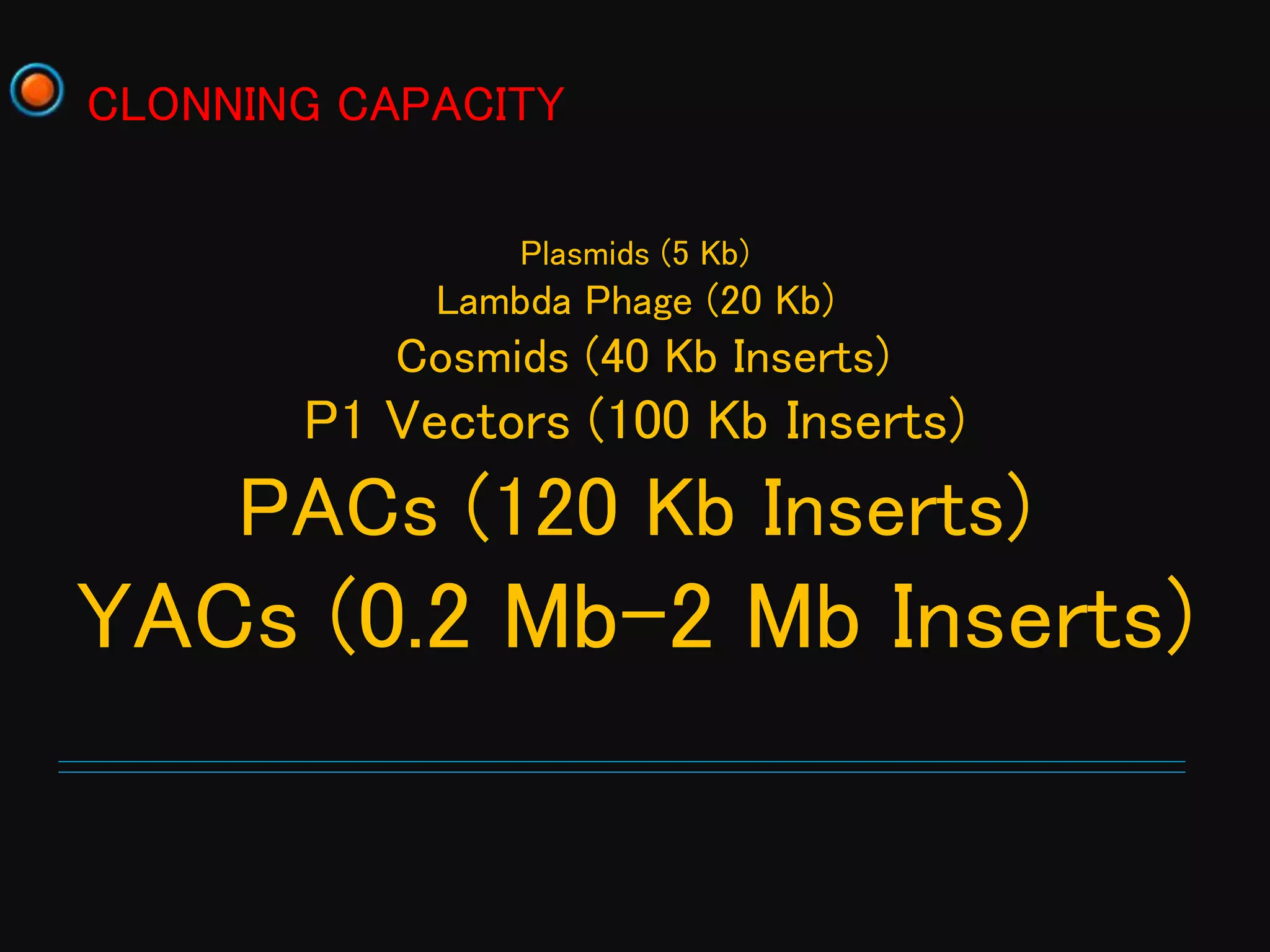
Plasmids (5 Kb)
Lambda Phage (20 Kb)
Cosmids (40 Kb Inserts)
P1 Vectors (100 Kb Inserts)
PACs (120 Kb Inserts)
YACs (0.2 Mb–2 Mb Inserts)
CLONNING CAPACITY
YAC is an artificially constructed chromosome that
contains a
Centromere
Telomeres
Autonomous replicating sequence (ARS) element
required for replication and preservation of
YAC in yeast cells.
YAC cloning vehicles are plasmids
Final chimeric DNA is a linear DNA molecule with
telomeric ends: Artificial Chromosome
Telomere
Selective Marker
BAMPICILLIN
RESISTANCE
ARS (Replications
origin)ARS1
Centromere
CEN4
Selective Marker
AURA3
Telomer
e
EcoRI Cloning site
BamHI
YEAST
CHROMOSOME
VECTOR
(YAC VECTOR)
BamHI
D i g e s t i o n w i t h B a m H I
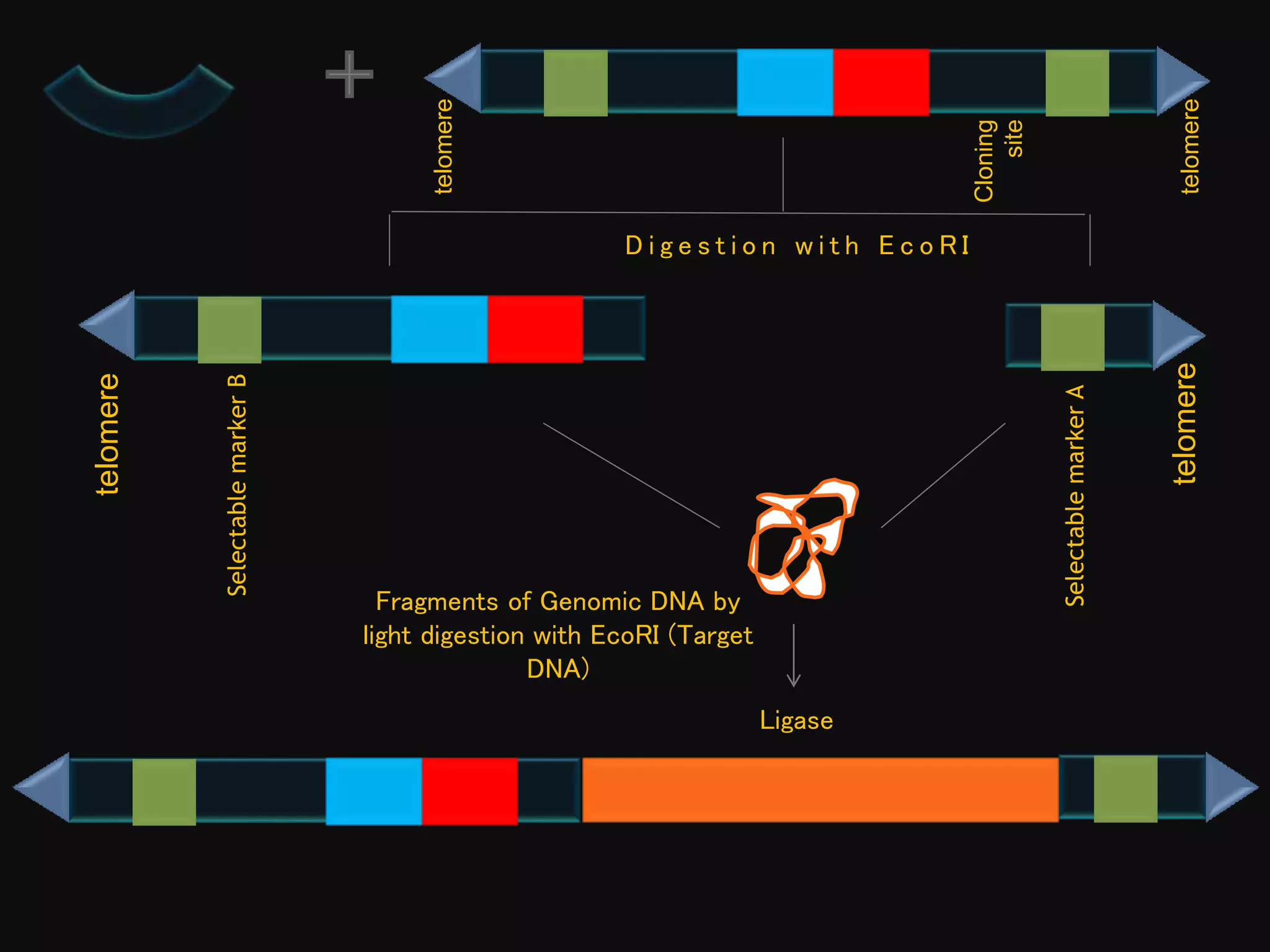
D i g e s t i o n w i t h E c o R I
Fragments of Genomic DNA by
light digestion with EcoRI (Target
DNA)
telomere
telomere
telomere
telomere
Ligase
SelectablemarkerB
SelectablemarkerA
Cloning
site
YAC Transform
Yeast Cell Yeast Spheroplast Yeast with YAC done
Enzymatic
digestion of cell
wall
Select for
A& B
GROUPS OF
YACs
Vector
BASED ON THE MODE OF REPLICATION
Yeast Integrating
plasmids (YIp)
These plasmids
lack an ORI and
must be integrated
directly into the
host chromosome
via homologous
recombination.
Yeast
Centromere
plasmids (YCp):
These are considered
low copy vectors and
incorporate part of an
ARS along with part of a
centromere sequence
(CEN). These vectors
replicate as though they
are small independent
chromosomes and are
thus typically found as a
single copy. Unlike the
ARS vectors, CEN
vectors are stable
without integration.
Yeast Episomal
plasmids (Yep)
These are most similar
to bacterial plasmids
and are considered
“high copy”. A fragment
from the 2 micron circle
(a natural yeast
plasmid) allows for 50+
copies to stably
propogate per cell. The
copy number of these
vectors can also be
controlled if specific
regulatable elements
are included
OF
APPLICATIONS
YACs VECTOR
 generating whole DNA libraries of the genomes of higher
organisms to identifying essential mammalian chromosomal
sequences necessary for the future construction of
specialized Mammalian Artificial Chromosomes (MACs)
 Useful in the study of molecular genetics and
molecular cytogenetics
 Useful in gene mapping, FISH(in situ hybridisation)
banding, determination of chromosomal
breakpoints.
OF
DISADVANTAGES
YACs VECTOR
 Though the principle of cloning is similar to plasmid or
cosmid, but the process of cloning is too complicated to
carry out.
 It is difficult to isolate YAC DNA from host cell because of
its smaller size to host chromosome. Even higher yields
cannot be obtained.
 However, YACs are significantly less stable than
BACs, producing "chimeric effects“
 YACs harbor very large sized insert which is prone
to breakage resulting in rearrangement and
recombination with other DNA in host cell.
Thank
You

Biotechnology: Yeast Artificial Chromosome Cloning Vector

  • 1.
    Yeast artificial chromosome& YAC VECTOR Manish raj
  • 2.
  • 3.
    Yeast artificial chromosomes(YACs) are genetically engineered chromosomes derived from the DNA of the yeast, Saccharomyces cerevisiae, which is then ligated into a bacterial plasmid. First described in1983 by Murray and Szostak YACs are the largest capacity Yeast vectors, accommodating megabase range (0.2 to 2 Mb) foreign DNA fragments within Yeast Cell.
  • 4.
    Plasmids (5 Kb) LambdaPhage (20 Kb) Cosmids (40 Kb Inserts) P1 Vectors (100 Kb Inserts) PACs (120 Kb Inserts) YACs (0.2 Mb–2 Mb Inserts) CLONNING CAPACITY
  • 5.
    YAC is anartificially constructed chromosome that contains a Centromere Telomeres Autonomous replicating sequence (ARS) element required for replication and preservation of YAC in yeast cells. YAC cloning vehicles are plasmids Final chimeric DNA is a linear DNA molecule with telomeric ends: Artificial Chromosome
  • 6.
    Telomere Selective Marker BAMPICILLIN RESISTANCE ARS (Replications origin)ARS1 Centromere CEN4 SelectiveMarker AURA3 Telomer e EcoRI Cloning site BamHI YEAST CHROMOSOME VECTOR (YAC VECTOR) BamHI D i g e s t i o n w i t h B a m H I
  • 7.
    D i ge s t i o n w i t h E c o R I Fragments of Genomic DNA by light digestion with EcoRI (Target DNA) telomere telomere telomere telomere Ligase SelectablemarkerB SelectablemarkerA Cloning site
  • 8.
    YAC Transform Yeast CellYeast Spheroplast Yeast with YAC done Enzymatic digestion of cell wall Select for A& B
  • 9.
  • 10.
    BASED ON THEMODE OF REPLICATION Yeast Integrating plasmids (YIp) These plasmids lack an ORI and must be integrated directly into the host chromosome via homologous recombination. Yeast Centromere plasmids (YCp): These are considered low copy vectors and incorporate part of an ARS along with part of a centromere sequence (CEN). These vectors replicate as though they are small independent chromosomes and are thus typically found as a single copy. Unlike the ARS vectors, CEN vectors are stable without integration. Yeast Episomal plasmids (Yep) These are most similar to bacterial plasmids and are considered “high copy”. A fragment from the 2 micron circle (a natural yeast plasmid) allows for 50+ copies to stably propogate per cell. The copy number of these vectors can also be controlled if specific regulatable elements are included
  • 11.
  • 12.
     generating wholeDNA libraries of the genomes of higher organisms to identifying essential mammalian chromosomal sequences necessary for the future construction of specialized Mammalian Artificial Chromosomes (MACs)  Useful in the study of molecular genetics and molecular cytogenetics  Useful in gene mapping, FISH(in situ hybridisation) banding, determination of chromosomal breakpoints.
  • 13.
  • 14.
     Though theprinciple of cloning is similar to plasmid or cosmid, but the process of cloning is too complicated to carry out.  It is difficult to isolate YAC DNA from host cell because of its smaller size to host chromosome. Even higher yields cannot be obtained.  However, YACs are significantly less stable than BACs, producing "chimeric effects“  YACs harbor very large sized insert which is prone to breakage resulting in rearrangement and recombination with other DNA in host cell.
  • 15.