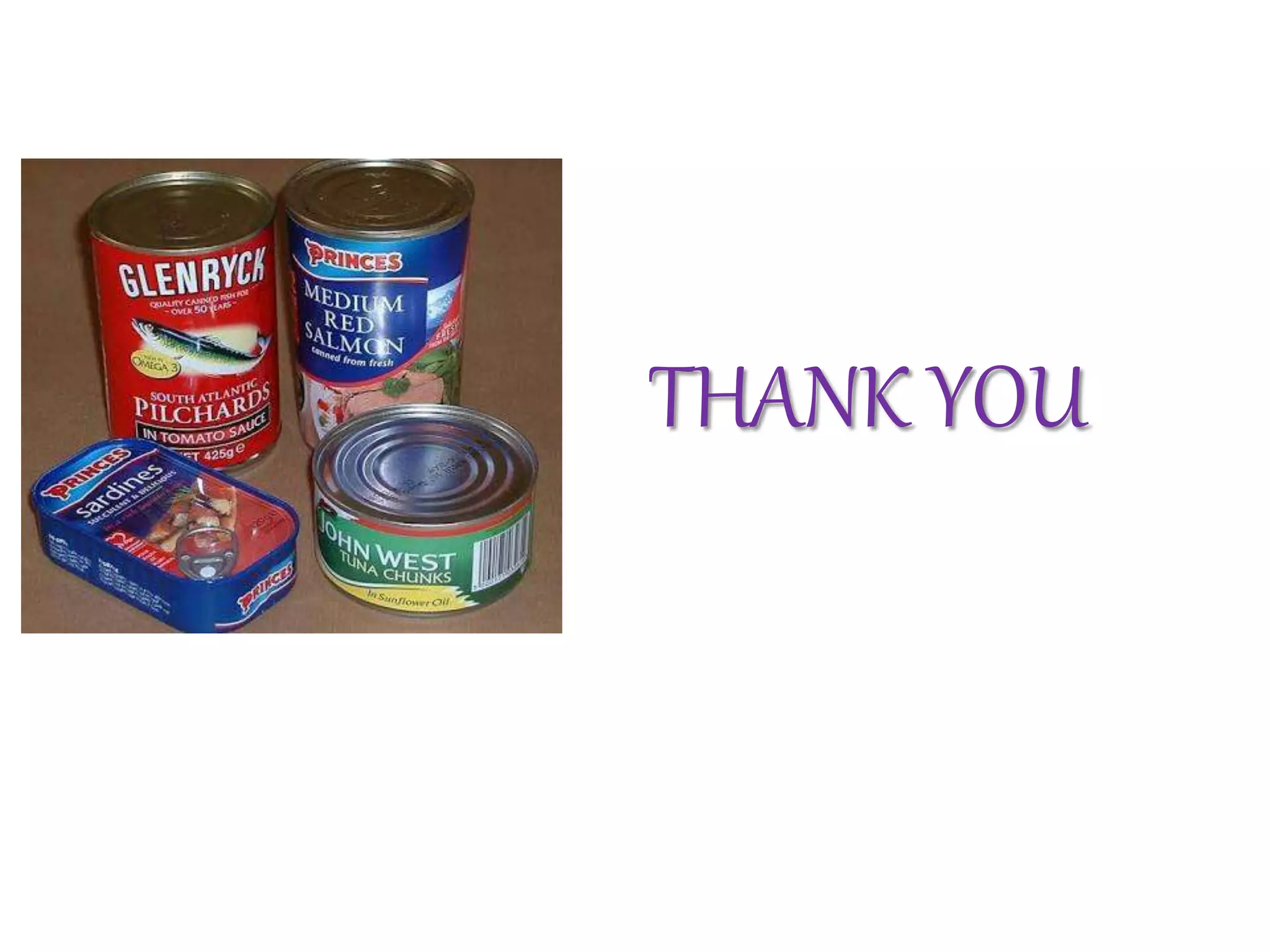
Canning Fish
Canning
• Canning is a method of preserving food.
• Provides a typical shelf life ranging from one to five years.
• Food contents are processed and sealed in airtight container.
• Frenchman Nicolas Appert is known as the Father of Canning.
Fish for Canning
Fresh water fishes suitable for canning:
• Catfish
• Northern pike
• Salmon
• Smelt
• Trout
Start with high quality ingredients….
• It is important to know that fish have been handled safely throughout
processing.
• Unsafe handling can lead to contamination with food poisoning
bacteria such as Salmonella, Listeria and E. coli
• Fish and shellfish are most perishable of all raw foods and require
careful handling to maintain safety and quality.
• Fish and shellfish can be significant sources of food poisoning bacteria
such as Clostridium botulinum, and requires a longer processing time
in a pressure canner than do other foods canned.
Handling fish for canning
• Remove internal organs from fish soon after they are caught,
preferably after 24 hours. Keep freshly caught fish in cold ice until they
can be gutted and cleaned.
• Keep cleaned fish on ice or refrigerator until ready to can or freeze.
Store at 40⁰ F or colder no longer than 2 days until canning or
freezing.
• Fish are most often skinned for canning:
– For large fish, remove bones and fat from skinned fillets. Cut fillets
into pices thjat will fit in large-mouth pint or half-pint home
canning jars.
– Small fish like smelt are usually canned whole, minus heads and
tails.
Packing methods
• Packing can be either hot or raw.
– The hot pack method is recommended for most meats, as it
consistently yields a safe, high quality product.
– The raw pack method is an option for only larger pieces of meat, wild
game or poultry or fatty fish.
• Salmon, trout and other fatty fish are packed raw with no
added liquid. Smoked fish is also packed with no added liquid.
Pressure canning
• Fishes are low-acid foods and must be processed in a pressure
canner for the full time specified to destroy food-poisoning
bacterial spores that might be present.
• Other methods for the same purpose like boiling water bath,
microwave or oven canning are unsafe and not preferred.
• To destroy C. botulinum spores, low acid foods must be processed at
temperatures higher than the boiling point of water. This can be
achieved by surrounding the jars of food with pure steam under
pressure, using a steam pressure canner with atleast 16 - 22 quart
capacity.
• Pressure processing times must be long enough to:
– Allow heat to penetrate to the coldest spot in the jar and
throughout the food, and
– Reach temperatures needed to destroy harmful bacteria and
bacterial spores.
THANK YOU

Canning fish

  • 1.
  • 2.
    Canning • Canning isa method of preserving food. • Provides a typical shelf life ranging from one to five years. • Food contents are processed and sealed in airtight container. • Frenchman Nicolas Appert is known as the Father of Canning.
  • 3.
    Fish for Canning Freshwater fishes suitable for canning: • Catfish • Northern pike • Salmon • Smelt • Trout
  • 4.
    Start with highquality ingredients…. • It is important to know that fish have been handled safely throughout processing. • Unsafe handling can lead to contamination with food poisoning bacteria such as Salmonella, Listeria and E. coli • Fish and shellfish are most perishable of all raw foods and require careful handling to maintain safety and quality. • Fish and shellfish can be significant sources of food poisoning bacteria such as Clostridium botulinum, and requires a longer processing time in a pressure canner than do other foods canned.
  • 5.
    Handling fish forcanning • Remove internal organs from fish soon after they are caught, preferably after 24 hours. Keep freshly caught fish in cold ice until they can be gutted and cleaned. • Keep cleaned fish on ice or refrigerator until ready to can or freeze. Store at 40⁰ F or colder no longer than 2 days until canning or freezing.
  • 6.
    • Fish aremost often skinned for canning: – For large fish, remove bones and fat from skinned fillets. Cut fillets into pices thjat will fit in large-mouth pint or half-pint home canning jars. – Small fish like smelt are usually canned whole, minus heads and tails.
  • 7.
    Packing methods • Packingcan be either hot or raw. – The hot pack method is recommended for most meats, as it consistently yields a safe, high quality product. – The raw pack method is an option for only larger pieces of meat, wild game or poultry or fatty fish. • Salmon, trout and other fatty fish are packed raw with no added liquid. Smoked fish is also packed with no added liquid.
  • 8.
    Pressure canning • Fishesare low-acid foods and must be processed in a pressure canner for the full time specified to destroy food-poisoning bacterial spores that might be present. • Other methods for the same purpose like boiling water bath, microwave or oven canning are unsafe and not preferred.
  • 9.
    • To destroyC. botulinum spores, low acid foods must be processed at temperatures higher than the boiling point of water. This can be achieved by surrounding the jars of food with pure steam under pressure, using a steam pressure canner with atleast 16 - 22 quart capacity.
  • 10.
    • Pressure processingtimes must be long enough to: – Allow heat to penetrate to the coldest spot in the jar and throughout the food, and – Reach temperatures needed to destroy harmful bacteria and bacterial spores.
  • 11.