Monte Carlo  Simulations
&
Membrane  Simulation  and  dynamics
Monte Carlo  Simulations
● Monte Carlo simulation (MCS) is a common methodology
to compute pathways and thermodynamic properties of
proteins.
● A simulation run is a series of random steps in conformation
space, each perturbing some degrees of freedom of the
molecule.
● A step is accepted with a probability that depends on the
change in value of an energy function.
● Its core idea is to use random samples of parameters or
inputs to explore the behaviour of a complex system or
process.
StepsinMCsimulationStepsinMCsimulation
Membrane  Simulation  and  dynamics
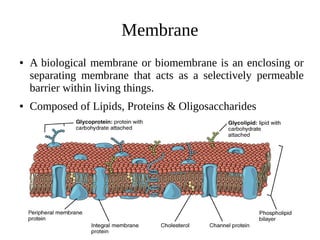
Membrane
● A biological membrane or biomembrane is an enclosing or
separating membrane that acts as a selectively permeable
barrier within living things.
● Composed of Lipids, Proteins & Oligosaccharides
Lipids
● Any of a class of organic
compounds that are fatty acids or
their derivatives and are insoluble
in water but soluble in organic
solvents.
● Charged or strongly polar head-
groups
● Hydrophobic chain(s)
● DLPC (1,2-dilauroyl-sn-glycero-3-phosphocholine) [12
carbon atoms]
● DMPC (1,2-dimyristoyl-sn-glycero-3-phosphocholine)[14
carbon atoms]
● DPPC (1,2-dipalmitoyl-sn-glycero-3-phosphocholine) [16
carbon atoms]
● DSPC (1,2-distearoyl-sn-glycero-3-phosphocholine) [18
carbon atoms]
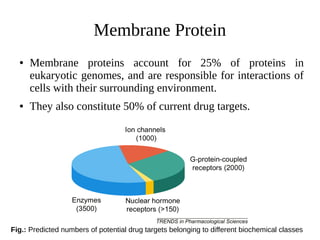
Membrane Protein
● Membrane proteins account for 25% of proteins in
eukaryotic genomes, and are responsible for interactions of
cells with their surrounding environment.
● They also constitute 50% of current drug targets.
Fig.: Predicted numbers of potential drug targets belonging to different biochemical classes
● Despite significant efforts, there are still only 100 distinct
high-resolution membrane protein structures, of which just
over half consist of bundles of hydrophobic transmembrane
(TM) α-helices.
● As the lipid bilayer environment is a complex two-
dimensional liquid crystalline system it has proved difficult
to map details of protein-membrane interactions using
experimental techniques.
● This makes them good targets for computer simulations.
● However, because of their size and the simulation timescales
involved it is only recently that simulations have enabled
prediction of biological properties.
Molecular dynamics simulations (MDS)
● MDS numerically investigate the motions of a system of
discrete particles under the influence of internal and external
forces.
Principle: Interactions of the respective particles are
empirically described by a potential energy function from
which the forces that act on each particle are derived. With
knowledge of these forces it is possible to calculate the
dynamic behavior of the system using classical equations of
motion, in their simplest form Newton’s law, for all atoms in
the system. For biomolecular systems, a discrete time step of
up to a few femtoseconds is used, with typical simulations
consisting of millions of steps.
v = u + at s = ut + 1
/2
at2
v2 
= u2 
+ 2as
● For an atomic system, the potential energy function consists
of a set of equations that empirically describe bonded and
non-bonded interactions between atoms. This energy
function together with the set of its empirical parameters is
referred to as the “force field.”
● Molecular dynamics force fields usually consist of two
major components:
– The first part describes interactions between atoms
connected via covalent bonds, which typically includes
bonds, bond angles, and dihedrals.
– The second part treats non-bonded interactions, typically
as electrostatic interactions between the (partial) charges
on each atom and a Lennard-Jones potential to model
dispersive van der Waals interactions.
MDS of Membrane proteins
The application of simulations to lipid bilayers with explicit
solvent was pioneered by Egberts and Berendsen in their 1988
study of a ternary alcohol-fatty acid-water system.
Obtain protein coordinates
Immerse in bilayer/mimetic
Solvate outside of membrane
(and inside any pore region)
Add counter ions
(optional)
Run simulation
S
T
E
P
S
MDS types
● Atomistic MD simulations
● Coarse-grained simulations
●
Atomistic MD simulationsAtomistic MD simulations
– Retain virtually all atomic-level interactions and use
time-steps in the femto second range.
– Can currently be performed for system sizes of up to a
million atoms.
– Simulation times in the microsecond range.
– The standard technique to study membrane proteins in a
lipid bilayer is based on the insertion of the protein of
interest into a pre-equilibrated bilayer of given
composition and size, moving the lipids out of the way.
– A different strategy in use is based on building a bilayer
around the protein, either by placing lipid by lipid around
the protein or by spontaneous aggregation of lipids to
form a micelle or a bilayer around the membrane protein.
– The latter methods require comparably long simulation
times, i.e., of up to hundreds of nanoseconds for the
simulation of the combined system, requiring several
days of computational time on a high-performance
compute cluster.
– An additional problem arises when the membrane to be
inserted has a mixed composition.
– For single-component membranes, a merged system will
be close to equilibrium, but in multicomponent
membranes, specific interactions between the protein and
the different lipids may cause the merged system to be
far from equilibrium, requiring up to microseconds for
resorting of the lipids.
●
Coarse-grained simulationsCoarse-grained simulations
– Are very fast but lack the atomistic details.
– In these models, a single CG particle represents 2–5 heavy
atoms, and new ‘artificial’ bonded and non-bonded
interactions are parameterized to reproduce
thermodynamic properties such as oil–water partition
coefficients of building block molecules.
– Not only does this lead to an order-of-magnitude fewer
interactions, but the removal of the fastest degrees of
freedom additionally makes it possible to take much longer
timesteps (typically 40 fs), which together with the
reduced interaction density provides 2–3 orders of
magnitude speedup compared to atomistic simulations
Which MDS???Which MDS???
● The type of simulation to be chosen depends very much on
the particular problem and the following questions should
be considered:
– What is the time scale of the processes to be studied?
– How large should the membrane environment be chosen?
– Is sufficient sampling in the simulation expected?
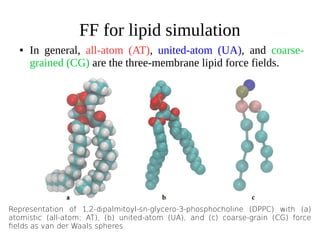
FF for lipid simulation
● In general, all-atom (AT), united-atom (UA), and coarse-
grained (CG) are the three-membrane lipid force fields.
Representation of 1,2-dipalmitoyl-sn-glycero-3-phosphocholine (DPPC) with (a)
atomistic (all-atom; AT), (b) united-atom (UA), and (c) coarse-grain (CG) force
fields as van der Waals spheres.
●
ALL-ATOM (AT) FFALL-ATOM (AT) FF
– AT MD simulation represents every atom in the system
as a single interaction site.
– To date, Chemistry at HARvard Macromolecular
Mechanics (CHARMM) and Assisted Model Building
with Energy Refinement (AMBER) are the only fully AT
force field parameterization available for lipids.
●
UNITED-ATOM (UA) FFUNITED-ATOM (UA) FF
– The UA representation of lipids simplifies the carbon
tails of the lipid by associating the aliphatic carbon and
its hydrogen atoms into a single particle.
– Because the non-polar hydrogen atoms are treated
implicitly, the number of interaction sites per lipid can be
reduced by two third.
– The computational costs for simulations of such
membrane systems become relatively cheap as the 60%
of the pairwise interactions in the membrane is reduced.
– The model lipid DPPC can be represented by 50 particles
in UA force field, but needed 130 interaction sites in an
AT force field.
– The UA lipid models parameterized by Berger et al.
(1997) were one of the most popular lipid force field for
lipids and were originally developed by Essex and
colleagues from the Optimized Potentials for Liquid
Simulations (OPLSs) UA force field.
– Bonded parameters of the Berger lipids were obtained
from the GROMOS87 force field (note: GROMOS is the
GROningen Molecular Simulation package), the acyl
chains used Ryckaert-Bellemans dihedral parameters
whereas the van der Waals terms were from OPLS and
atomic partial charges were from Chiu and colleagues'
calculations.
– For membrane protein simulations, Berger lipids are
commonly used with OPLS and GROMOS.
●
COARSE-GRAINED (CG) FFCOARSE-GRAINED (CG) FF
– CG simulations are being widely used to investigate
phenomenon occurring in timescales not accessible by
AT simulation.
– In a CG simulation, 3–4 heavy atoms (non-H) are
grouped together and represented by a single particle.
– For example, a DMPC lipid consisting of 130 atoms can
be represented by 12 interaction sites.
– MARTINI is a CG force field developed by Marrink and
coworkers.
– In MARTINI, an average of four heavy atoms were
represented by a single interaction site, with the
exception of ring structures which has 2 or 3 ring atoms
mapped to a CG bead.
References:
● Christian Kandt, Walter L. Ash, D. Peter Tieleman, Setting up and running
molecular dynamics simulations of membrane proteins, Methods 41 (2007) 475–488
● Erik Lindahl1 and Mark SP Sansom, Membrane proteins: molecular dynamics
simulations, Current Opinion in Structural Biology 2008, 18:425–431
● Kristyna Pluhackova , Tsjerk A. Wassenaar , and Rainer A. Böckmann; Molecular
Dynamics Simulations of Membrane Proteins; Methods in Molecular Biology, vol.
1033, DOI 10.1007/978-1-62703-487-6_6
● S. W. Leong, T. S. Lim and Y. S. Choong; Bioinformatics for Membrane Lipid
Simulations: Models, Computational Methods, and Web Server Tools; DOI:
10.5772/62576
● Georg C. Terstappen and Angelo Reggiani; In silico research in drug discovery;
TRENDS in Pharmacological Sciences Vol. 22 No.1 January 2001
THANK YOU

Monte Carlo Simulations & Membrane Simulation and Dynamics

  • 1.
  • 2.
  • 3.
    ● Monte Carlosimulation (MCS) is a common methodology to compute pathways and thermodynamic properties of proteins. ● A simulation run is a series of random steps in conformation space, each perturbing some degrees of freedom of the molecule. ● A step is accepted with a probability that depends on the change in value of an energy function. ● Its core idea is to use random samples of parameters or inputs to explore the behaviour of a complex system or process.
  • 4.
  • 5.
  • 6.
    Membrane ● A biologicalmembrane or biomembrane is an enclosing or separating membrane that acts as a selectively permeable barrier within living things. ● Composed of Lipids, Proteins & Oligosaccharides
  • 7.
    Lipids ● Any ofa class of organic compounds that are fatty acids or their derivatives and are insoluble in water but soluble in organic solvents. ● Charged or strongly polar head- groups ● Hydrophobic chain(s)
  • 8.
    ● DLPC (1,2-dilauroyl-sn-glycero-3-phosphocholine)[12 carbon atoms] ● DMPC (1,2-dimyristoyl-sn-glycero-3-phosphocholine)[14 carbon atoms] ● DPPC (1,2-dipalmitoyl-sn-glycero-3-phosphocholine) [16 carbon atoms] ● DSPC (1,2-distearoyl-sn-glycero-3-phosphocholine) [18 carbon atoms]
  • 9.
    Membrane Protein ● Membraneproteins account for 25% of proteins in eukaryotic genomes, and are responsible for interactions of cells with their surrounding environment. ● They also constitute 50% of current drug targets. Fig.: Predicted numbers of potential drug targets belonging to different biochemical classes
  • 10.
    ● Despite significantefforts, there are still only 100 distinct high-resolution membrane protein structures, of which just over half consist of bundles of hydrophobic transmembrane (TM) α-helices.
  • 11.
    ● As thelipid bilayer environment is a complex two- dimensional liquid crystalline system it has proved difficult to map details of protein-membrane interactions using experimental techniques. ● This makes them good targets for computer simulations. ● However, because of their size and the simulation timescales involved it is only recently that simulations have enabled prediction of biological properties.
  • 12.
    Molecular dynamics simulations(MDS) ● MDS numerically investigate the motions of a system of discrete particles under the influence of internal and external forces.
  • 13.
    Principle: Interactions ofthe respective particles are empirically described by a potential energy function from which the forces that act on each particle are derived. With knowledge of these forces it is possible to calculate the dynamic behavior of the system using classical equations of motion, in their simplest form Newton’s law, for all atoms in the system. For biomolecular systems, a discrete time step of up to a few femtoseconds is used, with typical simulations consisting of millions of steps. v = u + at s = ut + 1 /2 at2 v2  = u2  + 2as
  • 14.
    ● For anatomic system, the potential energy function consists of a set of equations that empirically describe bonded and non-bonded interactions between atoms. This energy function together with the set of its empirical parameters is referred to as the “force field.” ● Molecular dynamics force fields usually consist of two major components: – The first part describes interactions between atoms connected via covalent bonds, which typically includes bonds, bond angles, and dihedrals. – The second part treats non-bonded interactions, typically as electrostatic interactions between the (partial) charges on each atom and a Lennard-Jones potential to model dispersive van der Waals interactions.
  • 15.
    MDS of Membraneproteins The application of simulations to lipid bilayers with explicit solvent was pioneered by Egberts and Berendsen in their 1988 study of a ternary alcohol-fatty acid-water system.
  • 16.
  • 17.
    MDS types ● AtomisticMD simulations ● Coarse-grained simulations
  • 18.
    ● Atomistic MD simulationsAtomisticMD simulations – Retain virtually all atomic-level interactions and use time-steps in the femto second range. – Can currently be performed for system sizes of up to a million atoms. – Simulation times in the microsecond range. – The standard technique to study membrane proteins in a lipid bilayer is based on the insertion of the protein of interest into a pre-equilibrated bilayer of given composition and size, moving the lipids out of the way. – A different strategy in use is based on building a bilayer around the protein, either by placing lipid by lipid around the protein or by spontaneous aggregation of lipids to form a micelle or a bilayer around the membrane protein.
  • 19.
    – The lattermethods require comparably long simulation times, i.e., of up to hundreds of nanoseconds for the simulation of the combined system, requiring several days of computational time on a high-performance compute cluster. – An additional problem arises when the membrane to be inserted has a mixed composition. – For single-component membranes, a merged system will be close to equilibrium, but in multicomponent membranes, specific interactions between the protein and the different lipids may cause the merged system to be far from equilibrium, requiring up to microseconds for resorting of the lipids.
  • 20.
    ● Coarse-grained simulationsCoarse-grained simulations –Are very fast but lack the atomistic details. – In these models, a single CG particle represents 2–5 heavy atoms, and new ‘artificial’ bonded and non-bonded interactions are parameterized to reproduce thermodynamic properties such as oil–water partition coefficients of building block molecules. – Not only does this lead to an order-of-magnitude fewer interactions, but the removal of the fastest degrees of freedom additionally makes it possible to take much longer timesteps (typically 40 fs), which together with the reduced interaction density provides 2–3 orders of magnitude speedup compared to atomistic simulations
  • 21.
    Which MDS???Which MDS??? ●The type of simulation to be chosen depends very much on the particular problem and the following questions should be considered: – What is the time scale of the processes to be studied? – How large should the membrane environment be chosen? – Is sufficient sampling in the simulation expected?
  • 22.
    FF for lipidsimulation ● In general, all-atom (AT), united-atom (UA), and coarse- grained (CG) are the three-membrane lipid force fields. Representation of 1,2-dipalmitoyl-sn-glycero-3-phosphocholine (DPPC) with (a) atomistic (all-atom; AT), (b) united-atom (UA), and (c) coarse-grain (CG) force fields as van der Waals spheres.
  • 23.
    ● ALL-ATOM (AT) FFALL-ATOM(AT) FF – AT MD simulation represents every atom in the system as a single interaction site. – To date, Chemistry at HARvard Macromolecular Mechanics (CHARMM) and Assisted Model Building with Energy Refinement (AMBER) are the only fully AT force field parameterization available for lipids.
  • 24.
    ● UNITED-ATOM (UA) FFUNITED-ATOM(UA) FF – The UA representation of lipids simplifies the carbon tails of the lipid by associating the aliphatic carbon and its hydrogen atoms into a single particle. – Because the non-polar hydrogen atoms are treated implicitly, the number of interaction sites per lipid can be reduced by two third. – The computational costs for simulations of such membrane systems become relatively cheap as the 60% of the pairwise interactions in the membrane is reduced. – The model lipid DPPC can be represented by 50 particles in UA force field, but needed 130 interaction sites in an AT force field.
  • 25.
    – The UAlipid models parameterized by Berger et al. (1997) were one of the most popular lipid force field for lipids and were originally developed by Essex and colleagues from the Optimized Potentials for Liquid Simulations (OPLSs) UA force field. – Bonded parameters of the Berger lipids were obtained from the GROMOS87 force field (note: GROMOS is the GROningen Molecular Simulation package), the acyl chains used Ryckaert-Bellemans dihedral parameters whereas the van der Waals terms were from OPLS and atomic partial charges were from Chiu and colleagues' calculations. – For membrane protein simulations, Berger lipids are commonly used with OPLS and GROMOS.
  • 26.
    ● COARSE-GRAINED (CG) FFCOARSE-GRAINED(CG) FF – CG simulations are being widely used to investigate phenomenon occurring in timescales not accessible by AT simulation. – In a CG simulation, 3–4 heavy atoms (non-H) are grouped together and represented by a single particle. – For example, a DMPC lipid consisting of 130 atoms can be represented by 12 interaction sites. – MARTINI is a CG force field developed by Marrink and coworkers. – In MARTINI, an average of four heavy atoms were represented by a single interaction site, with the exception of ring structures which has 2 or 3 ring atoms mapped to a CG bead.
  • 27.
    References: ● Christian Kandt,Walter L. Ash, D. Peter Tieleman, Setting up and running molecular dynamics simulations of membrane proteins, Methods 41 (2007) 475–488 ● Erik Lindahl1 and Mark SP Sansom, Membrane proteins: molecular dynamics simulations, Current Opinion in Structural Biology 2008, 18:425–431 ● Kristyna Pluhackova , Tsjerk A. Wassenaar , and Rainer A. Böckmann; Molecular Dynamics Simulations of Membrane Proteins; Methods in Molecular Biology, vol. 1033, DOI 10.1007/978-1-62703-487-6_6 ● S. W. Leong, T. S. Lim and Y. S. Choong; Bioinformatics for Membrane Lipid Simulations: Models, Computational Methods, and Web Server Tools; DOI: 10.5772/62576 ● Georg C. Terstappen and Angelo Reggiani; In silico research in drug discovery; TRENDS in Pharmacological Sciences Vol. 22 No.1 January 2001
  • 28.