CARDIAC ARRYTHMIAS
ORHAN HAKLI, NP
CARDIAC CONDUCTION SYSTEM
SA NODE :
-AT THE UPPER POSTERIOR PART OF THE ATRIUM
-PRIMARY PACEMAKER
-DISCHARGES ELECTICAL IMPULSES 60-100 A
MINUTE
AV NODE :
-RECEIVES IMPULSES FROM SA NODE
-SLOW THE CONDUCTION AND DELAYS THE
INPUT IN ORDER ATRIUMS TO VENTRICULS
COMPLETELY(Atrial kick 5-30% of the CO)
-BLOCK SOME OF THE IMPULSES TO PREVENT
GOING THE HEART TACHY
-SERVES AS A BACK UP PACEMAKER IF SA NODE
FAILS (ELECTRICAL IMPULSES OF 40-60 A MINUTE)
PURKINJE FIBERS:
-RECEIVES IMPULSES FROM BUNDLE
BRANCHES
-DISCHARGES ELECTRICAL IMPULSES 20-40
A MINUTE
CAUSES OF DYSRHYTHMIAS
ENHANCED
AUTOMATICITY
Increased activity or
rhythm disturbances
TRIGIRRED ACTIVITY
Abnormal electric
impulses when cells are
at rest
RE-ENTRY
Spread of an impulse
through tissue already
stimulated by that same
impulse
ACIDOSIS HYPOXIA HYPERCALIMIA
ALCOLOSIS HYPOMAGNESIA MYOCARDIAL ISCHEMIA
HYPOXIA MYOCARDIAL INJURY ANTIARYTHMATIC MEDS
ISCHEMIA/INFARCT MEDICATIONS THAT
PROLONGS
REPOLARIZATION
(IE.QUINIDINE)
ELECTROLYTE
PROBLEMS (K-CA)
DIG.TOXICITY
ADMINISTRATION OF
ATROPINE/
EPINEPHRINE
EKG
HEART RATE
-To determine the ventricular rate, count
the QRS complex on a 6 sec paper and
multiply by 10
WAVES
-P wave: atrial depolarization
-QRS complex :ventricular depolarization
-Twave :Ventricular repolarization
INTERVALS
-PR :0.12-0.20 sec
-QRS :under 0.10sec
-QT:under 0.38 sec
MAJOR CARDIAC ARRHYTHMIAS
SINUS RYTHMS ATRIAL
RYTHMS
VETRICULAR
RHYTHMS
ATRIO-
VENTRICULAR
(AV) RHYTHMS
SINUS BRADY PREMATURE
ATRIAL
CONTRACTION
(PAC)
PREMATURE
VENTRICULAR
CONTRACTION
(PVC)
1ST DEGREE AV
BLOCK
SINUS
TACHICARDIA
ATRIAL
FLUTTER
VENTRICULAR
TACHICARDIA
2ND DEGREE AV
BLOCK TYPE I
SINUS
ARRYTHMIA
ATRIAL
FIBRILATION
VENTRICULAR
FIBRILATION
2ND DEGREE AV
BLOCK TYPE II
SINUS ARREST ASYSTOLE 3RD DEGREE AV
BLOCK
SINUS RHYTMS
CHARACTERISTICS
-less than 60bpm
-regular PP and RR
-PR 0.12-.20
QRS0.10
WHAT TO DO?
-watch the patient for s/s of bradycardia
-If symptomatic; iv access, o2, transcuteneus pacing
MEDICATION
Atropine 0.5mg ivp
SINUS RHYTHMS
 CHARACTERISTICS
 - 101-150bpm
 -regular PP and RR
 -PR 0.12-.20
 QRS0.10 or less
 WHAT TO DO?
 -watch the patient for s/s of Tachycardia
 -correct underlying problems/Never shock ST
 MEDICATION
 Atenelol/Meteprolol (Beta blockers)
SINUS RHYTHMS
 CHARACTERISTICS
 - usually 60-100bpm, but can be slower or faster
 -irregular with respiration, HR increases with inspiration
and decreases with expiration
 -PR 0.12-.20
 QRS0.10 or less
 WHAT TO DO?
 NOTHING !!!
 MEDICATION
 If hemodynamic compromise is present ATROPINE
SINUS RHYTHMS
 CHARACTERISTICS
 - Rate varies because of the pause
 -irregular rhythm
 -PR 0.12-.20
 QRS0.10 or less
 WHAT TO DO?
 If transient and major s/s of decline monitor the pt
 If more than 3 sec. ATROPINE, Bedside Pacer or
Possible Permanent PM insertion
 MEDICATION
 ATROPINE
SINUS ARREST
ATRIAL RHYTHMS
 CHARACTERISTICS
 - Rate; Depends on the underlying rhythm but usually w/i normal
limits
 -Regular rhythm, except the premature beats
 -PR may be normal or prolonged
 QRS0.10 or less but might be wide
 WHAT TO DO?
 NOTHING!!!
 Reducing stress, stimulants(coffee), treating CHF may help
 MEDICATION
 If needed beta blockers, CA blockers or anxiety meds
PREMATURE ATRIAL COMPLEX
ATRIAL RHYTHMS
AFIB
AFLUTTER
VENTRICULAR RHYTMS
PREMATURE VENTRICULAR COMPLEX
 CHARACTERISTICS
 - Rate; Depends on the underlying rhythm
 -Regular rhythm, except the premature beats
 -PR no PR because ectopy comes from ventricles
 QRS more then 0.12, wide and bizarre looking
 WHAT TO DO?
 NOTHING!!!
 Monitor the pt, if frequent check if they have enough cardiac output
VENTRICULAR RHYTHMS
VENTRICULAR TACHICARDIA
VENTRICULAR FIBRILATION
ASYSTOLE
ATRIOVENTRICULAR (AV) BLOCKS
 CHARACTERISTICS
 - Rate; Depends on the underlying rhythm, but usually normal
 -Regular rhythm
 -PR prolonged, greater than 0.20 sec
 QRS usually 0.10 sec or less
 WHAT TO DO?
 They are usually asymptomatic, Monitor the pt if MI is causing the
block
 Hold the meds that could cause the block(IE beta blockers, CA
blockers, Dig, quinidine)
FIRST DEGREE AV BLOCK
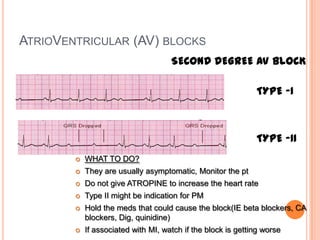
ATRIOVENTRICULAR (AV) BLOCKS
 WHAT TO DO?
 They are usually asymptomatic, Monitor the pt
 Do not give ATROPINE to increase the heart rate
 Type II might be indication for PM
 Hold the meds that could cause the block(IE beta blockers, CA
blockers, Dig, quinidine)
 If associated with MI, watch if the block is getting worse
SECOND DEGREE AV BLOCK
TYPE -I
TYPE -II
ATRIOVENTRICULAR (AV) BLOCKS
 CHARACTERISTICS
 - Rate; atrial rate is greater then ventricular rate
 -Regular ratrial (P) and regular ventricular but no relationship
between the two
 -P normal size and shape; PR none
 QRS can be narrow or wide
 WHAT TO DO?
 ATROPINE /Transcuteneus Pacing
 Possible permanent Pacemaker
THIRD DEGREE AV BLOCK
REFERENCES
 Aehlert, B. (2006). ECGs Made Easy. Arizona: Sauthwest EMS
education Inc.
 Heart Blocks. (2012). Retrieved from http://www.nhlbi.nih.gov:
http://www.nhlbi.nih.gov/health/health-topics/topics/hb/types.html
 Huff, j. (2006). ECG Workout: Exercises in Arrhythmia Interpretation. PA:
Lippincott Williams & Wilkins.
 Nicod, P.; Hillis, L.; Winniford, M.D.; Firth, B.G. (February 15, 1986).
Importance of the "atrial kick" in determining the effective mitral valve
orifice area in mitral stenosis. The American Journal of Cardiology ,
Volume 57, issue 6 p. 403-407.
 Sauer, W. (2012). Normal sinus rhythm and sinus arrhythmia. Retrieved
from http://www.uptodate.com:
http://www.uptodate.com/contents/normal-sinus-rhythm-and-sinus-
arrhythmia


Cardiac arrythmias

  • 1.
  • 2.
    CARDIAC CONDUCTION SYSTEM SANODE : -AT THE UPPER POSTERIOR PART OF THE ATRIUM -PRIMARY PACEMAKER -DISCHARGES ELECTICAL IMPULSES 60-100 A MINUTE AV NODE : -RECEIVES IMPULSES FROM SA NODE -SLOW THE CONDUCTION AND DELAYS THE INPUT IN ORDER ATRIUMS TO VENTRICULS COMPLETELY(Atrial kick 5-30% of the CO) -BLOCK SOME OF THE IMPULSES TO PREVENT GOING THE HEART TACHY -SERVES AS A BACK UP PACEMAKER IF SA NODE FAILS (ELECTRICAL IMPULSES OF 40-60 A MINUTE) PURKINJE FIBERS: -RECEIVES IMPULSES FROM BUNDLE BRANCHES -DISCHARGES ELECTRICAL IMPULSES 20-40 A MINUTE
  • 3.
    CAUSES OF DYSRHYTHMIAS ENHANCED AUTOMATICITY Increasedactivity or rhythm disturbances TRIGIRRED ACTIVITY Abnormal electric impulses when cells are at rest RE-ENTRY Spread of an impulse through tissue already stimulated by that same impulse ACIDOSIS HYPOXIA HYPERCALIMIA ALCOLOSIS HYPOMAGNESIA MYOCARDIAL ISCHEMIA HYPOXIA MYOCARDIAL INJURY ANTIARYTHMATIC MEDS ISCHEMIA/INFARCT MEDICATIONS THAT PROLONGS REPOLARIZATION (IE.QUINIDINE) ELECTROLYTE PROBLEMS (K-CA) DIG.TOXICITY ADMINISTRATION OF ATROPINE/ EPINEPHRINE
  • 4.
    EKG HEART RATE -To determinethe ventricular rate, count the QRS complex on a 6 sec paper and multiply by 10 WAVES -P wave: atrial depolarization -QRS complex :ventricular depolarization -Twave :Ventricular repolarization INTERVALS -PR :0.12-0.20 sec -QRS :under 0.10sec -QT:under 0.38 sec
  • 5.
    MAJOR CARDIAC ARRHYTHMIAS SINUSRYTHMS ATRIAL RYTHMS VETRICULAR RHYTHMS ATRIO- VENTRICULAR (AV) RHYTHMS SINUS BRADY PREMATURE ATRIAL CONTRACTION (PAC) PREMATURE VENTRICULAR CONTRACTION (PVC) 1ST DEGREE AV BLOCK SINUS TACHICARDIA ATRIAL FLUTTER VENTRICULAR TACHICARDIA 2ND DEGREE AV BLOCK TYPE I SINUS ARRYTHMIA ATRIAL FIBRILATION VENTRICULAR FIBRILATION 2ND DEGREE AV BLOCK TYPE II SINUS ARREST ASYSTOLE 3RD DEGREE AV BLOCK
  • 6.
    SINUS RHYTMS CHARACTERISTICS -less than60bpm -regular PP and RR -PR 0.12-.20 QRS0.10 WHAT TO DO? -watch the patient for s/s of bradycardia -If symptomatic; iv access, o2, transcuteneus pacing MEDICATION Atropine 0.5mg ivp
  • 7.
    SINUS RHYTHMS  CHARACTERISTICS - 101-150bpm  -regular PP and RR  -PR 0.12-.20  QRS0.10 or less  WHAT TO DO?  -watch the patient for s/s of Tachycardia  -correct underlying problems/Never shock ST  MEDICATION  Atenelol/Meteprolol (Beta blockers)
  • 8.
    SINUS RHYTHMS  CHARACTERISTICS - usually 60-100bpm, but can be slower or faster  -irregular with respiration, HR increases with inspiration and decreases with expiration  -PR 0.12-.20  QRS0.10 or less  WHAT TO DO?  NOTHING !!!  MEDICATION  If hemodynamic compromise is present ATROPINE
  • 9.
    SINUS RHYTHMS  CHARACTERISTICS - Rate varies because of the pause  -irregular rhythm  -PR 0.12-.20  QRS0.10 or less  WHAT TO DO?  If transient and major s/s of decline monitor the pt  If more than 3 sec. ATROPINE, Bedside Pacer or Possible Permanent PM insertion  MEDICATION  ATROPINE SINUS ARREST
  • 10.
    ATRIAL RHYTHMS  CHARACTERISTICS - Rate; Depends on the underlying rhythm but usually w/i normal limits  -Regular rhythm, except the premature beats  -PR may be normal or prolonged  QRS0.10 or less but might be wide  WHAT TO DO?  NOTHING!!!  Reducing stress, stimulants(coffee), treating CHF may help  MEDICATION  If needed beta blockers, CA blockers or anxiety meds PREMATURE ATRIAL COMPLEX
  • 11.
  • 12.
    VENTRICULAR RHYTMS PREMATURE VENTRICULARCOMPLEX  CHARACTERISTICS  - Rate; Depends on the underlying rhythm  -Regular rhythm, except the premature beats  -PR no PR because ectopy comes from ventricles  QRS more then 0.12, wide and bizarre looking  WHAT TO DO?  NOTHING!!!  Monitor the pt, if frequent check if they have enough cardiac output
  • 13.
  • 14.
    ATRIOVENTRICULAR (AV) BLOCKS CHARACTERISTICS  - Rate; Depends on the underlying rhythm, but usually normal  -Regular rhythm  -PR prolonged, greater than 0.20 sec  QRS usually 0.10 sec or less  WHAT TO DO?  They are usually asymptomatic, Monitor the pt if MI is causing the block  Hold the meds that could cause the block(IE beta blockers, CA blockers, Dig, quinidine) FIRST DEGREE AV BLOCK
  • 15.
    ATRIOVENTRICULAR (AV) BLOCKS WHAT TO DO?  They are usually asymptomatic, Monitor the pt  Do not give ATROPINE to increase the heart rate  Type II might be indication for PM  Hold the meds that could cause the block(IE beta blockers, CA blockers, Dig, quinidine)  If associated with MI, watch if the block is getting worse SECOND DEGREE AV BLOCK TYPE -I TYPE -II
  • 16.
    ATRIOVENTRICULAR (AV) BLOCKS CHARACTERISTICS  - Rate; atrial rate is greater then ventricular rate  -Regular ratrial (P) and regular ventricular but no relationship between the two  -P normal size and shape; PR none  QRS can be narrow or wide  WHAT TO DO?  ATROPINE /Transcuteneus Pacing  Possible permanent Pacemaker THIRD DEGREE AV BLOCK
  • 17.
    REFERENCES  Aehlert, B.(2006). ECGs Made Easy. Arizona: Sauthwest EMS education Inc.  Heart Blocks. (2012). Retrieved from http://www.nhlbi.nih.gov: http://www.nhlbi.nih.gov/health/health-topics/topics/hb/types.html  Huff, j. (2006). ECG Workout: Exercises in Arrhythmia Interpretation. PA: Lippincott Williams & Wilkins.  Nicod, P.; Hillis, L.; Winniford, M.D.; Firth, B.G. (February 15, 1986). Importance of the "atrial kick" in determining the effective mitral valve orifice area in mitral stenosis. The American Journal of Cardiology , Volume 57, issue 6 p. 403-407.  Sauer, W. (2012). Normal sinus rhythm and sinus arrhythmia. Retrieved from http://www.uptodate.com: http://www.uptodate.com/contents/normal-sinus-rhythm-and-sinus- arrhythmia 