SCHOOL OF PHARMACY
Subject : PATHOPHYSIOLOGY
Subject code: SMS1333
Assignment: ARRYTHMIA
Prepared by:
Full Name ID Number
Annisa Hayatunnufus 012014052438
Christine Shalin Selvaraj 012014052277
Hong Tshun Kuan 012014110766
Varisha Priyaa Chandra Sekaran 012014052274
Yeoh Chun Siong 012014110822
Lecturer’s Name : DR. REYADH AL-RASHIDI
Date of submission : Friday, 29th
May 2015
2
A. INTRODUCTION
Arrhythmia is defined as any changes from normal sequence of electrical
impulses in the heart. These electrical impulses may happen either too fast, too slow
or erratically which can cause the heart to beat too fast, too slow or erratically. When
heart doesn’t beat properly, it can’t pump blood efficiently throughout the body and
when this happens, our lungs, brain and all the other organs can’t work properly and
may shut down or damages.
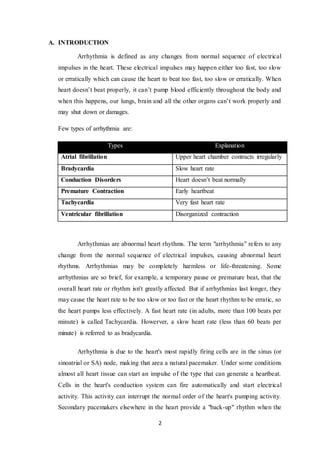
Few types of arrhythmia are:
Types Explanation
Atrial fibrillation Upper heart chamber contracts irregularly
Bradycardia Slow heart rate
Conduction Disorders Heart doesn’t beat normally
Premature Contraction Early heartbeat
Tachycardia Very fast heart rate
Ventricular fibrillation Disorganized contraction
Arrhythmias are abnormal heart rhythms. The term "arrhythmia" refers to any
change from the normal sequence of electrical impulses, causing abnormal heart
rhythms. Arrhythmias may be completely harmless or life-threatening. Some
arrhythmias are so brief, for example, a temporary pause or premature beat, that the
overall heart rate or rhythm isn't greatly affected. But if arrhythmias last longer, they
may cause the heart rate to be too slow or too fast or the heart rhythm to be erratic, so
the heart pumps less effectively. A fast heart rate (in adults, more than 100 beats per
minute) is called Tachycardia. Howerver, a slow heart rate (less than 60 beats per
minute) is referred to as bradycardia.
Arrhythmia is due to the heart's most rapidly firing cells are in the sinus (or
sinoatrial or SA) node, making that area a natural pacemaker. Under some conditions
almost all heart tissue can start an impulse of the type that can generate a heartbeat.
Cells in the heart's conduction system can fire automatically and start electrical
activity. This activity can interrupt the normal order of the heart's pumping activity.
Secondary pacemakers elsewhere in the heart provide a "back-up" rhythm when the
3
sinus node doesn't work properly or when impulses are blocked somewhere in the
conduction system.
To understand arrhythmias, it helps to understand the heart's internal electrical
system. The heart's electrical system controls the rate and rhythm of the heartbeat.
With each heartbeat, an electrical signal spreads from the top of the heart to the
bottom. As the signal travels, it causes the heart to contract and pump blood.
Each electrical signal begins in a group of cells called the sinus node or
sinoatrial (SA) node. The SA node is located in the heart's upper right chamber, the
right atrium. In a healthy adult heart at rest, the SA node fires off an electrical signal
to begin a new heartbeat 60 to 100 times a minute.
From the SA node, the electrical signal travels through special pathways in the
right and left atria. This causes the atria to contract and pump blood into the heart's
two lower chambers, the ventricles.
The electrical signal then moves down to a group of cells called the
atrioventricular (AV) node, located between the atria and the ventricles. Here, the
signal slows down just a little, allowing the ventricles time to finish filling with blood.
The electrical signal then leaves the AV node and travels along a pathway
called the bundle of His. This pathway divides into a right bundle branch and a left
bundle branch. The signal goes down these branches to the ventricles, causing them to
contract and pump blood to the lungs and the rest of the body. The ventricles then
relax, and the heartbeat process starts all over again in the SA node. A problem with
any part of this process can cause an arrhythmia. For example, in atrial fibrillation, a
common type of arrhythmia, electrical signals travel through the atria in a fast and
disorganized way. This causes the atria to quiver instead to contract.
An arrhythmia usually occurs when:
 The heart's natural pacemaker develops an abnormal rate or rhythm.
 The normal conduction pathway is interrupted.
 Another part of the heart takes over as pacemaker.
4
Common arrhythmia treatments include medicines, medical procedures, and
surgery. The doctor may recommend treatment if the arrhythmia causes serious
symptoms, such as dizziness, chest pain, or fainting. The doctor also may recommend
treatment if the arrhythmia increases your risk for problems such as heart
failure, stroke, or sudden cardiac arrest.
5
B. CLASSIFICATION OF ARRYTHMIA
Arrhythmias are classified in various ways. Arrhythmia may be classified by
rate (tachycardia, bradycardia), mechanism (automaticity, reentry, triggered) or
duration (isolated premature beats; couplets; runs, that is 3 or more beats; non-
sustained= less than 30 seconds or sustained= over 30 seconds) or by its site of origin.
By its site of origin arrhythmia can be classified into atria, junctional or ventricles.
 CLASSIFICATION OF ARRHYTHMIA BY ORIGIN
1. Atrial 2. Junctional Arrythmias
o Sinus bradycardia o AV nodal reentrant tachycardia
o Atrial tachycardia o Junctional Rythm
o Multifocal atrial tachycardia o Junctional tachycardia
o Supraventricular tachycardia
(SVT)
o Premature junctional
contraction
o Atrial flutter
o Atrial fibrillation (Afib)
o Wandering Atrial Pacemaker
o Premature Atrial Contractions
(PACs)
3. Ventricular
 Premature ventricular contractions (PVCs), sometimes called ventricular
extra beats (VEBs)
 Accelerated idioventricular rhythm
 Monomorphic ventricular tachycardia
 Polymorphic ventricular tachycardia
 Ventricular fibrillation
 CLASSIFICATION OF ARRYTHMIA BASED ON RATE
Can be divided into bradycardia and tachycardia:
6
I) BRADYCARDIA
Bradycardia, also known as bradyarrhythmia, is a slow heart rate,
namely, a resting heart rate of under 60 beats per minute (BPM) in adults.
However, symptoms usually manifest only for heart rates less than 50. Can
be divided into 4 types:
a) Atrial
Atrial bradycardias are divided into three different types. The first,
respiratory sinus arrhythmia where heart rate increases during inhalation
and decreases during exhalation. The second, sinus bradycardia, is a
sinus rhythm of less than 60 bpm. It is a common condition found in
both healthy individuals and those considered well-conditioned athletes.
The third, Sick sinus syndrome is where the sinus node (heart's
pacemaker) does not fire its signals properly, so that the heart rate slows
down. Sometimes the rate changes back and forth between a slow
(bradycardia) and fast (tachycardia) rate.
b) Ventricular
A ventricular bradycardia, also known as ventricular escape rhythm
or idioventricular rhythm, is a heart rate of less than 50 bpm. This is a
safety mechanism when there is lack of electrical impulse or stimuli
from the atrium. Impulses originating within or below the bundle of His
in the atrioventricular node will produce a wide QRS complex with heart
rates between 20 and 40 bpm. Those above the bundle of His, also
known as junctional, will typically range between 40 and 60 bpm with a
narrow QRS complex. In a third-degree heart block, approximately 61%
take place at the bundle branch-Purkinje system, 21% at the AV node,
and 15% at the bundle of His.
c) Atrioventricular nodal
An atrioventricular nodal bradycardia or AV junction rhythm is
usually caused by the absence of the electrical impulse from the sinus
node. This usually appears on an EKG with a normal QRS complex
7
accompanied with an inverted P wave either before, during, or after the
QRS complex. An AV junctional escape is a delayed heartbeat
originating from an ectopic focus somewhere in the AV junction. It
occurs when the rate of depolarization of the SA node falls below the
rate of the AV node. This dysrhythmia also may occur when the
electrical impulses from the SA node fail to reach the AV node because
of SA or AV block.
d) Infantile
For infants, bradycardia is defined as a heart rate of less than
100 bpm (normal is around 120–160). Premature babies are more likely
than full-term babies to have apnea and bradycardia spells. Touching the
baby gently or rocking the incubator slightly will almost always get the
baby to start breathing again, which increases the heart rate
II) TACHYCARDIA
Tachycardia, also called tachyarrhythmia, is a heart rate that exceeds
the normal resting rate. An electrocardiogram (ECG) is used to classify the
type of tachycardia. Tachyarrhythmias may be divided into 4 groups,
defined by being visibly regular vs irregular and by having a narrow vs wide
QRS complex.
 Irregular, narrow QRS complex tachyarrhythmias include atrial
fibrillation (AF), atrial flutter or true atrial tachycardia with variable AV
conduction, and multifocal atrial tachycardia. Atrial ECG signals that are
continuous, irregular in timing and morphology, and very rapid (>
300/min) without discrete P waves indicate Atrial Fibrillation. Discrete P
waves that vary from beat to beat with at least 3 different morphologies
are known as multifocal atrial tachycardia. Regular, discrete, uniform
atrial signals without intervening isoelectric periods are known as atrial
flutter.
 Irregular, wide QRS complex tachyarrhythmias include the above 4
atrial tachyarrhythmias, conducted with either bundle branch block or
8
ventricular preexcitation, and polymorphic ventricular tachycardia (VT).
Differentiation is based on atrial ECG signals and the presence in
polymorphic VT of a very rapid rate (> 250 beats/min).
 Regular, narrow QRS complex tachyarrhythmias include sinus
tachycardia, atrial flutter or true atrial tachycardia with a consistent AV
conduction ratio, and paroxysmal SVTs (AV nodal reentrant SVT,
orthodromic reciprocating AV tachycardia in the presence of an
accessory AV connection, and SA nodal reentrant SVT).
 Regular, wide QRS complex tachyarrhythmias include those listed for a
regular, narrow QRS complex tachyarrhythmia, each with bundle branch
block or ventricular preexcitation, and monomorphic VT.
9
C. CAUSES AND RISK FACTORS
There are no any direct causes of arrhythmia. However, scientists who have
conducted research found that there are many risk factors of causing arrhythmia. A
risk factor is something that increases your likelihood of getting a disease or condition.
However, the more risk factors you have, the greater your likelihood of developing
arrhythmias. If you have a number of risk factors, ask your doctor what you can do to
reduce your risk of arrhythmias. It is possible to develop arrhythmias with the risk
factors listed below:
 Coronary Heart Disease
Scarring on the heart or the blood vessels or a formation of plaque make it more
difficult for the heart to pump blood. This can slow the rate of the heart,
increasing the risk of causing an arrhythmia.
 Heart Attack or Heart Failure
People who have had heart attacks or heart failure are at increased risk for
arrhythmias because this can change the heart’s electrical impulses.
 Endocarditis
This is an inflammation of the heart muscle, and people with this condition often
have atrial fibrillation.
 Heart Valve Disease
Leaky or weak heart valves can cause changes in the way the heart beats.
 Cardiomyopathy
Disease of the myocardium (heart muscle). The walls of the ventricles may stretch
or enlarge, or the left ventricle wall may thicken and constrict. The heart's blood-
pumping efficiency is affected, often resulting in heart tissue damage.
 Reduction in Blood Supply
A drop in blood supply to the heart can alter the ability of heart cells and tissue to
conduct electrical impulses.
10
 Damaged or DestroyedHeart Tissue
If heart tissue has died or is damaged the way electrical impulses spread in the
heart can be affected.
 Problems with Initiating the Electrical Signal
Either the sinus node fires abnormally, or there is a competing impulse elsewhere
in the heart.
 Problems with the Conduction of the Electrical Impulse
Connections from the atria to the ventricles are hindered (this is often called
a heart block).
 Congenital Heart Disorders
Sometimes people are born with heart conditions that affect the way the heart
works, and the heart is unable to produce a normal heartbeat.
 High Blood Pressure
This increases your risk of developing coronary artery disease. It may also cause
the walls of your left ventricle to become stiff and thick, which can change how
electrical impulses travel through your heart.
 Thyroid Problems (Hypothyroidism or hyperthyroidism)
Having an overactive or underactive thyroid gland can raise your risk for
arrhythmias.
 Diabetes
Your risk of developing coronary artery disease and high blood pressure greatly
increases with uncontrolled diabetes.
 Obesity
Obesity leads to a huge number of health problems, including diabetes type
2, cancer, cardiovascular disease, heart disease, and arrhythmia.
11
 Obstructive SleepApnea
This disorder, in which your breathing is interrupted during sleep, can increase
your risk of bradycardia, atrial fibrillation and other arrhythmias.
 Electrolyte Imbalance
Substances in your blood called electrolytes — such as potassium, sodium,
calcium and magnesium — help trigger and conduct the electrical impulses in
your heart. Electrolyte levels that are too high or too low can affect your heart's
electrical impulses and contribute to arrhythmia development.
 Drinking Too Much Alcohol
Drinking too much alcohol can affect the electrical impulses in your heart and can
increase the chance of developing atrial fibrillation.
 Caffeine or Nicotine Use
Caffeine, nicotine and other stimulants can cause your heart to beat faster and may
contribute to the development of more-serious arrhythmias.
 Age
People over 60 are more likely to develop an arrhythmia than younger people.
This is because they are at increased risk for heart disease and often take
medications that affect the heart’s rhythm.
 Gender
In addition, some types of arrhythmia are more common in certain genders. For
example, men are more likely to develop atrial fibrillation than women.
 Drugs and Supplements
Certain over-the-counter cough and cold medicines containing pseudoephedrine
and certain prescription drugs may contribute to arrhythmia development.
 Illegal Drugs
12
Illegal drugs, such as amphetamines and cocaine, may profoundly affect the heart
and lead to many types of arrhythmias or to sudden death due to ventricular
fibrillation.
 Mental State Problems
Persistent stress, frequent and angry outbursts, mental disorders, such as panic
disorder can increase the risk of causing arrhythmia.
 Eating Disorders
Eating disorders such as anorexia nervosa can lead to higher risk of arrhythmia.
 Respiratory System Disorders
Chronic lung disease, pulmonary embolism (a clot that develops in the lungs),
emphysema (a disorder of the lungs cause by smoking) and asthma may cause
arrhythmia.
13
D. MANAGEMENT OF ARRYTHMIA
 MEDICAL TREATMENT
Symptomatic tachycardias and premature beats may be treated with a variety
of antiarrhythmic drugs. These may be given intravenously in an emergency
situation or orally for long-term treatment. These drugs either suppress the
abnormal firing of pacemaker tissue or depress the transmission of impulses in
tissues that either conduct too rapidly or participate in re-entry.
In patients with atrial fibrillation, a blood thinner (anticoagulant or
antiplatelet agent such as aspirin) is usually added to reduce the risk of blood clots
and stroke.
When tachycardias or premature beats occur often, the effectiveness of
antiarrhythmic drug therapy may be gauged by electrocardiographic monitoring in
a hospital, by using a 24-hour Holter monitor or by serial drug evaluation with
electrophysiologic testing.
The relative simplicity of antiarrhythmic drug therapy must be balanced
against two disadvantages. One is that the drugs must be taken daily and
indefinitely. The other is the risk of side effects. While side effects are a risk of all
medication, those associated with antiarrhythmic drugs can be very hard to
manage. They include proarrhythmia, the more-frequent occurrence of
preexisting arrhythmias or the appearance of new arrhythmias as bad as or worse
than those being treated.
Antiarrhythmic medicines are split into four categories:
 Class I antiarrhythmic medicines are sodium-channel blockers, which slow
electrical conduction in the heart.
 Class II antiarrhythmic medicines are beta-blockers, which work by
blocking the impulses that may cause an irregular heart rhythm and by
interfering with hormonal influences (such as adrenaline) on the heart's cells.
By doing this, they also reduce blood pressure and heart rate.
14
 Class III antiarrhythmic medicines slow the electrical impulses in the heart
by blocking the heart's potassium channels.
 Class IV antiarrhythmic medicines work like class II medicines but act by
blocking the calcium channels in the heart.
Some commonly prescribed antiarrhythmic drugs include (generic name first;
common brand names in parentheses – read drug brand name disclaimer above):
 Amiodarone (Cordarone,
Pacerone)
 Bepridil Hydrochloride (Vascor)
 Disopyramide (Norpace)
 Dofetilide (Tikosyn)
 Dronedarone (Multaq)
 Flecainide (Tambocor)
 Ibutilide (Corvert)
 Lidocaine (Xylocaine)
 Procainamide (Procan, Procanbid)
 Propafenone (Rythmol)
 Propranolol (Inderal)
 Quinidine (many trade names)
 Sotalol (Betapace)
 Tocainide (Tonocarid)
 SUPPORTIVE TREATMENT
In a medical emergency, life-threatening arrhythmias may be stopped by
giving the heart an electric shock (as with a defibrillator).
For people with recurrent arrhythmias, medical devices such as a pacemaker
and implantable cardioverter defibrillator (ICD) can help by continuously
monitoring the heart's electrical system and providing automatic correction when
an arrhythmia starts to occur.
This section covers everything you need to know about these devices.
 Implantable Cardioverter Defibrillator (ICD)
An ICD is a battery-powered device placed under the skin that keeps
track of your heart rate. Thin wires connect the ICD to your heart. If an
abnormal heart rhythm is detected the device will deliver an electric shock to
15
restore a normal heartbeat if your heart is beating chaotically and much too
fast.
ICDs have been very useful in preventing sudden death in patients with
known, sustained ventricular tachycardia or fibrillation (View an animation of
an ICD). Studies have shown that they may have a role in preventing cardiac
arrest in high-risk patients who haven't had, but are at risk for, life-threatening
ventricular arrhythmias.
 Pacemakers
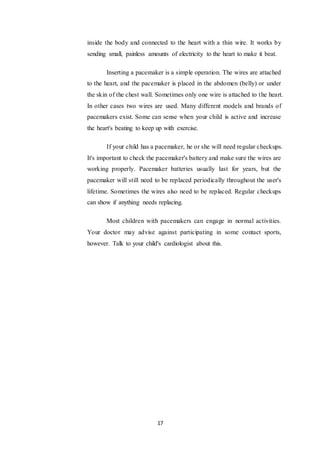
A small battery-operated device that helps the heart beat in a regular rhythm.
There are two parts: a generator and wires (leads).
 The generator is a small battery-powered unit.
 It produces the electrical impulses that stimulate your heart to beat.
 The generator may be implanted under your skin through a small incision.
 The generator is connected to your heart through tiny wires that are
implanted at the same time.
 The impulses flow through these leads to your heart and are timed to flow
at regular intervals just as impulses from your heart's natural pacemaker
would.
 Some pacemakers are external and temporary, not surgically implanted.
 MANAGEMENT OF TREATMENT IN CHILDREN
 Medications
Many rhythm disorders, especially tachycardias, respond to
medications. Several drugs are now available and more are being developed.
These drugs can't cure the arrhythmia, but they can improve symptoms. They
do this by preventing the episodes from starting, decreasing the heart rate
during the episode or shortening how long the episode lasts.
Sometimes it's hard to find the best medication for a child. Several
drugs may need to be tried before the right one is found. Some children must
16
take medication every day; others need medications only when they have a
tachycardia episode. It's very important to take the medication as prescribed.
All medications have side effects, including drugs to treat arrhythmias.
Most of the side effects aren't serious and disappear when the dose is changed
or the medication is stopped. But some side effects are very serious. That's
why some children are admitted to the hospital to begin the medication. If
your child is prescribed medication, it's very important that your child take the
medication just the way the doctor prescribes it.
It's often necessary to monitor how much of a drug is in your child's
blood. The goal is to make sure there's enough of the drug to be effective, but
not so much that harmful side effects occur. These blood tests require taking a
small amount of blood from a vein or the finger. It's a good idea to talk to your
child about this before the doctor visit.
 Supportive treatments
 Radiofrequency ablation — Some tachycardias are life-threatening or
significantly interfere with a child's normal activities. These problems may
warrant more permanent treatment. One procedure, called radiofrequency
catheter ablation, is done with several catheters in the heart. One is
positioned right over the area that's causing the tachycardia. Then its tip is
heated and that small area of the heart is altered so electrical current won't
pass through the tissue.
 Surgery — Sometimes surgery that interrupts the abnormal connection in
the heart is required to permanently stop the tachycardia.
 Artificial pacemaker — A variety of rhythm disorders can be controlled
with an artificial pacemaker. Slow heart rates, such as heart block, are the
most common reason to use a pacemaker. But new technology now lets
doctors treat some fast heart rates with a pacemaker, too. An artificial
pacemaker is a small device (1 to 2 ounces, 1.5 by 1.5 inches). It's put
17
inside the body and connected to the heart with a thin wire. It works by
sending small, painless amounts of electricity to the heart to make it beat.
Inserting a pacemaker is a simple operation. The wires are attached
to the heart, and the pacemaker is placed in the abdomen (belly) or under
the skin of the chest wall. Sometimes only one wire is attached to the heart.
In other cases two wires are used. Many different models and brands of
pacemakers exist. Some can sense when your child is active and increase
the heart's beating to keep up with exercise.
If your child has a pacemaker, he or she will need regular checkups.
It's important to check the pacemaker's battery and make sure the wires are
working properly. Pacemaker batteries usually last for years, but the
pacemaker will still need to be replaced periodically throughout the user's
lifetime. Sometimes the wires also need to be replaced. Regular checkups
can show if anything needs replacing.
Most children with pacemakers can engage in normal activities.
Your doctor may advise against participating in some contact sports,
however. Talk to your child's cardiologist about this.
18
E. REFERENCES
1. Healthline Networks, Inc. (2015). Risk Factors for Arrhythmia. Retrieved from:
http://www.healthline.com/health/arrhythmia/risk-factors#ReducingYourRisks5
(accessed 1/5/2015)
2. Heart Rhythm Society. (2015). Risk Factors & Prevention of Arrhythmia.
Retrieved from: http://www.hrsonline.org/Patient-Resources/Risk-Factors-
Prevention#axzz3Yqg71Vaz (accessed 1/5/2015)
3. Mayo Foundation for Medical Education and Research. (2015). Risk factors of
Arrhythmia. Retrieved from: http://www.mayoclinic.org/diseases-
conditions/heart-arrhythmia/basics/risk-factors/con-20027707 (accessed 1/5/2015)
4. MediLexicon International Limited. (2015). What is arrhythmia? What causes
arrhythmia?. Retrieved from:
http://www.medicalnewstoday.com/articles/8887.php (accessed 1/5/2015)
5. MediResource Inc. (2015). Arrhythmias. Retrieved from:
http://bodyandhealth.canada.com/channel_condition_info_details.asp?disease_id=
10&channel_id=2111&relation_id=84867 (accessed 1/5/2015)
6. National Institute of Health. (2011). Who Is at Risk for an Arrhythmia?. Retrieved
from: http://www.nhlbi.nih.gov/health/health-topics/topics/arr/atrisk (accessed
1/5/2015)
7. Antiarrhythmics - Texas Heart Institute Heart Information Center. (n.d.).
Retrieved 22 May 2015, from
http://www.texasheart.org/HIC/Topics/Meds/antiarrh.cfm
8. Medications for Arrhythmia. (n.d.). Retrieved 20 May 2015, from
http://www.heart.org/HEARTORG/Conditions/Arrhythmia/PreventionTreatmento
fArrhythmia/Medications-for-Arrhythmia_UCM_301990_Article.jsp
9. http://www.nlm.nih.gov/medlineplus/arrhythmia.html
19
10. http://www.nhlbi.nih.gov/health/health-topics/topics/arr/treatment
11. http://www.heart.org/HEARTORG/Conditions/Arrhythmia/AboutArrhythmia/Ab
out-Arrhythmia_UCM_002010_Article.jsp

Paperwork - Arrythmia

  • 1.
    SCHOOL OF PHARMACY Subject: PATHOPHYSIOLOGY Subject code: SMS1333 Assignment: ARRYTHMIA Prepared by: Full Name ID Number Annisa Hayatunnufus 012014052438 Christine Shalin Selvaraj 012014052277 Hong Tshun Kuan 012014110766 Varisha Priyaa Chandra Sekaran 012014052274 Yeoh Chun Siong 012014110822 Lecturer’s Name : DR. REYADH AL-RASHIDI Date of submission : Friday, 29th May 2015
  • 2.
    2 A. INTRODUCTION Arrhythmia isdefined as any changes from normal sequence of electrical impulses in the heart. These electrical impulses may happen either too fast, too slow or erratically which can cause the heart to beat too fast, too slow or erratically. When heart doesn’t beat properly, it can’t pump blood efficiently throughout the body and when this happens, our lungs, brain and all the other organs can’t work properly and may shut down or damages. Few types of arrhythmia are: Types Explanation Atrial fibrillation Upper heart chamber contracts irregularly Bradycardia Slow heart rate Conduction Disorders Heart doesn’t beat normally Premature Contraction Early heartbeat Tachycardia Very fast heart rate Ventricular fibrillation Disorganized contraction Arrhythmias are abnormal heart rhythms. The term "arrhythmia" refers to any change from the normal sequence of electrical impulses, causing abnormal heart rhythms. Arrhythmias may be completely harmless or life-threatening. Some arrhythmias are so brief, for example, a temporary pause or premature beat, that the overall heart rate or rhythm isn't greatly affected. But if arrhythmias last longer, they may cause the heart rate to be too slow or too fast or the heart rhythm to be erratic, so the heart pumps less effectively. A fast heart rate (in adults, more than 100 beats per minute) is called Tachycardia. Howerver, a slow heart rate (less than 60 beats per minute) is referred to as bradycardia. Arrhythmia is due to the heart's most rapidly firing cells are in the sinus (or sinoatrial or SA) node, making that area a natural pacemaker. Under some conditions almost all heart tissue can start an impulse of the type that can generate a heartbeat. Cells in the heart's conduction system can fire automatically and start electrical activity. This activity can interrupt the normal order of the heart's pumping activity. Secondary pacemakers elsewhere in the heart provide a "back-up" rhythm when the
  • 3.
    3 sinus node doesn'twork properly or when impulses are blocked somewhere in the conduction system. To understand arrhythmias, it helps to understand the heart's internal electrical system. The heart's electrical system controls the rate and rhythm of the heartbeat. With each heartbeat, an electrical signal spreads from the top of the heart to the bottom. As the signal travels, it causes the heart to contract and pump blood. Each electrical signal begins in a group of cells called the sinus node or sinoatrial (SA) node. The SA node is located in the heart's upper right chamber, the right atrium. In a healthy adult heart at rest, the SA node fires off an electrical signal to begin a new heartbeat 60 to 100 times a minute. From the SA node, the electrical signal travels through special pathways in the right and left atria. This causes the atria to contract and pump blood into the heart's two lower chambers, the ventricles. The electrical signal then moves down to a group of cells called the atrioventricular (AV) node, located between the atria and the ventricles. Here, the signal slows down just a little, allowing the ventricles time to finish filling with blood. The electrical signal then leaves the AV node and travels along a pathway called the bundle of His. This pathway divides into a right bundle branch and a left bundle branch. The signal goes down these branches to the ventricles, causing them to contract and pump blood to the lungs and the rest of the body. The ventricles then relax, and the heartbeat process starts all over again in the SA node. A problem with any part of this process can cause an arrhythmia. For example, in atrial fibrillation, a common type of arrhythmia, electrical signals travel through the atria in a fast and disorganized way. This causes the atria to quiver instead to contract. An arrhythmia usually occurs when:  The heart's natural pacemaker develops an abnormal rate or rhythm.  The normal conduction pathway is interrupted.  Another part of the heart takes over as pacemaker.
  • 4.
    4 Common arrhythmia treatmentsinclude medicines, medical procedures, and surgery. The doctor may recommend treatment if the arrhythmia causes serious symptoms, such as dizziness, chest pain, or fainting. The doctor also may recommend treatment if the arrhythmia increases your risk for problems such as heart failure, stroke, or sudden cardiac arrest.
  • 5.
    5 B. CLASSIFICATION OFARRYTHMIA Arrhythmias are classified in various ways. Arrhythmia may be classified by rate (tachycardia, bradycardia), mechanism (automaticity, reentry, triggered) or duration (isolated premature beats; couplets; runs, that is 3 or more beats; non- sustained= less than 30 seconds or sustained= over 30 seconds) or by its site of origin. By its site of origin arrhythmia can be classified into atria, junctional or ventricles.  CLASSIFICATION OF ARRHYTHMIA BY ORIGIN 1. Atrial 2. Junctional Arrythmias o Sinus bradycardia o AV nodal reentrant tachycardia o Atrial tachycardia o Junctional Rythm o Multifocal atrial tachycardia o Junctional tachycardia o Supraventricular tachycardia (SVT) o Premature junctional contraction o Atrial flutter o Atrial fibrillation (Afib) o Wandering Atrial Pacemaker o Premature Atrial Contractions (PACs) 3. Ventricular  Premature ventricular contractions (PVCs), sometimes called ventricular extra beats (VEBs)  Accelerated idioventricular rhythm  Monomorphic ventricular tachycardia  Polymorphic ventricular tachycardia  Ventricular fibrillation  CLASSIFICATION OF ARRYTHMIA BASED ON RATE Can be divided into bradycardia and tachycardia:
  • 6.
    6 I) BRADYCARDIA Bradycardia, alsoknown as bradyarrhythmia, is a slow heart rate, namely, a resting heart rate of under 60 beats per minute (BPM) in adults. However, symptoms usually manifest only for heart rates less than 50. Can be divided into 4 types: a) Atrial Atrial bradycardias are divided into three different types. The first, respiratory sinus arrhythmia where heart rate increases during inhalation and decreases during exhalation. The second, sinus bradycardia, is a sinus rhythm of less than 60 bpm. It is a common condition found in both healthy individuals and those considered well-conditioned athletes. The third, Sick sinus syndrome is where the sinus node (heart's pacemaker) does not fire its signals properly, so that the heart rate slows down. Sometimes the rate changes back and forth between a slow (bradycardia) and fast (tachycardia) rate. b) Ventricular A ventricular bradycardia, also known as ventricular escape rhythm or idioventricular rhythm, is a heart rate of less than 50 bpm. This is a safety mechanism when there is lack of electrical impulse or stimuli from the atrium. Impulses originating within or below the bundle of His in the atrioventricular node will produce a wide QRS complex with heart rates between 20 and 40 bpm. Those above the bundle of His, also known as junctional, will typically range between 40 and 60 bpm with a narrow QRS complex. In a third-degree heart block, approximately 61% take place at the bundle branch-Purkinje system, 21% at the AV node, and 15% at the bundle of His. c) Atrioventricular nodal An atrioventricular nodal bradycardia or AV junction rhythm is usually caused by the absence of the electrical impulse from the sinus node. This usually appears on an EKG with a normal QRS complex
  • 7.
    7 accompanied with aninverted P wave either before, during, or after the QRS complex. An AV junctional escape is a delayed heartbeat originating from an ectopic focus somewhere in the AV junction. It occurs when the rate of depolarization of the SA node falls below the rate of the AV node. This dysrhythmia also may occur when the electrical impulses from the SA node fail to reach the AV node because of SA or AV block. d) Infantile For infants, bradycardia is defined as a heart rate of less than 100 bpm (normal is around 120–160). Premature babies are more likely than full-term babies to have apnea and bradycardia spells. Touching the baby gently or rocking the incubator slightly will almost always get the baby to start breathing again, which increases the heart rate II) TACHYCARDIA Tachycardia, also called tachyarrhythmia, is a heart rate that exceeds the normal resting rate. An electrocardiogram (ECG) is used to classify the type of tachycardia. Tachyarrhythmias may be divided into 4 groups, defined by being visibly regular vs irregular and by having a narrow vs wide QRS complex.  Irregular, narrow QRS complex tachyarrhythmias include atrial fibrillation (AF), atrial flutter or true atrial tachycardia with variable AV conduction, and multifocal atrial tachycardia. Atrial ECG signals that are continuous, irregular in timing and morphology, and very rapid (> 300/min) without discrete P waves indicate Atrial Fibrillation. Discrete P waves that vary from beat to beat with at least 3 different morphologies are known as multifocal atrial tachycardia. Regular, discrete, uniform atrial signals without intervening isoelectric periods are known as atrial flutter.  Irregular, wide QRS complex tachyarrhythmias include the above 4 atrial tachyarrhythmias, conducted with either bundle branch block or
  • 8.
    8 ventricular preexcitation, andpolymorphic ventricular tachycardia (VT). Differentiation is based on atrial ECG signals and the presence in polymorphic VT of a very rapid rate (> 250 beats/min).  Regular, narrow QRS complex tachyarrhythmias include sinus tachycardia, atrial flutter or true atrial tachycardia with a consistent AV conduction ratio, and paroxysmal SVTs (AV nodal reentrant SVT, orthodromic reciprocating AV tachycardia in the presence of an accessory AV connection, and SA nodal reentrant SVT).  Regular, wide QRS complex tachyarrhythmias include those listed for a regular, narrow QRS complex tachyarrhythmia, each with bundle branch block or ventricular preexcitation, and monomorphic VT.
  • 9.
    9 C. CAUSES ANDRISK FACTORS There are no any direct causes of arrhythmia. However, scientists who have conducted research found that there are many risk factors of causing arrhythmia. A risk factor is something that increases your likelihood of getting a disease or condition. However, the more risk factors you have, the greater your likelihood of developing arrhythmias. If you have a number of risk factors, ask your doctor what you can do to reduce your risk of arrhythmias. It is possible to develop arrhythmias with the risk factors listed below:  Coronary Heart Disease Scarring on the heart or the blood vessels or a formation of plaque make it more difficult for the heart to pump blood. This can slow the rate of the heart, increasing the risk of causing an arrhythmia.  Heart Attack or Heart Failure People who have had heart attacks or heart failure are at increased risk for arrhythmias because this can change the heart’s electrical impulses.  Endocarditis This is an inflammation of the heart muscle, and people with this condition often have atrial fibrillation.  Heart Valve Disease Leaky or weak heart valves can cause changes in the way the heart beats.  Cardiomyopathy Disease of the myocardium (heart muscle). The walls of the ventricles may stretch or enlarge, or the left ventricle wall may thicken and constrict. The heart's blood- pumping efficiency is affected, often resulting in heart tissue damage.  Reduction in Blood Supply A drop in blood supply to the heart can alter the ability of heart cells and tissue to conduct electrical impulses.
  • 10.
    10  Damaged orDestroyedHeart Tissue If heart tissue has died or is damaged the way electrical impulses spread in the heart can be affected.  Problems with Initiating the Electrical Signal Either the sinus node fires abnormally, or there is a competing impulse elsewhere in the heart.  Problems with the Conduction of the Electrical Impulse Connections from the atria to the ventricles are hindered (this is often called a heart block).  Congenital Heart Disorders Sometimes people are born with heart conditions that affect the way the heart works, and the heart is unable to produce a normal heartbeat.  High Blood Pressure This increases your risk of developing coronary artery disease. It may also cause the walls of your left ventricle to become stiff and thick, which can change how electrical impulses travel through your heart.  Thyroid Problems (Hypothyroidism or hyperthyroidism) Having an overactive or underactive thyroid gland can raise your risk for arrhythmias.  Diabetes Your risk of developing coronary artery disease and high blood pressure greatly increases with uncontrolled diabetes.  Obesity Obesity leads to a huge number of health problems, including diabetes type 2, cancer, cardiovascular disease, heart disease, and arrhythmia.
  • 11.
    11  Obstructive SleepApnea Thisdisorder, in which your breathing is interrupted during sleep, can increase your risk of bradycardia, atrial fibrillation and other arrhythmias.  Electrolyte Imbalance Substances in your blood called electrolytes — such as potassium, sodium, calcium and magnesium — help trigger and conduct the electrical impulses in your heart. Electrolyte levels that are too high or too low can affect your heart's electrical impulses and contribute to arrhythmia development.  Drinking Too Much Alcohol Drinking too much alcohol can affect the electrical impulses in your heart and can increase the chance of developing atrial fibrillation.  Caffeine or Nicotine Use Caffeine, nicotine and other stimulants can cause your heart to beat faster and may contribute to the development of more-serious arrhythmias.  Age People over 60 are more likely to develop an arrhythmia than younger people. This is because they are at increased risk for heart disease and often take medications that affect the heart’s rhythm.  Gender In addition, some types of arrhythmia are more common in certain genders. For example, men are more likely to develop atrial fibrillation than women.  Drugs and Supplements Certain over-the-counter cough and cold medicines containing pseudoephedrine and certain prescription drugs may contribute to arrhythmia development.  Illegal Drugs
  • 12.
    12 Illegal drugs, suchas amphetamines and cocaine, may profoundly affect the heart and lead to many types of arrhythmias or to sudden death due to ventricular fibrillation.  Mental State Problems Persistent stress, frequent and angry outbursts, mental disorders, such as panic disorder can increase the risk of causing arrhythmia.  Eating Disorders Eating disorders such as anorexia nervosa can lead to higher risk of arrhythmia.  Respiratory System Disorders Chronic lung disease, pulmonary embolism (a clot that develops in the lungs), emphysema (a disorder of the lungs cause by smoking) and asthma may cause arrhythmia.
  • 13.
    13 D. MANAGEMENT OFARRYTHMIA  MEDICAL TREATMENT Symptomatic tachycardias and premature beats may be treated with a variety of antiarrhythmic drugs. These may be given intravenously in an emergency situation or orally for long-term treatment. These drugs either suppress the abnormal firing of pacemaker tissue or depress the transmission of impulses in tissues that either conduct too rapidly or participate in re-entry. In patients with atrial fibrillation, a blood thinner (anticoagulant or antiplatelet agent such as aspirin) is usually added to reduce the risk of blood clots and stroke. When tachycardias or premature beats occur often, the effectiveness of antiarrhythmic drug therapy may be gauged by electrocardiographic monitoring in a hospital, by using a 24-hour Holter monitor or by serial drug evaluation with electrophysiologic testing. The relative simplicity of antiarrhythmic drug therapy must be balanced against two disadvantages. One is that the drugs must be taken daily and indefinitely. The other is the risk of side effects. While side effects are a risk of all medication, those associated with antiarrhythmic drugs can be very hard to manage. They include proarrhythmia, the more-frequent occurrence of preexisting arrhythmias or the appearance of new arrhythmias as bad as or worse than those being treated. Antiarrhythmic medicines are split into four categories:  Class I antiarrhythmic medicines are sodium-channel blockers, which slow electrical conduction in the heart.  Class II antiarrhythmic medicines are beta-blockers, which work by blocking the impulses that may cause an irregular heart rhythm and by interfering with hormonal influences (such as adrenaline) on the heart's cells. By doing this, they also reduce blood pressure and heart rate.
  • 14.
    14  Class IIIantiarrhythmic medicines slow the electrical impulses in the heart by blocking the heart's potassium channels.  Class IV antiarrhythmic medicines work like class II medicines but act by blocking the calcium channels in the heart. Some commonly prescribed antiarrhythmic drugs include (generic name first; common brand names in parentheses – read drug brand name disclaimer above):  Amiodarone (Cordarone, Pacerone)  Bepridil Hydrochloride (Vascor)  Disopyramide (Norpace)  Dofetilide (Tikosyn)  Dronedarone (Multaq)  Flecainide (Tambocor)  Ibutilide (Corvert)  Lidocaine (Xylocaine)  Procainamide (Procan, Procanbid)  Propafenone (Rythmol)  Propranolol (Inderal)  Quinidine (many trade names)  Sotalol (Betapace)  Tocainide (Tonocarid)  SUPPORTIVE TREATMENT In a medical emergency, life-threatening arrhythmias may be stopped by giving the heart an electric shock (as with a defibrillator). For people with recurrent arrhythmias, medical devices such as a pacemaker and implantable cardioverter defibrillator (ICD) can help by continuously monitoring the heart's electrical system and providing automatic correction when an arrhythmia starts to occur. This section covers everything you need to know about these devices.  Implantable Cardioverter Defibrillator (ICD) An ICD is a battery-powered device placed under the skin that keeps track of your heart rate. Thin wires connect the ICD to your heart. If an abnormal heart rhythm is detected the device will deliver an electric shock to
  • 15.
    15 restore a normalheartbeat if your heart is beating chaotically and much too fast. ICDs have been very useful in preventing sudden death in patients with known, sustained ventricular tachycardia or fibrillation (View an animation of an ICD). Studies have shown that they may have a role in preventing cardiac arrest in high-risk patients who haven't had, but are at risk for, life-threatening ventricular arrhythmias.  Pacemakers A small battery-operated device that helps the heart beat in a regular rhythm. There are two parts: a generator and wires (leads).  The generator is a small battery-powered unit.  It produces the electrical impulses that stimulate your heart to beat.  The generator may be implanted under your skin through a small incision.  The generator is connected to your heart through tiny wires that are implanted at the same time.  The impulses flow through these leads to your heart and are timed to flow at regular intervals just as impulses from your heart's natural pacemaker would.  Some pacemakers are external and temporary, not surgically implanted.  MANAGEMENT OF TREATMENT IN CHILDREN  Medications Many rhythm disorders, especially tachycardias, respond to medications. Several drugs are now available and more are being developed. These drugs can't cure the arrhythmia, but they can improve symptoms. They do this by preventing the episodes from starting, decreasing the heart rate during the episode or shortening how long the episode lasts. Sometimes it's hard to find the best medication for a child. Several drugs may need to be tried before the right one is found. Some children must
  • 16.
    16 take medication everyday; others need medications only when they have a tachycardia episode. It's very important to take the medication as prescribed. All medications have side effects, including drugs to treat arrhythmias. Most of the side effects aren't serious and disappear when the dose is changed or the medication is stopped. But some side effects are very serious. That's why some children are admitted to the hospital to begin the medication. If your child is prescribed medication, it's very important that your child take the medication just the way the doctor prescribes it. It's often necessary to monitor how much of a drug is in your child's blood. The goal is to make sure there's enough of the drug to be effective, but not so much that harmful side effects occur. These blood tests require taking a small amount of blood from a vein or the finger. It's a good idea to talk to your child about this before the doctor visit.  Supportive treatments  Radiofrequency ablation — Some tachycardias are life-threatening or significantly interfere with a child's normal activities. These problems may warrant more permanent treatment. One procedure, called radiofrequency catheter ablation, is done with several catheters in the heart. One is positioned right over the area that's causing the tachycardia. Then its tip is heated and that small area of the heart is altered so electrical current won't pass through the tissue.  Surgery — Sometimes surgery that interrupts the abnormal connection in the heart is required to permanently stop the tachycardia.  Artificial pacemaker — A variety of rhythm disorders can be controlled with an artificial pacemaker. Slow heart rates, such as heart block, are the most common reason to use a pacemaker. But new technology now lets doctors treat some fast heart rates with a pacemaker, too. An artificial pacemaker is a small device (1 to 2 ounces, 1.5 by 1.5 inches). It's put
  • 17.
    17 inside the bodyand connected to the heart with a thin wire. It works by sending small, painless amounts of electricity to the heart to make it beat. Inserting a pacemaker is a simple operation. The wires are attached to the heart, and the pacemaker is placed in the abdomen (belly) or under the skin of the chest wall. Sometimes only one wire is attached to the heart. In other cases two wires are used. Many different models and brands of pacemakers exist. Some can sense when your child is active and increase the heart's beating to keep up with exercise. If your child has a pacemaker, he or she will need regular checkups. It's important to check the pacemaker's battery and make sure the wires are working properly. Pacemaker batteries usually last for years, but the pacemaker will still need to be replaced periodically throughout the user's lifetime. Sometimes the wires also need to be replaced. Regular checkups can show if anything needs replacing. Most children with pacemakers can engage in normal activities. Your doctor may advise against participating in some contact sports, however. Talk to your child's cardiologist about this.
  • 18.
    18 E. REFERENCES 1. HealthlineNetworks, Inc. (2015). Risk Factors for Arrhythmia. Retrieved from: http://www.healthline.com/health/arrhythmia/risk-factors#ReducingYourRisks5 (accessed 1/5/2015) 2. Heart Rhythm Society. (2015). Risk Factors & Prevention of Arrhythmia. Retrieved from: http://www.hrsonline.org/Patient-Resources/Risk-Factors- Prevention#axzz3Yqg71Vaz (accessed 1/5/2015) 3. Mayo Foundation for Medical Education and Research. (2015). Risk factors of Arrhythmia. Retrieved from: http://www.mayoclinic.org/diseases- conditions/heart-arrhythmia/basics/risk-factors/con-20027707 (accessed 1/5/2015) 4. MediLexicon International Limited. (2015). What is arrhythmia? What causes arrhythmia?. Retrieved from: http://www.medicalnewstoday.com/articles/8887.php (accessed 1/5/2015) 5. MediResource Inc. (2015). Arrhythmias. Retrieved from: http://bodyandhealth.canada.com/channel_condition_info_details.asp?disease_id= 10&channel_id=2111&relation_id=84867 (accessed 1/5/2015) 6. National Institute of Health. (2011). Who Is at Risk for an Arrhythmia?. Retrieved from: http://www.nhlbi.nih.gov/health/health-topics/topics/arr/atrisk (accessed 1/5/2015) 7. Antiarrhythmics - Texas Heart Institute Heart Information Center. (n.d.). Retrieved 22 May 2015, from http://www.texasheart.org/HIC/Topics/Meds/antiarrh.cfm 8. Medications for Arrhythmia. (n.d.). Retrieved 20 May 2015, from http://www.heart.org/HEARTORG/Conditions/Arrhythmia/PreventionTreatmento fArrhythmia/Medications-for-Arrhythmia_UCM_301990_Article.jsp 9. http://www.nlm.nih.gov/medlineplus/arrhythmia.html
  • 19.