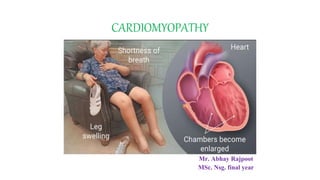


CARDIOMYOPATHY
Mr. Abhay Rajpoot
MSc. Nsg. final year
CARDIOMYOPATHY
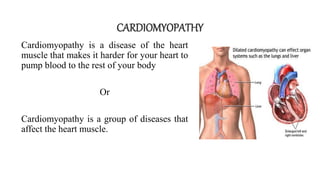
Cardiomyopathy is a disease of the heart
muscle that makes it harder for your heart to
pump blood to the rest of your body
Or
Cardiomyopathy is a group of diseases that
affect the heart muscle.
INCIDENCE:
Dilated cardiomyopathy, the most common form,affects 5% in
100,000 adults and 0.57% in 100,000 children.
Hypertrophic cardiomyopathy, the leading cause of sudden death in
athletes, with an incidence of one in 500 persons.
Restrictive cardiomyopathy and arrhythmogenic right ventricular
cardiomyopathy are rare, and their noses require a high index of
suspicion.
Risk factors:
MODIFIABLE RISK FACTORS:
• Tobacco use
• High blood cholesterol or triglyceride levels
• Lack of exercise
• Obesity
• Stress
NONMODIFIABLE RISK FACTORS:
• Family history of heart disease
• Older age
• Diabetes
• High blood pressure
Etiology:
Idiopathic(unknown cause)
Infectious disease
Genetic conditions
Systemic connective tissue diseases
Long-term high blood pressure
Nutritional deficiencies
Cardiovascular disease
Heart tissue damage from a previous heart attack
Classification:
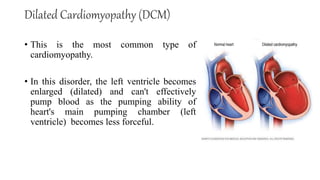
Dilated Cardiomyopathy (DCM)
• This is the most common type of
cardiomyopathy.
• In this disorder, the left ventricle becomes
enlarged (dilated) and can't effectively
pump blood as the pumping ability of
heart's main pumping chamber (left
ventricle) becomes less forceful.
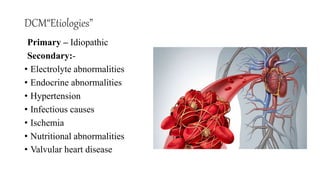
DCM“Etiologies”
Primary – Idiopathic
Secondary:-
• Electrolyte abnormalities
• Endocrine abnormalities
• Hypertension
• Infectious causes
• Ischemia
• Nutritional abnormalities
• Valvular heart disease
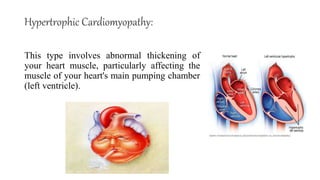
Hypertrophic Cardiomyopathy:
This type involves abnormal thickening of
your heart muscle, particularly affecting the
muscle of your heart's main pumping chamber
(left ventricle).
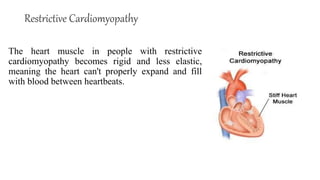
Restrictive Cardiomyopathy
The heart muscle in people with restrictive
cardiomyopathy becomes rigid and less elastic,
meaning the heart can't properly expand and fill
with blood between heartbeats.
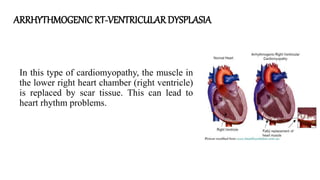
ARRHYTHMOGENIC RT-VENTRICULARDYSPLASIA
In this type of cardiomyopathy, the muscle in
the lower right heart chamber (right ventricle)
is replaced by scar tissue. This can lead to
heart rhythm problems.
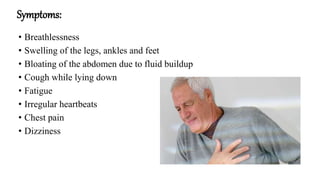
Symptoms:
• Breathlessness
• Swelling of the legs, ankles and feet
• Bloating of the abdomen due to fluid buildup
• Cough while lying down
• Fatigue
• Irregular heartbeats
• Chest pain
• Dizziness
Diagnostic Evaluation:
Chest X-ray
Echocardiogram
Electrocardiogram (ECG)
Treadmill stress test
Cardiac catheterization
Cardiac magnetic resonance imaging (MRI)
Cardiac computerized tomography (CT) scan
Blood tests
Genetic testing or screening
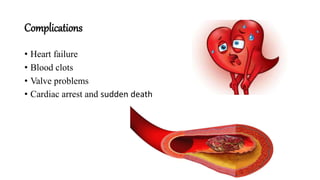
Complications
• Heart failure
• Blood clots
• Valve problems
• Cardiac arrest and sudden death
Prevention:
• Avoiding the use of alcohol.
• Controlling high blood pressure, high cholesterol.
• Eating a healthy diet.
• Getting regular exercise.
• Getting enough sleep.
• Reducing stress.
Medical Management
Vasodilators (These drugs acts as blood vessel dilator):
• Nitrates
• Beta-Blockers (Decrease work load in heart):
• Propranolol 20-40 mg
Calcium channel blocker (They improve coronary blood flow):
• Nifedipine
• Verapamil
Conti….
Anticoagulant Drugs:
• Heparin
Opiate Analgesic (For reduce pain)
• Morphine sulphate
Thrombolytic Drugs:
• Streptokinase,Urokinase
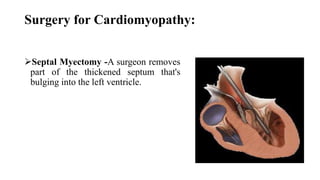
Surgery for Cardiomyopathy:
Septal Myectomy -A surgeon removes
part of the thickened septum that's
bulging into the left ventricle.
Conti..
• Heart Transplant - A heart transplant is a last resort treatment for people
who have end-stage of heart failure.
NURSING DIAGNOSIS:
• Impaired gas exchange related to decreased blood flow as evidenced
by breathlessness
• Acute pain related to disease condition as evidenced by patient
verbalization
• Impaired physical mobility related to weakness as evidenced by
patient is unable to perform daily activity.
• Imbalanced nutrition less than body requirement related to less intake
of food as evidenced by weight loss.
RESEARCH STUDY:
A study was conducted by European National health care database
reviled that many commonly used non steroidal anti-inflammatory drugs
are associated with 19% elevated risk for hospital admission for heart
failure. The risk for heart failure doubled for NSAIDs used at twice or
more the recommended daily allowable dose.
SUMMARY:
CONCLUSION:
The scientists discovered genes which increase the risk of dilated
cardiomyopathy, an inherited myocardial insufficiency that can lead to
heart failure and sudden death. During herat transplants, the scientists
collected biopsies from the left ventricle of 97 patients with DCM and
108 healthy donors. They analysed the transcriptome and managed to
identify 228 genes which are expressed differently in DCM patients
and heathy subjects.
BIBLIOGRAPHY:
• Black M. joyce, Hwks hokanson jane,medical surgical nursing.8th edition. volume
2. New delhi ;Reed elsevier india private limited:2009.p1411-1426.
• Siddharth’s and brunner, Hinkle L.Janice, Cheever H.Kerry. text book of medical
surgical nursing.13th edition . volume 1.New delhi: wolters kluwer india Pvt ltd
;2014.p729-759.
• Chugh N S . text book of medical surgical nursing .volume 1.delhi;avichal
publisher company:2013.p303-310.
• https://www.mayoclinic.org/diseases-conditions/cardiomyopathy/diagnosis-
treatment/drc-20370714
• https://www.nhs.uk/conditions/cardiomyopathy/
• https://www.webmd.com/heart-disease/guide/muscle-cardiomyopathy
• https://www.heart.org/en/health-topics/cardiomyopathy/what-is-
cardiomyopathy-in-adults
• https://www.sciencedaily.com/releases/2019/02/190222131936.htm
Cardiomyopathy

Cardiomyopathy

  • 1.
  • 2.
    CARDIOMYOPATHY Cardiomyopathy is adisease of the heart muscle that makes it harder for your heart to pump blood to the rest of your body Or Cardiomyopathy is a group of diseases that affect the heart muscle.
  • 3.
    INCIDENCE: Dilated cardiomyopathy, themost common form,affects 5% in 100,000 adults and 0.57% in 100,000 children. Hypertrophic cardiomyopathy, the leading cause of sudden death in athletes, with an incidence of one in 500 persons. Restrictive cardiomyopathy and arrhythmogenic right ventricular cardiomyopathy are rare, and their noses require a high index of suspicion.
  • 4.
    Risk factors: MODIFIABLE RISKFACTORS: • Tobacco use • High blood cholesterol or triglyceride levels • Lack of exercise • Obesity • Stress NONMODIFIABLE RISK FACTORS: • Family history of heart disease • Older age • Diabetes • High blood pressure
  • 5.
    Etiology: Idiopathic(unknown cause) Infectious disease Geneticconditions Systemic connective tissue diseases Long-term high blood pressure Nutritional deficiencies Cardiovascular disease Heart tissue damage from a previous heart attack
  • 6.
  • 7.
    Dilated Cardiomyopathy (DCM) •This is the most common type of cardiomyopathy. • In this disorder, the left ventricle becomes enlarged (dilated) and can't effectively pump blood as the pumping ability of heart's main pumping chamber (left ventricle) becomes less forceful.
  • 8.
    DCM“Etiologies” Primary – Idiopathic Secondary:- •Electrolyte abnormalities • Endocrine abnormalities • Hypertension • Infectious causes • Ischemia • Nutritional abnormalities • Valvular heart disease
  • 9.
    Hypertrophic Cardiomyopathy: This typeinvolves abnormal thickening of your heart muscle, particularly affecting the muscle of your heart's main pumping chamber (left ventricle).
  • 10.
    Restrictive Cardiomyopathy The heartmuscle in people with restrictive cardiomyopathy becomes rigid and less elastic, meaning the heart can't properly expand and fill with blood between heartbeats.
  • 11.
    ARRHYTHMOGENIC RT-VENTRICULARDYSPLASIA In thistype of cardiomyopathy, the muscle in the lower right heart chamber (right ventricle) is replaced by scar tissue. This can lead to heart rhythm problems.
  • 12.
    Symptoms: • Breathlessness • Swellingof the legs, ankles and feet • Bloating of the abdomen due to fluid buildup • Cough while lying down • Fatigue • Irregular heartbeats • Chest pain • Dizziness
  • 13.
    Diagnostic Evaluation: Chest X-ray Echocardiogram Electrocardiogram(ECG) Treadmill stress test Cardiac catheterization Cardiac magnetic resonance imaging (MRI) Cardiac computerized tomography (CT) scan Blood tests Genetic testing or screening
  • 14.
    Complications • Heart failure •Blood clots • Valve problems • Cardiac arrest and sudden death
  • 15.
    Prevention: • Avoiding theuse of alcohol. • Controlling high blood pressure, high cholesterol. • Eating a healthy diet. • Getting regular exercise. • Getting enough sleep. • Reducing stress.
  • 16.
    Medical Management Vasodilators (Thesedrugs acts as blood vessel dilator): • Nitrates • Beta-Blockers (Decrease work load in heart): • Propranolol 20-40 mg Calcium channel blocker (They improve coronary blood flow): • Nifedipine • Verapamil
  • 17.
    Conti…. Anticoagulant Drugs: • Heparin OpiateAnalgesic (For reduce pain) • Morphine sulphate Thrombolytic Drugs: • Streptokinase,Urokinase
  • 18.
    Surgery for Cardiomyopathy: SeptalMyectomy -A surgeon removes part of the thickened septum that's bulging into the left ventricle.
  • 19.
    Conti.. • Heart Transplant- A heart transplant is a last resort treatment for people who have end-stage of heart failure.
  • 21.
    NURSING DIAGNOSIS: • Impairedgas exchange related to decreased blood flow as evidenced by breathlessness • Acute pain related to disease condition as evidenced by patient verbalization • Impaired physical mobility related to weakness as evidenced by patient is unable to perform daily activity. • Imbalanced nutrition less than body requirement related to less intake of food as evidenced by weight loss.
  • 22.
    RESEARCH STUDY: A studywas conducted by European National health care database reviled that many commonly used non steroidal anti-inflammatory drugs are associated with 19% elevated risk for hospital admission for heart failure. The risk for heart failure doubled for NSAIDs used at twice or more the recommended daily allowable dose.
  • 23.
  • 24.
    CONCLUSION: The scientists discoveredgenes which increase the risk of dilated cardiomyopathy, an inherited myocardial insufficiency that can lead to heart failure and sudden death. During herat transplants, the scientists collected biopsies from the left ventricle of 97 patients with DCM and 108 healthy donors. They analysed the transcriptome and managed to identify 228 genes which are expressed differently in DCM patients and heathy subjects.
  • 25.
    BIBLIOGRAPHY: • Black M.joyce, Hwks hokanson jane,medical surgical nursing.8th edition. volume 2. New delhi ;Reed elsevier india private limited:2009.p1411-1426. • Siddharth’s and brunner, Hinkle L.Janice, Cheever H.Kerry. text book of medical surgical nursing.13th edition . volume 1.New delhi: wolters kluwer india Pvt ltd ;2014.p729-759. • Chugh N S . text book of medical surgical nursing .volume 1.delhi;avichal publisher company:2013.p303-310. • https://www.mayoclinic.org/diseases-conditions/cardiomyopathy/diagnosis- treatment/drc-20370714 • https://www.nhs.uk/conditions/cardiomyopathy/ • https://www.webmd.com/heart-disease/guide/muscle-cardiomyopathy • https://www.heart.org/en/health-topics/cardiomyopathy/what-is- cardiomyopathy-in-adults • https://www.sciencedaily.com/releases/2019/02/190222131936.htm