welcome
Case
• 85 y.o. F complaining of feeling “off” and
being “just so tired”
• SOB
• Vaguely recalls feeling a bit “unsteady” on a
couple of occasions
• Hx: osteoporosis, hypothyroidism and
depression
• Meds: Calcium, Vit D, Celexa, Synthroid
Case cont’d
• Vitals:
– HR 45, irregular
– RR 16
– BP 108/75
– Afebrile
:
Arrythmias
heart block
Presented by
Anu k george
Msc (N) II Year
TERMINOLOGIES
Common terms
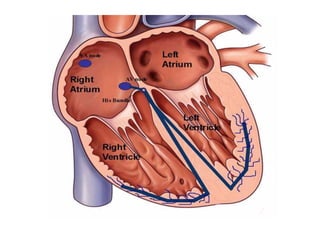
REVIEW OF CONDUCTION SYSTEM
OF HEART
ELECTROCARDIOGRAM
• The electrocardiogram (ECG) is a
representation of the electrical events of the
cardiac cycle.
• Each event has a distinctive waveform, the
study of which can lead to greater insight into
a patient’s cardiac pathophysiology
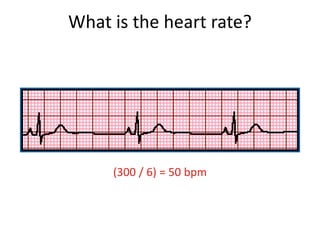
(300 / 6) = 50 bpm
What is the heart rate?
4 Mechanisms of Arrhythmia
• reentry (most common)
• automaticity
• parasystole
• triggered activity
Fast Conduction Path
Slow Recovery
Slow Conduction Path
Fast Recovery
Premature Beat Impulse
Cardiac
Conduction
Tissue
1. An arrhythmia is triggered by a premature beat
2. The fast conducting pathway is blocked because of its
long refractory period so the beat can only go down the
slow conducting pathway
Repolarizing Tissue
(long refractory period)
Reentry Mechanism
3. The wave of excitation from the premature beat
arrives at the distal end of the fast conducting
pathway, which has now recovered and therefore
travels retrogradely (backwards) up the fast pathway
Fast Conduction Path
Slow Recovery
Slow Conduction Path
Fast Recovery
Cardiac
Conduction
Tissue
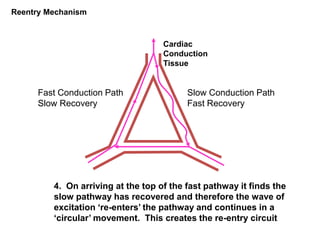
Reentry Mechanism
4. On arriving at the top of the fast pathway it finds the
slow pathway has recovered and therefore the wave of
excitation ‘re-enters’ the pathway and continues in a
‘circular’ movement. This creates the re-entry circuit
Fast Conduction Path
Slow Recovery
Slow Conduction Path
Fast Recovery
Cardiac
Conduction
Tissue
Reentry Mechanism
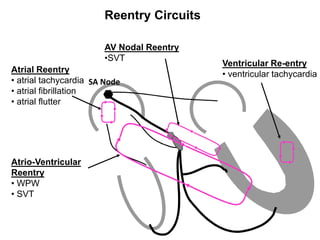
Atrial Reentry
• atrial tachycardia
• atrial fibrillation
• atrial flutter
Atrio-Ventricular
Reentry
• WPW
• SVT
Ventricular Re-entry
• ventricular tachycardia
AV Nodal Reentry
•SVT
Reentry Circuits
SA Node
Automaticity
• Heart cells other than those of the SA node
depolarize faster than SA node cells, and take
control as the cardiac pacemaker.
• Factors that enhance automaticity include:
 SANS,  PANS,  CO2,  O2,  H+,  stretch,
hypokalemia and hypocalcaemia.
Examples: Ectopic atrial tachycardia or multifocal
tachycardia in patients with chronic lung disease
OR ventricular ectopy after MI
Parasystole…
• is a benign type of automaticity problem
that affects only a small region of atrial or
ventricular cells.
• 3% of PVCs
Triggered activity…
• is like a domino effect where the arrhythmia is
due to the preceding beat.
• Delayed after-depolarizations arise during the
resting phase of the last beat and may be the
cause of digitalis-induced arrhythmias.
• Early after-depolarizations arise during the
plateau phase or the repolarization phase of the
last beat and may be the cause of torsades de
pointes (ex. Quinidine induced)
Definition
• The term "arrhythmia" refers to any change from the
normal sequence of electrical impulses. The electrical
impulses may happen too fast, too slowly, or erratically –
causing the heart to beat too fast, too slowly, or erratically.
When the heart doesn't beat properly, it can't pump blood
effectively
-American Heart Association
ETIOLOGY
• Dysrhythmias occur as the result of various
abnormalities and disease rate.
Cardiac conditions
• Cardiomyopathy
• Conduction defects
• Heart failure
• Myocardial cell degeneration & MI
• Valve disease
Non cardiac condition
• Acid base imbalance
• Alcohol ,Caffeine & tobacco
• Connective tissue disorder
• Drugs & Toxicity
• Electric shock, hypoxia & shock
• Emotional crisis
• Herbal supplements
• Near drowning and poisoning
• Metabolic condition
TYPES OF DYSRHYTHMIAS
SINUS BRADYCARDIA
• The conduction pathway is the same as that in
sinus rhythm but the SA node fires at a rate
less than 60beats/min
Absolute
bradycardia
Relative
bradycardia
Cont…Etiology:
Increased vagal tone
Hypothermia
Increased intraocular pressure
Administration of parasympathomimetic drugs
& adverse drug effects
Acute MI
Disease condition – hypothyroidism, increased
ICP & obstructive jaundice
Cont..
Clinical manifestation:
At rest, asymptomatic
Pale, cool skin, hypotension, weakness and angina.
Dizziness or syncope
Confusion and disorientation
Shortness of breath
Cont…
Clinical association- for aerobically trained athletes.
ECG characteristics:
Regular P waves by regular QRS complex
Cont..
Therapy:
Atropine IV o.5mg to I mg
Transcutaneous pacing
Dopamine- 5 to 20µg/kg/min
Epinephrine – 2 to 10µg/min
Isoproterenol- 2 to 10µg/min
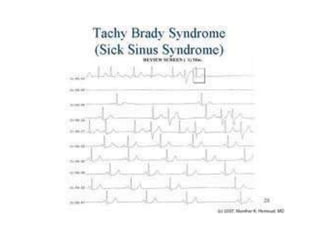
SICK SINUS SYNDROME
• SSS also called sinus node dysfunction is a group of
abnormal heart rhythms causes by malfunction of
sinus node.
• Bradycardia-tachycardia syndrome
Cont…
Etiology:
 Medication: digitalis, sympatholytic drugs
 Sarcoidosis, amyloidosis
 Cardiomyopathies
 CAD
Cont…
Symptoms:
Dizziness
Palpitation
Chest pain
Angina
Shortness of breath
Fatigue & headache
Nausea and fainting
Cont…
ECG Characteristics:
Combination of sinoatrial and atrioventricular
conduction disturbances.
Cont…
• Treatment- artificial pacemaker
SINUS TACHYCARDIA
• Sinus rate more than 100beats/min and is
normally due to increase in sympathetic
activity.
• Conduction pathway is same. Discharge rate
from the sinus node is increased.
Cont…Etiology:
Physical and psychological stressors: exercise,
fever,pain, hypotension, hpovolemia, anemia,
hypoglycemia, MI, HF, anxiety
Adrenergic stimulation
Drugs
Pheochromocytoma
Caffeine
Cont…
Clinical manifestation:
Patients intolerance to increased heart rate
Dizziness
Dyspnea
Hypotension
Increased myocardial oxygen consumption
Cont…
ECG characteristics:
Treatment: no specific treatment
Never counter shock
Rate: more
than 100
b/min
Rhythm : sinus PR interval:
</= 0.20sec
QRS complex-
normal
PREMATURE ATRIAL CONTRACTION
PAC is a contraction originating from an ectopic focus in
the atrium in a location other than the sinus node
Cont…
Etiology:
☺Hypoxia
☺Electrolyte imbalance
☺Hyperthyroidism
☺COPD
☺Heart disease- CAD
☺Valvular disorder
Cont…
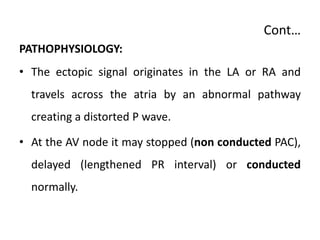
PATHOPHYSIOLOGY:
• The ectopic signal originates in the LA or RA and
travels across the atria by an abnormal pathway
creating a distorted P wave.
• At the AV node it may stopped (non conducted PAC),
delayed (lengthened PR interval) or conducted
normally.
Cont…
ECG characteristic:
Cont…
Treatment:
Beta blockers
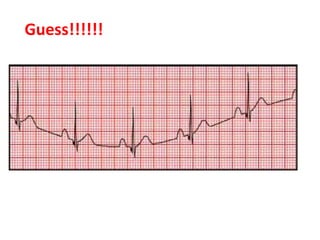
Guess!!!!!!
ATRIAL FLUTTER
• It is characterized by large re-entry circuit within the
right atrium, usually encircling the tricuapid annulus
• “Impulses take a circular course around the atria,
setting up the flutter waves”
Cont…
Etiology:
♥ Acute coronary syndrome
♥ Mitral and tricuspid valve disorders
♥ Hypoxia, HT, chromic lung disease
♥ Cardiomyopathy
♥ Pulmonary embolus & cor pulmonale
♥ Hyperthyroidism
♥ Drug induced
Cont…
Clinical manifestation:
Can be asymptomatic
Palpitation
High ventricular rate- flutter can cause decrease cardiac
output--- HF
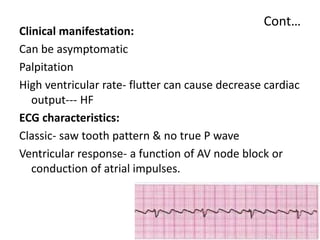
ECG characteristics:
Classic- saw tooth pattern & no true P wave
Ventricular response- a function of AV node block or
conduction of atrial impulses.
Cont…
Treatment:
Calcium
channel
blocker
Beta
adrenergic
blockers
To control
ventricular
rate
Cont…
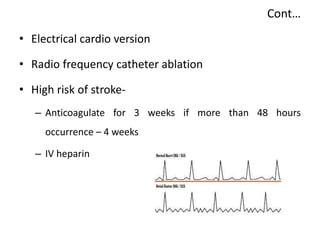
• Electrical cardio version
• Radio frequency catheter ablation
• High risk of stroke-
– Anticoagulate for 3 weeks if more than 48 hours
occurrence – 4 weeks
– IV heparin
ATRIAL FIBRILLATION
• It is characterized by presence of
multiple, interacting re-entry circuit
looping around the atria.
• Total disorganisation of atrial electrical
activity due to multiple ectopic foci
resulting in loss of effective atrial
contraction
Cont…
Etiology:
 Thyrotoxicosis, alcohol intoxication, caffeine use,
electrolyte disturbance, stress and cardiac surgery
Atrial impulse faster than the SA node impulses,
impulses take multiple , choatic, random pathways
through the atria
Cont…
Clinical manifestation:
Atrial fibrillatory waves- AF with rapid ventricular
response
Thrombi form- 5 fold increase risk to get stroke
Decreased cardiac output.
Cont…
ECG Characteristics:
“irregularly irregular rhythm- with variation in both
interval & amplitude from R wave to R wave”
Rate- wide ranging ventricular response to atrial rate of
300-400 beats/min
Cont…
Treatment:
♫ Calcium channel blockers
♫ Beta adrenergic blockers
♫ Antiarrythmic drugs
♫ Anti coagulation therapy
♫ Maze procedure:
• Cryoablation (use of cold)
• Heat (high intensity ultrasound)
Cont…
Rhythm control
• Immediate cardio version after administration of IV
heparin
• To restore sinus rhythm flecainide= 2mg/kg over
30min max dose 150mg
• INR to be maintained 2.0 to 3.0 for a minimum of 3
weeks
Cont…
Rate control:
o Digoxin
o Beta blokers
o Rate limiting calcium antagonist
– Verapamil
– diltiazem
o Combination therapy:
• Digoxin + atenolol
WOLFF PARKINSON WHITE SYNDROME
WPW is one of the severe disorder of the conduction
system. WPW is caused by the presence of an
abnormal electrical conduction pathway between
atria and ventricle
0.1% to 0.3%
PRKAG-2 gene/ congenital
Cont…
• Notching of positive upstroke of QRS complex
Rate: 60-100b/min
Rhythm: normal sinus except pre-excitation
tachycardia
PR interval: shorter
Cont…
Clinical manifestation:
Asymptomatic
Sometimes signs of tachycardia
Treatment:
• Cardio verison
• Anti arrythmic drugs
• Digoxin
• Ca channel blockers and beta blockers
JUNCTIONAL TACHYCARDIA
• It originates in the area of the AV node, primarily
because the SA node has failed to fire or the signal
has been blocked.
Cont…
• Impulse from the AV node usually moves in a
retrograde (backward fashion) that produce an
abnormal P wave just occuring before or after QRS
complex
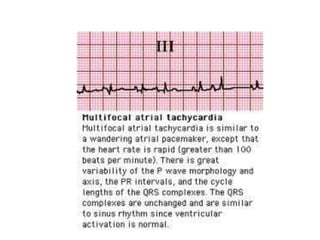
MULTIFOCAL ATRIAL TACHYCARDIA
• Area of automaticity (impulse formation)
originate irregularly and rapidly at different
points in the atria
Cont…
ECG Characteristic:
“wandering atrial pacemaker”
P waves- 3 or more P wave that differ in polarity
(up/down) shape and size since the atrial impulse is
generated from multiple foci
Cont…
Clinical manifestation:
Signs of less ejection fraction and tachycardia.
Treatment:
Beta blocker
Calcium channel blockers
Amiodarone
No cardio version
PAROXYSMAL SUPRAVENTRICULAR
TACHYCARDIA
Ectopic focus anywhere above the bifuraction of
the bundle of his.
Etiology:
Over exersion
Emotional stress
Deep inspiration
RHD, CAD, COPD & CHF
Cont…
• PATHOPHYSIOLOGY:
Impulse arise and recycle repeatedly in the AV node
because of areas of unidirectional block in the
purkinjie fibers
Reexcitation of the atria when there is a one way
block
PSVT occurs because of a reentrant phenomenon
Cont…
Clinical manifestation:
Prolonged episode and HR greater than
180beats/min
Decreased CO- Hypotension, dyspnea & angina
Anxious and uncomfortable
ECG Feature:
Cont…
Treatment:
Vagal stimulation
IV adenosine
IV Verapamil- 5-10mg
Beta blockers
Cardio version
PREMATURE VENTRICULAR
CONTRACTION
Originating ectopic focus in the ventricles.
Premature occurrence of a QRS complex which
is wide and distorted in shape.
Multifocal
PVC
Unifocal
PVC
VENTRICULAR FIBRILLATION
• Ventricle consist of areas of normal myocardium
alternating with areas of ischemic, injured or
infracted myocardium, leading to chaotic pattern of
ventricular depolarization
Cont…
Etiology:
♯ Acute coronary syndrome
♯ Stable to unstable VT
♯ PVC’S with R on T phenomenon
♯ Multiple drug
♯ Electrolyte disturbance
♯ Hypoxia, metabolic acidosis
Cont…
• Quickering ventricle no effective contraction
Cont…
Clinical manifestation:
Pulse disappears with onset of VF
Collapse, unconsiousness
Agonal breath
Onset of reversible death
Cont…
TREATMENT:
• Defibrillation
• Oxygen, CPR, INTUBATION
• Epinephrine
• Vasopressin
• Antiarrythmic
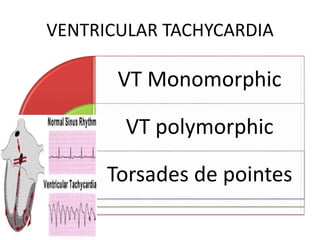
VENTRICULAR TACHYCARDIA
VT Monomorphic
VT polymorphic
Torsades de pointes
MONOMORPHIC VT
• Impulse conduction is slowed around area of
ventricular injury, infarct or ischemia
• Ectopic impulses (irritable foci)
• Area of injury can cause the impulse to take a
circular course, leading to the re-entry
phenomenon and rapid repetitive
depolarization
Cont…
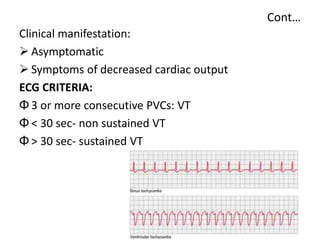
Clinical manifestation:
 Asymptomatic
 Symptoms of decreased cardiac output
ECG CRITERIA:
Φ 3 or more consecutive PVCs: VT
Φ < 30 sec- non sustained VT
Φ > 30 sec- sustained VT
Wide QRS complex
POLYMORPHIC VT
• Impulse conduction is slowed around multiple areas
of ventricular injury, infarcts or ischemia
• Irritable foci occur in multiple area of the ventricles
• Asymptomatic
TORSADES DE POINTES
• Twisting of the points
• QT interval is abnormally long
• Lead to increase in the relative refractory period
• Increase probability that an irritable focus (PVC) will occur on
the T-wave
PULSELESS ELECTRICAL ACTIVITY
• PEA a situation in which electrical activity can be
observed on the ECG, but there is no mechanical
activity of the ventricles and the patient has no
pulse.
• Causes: 5H & 5T
Cont…
• Cardiac conduction impulses occur in organized
pattern , but this fails to produce myocardial
contraction (electromechanical dissociation) or
insufficient filling during diastole or ineffective
contractions
Cont…
Clinical manifestation:
Collapse, unconscious
Agonal respiration or apnea
No pulse
ASYSTOLE
• Total absence of ventricular electrical activity,
• Occasional P wave can be seen
DEFINITION :
This is the inhibition or failure of the
electrical impulses generated in the SA node to
be conducted through the conduction system
to the ventricles . This can occur because of an
abnormality of conduction velocity or complete
refractoriness in the conduction system .
HEART BLOCK
TYPES
AV NODAL BLOCKS (HEART BLOCKS)
Disturbances of the conduction through the
heart, occurring at the AV Node
AV Node – damaged/diseased – delay or total
block of impulses at the AV Node
This conduction defect can be seen on the
ECG
AV Node
• AV nodal conduction time is represented on
the ECG as the PR segment.
• But - we always measure the PR interval.
FIRST DEGREE HEART BLOCK (1º)
DEFINITION
It is a type of heart block in which every impulse is
conducted to the ventricles but the duration of AV
conduction is prolonged. After the impulse moves
through the AV node, it is usually conducted normally
through the ventricles.
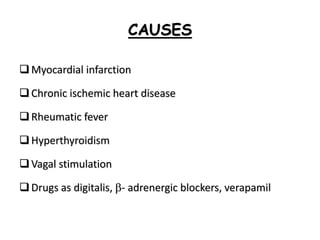
CAUSES
Myocardial infarction
Chronic ischemic heart disease
Rheumatic fever
Hyperthyroidism
Vagal stimulation
Drugs as digitalis, - adrenergic blockers, verapamil
AV nodal dysfunction accounts for the
majority of cases. First-degree AV block
caused by conduction delay in the His-Purkinje
system often is associated with bundle-branch
block.
PATHOPHYSIOLOGY
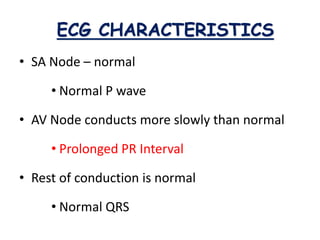
ECG CHARACTERISTICS
• SA Node – normal
• Normal P wave
• AV Node conducts more slowly than normal
• Prolonged PR Interval
• Rest of conduction is normal
• Normal QRS
Cont...
Type
of
block
Rate
and
Rhyth
m
P wave PR
Interv
al
QRS
complex
P:QRS
Ratio
First
Degree
Heart
Block
Normal
and
regular
Normal >0.20
sec
Normal 1:1
FIRST DEGREE HEART BLOCK
(1º)
PR Interval > 0.2 seconds (5 small sq)
• Note – the PR Interval is constant
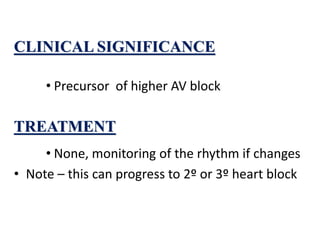
CLINICAL SIGNIFICANCE
• Precursor of higher AV block
TREATMENT
• None, monitoring of the rhythm if changes
• Note – this can progress to 2º or 3º heart block
There is no treatment for first degree heart
block .
Temporary pacing .
MANAGEMENT
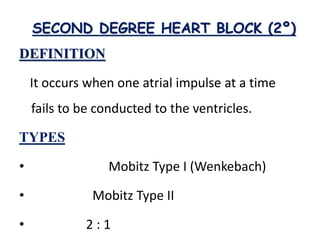
SECOND DEGREE HEART BLOCK (2º)
DEFINITION
It occurs when one atrial impulse at a time
fails to be conducted to the ventricles.
TYPES
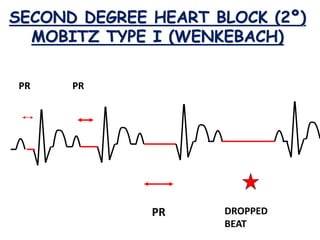
• Mobitz Type I (Wenkebach)
• Mobitz Type II
• 2 : 1
SECOND DEGREE HEART BLOCK (2º) MOBITZ
TYPE I (WENKEBACH)
DEFINITION
It is a progressive increase in conduction times
of consecutive atrial impulses into the
ventricles until one impulse fails to conduct or
is dropped
CAUSES
Chronic ischemic heart disease
Drugs as digoxin, - adrenergic blockers
ECG CHARACTERISTICS
PR Interval prolongs with each beat until a
dropped beat is seen
The PR Interval is NOT constant
After each dropped beat, the PR interval is
normal and the cycle starts again
CONT….
Type of
block
Rate and
Rhythm
P wave PR
Interv
al
QRS
Complex
P:
QRS
Ratio
Mobitz
Type I
Atrial:
Normal and
regular
Ventricular
: slower and
irregular
Normal Progres
sively
lengthe
ned
Normal
QRS
width, with
pattern of
one
nonconduc
ted QRS
3:2, 4:3,
5:4
SECOND DEGREE HEART BLOCK (2º)
MOBITZ TYPE I (WENKEBACH)
PR PR
PR DROPPED
BEAT
TREATMENT
Symptomatic = atropine or temporary pacemaker
Asymptomatic = the rhythm should be observed
with a transcutaneous pacemaker on standby.
SECOND DEGREE HEART BLOCK (2º)
MOBITZ TYPE II
DEFINITION
It is sudden failure of conduction of an atrial
impulse to the ventricles without progressive increases in
conduction time of consecutive P waves. It occurs below the
AV node and is usually associated with bundle- branch
block; therefore, the dropped beats are usually a
manifestation of bilateral bundle- branch block.
CAUSES
Anterior myocardial infarction
Coronary heart disease
Rheumatic heart disease
Digitalis toxicity
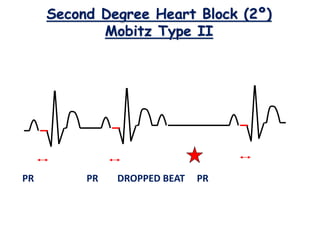
ECG CHARACTERISTICS
PR Interval normal & constant
Occasionally a dropped beat is seen
CONT….
Type
of
block
Rate and
Rhythm
P wave PR
Interv
al
QRS
Complex
P:QR
S
Ratio
Mobitz
Type II
Atrial :
Usually
normal and
regular or
irregular
Ventricular:
slower and
regular or
irregular
P wave
occurs in
multiples
Normal
or
prolong
ed
Widened
QRS, no
connectio
n with P
waves
2:1,
3:1,
4:1,
5:1
Second Degree Heart Block (2º)
Mobitz Type II
PR PR DROPPED BEAT PR
CLINICAL SIGNIFICANCE
• significant disease.
• This can progress to third degree heart block
and is associated with a poor prognosis.
TREATMENT
• pacemaker
• Drugs as atropine, epinephrine, isoproterenol
or dopamine can be used to increase heart
rate.
SECOND DEGREE HEART BLOCK (2º)
2 : 1
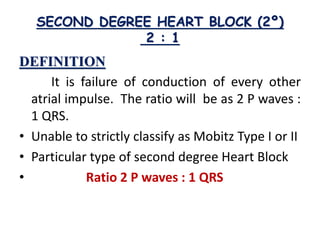
DEFINITION
It is failure of conduction of every other
atrial impulse. The ratio will be as 2 P waves :
1 QRS.
• Unable to strictly classify as Mobitz Type I or II
• Particular type of second degree Heart Block
• Ratio 2 P waves : 1 QRS
ECG CHARACTERISTICS
PR interval
• Type I- Longer than normal (more than 0.20
second)
• Type II- Normal
QRS complex
• Type I- Narrow
• Type II- Wide
Second Degree Heart Block (2º)
2 : 1
Cont...
CLINICAL SIGNIFICANCE
• Unable to classify as Mobitz type I or II
• Will be associated with symptoms, dizziness,
lethargy etc.
• This can deteriorate to 3º Heart Block
TREATMENT
• Pacemaker
THIRD DEGREE HEART BLOCK (3º)
(COMPLETE)
DEFINITION
It constitutes one form of AV
dissociation in which no impulses from the atria
are conducted to the ventricles. The atria are
stimulated and contract independently of the
ventricles. The ventricular rhythm is an escape
rhythm and the ectopic pacemaker may be
above or below the bifurcation of the His
bundle.
CAUSES
Fibrosis or calcification of cardiac conduction
system
Coronary artery disease
Cardiomyopathy
Myocarditis
Myocardial infarction
• Surgery
ECG CHARACTERISTICS
Complete failure of the AV Node
No impulses from Sinus Node will pass
through to the ventricles
Some part if the conducting system will take
over as pacemaker of the heart (even a
myocardial cell 10-15 bpm)
CONT…
• P wave rate – normal
• Ventricular rate – slow
• Ventricular complex may be broad
• Complete dissociation between P waves &
QRS
CONT…
Type
of
block
Rate
and
Rhythm
P wave PR
Interv
al
QRS
Complex
P:QRS
Ratio
Third
degree
heart
block
Ventricula
r rate 20-
40
beats/min
and
regular
Normal
but no
connectio
n with
QRS
complex
Variable Normal
or
widened
QRS, no
connectio
n with P
waves
More P
waves
than
QRS
complex
Third Degree Heart Block (3º)
(Complete)
P P P P P
QRS QRS
Cont....
CLINICAL SIGNIFICANCE
• Symptoms LOC, Confusion, Dizziness, Low
BP
• Can lead to standstill, VT or VF (stokes
Adams)
TREATMENT - pacemaker
Types of infra-hisan block
Left bundle branch block
 Left anterior fascicular block
 Left posterior fascicular block
Right bundle branch block
CLINICAL MANIFESTATIONS
Slow heart rate
Irregular heart rate
Arrhythmias
In case of severe block ;
Breathlessness
Breathlessness with exertion
 Dizziness
Fainting
Fatigue
Heart block
Chest pain
Shortness of breath
Seizures
Light headedness
MANAGEMENT
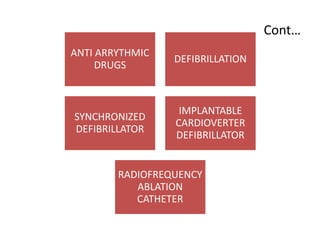
Cont…
ANTI ARRYTHMIC
DRUGS
DEFIBRILLATION
SYNCHRONIZED
DEFIBRILLATOR
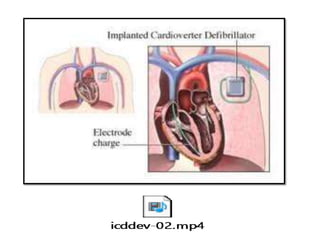
IMPLANTABLE
CARDIOVERTER
DEFIBRILLATOR
RADIOFREQUENCY
ABLATION
CATHETER
Anti-arrhythmic drugs
• Class I membrane stabilizing agents
• Class II β-adrenoceptor antagonist β blockers
• Class III Amiodarone drugs – prolong action potential
• Class IV Slow calcium channel blockers
Cont…
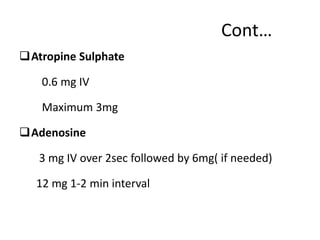
Atropine Sulphate
0.6 mg IV
Maximum 3mg
Adenosine
3 mg IV over 2sec followed by 6mg( if needed)
12 mg 1-2 min interval
Cont…
DIGOXIN
0.2-0.5 mg oral / IV
Digoxin toxity
Extracardiac manifestations – Anorexia, Nausea,
Vomiting, Diarrhea, Altered colour vision.
Cardiac manifestations
• Bradycardia, ventricular ectopics
• Atrial & ventricular tachycardia
• Ventricular fibrillation & bigeminy
Radio frequency catheter ablation
It is a procedure that can cure many
types of fast heart beats. Using a special wires
or catheters threaded into the heart. Here
they are using radiofrequency energy.
Arrythmia . Anu k George

Arrythmia . Anu k George

Editor's Notes

  • #7 In normal heart automaticity is maximum in SA node (Pacemaker). In diseased heart, other areas of myocardium may may develop automaticity and become focus of ectopic impulse generation and arrhythmias. Excitability: can be conceived in terms of minimum intensity of stimulus required to depolarize the cell membrane. It depends upon the level of resting(diastolic) intracellular negativity, if negeativity decreases eg from -90mV TO -70mV excitability of cell increases. Threshold potential: if threshold potential is raised changed from -70 to -60 mV Automaticity of tissue is supressed.
  • #8 A drug which reduces phase zero slope(at any given RMP) will shift membrane responsiveness curve to right and impede the conduction. Reverse occurs if a drug shifts curve to left. Normally purkinje fibres have highest conduction velocity 4000 mm/sec