ARRYTHMIAS


    Dr Abida Shaheen
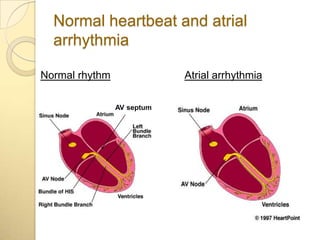
Normal heartbeat and atrial
  arrhythmia

Normal rhythm               Atrial arrhythmia

                AV septum
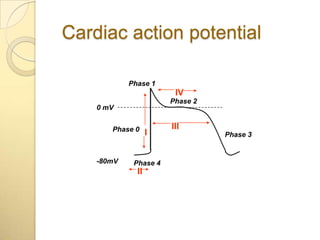
Cardiac action potential

            Phase 1
                        IV
                       Phase 2
    0 mV


       Phase 0         III
                   I             Phase 3


    -80mV    Phase 4
              II
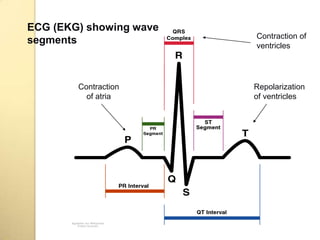
ECG (EKG) showing wave
                         Contraction of
segments                 ventricles


        Contraction      Repolarization
          of atria       of ventricles
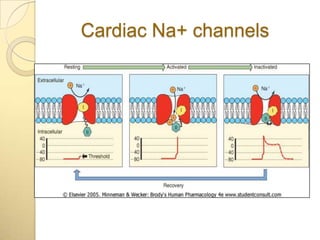
Cardiac Na+ channels
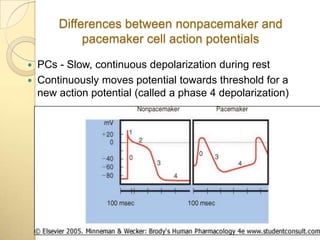
Differences between nonpacemaker and
             pacemaker cell action potentials

   PCs - Slow, continuous depolarization during rest
   Continuously moves potential towards threshold for a
    new action potential (called a phase 4 depolarization)
Mechanisms of Cardiac Arrhythmias

   Result from disorders of impulse
    formation, conduction, or both

   Causes of arrhythmias
    ◦ Cardiac ischemia
    ◦ Excessive discharge or sensitivity to
      autonomic transmitters
    ◦ Exposure to toxic substances
    ◦ Unknown etiology
Disorders of impulse
formation
    No signal from the pacemaker site

    Development of an ectopic pacemaker
     ◦ May arise from conduction cells (most are capable of
       spontaneous activity)
     ◦ Usually under control of SA node  if it slows down too
       much conduction cells could become dominant
     ◦ Often a result of other injury (ischemia, hypoxia)

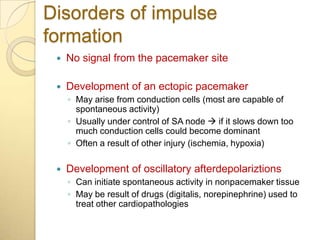
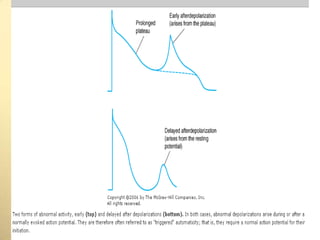
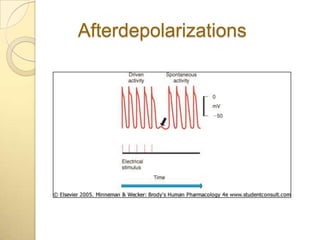
    Development of oscillatory afterdepolariztions
     ◦ Can initiate spontaneous activity in nonpacemaker tissue
     ◦ May be result of drugs (digitalis, norepinephrine) used to
       treat other cardiopathologies
Afterdepolarizations
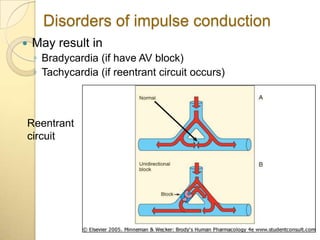
Disorders of impulse conduction
   May result in
    ◦ Bradycardia (if have AV block)
    ◦ Tachycardia (if reentrant circuit occurs)


Reentrant
circuit
Therapeutic overview
 Na+ channel blockade
 β-adrenergic receptor blockade
 Prolong repolarization
 Ca2+ channel blockade


 Adenosine, Magnesium, Potassium
 Digitalis glycosides
Classification of antiarrhythmics
(based on mechanisms of action)
   Class I – blocker’s of fast Na+
    channels
    ◦ Subclass IA
        moderate Phase 0 depression
        Prolong repolarization
        Increased duration of action potential
        Includes
          Quinidine – 1st antiarrhythmic used, treat both atrial
           and ventricular arrhythmias, increases refractory period
          Procainamide - increases refractory period but side
           effects
          Disopyramide – extended duration of action, used only
           for treating ventricular arrthymias
Classification of antiarrhythmics
(based on mechanisms of action)
  ◦ Subclass IB
    Minimal Phase 0 depression
    Decreased action potential duration
    Includes
      Lidocane (also acts as local anesthetic) – blocks Na+
       channels mostly in ventricular cells, also good for
       digitalis-associated arrhythmias
      Mexiletine - oral lidocaine derivative, similar activity
      Phenytoin – anticonvulsant that also works as
       antiarrhythmic similar to lidocane
Classification of antiarrhythmics
(based on mechanisms of action)
  ◦ Subclass IC
    Marked Phase 0 depression
    No effect on action potential duration

    Includes
      Flecainide (initially developed as a local anesthetic)
        Slows conduction in all parts of heart,
        Also inhibits abnormal automaticity

      Propafenone
        Also slows conduction
        Weak β – blocker
        Also some Ca2+ channel blockade

Arrythmia

  • 1.
    ARRYTHMIAS Dr Abida Shaheen
  • 2.
    Normal heartbeat andatrial arrhythmia Normal rhythm Atrial arrhythmia AV septum
  • 3.
    Cardiac action potential Phase 1 IV Phase 2 0 mV Phase 0 III I Phase 3 -80mV Phase 4 II
  • 4.
    ECG (EKG) showingwave Contraction of segments ventricles Contraction Repolarization of atria of ventricles
  • 5.
  • 6.
    Differences between nonpacemakerand pacemaker cell action potentials  PCs - Slow, continuous depolarization during rest  Continuously moves potential towards threshold for a new action potential (called a phase 4 depolarization)
  • 7.
    Mechanisms of CardiacArrhythmias  Result from disorders of impulse formation, conduction, or both  Causes of arrhythmias ◦ Cardiac ischemia ◦ Excessive discharge or sensitivity to autonomic transmitters ◦ Exposure to toxic substances ◦ Unknown etiology
  • 8.
    Disorders of impulse formation  No signal from the pacemaker site  Development of an ectopic pacemaker ◦ May arise from conduction cells (most are capable of spontaneous activity) ◦ Usually under control of SA node  if it slows down too much conduction cells could become dominant ◦ Often a result of other injury (ischemia, hypoxia)  Development of oscillatory afterdepolariztions ◦ Can initiate spontaneous activity in nonpacemaker tissue ◦ May be result of drugs (digitalis, norepinephrine) used to treat other cardiopathologies
  • 10.
  • 11.
    Disorders of impulseconduction  May result in ◦ Bradycardia (if have AV block) ◦ Tachycardia (if reentrant circuit occurs) Reentrant circuit
  • 12.
    Therapeutic overview  Na+channel blockade  β-adrenergic receptor blockade  Prolong repolarization  Ca2+ channel blockade  Adenosine, Magnesium, Potassium  Digitalis glycosides
  • 13.
    Classification of antiarrhythmics (basedon mechanisms of action)  Class I – blocker’s of fast Na+ channels ◦ Subclass IA  moderate Phase 0 depression  Prolong repolarization  Increased duration of action potential  Includes  Quinidine – 1st antiarrhythmic used, treat both atrial and ventricular arrhythmias, increases refractory period  Procainamide - increases refractory period but side effects  Disopyramide – extended duration of action, used only for treating ventricular arrthymias
  • 14.
    Classification of antiarrhythmics (basedon mechanisms of action) ◦ Subclass IB  Minimal Phase 0 depression  Decreased action potential duration  Includes  Lidocane (also acts as local anesthetic) – blocks Na+ channels mostly in ventricular cells, also good for digitalis-associated arrhythmias  Mexiletine - oral lidocaine derivative, similar activity  Phenytoin – anticonvulsant that also works as antiarrhythmic similar to lidocane
  • 15.
    Classification of antiarrhythmics (basedon mechanisms of action) ◦ Subclass IC  Marked Phase 0 depression  No effect on action potential duration  Includes  Flecainide (initially developed as a local anesthetic)  Slows conduction in all parts of heart,  Also inhibits abnormal automaticity  Propafenone  Also slows conduction  Weak β – blocker  Also some Ca2+ channel blockade