EQUIPPING
STAFF
FOR
DIGITAL
PRESERVATION
TASKS
Adelaide Parr
Victoria University
VICTORIA
UNIVERSITY

• A multi sector institution with
  courses in higher education
  and TAFE sectors
• Strong profiles in research and
  community engagement
• Over 50,000 students both on
  and off shore
• Over 3000 staff across 10
  campuses
• the University for the West –
  serving the western suburbs of
  Melbourne.
RECORDS MANAGEMENT
AT VU

• A public agency under the Public
  Records Act 1973 (Vic)
• Decentralised records management
  (and other functions) handled by each
  business area
• Issues with disposal, storage and
  identification of records
• An identified lack of consistency, and
  consequent risk to the university
• Increased desire within administrative
  areas to adopt a ‘scan and destroy’
  approach
DEFINING                                     General
SKILLSETS                                   principles

• Determine your records management
  responsibilities – both legislative and
  business requirements
• Determine the records management
  model including levels of
  preservation and migration
• Determine the tasks to be
  undertaken by each group or
  individual
• Consider the potential employment
  lifespan of core staff
• Develop cross training and skills
  fertilisation opportunities across
  internal business units
DEFINING                                        VU
SKILLSETS                                Case Study

• Retaining the decentralised
  environment
• Identifying key issues for practical
  day to day records management
  for staff
         •    creation
         •   retention
         •   disposal
         •   Storage

• Determining the balance for
  Records Services between
  undertaking and supporting tasks
DEVELOPING                                  General
TRAINING                                   principles

• Training should meet the user where
  they are
• Training should skill each user with
  the skills that they need
• Training should understand, anticipate
  and acknowledge the user’s
  environment
• Training should understand that
  records management is not the key
  focus of most users
• Training should promote the idea that
  records management is integral to the
  work of all users and that they have
  responsibilities in this area
DEVELOPING                                                              VU
TRAINING                                                         Case Study
• Training should be engaging
• Four key groups identified across the
  university:
        •   General users
        •   Academic and research staff
        •   Managers (direct reports)
        •   Records Champions

• Training to be done sequentially:
    • Records Essentials training
                   •   Broad focus
                   •   Meets immediate need
                   •   Overview
                   •   Induction training
    • Project MIRRA training
                   • Specific to key areas
                   • Specific to new system
                   • Provided as part of implementation of new
                     regime
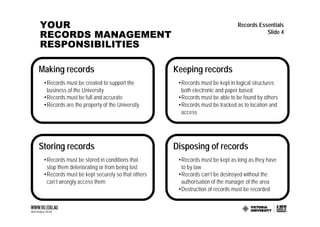
YOUR                                                                       Records Essentials
RECORDS MANAGEMENT                                                                    Slide 4

RESPONSIBILITIES

Making records                                   Keeping records
 •Records must be created to support the          •Records must be kept in logical structures
  business of the University                       both electronic and paper based
 •Records must be full and accurate               •Records must be able to be found by others
 •Records are the property of the University      •Records must be tracked as to location and
                                                   access


Storing records                                  Disposing of records
 •Records must be stored in conditions that       •Records must be kept as long as they have
  stop them deteriorating or from being lost       to by law
 •Records must be kept securely so that others    •Records can’t be destroyed without the
  can’t wrongly access them                        authorisation of the manager of the area
                                                  •Destruction of records must be recorded
BENEFITS                                              Records Essentials
OF                                                               Slide 5

RECORDS MANAGEMENT

• Find what you are looking for

• Effective sharing of information and resources

• Know where information can be found

• Know who has accessed what information

• Know when a record was created, accessed, changed or disposed of

•   Comply with legislative requirements
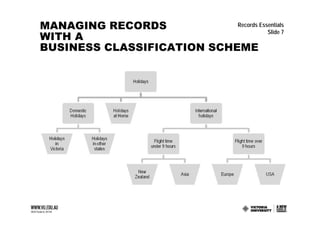
MANAGING RECORDS            Records Essentials

WITH A
                                       Slide 7

BUSINESS CLASSIFICATION SCHEME
ELECTRONIC                                          Records Essentials

RECORDS
                                                              Slide 11


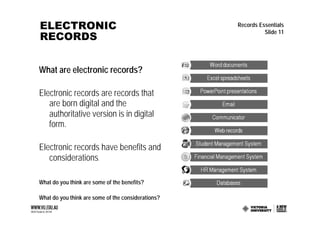
What are electronic records?

Electronic records are records that
   are born digital and the
   authoritative version is in digital
   form.

Electronic records have benefits and
   considerations.

What do you think are some of the benefits?

What do you think are some of the considerations?
DISPOSAL                                                  Records Essentials
                                                                    Slide 17
FRAMEWORKS
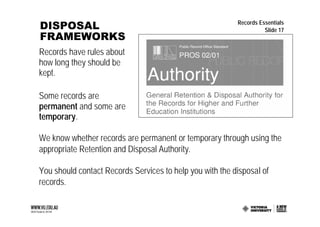
Records have rules about
how long they should be
kept.

Some records are
permanent and some are
temporary.

We know whether records are permanent or temporary through using the
appropriate Retention and Disposal Authority.

You should contact Records Services to help you with the disposal of
records.
Records Essentials
CONTACT                                              Slide 21

DETAILS


<Name>                  <Name>
Records Services        Records Services

PHONE                   PHONE
EMAIL                   EMAIL


              records@vu.edu.au
POST TRAINING                               General
SUPPORT                                    principles

• Users need to know that they are not
  alone
• Users need access to identified and
  visible experts
• Users need to have time to consider
  and question their role and how to
  fulfil it
• Users need the opportunity to identify
  ongoing training needs and to have
  these needs met either individually or
  as a wider group
RECORDS                               Records Essentials
                                                Slide 19
CHAMPIONS
• Identified individuals in each
  business area
• People who have an interest in,
  or work with records within their
  area
• First point of contact for
  colleagues with problems
• Supported by Records Services
• Regular meetings and training
  for support
• Add to your SPDP!
OBSOLETE
TECHNOLOGY

• Identification of vital and non vital
  technology to support
• Determine appropriate migration
  strategies
• Determine ‘historic’ value of records
  dependent on specific technologies
• Determine cost balance between
  migration and support
• Identification of appropriate
  individuals/roles to support
  technology needs
QUESTIONS?
CONTACT
DETAILS

          Adelaide Parr

          Senior Records Consultant
          Records Services

          Victoria University
          Footscray Park Campus
          Ballarat Road, Footscray
          PO Box 14428
          Melbourne Vic 8001 Australia

          Phone +61 3 9919 5345
          Fax: +61 3 9919 5340
          Email: adelaide.parr@vu.edu.au

Adelaide Parr

  • 1.
  • 2.
    VICTORIA UNIVERSITY • A multisector institution with courses in higher education and TAFE sectors • Strong profiles in research and community engagement • Over 50,000 students both on and off shore • Over 3000 staff across 10 campuses • the University for the West – serving the western suburbs of Melbourne.
  • 3.
    RECORDS MANAGEMENT AT VU •A public agency under the Public Records Act 1973 (Vic) • Decentralised records management (and other functions) handled by each business area • Issues with disposal, storage and identification of records • An identified lack of consistency, and consequent risk to the university • Increased desire within administrative areas to adopt a ‘scan and destroy’ approach
  • 4.
    DEFINING General SKILLSETS principles • Determine your records management responsibilities – both legislative and business requirements • Determine the records management model including levels of preservation and migration • Determine the tasks to be undertaken by each group or individual • Consider the potential employment lifespan of core staff • Develop cross training and skills fertilisation opportunities across internal business units
  • 5.
    DEFINING VU SKILLSETS Case Study • Retaining the decentralised environment • Identifying key issues for practical day to day records management for staff • creation • retention • disposal • Storage • Determining the balance for Records Services between undertaking and supporting tasks
  • 6.
    DEVELOPING General TRAINING principles • Training should meet the user where they are • Training should skill each user with the skills that they need • Training should understand, anticipate and acknowledge the user’s environment • Training should understand that records management is not the key focus of most users • Training should promote the idea that records management is integral to the work of all users and that they have responsibilities in this area
  • 7.
    DEVELOPING VU TRAINING Case Study • Training should be engaging • Four key groups identified across the university: • General users • Academic and research staff • Managers (direct reports) • Records Champions • Training to be done sequentially: • Records Essentials training • Broad focus • Meets immediate need • Overview • Induction training • Project MIRRA training • Specific to key areas • Specific to new system • Provided as part of implementation of new regime
  • 8.
    YOUR Records Essentials RECORDS MANAGEMENT Slide 4 RESPONSIBILITIES Making records Keeping records •Records must be created to support the •Records must be kept in logical structures business of the University both electronic and paper based •Records must be full and accurate •Records must be able to be found by others •Records are the property of the University •Records must be tracked as to location and access Storing records Disposing of records •Records must be stored in conditions that •Records must be kept as long as they have stop them deteriorating or from being lost to by law •Records must be kept securely so that others •Records can’t be destroyed without the can’t wrongly access them authorisation of the manager of the area •Destruction of records must be recorded
  • 9.
    BENEFITS Records Essentials OF Slide 5 RECORDS MANAGEMENT • Find what you are looking for • Effective sharing of information and resources • Know where information can be found • Know who has accessed what information • Know when a record was created, accessed, changed or disposed of • Comply with legislative requirements
  • 10.
    MANAGING RECORDS Records Essentials WITH A Slide 7 BUSINESS CLASSIFICATION SCHEME
  • 11.
    ELECTRONIC Records Essentials RECORDS Slide 11 What are electronic records? Electronic records are records that are born digital and the authoritative version is in digital form. Electronic records have benefits and considerations. What do you think are some of the benefits? What do you think are some of the considerations?
  • 12.
    DISPOSAL Records Essentials Slide 17 FRAMEWORKS Records have rules about how long they should be kept. Some records are permanent and some are temporary. We know whether records are permanent or temporary through using the appropriate Retention and Disposal Authority. You should contact Records Services to help you with the disposal of records.
  • 13.
    Records Essentials CONTACT Slide 21 DETAILS <Name> <Name> Records Services Records Services PHONE PHONE EMAIL EMAIL records@vu.edu.au
  • 14.
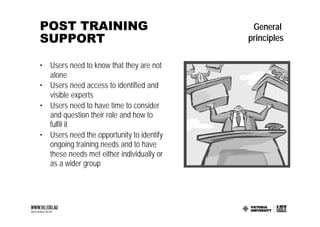
    POST TRAINING General SUPPORT principles • Users need to know that they are not alone • Users need access to identified and visible experts • Users need to have time to consider and question their role and how to fulfil it • Users need the opportunity to identify ongoing training needs and to have these needs met either individually or as a wider group
  • 15.
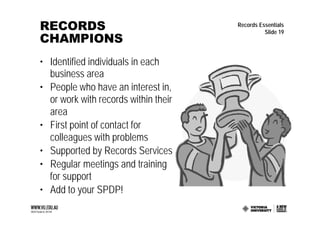
    RECORDS Records Essentials Slide 19 CHAMPIONS • Identified individuals in each business area • People who have an interest in, or work with records within their area • First point of contact for colleagues with problems • Supported by Records Services • Regular meetings and training for support • Add to your SPDP!
  • 16.
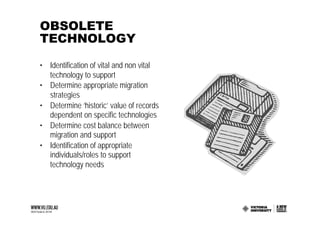
    OBSOLETE TECHNOLOGY • Identification ofvital and non vital technology to support • Determine appropriate migration strategies • Determine ‘historic’ value of records dependent on specific technologies • Determine cost balance between migration and support • Identification of appropriate individuals/roles to support technology needs
  • 17.
  • 18.
    CONTACT DETAILS Adelaide Parr Senior Records Consultant Records Services Victoria University Footscray Park Campus Ballarat Road, Footscray PO Box 14428 Melbourne Vic 8001 Australia Phone +61 3 9919 5345 Fax: +61 3 9919 5340 Email: adelaide.parr@vu.edu.au