Customer Service
     Satisfaction in a Library
     2.0 Environment

                                          By Fe Angela M. Verzosa

            PLAI - Cagayan Valley Region Librarians Council (CaVRLC)
      Conference on “Library 2.0 Environment: Challenges and Opportunities”
      Saint Mary’s University, Bayombong, Nueva Vizcaya, 15 February 2012


What do we talk about today?


1.   2.0 environment
2.   Library 2.0
3.   Library Services
4.   Service Quality
5.   Customer Satisfaction


                                                                              1
First, let’s take a quick look at
libraries today and observe
the many changes….


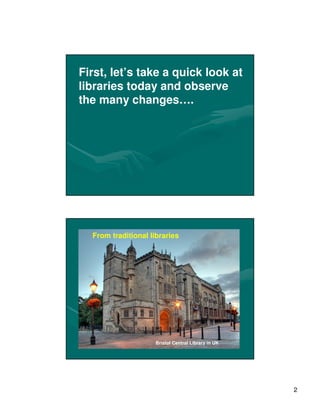
  From traditional libraries


                     Bristol Central Library in UK


                                                     2
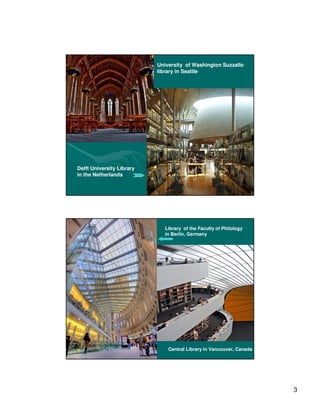
University of Washington Suzzallo
                           library in Seattle


Delft University Library
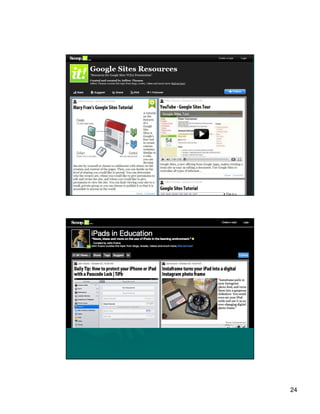
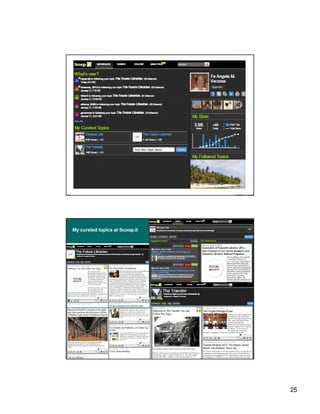
in the Netherlands


                             Library of the Faculty of Philology
                             in Berlin, Germany


                               Central Library in Vancouver, Canada


                                                                      3
The Changing Environment
 • Cell phones                      • Social networking
 • Texting                          • High transparency
 • Multi-tasking
   Multi-                             (Facebook etc.)
 • Expectation of fast              • Online photo sharing
   delivery                         • Less TV, more online
 • Self-service
   Self-                              news and blogs
   information                      • Curating contents from
 • Believe it’s all on                the Web ( Scoop.it )
   the Web


 Challenges in the changing environment

• focus on accountability -
     increasing demand for libraries to
     demonstrate outcomes/impacts in areas of
     importance to institution
• emphasis on assessment of
  student performance
• financial pressures
• user education in new
  technologies
• migration to online full-text
                      full-
  sources
• greater need for staff
  training
• need for Best Practices


                                                               4
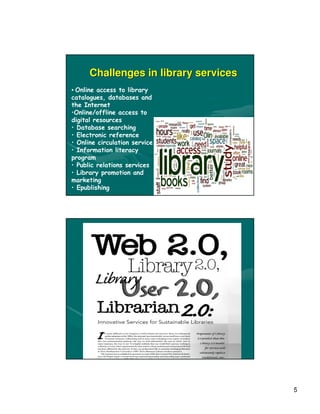
Challenges in library services
• Online access to library
catalogues, databases and
the Internet
•Online/offline access to
digital resources
• Database searching
• Electronic reference
• Online circulation service
• Information literacy
program
• Public relations services
• Library promotion and
marketing
• Epublishing


                                       5
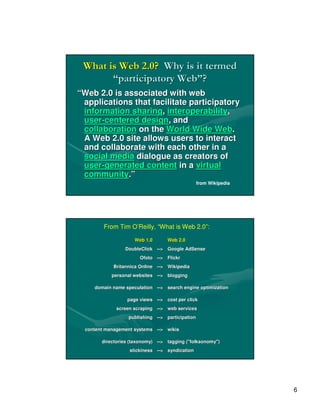
What is Web 2.0? Why is it termed
       “participatory Web”?
“Web 2.0 is associated with web
 applications that facilitate participatory
 information sharing, interoperability,
 user-centered design, and
 collaboration on the World Wide Web.
 A Web 2.0 site allows users to interact
 and collaborate with each other in a
 social media dialogue as creators of
 user-generated content in a virtual
 community.”
                                                  from Wikipedia


         From Tim O’Reilly, “What is Web 2.0”:

                     Web 1.0       Web 2.0
                 DoubleClick --> Google AdSense
                             -->
                       Ofoto --> Flickr
                             -->
            Britannica Online --> Wikipedia
                              -->
            personal websites --> blogging
                              -->

     domain name speculation --> search engine optimization
                             -->

                  page views --> cost per click
                             -->
              screen scraping --> web services
                              -->
                   publishing --> participation
                              -->

  content management systems --> wikis
                             -->

        directories (taxonomy) --> tagging ("folksonomy")
                               -->         ("folksonomy")
                   stickiness --> syndication
                              -->


                                                                   6
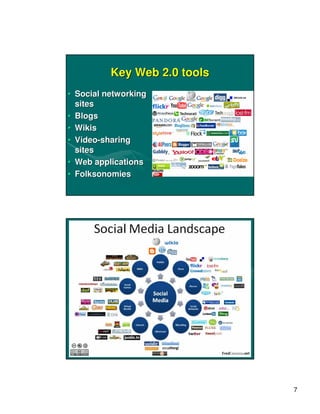
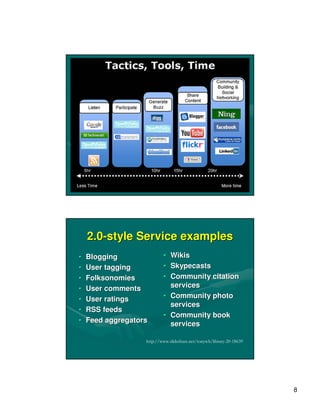
Key Web 2.0 tools
• Social networking
  sites
• Blogs
• Wikis
• Video-sharing
  sites
• Web applications
• Folksonomies


                              7
2.0-style Service examples
•   Blogging               • Wikis
•   User tagging           • Skypecasts
•   Folksonomies           • Community citation
•   User comments            services
•   User ratings           • Community photo
                             services
•   RSS feeds
                           • Community book
•   Feed aggregators         services

                   http://www.slideshare.net/tonywh/library-20-18639


                                                                       8
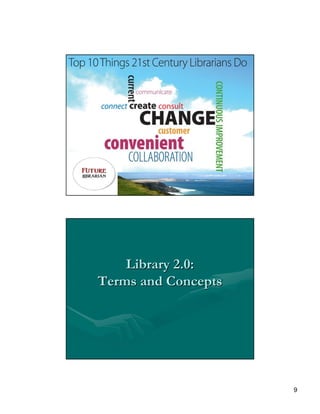
Library 2.0:
Terms and Concepts


                     9
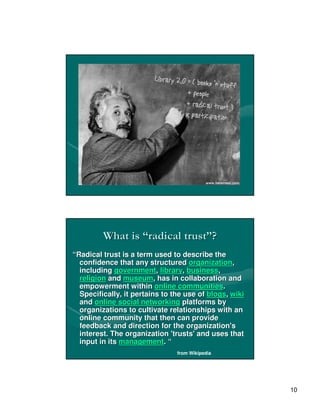
What is “radical trust”?
“Radical trust is a term used to describe the
  confidence that any structured organization,
                                    organization,
  including government, library, business,
             government, library, business,
  religion and museum, has in collaboration and
                museum,
  empowerment within online communities.
                                 communities.
  Specifically, it pertains to the use of blogs, wiki
                                          blogs,
  and online social networking platforms by
  organizations to cultivate relationships with an
  online community that then can provide
  feedback and direction for the organization's
  interest. The organization 'trusts' and uses that
  input in its management. “
               management.
                                from Wikipedia


                                                        10
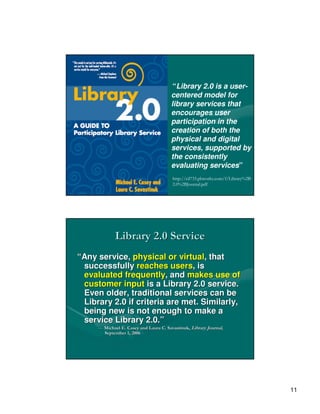
“Library 2.0 is a user-
                                        centered model for
                                        library services that
                                        encourages user
                                        participation in the
                                        creation of both the
                                        physical and digital
                                        services, supported by
                                        the consistently
                                        evaluating services”
                                        http://cil733.pbworks.com/f/Library%2B
                                        2.0%2BJournal.pdf


             Library 2.0 Service
“Any service, physical or virtual, that
 successfully reaches users, is
 evaluated frequently, and makes use of
 customer input is a Library 2.0 service.
 Even older, traditional services can be
 Library 2.0 if criteria are met. Similarly,
 being new is not enough to make a
 service Library 2.0.”
     — Michael E. Casey and Laura C. Savastinuk, Library Journal,
                                     Savastinuk,
       September 1, 2006


                                                                                 11
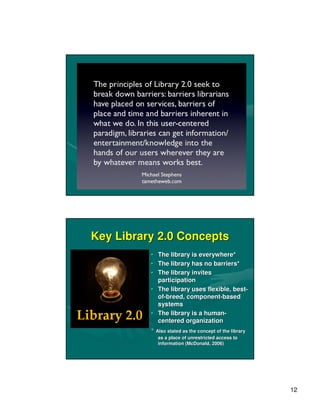
Key Library 2.0 Concepts
          • The library is everywhere*
          • The library has no barriers*
          • The library invites
            participation
          • The library uses flexible, best-
                                       best-
            of-breed, component-based
            of-       component-
            systems
          • The library is a human-
                             human-
            centered organization
          * Also stated as the concept of the library
             as a place of unrestricted access to
             information (McDonald, 2006)


                                                        12
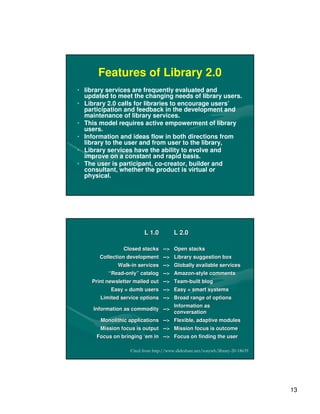
Features of Library 2.0
• library services are frequently evaluated and
  updated to meet the changing needs of library users.
• Library 2.0 calls for libraries to encourage users’
  participation and feedback in the development and
  maintenance of library services.
• This model requires active empowerment of library
  users.
• Information and ideas flow in both directions from
  library to the user and from user to the library,
• Library services have the ability to evolve and
  improve on a constant and rapid basis.
• The user is participant, co-creator, builder and
  consultant, whether the product is virtual or
  physical.


                         L 1.0          L 2.0

                Closed stacks --> Open stacks
                              -->
       Collection development --> Library suggestion box
                              -->
              Walk-in services --> Globally available services
              Walk-            -->
          “Read-only” catalog --> Amazon-style comments
           Read-              --> Amazon-
    Print newsletter mailed out --> Team-built blog
                                --> Team-
           Easy = dumb users --> Easy = smart systems
                             -->
       Limited service options --> Broad range of options
                               -->
                                        Information as
     Information as commodity -->
                              -->
                                        conversation
       Monolithic applications --> Flexible, adaptive modules
                               -->
       Mission focus is output --> Mission focus is outcome
                               -->
      Focus on bringing ‘em in --> Focus on finding the user
                        ‘em    -->

                  Cited from http://www.slideshare.net/tonywh/library-20-18639


                                                                                 13
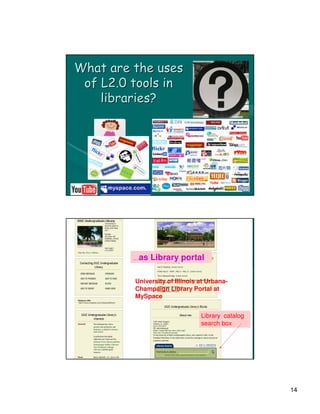
What are the uses
 of L2.0 tools in
    libraries?


    …as Library Portals
         …as Library portal


           University of Illinois at Urbana-
           Champaign Library Portal at
           MySpace


                                  Library catalog
                                  search box


                                                    14
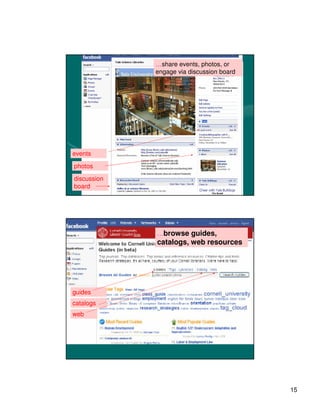
…share events, photos, or
             engage via discussion board


events

photos

discussion
board


             …browse guides,
             catalogs, web resources


guides
catalogs
web


                                           15
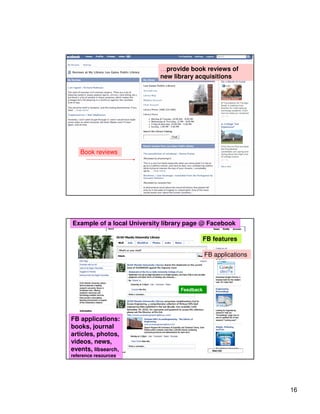
…provide book reviews of
                            new library acquisitions


    Book reviews


Example of a local University library page @ Facebook

                                              FB features

                                              FB applications


                                   Feedback


FB applications:
books, journal
articles, photos,
videos, news,
events, libsearch,
reference resources...


                                                                16
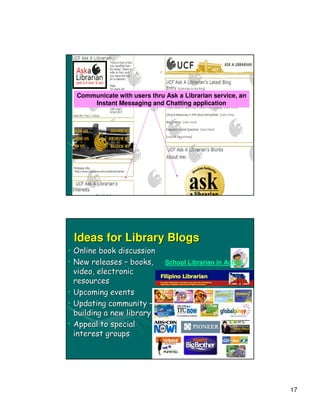
…for Marketing/Promotion

  Communicate with users thru Ask a Librarian service, an
      Instant Messaging and Chatting application


 Ideas for Library Blogs
• Online book discussion
• New releases – books,       School Librarian in Action
  video, electronic
  resources
• Upcoming events
• Updating community –
  building a new library
• Appeal to special
  interest groups


                                                            17
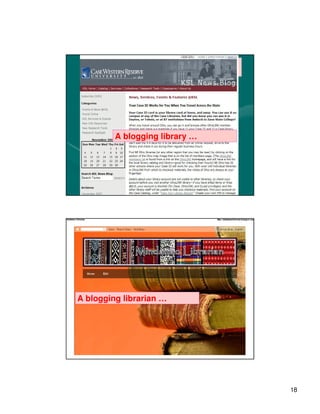
Blogs as Library News
      Vehicles


         A blogging library …


A blogging librarian …


                                18
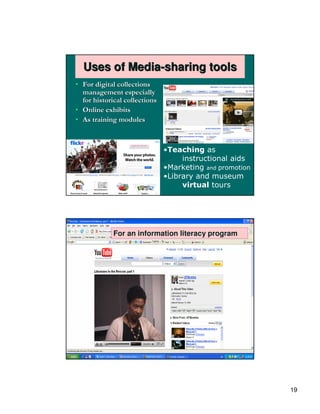
Uses of Media-sharing tools
• For digital collections
  management especially
  for historical collections
• Online exhibits
• As training modules


                               •Teaching as
                                    instructional aids
                               •Marketing and promotion
                               •Library and museum
                                    virtual tours


Video-sharing information literacy program
        For an for Library Orientation


                                                          19
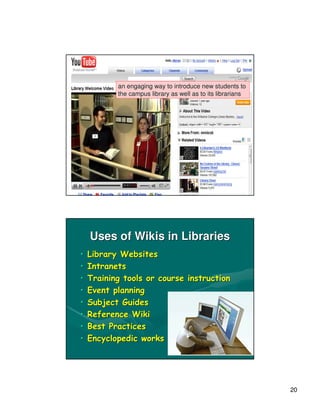
Video-sharing for Library
      Tours
           an engaging way to introduce new students to
           the campus library as well as to its librarians


    Uses of Wikis in Libraries
•   Library Websites
•   Intranets
•   Training tools or course instruction
•   Event planning
•   Subject Guides
•   Reference Wiki
•   Best Practices
•   Encyclopedic works


                                                             20
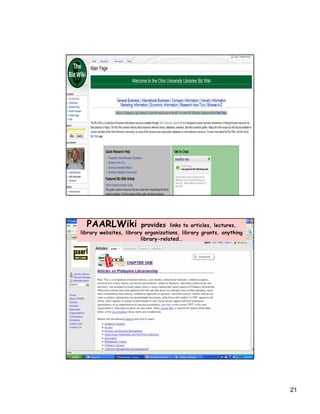
Wikis as Subject Guides


  PAARLWiki             provides links to articles, lectures,
library websites, library organizations, library grants, anything
                                                         anything
                        library-related…
                        library-


                                                                    21
The Semantic Web – Web 3.0


   Now the future librarian is
  moving towards Library 3.0…
• Librarian 3.0 will enhance the ability to
  collect and provide information and to offer
  instruction in research techniques and
  information use.
• Librarian 3.0 will also have to offer
  alternative services such as content curation
  and other value added services.
• Librarians or library staff of the future will
  have to be prepared for lifelong learning.
   http://ir.inflibnet.ac.in/dxml/bitstream/handle/1944/1135/20.pdf?sequence=1


                                                                                 22
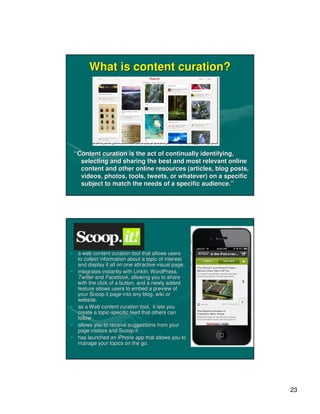
What is content curation?


 “Content curation is the act of continually identifying,
   selecting and sharing the best and most relevant online
   content and other online resources (articles, blog posts,
   videos, photos, tools, tweets, or whatever) on a specific
   subject to match the needs of a specific audience.”


• a web content curation tool that allows users
  to collect information about a topic of interest
  and display it all on one attractive visual page.
• integrates instantly with LinkIn, WordPress,
                            LinkIn, WordPress,
  Twitter and Facebook, allowing you to share
                Facebook,
  with the click of a button, and a newly added
  feature allows users to embed a preview of
  your Scoop.it page into any blog, wiki or
                                blog,
  website.
• as a Web content curation tool, it lets you
  create a topic-specific feed that others can
            topic-
  follow
• allows you to receive suggestions from your
  page visitors and Scoop.it
• has launched an iPhone app that allows you to
  manage your topics on the go.


                                                               23
24
My curated topics at Scoop.it


                                25
T
O
P

10

Fa
ce
bo
ok

Ap
ps

for

Li
br
ari
an
s


 Service


      “Libraries are in the service business. The
      most important product they have is service.
      Without service, libraries are indistinguishable
      from museums or … they are a combination of
      a maze and morgue for books. Service is a
      pervasive    ethic  of    the   profession    of
      librarianship.”
                                   (Gorman, 1999)


                                                         26
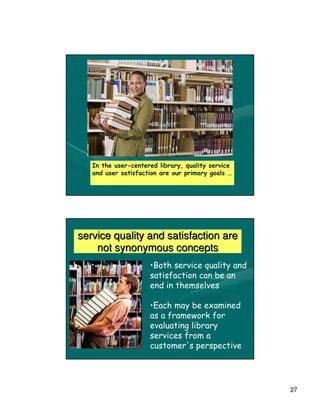
In the user-centered library, quality service
   and user satisfaction are our primary goals …


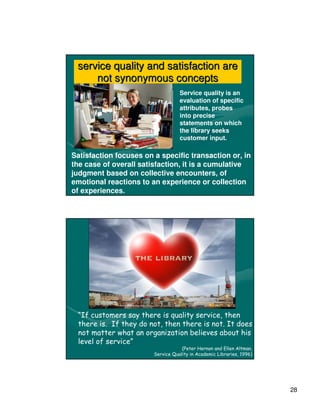
service quality and satisfaction are
    not synonymous concepts
                     •Both service quality and
                     satisfaction can be an
                     end in themselves

                     •Each may be examined
                     as a framework for
                     evaluating library
                     services from a
                     customer's perspective


                                                   27
service quality and satisfaction are
     not synonymous concepts
                                   Service quality is an
                                   evaluation of specific
                                   attributes, probes
                                   into precise
                                   statements on which
                                   the library seeks
                                   customer input.

Satisfaction focuses on a specific transaction or, in
the case of overall satisfaction, it is a cumulative
judgment based on collective encounters, of
emotional reactions to an experience or collection
of experiences.


 “If customers say there is quality service, then
 there is. If they do not, then there is not. It does
 not matter what an organization believes about his
 level of service”
                                    (Peter Hernon and Ellen Altman,
                        Service Quality in Academic Libraries, 1996)


                                                                       28
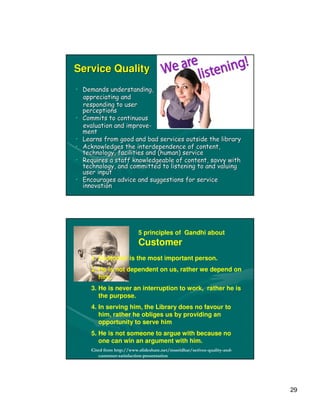
Service Quality
• Demands understanding,
  appreciating and
  responding to user
  perceptions
• Commits to continuous
  evaluation and improve-
                 improve-
  ment
• Learns from good and bad services outside the library
• Acknowledges the interdependence of content,
  technology, facilities and (human) service
• Requires a staff knowledgeable of content, savvy with
  technology, and committed to listening to and valuing
  user input
• Encourages advice and suggestions for service
  innovation


                           5 principles of Gandhi about
                           Customer
     1. Customer is the most important person.
     2. He is not dependent on us, rather we depend on
        him.
     3. He is never an interruption to work, rather he is
        the purpose.
     4. In serving him, the Library does no favour to
        him, rather he obliges us by providing an
        opportunity to serve him
     5. He is not someone to argue with because no
        one can win an argument with him.
     Cited from http://www.slideshare.net/mssridhar/serivce-quality-and-
        customer-satisfaction-presentation


                                                                           29
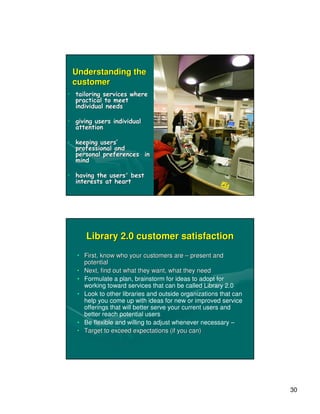
Understanding the
 customer
• tailoring services where
  practical to meet
  individual needs

• giving users individual
  attention

• keeping users’
  professional and
  personal preferences in
  mind

• having the users' best
  interests at heart


      Library 2.0 customer satisfaction
   • First, know who your customers are – present and
     potential
   • Next, find out what they want, what they need
   • Formulate a plan, brainstorm for ideas to adopt for
     working toward services that can be called Library 2.0
   • Look to other libraries and outside organizations that can
     help you come up with ideas for new or improved service
     offerings that will better serve your current users and
     better reach potential users
   • Be flexible and willing to adjust whenever necessary –
   • Target to exceed expectations (if you can)


                                                                  30
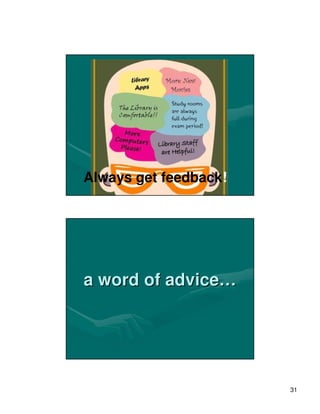
Always get feedback!


a word of advice…


                       31
a word of advice…
   and don’t forget


                      32
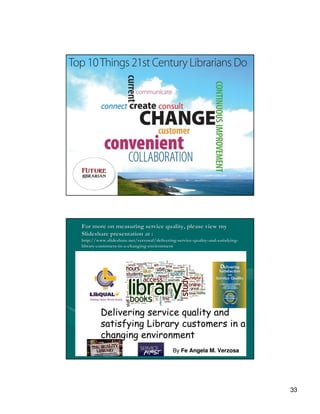
For more on measuring service quality, please view my
Slideshare presentation at :
http://www.slideshare.net/verzosaf/delivering-service-quality-and-satisfying-
http://www.slideshare.net/verzosaf/delivering- service- quality- and- satisfying-
library-customers-in-a-changing-environment
library- customers- in- changing-


                                                                                    33
Questions?

Contact famverzosa@yahoo.com


                               34
Please
   Remix/Reuse/Share!
  This presentation may be used for your library or
organization without further request from the author.
     Please feel free to use it in whole or in part,
 incorporate it into another presentation, quote from
      it, snag the images, etc. A citation to this
    presentation with a nod to the original author,
Fe Angela M. Verzosa would be greatly appreciated.


                                                        35

Customer service satisfaction in a library 2.0 environment

  • 1.
    Customer Service Satisfaction in a Library 2.0 Environment By Fe Angela M. Verzosa PLAI - Cagayan Valley Region Librarians Council (CaVRLC) Conference on “Library 2.0 Environment: Challenges and Opportunities” Saint Mary’s University, Bayombong, Nueva Vizcaya, 15 February 2012 What do we talk about today? 1. 2.0 environment 2. Library 2.0 3. Library Services 4. Service Quality 5. Customer Satisfaction 1
  • 2.
    First, let’s takea quick look at libraries today and observe the many changes…. From traditional libraries Bristol Central Library in UK 2
  • 3.
    University of WashingtonSuzzallo library in Seattle Delft University Library in the Netherlands Library of the Faculty of Philology in Berlin, Germany Central Library in Vancouver, Canada 3
  • 4.
    The Changing Environment • Cell phones • Social networking • Texting • High transparency • Multi-tasking Multi- (Facebook etc.) • Expectation of fast • Online photo sharing delivery • Less TV, more online • Self-service Self- news and blogs information • Curating contents from • Believe it’s all on the Web ( Scoop.it ) the Web Challenges in the changing environment • focus on accountability - increasing demand for libraries to demonstrate outcomes/impacts in areas of importance to institution • emphasis on assessment of student performance • financial pressures • user education in new technologies • migration to online full-text full- sources • greater need for staff training • need for Best Practices 4
  • 5.
    Challenges in libraryservices • Online access to library catalogues, databases and the Internet •Online/offline access to digital resources • Database searching • Electronic reference • Online circulation service • Information literacy program • Public relations services • Library promotion and marketing • Epublishing 5
  • 6.
    What is Web2.0? Why is it termed “participatory Web”? “Web 2.0 is associated with web applications that facilitate participatory information sharing, interoperability, user-centered design, and collaboration on the World Wide Web. A Web 2.0 site allows users to interact and collaborate with each other in a social media dialogue as creators of user-generated content in a virtual community.” from Wikipedia From Tim O’Reilly, “What is Web 2.0”: Web 1.0 Web 2.0 DoubleClick --> Google AdSense --> Ofoto --> Flickr --> Britannica Online --> Wikipedia --> personal websites --> blogging --> domain name speculation --> search engine optimization --> page views --> cost per click --> screen scraping --> web services --> publishing --> participation --> content management systems --> wikis --> directories (taxonomy) --> tagging ("folksonomy") --> ("folksonomy") stickiness --> syndication --> 6
  • 7.
    Key Web 2.0tools • Social networking sites • Blogs • Wikis • Video-sharing sites • Web applications • Folksonomies 7
  • 8.
    2.0-style Service examples • Blogging • Wikis • User tagging • Skypecasts • Folksonomies • Community citation • User comments services • User ratings • Community photo services • RSS feeds • Community book • Feed aggregators services http://www.slideshare.net/tonywh/library-20-18639 8
  • 9.
  • 10.
    What is “radicaltrust”? “Radical trust is a term used to describe the confidence that any structured organization, organization, including government, library, business, government, library, business, religion and museum, has in collaboration and museum, empowerment within online communities. communities. Specifically, it pertains to the use of blogs, wiki blogs, and online social networking platforms by organizations to cultivate relationships with an online community that then can provide feedback and direction for the organization's interest. The organization 'trusts' and uses that input in its management. “ management. from Wikipedia 10
  • 11.
    “Library 2.0 isa user- centered model for library services that encourages user participation in the creation of both the physical and digital services, supported by the consistently evaluating services” http://cil733.pbworks.com/f/Library%2B 2.0%2BJournal.pdf Library 2.0 Service “Any service, physical or virtual, that successfully reaches users, is evaluated frequently, and makes use of customer input is a Library 2.0 service. Even older, traditional services can be Library 2.0 if criteria are met. Similarly, being new is not enough to make a service Library 2.0.” — Michael E. Casey and Laura C. Savastinuk, Library Journal, Savastinuk, September 1, 2006 11
  • 12.
    Key Library 2.0Concepts • The library is everywhere* • The library has no barriers* • The library invites participation • The library uses flexible, best- best- of-breed, component-based of- component- systems • The library is a human- human- centered organization * Also stated as the concept of the library as a place of unrestricted access to information (McDonald, 2006) 12
  • 13.
    Features of Library2.0 • library services are frequently evaluated and updated to meet the changing needs of library users. • Library 2.0 calls for libraries to encourage users’ participation and feedback in the development and maintenance of library services. • This model requires active empowerment of library users. • Information and ideas flow in both directions from library to the user and from user to the library, • Library services have the ability to evolve and improve on a constant and rapid basis. • The user is participant, co-creator, builder and consultant, whether the product is virtual or physical. L 1.0 L 2.0 Closed stacks --> Open stacks --> Collection development --> Library suggestion box --> Walk-in services --> Globally available services Walk- --> “Read-only” catalog --> Amazon-style comments Read- --> Amazon- Print newsletter mailed out --> Team-built blog --> Team- Easy = dumb users --> Easy = smart systems --> Limited service options --> Broad range of options --> Information as Information as commodity --> --> conversation Monolithic applications --> Flexible, adaptive modules --> Mission focus is output --> Mission focus is outcome --> Focus on bringing ‘em in --> Focus on finding the user ‘em --> Cited from http://www.slideshare.net/tonywh/library-20-18639 13
  • 14.
    What are theuses of L2.0 tools in libraries? …as Library Portals …as Library portal University of Illinois at Urbana- Champaign Library Portal at MySpace Library catalog search box 14
  • 15.
    …share events, photos,or engage via discussion board events photos discussion board …browse guides, catalogs, web resources guides catalogs web 15
  • 16.
    …provide book reviewsof new library acquisitions Book reviews Example of a local University library page @ Facebook FB features FB applications Feedback FB applications: books, journal articles, photos, videos, news, events, libsearch, reference resources... 16
  • 17.
    …for Marketing/Promotion Communicate with users thru Ask a Librarian service, an Instant Messaging and Chatting application Ideas for Library Blogs • Online book discussion • New releases – books, School Librarian in Action video, electronic resources • Upcoming events • Updating community – building a new library • Appeal to special interest groups 17
  • 18.
    Blogs as LibraryNews Vehicles A blogging library … A blogging librarian … 18
  • 19.
    Uses of Media-sharingtools • For digital collections management especially for historical collections • Online exhibits • As training modules •Teaching as instructional aids •Marketing and promotion •Library and museum virtual tours Video-sharing information literacy program For an for Library Orientation 19
  • 20.
    Video-sharing for Library Tours an engaging way to introduce new students to the campus library as well as to its librarians Uses of Wikis in Libraries • Library Websites • Intranets • Training tools or course instruction • Event planning • Subject Guides • Reference Wiki • Best Practices • Encyclopedic works 20
  • 21.
    Wikis as SubjectGuides PAARLWiki provides links to articles, lectures, library websites, library organizations, library grants, anything anything library-related… library- 21
  • 22.
    The Semantic Web– Web 3.0 Now the future librarian is moving towards Library 3.0… • Librarian 3.0 will enhance the ability to collect and provide information and to offer instruction in research techniques and information use. • Librarian 3.0 will also have to offer alternative services such as content curation and other value added services. • Librarians or library staff of the future will have to be prepared for lifelong learning. http://ir.inflibnet.ac.in/dxml/bitstream/handle/1944/1135/20.pdf?sequence=1 22
  • 23.
    What is contentcuration? “Content curation is the act of continually identifying, selecting and sharing the best and most relevant online content and other online resources (articles, blog posts, videos, photos, tools, tweets, or whatever) on a specific subject to match the needs of a specific audience.” • a web content curation tool that allows users to collect information about a topic of interest and display it all on one attractive visual page. • integrates instantly with LinkIn, WordPress, LinkIn, WordPress, Twitter and Facebook, allowing you to share Facebook, with the click of a button, and a newly added feature allows users to embed a preview of your Scoop.it page into any blog, wiki or blog, website. • as a Web content curation tool, it lets you create a topic-specific feed that others can topic- follow • allows you to receive suggestions from your page visitors and Scoop.it • has launched an iPhone app that allows you to manage your topics on the go. 23
  • 24.
  • 25.
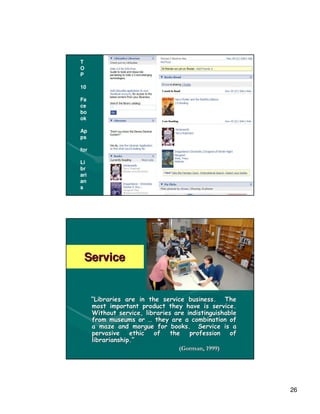
    My curated topicsat Scoop.it 25
  • 26.
    T O P 10 Fa ce bo ok Ap ps for Li br ari an s Service “Libraries are in the service business. The most important product they have is service. Without service, libraries are indistinguishable from museums or … they are a combination of a maze and morgue for books. Service is a pervasive ethic of the profession of librarianship.” (Gorman, 1999) 26
  • 27.
    In the user-centeredlibrary, quality service and user satisfaction are our primary goals … service quality and satisfaction are not synonymous concepts •Both service quality and satisfaction can be an end in themselves •Each may be examined as a framework for evaluating library services from a customer's perspective 27
  • 28.
    service quality andsatisfaction are not synonymous concepts Service quality is an evaluation of specific attributes, probes into precise statements on which the library seeks customer input. Satisfaction focuses on a specific transaction or, in the case of overall satisfaction, it is a cumulative judgment based on collective encounters, of emotional reactions to an experience or collection of experiences. “If customers say there is quality service, then there is. If they do not, then there is not. It does not matter what an organization believes about his level of service” (Peter Hernon and Ellen Altman, Service Quality in Academic Libraries, 1996) 28
  • 29.
    Service Quality • Demandsunderstanding, appreciating and responding to user perceptions • Commits to continuous evaluation and improve- improve- ment • Learns from good and bad services outside the library • Acknowledges the interdependence of content, technology, facilities and (human) service • Requires a staff knowledgeable of content, savvy with technology, and committed to listening to and valuing user input • Encourages advice and suggestions for service innovation 5 principles of Gandhi about Customer 1. Customer is the most important person. 2. He is not dependent on us, rather we depend on him. 3. He is never an interruption to work, rather he is the purpose. 4. In serving him, the Library does no favour to him, rather he obliges us by providing an opportunity to serve him 5. He is not someone to argue with because no one can win an argument with him. Cited from http://www.slideshare.net/mssridhar/serivce-quality-and- customer-satisfaction-presentation 29
  • 30.
    Understanding the customer •tailoring services where practical to meet individual needs • giving users individual attention • keeping users’ professional and personal preferences in mind • having the users' best interests at heart Library 2.0 customer satisfaction • First, know who your customers are – present and potential • Next, find out what they want, what they need • Formulate a plan, brainstorm for ideas to adopt for working toward services that can be called Library 2.0 • Look to other libraries and outside organizations that can help you come up with ideas for new or improved service offerings that will better serve your current users and better reach potential users • Be flexible and willing to adjust whenever necessary – • Target to exceed expectations (if you can) 30
  • 31.
    Always get feedback! aword of advice… 31
  • 32.
    a word ofadvice… and don’t forget 32
  • 33.
    For more onmeasuring service quality, please view my Slideshare presentation at : http://www.slideshare.net/verzosaf/delivering-service-quality-and-satisfying- http://www.slideshare.net/verzosaf/delivering- service- quality- and- satisfying- library-customers-in-a-changing-environment library- customers- in- changing- 33
  • 34.
  • 35.
    Please Remix/Reuse/Share! This presentation may be used for your library or organization without further request from the author. Please feel free to use it in whole or in part, incorporate it into another presentation, quote from it, snag the images, etc. A citation to this presentation with a nod to the original author, Fe Angela M. Verzosa would be greatly appreciated. 35