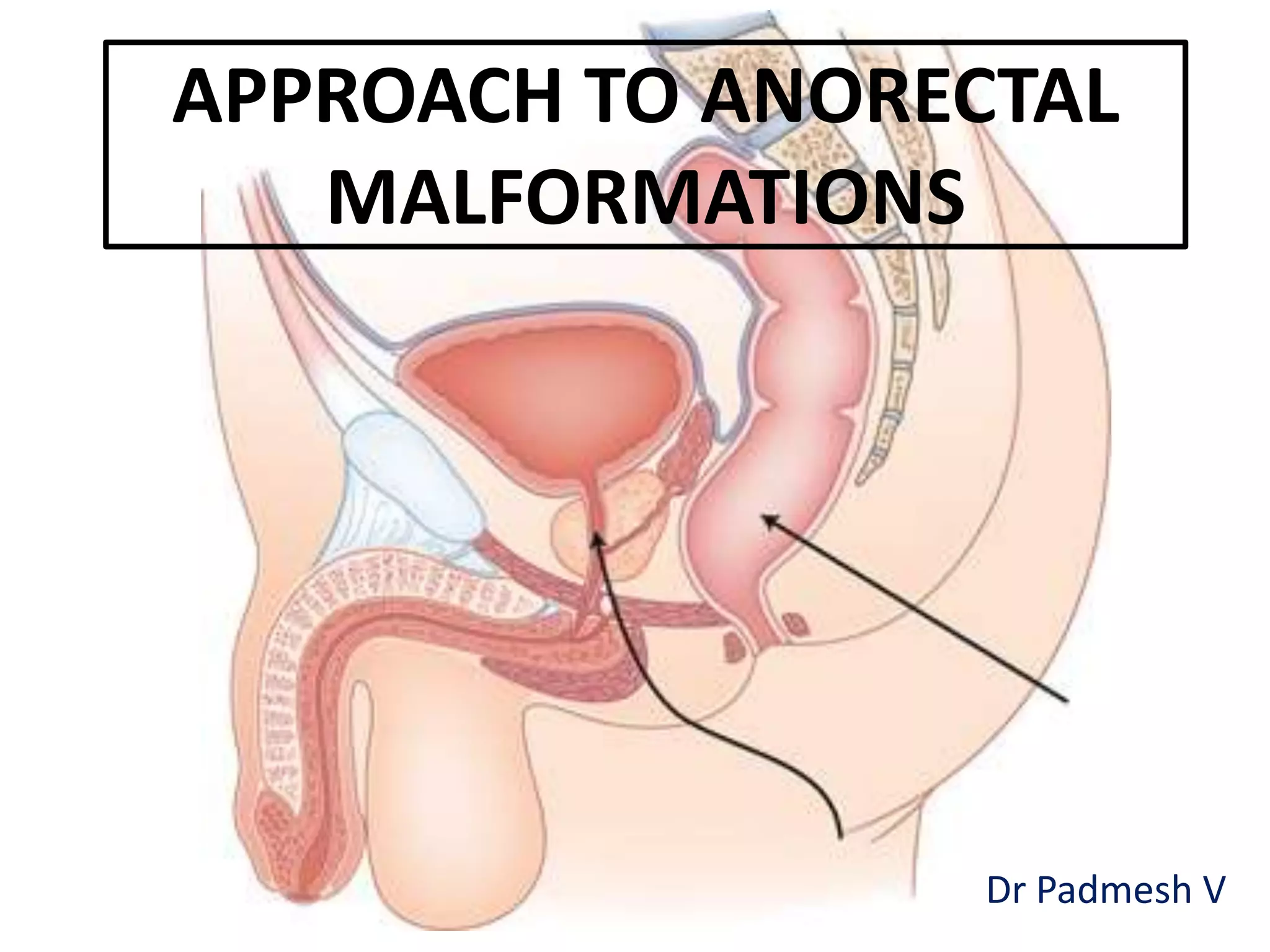
APPROACH TO ANORECTAL
MALFORMATIONS
Dr Padmesh V
• INTRODUCTION:
• Incidence: 1 in 4,000 to 1 in 5,000.
• Anorectal malformations (ARMs): common
surgically treated anomalies in the newborn period.
• Imperforate anus can be divided into:
– Low lesions, where the rectum has descended through
the sphincter complex, and
– High lesions, where it has not descended through
sphincter complex.
(Sphincter complex: puborectalis, levator ani, external and
internal sphincters)
• EMBRYOLOGY:
• Interference in development of anorectal and genitourinary
organs at various stages upto 7 to 8 weeks of gestation.
• Continued communication between the urogenital tract
and rectal portions of the cloacal plate causes rectourethral
fistulas or rectovestibular fistulas.
• Anomalies in the pelvic floor as well as the external anal
sphincter (which are derived from exterior mesoderm).
• The higher the rectal pouch, more are the chances of mal-
development of the pelvic floor.
• ETIOLOGY:
–Consanguinity,
–HLXB9 gene mutations, and
–Congenital syndromes
• Presence of an ARM  Evaluate for VACTERL
anomalies (vertebral anomalies, anal atresia, cardiac defects,
tracheoesophageal fistula and/or esophageal atresia, renal and radial
anomalies, and limb defects).
• Most common association: Caudal regression
syndrome
• Associated
Malformations
• GENITOURINARY
• Vesicoureteric reflux
• Renal agenesis/dysplasia
• Ureteral duplication
• Cryptorchidism
• Hypospadias
• Bicornuate uterus
• Vaginal septums
• VERTEBRAL
• Spinal dysraphism
• Tethered chord
• Presacral masses
• Meningocele
• Lipoma
• Dermoid
• Teratoma
• CARDIOVASCULAR
• Tetralogy of Fallot
• Ventricular septal defect
• Transposition of the great vessels
• Hypoplastic left-heart syndrome
• GASTROINTESTINAL
• Tracheoesophageal fistula
• Duodenal atresia
• Malrotation
• Hirschsprung disease
• CENTRAL NERVOUS SYSTEM
• Spina bifida
• Tethered cord
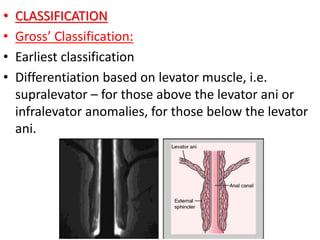
• CLASSIFICATION
• Gross’ Classification:
• Earliest classification
• Differentiation based on levator muscle, i.e.
supralevator – for those above the levator ani or
infralevator anomalies, for those below the levator
ani.
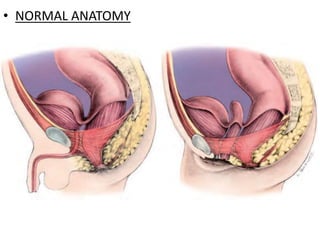
• NORMAL ANATOMY
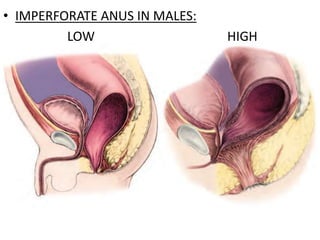
• IMPERFORATE ANUS IN MALES:
LOW HIGH
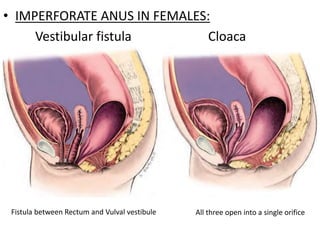
• IMPERFORATE ANUS IN FEMALES:
Vestibular fistula Cloaca
Fistula between Rectum and Vulval vestibule All three open into a single orifice
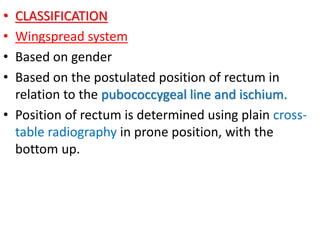
• CLASSIFICATION
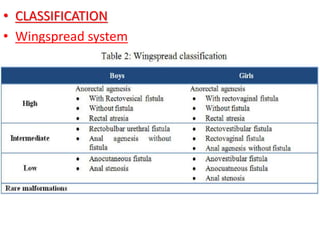
• Wingspread system
• Based on gender
• Based on the postulated position of rectum in
relation to the pubococcygeal line and ischium.
• Position of rectum is determined using plain cross-
table radiography in prone position, with the
bottom up.
• CLASSIFICATION
• Wingspread system
• CLASSIFICATION
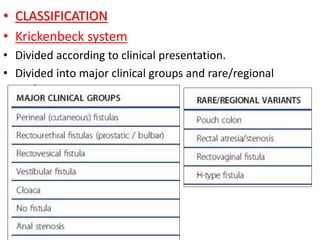
• Krickenbeck system
• Divided according to clinical presentation.
• Divided into major clinical groups and rare/regional
variants
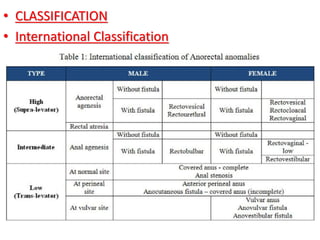
• CLASSIFICATION
• International Classification
• PRENATAL EVALUATION
• Prenatal diagnosis of most ARMs is rare.
• Presence of a cystic abdominal/pelvic mass in
combination with gastrointestinal and urologic
anomaly should heighten the suspicion for cloacal
anomalies.
• The use of fetal magnetic resonance imaging (MRI)
after 20 weeks of gestation.
• POSTNATAL EVALUATION
• Thorough physical examination.
• A clear understanding of the potential locations for
perineal fistulas is essential.
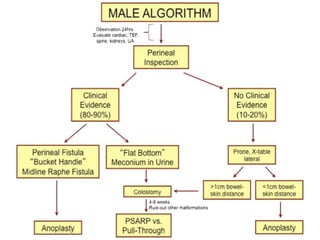
• Boys:
• Perineal body
• Median raphe should be carefully inspected
• Scrotum
• Penis
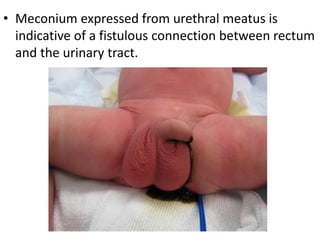
• Meconium expressed from urethral meatus is
indicative of a fistulous connection between rectum
and the urinary tract.
• POSTNATAL EVALUATION
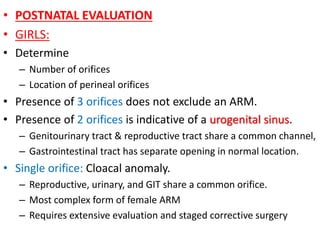
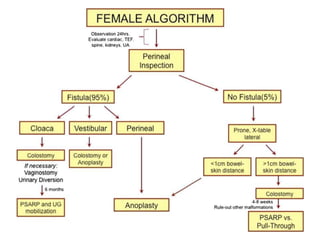
• GIRLS:
• Determine
– Number of orifices
– Location of perineal orifices
• Presence of 3 orifices does not exclude an ARM.
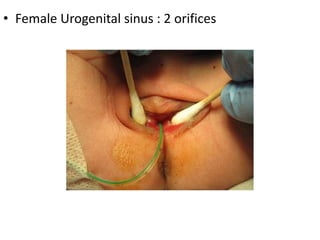
• Presence of 2 orifices is indicative of a urogenital sinus.
– Genitourinary tract & reproductive tract share a common channel,
– Gastrointestinal tract has separate opening in normal location.
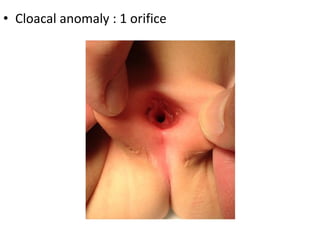
• Single orifice: Cloacal anomaly.
– Reproductive, urinary, and GIT share a common orifice.
– Most complex form of female ARM
– Requires extensive evaluation and staged corrective surgery
• Female Urogenital sinus : 2 orifices
• Cloacal anomaly : 1 orifice
• Normal position of anus on perineum is approx halfway
(0.5 ratio) between coccyx and scrotum or introitus.
• If fistulous connections are difficult to identify, wait for 24
hours  meconium descends  facilitates visualization.
• If Cutaneous fistula can be seen, it is a low lesion.
• Majority of ARMs do not require emergent surgical
intervention.
• Timing of surgery typically after first 24 to 48 hours.
• During the first 24 hours, gas and meconium descend
through the rectum to either the lowest level of the pouch
or into the fistula  more accurate assessment of extent of
anomaly.
• RADIOLOGIC EVALUATION
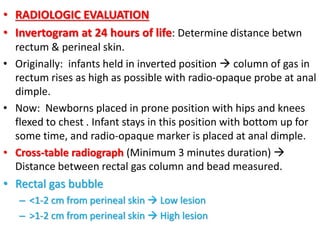
• Invertogram at 24 hours of life: Determine distance betwn
rectum & perineal skin.
• Originally: infants held in inverted position  column of gas in
rectum rises as high as possible with radio-opaque probe at anal
dimple.
• Now: Newborns placed in prone position with hips and knees
flexed to chest . Infant stays in this position with bottom up for
some time, and radio-opaque marker is placed at anal dimple.
• Cross-table radiograph (Minimum 3 minutes duration) 
Distance between rectal gas column and bead measured.
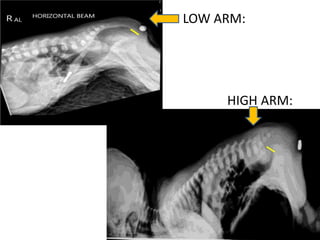
• Rectal gas bubble
– <1-2 cm from perineal skin  Low lesion
– >1-2 cm from perineal skin  High lesion
LOW ARM:
HIGH ARM:
• RADIOLOGIC EVALUATION
• Fluoroscopy: contrast study
• To detect a recto-urinary, rectovaginal, or rectoperineal
fistula
• Fistula is termed
– Low : if below the levator ani plane
– High : if it is below the pubococcygeal line (PCL)
• SURGICAL TECHNIQUES:
• A) Primary Repair
• Patients with perineal/vestibular fistulas.
• Options:
–Cutback Anoplasty
–Posterior sagittal anorectoplasty (PSARP).
• Two weeks after repair, the neo-anus is calibrated
using a dilator, and serial dilations performed.
• SURGICAL TECHNIQUES:
• B) Staged Repair
• Rectourethral/rectovesicular fistulas, cloacal
anomalies, rare variants, or complex life-
threatening associated anomalies.
• These stages are divided into:
– 1. Performing a colostomy for enteric diversion,
– 2. Definite reconstruction,
– 3. Subsequent restoration of enteric continuity via
colostomy reversal.
• SURGICAL TECHNIQUES:
• Staged Repair
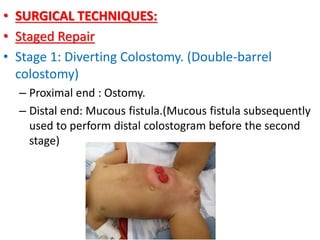
• Stage 1: Diverting Colostomy. (Double-barrel
colostomy)
– Proximal end : Ostomy.
– Distal end: Mucous fistula.(Mucous fistula subsequently
used to perform distal colostogram before the second
stage)
• SURGICAL TECHNIQUES:
• Staged Repair
• Stage 2: Definitive reconstruction: (At about 1 year
age)
• Two main approaches for reconstruction of ARM:
– PSARP (posterior sagittal anorectoplasty)
– LAARP (Laparoscopy-Assisted Anorectoplasty)
• SURGICAL TECHNIQUES:
• Staged Repair
• Stage3: Colostomy Closure.
– Once the reconstruction has been performed and
healed, the colostomy is reversed.
– Typically 4 to 6 weeks after reconstruction.
• OUTCOMES:
• Depends on
– (1) Extent and nature of the anomaly,
– (2) surgical expertise,
– (3) the presence of associated syndromic anomalies,
– (4) compliance with an effective and aggressive bowel
management program.
• OUTCOMES:
• 1. Urinary Incontinence
• Rates of urinary incontinence ranges between 0% for low
anomalies to 10% for high anomalies.
• 2. Fecal Incontinence
• Low ARMs had good bowel function with no soiling,
whereas one-third of those with “high” or “intermediate”
anomalies had fecal soiling.
• 3. Sexual Function and Fertility
• Variable outcomes
Willis J. Potts:
“No congenital anomaly requires more thoughtful
surgical care than imperforate anus or atresia of
the rectum.
In practically every case the future of a child so
unfortunate as to be born with an imperforate
anus is determined by the adequacy and skill of
the first operation”
THANK YOU!!!

Approach to Ano Rectal Malformations - Dr Padmesh - Neonatology

  • 1.
  • 2.
    • INTRODUCTION: • Incidence:1 in 4,000 to 1 in 5,000. • Anorectal malformations (ARMs): common surgically treated anomalies in the newborn period. • Imperforate anus can be divided into: – Low lesions, where the rectum has descended through the sphincter complex, and – High lesions, where it has not descended through sphincter complex. (Sphincter complex: puborectalis, levator ani, external and internal sphincters)
  • 3.
    • EMBRYOLOGY: • Interferencein development of anorectal and genitourinary organs at various stages upto 7 to 8 weeks of gestation. • Continued communication between the urogenital tract and rectal portions of the cloacal plate causes rectourethral fistulas or rectovestibular fistulas. • Anomalies in the pelvic floor as well as the external anal sphincter (which are derived from exterior mesoderm). • The higher the rectal pouch, more are the chances of mal- development of the pelvic floor.
  • 4.
    • ETIOLOGY: –Consanguinity, –HLXB9 genemutations, and –Congenital syndromes • Presence of an ARM  Evaluate for VACTERL anomalies (vertebral anomalies, anal atresia, cardiac defects, tracheoesophageal fistula and/or esophageal atresia, renal and radial anomalies, and limb defects). • Most common association: Caudal regression syndrome
  • 5.
    • Associated Malformations • GENITOURINARY •Vesicoureteric reflux • Renal agenesis/dysplasia • Ureteral duplication • Cryptorchidism • Hypospadias • Bicornuate uterus • Vaginal septums • VERTEBRAL • Spinal dysraphism • Tethered chord • Presacral masses • Meningocele • Lipoma • Dermoid • Teratoma • CARDIOVASCULAR • Tetralogy of Fallot • Ventricular septal defect • Transposition of the great vessels • Hypoplastic left-heart syndrome • GASTROINTESTINAL • Tracheoesophageal fistula • Duodenal atresia • Malrotation • Hirschsprung disease • CENTRAL NERVOUS SYSTEM • Spina bifida • Tethered cord
  • 6.
    • CLASSIFICATION • Gross’Classification: • Earliest classification • Differentiation based on levator muscle, i.e. supralevator – for those above the levator ani or infralevator anomalies, for those below the levator ani.
  • 7.
  • 8.
    • IMPERFORATE ANUSIN MALES: LOW HIGH
  • 9.
    • IMPERFORATE ANUSIN FEMALES: Vestibular fistula Cloaca Fistula between Rectum and Vulval vestibule All three open into a single orifice
  • 10.
    • CLASSIFICATION • Wingspreadsystem • Based on gender • Based on the postulated position of rectum in relation to the pubococcygeal line and ischium. • Position of rectum is determined using plain cross- table radiography in prone position, with the bottom up.
  • 11.
  • 12.
    • CLASSIFICATION • Krickenbecksystem • Divided according to clinical presentation. • Divided into major clinical groups and rare/regional variants
  • 13.
  • 14.
    • PRENATAL EVALUATION •Prenatal diagnosis of most ARMs is rare. • Presence of a cystic abdominal/pelvic mass in combination with gastrointestinal and urologic anomaly should heighten the suspicion for cloacal anomalies. • The use of fetal magnetic resonance imaging (MRI) after 20 weeks of gestation.
  • 15.
    • POSTNATAL EVALUATION •Thorough physical examination. • A clear understanding of the potential locations for perineal fistulas is essential. • Boys: • Perineal body • Median raphe should be carefully inspected • Scrotum • Penis
  • 16.
    • Meconium expressedfrom urethral meatus is indicative of a fistulous connection between rectum and the urinary tract.
  • 17.
    • POSTNATAL EVALUATION •GIRLS: • Determine – Number of orifices – Location of perineal orifices • Presence of 3 orifices does not exclude an ARM. • Presence of 2 orifices is indicative of a urogenital sinus. – Genitourinary tract & reproductive tract share a common channel, – Gastrointestinal tract has separate opening in normal location. • Single orifice: Cloacal anomaly. – Reproductive, urinary, and GIT share a common orifice. – Most complex form of female ARM – Requires extensive evaluation and staged corrective surgery
  • 18.
    • Female Urogenitalsinus : 2 orifices
  • 19.
  • 20.
    • Normal positionof anus on perineum is approx halfway (0.5 ratio) between coccyx and scrotum or introitus. • If fistulous connections are difficult to identify, wait for 24 hours  meconium descends  facilitates visualization. • If Cutaneous fistula can be seen, it is a low lesion. • Majority of ARMs do not require emergent surgical intervention. • Timing of surgery typically after first 24 to 48 hours. • During the first 24 hours, gas and meconium descend through the rectum to either the lowest level of the pouch or into the fistula  more accurate assessment of extent of anomaly.
  • 21.
    • RADIOLOGIC EVALUATION •Invertogram at 24 hours of life: Determine distance betwn rectum & perineal skin. • Originally: infants held in inverted position  column of gas in rectum rises as high as possible with radio-opaque probe at anal dimple. • Now: Newborns placed in prone position with hips and knees flexed to chest . Infant stays in this position with bottom up for some time, and radio-opaque marker is placed at anal dimple. • Cross-table radiograph (Minimum 3 minutes duration)  Distance between rectal gas column and bead measured. • Rectal gas bubble – <1-2 cm from perineal skin  Low lesion – >1-2 cm from perineal skin  High lesion
  • 22.
  • 23.
    • RADIOLOGIC EVALUATION •Fluoroscopy: contrast study • To detect a recto-urinary, rectovaginal, or rectoperineal fistula • Fistula is termed – Low : if below the levator ani plane – High : if it is below the pubococcygeal line (PCL)
  • 24.
    • SURGICAL TECHNIQUES: •A) Primary Repair • Patients with perineal/vestibular fistulas. • Options: –Cutback Anoplasty –Posterior sagittal anorectoplasty (PSARP). • Two weeks after repair, the neo-anus is calibrated using a dilator, and serial dilations performed.
  • 25.
    • SURGICAL TECHNIQUES: •B) Staged Repair • Rectourethral/rectovesicular fistulas, cloacal anomalies, rare variants, or complex life- threatening associated anomalies. • These stages are divided into: – 1. Performing a colostomy for enteric diversion, – 2. Definite reconstruction, – 3. Subsequent restoration of enteric continuity via colostomy reversal.
  • 26.
    • SURGICAL TECHNIQUES: •Staged Repair • Stage 1: Diverting Colostomy. (Double-barrel colostomy) – Proximal end : Ostomy. – Distal end: Mucous fistula.(Mucous fistula subsequently used to perform distal colostogram before the second stage)
  • 27.
    • SURGICAL TECHNIQUES: •Staged Repair • Stage 2: Definitive reconstruction: (At about 1 year age) • Two main approaches for reconstruction of ARM: – PSARP (posterior sagittal anorectoplasty) – LAARP (Laparoscopy-Assisted Anorectoplasty)
  • 28.
    • SURGICAL TECHNIQUES: •Staged Repair • Stage3: Colostomy Closure. – Once the reconstruction has been performed and healed, the colostomy is reversed. – Typically 4 to 6 weeks after reconstruction.
  • 31.
    • OUTCOMES: • Dependson – (1) Extent and nature of the anomaly, – (2) surgical expertise, – (3) the presence of associated syndromic anomalies, – (4) compliance with an effective and aggressive bowel management program.
  • 32.
    • OUTCOMES: • 1.Urinary Incontinence • Rates of urinary incontinence ranges between 0% for low anomalies to 10% for high anomalies. • 2. Fecal Incontinence • Low ARMs had good bowel function with no soiling, whereas one-third of those with “high” or “intermediate” anomalies had fecal soiling. • 3. Sexual Function and Fertility • Variable outcomes
  • 33.
    Willis J. Potts: “Nocongenital anomaly requires more thoughtful surgical care than imperforate anus or atresia of the rectum. In practically every case the future of a child so unfortunate as to be born with an imperforate anus is determined by the adequacy and skill of the first operation”
  • 34.