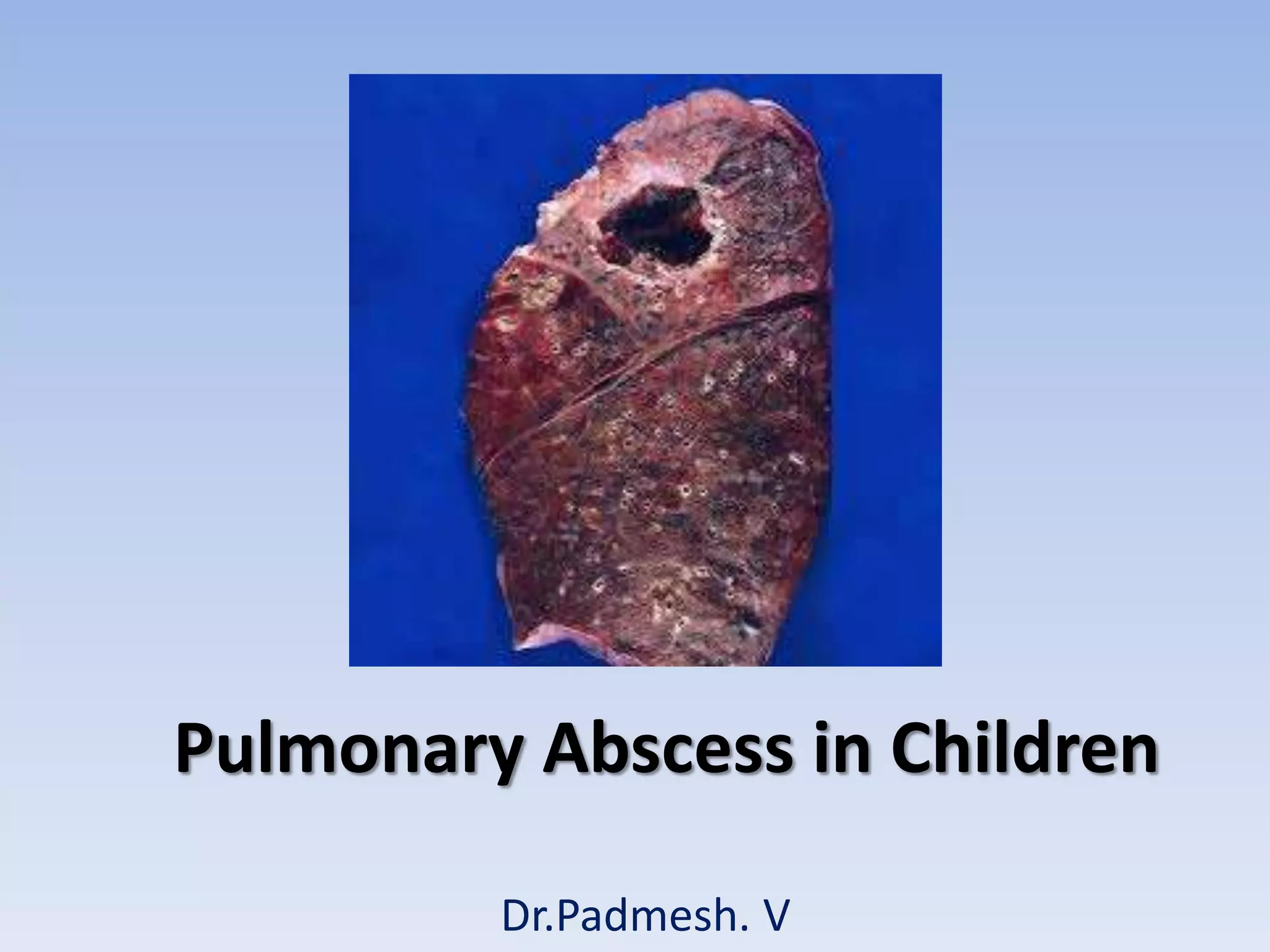
Pulmonary Abscess in Children
Dr.Padmesh. V
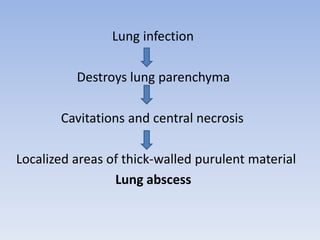
Lung infection
Destroys lung parenchyma
Cavitations and central necrosis
Localized areas of thick-walled purulent material
Lung abscess
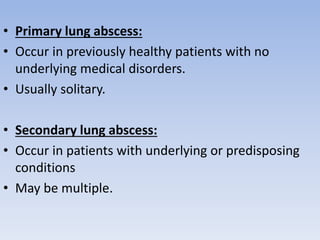
• Primary lung abscess:
• Occur in previously healthy patients with no
underlying medical disorders.
• Usually solitary.
• Secondary lung abscess:
• Occur in patients with underlying or predisposing
conditions
• May be multiple.
• PATHOLOGY AND PATHOGENESIS
• Predisposing conditions:
• Aspiration (of infected material or FB)
• Pneumonia / Hematogenous seeding from other sites
• Cystic fibrosis
• Gastroesophageal reflux
• Tracheoesophageal fistula
• Immunodeficiencies
• Postoperative complications of tonsillectomy and
adenoidectomy
• Seizures
• Neurologic and other conditions associated with
impaired mucociliary defense.
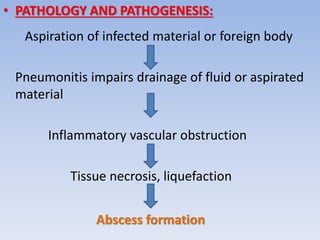
• PATHOLOGY AND PATHOGENESIS:
Aspiration of infected material or foreign body
Pneumonitis impairs drainage of fluid or aspirated
material
Inflammatory vascular obstruction
Tissue necrosis, liquefaction
Abscess formation
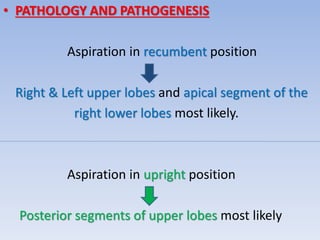
• PATHOLOGY AND PATHOGENESIS
Aspiration in recumbent position
Right & Left upper lobes and apical segment of the
right lower lobes most likely.
Aspiration in upright position
Posterior segments of upper lobes most likely
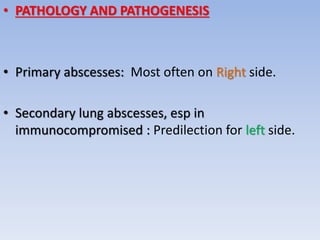
• PATHOLOGY AND PATHOGENESIS
• Primary abscesses: Most often on Right side.
• Secondary lung abscesses, esp in
immunocompromised : Predilection for left side.
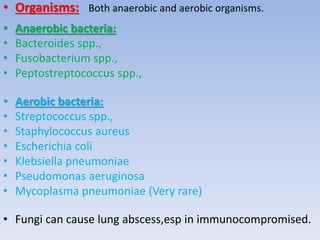
• Organisms: Both anaerobic and aerobic organisms.
• Anaerobic bacteria:
• Bacteroides spp.,
• Fusobacterium spp.,
• Peptostreptococcus spp.,
• Aerobic bacteria:
• Streptococcus spp.,
• Staphylococcus aureus
• Escherichia coli
• Klebsiella pneumoniae
• Pseudomonas aeruginosa
• Mycoplasma pneumoniae (Very rare)
• Fungi can cause lung abscess,esp in immunocompromised.
• CLINICAL MANIFESTATIONS: Symptoms
• Cough,
• Fever,
• Dyspnea,
• Chest pain,
• Vomiting,
• Sputum production,
• Weight loss,
• Hemoptysis.
• CLINICAL MANIFESTATIONS: Signs
• Tachypnea
• Dyspnea
• Retractions with accessory muscle use
• Decreased breath sounds
• Dullness to percussion in affected area
• Crackles
• Occasionally a prolonged expiratory phase on
auscultation
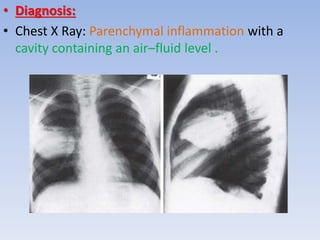
• Diagnosis:
• Chest X Ray: Parenchymal inflammation with a
cavity containing an air–fluid level .
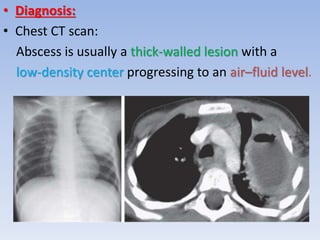
• Diagnosis:
• Chest CT scan:
Abscess is usually a thick-walled lesion with a
low-density center progressing to an air–fluid level.
• Diagnosis:
• Gram stain of sputum: Early clue.
• Sputum cultures: Yield mixed bacteria, therefore
not always reliable.
• Attempts to avoid contamination from oral flora include direct lung
puncture, percutaneous (aided by CT guidance) or transtracheal
aspiration, and bronchoalveolar lavage specimens obtained
bronchoscopically.
• Diagnosis:
• Bronchoscopic aspiration should be avoided as it
can be complicated by massive intrabronchial
aspiration.
• To avoid invasive procedures in previously normal
hosts, empiric therapy can be initiated in the
absence of culturable material.
• Differential Diagnosis:
• Abscesses should be distinguished from pneumatoceles.
• Pneumatoceles often complicate severe bacterial
pneumonias.
• Pneumatoceles: Thin- and Smooth-walled, localized air
collections with or without air–fluid level.
• Pneumatoceles often resolve spontaneously with
treatment of specific cause of the pneumonia.
• TREATMENT:
• Conservative management.
• 2-3 wk course of parenteral antibiotics for
uncomplicated cases, followed by oral antibiotics to
complete a Total of 4-6 wk.
• Aerobic and anaerobic coverage.
• Include penicillinase-resistant agent active against S.aureus
and anaerobic coverage, typically clindamycin or
ticarcillin/clavulanic acid.
• If Gram-negative bacteria are suspected or isolated, an
aminoglycoside should be added.
• TREATMENT
• Early CT-guided percutaneous aspiration or drainage.
• Severely ill or those who fail to improve after 7-10 days of
antibiotics  Surgical intervention.
• Minimally invasive CT guided percutaneous aspiration.
• Thorascopic drainage.
• In rare complicated cases  Thoracotomy with surgical
drainage or lobectomy and/or decortication.
• PROGNOSIS
• Excellent.
• Presence of aerobic organisms may be a negative
prognostic indicator, particularly in those with
secondary lung abscesses.
• Most become asymptomatic within 7-10 days,
although fever can persist for as long as 3 wk.
• Radiologic abnormalities usually resolve in 1-3 mo
but can persist for years.
www.slideshare.net/Dr_Padmesh
dnbpediatricstheory.blogspot.com/
oscepediatrics.blogspot.com/

Pulmonary Abscess in Children .. Dr Padmesh

  • 1.
    Pulmonary Abscess inChildren Dr.Padmesh. V
  • 2.
    Lung infection Destroys lungparenchyma Cavitations and central necrosis Localized areas of thick-walled purulent material Lung abscess
  • 3.
    • Primary lungabscess: • Occur in previously healthy patients with no underlying medical disorders. • Usually solitary. • Secondary lung abscess: • Occur in patients with underlying or predisposing conditions • May be multiple.
  • 4.
    • PATHOLOGY ANDPATHOGENESIS • Predisposing conditions: • Aspiration (of infected material or FB) • Pneumonia / Hematogenous seeding from other sites • Cystic fibrosis • Gastroesophageal reflux • Tracheoesophageal fistula • Immunodeficiencies • Postoperative complications of tonsillectomy and adenoidectomy • Seizures • Neurologic and other conditions associated with impaired mucociliary defense.
  • 5.
    • PATHOLOGY ANDPATHOGENESIS: Aspiration of infected material or foreign body Pneumonitis impairs drainage of fluid or aspirated material Inflammatory vascular obstruction Tissue necrosis, liquefaction Abscess formation
  • 6.
    • PATHOLOGY ANDPATHOGENESIS Aspiration in recumbent position Right & Left upper lobes and apical segment of the right lower lobes most likely. Aspiration in upright position Posterior segments of upper lobes most likely
  • 7.
    • PATHOLOGY ANDPATHOGENESIS • Primary abscesses: Most often on Right side. • Secondary lung abscesses, esp in immunocompromised : Predilection for left side.
  • 8.
    • Organisms: Bothanaerobic and aerobic organisms. • Anaerobic bacteria: • Bacteroides spp., • Fusobacterium spp., • Peptostreptococcus spp., • Aerobic bacteria: • Streptococcus spp., • Staphylococcus aureus • Escherichia coli • Klebsiella pneumoniae • Pseudomonas aeruginosa • Mycoplasma pneumoniae (Very rare) • Fungi can cause lung abscess,esp in immunocompromised.
  • 9.
    • CLINICAL MANIFESTATIONS:Symptoms • Cough, • Fever, • Dyspnea, • Chest pain, • Vomiting, • Sputum production, • Weight loss, • Hemoptysis.
  • 10.
    • CLINICAL MANIFESTATIONS:Signs • Tachypnea • Dyspnea • Retractions with accessory muscle use • Decreased breath sounds • Dullness to percussion in affected area • Crackles • Occasionally a prolonged expiratory phase on auscultation
  • 11.
    • Diagnosis: • ChestX Ray: Parenchymal inflammation with a cavity containing an air–fluid level .
  • 12.
    • Diagnosis: • ChestCT scan: Abscess is usually a thick-walled lesion with a low-density center progressing to an air–fluid level.
  • 13.
    • Diagnosis: • Gramstain of sputum: Early clue. • Sputum cultures: Yield mixed bacteria, therefore not always reliable. • Attempts to avoid contamination from oral flora include direct lung puncture, percutaneous (aided by CT guidance) or transtracheal aspiration, and bronchoalveolar lavage specimens obtained bronchoscopically.
  • 14.
    • Diagnosis: • Bronchoscopicaspiration should be avoided as it can be complicated by massive intrabronchial aspiration. • To avoid invasive procedures in previously normal hosts, empiric therapy can be initiated in the absence of culturable material.
  • 15.
    • Differential Diagnosis: •Abscesses should be distinguished from pneumatoceles. • Pneumatoceles often complicate severe bacterial pneumonias. • Pneumatoceles: Thin- and Smooth-walled, localized air collections with or without air–fluid level. • Pneumatoceles often resolve spontaneously with treatment of specific cause of the pneumonia.
  • 16.
    • TREATMENT: • Conservativemanagement. • 2-3 wk course of parenteral antibiotics for uncomplicated cases, followed by oral antibiotics to complete a Total of 4-6 wk. • Aerobic and anaerobic coverage. • Include penicillinase-resistant agent active against S.aureus and anaerobic coverage, typically clindamycin or ticarcillin/clavulanic acid. • If Gram-negative bacteria are suspected or isolated, an aminoglycoside should be added.
  • 17.
    • TREATMENT • EarlyCT-guided percutaneous aspiration or drainage. • Severely ill or those who fail to improve after 7-10 days of antibiotics  Surgical intervention. • Minimally invasive CT guided percutaneous aspiration. • Thorascopic drainage. • In rare complicated cases  Thoracotomy with surgical drainage or lobectomy and/or decortication.
  • 18.
    • PROGNOSIS • Excellent. •Presence of aerobic organisms may be a negative prognostic indicator, particularly in those with secondary lung abscesses. • Most become asymptomatic within 7-10 days, although fever can persist for as long as 3 wk. • Radiologic abnormalities usually resolve in 1-3 mo but can persist for years.
  • 19.