




Touch & Massage therapy in
Newborns
Dr Padmesh
• 1. History
• 2. Types of massage
• 3. Procedure
• 4. Effects of massage
• 5. Drawbacks
• 6. Recent advances & research
Touch & Massage therapy in
Newborns
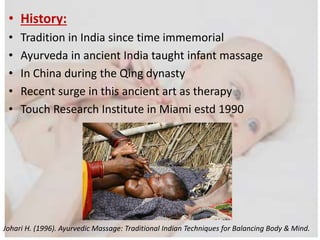
• History:
• Tradition in India since time immemorial
• Ayurveda in ancient India taught infant massage
• In China during the Qing dynasty
• Recent surge in this ancient art as therapy
• Touch Research Institute in Miami estd 1990
Johari H. (1996). Ayurvedic Massage: Traditional Indian Techniques for Balancing Body & Mind.
• Types of Touch:
• 1. ACTIVE: with voluntary movement on part of subject.
• 2.PASSIVE: without voluntary movement on part of
subject
– Care touch: associated with feeding /changing
diapers/ handling /holding/ KMC
– Massage: methodological touch intended to stimulate.
Can J Physiol Pharmacol. 1994 May;72(5):558-70.
• POSITIVE TOUCH:
• Term coined by Cherry Bond
• Technique originated from Dr Frederick Leboyer's
book ‘Loving Hands’ - Shantala a young Indian
mother, massaging her baby in the streets of
Calcutta.
Semin Neonatol 2002; 7: 477-486
• Role of Infant skin:
• (1) Sensory surface
• (2) Protective mantle
• (3) Psychological/perceptual interface with
caregivers and parents
• (4) Information rich surface for non-invasive
monitoring
• The baby's experience:
• Skin is the largest sensory organ of the body (2500
sq cm in newborn)
• Tactile system is the earliest sensory system to
become functional
• THE PROCESS OF NEONATAL MASSAGE:
• Conducive environment.
• Room with
– soft light,
– warm temperature,
– low noise levels.
• Massage between feeds
• Ideally 1 hour after a feed to avoid regurgitation or
vomiting.
• Involve entire body starting from head, neck, trunk and
extremities.
• THE PROCESS OF NEONATAL MASSAGE:
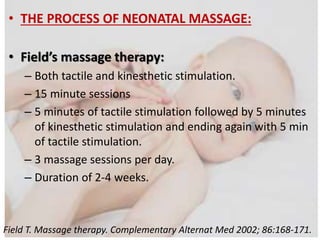
• Field’s massage therapy:
– Both tactile and kinesthetic stimulation.
– 15 minute sessions
– 5 minutes of tactile stimulation followed by 5 minutes
of kinesthetic stimulation and ending again with 5 min
of tactile stimulation.
– 3 massage sessions per day.
– Duration of 2-4 weeks.
Field T. Massage therapy. Complementary Alternat Med 2002; 86:168-171.
• THE PROCESS OF NEONATAL MASSAGE:
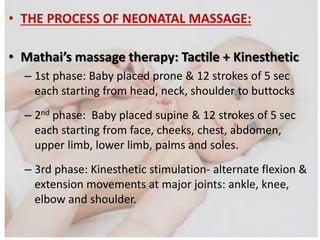
• Mathai’s massage therapy: Tactile + Kinesthetic
– 1st phase: Baby placed prone & 12 strokes of 5 sec
each starting from head, neck, shoulder to buttocks
– 2nd phase: Baby placed supine & 12 strokes of 5 sec
each starting from face, cheeks, chest, abdomen,
upper limb, lower limb, palms and soles.
– 3rd phase: Kinesthetic stimulation- alternate flexion &
extension movements at major joints: ankle, knee,
elbow and shoulder.
• THE PROCESS OF NEONATAL MASSAGE:
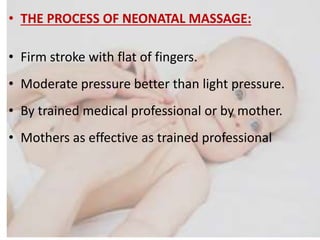
• Firm stroke with flat of fingers.
• Moderate pressure better than light pressure.
• By trained medical professional or by mother.
• Mothers as effective as trained professional
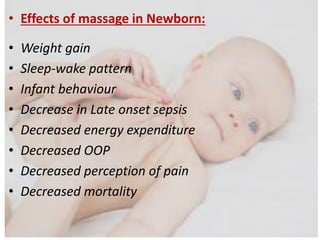
• Effects of massage in Newborn:
• Weight gain
• Sleep-wake pattern
• Infant behaviour
• Decrease in Late onset sepsis
• Decreased energy expenditure
• Decreased OOP
• Decreased perception of pain
• Decreased mortality
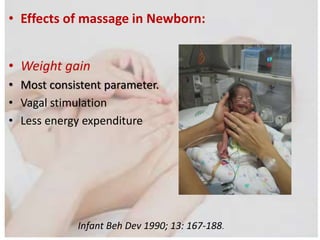
• Effects of massage in Newborn:
• Weight gain
• Most consistent parameter.
• Vagal stimulation
• Less energy expenditure
Infant Beh Dev 1990; 13: 167-188.
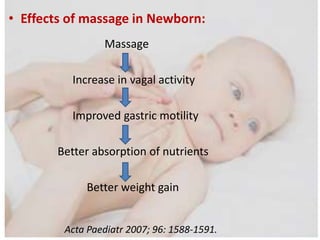
• Effects of massage in Newborn:
Massage
Increase in vagal activity
Improved gastric motility
Better absorption of nutrients
Better weight gain
Acta Paediatr 2007; 96: 1588-1591.
• Effects of massage in Newborn:
• Weight gain
• Increase in serum insulin and serum IGF-1 levels.
• Decreases levels of stress by:
– decreasing the serum cortisol and norepinephrine
– increasing urinary excretion of epinephrine and
norepinephrine.
J Pediatr 1991; 119: 434-440.
• Effects of massage in Newborn:
• Weight gain
• Scafidi et al:
• 40 preterms (Mean GA 30 weeks.Mean birthweight 1.17
kg)  45 minutes/day (3 sessions of 15 mins each) for 10
days.
• Massage group : 21% greater weight gain (34 vs 28 g).
• Mathai et al:
• Similar results -weight gain of 21.9%; 4.24g/day)
Infant Beh Dev 1990; 13: 167-188.
• Effects of massage in Newborn:
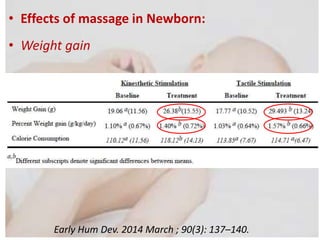
• Weight gain
Early Hum Dev. 2014 March ; 90(3): 137–140.
• Effects of massage in Newborn:
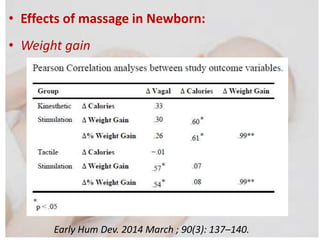
• Weight gain
Early Hum Dev. 2014 March ; 90(3): 137–140.
• Effects of massage in Newborn:
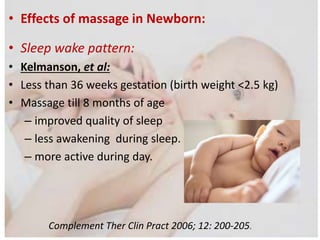
• Sleep wake pattern:
• Kelmanson, et al:
• Less than 36 weeks gestation (birth weight <2.5 kg)
• Massage till 8 months of age
– improved quality of sleep
– less awakening during sleep.
– more active during day.
Complement Ther Clin Pract 2006; 12: 200-205.
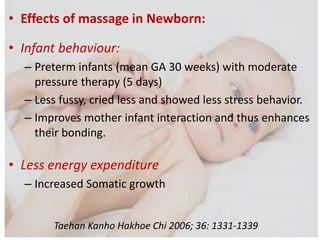
• Effects of massage in Newborn:
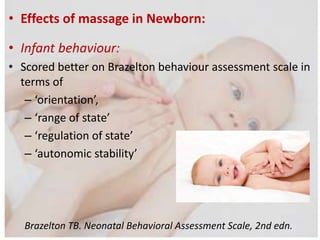
• Infant behaviour:
• Scored better on Brazelton behaviour assessment scale in
terms of
– ‘orientation’,
– ‘range of state’
– ‘regulation of state’
– ‘autonomic stability’
Brazelton TB. Neonatal Behavioral Assessment Scale, 2nd edn.
• Effects of massage in Newborn:
• Infant behaviour:
– Preterm infants (mean GA 30 weeks) with moderate
pressure therapy (5 days)
– Less fussy, cried less and showed less stress behavior.
– Improves mother infant interaction and thus enhances
their bonding.
• Less energy expenditure
– Increased Somatic growth
Taehan Kanho Hakhoe Chi 2006; 36: 1331-1339
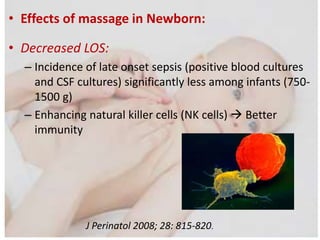
• Effects of massage in Newborn:
• Decreased LOS:
– Incidence of late onset sepsis (positive blood cultures
and CSF cultures) significantly less among infants (750-
1500 g)
– Enhancing natural killer cells (NK cells)  Better
immunity
J Perinatol 2008; 28: 815-820.
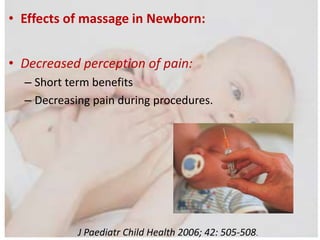
• Effects of massage in Newborn:
• Decreased perception of pain:
– Short term benefits
– Decreasing pain during procedures.
J Paediatr Child Health 2006; 42: 505-508.
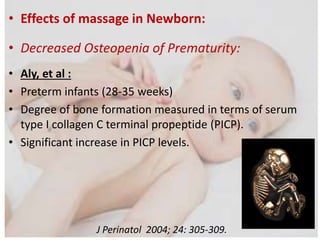
• Effects of massage in Newborn:
• Decreased Osteopenia of Prematurity:
• Aly, et al :
• Preterm infants (28-35 weeks)
• Degree of bone formation measured in terms of serum
type I collagen C terminal propeptide (PICP).
• Significant increase in PICP levels.
J Perinatol 2004; 24: 305-309.
• Effects of massage in Newborn:
• Decreased Osteopenia of Prematurity:
• DEXA (dual energy X ray absorptiometry) scan
performed as marker of bone mineralization.
• Infants who received massage therapy had a
greater score when compared to controls.
J Perinatol 2008; 28 : 432-437.
• Effects of massage in Newborn:
• Reduced hospital stay
Decreased hospital stay
Reduced expenditure
Pediatrics 2008; 121: 522- 529.
• Drawbacks of massage in Newborn:
• Most studies enrolled medically stable preterms.
• Efficacy, safety of massage in sick preterm not
established.
• Some babies develop allergic rash with oil.
• Massage to be avoided in medically unstable
newborns & with serious cardiac disease.
• Effects of OIL massage in Newborn:
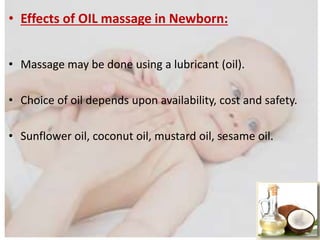
• Massage may be done using a lubricant (oil).
• Choice of oil depends upon availability, cost and safety.
• Sunflower oil, coconut oil, mustard oil, sesame oil.
• Effects of OIL massage in Newborn:
• Nutritional purpose:
• Transcutaneous absorption of lipids
• Serum triglyceride levels increased in preterms
who received oil massage with safflower oil and
coconut oil 4 times a day for 5 days.
• Soybean oil massage  Increased serum linoleic
acid  improved anthropometric parameters
J Pediatr Gastroenterol Nutr 2000; 31: 387-390.
• Effects of OIL massage in Newborn:
• Local effects on skin:
• Improved thermoregulation
• Decrease in the convection losses through skin.
• Incidence of hypothermia decreased by 30-50%.
• Remove dead cells of skin
• Improve texture of skin.
• Improve skin barrier function
Pediatr Clin North Am 2000; 47: 757-782.
• Effects of OIL massage in Newborn:
• Decreased Mortality:
• By protecting from infections
• Topical emollient treatment with safflower oil or
aquaphor (petrolatum, mineral oil, mineral wax,
lanolin alcohol) : 41% less likely to develop
nosocomial infections than control.
Pediatrics 2008; 121: 522-529.
• Effects of OIL massage in Newborn:
• Field, et al: (Compared with no oil)
• Massage with oil makes baby more alert.
• Shows fewer stress
• Effects of OIL massage in Newborn:
• STUDIES:
• 3 groups: coconut oil, mineral oil and placebo compared.
• Infants 1.5-2 kg
• Massage therapy 4 times a day for first month.
• Infants with coconut oil massage  better weight gain
velocity as compared to mineral oil.
• Effects of OIL massage in Newborn:
• STUDIES:
• Sesame oil: greater improvement in anthropometric
parameters as compared to mustard and mineral oil.
• RECENT ADVANCES & RESEARCH:
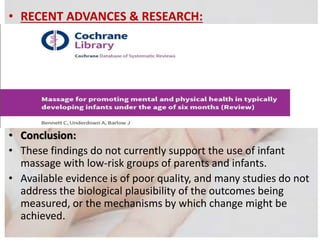
• Conclusion:
• These findings do not currently support the use of infant
massage with low-risk groups of parents and infants.
• Available evidence is of poor quality, and many studies do not
address the biological plausibility of the outcomes being
measured, or the mechanisms by which change might be
achieved.
• RECENT ADVANCES & RESEARCH:
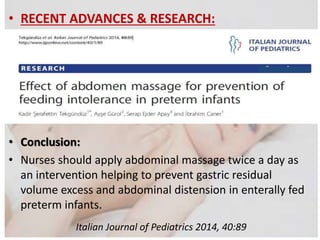
• Effect of abdomen massage for prevention of feeding
intolerance in preterm infants:
(Kadir Şerafettin Tekgündüz, Ayşe Gürol, Serap Ejder Apay and
İbrahim Caner)
• Conclusion:
• Nurses should apply abdominal massage twice a day as
an intervention helping to prevent gastric residual
volume excess and abdominal distension in enterally fed
preterm infants.
Italian Journal of Pediatrics 2014, 40:89
• RECENT ADVANCES & RESEARCH:
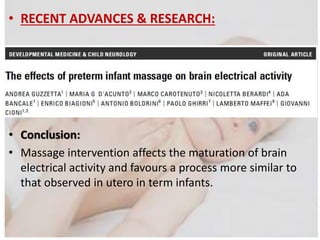
• Conclusion:
• Massage intervention affects the maturation of brain
electrical activity and favours a process more similar to
that observed in utero in term infants.
• RECENT ADVANCES & RESEARCH:
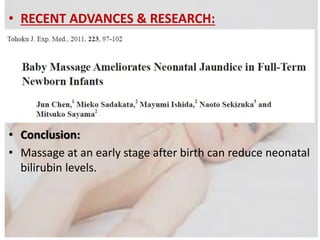
• Conclusion:
• Massage at an early stage after birth can reduce neonatal
bilirubin levels.
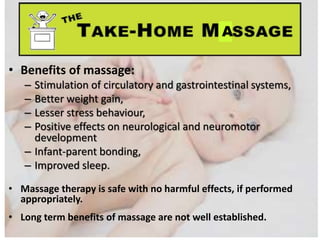
• Benefits of massage:
– Stimulation of circulatory and gastrointestinal systems,
– Better weight gain,
– Lesser stress behaviour,
– Positive effects on neurological and neuromotor
development
– Infant-parent bonding,
– Improved sleep.
• Massage therapy is safe with no harmful effects, if performed
appropriately.
• Long term benefits of massage are not well established.
A
Touch and Massage Therapy in Newborn - Dr Padmesh V

Touch and Massage Therapy in Newborn - Dr Padmesh V

  • 1.
    Touch & Massagetherapy in Newborns Dr Padmesh
  • 2.
    • 1. History •2. Types of massage • 3. Procedure • 4. Effects of massage • 5. Drawbacks • 6. Recent advances & research Touch & Massage therapy in Newborns
  • 3.
    • History: • Traditionin India since time immemorial • Ayurveda in ancient India taught infant massage • In China during the Qing dynasty • Recent surge in this ancient art as therapy • Touch Research Institute in Miami estd 1990 Johari H. (1996). Ayurvedic Massage: Traditional Indian Techniques for Balancing Body & Mind.
  • 4.
    • Types ofTouch: • 1. ACTIVE: with voluntary movement on part of subject. • 2.PASSIVE: without voluntary movement on part of subject – Care touch: associated with feeding /changing diapers/ handling /holding/ KMC – Massage: methodological touch intended to stimulate. Can J Physiol Pharmacol. 1994 May;72(5):558-70.
  • 5.
    • POSITIVE TOUCH: •Term coined by Cherry Bond • Technique originated from Dr Frederick Leboyer's book ‘Loving Hands’ - Shantala a young Indian mother, massaging her baby in the streets of Calcutta. Semin Neonatol 2002; 7: 477-486
  • 6.
    • Role ofInfant skin: • (1) Sensory surface • (2) Protective mantle • (3) Psychological/perceptual interface with caregivers and parents • (4) Information rich surface for non-invasive monitoring
  • 7.
    • The baby'sexperience: • Skin is the largest sensory organ of the body (2500 sq cm in newborn) • Tactile system is the earliest sensory system to become functional
  • 8.
    • THE PROCESSOF NEONATAL MASSAGE: • Conducive environment. • Room with – soft light, – warm temperature, – low noise levels. • Massage between feeds • Ideally 1 hour after a feed to avoid regurgitation or vomiting. • Involve entire body starting from head, neck, trunk and extremities.
  • 9.
    • THE PROCESSOF NEONATAL MASSAGE: • Field’s massage therapy: – Both tactile and kinesthetic stimulation. – 15 minute sessions – 5 minutes of tactile stimulation followed by 5 minutes of kinesthetic stimulation and ending again with 5 min of tactile stimulation. – 3 massage sessions per day. – Duration of 2-4 weeks. Field T. Massage therapy. Complementary Alternat Med 2002; 86:168-171.
  • 10.
    • THE PROCESSOF NEONATAL MASSAGE: • Mathai’s massage therapy: Tactile + Kinesthetic – 1st phase: Baby placed prone & 12 strokes of 5 sec each starting from head, neck, shoulder to buttocks – 2nd phase: Baby placed supine & 12 strokes of 5 sec each starting from face, cheeks, chest, abdomen, upper limb, lower limb, palms and soles. – 3rd phase: Kinesthetic stimulation- alternate flexion & extension movements at major joints: ankle, knee, elbow and shoulder.
  • 11.
    • THE PROCESSOF NEONATAL MASSAGE: • Firm stroke with flat of fingers. • Moderate pressure better than light pressure. • By trained medical professional or by mother. • Mothers as effective as trained professional
  • 12.
    • Effects ofmassage in Newborn: • Weight gain • Sleep-wake pattern • Infant behaviour • Decrease in Late onset sepsis • Decreased energy expenditure • Decreased OOP • Decreased perception of pain • Decreased mortality
  • 13.
    • Effects ofmassage in Newborn: • Weight gain • Most consistent parameter. • Vagal stimulation • Less energy expenditure Infant Beh Dev 1990; 13: 167-188.
  • 14.
    • Effects ofmassage in Newborn: Massage Increase in vagal activity Improved gastric motility Better absorption of nutrients Better weight gain Acta Paediatr 2007; 96: 1588-1591.
  • 15.
    • Effects ofmassage in Newborn: • Weight gain • Increase in serum insulin and serum IGF-1 levels. • Decreases levels of stress by: – decreasing the serum cortisol and norepinephrine – increasing urinary excretion of epinephrine and norepinephrine. J Pediatr 1991; 119: 434-440.
  • 16.
    • Effects ofmassage in Newborn: • Weight gain • Scafidi et al: • 40 preterms (Mean GA 30 weeks.Mean birthweight 1.17 kg)  45 minutes/day (3 sessions of 15 mins each) for 10 days. • Massage group : 21% greater weight gain (34 vs 28 g). • Mathai et al: • Similar results -weight gain of 21.9%; 4.24g/day) Infant Beh Dev 1990; 13: 167-188.
  • 17.
    • Effects ofmassage in Newborn: • Weight gain Early Hum Dev. 2014 March ; 90(3): 137–140.
  • 18.
    • Effects ofmassage in Newborn: • Weight gain Early Hum Dev. 2014 March ; 90(3): 137–140.
  • 19.
    • Effects ofmassage in Newborn: • Sleep wake pattern: • Kelmanson, et al: • Less than 36 weeks gestation (birth weight <2.5 kg) • Massage till 8 months of age – improved quality of sleep – less awakening during sleep. – more active during day. Complement Ther Clin Pract 2006; 12: 200-205.
  • 20.
    • Effects ofmassage in Newborn: • Infant behaviour: • Scored better on Brazelton behaviour assessment scale in terms of – ‘orientation’, – ‘range of state’ – ‘regulation of state’ – ‘autonomic stability’ Brazelton TB. Neonatal Behavioral Assessment Scale, 2nd edn.
  • 21.
    • Effects ofmassage in Newborn: • Infant behaviour: – Preterm infants (mean GA 30 weeks) with moderate pressure therapy (5 days) – Less fussy, cried less and showed less stress behavior. – Improves mother infant interaction and thus enhances their bonding. • Less energy expenditure – Increased Somatic growth Taehan Kanho Hakhoe Chi 2006; 36: 1331-1339
  • 22.
    • Effects ofmassage in Newborn: • Decreased LOS: – Incidence of late onset sepsis (positive blood cultures and CSF cultures) significantly less among infants (750- 1500 g) – Enhancing natural killer cells (NK cells)  Better immunity J Perinatol 2008; 28: 815-820.
  • 23.
    • Effects ofmassage in Newborn: • Decreased perception of pain: – Short term benefits – Decreasing pain during procedures. J Paediatr Child Health 2006; 42: 505-508.
  • 24.
    • Effects ofmassage in Newborn: • Decreased Osteopenia of Prematurity: • Aly, et al : • Preterm infants (28-35 weeks) • Degree of bone formation measured in terms of serum type I collagen C terminal propeptide (PICP). • Significant increase in PICP levels. J Perinatol 2004; 24: 305-309.
  • 25.
    • Effects ofmassage in Newborn: • Decreased Osteopenia of Prematurity: • DEXA (dual energy X ray absorptiometry) scan performed as marker of bone mineralization. • Infants who received massage therapy had a greater score when compared to controls. J Perinatol 2008; 28 : 432-437.
  • 26.
    • Effects ofmassage in Newborn: • Reduced hospital stay Decreased hospital stay Reduced expenditure Pediatrics 2008; 121: 522- 529.
  • 27.
    • Drawbacks ofmassage in Newborn: • Most studies enrolled medically stable preterms. • Efficacy, safety of massage in sick preterm not established. • Some babies develop allergic rash with oil. • Massage to be avoided in medically unstable newborns & with serious cardiac disease.
  • 29.
    • Effects ofOIL massage in Newborn: • Massage may be done using a lubricant (oil). • Choice of oil depends upon availability, cost and safety. • Sunflower oil, coconut oil, mustard oil, sesame oil.
  • 30.
    • Effects ofOIL massage in Newborn: • Nutritional purpose: • Transcutaneous absorption of lipids • Serum triglyceride levels increased in preterms who received oil massage with safflower oil and coconut oil 4 times a day for 5 days. • Soybean oil massage  Increased serum linoleic acid  improved anthropometric parameters J Pediatr Gastroenterol Nutr 2000; 31: 387-390.
  • 31.
    • Effects ofOIL massage in Newborn: • Local effects on skin: • Improved thermoregulation • Decrease in the convection losses through skin. • Incidence of hypothermia decreased by 30-50%. • Remove dead cells of skin • Improve texture of skin. • Improve skin barrier function Pediatr Clin North Am 2000; 47: 757-782.
  • 32.
    • Effects ofOIL massage in Newborn: • Decreased Mortality: • By protecting from infections • Topical emollient treatment with safflower oil or aquaphor (petrolatum, mineral oil, mineral wax, lanolin alcohol) : 41% less likely to develop nosocomial infections than control. Pediatrics 2008; 121: 522-529.
  • 33.
    • Effects ofOIL massage in Newborn: • Field, et al: (Compared with no oil) • Massage with oil makes baby more alert. • Shows fewer stress
  • 34.
    • Effects ofOIL massage in Newborn: • STUDIES: • 3 groups: coconut oil, mineral oil and placebo compared. • Infants 1.5-2 kg • Massage therapy 4 times a day for first month. • Infants with coconut oil massage  better weight gain velocity as compared to mineral oil.
  • 35.
    • Effects ofOIL massage in Newborn: • STUDIES: • Sesame oil: greater improvement in anthropometric parameters as compared to mustard and mineral oil.
  • 36.
    • RECENT ADVANCES& RESEARCH: • Conclusion: • These findings do not currently support the use of infant massage with low-risk groups of parents and infants. • Available evidence is of poor quality, and many studies do not address the biological plausibility of the outcomes being measured, or the mechanisms by which change might be achieved.
  • 37.
    • RECENT ADVANCES& RESEARCH: • Effect of abdomen massage for prevention of feeding intolerance in preterm infants: (Kadir Şerafettin Tekgündüz, Ayşe Gürol, Serap Ejder Apay and İbrahim Caner) • Conclusion: • Nurses should apply abdominal massage twice a day as an intervention helping to prevent gastric residual volume excess and abdominal distension in enterally fed preterm infants. Italian Journal of Pediatrics 2014, 40:89
  • 38.
    • RECENT ADVANCES& RESEARCH: • Conclusion: • Massage intervention affects the maturation of brain electrical activity and favours a process more similar to that observed in utero in term infants.
  • 39.
    • RECENT ADVANCES& RESEARCH: • Conclusion: • Massage at an early stage after birth can reduce neonatal bilirubin levels.
  • 40.
    • Benefits ofmassage: – Stimulation of circulatory and gastrointestinal systems, – Better weight gain, – Lesser stress behaviour, – Positive effects on neurological and neuromotor development – Infant-parent bonding, – Improved sleep. • Massage therapy is safe with no harmful effects, if performed appropriately. • Long term benefits of massage are not well established. A