LINEAR MODEL
2016/06/08
Yagi Takayuki
REFERENCE
Pattern Recognition and Machine Learning (PRML)
chapter3,4
TABLE OF CONTENTS
1. linear regression
1.1. what is regression
1.2. linear regression
1.3. ridge regression
1.4. lasso regression
1.5. generalization
1.6. maximum likelihood estimation
1.7. MAP estimation
2. linear classification
2.1. multi-class classification
2.2. disadvandages of least squares method
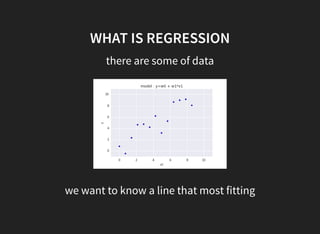
we want to know a line that most fitting
WHAT IS REGRESSION
there are some of data
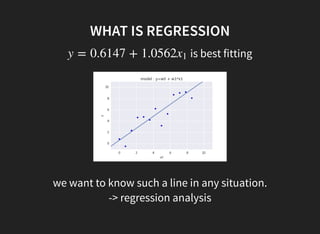
we want to know such a line in any situation.
-> regression analysis
WHAT IS REGRESSION
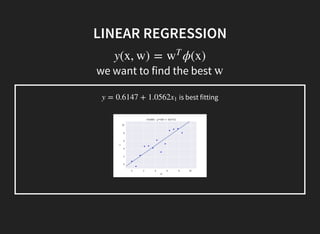
is best fittingy = 0.6147 + 1.0562x1
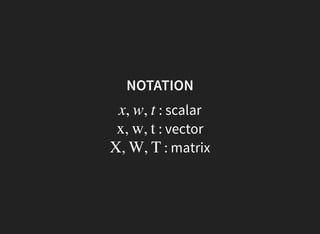
NOTATION
: scalarx, w, t
: vectorx, w, t
: matrixX, W, T
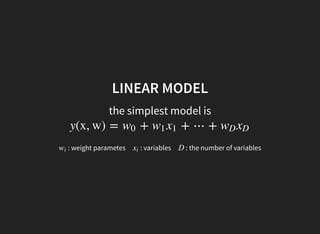
LINEAR MODEL
the simplest model is
y(x, w) = + + ⋯ +w0 w1 x1 wD xD
: weight parameteswi : variablesxi : the number of variablesD
FEATURE
linear with respect to
model is too simple (poor expressive power)
w
x
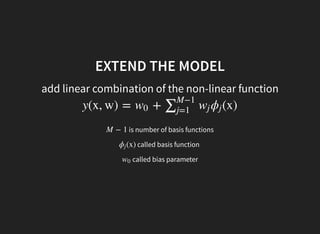
EXTEND THE MODEL
add linear combination of the non-linear function
y(x, w) = + (x)w0 ∑M−1
j=1
wj ϕj
is number of basis functionsM − 1
called basis function(x)ϕj
called bias parameterw0
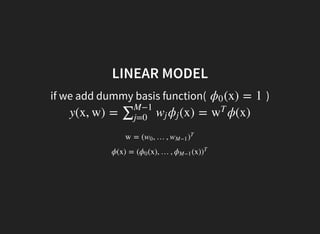
LINEAR MODEL
if we add dummy basis function( )(x) = 1ϕ0
y(x, w) = (x) = ϕ(x)∑M−1
j=0
wj ϕj w
T
w = ( , …,w0 wM−1 )
T
ϕ(x) = ( (x), …, (x)ϕ0 ϕM−1 )
T
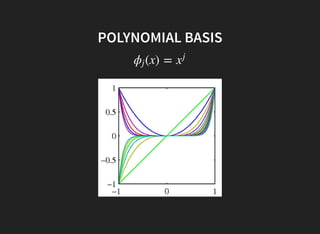
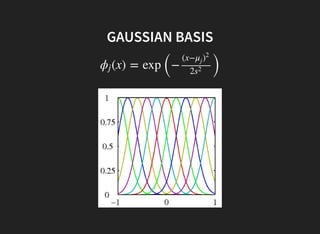
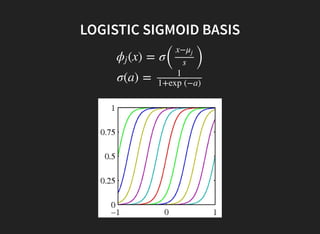
BASIS FUNCTION
there are various choices for the basis function
polynomial basis
gaussian basis
logistic sigmoid basis
POLYNOMIAL BASIS
(x) =ϕj x
j
GAUSSIAN BASIS
(x) = exp
(
− )
ϕj
(x−μj
)
2
2s
2
LOGISTIC SIGMOID BASIS
(x) = σ( )
ϕj
x−μj
s
σ(a) =
1
1+exp (−a)
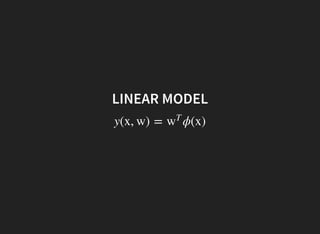
LINEAR MODEL
y(x, w) = ϕ(x)w
T
FEATURE
linear with respect to
non-linear with respect to
we can choose a favorite basis
w
x
LINEAR REGRESSION
we want to find the best
y(x, w) = ϕ(x)w
T
w
is best fittingy = 0.6147 + 1.0562x1
HOW TO REGRESSION
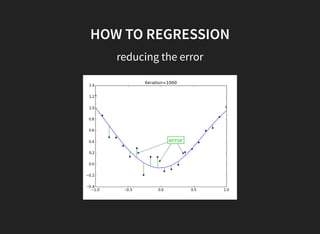
reducing the error
THE MAIN IDEA OF REGRESSION
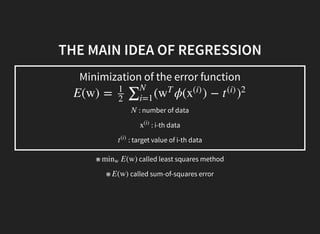
Minimization of the error function
: number of data
: i-th data
: target value of i-th data
E(w) = ( ϕ( ) −1
2
∑N
i=1
w
T
x
(i)
t
(i)
)
2
N
x
(i)
t
(i)
※ called least squares method
※
E(w)minw
called sum-of-squares errorE(w)
LINEAR REGRESSION
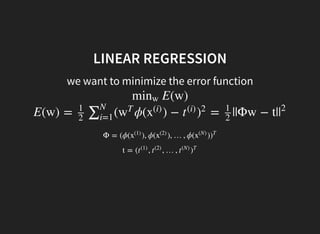
we want to minimize the error function
E(w)minw
E(w) = ( ϕ( ) − = ||Φw − t|
1
2
∑N
i=1
w
T
x
(i)
t
(i)
)
2 1
2
|
2
Φ = (ϕ( ), ϕ( ), …, ϕ( )x
(1)
x
(2)
x
(N)
)
T
t = ( , , …,t
(1)
t
(2)
t
(N)
)
T
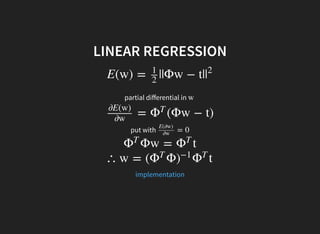
LINEAR REGRESSION
E(w) = ||Φw − t|
1
2
|
2
partial differential in w
= (Φw − t)
∂E(w)
∂w
Φ
T
put with = 0
E(∂w)
∂w
Φw = tΦ
T
Φ
T
∴ w = ( Φ tΦ
T
)
−1
Φ
T
implementation
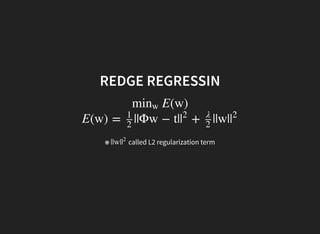
REDGE REGRESSIN
E(w)minw
E(w) = ||Φw − t| + ||w|
1
2
|
2 λ
2
|
2
※ called L2 regularization term||w||
2
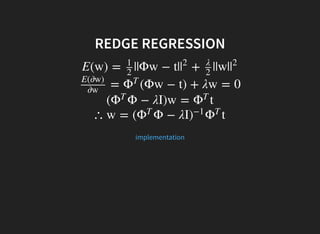
REDGE REGRESSION
E(w) = ||Φw − t| + ||w|
1
2
|
2 λ
2
|
2
= (Φw − t) + λw = 0
E(∂w)
∂w
Φ
T
( Φ − λI)w = tΦ
T
Φ
T
∴ w = ( Φ − λI tΦ
T
)
−1
Φ
T
implementation
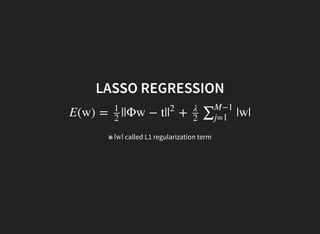
LASSO REGRESSION
E(w) = ||Φw − t| + |w|
1
2
|
2 λ
2
∑M−1
j=1
※ called L1 regularization term|w|
LASSO REGRESSION
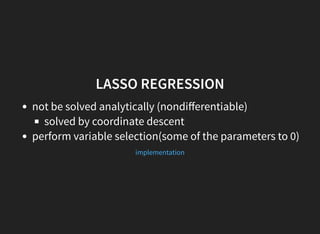
not be solved analytically (nondifferentiable)
solved by coordinate descent
perform variable selection(some of the parameters to 0)
implementation
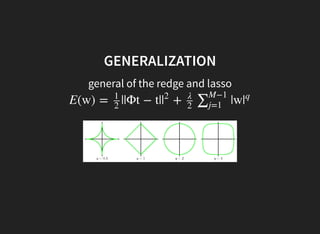
GENERALIZATION
general of the redge and lasso
E(w) = ||Φt − t| + |w
1
2
|
2 λ
2
∑M−1
j=1
|
q
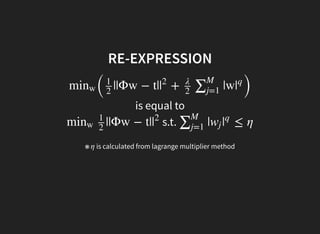
RE-EXPRESSION
is equal to
s.t.
(
||Φw − t| + |w
)
minw
1
2
|
2 λ
2
∑M
j=1
|
q
||Φw − t|minw
1
2
|
2
| ≤ η∑M
j=1
wj |
q
※ is calculated from lagrange multiplier methodη
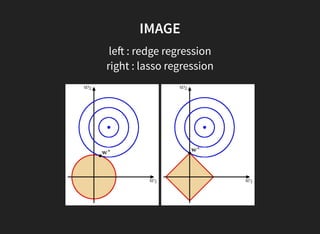
IMAGE
le : redge regression
right : lasso regression
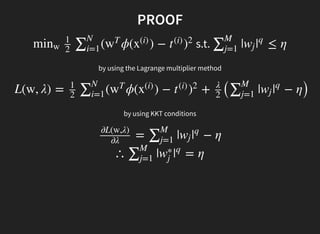
PROOF
s.t.( ϕ( ) −minw
1
2
∑N
i=1
w
T
x
(i)
t
(i)
)
2
| ≤ η∑M
j=1
wj |
q
by using the Lagrange multiplier method
L(w, λ) = ( ϕ( ) − + ( | − η)
1
2
∑N
i=1
w
T
x
(i)
t
(i)
)
2 λ
2
∑M
j=1
wj |
q
by using KKT conditions
= | − η∂L(w,λ)
∂λ ∑M
j=1
wj |
q
∴ | = η∑M
j=1
w
∗
j
|
q
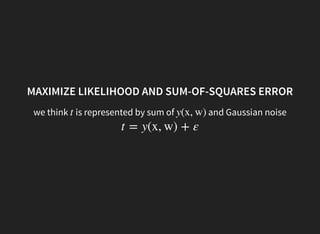
MAXIMIZE LIKELIHOOD AND SUM-OF-SQUARES ERROR
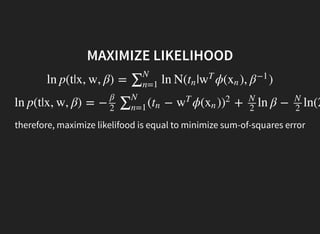
we think is represented by sum of and Gaussian noiset y(x, w)
t = y(x, w) + ε
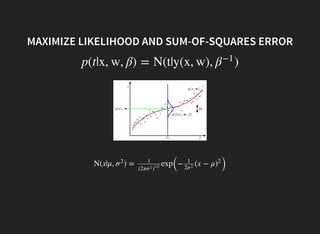
MAXIMIZE LIKELIHOOD AND SUM-OF-SQUARES ERROR
p(t|x, w, β) = N(t|y(x, w), )β−1
N(x|μ, ) = exp
(
− (x − μ )
σ2 1
(2πσ2
)
1/2
1
2σ2
)
2
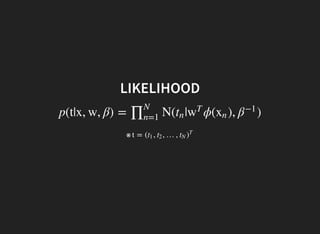
LIKELIHOOD
p(t|x, w, β) = N( | ϕ( ), )∏N
n=1
tn w
T
xn β−1
※ t = ( , , …,t1 t2 tN )
T
MAXIMIZE LIKELIHOOD
ln p(t|x, w, β) = ln N( | ϕ( ), )∑N
n=1
tn w
T
xn β−1
ln p(t|x, w, β) = − ( − ϕ( ) + ln β − ln(2
β
2
∑N
n=1
tn w
T
xn )
2 N
2
N
2
therefore, maximize likelifood is equal to minimize sum-of-squares error
FORMULA DEFORMATION
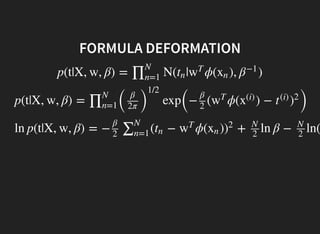
p(t|X, w, β) = N( | ϕ( ), )∏N
n=1
tn w
T
xn β−1
p(t|X, w, β) =
(
exp
(
− ( ϕ( ) − )
∏N
n=1
β
2π )
1/2
β
2
w
T
x
(i)
t
(i)
)
2
ln p(t|X, w, β) = − ( − ϕ( ) + ln β − ln(
β
2
∑N
n=1
tn w
T
xn )
2 N
2
N
2
MAP ESTIMATION AND L2 REGULARIZATION
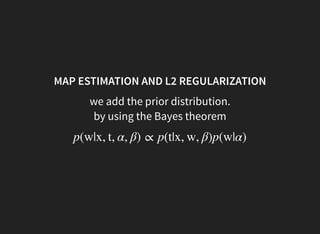
we add the prior distribution.
by using the Bayes theorem
p(w|x, t, α, β) ∝ p(t|x, w, β)p(w|α)
PRIOR DISTRIBUTION
Given this prior distribution
because calculation is easy.
p(w|α) = N(w|0, I) =
(
exp(− w)α−1 α
2π )
(M+1)/2
α
2
w
T
MAP ESTIMATION
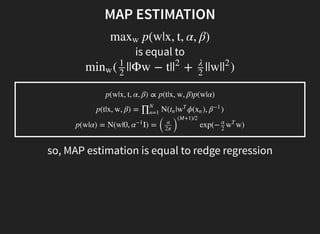
is equal to
p(w|x, t, α, β)maxw
( ||Φw − t| + ||w| )minw
1
2
|
2 λ
2
|
2
p(w|x, t, α, β) ∝ p(t|x, w, β)p(w|α)
p(t|x, w, β) = N( | ϕ( ), )∏N
n=1
tn w
T
xn β−1
p(w|α) = N(w|0, I) =
(
exp(− w)α−1 α
2π )
(M+1)/2
α
2
w
T
so, MAP estimation is equal to redge regression
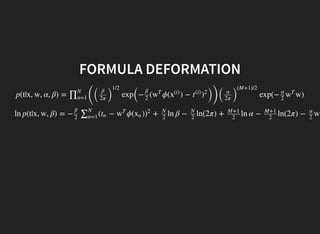
FORMULA DEFORMATION
p(t|x, w, α, β) =
((
exp
(
− ( ϕ( ) − ))(
exp(− w)∏N
n=1
β
2π )
1/2
β
2
w
T
x
(i)
t
(i)
)
2 α
2π )
(M+1)/2
α
2
w
T
ln p(t|x, w, β) = − ( − ϕ( ) + ln β − ln(2π) + ln α − ln(2π) −
β
2
∑N
n=1
tn w
T
xn )
2 N
2
N
2
M+1
2
M+1
2
α
2
w
T
SUMMARY OF LINEAR REGRESSION
I introduced some of the linear regression model
I showed maximize likelifood is equal to minimize sum-of-
squares error
I showed MAP estimation is equal to redge regression
LINEAR CLASSIFICATION
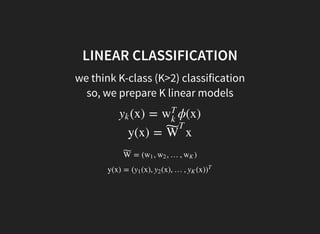
we think K-class (K>2) classification
so, we prepare K linear models
(x) = ϕ(x)yk w
T
k
y(x) = xW˜
T
= ( , , …, )W˜ w1 w2 wK
y(x) = ( (x), (x), …, (x)y1 y2 yK )
T
1-OF-K CODING
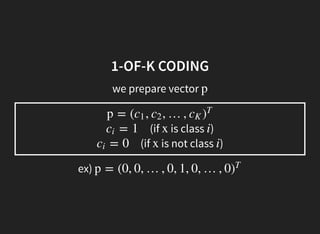
we prepare vector p
(if is class )
(if is not class )
p = ( , , …,c1 c2 cK )
T
= 1ci x i
= 0ci x i
ex) p = (0, 0, …, 0, 1, 0, …, 0)
T
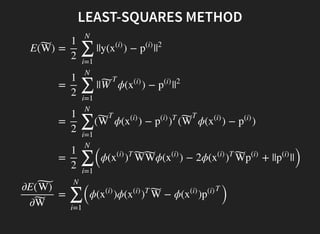
E( )W˜
∂E( W)˜
∂W˜
= ||y( ) − |
1
2 ∑
i=1
N
x
(i)
p
(i)
|
2
= || ϕ( ) − |
1
2 ∑
i=1
N
W˜
T
x
(i)
p
(i)
|
2
= ( ϕ( ) − ( ϕ( ) − )
1
2 ∑
i=1
N
W˜
T
x
(i)
p
(i)
)
T
W˜
T
x
(i)
p
(i)
=
(
ϕ( ϕ( ) − 2ϕ( + || ||
)
1
2 ∑
i=1
N
x
(i)
)
T
W˜W˜ x
(i)
x
(i)
)
T
W˜p
(i)
p
(i)
=
(
ϕ( )ϕ( − ϕ( )
)∑
i=1
N
x
(i)
x
(i)
)
T
W˜ x
(i)
p
(i)
T
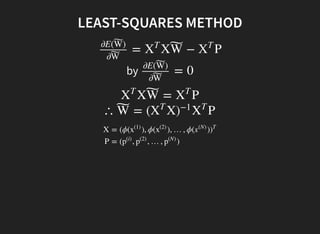
LEAST-SQUARES METHOD
by
= X − P
∂E( )W˜
∂W˜
X
T
W˜ X
T
= 0
∂E( )W˜
∂W˜
X = PX
T
W˜ X
T
∴ = ( X PW˜ X
T
)
−1
X
T
X
P
= (ϕ( ), ϕ( ), …, ϕ( )x
(1)
x
(2)
x
(N)
)
T
= ( , , …, )p
(i)
p
(2)
p
(N)
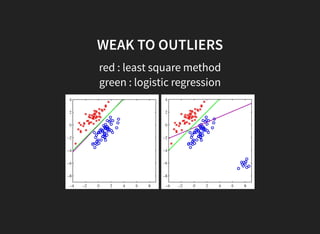
WEAK TO OUTLIERS
red : least square method
green : logistic regression
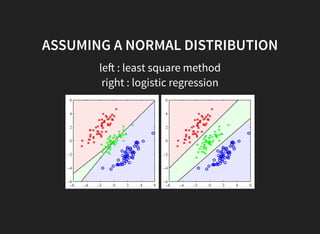
ASSUMING A NORMAL DISTRIBUTION
le : least square method
right : logistic regression
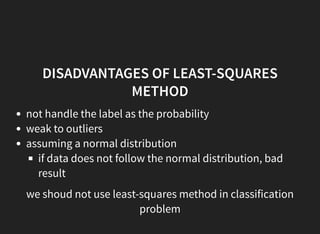
DISADVANTAGES OF LEAST-SQUARES
METHOD
not handle the label as the probability
weak to outliers
assuming a normal distribution
if data does not follow the normal distribution, bad
result
we shoud not use least-squares method in classification
problem
SUMMARY
I introduced linear model (regression, classification)
there are the basis for some of other machine learning
model
PRML is difficult for me, but I want to continue reading
thank you

線形回帰モデル

  • 1.
  • 2.
    REFERENCE Pattern Recognition andMachine Learning (PRML) chapter3,4
  • 3.
    TABLE OF CONTENTS 1.linear regression 1.1. what is regression 1.2. linear regression 1.3. ridge regression 1.4. lasso regression 1.5. generalization 1.6. maximum likelihood estimation 1.7. MAP estimation 2. linear classification 2.1. multi-class classification 2.2. disadvandages of least squares method
  • 4.
    we want toknow a line that most fitting WHAT IS REGRESSION there are some of data
  • 5.
    we want toknow such a line in any situation. -> regression analysis WHAT IS REGRESSION is best fittingy = 0.6147 + 1.0562x1
  • 6.
    NOTATION : scalarx, w,t : vectorx, w, t : matrixX, W, T
  • 7.
    LINEAR MODEL the simplestmodel is y(x, w) = + + ⋯ +w0 w1 x1 wD xD : weight parameteswi : variablesxi : the number of variablesD
  • 8.
    FEATURE linear with respectto linear with respect to model is too simple (poor expressive power) w x
  • 9.
    EXTEND THE MODEL addlinear combination of the non-linear function y(x, w) = + (x)w0 ∑M−1 j=1 wj ϕj is number of basis functionsM − 1 called basis function(x)ϕj called bias parameterw0
  • 10.
    LINEAR MODEL if weadd dummy basis function( )(x) = 1ϕ0 y(x, w) = (x) = ϕ(x)∑M−1 j=0 wj ϕj w T w = ( , …,w0 wM−1 ) T ϕ(x) = ( (x), …, (x)ϕ0 ϕM−1 ) T
  • 11.
    BASIS FUNCTION there arevarious choices for the basis function polynomial basis gaussian basis logistic sigmoid basis
  • 12.
  • 13.
    GAUSSIAN BASIS (x) =exp ( − ) ϕj (x−μj ) 2 2s 2
  • 14.
    LOGISTIC SIGMOID BASIS (x)= σ( ) ϕj x−μj s σ(a) = 1 1+exp (−a)
  • 15.
  • 16.
    FEATURE linear with respectto non-linear with respect to we can choose a favorite basis w x
  • 17.
    LINEAR REGRESSION we wantto find the best y(x, w) = ϕ(x)w T w is best fittingy = 0.6147 + 1.0562x1
  • 18.
  • 19.
    THE MAIN IDEAOF REGRESSION Minimization of the error function : number of data : i-th data : target value of i-th data E(w) = ( ϕ( ) −1 2 ∑N i=1 w T x (i) t (i) ) 2 N x (i) t (i) ※ called least squares method ※ E(w)minw called sum-of-squares errorE(w)
  • 20.
    LINEAR REGRESSION we wantto minimize the error function E(w)minw E(w) = ( ϕ( ) − = ||Φw − t| 1 2 ∑N i=1 w T x (i) t (i) ) 2 1 2 | 2 Φ = (ϕ( ), ϕ( ), …, ϕ( )x (1) x (2) x (N) ) T t = ( , , …,t (1) t (2) t (N) ) T
  • 21.
    LINEAR REGRESSION E(w) =||Φw − t| 1 2 | 2 partial differential in w = (Φw − t) ∂E(w) ∂w Φ T put with = 0 E(∂w) ∂w Φw = tΦ T Φ T ∴ w = ( Φ tΦ T ) −1 Φ T implementation
  • 22.
    REDGE REGRESSIN E(w)minw E(w) =||Φw − t| + ||w| 1 2 | 2 λ 2 | 2 ※ called L2 regularization term||w|| 2
  • 23.
    REDGE REGRESSION E(w) =||Φw − t| + ||w| 1 2 | 2 λ 2 | 2 = (Φw − t) + λw = 0 E(∂w) ∂w Φ T ( Φ − λI)w = tΦ T Φ T ∴ w = ( Φ − λI tΦ T ) −1 Φ T implementation
  • 24.
    LASSO REGRESSION E(w) =||Φw − t| + |w| 1 2 | 2 λ 2 ∑M−1 j=1 ※ called L1 regularization term|w|
  • 25.
    LASSO REGRESSION not besolved analytically (nondifferentiable) solved by coordinate descent perform variable selection(some of the parameters to 0) implementation
  • 26.
    GENERALIZATION general of theredge and lasso E(w) = ||Φt − t| + |w 1 2 | 2 λ 2 ∑M−1 j=1 | q
  • 27.
    RE-EXPRESSION is equal to s.t. ( ||Φw− t| + |w ) minw 1 2 | 2 λ 2 ∑M j=1 | q ||Φw − t|minw 1 2 | 2 | ≤ η∑M j=1 wj | q ※ is calculated from lagrange multiplier methodη
  • 28.
    IMAGE le : redgeregression right : lasso regression
  • 29.
    PROOF s.t.( ϕ( )−minw 1 2 ∑N i=1 w T x (i) t (i) ) 2 | ≤ η∑M j=1 wj | q by using the Lagrange multiplier method L(w, λ) = ( ϕ( ) − + ( | − η) 1 2 ∑N i=1 w T x (i) t (i) ) 2 λ 2 ∑M j=1 wj | q by using KKT conditions = | − η∂L(w,λ) ∂λ ∑M j=1 wj | q ∴ | = η∑M j=1 w ∗ j | q
  • 30.
    MAXIMIZE LIKELIHOOD ANDSUM-OF-SQUARES ERROR we think is represented by sum of and Gaussian noiset y(x, w) t = y(x, w) + ε
  • 31.
    MAXIMIZE LIKELIHOOD ANDSUM-OF-SQUARES ERROR p(t|x, w, β) = N(t|y(x, w), )β−1 N(x|μ, ) = exp ( − (x − μ ) σ2 1 (2πσ2 ) 1/2 1 2σ2 ) 2
  • 32.
    LIKELIHOOD p(t|x, w, β)= N( | ϕ( ), )∏N n=1 tn w T xn β−1 ※ t = ( , , …,t1 t2 tN ) T
  • 33.
    MAXIMIZE LIKELIHOOD ln p(t|x,w, β) = ln N( | ϕ( ), )∑N n=1 tn w T xn β−1 ln p(t|x, w, β) = − ( − ϕ( ) + ln β − ln(2 β 2 ∑N n=1 tn w T xn ) 2 N 2 N 2 therefore, maximize likelifood is equal to minimize sum-of-squares error
  • 34.
    FORMULA DEFORMATION p(t|X, w,β) = N( | ϕ( ), )∏N n=1 tn w T xn β−1 p(t|X, w, β) = ( exp ( − ( ϕ( ) − ) ∏N n=1 β 2π ) 1/2 β 2 w T x (i) t (i) ) 2 ln p(t|X, w, β) = − ( − ϕ( ) + ln β − ln( β 2 ∑N n=1 tn w T xn ) 2 N 2 N 2
  • 35.
    MAP ESTIMATION ANDL2 REGULARIZATION we add the prior distribution. by using the Bayes theorem p(w|x, t, α, β) ∝ p(t|x, w, β)p(w|α)
  • 36.
    PRIOR DISTRIBUTION Given thisprior distribution because calculation is easy. p(w|α) = N(w|0, I) = ( exp(− w)α−1 α 2π ) (M+1)/2 α 2 w T
  • 37.
    MAP ESTIMATION is equalto p(w|x, t, α, β)maxw ( ||Φw − t| + ||w| )minw 1 2 | 2 λ 2 | 2 p(w|x, t, α, β) ∝ p(t|x, w, β)p(w|α) p(t|x, w, β) = N( | ϕ( ), )∏N n=1 tn w T xn β−1 p(w|α) = N(w|0, I) = ( exp(− w)α−1 α 2π ) (M+1)/2 α 2 w T so, MAP estimation is equal to redge regression
  • 38.
    FORMULA DEFORMATION p(t|x, w,α, β) = (( exp ( − ( ϕ( ) − ))( exp(− w)∏N n=1 β 2π ) 1/2 β 2 w T x (i) t (i) ) 2 α 2π ) (M+1)/2 α 2 w T ln p(t|x, w, β) = − ( − ϕ( ) + ln β − ln(2π) + ln α − ln(2π) − β 2 ∑N n=1 tn w T xn ) 2 N 2 N 2 M+1 2 M+1 2 α 2 w T
  • 39.
    SUMMARY OF LINEARREGRESSION I introduced some of the linear regression model I showed maximize likelifood is equal to minimize sum-of- squares error I showed MAP estimation is equal to redge regression
  • 40.
    LINEAR CLASSIFICATION we thinkK-class (K>2) classification so, we prepare K linear models (x) = ϕ(x)yk w T k y(x) = xW˜ T = ( , , …, )W˜ w1 w2 wK y(x) = ( (x), (x), …, (x)y1 y2 yK ) T
  • 41.
    1-OF-K CODING we preparevector p (if is class ) (if is not class ) p = ( , , …,c1 c2 cK ) T = 1ci x i = 0ci x i ex) p = (0, 0, …, 0, 1, 0, …, 0) T
  • 42.
    E( )W˜ ∂E( W)˜ ∂W˜ =||y( ) − | 1 2 ∑ i=1 N x (i) p (i) | 2 = || ϕ( ) − | 1 2 ∑ i=1 N W˜ T x (i) p (i) | 2 = ( ϕ( ) − ( ϕ( ) − ) 1 2 ∑ i=1 N W˜ T x (i) p (i) ) T W˜ T x (i) p (i) = ( ϕ( ϕ( ) − 2ϕ( + || || ) 1 2 ∑ i=1 N x (i) ) T W˜W˜ x (i) x (i) ) T W˜p (i) p (i) = ( ϕ( )ϕ( − ϕ( ) )∑ i=1 N x (i) x (i) ) T W˜ x (i) p (i) T LEAST-SQUARES METHOD
  • 43.
    LEAST-SQUARES METHOD by = X− P ∂E( )W˜ ∂W˜ X T W˜ X T = 0 ∂E( )W˜ ∂W˜ X = PX T W˜ X T ∴ = ( X PW˜ X T ) −1 X T X P = (ϕ( ), ϕ( ), …, ϕ( )x (1) x (2) x (N) ) T = ( , , …, )p (i) p (2) p (N)
  • 44.
    WEAK TO OUTLIERS red: least square method green : logistic regression
  • 45.
    ASSUMING A NORMALDISTRIBUTION le : least square method right : logistic regression
  • 46.
    DISADVANTAGES OF LEAST-SQUARES METHOD nothandle the label as the probability weak to outliers assuming a normal distribution if data does not follow the normal distribution, bad result we shoud not use least-squares method in classification problem
  • 47.
    SUMMARY I introduced linearmodel (regression, classification) there are the basis for some of other machine learning model PRML is difficult for me, but I want to continue reading
  • 48.