






Complementary slackness & Farkas’ lemmaSHAMEER P HDEPT OF FUTURES STUDIES
STRONG DUALITY THEOREMIf ZLP or WLP is finite, then both P and D have finite optimal value and ZLP= WLPCOROLLARY:There are only four possibilities for a dual pair of problems P and DZLP or WLP  are finite and equalZLP= ∞ and D is infeasibleWLP = -∞ and P is infeasibleboth P and D are infeasibleDEPT OF FUTURES STUDIES
Complementary Slackness PRIMAL: u = max{cx : Ax≤ b, x≥  0}DUAL:     w = min{by: Ay≥c, y ≥0}let‘s’ be the vector of slackvariables of theprimal&‘t’ isthe vector of surplus variables of duals= b-Ax≥0 and t= yA-c≥0DEPT OF FUTURES STUDIES
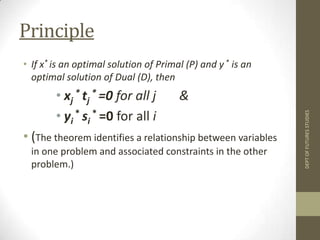
PrincipleIf x* isanoptimalsolution of Primal (P) and y *isanoptimalsolution of Dual (D), thenxj* tj * =0for all j	&yi* si * =0 foralli(The theorem identifies a relationship between variables in one problem and associated constraints in the other problem.)DEPT OF FUTURES STUDIES
proofUsing the definitions of s and t   cx*	=	(y*A-t*)x*=	y*Ax*- t*x*=	y*(b-s*)-t*x*	(since Ax*+s=b)=	y*b-y*s*-t*x*but by  strong duality theorem, cx*=y*bie; cx* 	= cx*-(y*s*+t*x*)0= y*s*+t*x*y*s*=0 and t*x*=0  			(Since, y*,x*,s*, t*≥0)DEPT OF FUTURES STUDIES
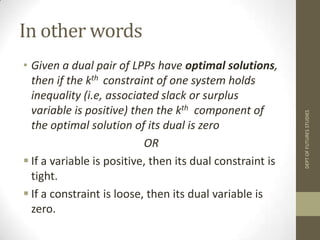
In other wordsGiven a dual pair of LPPs have optimal solutions, then if the kth constraint of one system holds inequality (i.e, associated slack or surplus variable is positive) then the kthcomponent of the optimal solution of its dual is zeroORIf a variable is positive, then its dual constraint is tight.
If a constraint is loose, then its dual variable is zero.DEPT OF FUTURES STUDIES
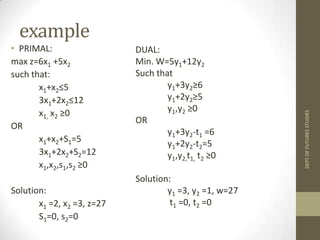
examplePRIMAL:max z=6x1 +5x2such that:	x1+x2≤5	3x1+2x2≤12	x1,x2 ≥0OR	x1+x2+S1=5	3x1+2x2+S2=12	x1,x2,s1,s2 ≥0Solution:	x1 =2, x2 =3, z=27	S1=0, s2=0DUAL:Min. W=5y1+12y2Such that 	y1+3y2≥6y1+2y2≥5y1,y2≥0OR	y1+3y2-t1 =6	y1+2y2-t2=5	y1,y2,t1,t2≥0Solution:	y1 =3, y2 =1, w=27t1 =0, t2=0DEPT OF FUTURES STUDIES
applicationsUsed in finding an optimal primal solution from the given optimal dual solution and vice versa
Used in finding a feasible solution is optimal for the primal problem DEPT OF FUTURES STUDIES
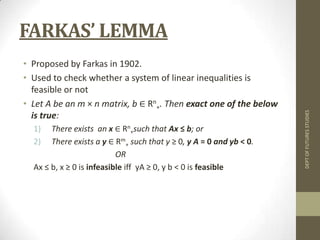
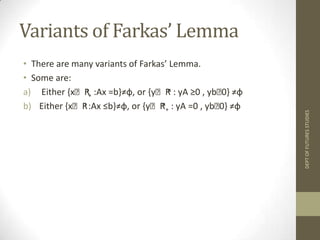
FARKAS’ LEMMAProposed by Farkas in 1902.Used to check whether a system of linear inequalities is feasible or not Let A be an m × n matrix, b ∈ Rn+. Then exact one of the below is true:There exists  an x∈ Rn+suchthat Ax≤ b; orThere exists a y∈ Rm+such that y ≥ 0, yA = 0 and yb < 0.			ORAx≤ b, x ≥ 0 is infeasibleiff  yA ≥0, y b < 0 is feasibleDEPT OF FUTURES STUDIES
Proof:Consider the LPP, ZLP =max{0x:Ax≤b, xԐRn+}	and its dual WLP =min{yb:yA≥0,yԐRm+} .As y=0 is a feasible solution to the dual problem, the only possibilities to occur are i  & iii of corollary of strong dual theorem .	ZLP =WLP  =0. hence {xԐRn+ :Ax ≤b}≠ф and  Yb≥0 for all yԐRm+ with yA ≥0WLP  = -∞. hence {xԐRn+ :Ax ≤b}=ф and there exists yԐRm+ with yA ≥0 and yb˂0.DEPT OF FUTURES STUDIES

Complementary slackness and farkas lemmaa

  • 1.
    Complementary slackness &Farkas’ lemmaSHAMEER P HDEPT OF FUTURES STUDIES
  • 2.
    STRONG DUALITY THEOREMIfZLP or WLP is finite, then both P and D have finite optimal value and ZLP= WLPCOROLLARY:There are only four possibilities for a dual pair of problems P and DZLP or WLP are finite and equalZLP= ∞ and D is infeasibleWLP = -∞ and P is infeasibleboth P and D are infeasibleDEPT OF FUTURES STUDIES
  • 3.
    Complementary Slackness PRIMAL:u = max{cx : Ax≤ b, x≥ 0}DUAL: w = min{by: Ay≥c, y ≥0}let‘s’ be the vector of slackvariables of theprimal&‘t’ isthe vector of surplus variables of duals= b-Ax≥0 and t= yA-c≥0DEPT OF FUTURES STUDIES
  • 4.
    PrincipleIf x* isanoptimalsolutionof Primal (P) and y *isanoptimalsolution of Dual (D), thenxj* tj * =0for all j &yi* si * =0 foralli(The theorem identifies a relationship between variables in one problem and associated constraints in the other problem.)DEPT OF FUTURES STUDIES
  • 5.
    proofUsing the definitionsof s and t cx* = (y*A-t*)x*= y*Ax*- t*x*= y*(b-s*)-t*x* (since Ax*+s=b)= y*b-y*s*-t*x*but by strong duality theorem, cx*=y*bie; cx* = cx*-(y*s*+t*x*)0= y*s*+t*x*y*s*=0 and t*x*=0 (Since, y*,x*,s*, t*≥0)DEPT OF FUTURES STUDIES
  • 6.
    In other wordsGivena dual pair of LPPs have optimal solutions, then if the kth constraint of one system holds inequality (i.e, associated slack or surplus variable is positive) then the kthcomponent of the optimal solution of its dual is zeroORIf a variable is positive, then its dual constraint is tight.
  • 7.
    If a constraintis loose, then its dual variable is zero.DEPT OF FUTURES STUDIES
  • 8.
    examplePRIMAL:max z=6x1 +5x2suchthat: x1+x2≤5 3x1+2x2≤12 x1,x2 ≥0OR x1+x2+S1=5 3x1+2x2+S2=12 x1,x2,s1,s2 ≥0Solution: x1 =2, x2 =3, z=27 S1=0, s2=0DUAL:Min. W=5y1+12y2Such that y1+3y2≥6y1+2y2≥5y1,y2≥0OR y1+3y2-t1 =6 y1+2y2-t2=5 y1,y2,t1,t2≥0Solution: y1 =3, y2 =1, w=27t1 =0, t2=0DEPT OF FUTURES STUDIES
  • 9.
    applicationsUsed in findingan optimal primal solution from the given optimal dual solution and vice versa
  • 10.
    Used in findinga feasible solution is optimal for the primal problem DEPT OF FUTURES STUDIES
  • 11.
    FARKAS’ LEMMAProposed byFarkas in 1902.Used to check whether a system of linear inequalities is feasible or not Let A be an m × n matrix, b ∈ Rn+. Then exact one of the below is true:There exists an x∈ Rn+suchthat Ax≤ b; orThere exists a y∈ Rm+such that y ≥ 0, yA = 0 and yb < 0. ORAx≤ b, x ≥ 0 is infeasibleiff yA ≥0, y b < 0 is feasibleDEPT OF FUTURES STUDIES
  • 12.
    Proof:Consider the LPP,ZLP =max{0x:Ax≤b, xԐRn+} and its dual WLP =min{yb:yA≥0,yԐRm+} .As y=0 is a feasible solution to the dual problem, the only possibilities to occur are i & iii of corollary of strong dual theorem . ZLP =WLP =0. hence {xԐRn+ :Ax ≤b}≠ф and Yb≥0 for all yԐRm+ with yA ≥0WLP = -∞. hence {xԐRn+ :Ax ≤b}=ф and there exists yԐRm+ with yA ≥0 and yb˂0.DEPT OF FUTURES STUDIES