
Initial Value Problems 
Ali jan 
M. Sc Previous (Semester-II)
Outline 
Taylor 
Series 
Runge 
Kutta 
Method 
Stability
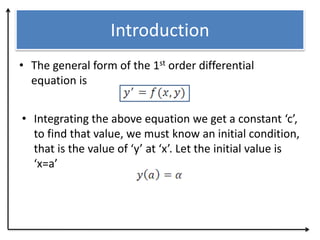
Introduction 
• The general form of the 1st order differential 
equation is 
• Integrating the above equation we get a constant ‘c’, 
to find that value, we must know an initial condition, 
that is the value of ‘y’ at ‘x’. Let the initial value is 
‘x=a’
Continue 
• An ordinary differential equation of order ‘n’: 
• Can always transform into ‘n’ first order equation: 
• The equivalent first-order equations are: 
• The solution now requires the knowledge ‘n’ auxiliary conditions. If there 
conditions are specified at the same value of ‘x=a’, the problem is said to be an 
initial value problem. The auxiliary conditions, called initial conditions: 
• For example,
Taylor Series 
• Taylor series method is use to gain high accuracy . Its basis is the truncated Taylor 
series for y about x, it is also a formula for numerical integration: 
• The last term determines the order of integration, the “truncation error”, due to 
the terms omitted from the series: 
• Using the finite difference approximation: 
• We obtain the more useful form:
Continue 
• The Taylor function implements the Taylor series method of 
integration of order four. It can handle any number of first-order 
differential equation: 
• The user is required to supply the function “derivative” that 
returns the 4 x n matrix:
Graphical Representation
Working of Taylor Series
Continue 
• Example 7.1 
h=0.1 
• The Taylor Series 
• Differentiation of the differential equation, yields
Continue 
at x=0 and y=1 
With h=0.1 and substituting the values of derivatives, the above equation becomes
Continue 
The approximate truncation error: 
Therefore 
The analytic solution of the differential equation:
• Example 7.2 
Continue 
• From x = 0 to 2 and h=0.25. 
• With the notation the equivalent first order equations 
and the initial conditions are 
• Repeated differentiation of the differential equation yields
Continue 
Thus the derivative array that has to be computed is
Code of Taylor Series 
1. from numpy import * 
2. def taylor(x, y, n, h): 
3. X = [ ] 
4. Y = [ ] 
5. X.append(x) 
6. Y.append(y) 
7. for i in range (n) : 
8. D = f(x,y) 
9. H = 1.0 
10. for j in range (4) : 
11. H = H * h/(j+1) 
12. y = y + D[j] *H 
13. x = x + h 
14. X.append(x) 
15. Y.append(y) 
16. print array(X), array(Y) 
17. return array (X), array(Y) 
18. def f (x,y): 
19. D = zeros ((4,2)) 
20. D [0] = [ y[1], -0.1*y[1]-x ] 
21. D [1]=[ D[0,1], 0.01*y[1]+0.1*x-1.0 ] 
22. D [2]=[ D[1,1], -0.00*y[1]-0.01*x+0.1 ] 
23. D [3]=[ D[2,1], 0.0001*y[1]+0.001*x-0.01 ] 
24. return D 
25. taylor( 0.0, array ([0.0,1.0]) ,8 , 0.25 )
The results for Taylor series are: 
Continue 
x y[0] y[1] 
0 0 1 
0.25 0.24431315 0.94432131 
0.5 0.46713137 0.82829196 
0.75 0.65355402 0.65340186 
1 0.78904832 0.42110415 
1.25 0.85944028 0.13281605 
1.5 0.85090579 -0.21008015 
1.75 0.74996208 -0.60623633 
2 0.54345919 -1.05433763
Runge-Kutta Method 
• The need for Runge-Kutta Method increased, 
because of a drawback of Taylor series. 
• Taylor series requires repeated differentiation 
of the dependent variables. 
• There is extra work of coding each of the 
derivatives. 
• Runge-Kutta method is used to eliminate the 
need for repeated differentiation of the 
differential equations.
Runge-Kutta Graph
RRuunnggee--KKuuttttaaMmeetthhoodd ooff FFoouurrtthh oOrrddeerr 
Example no. 7.4 
From x = 0 to 2 and h=0.25. 
With the notation the equivalent first order equations and the 
initial conditions are
Code of Runge-Kutta 
1. from numpy import * 
2. from math import * 
3. def run_kutta(x, y, h,n): 
4. def run_kut4(x,y,h): 
5. k0=h*f(x,y) 
6. k1=h*f(x+h/2.0, y+k0/2.0) 
7. k2=h*f(x+h/2.0, y+k1/2.0) 
8. k3=h*f(x+h, y+k2) 
9. return (k0 + 2.0*k1 + 2.0*k2 + k3)/6.0 
10. X=[] 
11. Y=[] 
12. X.append(x) 
13. Y.append(y) 
14. while x<n: 
15. y=y+run_kut4(x,y,h) 
16. x=x+h 
17. X.append(x) 
18. Y.append(y) 
19. print array(X), array(Y) 
20. return array(X), array(y) 
21. def f(x,y): 
22. f=zeros((2)) 
23. f[0]=y[1] 
24. f[1]=-0.1*y[1]-x 
25. return f 
26. run_kutta (0.0,array([0.0,1.0]),0.25,2.0)
Continue 
The results for Runge-Kutta: 
x y[0] y[1] 
0 0 1 
0.25 0.24431315 0.94432131 
0.5 0.46713137 0.82829196 
0.75 0.65355402 0.65340186 
1 0.78904832 0.42110415 
1.25 0.85944028 0.13281605 
1.5 0.85090579 -0.21008015 
1.75 0.74996208 -0.60623633 
2 0.54345919 -1.05433763
Stability 
• A numerical integration is said to be stable if 
the effects of local errors do not accumulate 
catastrophically. 
• If method is unstable, the global error will 
increase exponentially, eventually causing 
numerical overflow. 
• Stability has nothing to do with accuracy, in 
fact, an inaccurate method can be very stable.
Continue 
• Consider the linear problem 
• Where ‘λ’ is a positive constant. The numerical solution: 
• Substituting we get 
• If “І1- λ І>1”, the method is clearly unstable since ‘y’ increases 
in every integration step. Thus it is stable only if “І1- λ І<1”.
Miscellaneous 
Example 7.6 
A Spacecraft is launched at an altitude ‘H=772’ km above sea level with the speed 
‘v0=6700 m/s’ in the direction shown. The differential equations describing the 
motion of the spacecraft are 
‘r’ and ‘θ’ are polar coordinates of spacecraft. 
G= 6.672 × 10⁻¹¹ m3kg−1s−2 = universal gravitational constant 
Me= 5.9742 × 1024 kg = mass of the earth 
Re = 6378.14 km = radius of the earth at sea level
Continue 
So, we have 
Let 
then
Continue
Code 
1. from numpy import * 
2. from math import * 
3. def integrate(x, y, h,n): 
4. def run_kut4(x,y,h): 
5. k0=h*f(x,y) 
6. k1=h*f(x+h*0.5, y+k0*0.5) 
7. k2=h*f(x+h*0.5, y+k1*0.5) 
8. k3=h*f(x+h, y+k2) 
9. return (k0 + 2.0*k1 + 2.0*k2 + k3)/6.0 
10. X=[] 
11. Y=[] 
12. X.append(x) 
13. Y.append(y) 
14. while x<n: 
15. y=y+run_kut4(x,y,h) 
16. x=x+2*h 
17. X.append(x) 
18. Y.append(y) 
19. print array(X), array(Y) 
20. return array(X), array(y) 
21.f=zeros((4)) 
22. f[0]=y[1] 
23. f[1]=(y[0]*(y[3]**2) - 3.9860e14)/(y[0]**2) 
24. f[2]=y[3] 
25. f[3]=(-2.0*y[1]*y[3])/y[0] 
26. return f 
27.Integrate (0.0,array([7.15014e6,0,0,0.937045e-3]),50.,1200.)
Result 
X=t(s) r=y[0](m) r’=y[1](m) θ =y[2](rad) θ’ =y[3](rad) 
0 7.15E+06 0.00E+00 0.00E+00 9.37E-04 
100 7.14E+06 -3.90E+02 4.69E-02 9.40E-04 
200 7.11E+06 -7.83E+02 9.40E-02 9.47E-04 
300 7.06E+06 -1.18E+03 1.42E-01 9.61E-04 
400 6.99E+06 -1.58E+03 1.90E-01 9.80E-04 
500 6.90E+06 -2.00E+03 2.40E-01 1.01E-03 
600 6.79E+06 -2.42E+03 2.91E-01 1.04E-03 
700 6.66E+06 -2.86E+03 3.44E-01 1.08E-03 
800 6.51E+06 -3.32E+03 3.99E-01 1.13E-03 
900 6.33E+06 -3.80E+03 4.57E-01 1.20E-03 
1000 6.13E+06 -4.32E+03 5.19E-01 1.28E-03 
1100 5.90E+06 -4.87E+03 5.85E-01 1.38E-03 
1200 5.64E+06 -5.47E+03 6.57E-01 1.51E-03
Initial value problems

Initial value problems

  • 1.
    Initial Value Problems Ali jan M. Sc Previous (Semester-II)
  • 2.
    Outline Taylor Series Runge Kutta Method Stability
  • 3.
    Introduction • Thegeneral form of the 1st order differential equation is • Integrating the above equation we get a constant ‘c’, to find that value, we must know an initial condition, that is the value of ‘y’ at ‘x’. Let the initial value is ‘x=a’
  • 4.
    Continue • Anordinary differential equation of order ‘n’: • Can always transform into ‘n’ first order equation: • The equivalent first-order equations are: • The solution now requires the knowledge ‘n’ auxiliary conditions. If there conditions are specified at the same value of ‘x=a’, the problem is said to be an initial value problem. The auxiliary conditions, called initial conditions: • For example,
  • 5.
    Taylor Series •Taylor series method is use to gain high accuracy . Its basis is the truncated Taylor series for y about x, it is also a formula for numerical integration: • The last term determines the order of integration, the “truncation error”, due to the terms omitted from the series: • Using the finite difference approximation: • We obtain the more useful form:
  • 6.
    Continue • TheTaylor function implements the Taylor series method of integration of order four. It can handle any number of first-order differential equation: • The user is required to supply the function “derivative” that returns the 4 x n matrix:
  • 7.
  • 8.
  • 9.
    Continue • Example7.1 h=0.1 • The Taylor Series • Differentiation of the differential equation, yields
  • 10.
    Continue at x=0and y=1 With h=0.1 and substituting the values of derivatives, the above equation becomes
  • 11.
    Continue The approximatetruncation error: Therefore The analytic solution of the differential equation:
  • 12.
    • Example 7.2 Continue • From x = 0 to 2 and h=0.25. • With the notation the equivalent first order equations and the initial conditions are • Repeated differentiation of the differential equation yields
  • 13.
    Continue Thus thederivative array that has to be computed is
  • 14.
    Code of TaylorSeries 1. from numpy import * 2. def taylor(x, y, n, h): 3. X = [ ] 4. Y = [ ] 5. X.append(x) 6. Y.append(y) 7. for i in range (n) : 8. D = f(x,y) 9. H = 1.0 10. for j in range (4) : 11. H = H * h/(j+1) 12. y = y + D[j] *H 13. x = x + h 14. X.append(x) 15. Y.append(y) 16. print array(X), array(Y) 17. return array (X), array(Y) 18. def f (x,y): 19. D = zeros ((4,2)) 20. D [0] = [ y[1], -0.1*y[1]-x ] 21. D [1]=[ D[0,1], 0.01*y[1]+0.1*x-1.0 ] 22. D [2]=[ D[1,1], -0.00*y[1]-0.01*x+0.1 ] 23. D [3]=[ D[2,1], 0.0001*y[1]+0.001*x-0.01 ] 24. return D 25. taylor( 0.0, array ([0.0,1.0]) ,8 , 0.25 )
  • 15.
    The results forTaylor series are: Continue x y[0] y[1] 0 0 1 0.25 0.24431315 0.94432131 0.5 0.46713137 0.82829196 0.75 0.65355402 0.65340186 1 0.78904832 0.42110415 1.25 0.85944028 0.13281605 1.5 0.85090579 -0.21008015 1.75 0.74996208 -0.60623633 2 0.54345919 -1.05433763
  • 16.
    Runge-Kutta Method •The need for Runge-Kutta Method increased, because of a drawback of Taylor series. • Taylor series requires repeated differentiation of the dependent variables. • There is extra work of coding each of the derivatives. • Runge-Kutta method is used to eliminate the need for repeated differentiation of the differential equations.
  • 17.
  • 18.
    RRuunnggee--KKuuttttaaMmeetthhoodd ooff FFoouurrtthhoOrrddeerr Example no. 7.4 From x = 0 to 2 and h=0.25. With the notation the equivalent first order equations and the initial conditions are
  • 19.
    Code of Runge-Kutta 1. from numpy import * 2. from math import * 3. def run_kutta(x, y, h,n): 4. def run_kut4(x,y,h): 5. k0=h*f(x,y) 6. k1=h*f(x+h/2.0, y+k0/2.0) 7. k2=h*f(x+h/2.0, y+k1/2.0) 8. k3=h*f(x+h, y+k2) 9. return (k0 + 2.0*k1 + 2.0*k2 + k3)/6.0 10. X=[] 11. Y=[] 12. X.append(x) 13. Y.append(y) 14. while x<n: 15. y=y+run_kut4(x,y,h) 16. x=x+h 17. X.append(x) 18. Y.append(y) 19. print array(X), array(Y) 20. return array(X), array(y) 21. def f(x,y): 22. f=zeros((2)) 23. f[0]=y[1] 24. f[1]=-0.1*y[1]-x 25. return f 26. run_kutta (0.0,array([0.0,1.0]),0.25,2.0)
  • 20.
    Continue The resultsfor Runge-Kutta: x y[0] y[1] 0 0 1 0.25 0.24431315 0.94432131 0.5 0.46713137 0.82829196 0.75 0.65355402 0.65340186 1 0.78904832 0.42110415 1.25 0.85944028 0.13281605 1.5 0.85090579 -0.21008015 1.75 0.74996208 -0.60623633 2 0.54345919 -1.05433763
  • 21.
    Stability • Anumerical integration is said to be stable if the effects of local errors do not accumulate catastrophically. • If method is unstable, the global error will increase exponentially, eventually causing numerical overflow. • Stability has nothing to do with accuracy, in fact, an inaccurate method can be very stable.
  • 22.
    Continue • Considerthe linear problem • Where ‘λ’ is a positive constant. The numerical solution: • Substituting we get • If “І1- λ І>1”, the method is clearly unstable since ‘y’ increases in every integration step. Thus it is stable only if “І1- λ І<1”.
  • 23.
    Miscellaneous Example 7.6 A Spacecraft is launched at an altitude ‘H=772’ km above sea level with the speed ‘v0=6700 m/s’ in the direction shown. The differential equations describing the motion of the spacecraft are ‘r’ and ‘θ’ are polar coordinates of spacecraft. G= 6.672 × 10⁻¹¹ m3kg−1s−2 = universal gravitational constant Me= 5.9742 × 1024 kg = mass of the earth Re = 6378.14 km = radius of the earth at sea level
  • 24.
    Continue So, wehave Let then
  • 25.
  • 26.
    Code 1. fromnumpy import * 2. from math import * 3. def integrate(x, y, h,n): 4. def run_kut4(x,y,h): 5. k0=h*f(x,y) 6. k1=h*f(x+h*0.5, y+k0*0.5) 7. k2=h*f(x+h*0.5, y+k1*0.5) 8. k3=h*f(x+h, y+k2) 9. return (k0 + 2.0*k1 + 2.0*k2 + k3)/6.0 10. X=[] 11. Y=[] 12. X.append(x) 13. Y.append(y) 14. while x<n: 15. y=y+run_kut4(x,y,h) 16. x=x+2*h 17. X.append(x) 18. Y.append(y) 19. print array(X), array(Y) 20. return array(X), array(y) 21.f=zeros((4)) 22. f[0]=y[1] 23. f[1]=(y[0]*(y[3]**2) - 3.9860e14)/(y[0]**2) 24. f[2]=y[3] 25. f[3]=(-2.0*y[1]*y[3])/y[0] 26. return f 27.Integrate (0.0,array([7.15014e6,0,0,0.937045e-3]),50.,1200.)
  • 27.
    Result X=t(s) r=y[0](m)r’=y[1](m) θ =y[2](rad) θ’ =y[3](rad) 0 7.15E+06 0.00E+00 0.00E+00 9.37E-04 100 7.14E+06 -3.90E+02 4.69E-02 9.40E-04 200 7.11E+06 -7.83E+02 9.40E-02 9.47E-04 300 7.06E+06 -1.18E+03 1.42E-01 9.61E-04 400 6.99E+06 -1.58E+03 1.90E-01 9.80E-04 500 6.90E+06 -2.00E+03 2.40E-01 1.01E-03 600 6.79E+06 -2.42E+03 2.91E-01 1.04E-03 700 6.66E+06 -2.86E+03 3.44E-01 1.08E-03 800 6.51E+06 -3.32E+03 3.99E-01 1.13E-03 900 6.33E+06 -3.80E+03 4.57E-01 1.20E-03 1000 6.13E+06 -4.32E+03 5.19E-01 1.28E-03 1100 5.90E+06 -4.87E+03 5.85E-01 1.38E-03 1200 5.64E+06 -5.47E+03 6.57E-01 1.51E-03