Application of GIS and Remote
Sensing in Disease Prevention and
Control with special Reference to
Assam
Presentor: Moderator:
Dr. Ramkesh Prasad Dr. (Mrs.) Rupali Baruah, MD
PG Student Professor
Department of Community Medicine
Gauhati Medical College
Remote Sensing
Remote Sensing is the science and art of acquiring information
about material objects, area, or phenomenon, without coming
into physical contact with the objects, or area, or phenomenon
under investigation.
Passive : Makes use of sensors that detect the reflected or
emitted electro-magnetic radiation from natural sources.
Active : Makes use of sensors that detect reflected responses
from objects that are irradiated from artificially-generated
energy sources (RADAR, LIDAR, SONAR, Infra-red).
History of Remote Sensing
Our ancestors used the primitive method of RS (e.g. standing on high
cliff or tree to view the landscape), then came the use of lenses.
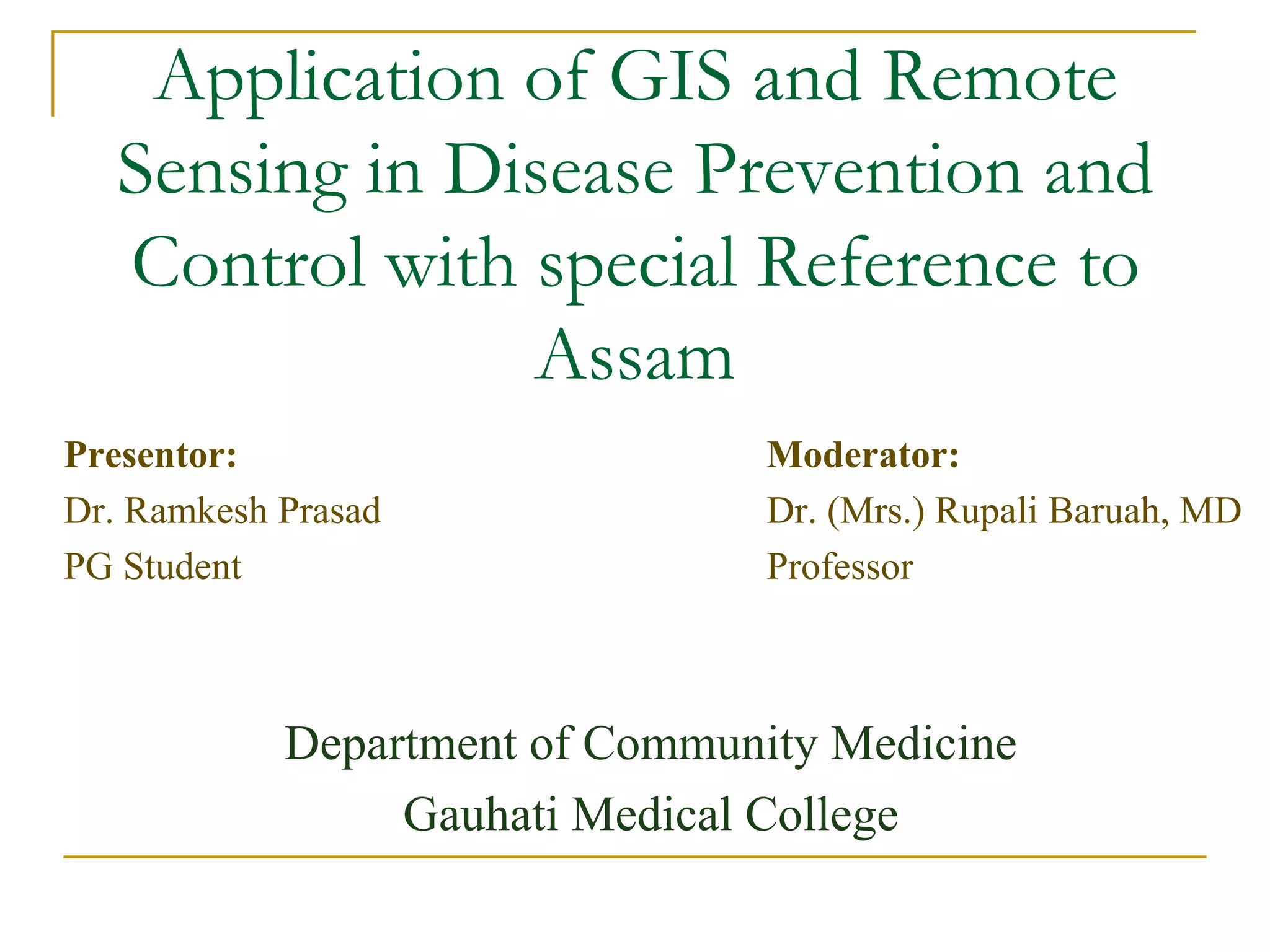
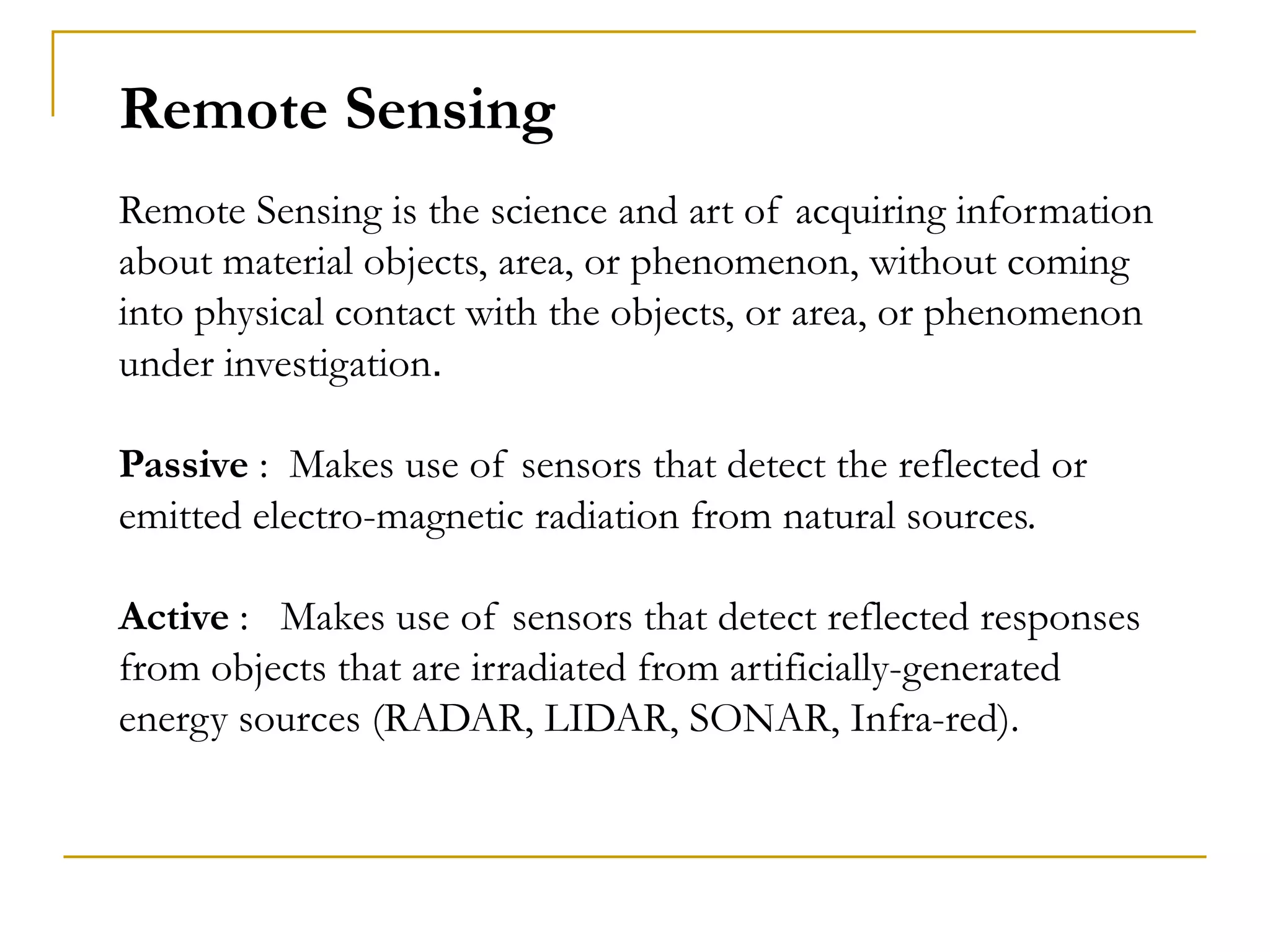
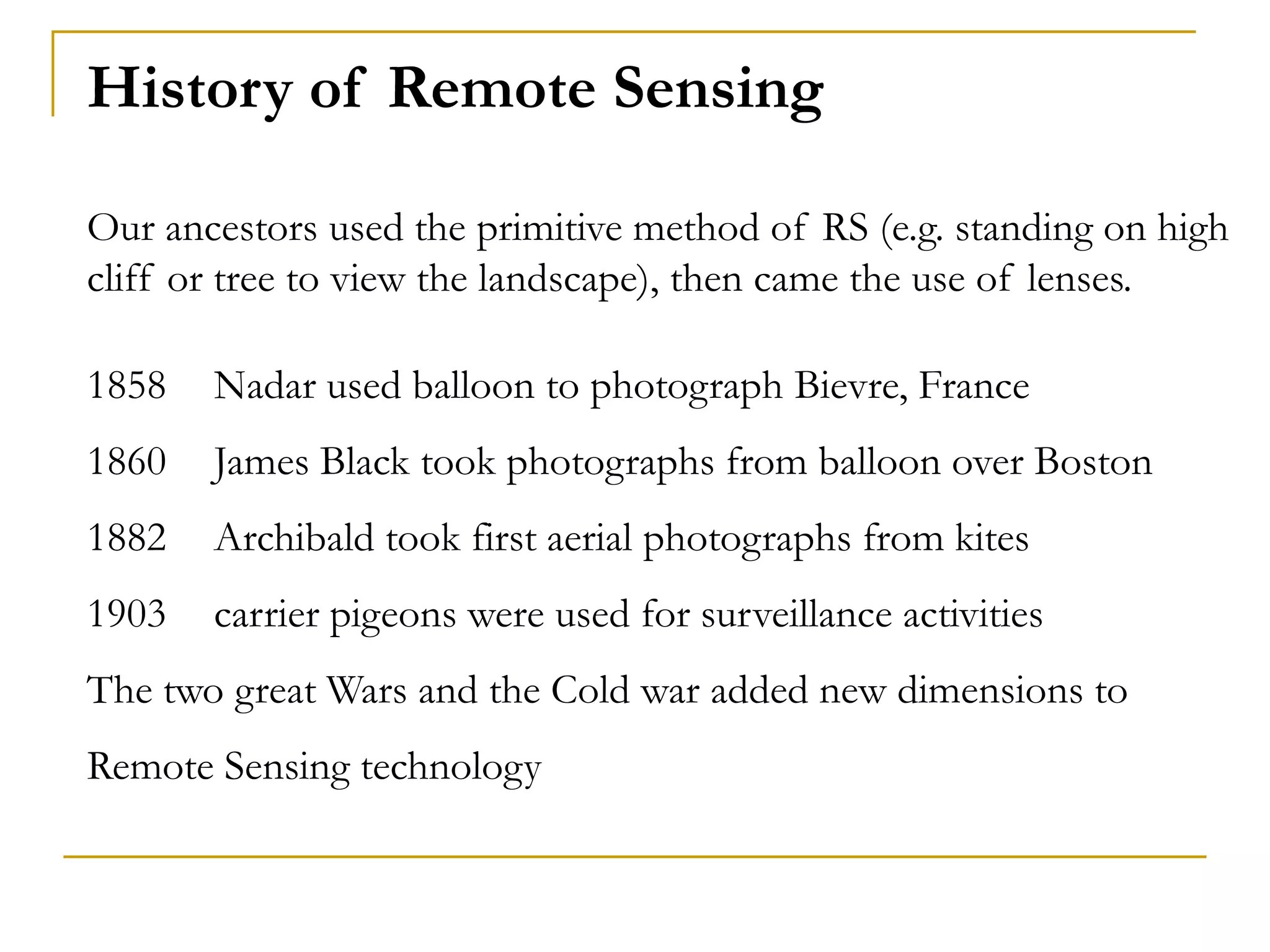
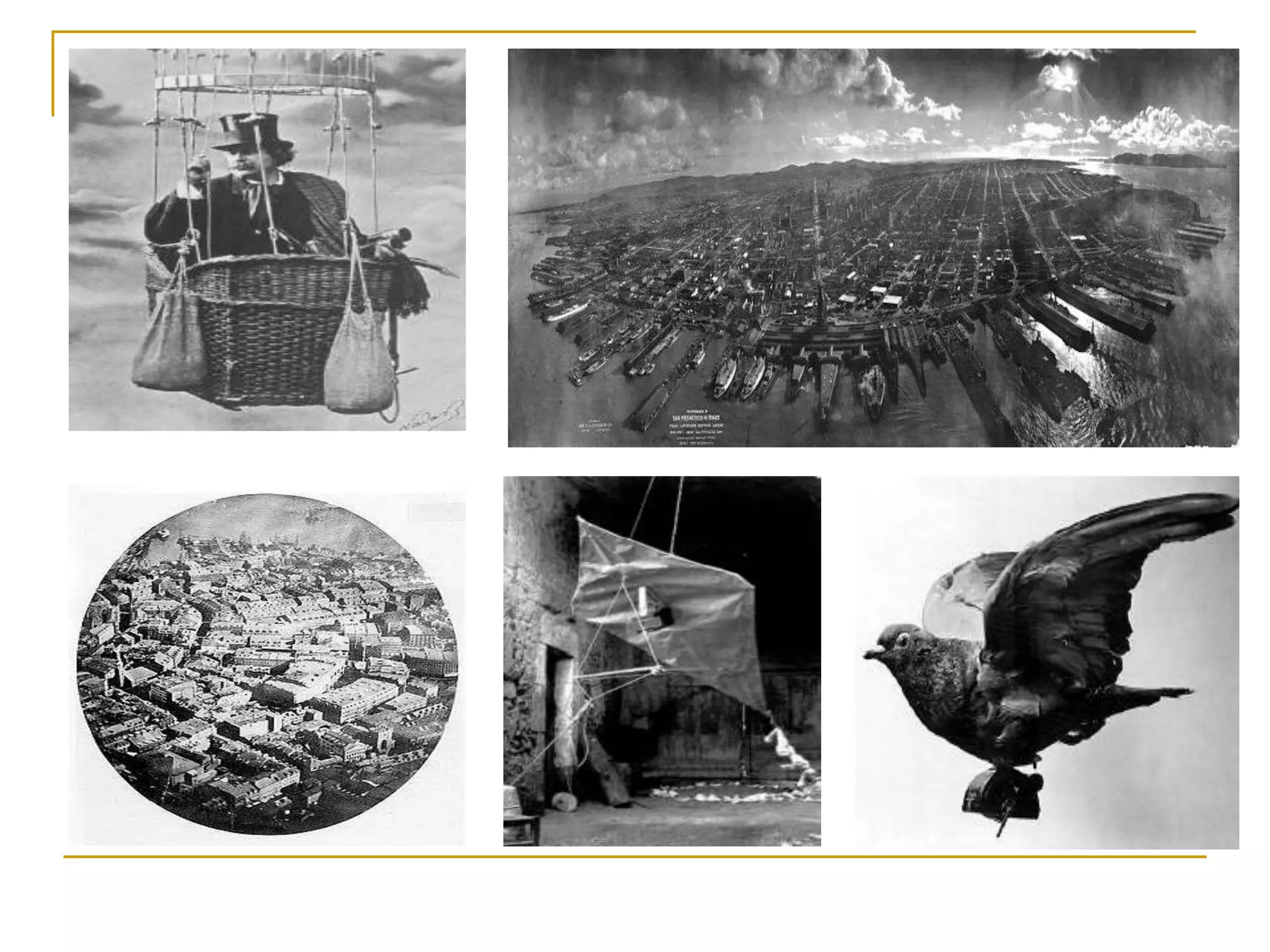
1858 Nadar used balloon to photograph Bievre, France
1860 James Black took photographs from balloon over Boston
1882 Archibald took first aerial photographs from kites
1903 carrier pigeons were used for surveillance activities
The two great Wars and the Cold war added new dimensions to
Remote Sensing technology
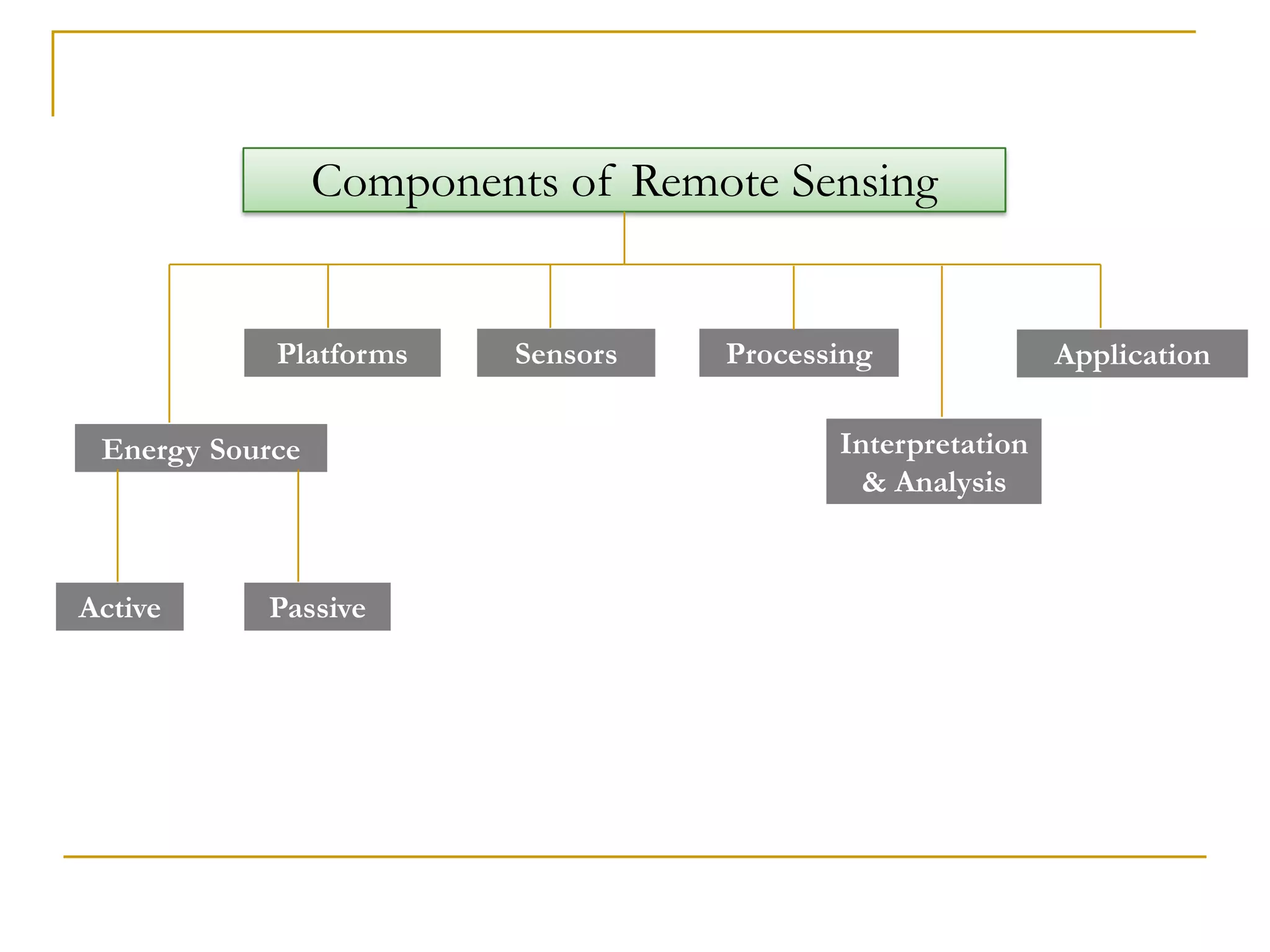
Components of Remote Sensing
Sensors Processing Application
Energy Source
Platforms
Active Passive
Interpretation
& Analysis
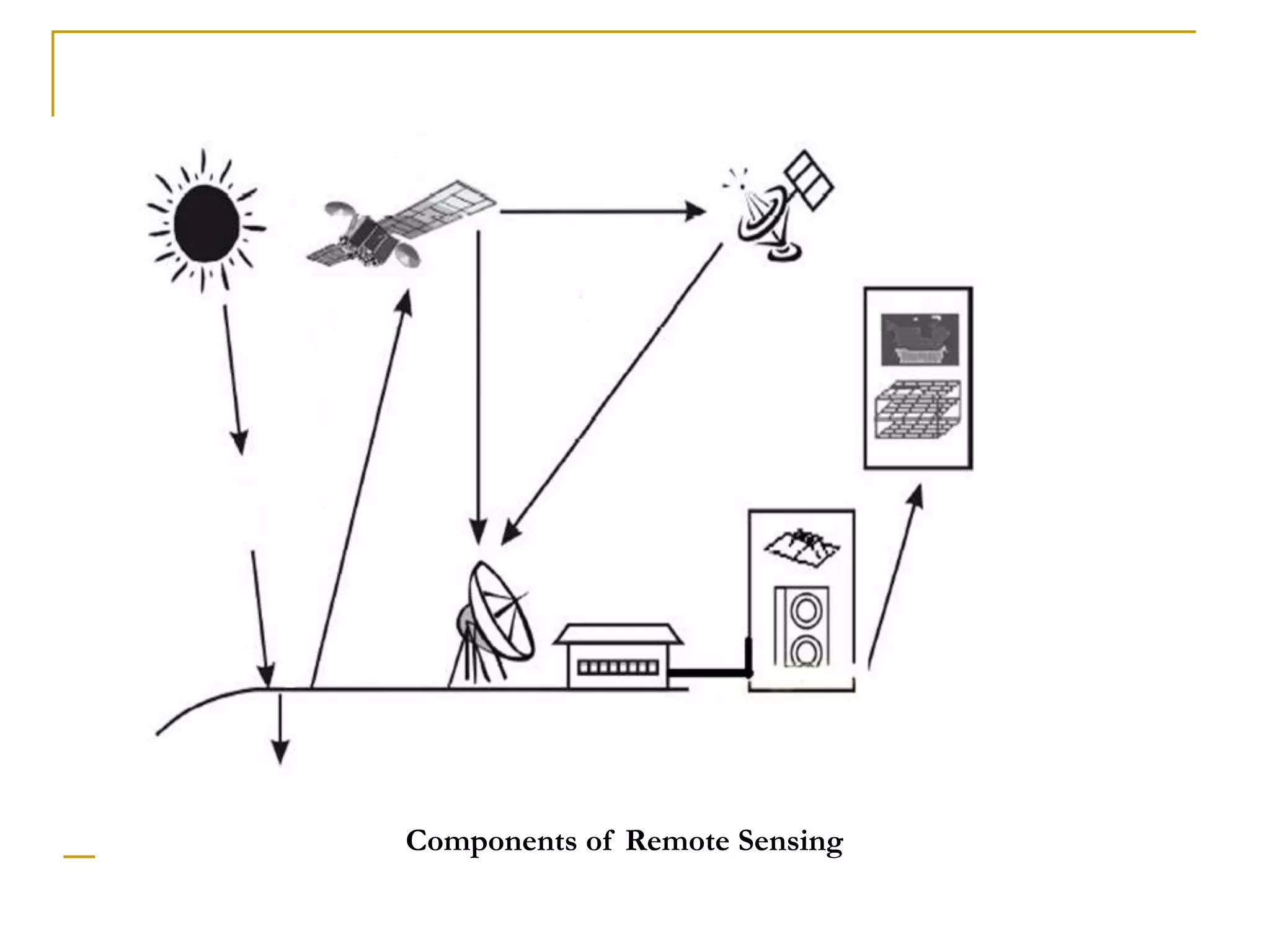
Components of Remote Sensing
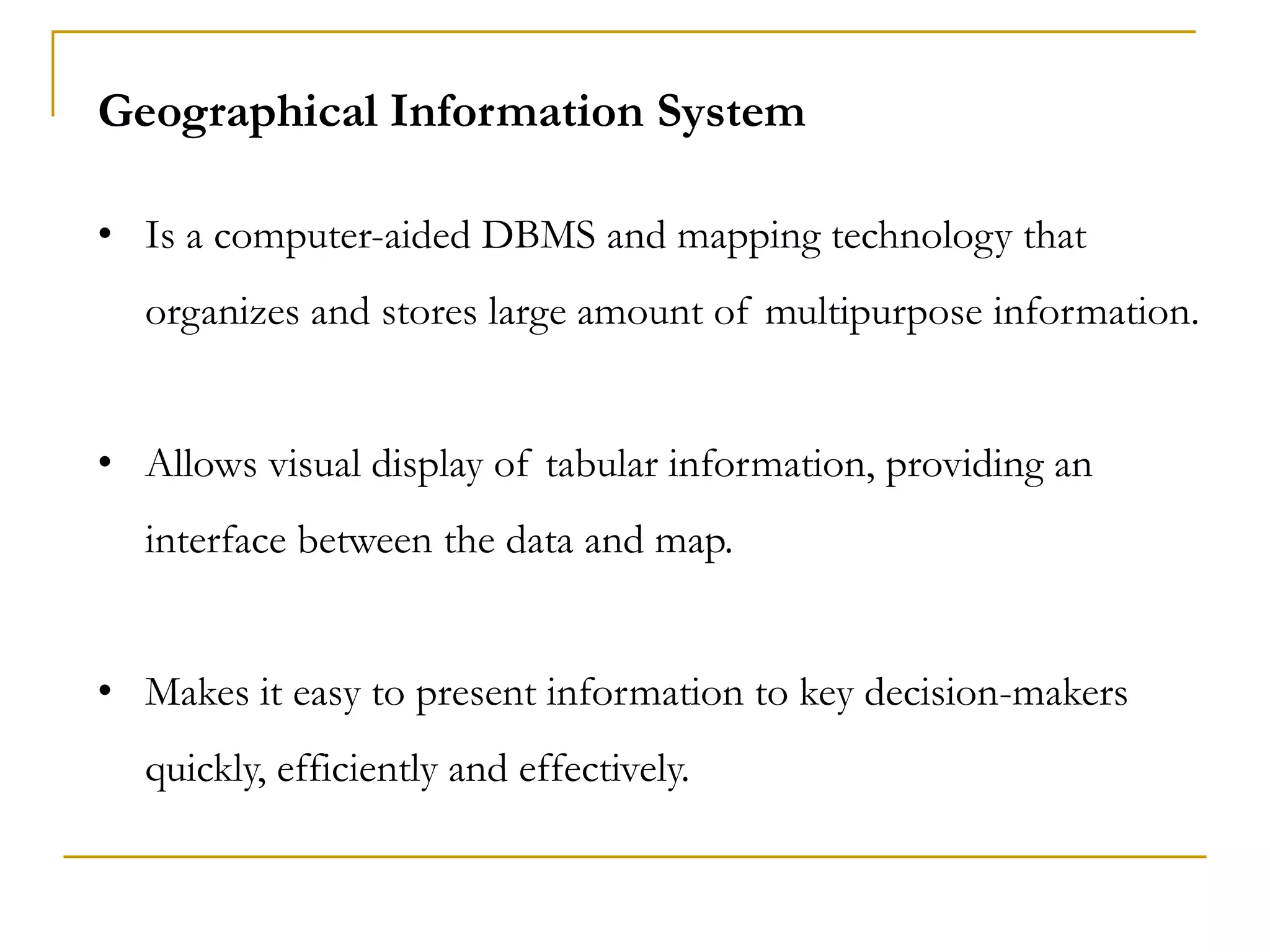
Geographical Information System
• Is a computer-aided DBMS and mapping technology that
organizes and stores large amount of multipurpose information.
• Allows visual display of tabular information, providing an
interface between the data and map.
• Makes it easy to present information to key decision-makers
quickly, efficiently and effectively.
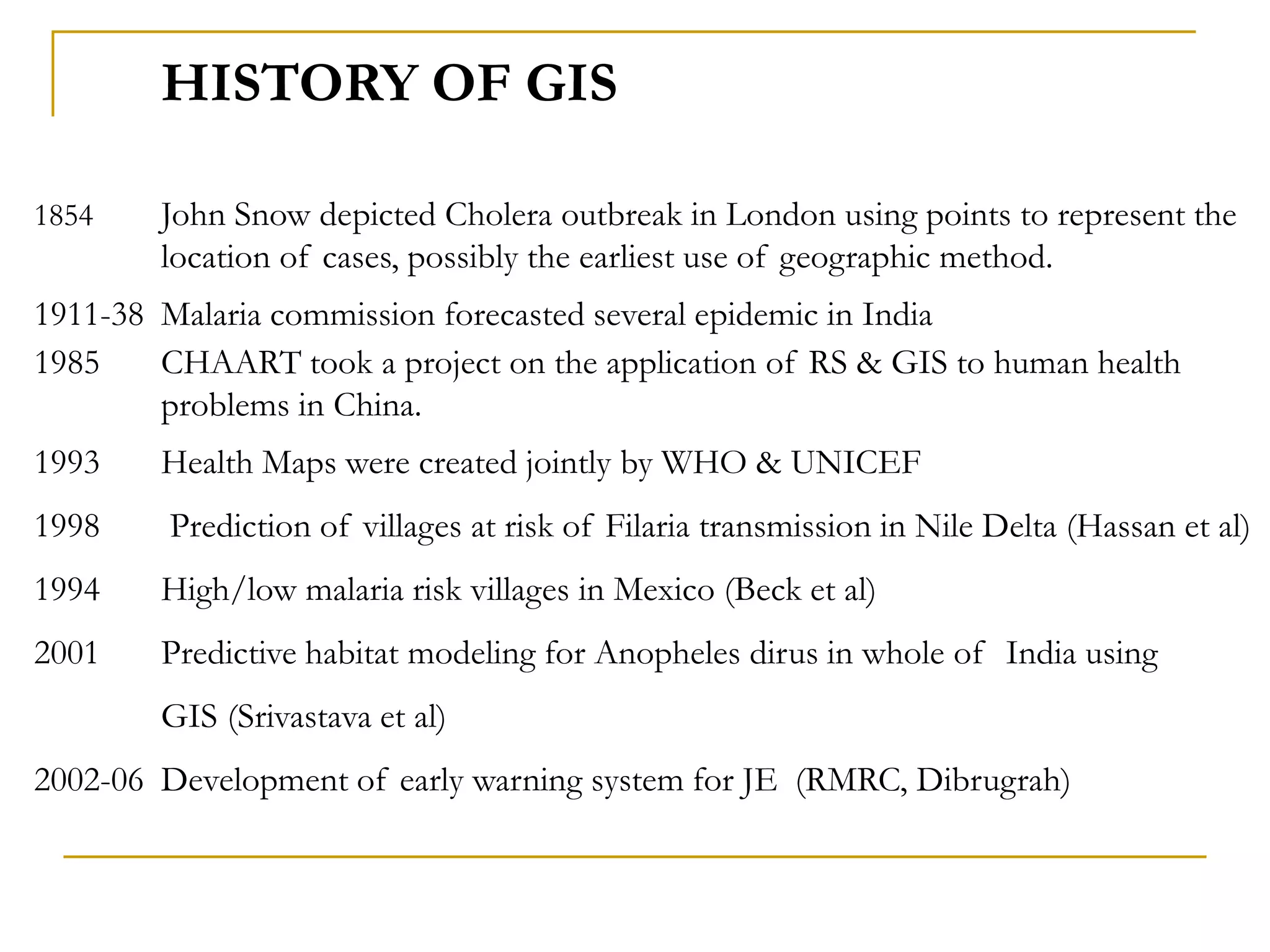
HISTORY OF GIS
1854 John Snow depicted Cholera outbreak in London using points to represent the
location of cases, possibly the earliest use of geographic method.
1911-38 Malaria commission forecasted several epidemic in India
1985 CHAART took a project on the application of RS & GIS to human health
problems in China.
1993 Health Maps were created jointly by WHO & UNICEF
1998 Prediction of villages at risk of Filaria transmission in Nile Delta (Hassan et al)
1994 High/low malaria risk villages in Mexico (Beck et al)
2001 Predictive habitat modeling for Anopheles dirus in whole of India using
GIS (Srivastava et al)
2002-06 Development of early warning system for JE (RMRC, Dibrugrah)
Functions of GIS
• Data entry
• Display
• Editing of Data
• Database query
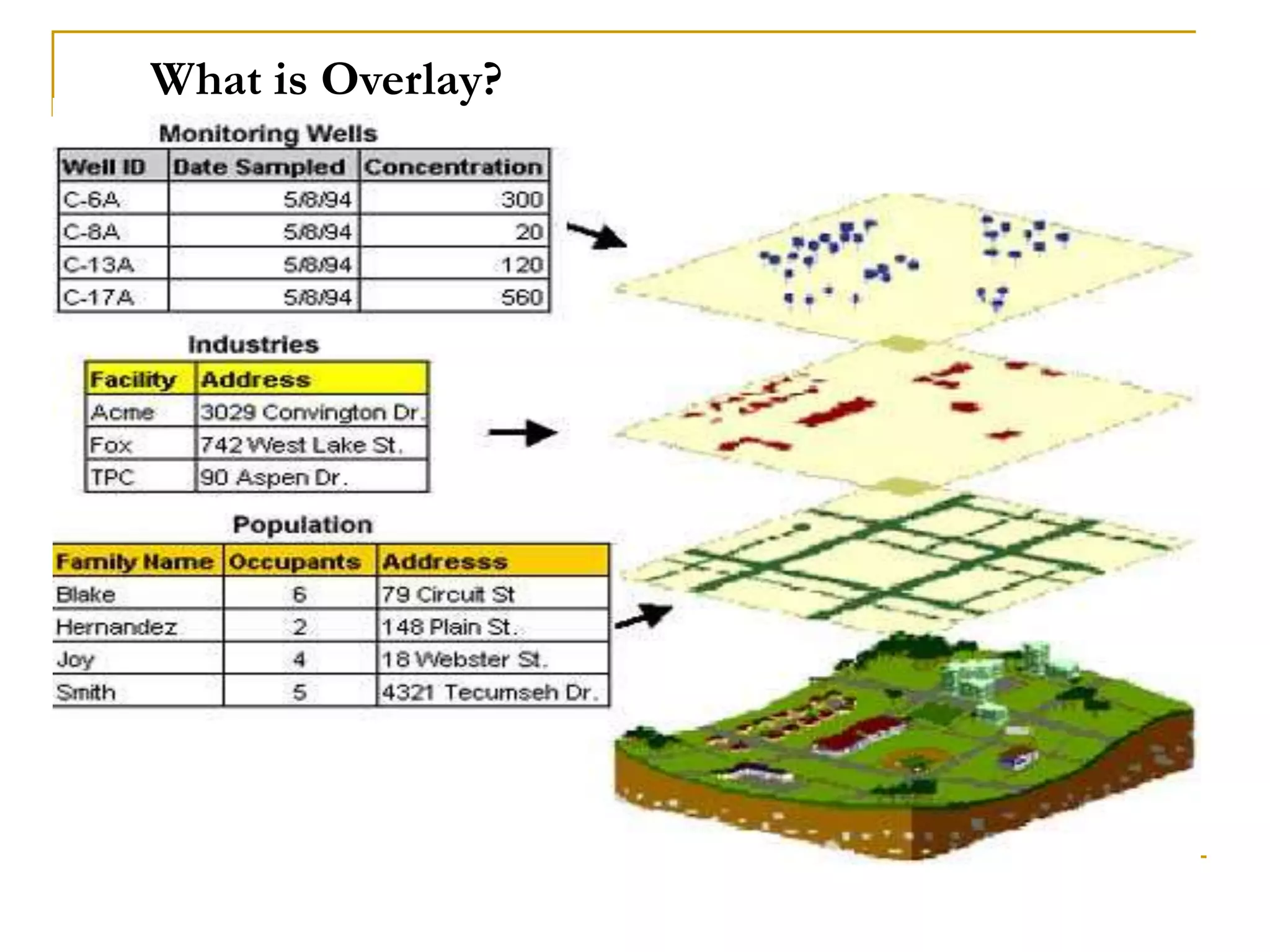
• Overlay
• Statistical extraction
• Output generation
What is Overlay?
USES OF GIS REMOTE SENSING
1. Agriculture & Forestry
2. Urban and Rural Planning
3. Health Services
4. Disaster Management
5. Marketing Research
6. Geology and Archeology
USE OF GIS & REMOTE SENSING IN HEALTH
1. Emergency Medical Services Delivery, 108, 911
2. Surveillance of Vector borne diseases: Malaria, Filaria, JE etc.
3. Monitoring contamination of ground water
4. Air pollution and its impact on human health
Recent uses:
• Study on Cholera in Bangladesh in collaboration with CDC
• Early warning system for the outbreak of JE in Dibrugarh, Assam
• In Patna: to assist immunization activities in interior areas using GPS
in collaboration with CDC
• Leprosy elimination in Tamil Nadu in collaboration with DANIDA
• Evaluation of Immunization coverage using GIS in Gujarat
USES IN PUBLIC HEALTH
• Determining geographical distribution of disease
• Analyzing spatial and temporal trends
• Mapping of population at risk and stratify risk factors
• Assessing health care needs of a community and resource allocation
• Planning and targeting interventions
• Monitoring disease and intervention over time
• Forecasting epidemics
• Identify gaps in immunizations
• Monitor the utilization of health centres
• Route health workers, equipment and supplies to service
locations
• Locate the nearest health facility.
DISEASES CURRENTLY UNDER SURVEILLANCE
USING REMOTE SENSING AND GIS IN INDIA
• JAPANESE ENCEPHALITIS
• MALARIA
• DENGUE
• FILARIA
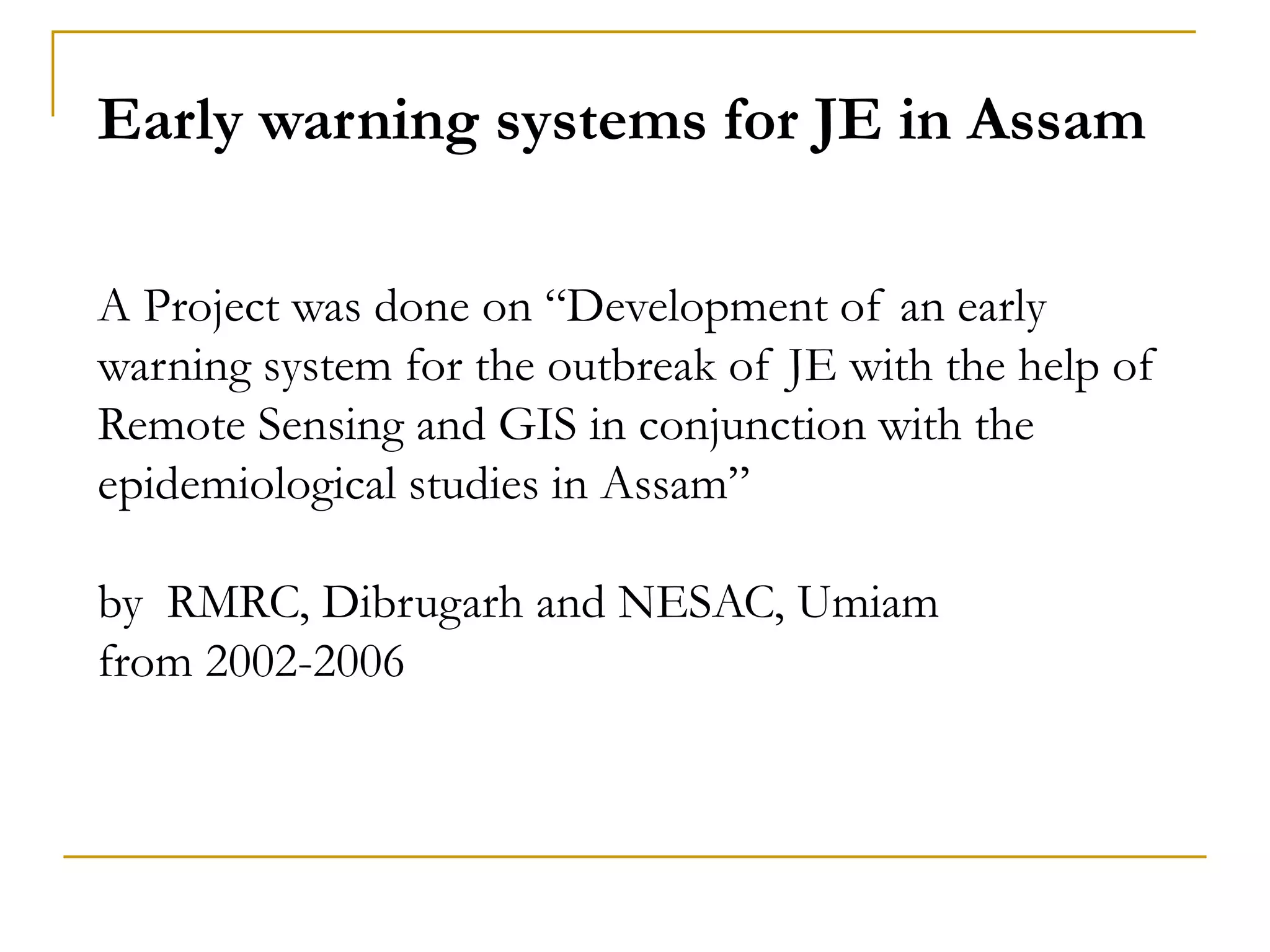
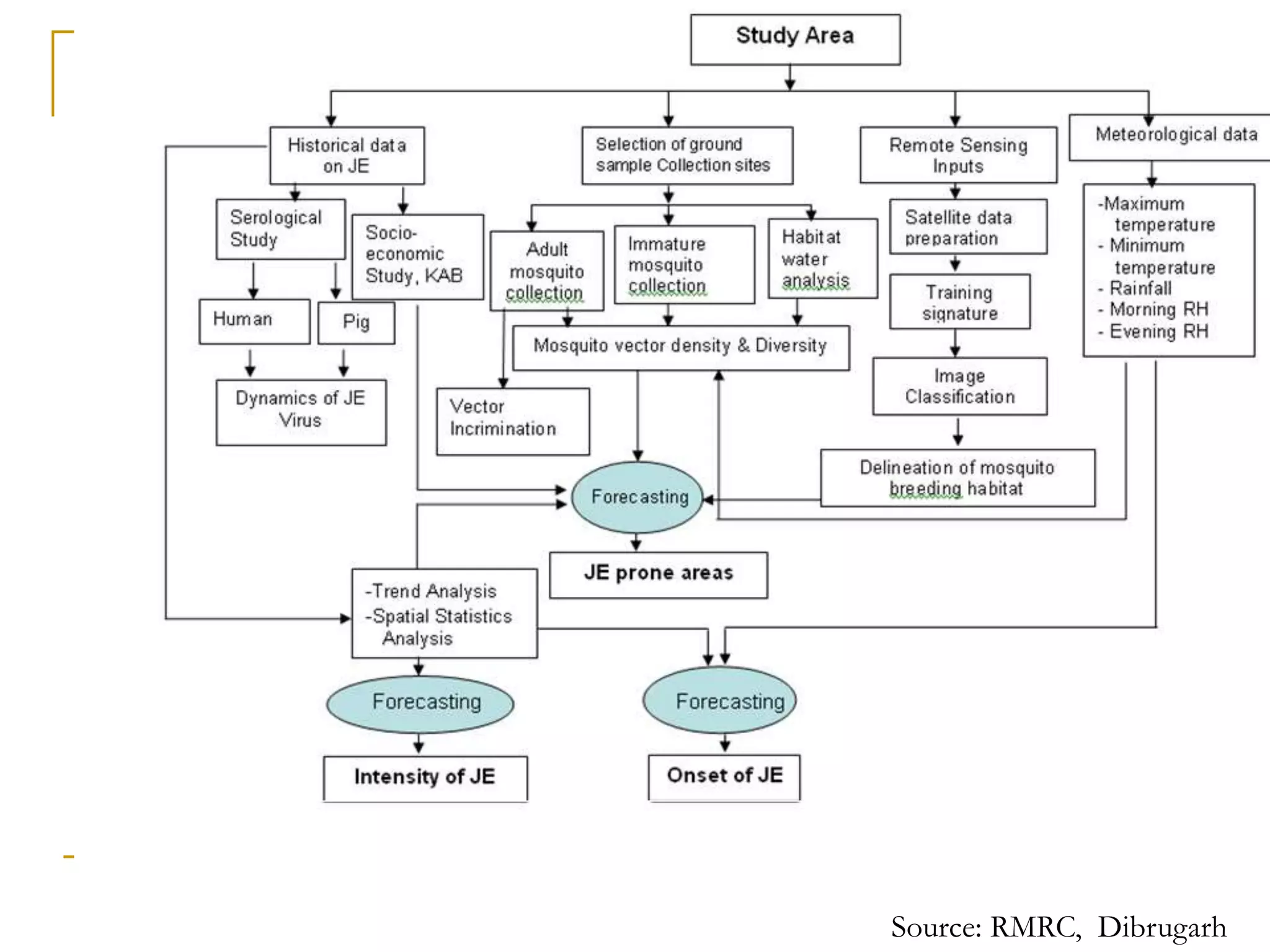
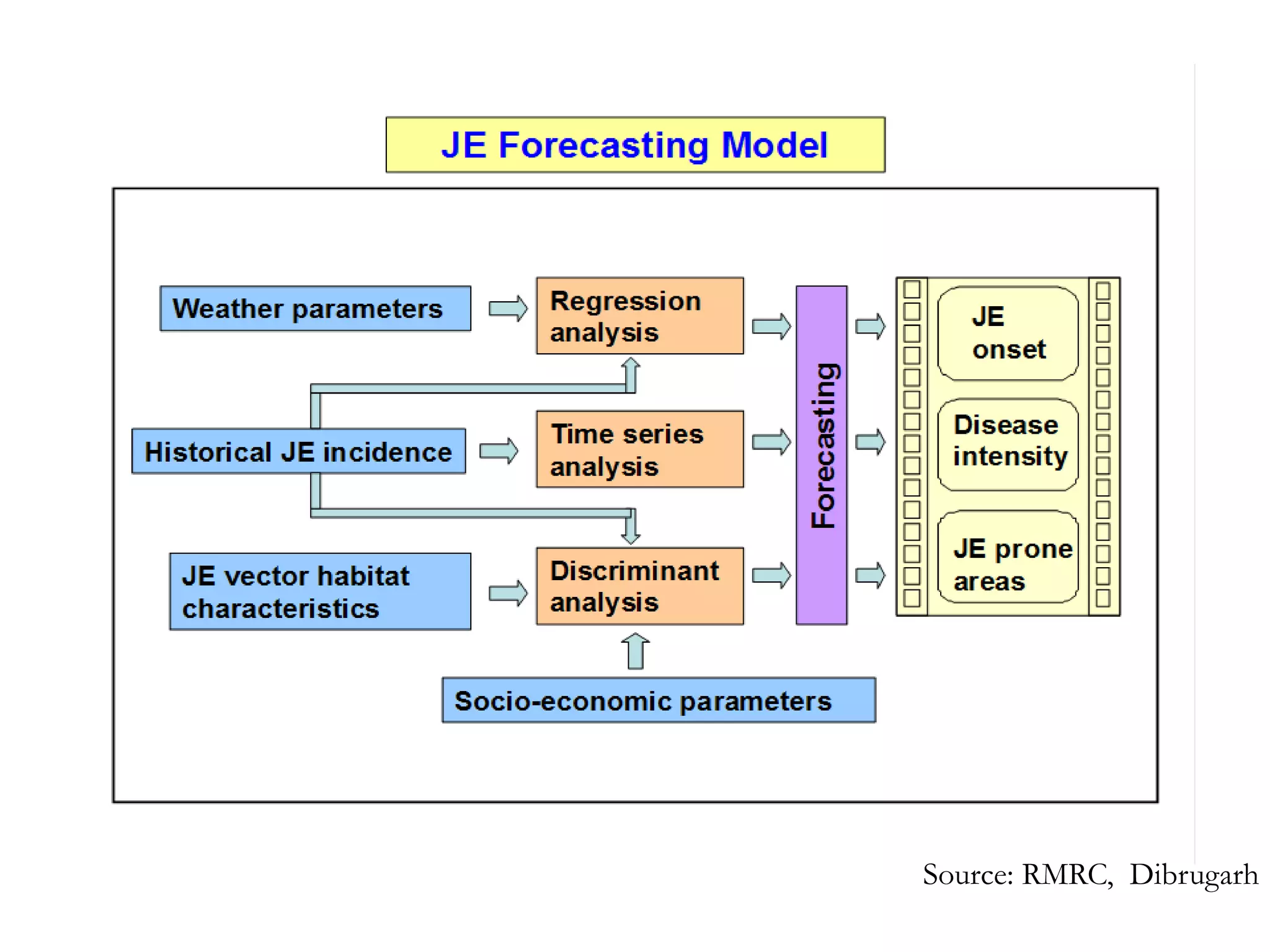
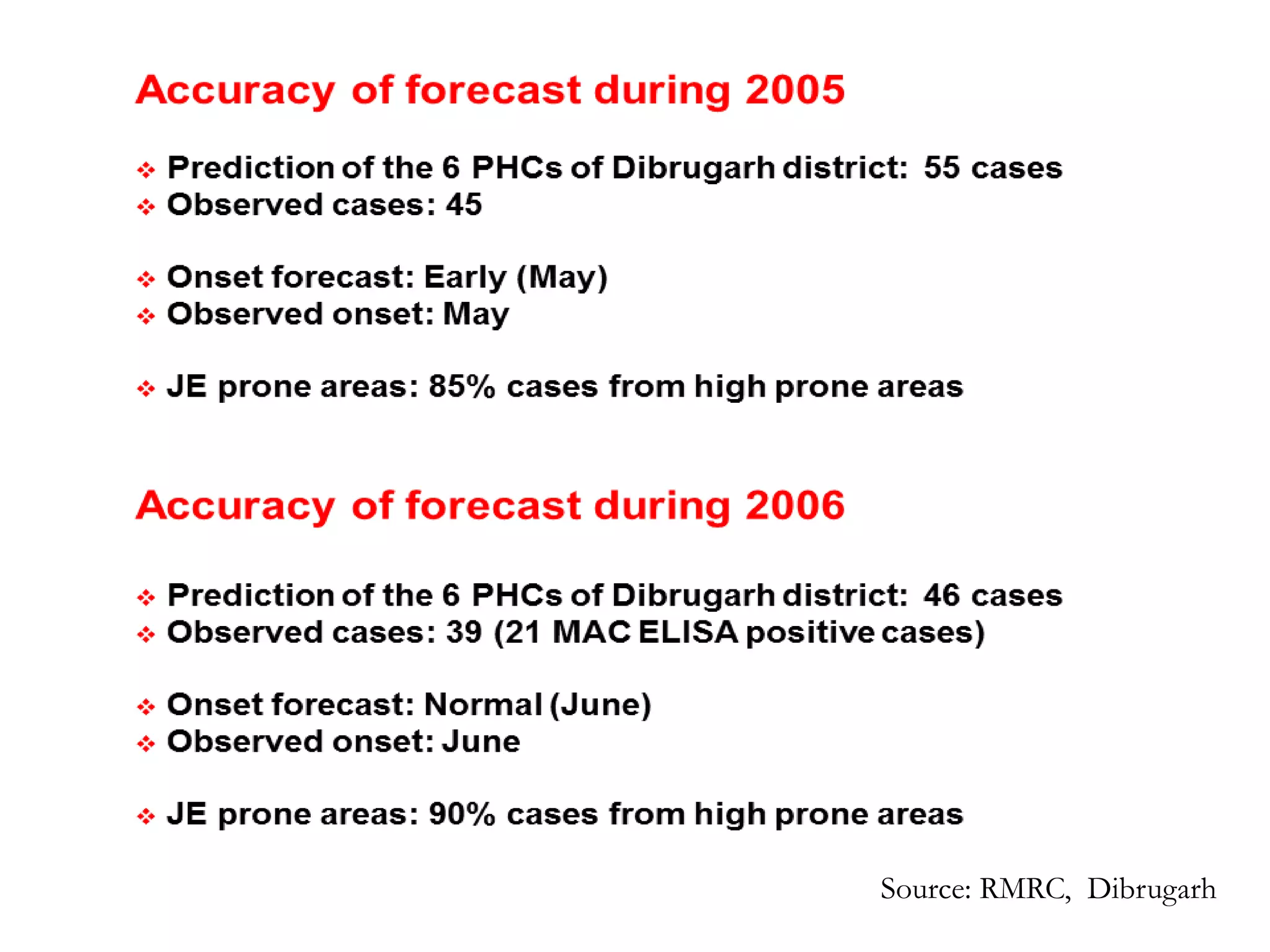
Early warning systems for JE in Assam
A Project was done on “Development of an early
warning system for the outbreak of JE with the help of
Remote Sensing and GIS in conjunction with the
epidemiological studies in Assam”
by RMRC, Dibrugarh and NESAC, Umiam
from 2002-2006
Source: RMRC, Dibrugarh
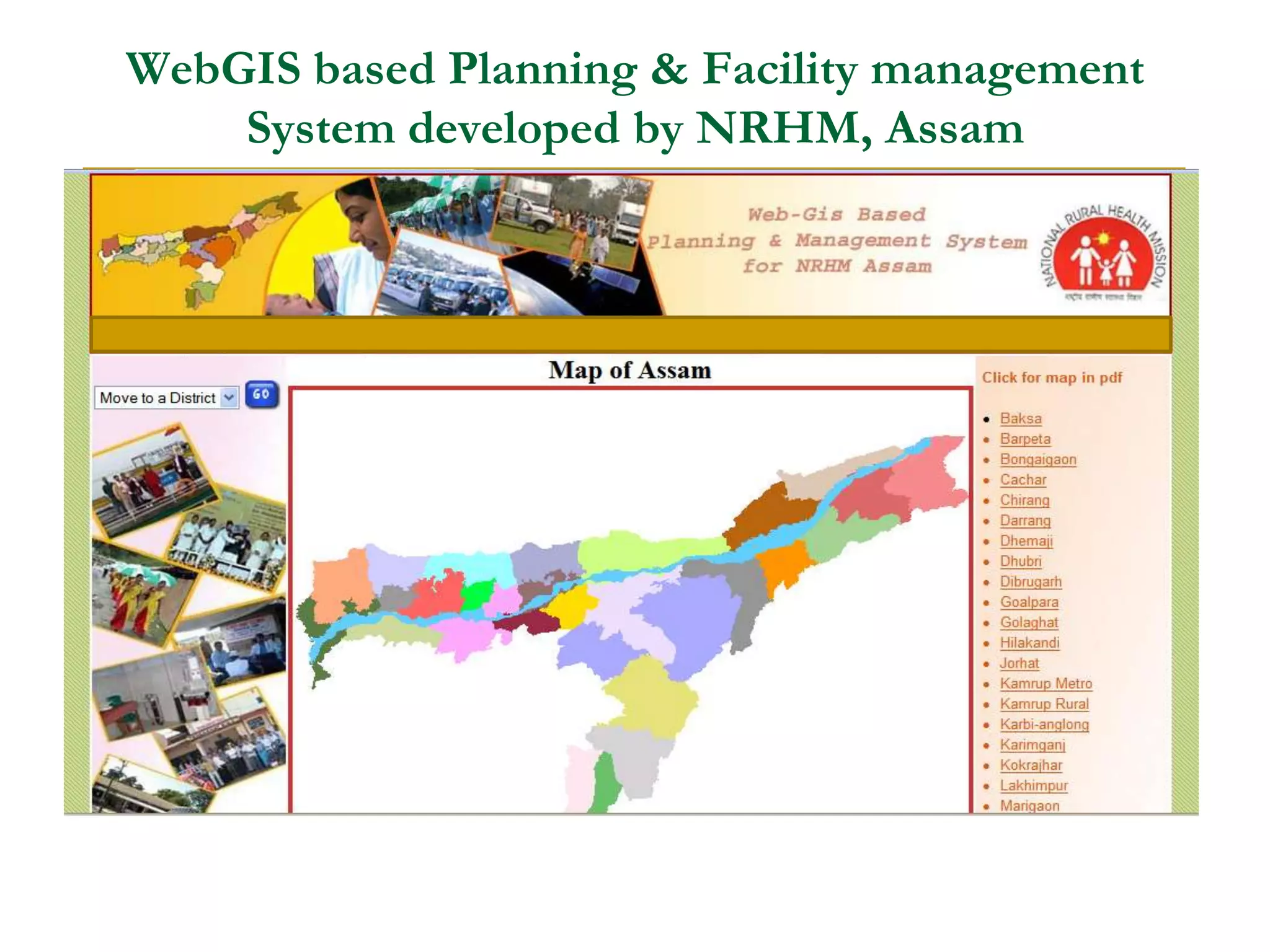
WebGIS based Planning & Facility management
System developed by NRHM, Assam
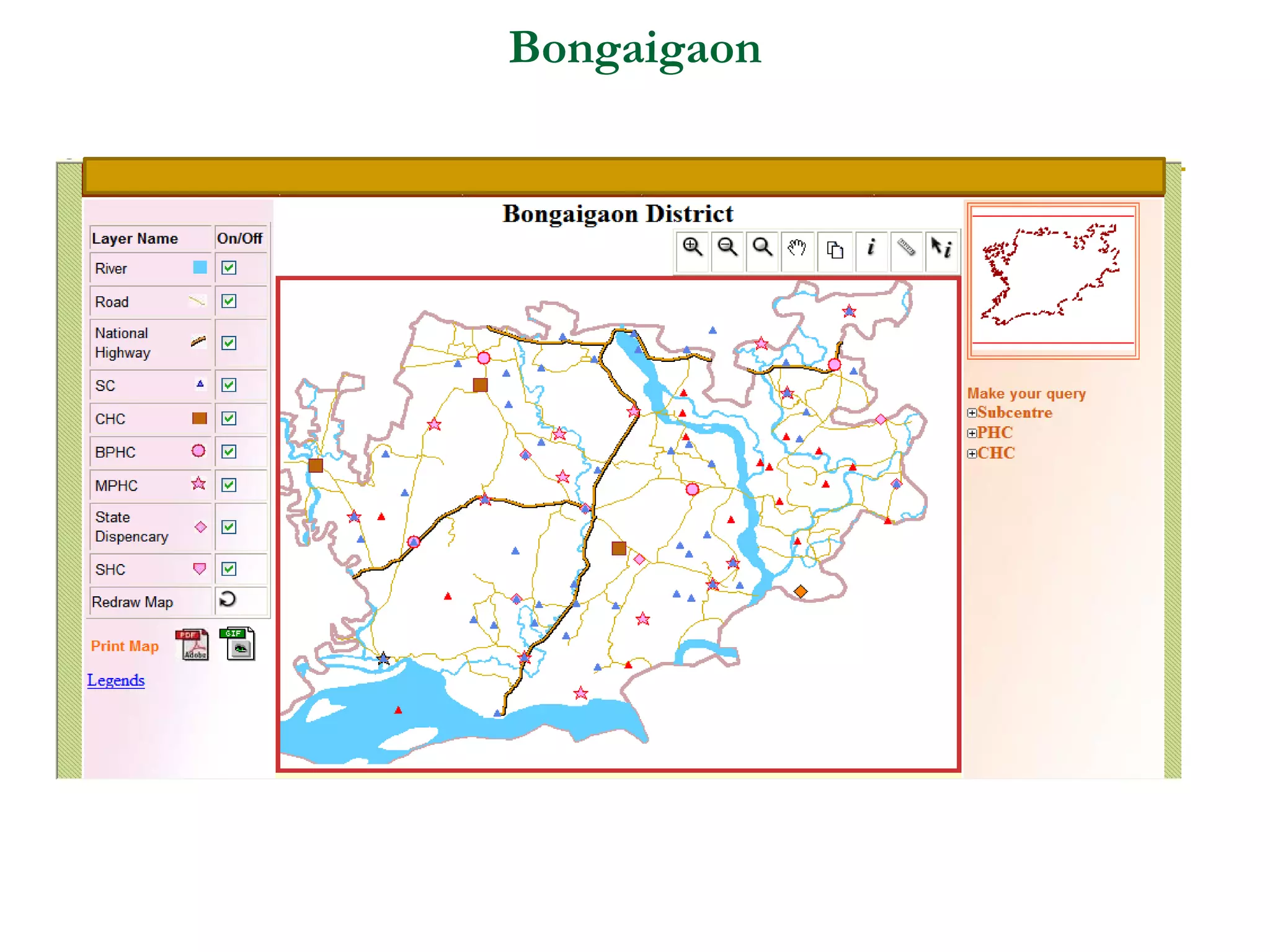
Bongaigaon
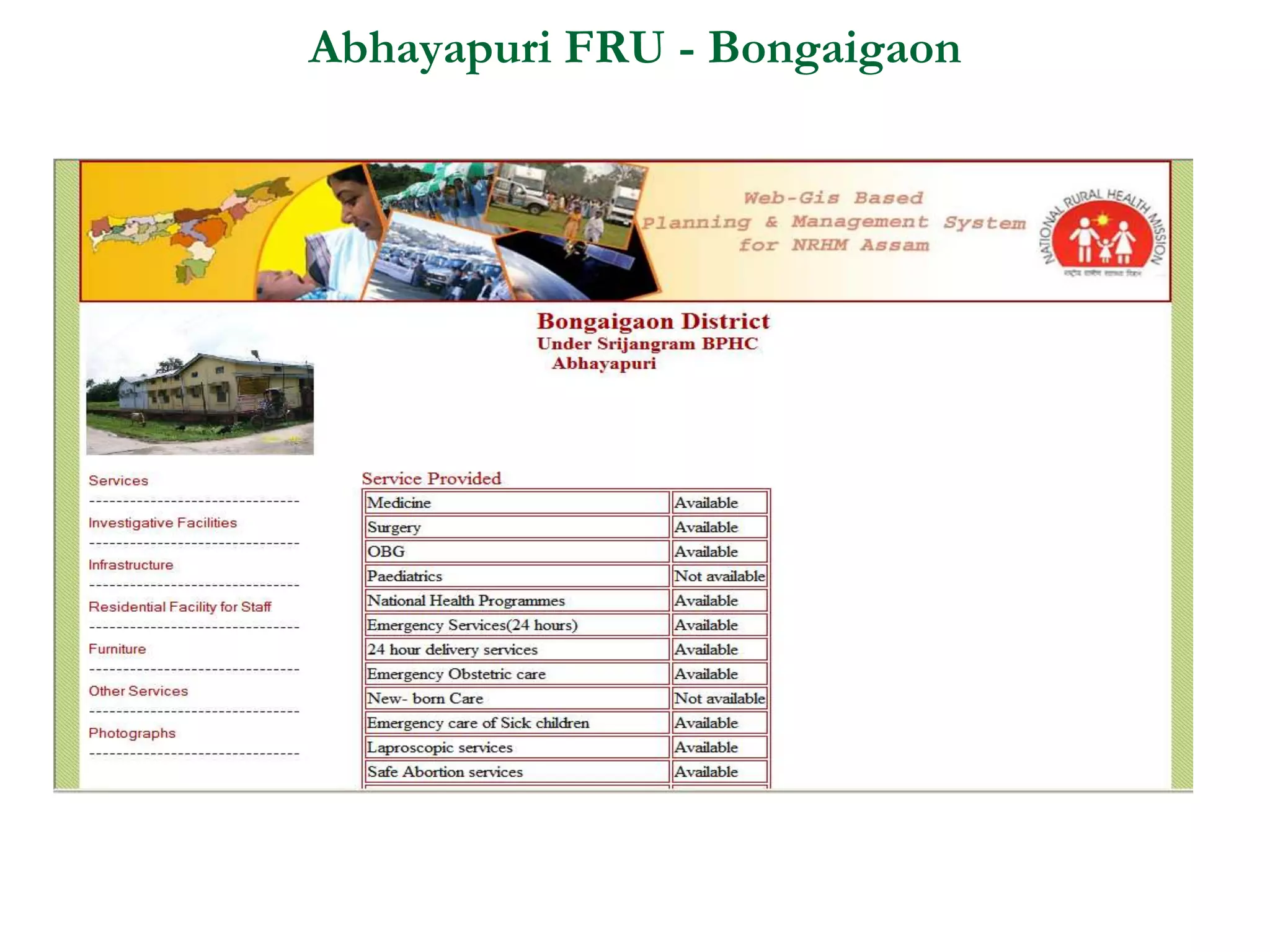
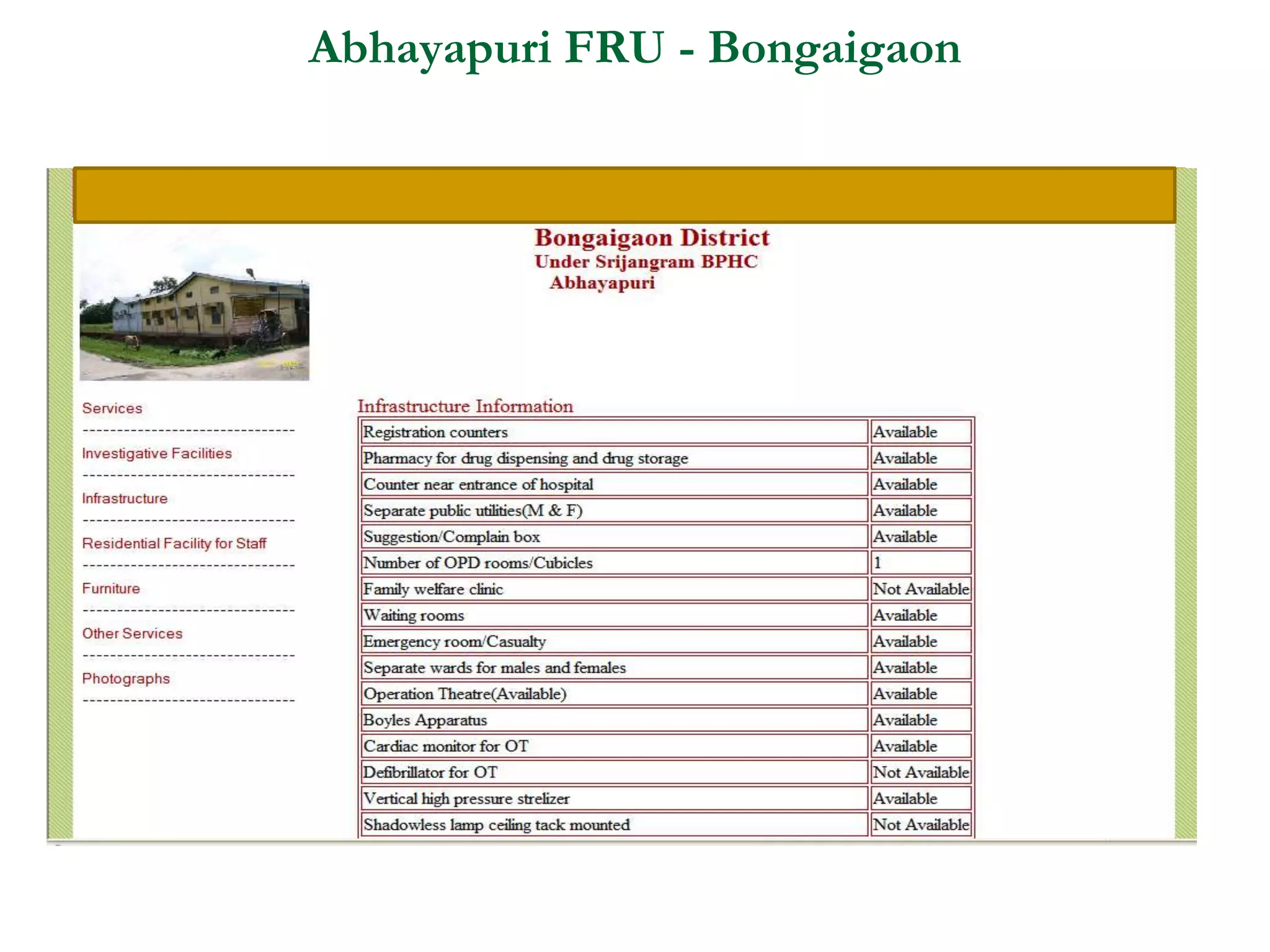
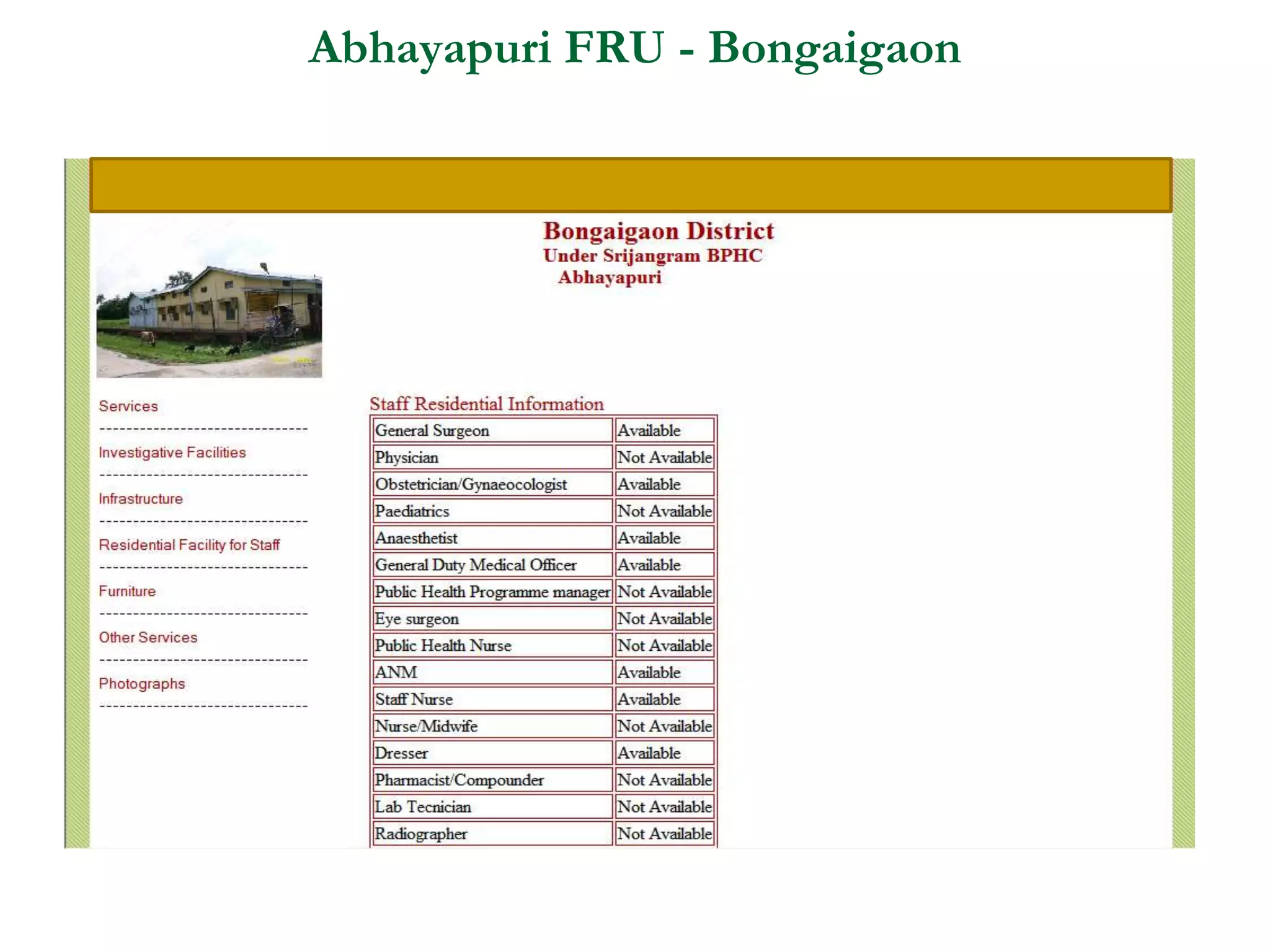
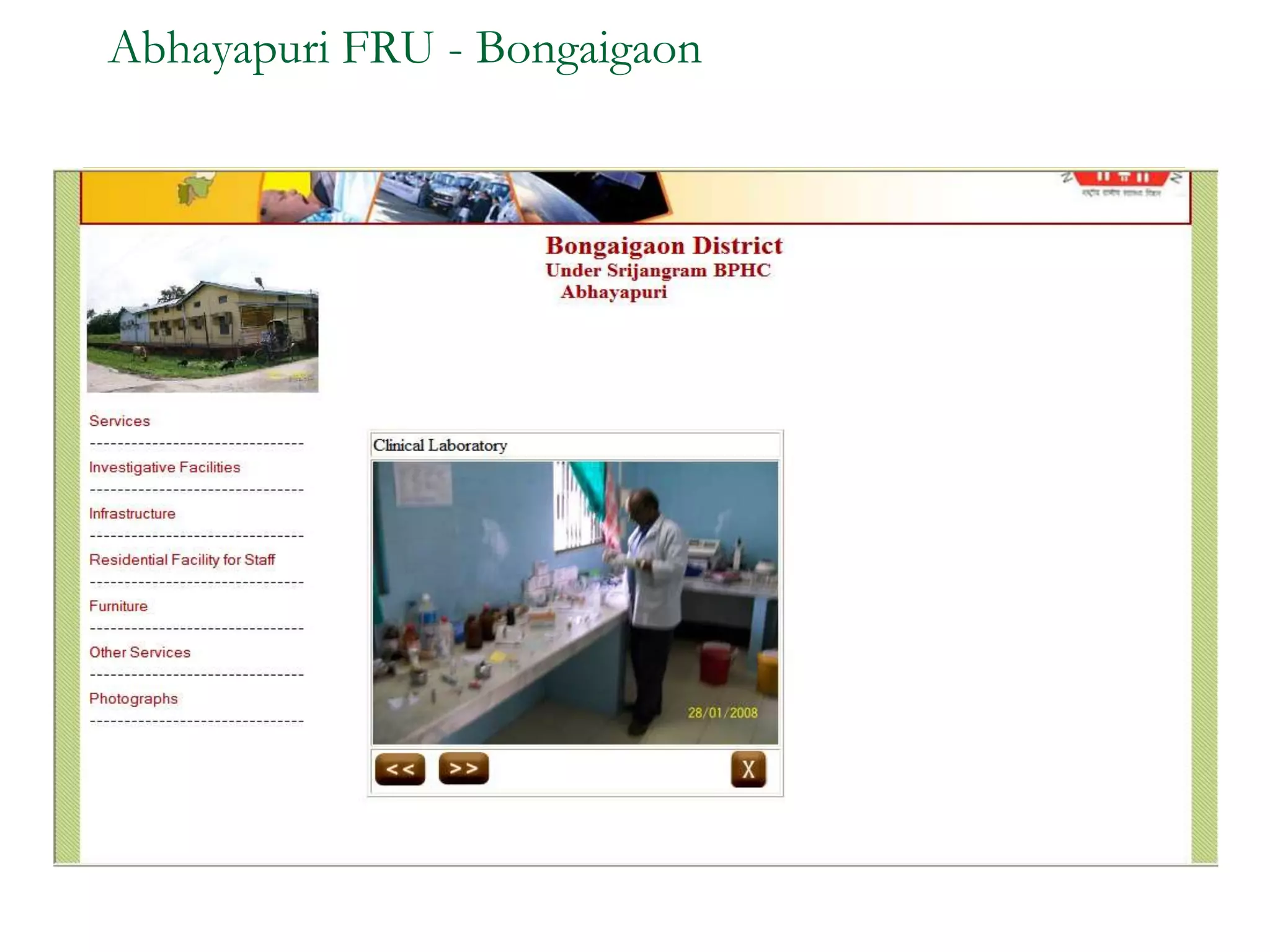
Abhayapuri FRU - Bongaigaon
Remote Sensing with GIS and Primary Health Care
• Intersectoral coordination
• Appropriate technology
• Technical co-operation among countries
• Community participation
THANK YOU

Application of gis and remote sensing in disease prevention and control with

  • 1.
    Application of GISand Remote Sensing in Disease Prevention and Control with special Reference to Assam Presentor: Moderator: Dr. Ramkesh Prasad Dr. (Mrs.) Rupali Baruah, MD PG Student Professor Department of Community Medicine Gauhati Medical College
  • 2.
    Remote Sensing Remote Sensingis the science and art of acquiring information about material objects, area, or phenomenon, without coming into physical contact with the objects, or area, or phenomenon under investigation. Passive : Makes use of sensors that detect the reflected or emitted electro-magnetic radiation from natural sources. Active : Makes use of sensors that detect reflected responses from objects that are irradiated from artificially-generated energy sources (RADAR, LIDAR, SONAR, Infra-red).
  • 3.
    History of RemoteSensing Our ancestors used the primitive method of RS (e.g. standing on high cliff or tree to view the landscape), then came the use of lenses. 1858 Nadar used balloon to photograph Bievre, France 1860 James Black took photographs from balloon over Boston 1882 Archibald took first aerial photographs from kites 1903 carrier pigeons were used for surveillance activities The two great Wars and the Cold war added new dimensions to Remote Sensing technology
  • 5.
    Components of RemoteSensing Sensors Processing Application Energy Source Platforms Active Passive Interpretation & Analysis
  • 6.
  • 7.
    Geographical Information System •Is a computer-aided DBMS and mapping technology that organizes and stores large amount of multipurpose information. • Allows visual display of tabular information, providing an interface between the data and map. • Makes it easy to present information to key decision-makers quickly, efficiently and effectively.
  • 8.
    HISTORY OF GIS 1854John Snow depicted Cholera outbreak in London using points to represent the location of cases, possibly the earliest use of geographic method. 1911-38 Malaria commission forecasted several epidemic in India 1985 CHAART took a project on the application of RS & GIS to human health problems in China. 1993 Health Maps were created jointly by WHO & UNICEF 1998 Prediction of villages at risk of Filaria transmission in Nile Delta (Hassan et al) 1994 High/low malaria risk villages in Mexico (Beck et al) 2001 Predictive habitat modeling for Anopheles dirus in whole of India using GIS (Srivastava et al) 2002-06 Development of early warning system for JE (RMRC, Dibrugrah)
  • 9.
    Functions of GIS •Data entry • Display • Editing of Data • Database query • Overlay • Statistical extraction • Output generation
  • 10.
  • 11.
    USES OF GISREMOTE SENSING 1. Agriculture & Forestry 2. Urban and Rural Planning 3. Health Services 4. Disaster Management 5. Marketing Research 6. Geology and Archeology
  • 12.
    USE OF GIS& REMOTE SENSING IN HEALTH 1. Emergency Medical Services Delivery, 108, 911 2. Surveillance of Vector borne diseases: Malaria, Filaria, JE etc. 3. Monitoring contamination of ground water 4. Air pollution and its impact on human health
  • 13.
    Recent uses: • Studyon Cholera in Bangladesh in collaboration with CDC • Early warning system for the outbreak of JE in Dibrugarh, Assam • In Patna: to assist immunization activities in interior areas using GPS in collaboration with CDC • Leprosy elimination in Tamil Nadu in collaboration with DANIDA • Evaluation of Immunization coverage using GIS in Gujarat
  • 14.
    USES IN PUBLICHEALTH • Determining geographical distribution of disease • Analyzing spatial and temporal trends • Mapping of population at risk and stratify risk factors • Assessing health care needs of a community and resource allocation • Planning and targeting interventions • Monitoring disease and intervention over time • Forecasting epidemics
  • 15.
    • Identify gapsin immunizations • Monitor the utilization of health centres • Route health workers, equipment and supplies to service locations • Locate the nearest health facility.
  • 16.
    DISEASES CURRENTLY UNDERSURVEILLANCE USING REMOTE SENSING AND GIS IN INDIA • JAPANESE ENCEPHALITIS • MALARIA • DENGUE • FILARIA
  • 17.
    Early warning systemsfor JE in Assam A Project was done on “Development of an early warning system for the outbreak of JE with the help of Remote Sensing and GIS in conjunction with the epidemiological studies in Assam” by RMRC, Dibrugarh and NESAC, Umiam from 2002-2006
  • 18.
  • 19.
  • 20.
  • 21.
    WebGIS based Planning& Facility management System developed by NRHM, Assam
  • 22.
  • 23.
    Abhayapuri FRU -Bongaigaon
  • 24.
    Abhayapuri FRU -Bongaigaon
  • 25.
    Abhayapuri FRU -Bongaigaon
  • 26.
    Abhayapuri FRU -Bongaigaon
  • 28.
    Remote Sensing withGIS and Primary Health Care • Intersectoral coordination • Appropriate technology • Technical co-operation among countries • Community participation
  • 29.