Wetland mapping using RS &
GIS
K Tharani
131863
1
Contents
 Introduction
 Function of wetlands
 Remote sensing in wetland mapping
 Literature review
 Common methodology
 Case studies
 Summary
 References
2
Introduction
 A wetland is a land area
which is completely saturated
with water either permanently
or seasonally.
 The factor that distinguishes
wetlands from other land
forms or water bodies is the
characteristic vegetation
that is adapted to its unique
soil conditions. Fig1:Amazon river basin
3
Functions of wetland
 Flood control
 Groundwater replenishment
 Water purification
 Shoreline stability
 Climate change mitigation and adaptation
 Recreation and tourism
4
Remote sensing in wetland mapping
 Satellite remote sensing can also provide information on
surrounding land uses and their changes over time.
 Current information on the uplands.
 Remote sensing of wetlands started in 1972 with the launch
of LANDSAT-1.
 But due to low resolution of LANDSAT, LANDSAT TM is
used for mapping of wetland changes.
 Landsat TM bands 4 (near infrared), 5 (mid-infrared), and 3
(red) were most optimal for discriminating between land-
water interface
5
Contd..
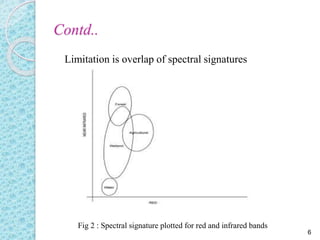
Limitation is overlap of spectral signatures
Fig 2 : Spectral signature plotted for red and infrared bands
6
Some of the satellites & sensors used
 Landsat MSS
 Landsat TM
 Landsat ETM+
 IRS P6 LISS III
 Panchromatic & multispectral sensors in IKONOS
7
Literature Review
 Ozesmi et.al (2002) explained the classification techniques for
wetland classification & identification.
 Chaves et.al(2007) described the combined usage of satellite data &
ancillary data for baseline inventory & also about wetland
restoration.
 Li et.al (2007) explained the change of the Yellow river delta
wetlands. The result has significance for building & protecting eco-
environment
8
 Jyotishman Deka et.al (2011) suggested that usage of remotely
sensed data for wetland mapping provides a cost effective method
& spatio-temporal characteristics of wetlands in terms of change
detection could serve as guiding tool, in conservation and
prioritization of wetlands
 Ghobadi et.al (2012) applied multi temporal remote sensing data &
GIS techniques to monitor changes in wetlands.
 Nidhi Nagabhatla et.al (2012) explained wetland delineation &
mapping in coastal regions. The study reflects an approach for
practical application of pro-supervised learning and pattern
recognition for the multi-spectral earth observation data
9
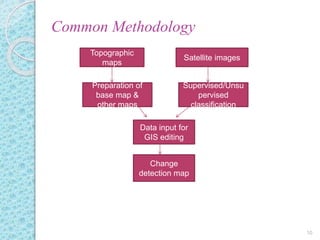
10
Topographic
maps
Satellite images
Preparation of
base map &
other maps
Supervised/Unsu
pervised
classification
Data input for
GIS editing
Change
detection map
Common Methodology
Case study 1
 Title : Use of Multi-Temporal Remote Sensing Data and GIS
for Wetland Change Monitoring and Degradation.
 Author : Ghobadi et.al (2012)
 Journal : Institute of Electrical & Electronic Engineers
 Objective: The main objective of this study is to assess the
wetland change and degradation using multi-temporal
satellite data, GIS and ancillary data in Hoor Al Azim
wetland.
11
 Study area : The study
area is located in the
southwest of Iran
bordering with Iraq and
lies within the latitude
31°28′4″ N and longitude
47° 56′ 57″ E in north of
the Persian Gulf. This
wetland is mainly fed by
Karkheh River
Fig 3: Location of study area
12
Data
Data and information on wetland and upstream,
was extracted from Multispectral Scanner (MSS) image
in 1985 and Enhance Thematic Mapper (ETM+) images
of the years 1999, 2002, and 2011
13
Image Path/row Date of
acquisition
Season time
Landsat 5 MSS 166/38 25/05/1985 Before harvesting
Landsat 7 ETM+ 166/38 18/10/1999 Beginning of
growth
Landsat 7 ETM+ 166/38 03/05/2002 Before harvesting
Landsat 7 ETM+ 166/38 03/10/2011 Beginning of
growth
Ancillary data
Fig 5 : Distribution of precipitation and evapotranspiration in the area
14
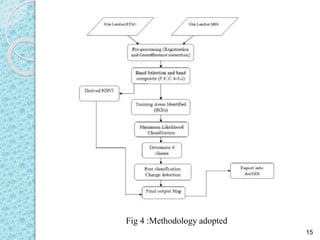
Fig 4 :Methodology adopted
15
Image preprocessing & classification
 Atmospheric & geometric corrections were applied for
images with image obtained on 3rd may 2002 as
reference.
 Supervised classification was performed & six classes
were identified. But in the present study two classes
have been assessed
16
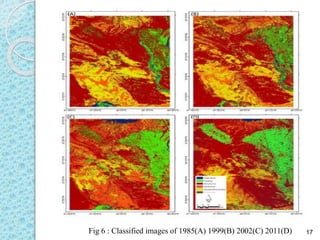
Fig 6 : Classified images of 1985(A) 1999(B) 2002(C) 2011(D) 17
Multi temporal classification :
The accuracy of the data for the years 1985, 1999, 2002, and 2011
was 76.83%, 82.84%, 76.74%, and 88.23% respectively.
The mean overall accuracy of classification was 81.16%
Table 2 : Area & percent of land cover area in study area
18
Class Percent % /area (ha)
1985 1999 2002 2011
1 1.56/207 2.13/277 3.04/15849 7.92/41325
2 4.52/5902 6.811/8681 13.6/35545 14.35/70887
3 49.5/64142 52.94/274033 43.16/58545 47.16/249637
4 7.14/9218 9.39/46432 14.25/19192 9.28/48443
5 25.61/33405 24.9/130275 7.34/9555 14.68/7735
6 11.46/14944 3.75/19530 6.65/22197 17.05/34684
Classes: 1 – Water body, 2 – Farming, 3 – Rangeland, 4 – Sand dune, 5 – Smooth
sand surface,6 – Farmland
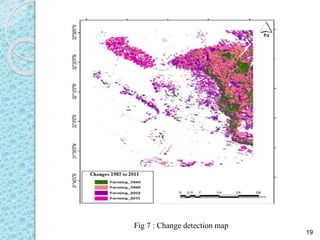
Fig 7 : Change detection map
19
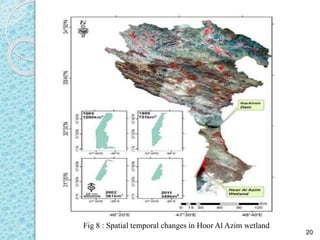
Fig 8 : Spatial temporal changes in Hoor Al Azim wetland
20
Case study 2
 Title : Remote Sensing & GIS based integrated study &
analysis for mangrove - wetland restoration in Ennore Creek,
Chennai, South India.
 Author : Chaves et.al (2008)
 Conference : The 12th World Lake Conference
 Objective : To study the wetland degradation & its factors.
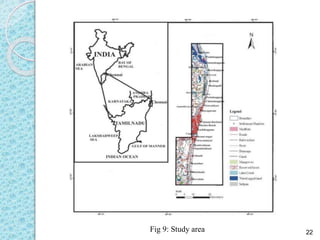
 Study area : Ennore creek is located 10 Km north of chennai
city between 130 11’10’’ to 130 15’00’’ north & longitudes 800
17’20’’ to 800 20’30’’
21
22Fig 9: Study area
Fig 10 : Methodology adopted
23
Image processing
 Image processing operations are essentially meant to
substitute visual analysis of remotely sensed data with
quantitative analysis.
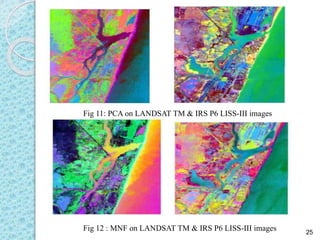
 The distinction between the features was achieved by
applying principal component analysis (PCA) &
minimum noise fraction analysis (MNF).
24
Fig 11: PCA on LANDSAT TM & IRS P6 LISS-III images
Fig 12 : MNF on LANDSAT TM & IRS P6 LISS-III images 25
26
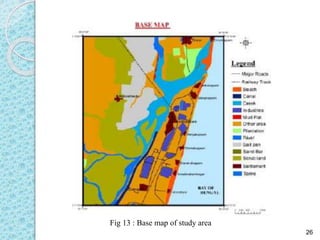
Fig 13 : Base map of study area
 A 3D model of the study
area was prepared by
draping the Landsat TM
false color composite of
bands 4,3 & 1 over the
Shuttle Radar
Topographic Mission
elevation data
Fig 15 :Area quantification map
27
Summary
 Multi temporal remote sensing data is complimentary to
wetland information extraction at a particular time &
monitoring change over a given period of time.
 The combined use of satellite data & ancillary data helps
to delineate coastal wetland boundary.
 GIS layers can be applied for wetland restoration.
28
References
 Birajdara, Samee Azmia, Arun Inamdara, Tutu Sengupta and A.K.
Sinha (2009) ISPRS Archives XXXVIII-8/W3 Workshop
Proceedings: Impact of Climate Change on Agriculture at
Ahmedabad, Dec 17-18 2009,381-385
 Chaves & Lakshumanan (2008) The 12th World lake conference at
Jaipur,29th oct-2nd Nov 2007,685-690
 Deka, Om Prakash Tripathi & Mohammad Latif Khan (2011)
Journal of wetlands ecology 5(4),40-47
29
 Ghobadi, Pradhan, Kabiri, Pirasteh, Shafri and Sayyad (2012)
IEEE colloquium humanities, science & engineering at Malaysia,
Dec 3-4 2012. Pg:103-108
 Li, Shifeng Huang, Ji-ren Li, Mei Xu (2007) Geoscience & Remote
sensing symposium at Barcelona , July 23-28 2007, 4607-4610
 Nagabhatla, C. M ax Finlayson and Sonali Seneratna Sellamuttu3
(2012) European journal of Remote sensing on wetland ecosystem,
45(3), 215-232
 Ozesmi and Marvin E. Bauer (2002) Journal on Wetlands Ecology
and Management, 10(5), 381-402
30

WETLAND MAPPING USING RS AND GIS

  • 1.
    Wetland mapping usingRS & GIS K Tharani 131863 1
  • 2.
    Contents  Introduction  Functionof wetlands  Remote sensing in wetland mapping  Literature review  Common methodology  Case studies  Summary  References 2
  • 3.
    Introduction  A wetlandis a land area which is completely saturated with water either permanently or seasonally.  The factor that distinguishes wetlands from other land forms or water bodies is the characteristic vegetation that is adapted to its unique soil conditions. Fig1:Amazon river basin 3
  • 4.
    Functions of wetland Flood control  Groundwater replenishment  Water purification  Shoreline stability  Climate change mitigation and adaptation  Recreation and tourism 4
  • 5.
    Remote sensing inwetland mapping  Satellite remote sensing can also provide information on surrounding land uses and their changes over time.  Current information on the uplands.  Remote sensing of wetlands started in 1972 with the launch of LANDSAT-1.  But due to low resolution of LANDSAT, LANDSAT TM is used for mapping of wetland changes.  Landsat TM bands 4 (near infrared), 5 (mid-infrared), and 3 (red) were most optimal for discriminating between land- water interface 5
  • 6.
    Contd.. Limitation is overlapof spectral signatures Fig 2 : Spectral signature plotted for red and infrared bands 6
  • 7.
    Some of thesatellites & sensors used  Landsat MSS  Landsat TM  Landsat ETM+  IRS P6 LISS III  Panchromatic & multispectral sensors in IKONOS 7
  • 8.
    Literature Review  Ozesmiet.al (2002) explained the classification techniques for wetland classification & identification.  Chaves et.al(2007) described the combined usage of satellite data & ancillary data for baseline inventory & also about wetland restoration.  Li et.al (2007) explained the change of the Yellow river delta wetlands. The result has significance for building & protecting eco- environment 8
  • 9.
     Jyotishman Dekaet.al (2011) suggested that usage of remotely sensed data for wetland mapping provides a cost effective method & spatio-temporal characteristics of wetlands in terms of change detection could serve as guiding tool, in conservation and prioritization of wetlands  Ghobadi et.al (2012) applied multi temporal remote sensing data & GIS techniques to monitor changes in wetlands.  Nidhi Nagabhatla et.al (2012) explained wetland delineation & mapping in coastal regions. The study reflects an approach for practical application of pro-supervised learning and pattern recognition for the multi-spectral earth observation data 9
  • 10.
    10 Topographic maps Satellite images Preparation of basemap & other maps Supervised/Unsu pervised classification Data input for GIS editing Change detection map Common Methodology
  • 11.
    Case study 1 Title : Use of Multi-Temporal Remote Sensing Data and GIS for Wetland Change Monitoring and Degradation.  Author : Ghobadi et.al (2012)  Journal : Institute of Electrical & Electronic Engineers  Objective: The main objective of this study is to assess the wetland change and degradation using multi-temporal satellite data, GIS and ancillary data in Hoor Al Azim wetland. 11
  • 12.
     Study area: The study area is located in the southwest of Iran bordering with Iraq and lies within the latitude 31°28′4″ N and longitude 47° 56′ 57″ E in north of the Persian Gulf. This wetland is mainly fed by Karkheh River Fig 3: Location of study area 12
  • 13.
    Data Data and informationon wetland and upstream, was extracted from Multispectral Scanner (MSS) image in 1985 and Enhance Thematic Mapper (ETM+) images of the years 1999, 2002, and 2011 13 Image Path/row Date of acquisition Season time Landsat 5 MSS 166/38 25/05/1985 Before harvesting Landsat 7 ETM+ 166/38 18/10/1999 Beginning of growth Landsat 7 ETM+ 166/38 03/05/2002 Before harvesting Landsat 7 ETM+ 166/38 03/10/2011 Beginning of growth
  • 14.
    Ancillary data Fig 5: Distribution of precipitation and evapotranspiration in the area 14
  • 15.
  • 16.
    Image preprocessing &classification  Atmospheric & geometric corrections were applied for images with image obtained on 3rd may 2002 as reference.  Supervised classification was performed & six classes were identified. But in the present study two classes have been assessed 16
  • 17.
    Fig 6 :Classified images of 1985(A) 1999(B) 2002(C) 2011(D) 17
  • 18.
    Multi temporal classification: The accuracy of the data for the years 1985, 1999, 2002, and 2011 was 76.83%, 82.84%, 76.74%, and 88.23% respectively. The mean overall accuracy of classification was 81.16% Table 2 : Area & percent of land cover area in study area 18 Class Percent % /area (ha) 1985 1999 2002 2011 1 1.56/207 2.13/277 3.04/15849 7.92/41325 2 4.52/5902 6.811/8681 13.6/35545 14.35/70887 3 49.5/64142 52.94/274033 43.16/58545 47.16/249637 4 7.14/9218 9.39/46432 14.25/19192 9.28/48443 5 25.61/33405 24.9/130275 7.34/9555 14.68/7735 6 11.46/14944 3.75/19530 6.65/22197 17.05/34684 Classes: 1 – Water body, 2 – Farming, 3 – Rangeland, 4 – Sand dune, 5 – Smooth sand surface,6 – Farmland
  • 19.
    Fig 7 :Change detection map 19
  • 20.
    Fig 8 :Spatial temporal changes in Hoor Al Azim wetland 20
  • 21.
    Case study 2 Title : Remote Sensing & GIS based integrated study & analysis for mangrove - wetland restoration in Ennore Creek, Chennai, South India.  Author : Chaves et.al (2008)  Conference : The 12th World Lake Conference  Objective : To study the wetland degradation & its factors.  Study area : Ennore creek is located 10 Km north of chennai city between 130 11’10’’ to 130 15’00’’ north & longitudes 800 17’20’’ to 800 20’30’’ 21
  • 22.
  • 23.
    Fig 10 :Methodology adopted 23
  • 24.
    Image processing  Imageprocessing operations are essentially meant to substitute visual analysis of remotely sensed data with quantitative analysis.  The distinction between the features was achieved by applying principal component analysis (PCA) & minimum noise fraction analysis (MNF). 24
  • 25.
    Fig 11: PCAon LANDSAT TM & IRS P6 LISS-III images Fig 12 : MNF on LANDSAT TM & IRS P6 LISS-III images 25
  • 26.
    26 Fig 13 :Base map of study area
  • 27.
     A 3Dmodel of the study area was prepared by draping the Landsat TM false color composite of bands 4,3 & 1 over the Shuttle Radar Topographic Mission elevation data Fig 15 :Area quantification map 27
  • 28.
    Summary  Multi temporalremote sensing data is complimentary to wetland information extraction at a particular time & monitoring change over a given period of time.  The combined use of satellite data & ancillary data helps to delineate coastal wetland boundary.  GIS layers can be applied for wetland restoration. 28
  • 29.
    References  Birajdara, SameeAzmia, Arun Inamdara, Tutu Sengupta and A.K. Sinha (2009) ISPRS Archives XXXVIII-8/W3 Workshop Proceedings: Impact of Climate Change on Agriculture at Ahmedabad, Dec 17-18 2009,381-385  Chaves & Lakshumanan (2008) The 12th World lake conference at Jaipur,29th oct-2nd Nov 2007,685-690  Deka, Om Prakash Tripathi & Mohammad Latif Khan (2011) Journal of wetlands ecology 5(4),40-47 29
  • 30.
     Ghobadi, Pradhan,Kabiri, Pirasteh, Shafri and Sayyad (2012) IEEE colloquium humanities, science & engineering at Malaysia, Dec 3-4 2012. Pg:103-108  Li, Shifeng Huang, Ji-ren Li, Mei Xu (2007) Geoscience & Remote sensing symposium at Barcelona , July 23-28 2007, 4607-4610  Nagabhatla, C. M ax Finlayson and Sonali Seneratna Sellamuttu3 (2012) European journal of Remote sensing on wetland ecosystem, 45(3), 215-232  Ozesmi and Marvin E. Bauer (2002) Journal on Wetlands Ecology and Management, 10(5), 381-402 30