USE OF REMOTE SENSING AND GIS FOR
MONITORING VECTOR-BORNE DISEASES
M.Janaki
M.Tech (Geoinformatics)
I year
Reg.No: 3318201
INTRODUCTION
 Vector-Borne diseases like Malaria, Dengue,
Chikungunya, Japanese Encephalitis are serious
problems for the developing worlds like Asia, Africa
and South America.
 How modern technology like remote sensing GIS is
used in identification of environmental factors
which affect the spread of vector-borne diseases.
OBJECTIVE
• To do epidemiological and ecological study to
determine the effect of temperature, rainfall, humidity,
forest cover and water bodies on the occurrence of
vector-borne diseases.
 To produce to risk map to predict and control the
occurrence of diseases.
 To use the latest technological advances like remote
sensing and GIS for risk assessment and diseases
prevention and to promote overall healthcare.
METHODOLOGY
 Multiple Linear Regression analysis using backward
elimination method was done to determine the
predictor variables affecting the presence and the
incidence of malaria.
 For disease mapping or prediction geostatistical or
variogram approaches are used.
 They have suggested usage of ordinary kriging to
interpolate disease prevalence as recorded values at
known locations.
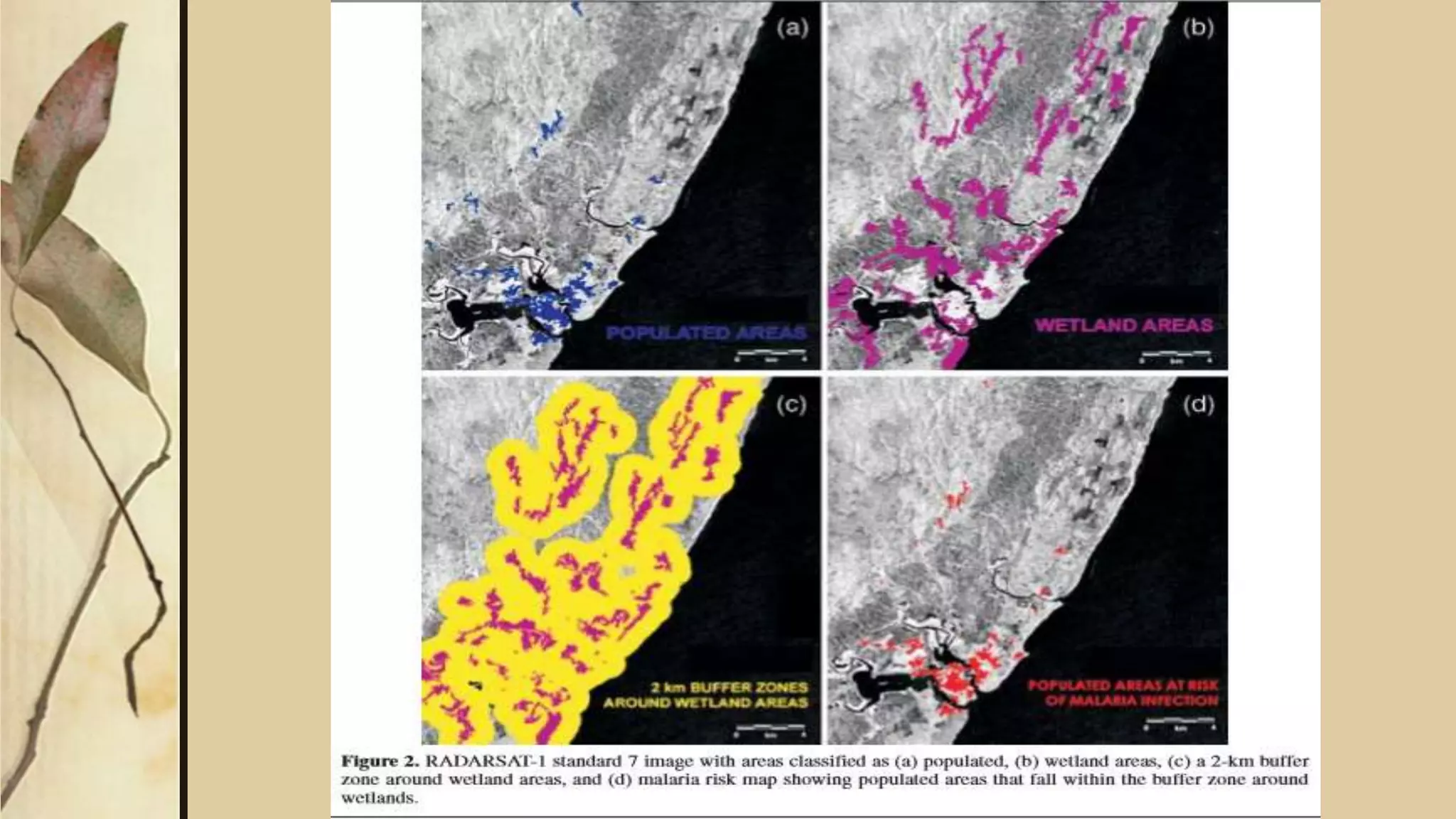
 This paper discusses RADARSAT – 1 image for malarial
risk mapping and advantages of using RADARSAT-2 in
future.
DATABASE
 Malarial case data were collected from the Directorate of Health
through various PHCs.
 Malarial positive cases were collected from 70 PHCs randomly
distributed on rural areas and for 4 urban areas (Salem, Mettur,
Attur and Edappadi).
 Villages with PHCs recorded with malarial cases were imported
into Mapinfo 6.0 to prepare thematic maps.
 Monthly meteorological data such as temperature, humidity and
rainfall of the study are collected from Department of
Meteorology, GOI.
 Forest, vegetation cover and water bodies corresponding to the
study are were extracted from IRS 1C LISS III remotely-sensed
images.
 Satellite data from RADARSAT-1 for coastal Kenya.
RESULTS
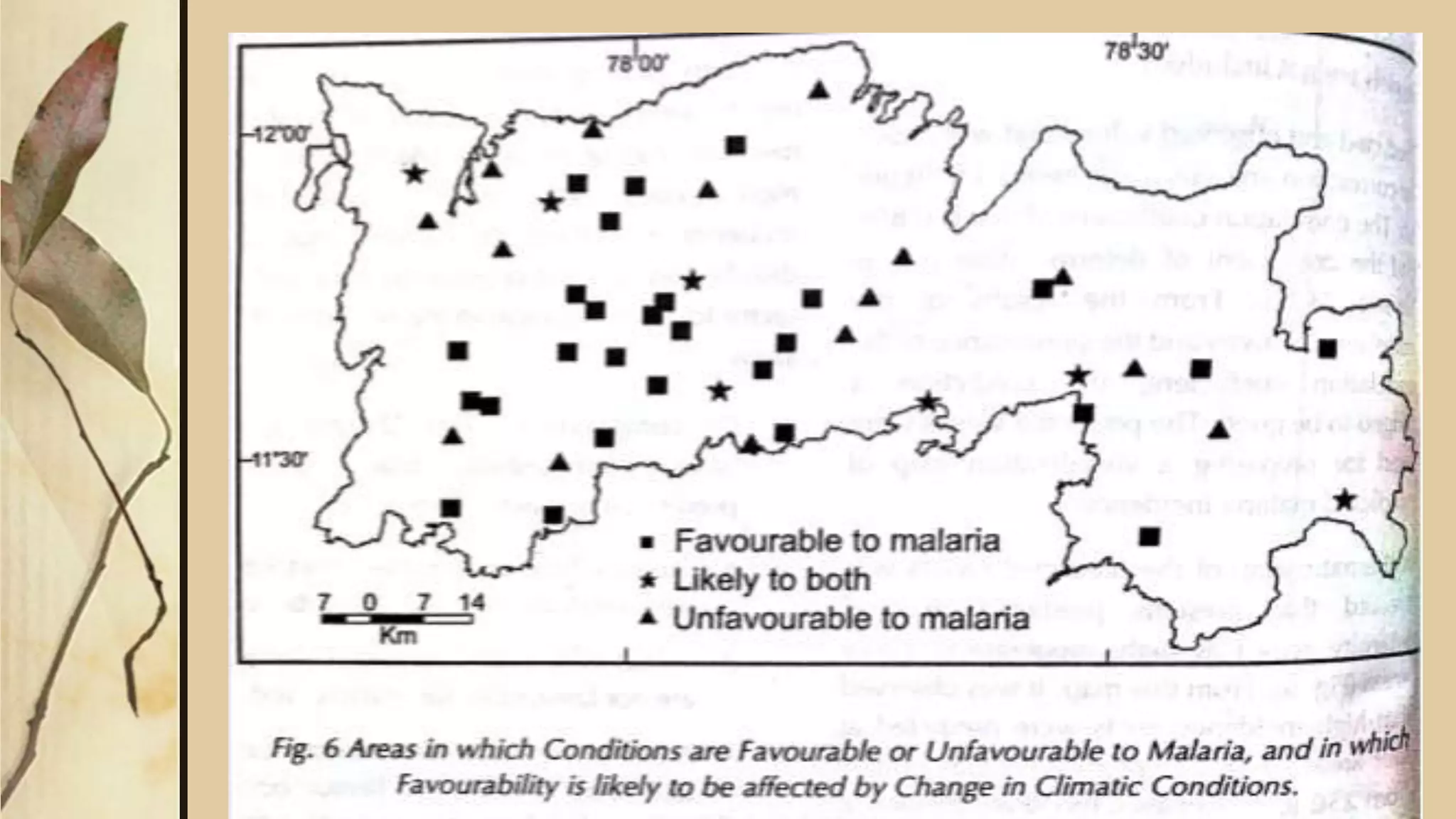
 In the first journal, the results show how temperature,
humidity, rainfall, vegetation cover and water bodies affect
the occurrence of malaria in the study area. They have
produced a prediction model which provides a detailed
mapping of high, medium and low incidence areas in Salem.
This map could be used for prediction and control of
malarial occurrences.
 In the third article, the results show the potential advantage
of radar remote sensing for classifying land covers
specifically as environmental variables relate to malaria
vector-breeding grounds. Radars are better suited because
of its capacity to penetrate clouds and haze and to image
both during day and night.
CONCLUSION
 From the three articles which were referred to we can understand
the effect of environmental factors like rainfall, humidity,
vegetation cover and water bodies on the occurrence of vector-
borne diseases especially malaria.
 We can also understand how remote sensing and GIS could be
used for risk mapping and prediction and promotion of health.
 We can also infer the advantage of using radar images as they
can be used under all weathers and not affected by presence of
clouds or haze.
 Finally, all this helps us understand how we can produce a risk
map of a particular study are for vector-borne diseases and how
this risk map could be used for prediction and prevention and
overall planning of disease control.
REFERENCES
 Use of Remote Sensing and GIS for monitoring Environmental factors associated
with Vector-Borne Disease [Indian Geographic Journal, June and December 2006,
Volume 81(1&2) ISSN 0019 – 4824 page number 47 – 60] (By M. Prasahanthi Devi
and Balasubramanian, Department of Environmental Sciences, Bharathiar
University, Coimbatore, India and B.Manickam, ISRO Head Quarters, Bangalore,
India).
 Spatial Temporal Analysis of Vector- Borne Diseases in Mysore District
[International Journal of Life Sciences, Vol.2 N.12013 pages 43 – 52 ISSN: 2227 –
193X] (By Minutha. V and Subhash.S.Sanasiddanannavar, Department of
Geography University of Mysore)
 Monitoring environmental indicators of Vector-Borne disease from space: a new
opportunity for RADARSAT – 2 [Canadian Journal of Remote Sensing, Vol. 30, No.3
pages: 560 – 565, 2004] (By S.Kaya, J. Sokol and T.J. Pultz).
 International conference on Globalisation and Sustainable Development
perspective of Digital Revolution and Environmental Management. [Aug 2002,
Vol.1 page : 23 – 25]
THANK YOU

Remote sensing and gis for monitoring vector borne diseases

  • 1.
    USE OF REMOTESENSING AND GIS FOR MONITORING VECTOR-BORNE DISEASES M.Janaki M.Tech (Geoinformatics) I year Reg.No: 3318201
  • 2.
    INTRODUCTION  Vector-Borne diseaseslike Malaria, Dengue, Chikungunya, Japanese Encephalitis are serious problems for the developing worlds like Asia, Africa and South America.  How modern technology like remote sensing GIS is used in identification of environmental factors which affect the spread of vector-borne diseases.
  • 3.
    OBJECTIVE • To doepidemiological and ecological study to determine the effect of temperature, rainfall, humidity, forest cover and water bodies on the occurrence of vector-borne diseases.  To produce to risk map to predict and control the occurrence of diseases.  To use the latest technological advances like remote sensing and GIS for risk assessment and diseases prevention and to promote overall healthcare.
  • 4.
    METHODOLOGY  Multiple LinearRegression analysis using backward elimination method was done to determine the predictor variables affecting the presence and the incidence of malaria.  For disease mapping or prediction geostatistical or variogram approaches are used.  They have suggested usage of ordinary kriging to interpolate disease prevalence as recorded values at known locations.  This paper discusses RADARSAT – 1 image for malarial risk mapping and advantages of using RADARSAT-2 in future.
  • 5.
    DATABASE  Malarial casedata were collected from the Directorate of Health through various PHCs.  Malarial positive cases were collected from 70 PHCs randomly distributed on rural areas and for 4 urban areas (Salem, Mettur, Attur and Edappadi).  Villages with PHCs recorded with malarial cases were imported into Mapinfo 6.0 to prepare thematic maps.  Monthly meteorological data such as temperature, humidity and rainfall of the study are collected from Department of Meteorology, GOI.  Forest, vegetation cover and water bodies corresponding to the study are were extracted from IRS 1C LISS III remotely-sensed images.  Satellite data from RADARSAT-1 for coastal Kenya.
  • 6.
    RESULTS  In thefirst journal, the results show how temperature, humidity, rainfall, vegetation cover and water bodies affect the occurrence of malaria in the study area. They have produced a prediction model which provides a detailed mapping of high, medium and low incidence areas in Salem. This map could be used for prediction and control of malarial occurrences.  In the third article, the results show the potential advantage of radar remote sensing for classifying land covers specifically as environmental variables relate to malaria vector-breeding grounds. Radars are better suited because of its capacity to penetrate clouds and haze and to image both during day and night.
  • 9.
    CONCLUSION  From thethree articles which were referred to we can understand the effect of environmental factors like rainfall, humidity, vegetation cover and water bodies on the occurrence of vector- borne diseases especially malaria.  We can also understand how remote sensing and GIS could be used for risk mapping and prediction and promotion of health.  We can also infer the advantage of using radar images as they can be used under all weathers and not affected by presence of clouds or haze.  Finally, all this helps us understand how we can produce a risk map of a particular study are for vector-borne diseases and how this risk map could be used for prediction and prevention and overall planning of disease control.
  • 10.
    REFERENCES  Use ofRemote Sensing and GIS for monitoring Environmental factors associated with Vector-Borne Disease [Indian Geographic Journal, June and December 2006, Volume 81(1&2) ISSN 0019 – 4824 page number 47 – 60] (By M. Prasahanthi Devi and Balasubramanian, Department of Environmental Sciences, Bharathiar University, Coimbatore, India and B.Manickam, ISRO Head Quarters, Bangalore, India).  Spatial Temporal Analysis of Vector- Borne Diseases in Mysore District [International Journal of Life Sciences, Vol.2 N.12013 pages 43 – 52 ISSN: 2227 – 193X] (By Minutha. V and Subhash.S.Sanasiddanannavar, Department of Geography University of Mysore)  Monitoring environmental indicators of Vector-Borne disease from space: a new opportunity for RADARSAT – 2 [Canadian Journal of Remote Sensing, Vol. 30, No.3 pages: 560 – 565, 2004] (By S.Kaya, J. Sokol and T.J. Pultz).  International conference on Globalisation and Sustainable Development perspective of Digital Revolution and Environmental Management. [Aug 2002, Vol.1 page : 23 – 25]
  • 11.