Geospatial Technology
Presented By:
Dr. Poonam Panwar
Associate Professor
Faculty of Agriculture
MM(DU), Mullana, Ambala, Haryana
Geospatial Technology
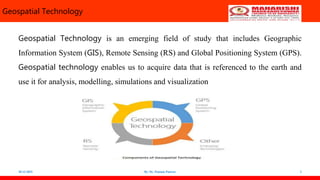
Geospatial Technology is an emerging field of study that includes Geographic
Information System (GIS), Remote Sensing (RS) and Global Positioning System (GPS).
Geospatial technology enables us to acquire data that is referenced to the earth and
use it for analysis, modelling, simulations and visualization
18-12-2022 By: Dr. Poonam Panwar 2
Role of geospatial technology in agriculture
• The application of new and contemporary information, geospatial and communication technologies
(ICTs) for rural and agricultural development in the Asia-Pacific region has been advancing quite rapidly
over the last decade.
• Geospatial technology is used mostly for surveying and mapping of plantation crops. Mapping of
rice is the major activity in countries like Malaysia and Indonesia.
• Australia is among the major users of geospatial technologies, whereas technologies like remote sensing
and GIS are most widely used for mapping of crops like sugarcane and oil palms.
• At the micro level implementation of geospatial tools is mainly used for mapping of ground water
resources, drainage patterns, variable rate application and management of fertilizers, pesticides
and insecticides. Geospatial technologies play an influential role in the agriculture sector by
increasing yields, managing of resources, prediction of outcomes and improving farm
practices.
18-12-2022 By: Dr. Poonam Panwar 3
Remote Sensing
• Remote sensing is the process of detecting and monitoring the physical characteristics
of an area by measuring its reflected and emitted radiation at a distance (typically
from satellite or aircraft).
• Remote: something which is not in physical contact
Something which is far away
Sensing: getting information, getting data
Any input: temp, pressure, Photograph
Sonography, x-ray = RS getting information without actually contact
18-12-2022 By: Dr. Poonam Panwar 4
Process of RS
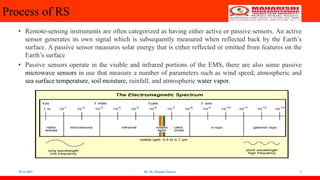
• Remote-sensing instruments are often categorized as having either active or passive sensors. An active
sensor generates its own signal which is subsequently measured when reflected back by the Earth’s
surface. A passive sensor measures solar energy that is either reflected or emitted from features on the
Earth’s surface
• Passive sensors operate in the visible and infrared portions of the EMS, there are also some passive
microwave sensors in use that measure a number of parameters such as wind speed, atmospheric and
sea surface temperature, soil moisture, rainfall, and atmospheric water vapor.
18-12-2022 By: Dr. Poonam Panwar 5
Process of RS
• An advantage of passive sensors is that most rely on the Sun’s energy to illuminate the target and
therefore do not need their own energy source so in general they are simpler instruments. A
limitation for most passive optical sensors is that they require daylight to operate, although there are
some sensors that record night time lights and clouds at night and others that record energy emitted
from the Earth’s surface.
• Since most of these sensors operate in the visible and infrared wavelengths, they are adversely
affected by weather and cloud cover.
• Since sunlight is primarily reflected from the top of a feature, such as a forest, it is not
possible to ‘see’ under a canopy to measure vegetation structure. To obtain this kind of
information it is necessary to use active sensors.
18-12-2022 By: Dr. Poonam Panwar 6
Process of RS
• Active sensors, such as radar and lidar emit their own energy to illuminate a target and are comprised of a signal
generator and receiver. They measure the strength of the returned signal and the time delay between when the
instrument emits the energy and when it receives the returned pulse. These two types of information are used to
describe vegetation structure. Radar is an acronym for ‘radio detection and ranging’. Radar systems operate in
the long-wavelength microwave portion of the EMS and thus are largely unaffected by clouds and rain
• Primary need: a source illumination
Light, infrared, radar thermal infrared
The incoming Sun energy is absorbing or reflecting by the earth,
• A reflecting energy would be detected by a sensor fit onboard the satellite, air craft or drone, then it is sent to
ground station and download at processing centre, some primary correction done, digital data available area
about to be infected by diseases send to the end user for town planner or for the urban development
18-12-2022 By: Dr. Poonam Panwar 7
Process of RS
18-12-2022 By: Dr. Poonam Panwar 8
Remote sensing applications in
agriculture
1. Crop identification
2. Crop acreage estimation
3. Crop condition assessment and stress detection
4. Identification of planting and harvesting dates
5. Crop yield modelling and estimation
6. Identification of pest and disease infestation.
7. Irrigation monitoring and management
8. Soil mapping
9. Monitoring of droughts
10. Land cover and land degradation mapping
11. Identification of problematic soils
18-12-2022 By: Dr. Poonam Panwar 9
Who needs remote sensing for
agriculture?
Govt. authorities or local agencies can use remote sensing data, in order to make important decisions
about the policies they will adopt or measures to tackle national issues regarding agriculture. Individual
farmers can also receive useful information from remote sensing images, when dealing with their
individual crops, about their health status and how to deal with any problems
18-12-2022 By: Dr. Poonam Panwar 10
Remotely sensed images can be used to
identify
 nutrient deficiencies
 diseases
 water deficiency or surplus
 weed infestations
 insect damage
 wind damage
 herbicide damage
 plant populations
18-12-2022 By: Dr. Poonam Panwar 11
Example
THE IMAGES ABOVE WERE ACQUIRED BY THE DAEDALUS SENSOR ABOARD A NASA AIRCRAFT FLYING OVER THE MARICOPA
AGRICULTURAL CENTER IN ARIZONA ON JANUARY 30, 2001.
18-12-2022 By: Dr. Poonam Panwar 12
PROBLEMS ON REMOTE SENSING FOR INDIAN
CONDITION
Small Size Of Plots
Diversity Of Crops Sown In A Particular Area
Variability Of Sowing & Harvesting Dates In Different Fields
Inter Cropping & Mixed Cropping Practices
Diverse Geographical Conditions hence more Cloudiness
18-12-2022 By: Dr. Poonam Panwar 13
ISRO
18-12-2022 By: Dr. Poonam Panwar 14
GIS
• Geographic Information System
• Geographic- location with specific data and any object on the earth can be defined, or can be associated
with Geographic coordinates which we know as latitude longitude.
• Term given by Roger Tomlinson-father of GIS
• GIS is a computer based information system designed to accept large volume of spatial data-
• a large data set can come into GIS data base and then can analyze in a very easily manner derived from
variety of source and to efficiently store, retrieve, analyze, model and display (output) these data
accordingly to user
• Spatial data, also known as geospatial data, is a term used to describe any data related to or containing
information about a specific location on the Earth's surface.
18-12-2022 By: Dr. Poonam Panwar 15
GIS
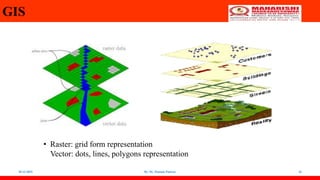
• Raster: grid form representation
Vector: dots, lines, polygons representation
18-12-2022 By: Dr. Poonam Panwar 16
GIS
18-12-2022 By: Dr. Poonam Panwar 17
Application of GIS in various farm
operations
18-12-2022 By: Dr. Poonam Panwar 18
GIS
• GIS is identified as a system used to manage infrastructure assets, natural resources
and any objects as per requirement. It is easier to analyse and manage facility and
asset data stored in GIS, making design, construction, and maintenance more efficient
and profitable.
• To identify the potential land for any particular crop, GIS is the best technique as it
brings all the data on a single platform for the analysis. Different vegetation indices
are widely used to monitor crop health which is also directly proportional to yield.
• In case of crop insurance, actual damage can be assessed. Claims and compensations
can be given on fair basis. To monitor crop health, its growth and production various
factors come into play such as temperature, irrigation facilities and the most important
soil health condition
18-12-2022 By: Dr. Poonam Panwar 19
Example of GIS
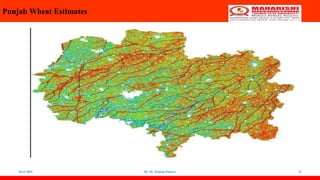
• Punjab Wheat Estimates
• GIS cartographers also use satellite and remote-sensing data to explore patterns and
relationships. Here, such digital data offers estimates of average wheat yields in the
Punjab region of India for 2000-2008.
• Red shows areas with highest yields, blue shows lowest yields, and white are non-
wheat areas (e.g. towns). Black lines show the location of major surface water
canals, where yields tend to be higher
18-12-2022 By: Dr. Poonam Panwar 20
Punjab Wheat Estimates
18-12-2022 By: Dr. Poonam Panwar 21
Twilight of the Arctic Ice
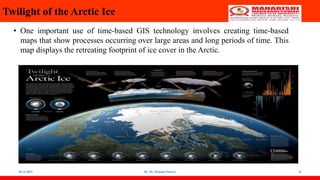
• One important use of time-based GIS technology involves creating time-based
maps that show processes occurring over large areas and long periods of time. This
map displays the retreating footprint of ice cover in the Arctic.
18-12-2022 By: Dr. Poonam Panwar 22
GPS
• Global Positioning System
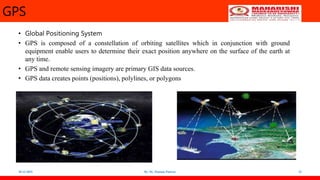
• GPS is composed of a constellation of orbiting satellites which in conjunction with ground
equipment enable users to determine their exact position anywhere on the surface of the earth at
any time.
• GPS and remote sensing imagery are primary GIS data sources.
• GPS data creates points (positions), polylines, or polygons
18-12-2022 By: Dr. Poonam Panwar 23
GPS Applications
• Field preparation, Planting and
Cultivation
• Fertilizing and Crop Protection
• Mapping, Scouting, and
Sampling
• Harvesting
• Planning and Analysis
18-12-2022 By: Dr. Poonam Panwar 24
GPS Use in Agriculture:
Tractor Guidance
Crop duster Targeting
Tracking Livestock
Yield monitoring
Soil sampling
GIS...the management center for GPS collected data..
• Application:
Creating Yield Maps...
18-12-2022 By: Dr. Poonam Panwar 25
GPS Applications
• Harvesting: Once the final step in farming, it has become another in a series of
cyclical procedures that makeup Precision Farming.
• Yield Monitors: are counters that take volume measurements on harvested material.
• Location: The location of measured yield is obtained by mounting a GPS receiver to a
combine.
• Yield map: Volume measurements combined with their exact geographic locations,
and input into a GIS package, produce a Yield Map providing a picture of the results
based on earlier decisions. This is a powerful tool for forecasting future needs, which
will lead to increased quality and quantity of yield.
18-12-2022 By: Dr. Poonam Panwar 26
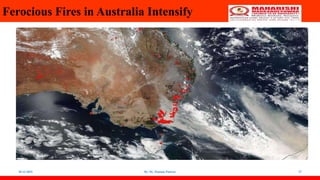
Ferocious Fires in Australia Intensify
18-12-2022 By: Dr. Poonam Panwar 27
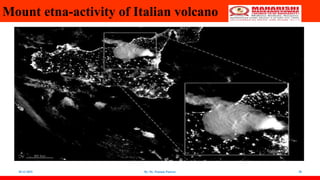
Mount etna-activity of Italian volcano
18-12-2022 By: Dr. Poonam Panwar 28
Changing colors of the river in USA
18-12-2022 By: Dr. Poonam Panwar 29
What is Precision Agriculture?
Precision agriculture, or precision farming, is therefore a farming concept that utilizes geographical
information to determine field variability to ensure optimal use of inputs and maximize the output from a
farm. Precision agriculture gained popularity after the realization that diverse fields of land hold different
properties. Large tracts of land usually have spatial variations of soils types, moisture content, nutrient
availability and soon. Therefore, with the use of remote sensing, geographical information systems
(GIS) and global positioning systems (GPS), farmers can more precisely determine what inputs to
put exactly where and with what quantities. This information helps farmers to effectively use expensive
resources such as fertilizers, pesticides and herbicides, and more efficiently use water resources. In the end,
farmers who use this method not only maximize on their yields but also reduce their operating expenses,
thus increasing their profits.
18-12-2022 By: Dr. Poonam Panwar 30
Precision agriculture cycle
18-12-2022 By: Dr. Poonam Panwar 31
Conclusion
 Recent developments in remote sensing and GIS hold much promise to enhance integrated management of
all available information and the extraction of desired information to promote sustainable agriculture and
development.
 GIS is considered one of the important tools for decision making in problem solving environment dealing
with geo-information.
 Remotely sensed images can be used to identify nutrient deficiencies, diseases, water deficiency or surplus,
weed infestations, insect damage, hail damage, wind damage, herbicide damage, and plant populations.
 Sustainable utilization of land resources.
 Remote Sensing and GIS technology is very effective tool for suggesting action plans /management
strategies for agricultural sustainability of any region.
18-12-2022 By: Dr. Poonam Panwar 32
Conclusion
 The decision makers can visualize all the farmlands with their allied information and current situation on
one click.
 The tasks like yield estimation & crop damage assessment done by traditional means
 take month or two and a whole lot of manpower to complete the work. By using these technologies the
same task can be completed within half or even in lesser time frame with minimum number of resources
and high accuracy.
 Balancing the inputs and outputs on a crop farm is essential to its success and cost- effectiveness. The
ability of GIS to study agricultural environments and workflows has proved to be favourable to those
involved in the farming industry. While natural inputs in farming cannot be measured but, can be better
understood and managed with GIS applications such as crop yield estimates, soil amendment analysis,
erosion identification and remediation.
18-12-2022 By: Dr. Poonam Panwar 33
Thank You
18-12-2022 By: Dr. Poonam Panwar 34

geospatial technology.pptx

  • 1.
    Geospatial Technology Presented By: Dr.Poonam Panwar Associate Professor Faculty of Agriculture MM(DU), Mullana, Ambala, Haryana
  • 2.
    Geospatial Technology Geospatial Technologyis an emerging field of study that includes Geographic Information System (GIS), Remote Sensing (RS) and Global Positioning System (GPS). Geospatial technology enables us to acquire data that is referenced to the earth and use it for analysis, modelling, simulations and visualization 18-12-2022 By: Dr. Poonam Panwar 2
  • 3.
    Role of geospatialtechnology in agriculture • The application of new and contemporary information, geospatial and communication technologies (ICTs) for rural and agricultural development in the Asia-Pacific region has been advancing quite rapidly over the last decade. • Geospatial technology is used mostly for surveying and mapping of plantation crops. Mapping of rice is the major activity in countries like Malaysia and Indonesia. • Australia is among the major users of geospatial technologies, whereas technologies like remote sensing and GIS are most widely used for mapping of crops like sugarcane and oil palms. • At the micro level implementation of geospatial tools is mainly used for mapping of ground water resources, drainage patterns, variable rate application and management of fertilizers, pesticides and insecticides. Geospatial technologies play an influential role in the agriculture sector by increasing yields, managing of resources, prediction of outcomes and improving farm practices. 18-12-2022 By: Dr. Poonam Panwar 3
  • 4.
    Remote Sensing • Remotesensing is the process of detecting and monitoring the physical characteristics of an area by measuring its reflected and emitted radiation at a distance (typically from satellite or aircraft). • Remote: something which is not in physical contact Something which is far away Sensing: getting information, getting data Any input: temp, pressure, Photograph Sonography, x-ray = RS getting information without actually contact 18-12-2022 By: Dr. Poonam Panwar 4
  • 5.
    Process of RS •Remote-sensing instruments are often categorized as having either active or passive sensors. An active sensor generates its own signal which is subsequently measured when reflected back by the Earth’s surface. A passive sensor measures solar energy that is either reflected or emitted from features on the Earth’s surface • Passive sensors operate in the visible and infrared portions of the EMS, there are also some passive microwave sensors in use that measure a number of parameters such as wind speed, atmospheric and sea surface temperature, soil moisture, rainfall, and atmospheric water vapor. 18-12-2022 By: Dr. Poonam Panwar 5
  • 6.
    Process of RS •An advantage of passive sensors is that most rely on the Sun’s energy to illuminate the target and therefore do not need their own energy source so in general they are simpler instruments. A limitation for most passive optical sensors is that they require daylight to operate, although there are some sensors that record night time lights and clouds at night and others that record energy emitted from the Earth’s surface. • Since most of these sensors operate in the visible and infrared wavelengths, they are adversely affected by weather and cloud cover. • Since sunlight is primarily reflected from the top of a feature, such as a forest, it is not possible to ‘see’ under a canopy to measure vegetation structure. To obtain this kind of information it is necessary to use active sensors. 18-12-2022 By: Dr. Poonam Panwar 6
  • 7.
    Process of RS •Active sensors, such as radar and lidar emit their own energy to illuminate a target and are comprised of a signal generator and receiver. They measure the strength of the returned signal and the time delay between when the instrument emits the energy and when it receives the returned pulse. These two types of information are used to describe vegetation structure. Radar is an acronym for ‘radio detection and ranging’. Radar systems operate in the long-wavelength microwave portion of the EMS and thus are largely unaffected by clouds and rain • Primary need: a source illumination Light, infrared, radar thermal infrared The incoming Sun energy is absorbing or reflecting by the earth, • A reflecting energy would be detected by a sensor fit onboard the satellite, air craft or drone, then it is sent to ground station and download at processing centre, some primary correction done, digital data available area about to be infected by diseases send to the end user for town planner or for the urban development 18-12-2022 By: Dr. Poonam Panwar 7
  • 8.
    Process of RS 18-12-2022By: Dr. Poonam Panwar 8
  • 9.
    Remote sensing applicationsin agriculture 1. Crop identification 2. Crop acreage estimation 3. Crop condition assessment and stress detection 4. Identification of planting and harvesting dates 5. Crop yield modelling and estimation 6. Identification of pest and disease infestation. 7. Irrigation monitoring and management 8. Soil mapping 9. Monitoring of droughts 10. Land cover and land degradation mapping 11. Identification of problematic soils 18-12-2022 By: Dr. Poonam Panwar 9
  • 10.
    Who needs remotesensing for agriculture? Govt. authorities or local agencies can use remote sensing data, in order to make important decisions about the policies they will adopt or measures to tackle national issues regarding agriculture. Individual farmers can also receive useful information from remote sensing images, when dealing with their individual crops, about their health status and how to deal with any problems 18-12-2022 By: Dr. Poonam Panwar 10
  • 11.
    Remotely sensed imagescan be used to identify  nutrient deficiencies  diseases  water deficiency or surplus  weed infestations  insect damage  wind damage  herbicide damage  plant populations 18-12-2022 By: Dr. Poonam Panwar 11
  • 12.
    Example THE IMAGES ABOVEWERE ACQUIRED BY THE DAEDALUS SENSOR ABOARD A NASA AIRCRAFT FLYING OVER THE MARICOPA AGRICULTURAL CENTER IN ARIZONA ON JANUARY 30, 2001. 18-12-2022 By: Dr. Poonam Panwar 12
  • 13.
    PROBLEMS ON REMOTESENSING FOR INDIAN CONDITION Small Size Of Plots Diversity Of Crops Sown In A Particular Area Variability Of Sowing & Harvesting Dates In Different Fields Inter Cropping & Mixed Cropping Practices Diverse Geographical Conditions hence more Cloudiness 18-12-2022 By: Dr. Poonam Panwar 13
  • 14.
    ISRO 18-12-2022 By: Dr.Poonam Panwar 14
  • 15.
    GIS • Geographic InformationSystem • Geographic- location with specific data and any object on the earth can be defined, or can be associated with Geographic coordinates which we know as latitude longitude. • Term given by Roger Tomlinson-father of GIS • GIS is a computer based information system designed to accept large volume of spatial data- • a large data set can come into GIS data base and then can analyze in a very easily manner derived from variety of source and to efficiently store, retrieve, analyze, model and display (output) these data accordingly to user • Spatial data, also known as geospatial data, is a term used to describe any data related to or containing information about a specific location on the Earth's surface. 18-12-2022 By: Dr. Poonam Panwar 15
  • 16.
    GIS • Raster: gridform representation Vector: dots, lines, polygons representation 18-12-2022 By: Dr. Poonam Panwar 16
  • 17.
    GIS 18-12-2022 By: Dr.Poonam Panwar 17
  • 18.
    Application of GISin various farm operations 18-12-2022 By: Dr. Poonam Panwar 18
  • 19.
    GIS • GIS isidentified as a system used to manage infrastructure assets, natural resources and any objects as per requirement. It is easier to analyse and manage facility and asset data stored in GIS, making design, construction, and maintenance more efficient and profitable. • To identify the potential land for any particular crop, GIS is the best technique as it brings all the data on a single platform for the analysis. Different vegetation indices are widely used to monitor crop health which is also directly proportional to yield. • In case of crop insurance, actual damage can be assessed. Claims and compensations can be given on fair basis. To monitor crop health, its growth and production various factors come into play such as temperature, irrigation facilities and the most important soil health condition 18-12-2022 By: Dr. Poonam Panwar 19
  • 20.
    Example of GIS •Punjab Wheat Estimates • GIS cartographers also use satellite and remote-sensing data to explore patterns and relationships. Here, such digital data offers estimates of average wheat yields in the Punjab region of India for 2000-2008. • Red shows areas with highest yields, blue shows lowest yields, and white are non- wheat areas (e.g. towns). Black lines show the location of major surface water canals, where yields tend to be higher 18-12-2022 By: Dr. Poonam Panwar 20
  • 21.
    Punjab Wheat Estimates 18-12-2022By: Dr. Poonam Panwar 21
  • 22.
    Twilight of theArctic Ice • One important use of time-based GIS technology involves creating time-based maps that show processes occurring over large areas and long periods of time. This map displays the retreating footprint of ice cover in the Arctic. 18-12-2022 By: Dr. Poonam Panwar 22
  • 23.
    GPS • Global PositioningSystem • GPS is composed of a constellation of orbiting satellites which in conjunction with ground equipment enable users to determine their exact position anywhere on the surface of the earth at any time. • GPS and remote sensing imagery are primary GIS data sources. • GPS data creates points (positions), polylines, or polygons 18-12-2022 By: Dr. Poonam Panwar 23
  • 24.
    GPS Applications • Fieldpreparation, Planting and Cultivation • Fertilizing and Crop Protection • Mapping, Scouting, and Sampling • Harvesting • Planning and Analysis 18-12-2022 By: Dr. Poonam Panwar 24 GPS Use in Agriculture: Tractor Guidance Crop duster Targeting Tracking Livestock Yield monitoring Soil sampling
  • 25.
    GIS...the management centerfor GPS collected data.. • Application: Creating Yield Maps... 18-12-2022 By: Dr. Poonam Panwar 25
  • 26.
    GPS Applications • Harvesting:Once the final step in farming, it has become another in a series of cyclical procedures that makeup Precision Farming. • Yield Monitors: are counters that take volume measurements on harvested material. • Location: The location of measured yield is obtained by mounting a GPS receiver to a combine. • Yield map: Volume measurements combined with their exact geographic locations, and input into a GIS package, produce a Yield Map providing a picture of the results based on earlier decisions. This is a powerful tool for forecasting future needs, which will lead to increased quality and quantity of yield. 18-12-2022 By: Dr. Poonam Panwar 26
  • 27.
    Ferocious Fires inAustralia Intensify 18-12-2022 By: Dr. Poonam Panwar 27
  • 28.
    Mount etna-activity ofItalian volcano 18-12-2022 By: Dr. Poonam Panwar 28
  • 29.
    Changing colors ofthe river in USA 18-12-2022 By: Dr. Poonam Panwar 29
  • 30.
    What is PrecisionAgriculture? Precision agriculture, or precision farming, is therefore a farming concept that utilizes geographical information to determine field variability to ensure optimal use of inputs and maximize the output from a farm. Precision agriculture gained popularity after the realization that diverse fields of land hold different properties. Large tracts of land usually have spatial variations of soils types, moisture content, nutrient availability and soon. Therefore, with the use of remote sensing, geographical information systems (GIS) and global positioning systems (GPS), farmers can more precisely determine what inputs to put exactly where and with what quantities. This information helps farmers to effectively use expensive resources such as fertilizers, pesticides and herbicides, and more efficiently use water resources. In the end, farmers who use this method not only maximize on their yields but also reduce their operating expenses, thus increasing their profits. 18-12-2022 By: Dr. Poonam Panwar 30
  • 31.
  • 32.
    Conclusion  Recent developmentsin remote sensing and GIS hold much promise to enhance integrated management of all available information and the extraction of desired information to promote sustainable agriculture and development.  GIS is considered one of the important tools for decision making in problem solving environment dealing with geo-information.  Remotely sensed images can be used to identify nutrient deficiencies, diseases, water deficiency or surplus, weed infestations, insect damage, hail damage, wind damage, herbicide damage, and plant populations.  Sustainable utilization of land resources.  Remote Sensing and GIS technology is very effective tool for suggesting action plans /management strategies for agricultural sustainability of any region. 18-12-2022 By: Dr. Poonam Panwar 32
  • 33.
    Conclusion  The decisionmakers can visualize all the farmlands with their allied information and current situation on one click.  The tasks like yield estimation & crop damage assessment done by traditional means  take month or two and a whole lot of manpower to complete the work. By using these technologies the same task can be completed within half or even in lesser time frame with minimum number of resources and high accuracy.  Balancing the inputs and outputs on a crop farm is essential to its success and cost- effectiveness. The ability of GIS to study agricultural environments and workflows has proved to be favourable to those involved in the farming industry. While natural inputs in farming cannot be measured but, can be better understood and managed with GIS applications such as crop yield estimates, soil amendment analysis, erosion identification and remediation. 18-12-2022 By: Dr. Poonam Panwar 33
  • 34.
    Thank You 18-12-2022 By:Dr. Poonam Panwar 34