@
Andrew Santoro Development Manager
Peter Connolly Application Architect
Ivan Ukolov Architect/Implementation Lead April 2015
Agenda
• Background/Problem Statement
• Options
• Migration
• Data Models
• Performance
• Retrospectives
• Future plans
• Video
Background & Problem Statement
About Us
- Real-time RESTful data services application
- Serve product, inventory and store data to
website, mobile, store, and partner applications
- Not “Big Data” or Analytics
- Growth in business lead us to want:
- 10x growth in data
- Move from a read-mostly model to one which
could handle near-real-time updates
- Move into multiple data centers
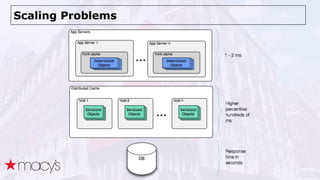
Scaling Problems
Operational Problems
- Prewarming step was a prerequisite to satisfy
performance SLA
- Maintained second data grid for failover scenario
- hard to keep those consistent
- complicated release process
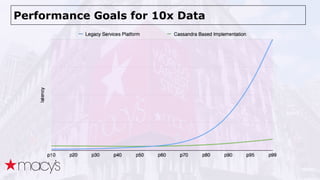
Performance Goals for 10x Data
Options Explored
Options Evaluated
- Denormalized Relational DB: DB2
- Document DB: MongoDB
- Columnar DB: Cassandra, Couchbase,
ActiveSpaces
- Graph: Neo4J
- Object: Versant
Options Short List
- MongoDB
- Feature-rich, JSON document DB
- Cassandra
- Scalable, true peer-to-peer
- ActiveSpaces
- TIBCO Proprietary
- Existing relationship with TIBCO
- In-memory key/value datagrid
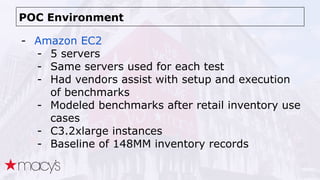
POC Environment
- Amazon EC2
- 5 servers
- Same servers used for each test
- Had vendors assist with setup and execution
of benchmarks
- Modeled benchmarks after retail inventory use
cases
- C3.2xlarge instances
- Baseline of 148MM inventory records
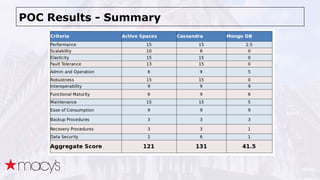
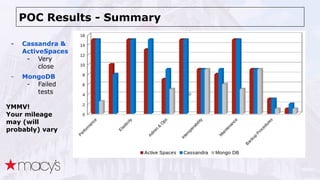
POC Results - Summary
- Cassandra &
ActiveSpaces
- Very
close
- MongoDB
- Failed
tests
YMMV!
Your mileage
may (will
probably) vary
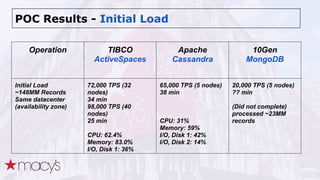
POC Results - Initial Load
Operation TIBCO
ActiveSpaces
Apache
Cassandra
10Gen
MongoDB
Initial Load
~148MM Records
Same datacenter
(availability zone)
72,000 TPS (32
nodes)
34 min
98,000 TPS (40
nodes)
25 min
CPU: 62.4%
Memory: 83.0%
I/O, Disk 1: 36%
I/O, Disk 2: 35%
65,000 TPS (5 nodes)
38 min
CPU: 31%
Memory: 59%
I/O, Disk 1: 42%
I/O, Disk 2: 14%
20,000 TPS (5 nodes)
?? min
(Did not complete)
processed ~23MM
records
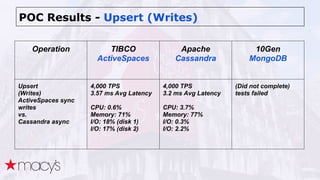
POC Results - Upsert (Writes)
Operation TIBCO
ActiveSpaces
Apache
Cassandra
10Gen
MongoDB
Upsert
(Writes)
ActiveSpaces sync
writes
vs.
Cassandra async
4,000 TPS
3.57 ms Avg Latency
CPU: 0.6%
Memory: 71%
I/O: 18% (disk 1)
I/O: 17% (disk 2)
4,000 TPS
3.2 ms Avg Latency
CPU: 3.7%
Memory: 77%
I/O: 0.3%
I/O: 2.2%
(Did not complete)
tests failed
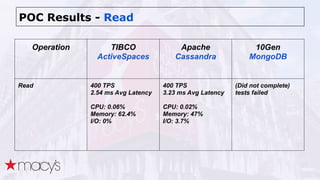
POC Results - Read
Operation TIBCO
ActiveSpaces
Apache
Cassandra
10Gen
MongoDB
Read 400 TPS
2.54 ms Avg Latency
CPU: 0.06%
Memory: 62.4%
I/O: 0%
400 TPS
3.23 ms Avg Latency
CPU: 0.02%
Memory: 47%
I/O: 3.7%
(Did not complete)
tests failed
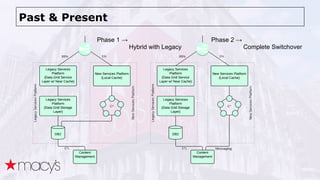
Migration Path
Past & Present
Phase 1 → 

Hybrid with Legacy
Phase 2 → 

Complete Switchover
Data Models
Data Model Requirements
- Model hierarchical domain objects
- Aggregate data to minimize reads
- No reads before writes
- Readable by 3rd party tools
(cqlsh, Dev Center)
Data Model based on Lists
id | name | upcId | upcColor | upcAttrId | upcAttrName | upcAttrValue | upcAttrRefId
----+----------------+-----------+---------------------+-----------------+---------------------------------------------------+---------------------+--------------
11 | Nike Pants | [22, 33] | ['White', 'Red'] | [44, 55, 66] | ['ACTIVE', 'PROMOTION', 'ACTIVE'] | ['Y', 'Y', 'N'] | [22, 22, 33]
Data Model based on Maps
id | name | upcColor | upcAttrName | upcAttrValue | upcAttrRefId
----+----------------+--------------------------------+-------------------------------------------------------------------+--------------------------------+--------------------------
11 | Nike Pants | {22: 'White', 33: 'Red'} | {44: 'ACTIVE', 55: 'PROMOTION', 66: 'ACTIVE'} | {44: 'Y', 55: 'Y', 66: 'N'} | {44: 22, 55: 22, 66:
33}
Collection Size Limits
- Native protocol v2
- collection max size is 64K
- collection element max size is 64K
- Native protocol v3
- the collection size and the length of each
element is 4 bytes long now
- still 64K limit for set element max size and
map key max size
https://github.com/apache/cassandra/blob/trunk/doc/native_protocol_v3.spec
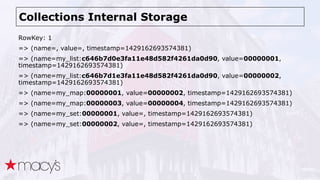
Collections Internal Storage
CREATE TABLE collections (
my_key int PRIMARY KEY,
my_set set<int>,
my_map map<int, int>,
my_list list<int>,
);
INSERT INTO collections
(my_key, my_set, my_map, my_list)
VALUES ( 1, {1, 2}, {1:2, 3:4}, [1, 2]);
SELECT * FROM collections ;
my_key | my_list | my_map | my_set
-------------+----------+---------------+--------
1 | [1, 2] | {1: 2, 3: 4} | {1, 2}
Collections Internal Storage
RowKey: 1
=> (name=, value=, timestamp=1429162693574381)
=> (name=my_list:c646b7d0e3fa11e48d582f4261da0d90, value=00000001,
timestamp=1429162693574381)
=> (name=my_list:c646b7d1e3fa11e48d582f4261da0d90, value=00000002,
timestamp=1429162693574381)
=> (name=my_map:00000001, value=00000002, timestamp=1429162693574381)
=> (name=my_map:00000003, value=00000004, timestamp=1429162693574381)
=> (name=my_set:00000001, value=, timestamp=1429162693574381)
=> (name=my_set:00000002, value=, timestamp=1429162693574381)
Data Model based on Compound Key & JSON
CREATE TABLE product (
id int, -- product id

upcId int, -- 0 means product row,
-- otherwise upc id indicating it is upc row
object text, -- JSON object
review text, -- JSON object
PRIMARY KEY(id, upcId)
);
id | upcId | object | review
----+--------+------------------------------------------------------------------------------------------------------------+--------------------------------------
11 | 0 | {"id" : "11", "name" : "Nike Pants"} | {"avgRating" : "5", "count" : "567"}
11 | 22 | {"color" : "White", "attr" : [{"id": "44", "name": "ACTIVE", "value": "Y"}, ...]} | null
11 | 33 | {"color" : "Red", "attr" : [{"id": "66", "name": "ACTIVE", "value": "N"}]} | null
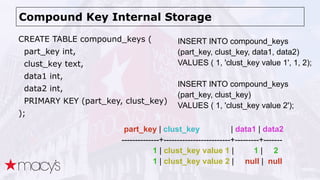
Compound Key Internal Storage
CREATE TABLE compound_keys (
part_key int,
clust_key text,
data1 int,
data2 int,
PRIMARY KEY (part_key, clust_key)
);
INSERT INTO compound_keys
(part_key, clust_key, data1, data2)
VALUES ( 1, 'clust_key value 1', 1, 2);
INSERT INTO compound_keys
(part_key, clust_key)
VALUES ( 1, 'clust_key value 2');
part_key | clust_key | data1 | data2
--------------+-------------------------+---------+-------
1 | clust_key value 1 | 1 | 2
1 | clust_key value 2 | null | null
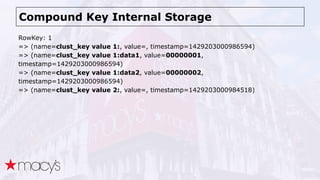
Compound Key Internal Storage
RowKey: 1
=> (name=clust_key value 1:, value=, timestamp=1429203000986594)
=> (name=clust_key value 1:data1, value=00000001,
timestamp=1429203000986594)
=> (name=clust_key value 1:data2, value=00000002,
timestamp=1429203000986594)
=> (name=clust_key value 2:, value=, timestamp=1429203000984518)
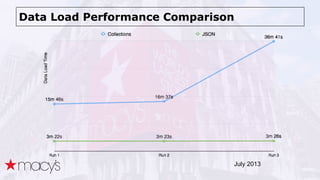
Data Load Performance Comparison
July 2013
Column Storage Overhead
- regular column size = column name + column
value + 15 bytes
- counter / expiring = +8 additional bytes
name : 2 bytes (length as short int) + byte[]
flags : 1 byte
timestamp : 8 bytes (long)
value : 4 bytes (length as int) + byte[]
http://btoddb-cass-storage.blogspot.ru/2011/07/column-overhead-and-sizing-every-column.html
https://issues.apache.org/jira/browse/CASSANDRA-4175
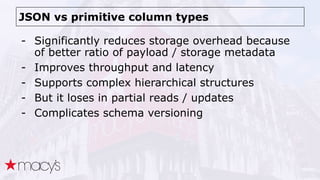
JSON vs primitive column types
- Significantly reduces storage overhead because
of better ratio of payload / storage metadata
- Improves throughput and latency
- Supports complex hierarchical structures
- But it loses in partial reads / updates
- Complicates schema versioning
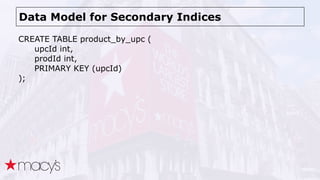
Data Model for Secondary Indices
CREATE TABLE product_by_upc (
upcId int,
prodId int,
PRIMARY KEY (upcId)
);
Pagination
base_service_url?filter=active&_limit=100&_offset=last_prod_id
CREATE TABLE product_paging (
filter text,
prodId int,
PRIMARY KEY (filter, prodId)
);
SELECT prodId FROM product_paging

WHERE filter=’active’ AND prodId >last_prod_id limit 100
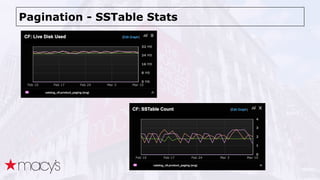
Pagination - SSTable Stats
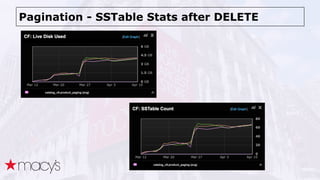
Pagination - SSTable Stats after DELETE
Compaction Issue
##########################################################
##### nodetool compactionstats Status at 03-03-2015 14:00:01 #####
##########################################################
compaction type keyspace table completed total unit progress
Compaction catalog_v9 product_paging 110 196860609 bytes 0.00%
INFO [CompactionExecutor] 2015-04-07 02:36:44,564 CompactionController Compacting large row
catalog_v9/product_paging (2030276075 bytes) incrementally
Performance
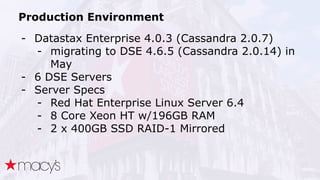
Production Environment
- Datastax Enterprise 4.0.3 (Cassandra 2.0.7)
- migrating to DSE 4.6.5 (Cassandra 2.0.14) in
May
- 6 DSE Servers
- Server Specs
- Red Hat Enterprise Linux Server 6.4
- 8 Core Xeon HT w/196GB RAM
- 2 x 400GB SSD RAID-1 Mirrored
Cassandra Config
- NetworkTopologyStrategy with RF 3
- Murmur3Partitioner
- PropertyFileSnitch
- Virtual nodes
- Key cache 100MB
- Concurrent reads 32
- Concurrent writes 32
- 8GB Heap, 400MB Young Gen
- SizeTieredCompactionStrategy for bulk load data
- LeveledCompactionStrategy for real time updates
Client App Config
- Datastax Java Driver version 2.1.4
- CQL 3
- Write CL is LOCAL_QUORUM
- Read CL is ONE
Read Requests
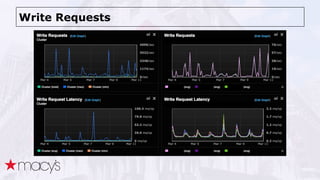
Write Requests
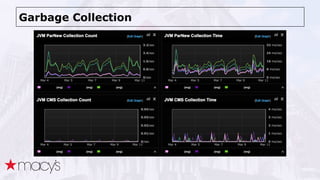
Garbage Collection
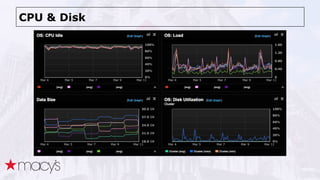
CPU & Disk
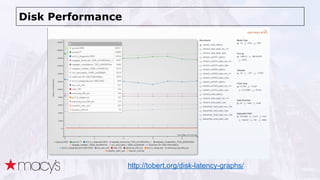
Disk Performance
Disk Performance
- DataStax provided measurement app
- Hats off to Al Tobey & Patrick McFadin
- Ran it internally
- Compared it against other vendors
- Result:
- SAN latency is significantly slower!
- Don’t be fooled by claims of high IOPS
- Action:
- Use locally-mounted SSD storage!
Disk Performance
http://tobert.org/disk-latency-graphs/
Retrospectives
What Worked Well
- Documentation is good
- CQL3 easy to learn and migrate to from SQL
background
- Query tracing is helpful
- Stable: Haven’t lost a node in production
- Able to reduce our reliance on caching in app tier
- Cassandra Cluster Manager (https://github.com/
pcmanus/ccm)
Problems encountered with Cassandra
- CQL queries brought down cluster
- Delete and creating a keyspace ….
- Lengthy compaction
- Need to understand underlying storage
- OpsCenter Performance Charts
Our own problems
- Small cluster all servers must perform well
- Lack of versioning of JSON schema
- How to handle performant exports
- 5% CPU -> 30%
- Non-primary key access
- Under-allocated test environments
One concern...
Secret Identity???
Patrick McFadin Buddy Pine/”Syndrome”
Future Plans
Future Plans
- Upgrade DSE 4.0.3 → 4.6.5
- Cassandra 2.0.7 → 2.0.14
- DSE Spark Integration for reporting
- Multi-Datacenter
- Using Mutagen for schema management
- JSON schema versioning
- RxJava for asynchronous operations
- Spring Data Cassandra
Stuff we’d like to see in DSE
- DSE Kibana
- Augment Spark’s query capability with an
interactive GUI
- Replication listeners
- Detect when replication is complete
Video
We’re hiring ...
ecommerce.macysjobs.com
3rd & Folsom
Questions?

Apache Cassandra at Macys

  • 1.
    @ Andrew Santoro DevelopmentManager Peter Connolly Application Architect Ivan Ukolov Architect/Implementation Lead April 2015
  • 2.
    Agenda • Background/Problem Statement •Options • Migration • Data Models • Performance • Retrospectives • Future plans • Video
  • 3.
  • 4.
    About Us - Real-timeRESTful data services application - Serve product, inventory and store data to website, mobile, store, and partner applications - Not “Big Data” or Analytics - Growth in business lead us to want: - 10x growth in data - Move from a read-mostly model to one which could handle near-real-time updates - Move into multiple data centers
  • 5.
  • 6.
    Operational Problems - Prewarmingstep was a prerequisite to satisfy performance SLA - Maintained second data grid for failover scenario - hard to keep those consistent - complicated release process
  • 7.
  • 8.
  • 9.
    Options Evaluated - DenormalizedRelational DB: DB2 - Document DB: MongoDB - Columnar DB: Cassandra, Couchbase, ActiveSpaces - Graph: Neo4J - Object: Versant
  • 10.
    Options Short List -MongoDB - Feature-rich, JSON document DB - Cassandra - Scalable, true peer-to-peer - ActiveSpaces - TIBCO Proprietary - Existing relationship with TIBCO - In-memory key/value datagrid
  • 11.
    POC Environment - AmazonEC2 - 5 servers - Same servers used for each test - Had vendors assist with setup and execution of benchmarks - Modeled benchmarks after retail inventory use cases - C3.2xlarge instances - Baseline of 148MM inventory records
  • 12.
  • 13.
    POC Results -Summary - Cassandra & ActiveSpaces - Very close - MongoDB - Failed tests YMMV! Your mileage may (will probably) vary
  • 14.
    POC Results -Initial Load Operation TIBCO ActiveSpaces Apache Cassandra 10Gen MongoDB Initial Load ~148MM Records Same datacenter (availability zone) 72,000 TPS (32 nodes) 34 min 98,000 TPS (40 nodes) 25 min CPU: 62.4% Memory: 83.0% I/O, Disk 1: 36% I/O, Disk 2: 35% 65,000 TPS (5 nodes) 38 min CPU: 31% Memory: 59% I/O, Disk 1: 42% I/O, Disk 2: 14% 20,000 TPS (5 nodes) ?? min (Did not complete) processed ~23MM records
  • 15.
    POC Results -Upsert (Writes) Operation TIBCO ActiveSpaces Apache Cassandra 10Gen MongoDB Upsert (Writes) ActiveSpaces sync writes vs. Cassandra async 4,000 TPS 3.57 ms Avg Latency CPU: 0.6% Memory: 71% I/O: 18% (disk 1) I/O: 17% (disk 2) 4,000 TPS 3.2 ms Avg Latency CPU: 3.7% Memory: 77% I/O: 0.3% I/O: 2.2% (Did not complete) tests failed
  • 16.
    POC Results -Read Operation TIBCO ActiveSpaces Apache Cassandra 10Gen MongoDB Read 400 TPS 2.54 ms Avg Latency CPU: 0.06% Memory: 62.4% I/O: 0% 400 TPS 3.23 ms Avg Latency CPU: 0.02% Memory: 47% I/O: 3.7% (Did not complete) tests failed
  • 17.
  • 18.
    Past & Present Phase1 → 
 Hybrid with Legacy Phase 2 → 
 Complete Switchover
  • 19.
  • 20.
    Data Model Requirements -Model hierarchical domain objects - Aggregate data to minimize reads - No reads before writes - Readable by 3rd party tools (cqlsh, Dev Center)
  • 21.
    Data Model basedon Lists id | name | upcId | upcColor | upcAttrId | upcAttrName | upcAttrValue | upcAttrRefId ----+----------------+-----------+---------------------+-----------------+---------------------------------------------------+---------------------+-------------- 11 | Nike Pants | [22, 33] | ['White', 'Red'] | [44, 55, 66] | ['ACTIVE', 'PROMOTION', 'ACTIVE'] | ['Y', 'Y', 'N'] | [22, 22, 33]
  • 22.
    Data Model basedon Maps id | name | upcColor | upcAttrName | upcAttrValue | upcAttrRefId ----+----------------+--------------------------------+-------------------------------------------------------------------+--------------------------------+-------------------------- 11 | Nike Pants | {22: 'White', 33: 'Red'} | {44: 'ACTIVE', 55: 'PROMOTION', 66: 'ACTIVE'} | {44: 'Y', 55: 'Y', 66: 'N'} | {44: 22, 55: 22, 66: 33}
  • 23.
    Collection Size Limits -Native protocol v2 - collection max size is 64K - collection element max size is 64K - Native protocol v3 - the collection size and the length of each element is 4 bytes long now - still 64K limit for set element max size and map key max size https://github.com/apache/cassandra/blob/trunk/doc/native_protocol_v3.spec
  • 24.
    Collections Internal Storage CREATETABLE collections ( my_key int PRIMARY KEY, my_set set<int>, my_map map<int, int>, my_list list<int>, ); INSERT INTO collections (my_key, my_set, my_map, my_list) VALUES ( 1, {1, 2}, {1:2, 3:4}, [1, 2]); SELECT * FROM collections ; my_key | my_list | my_map | my_set -------------+----------+---------------+-------- 1 | [1, 2] | {1: 2, 3: 4} | {1, 2}
  • 25.
    Collections Internal Storage RowKey:1 => (name=, value=, timestamp=1429162693574381) => (name=my_list:c646b7d0e3fa11e48d582f4261da0d90, value=00000001, timestamp=1429162693574381) => (name=my_list:c646b7d1e3fa11e48d582f4261da0d90, value=00000002, timestamp=1429162693574381) => (name=my_map:00000001, value=00000002, timestamp=1429162693574381) => (name=my_map:00000003, value=00000004, timestamp=1429162693574381) => (name=my_set:00000001, value=, timestamp=1429162693574381) => (name=my_set:00000002, value=, timestamp=1429162693574381)
  • 26.
    Data Model basedon Compound Key & JSON CREATE TABLE product ( id int, -- product id
 upcId int, -- 0 means product row, -- otherwise upc id indicating it is upc row object text, -- JSON object review text, -- JSON object PRIMARY KEY(id, upcId) ); id | upcId | object | review ----+--------+------------------------------------------------------------------------------------------------------------+-------------------------------------- 11 | 0 | {"id" : "11", "name" : "Nike Pants"} | {"avgRating" : "5", "count" : "567"} 11 | 22 | {"color" : "White", "attr" : [{"id": "44", "name": "ACTIVE", "value": "Y"}, ...]} | null 11 | 33 | {"color" : "Red", "attr" : [{"id": "66", "name": "ACTIVE", "value": "N"}]} | null
  • 27.
    Compound Key InternalStorage CREATE TABLE compound_keys ( part_key int, clust_key text, data1 int, data2 int, PRIMARY KEY (part_key, clust_key) ); INSERT INTO compound_keys (part_key, clust_key, data1, data2) VALUES ( 1, 'clust_key value 1', 1, 2); INSERT INTO compound_keys (part_key, clust_key) VALUES ( 1, 'clust_key value 2'); part_key | clust_key | data1 | data2 --------------+-------------------------+---------+------- 1 | clust_key value 1 | 1 | 2 1 | clust_key value 2 | null | null
  • 28.
    Compound Key InternalStorage RowKey: 1 => (name=clust_key value 1:, value=, timestamp=1429203000986594) => (name=clust_key value 1:data1, value=00000001, timestamp=1429203000986594) => (name=clust_key value 1:data2, value=00000002, timestamp=1429203000986594) => (name=clust_key value 2:, value=, timestamp=1429203000984518)
  • 29.
    Data Load PerformanceComparison July 2013
  • 30.
    Column Storage Overhead -regular column size = column name + column value + 15 bytes - counter / expiring = +8 additional bytes name : 2 bytes (length as short int) + byte[] flags : 1 byte timestamp : 8 bytes (long) value : 4 bytes (length as int) + byte[] http://btoddb-cass-storage.blogspot.ru/2011/07/column-overhead-and-sizing-every-column.html https://issues.apache.org/jira/browse/CASSANDRA-4175
  • 31.
    JSON vs primitivecolumn types - Significantly reduces storage overhead because of better ratio of payload / storage metadata - Improves throughput and latency - Supports complex hierarchical structures - But it loses in partial reads / updates - Complicates schema versioning
  • 32.
    Data Model forSecondary Indices CREATE TABLE product_by_upc ( upcId int, prodId int, PRIMARY KEY (upcId) );
  • 33.
    Pagination base_service_url?filter=active&_limit=100&_offset=last_prod_id CREATE TABLE product_paging( filter text, prodId int, PRIMARY KEY (filter, prodId) ); SELECT prodId FROM product_paging
 WHERE filter=’active’ AND prodId >last_prod_id limit 100
  • 34.
  • 35.
    Pagination - SSTableStats after DELETE
  • 36.
    Compaction Issue ########################################################## ##### nodetoolcompactionstats Status at 03-03-2015 14:00:01 ##### ########################################################## compaction type keyspace table completed total unit progress Compaction catalog_v9 product_paging 110 196860609 bytes 0.00% INFO [CompactionExecutor] 2015-04-07 02:36:44,564 CompactionController Compacting large row catalog_v9/product_paging (2030276075 bytes) incrementally
  • 37.
  • 38.
    Production Environment - DatastaxEnterprise 4.0.3 (Cassandra 2.0.7) - migrating to DSE 4.6.5 (Cassandra 2.0.14) in May - 6 DSE Servers - Server Specs - Red Hat Enterprise Linux Server 6.4 - 8 Core Xeon HT w/196GB RAM - 2 x 400GB SSD RAID-1 Mirrored
  • 39.
    Cassandra Config - NetworkTopologyStrategywith RF 3 - Murmur3Partitioner - PropertyFileSnitch - Virtual nodes - Key cache 100MB - Concurrent reads 32 - Concurrent writes 32 - 8GB Heap, 400MB Young Gen - SizeTieredCompactionStrategy for bulk load data - LeveledCompactionStrategy for real time updates
  • 40.
    Client App Config -Datastax Java Driver version 2.1.4 - CQL 3 - Write CL is LOCAL_QUORUM - Read CL is ONE
  • 41.
  • 42.
  • 43.
  • 44.
  • 45.
  • 46.
    Disk Performance - DataStaxprovided measurement app - Hats off to Al Tobey & Patrick McFadin - Ran it internally - Compared it against other vendors - Result: - SAN latency is significantly slower! - Don’t be fooled by claims of high IOPS - Action: - Use locally-mounted SSD storage!
  • 47.
  • 48.
  • 49.
    What Worked Well -Documentation is good - CQL3 easy to learn and migrate to from SQL background - Query tracing is helpful - Stable: Haven’t lost a node in production - Able to reduce our reliance on caching in app tier - Cassandra Cluster Manager (https://github.com/ pcmanus/ccm)
  • 50.
    Problems encountered withCassandra - CQL queries brought down cluster - Delete and creating a keyspace …. - Lengthy compaction - Need to understand underlying storage - OpsCenter Performance Charts
  • 51.
    Our own problems -Small cluster all servers must perform well - Lack of versioning of JSON schema - How to handle performant exports - 5% CPU -> 30% - Non-primary key access - Under-allocated test environments
  • 52.
    One concern... Secret Identity??? PatrickMcFadin Buddy Pine/”Syndrome”
  • 53.
  • 54.
    Future Plans - UpgradeDSE 4.0.3 → 4.6.5 - Cassandra 2.0.7 → 2.0.14 - DSE Spark Integration for reporting - Multi-Datacenter - Using Mutagen for schema management - JSON schema versioning - RxJava for asynchronous operations - Spring Data Cassandra
  • 55.
    Stuff we’d liketo see in DSE - DSE Kibana - Augment Spark’s query capability with an interactive GUI - Replication listeners - Detect when replication is complete
  • 56.
  • 57.
  • 58.