
@chbatey
Christopher Batey

Technical Evangelist for Apache Cassandra
Apache Cassandra 101
@chbatey
Who am I?
• Technical Evangelist for Apache Cassandra
•Founder of Stubbed Cassandra
•Help out Apache Cassandra users
• DataStax
•Builds enterprise ready version of Apache
Cassandra
• Previous: Cassandra backed apps at BSkyB
@chbatey
Overview
• Distributed databases: What and why?
• Cassandra use cases
• Replication
• Fault tolerance
• Read and write path
• Data modelling
• Java Driver
@chbatey
Distributed databases
@chbatey
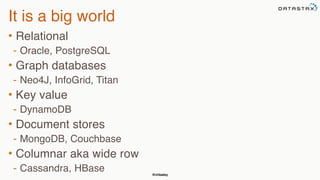
It is a big world
• Relational
- Oracle, PostgreSQL
• Graph databases
- Neo4J, InfoGrid, Titan
• Key value
- DynamoDB
• Document stores
- MongoDB, Couchbase
• Columnar aka wide row
- Cassandra, HBase
@chbatey
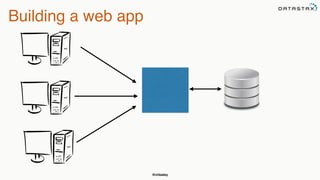
Building a web app
@chbatey
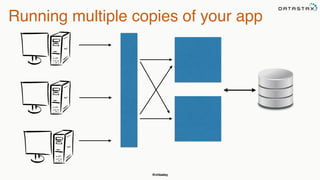
Running multiple copies of your app
@chbatey
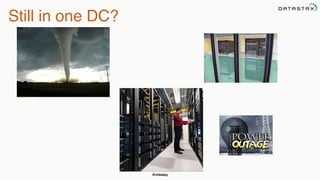
Still in one DC?
@chbatey
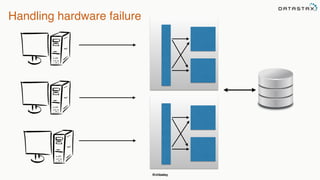
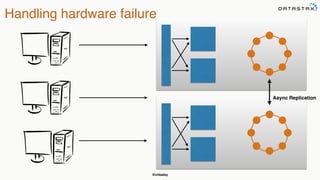
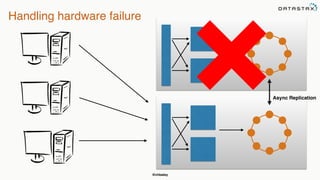
Handling hardware failure
@chbatey
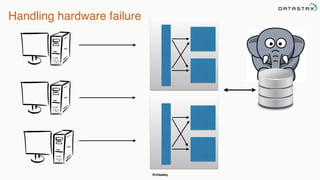
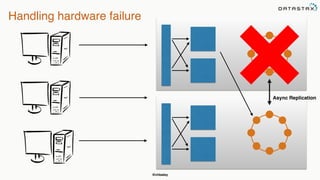
Handling hardware failure
@chbatey
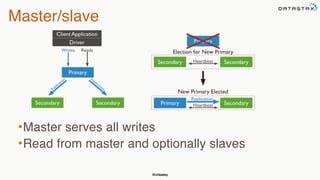
Master/slave
•Master serves all writes
•Read from master and optionally slaves
@chbatey
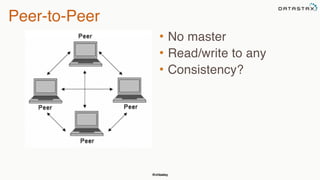
Peer-to-Peer
• No master
• Read/write to any
• Consistency?
@chbatey
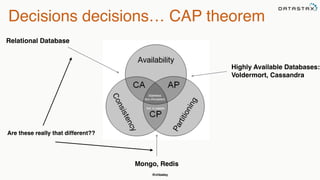
Decisions decisions… CAP theorem
Are these really that different??
Relational Database
Mongo, Redis
Highly Available Databases:
Voldermort, Cassandra
@chbatey
PAC-ELC
• If Partition: Trade off Availability vs Consistency
• Else: Trade off Latency vs Consistency
• http://dbmsmusings.blogspot.co.uk/2010/04/problems-
with-cap-and-yahoos-little.html
@chbatey
Cassandra use cases
@chbatey
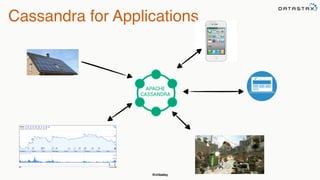
Cassandra for Applications
APACHE
CASSANDRA
@chbatey
Common use cases
•Ordered data such as time series
-Event stores
-Financial transactions
-Sensor data e.g IoT
@chbatey
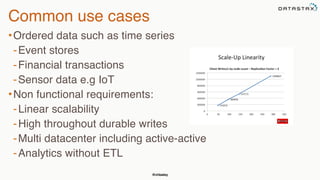
Common use cases
•Ordered data such as time series
-Event stores
-Financial transactions
-Sensor data e.g IoT
•Non functional requirements:
-Linear scalability
-High throughout durable writes
-Multi datacenter including active-active
-Analytics without ETL
@chbatey
Work loads
• High write and/or throughout
• Many small queries
• Distributed across the world (eventually consistent)
@chbatey
Cassandra deep dive
@chbatey
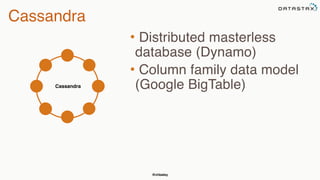
Cassandra
Cassandra
• Distributed masterless
database (Dynamo)
• Column family data model
(Google BigTable)
@chbatey
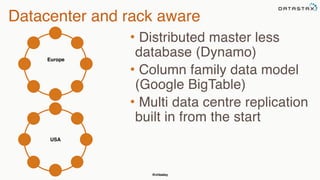
Datacenter and rack aware
Europe
• Distributed master less
database (Dynamo)
• Column family data model
(Google BigTable)
• Multi data centre replication
built in from the start
USA
@chbatey
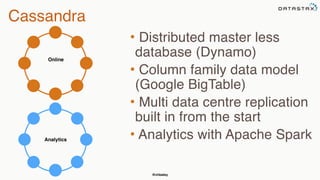
Cassandra
Online
• Distributed master less
database (Dynamo)
• Column family data model
(Google BigTable)
• Multi data centre replication
built in from the start
• Analytics with Apache SparkAnalytics
@chbatey
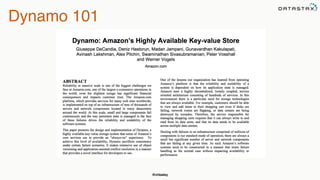
Dynamo 101
@chbatey
Dynamo 101
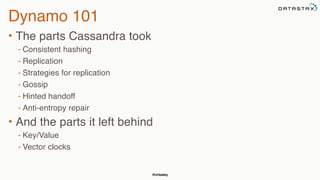
• The parts Cassandra took
- Consistent hashing
- Replication
- Strategies for replication
- Gossip
- Hinted handoff
- Anti-entropy repair
• And the parts it left behind
- Key/Value
- Vector clocks
@chbatey
Picking the right nodes
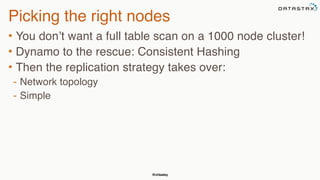
• You don’t want a full table scan on a 1000 node cluster!
• Dynamo to the rescue: Consistent Hashing
• Then the replication strategy takes over:
- Network topology
- Simple
@chbatey
Murmer3 Example
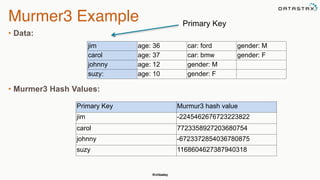
• Data:
• Murmer3 Hash Values:
jim age: 36 car: ford gender: M
carol age: 37 car: bmw gender: F
johnny age: 12 gender: M
suzy: age: 10 gender: F
Primary Key Murmur3 hash value
jim -2245462676723223822
carol 7723358927203680754
johnny -6723372854036780875
suzy 1168604627387940318
Primary Key
@chbatey
Company Confidential
Murmer3 Example
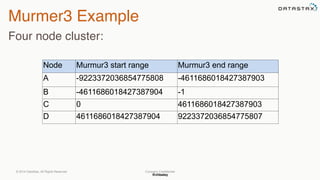
Four node cluster:
© 2014 DataStax, All Rights Reserved.
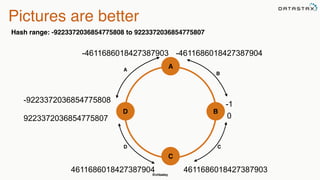
Node Murmur3 start range Murmur3 end range
A -9223372036854775808 -4611686018427387903
B -4611686018427387904 -1
C 0 4611686018427387903
D 4611686018427387904 9223372036854775807
@chbatey
Pictures are better
Hash range: -9223372036854775808 to 9223372036854775807
A
B
C
D
-4611686018427387903
-1
4611686018427387903
-9223372036854775808
9223372036854775807
-4611686018427387904
0
4611686018427387904
B
CD
A
@chbatey
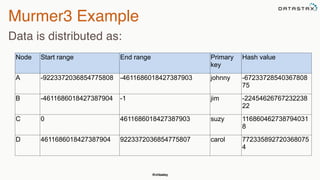
Murmer3 Example
Data is distributed as:
Node Start range End range Primary
key
Hash value
A -9223372036854775808 -4611686018427387903 johnny -67233728540367808
75
B -4611686018427387904 -1 jim -22454626767232238
22
C 0 4611686018427387903 suzy 116860462738794031
8
D 4611686018427387904 9223372036854775807 carol 772335892720368075
4
@chbatey
Replication
@chbatey
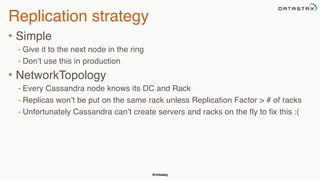
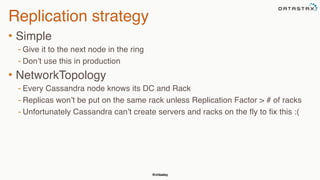
Replication strategy
• Simple
- Give it to the next node in the ring
- Don’t use this in production
• NetworkTopology
- Every Cassandra node knows its DC and Rack
- Replicas won’t be put on the same rack unless Replication Factor > # of racks
- Unfortunately Cassandra can’t create servers and racks on the fly to fix this :(
@chbatey
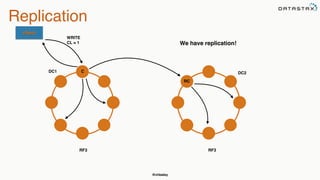
Replication
DC1 DC2
client
RF3 RF3
C
RC
WRITE
CL = 1 We have replication!
@chbatey
Replication strategy
• Simple
- Give it to the next node in the ring
- Don’t use this in production
• NetworkTopology
- Every Cassandra node knows its DC and Rack
- Replicas won’t be put on the same rack unless Replication Factor > # of racks
- Unfortunately Cassandra can’t create servers and racks on the fly to fix this :(
35
@chbatey
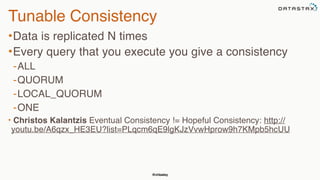
Tunable Consistency
•Data is replicated N times
•Every query that you execute you give a consistency
-ALL
-QUORUM
-LOCAL_QUORUM
-ONE
• Christos Kalantzis Eventual Consistency != Hopeful Consistency: http://
youtu.be/A6qzx_HE3EU?list=PLqcm6qE9lgKJzVvwHprow9h7KMpb5hcUU
@chbatey
Handling hardware failure
Async Replication
@chbatey
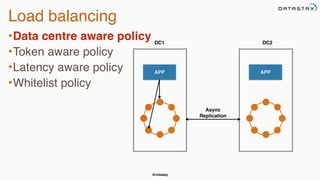
Load balancing
•Data centre aware policy
•Token aware policy
•Latency aware policy
•Whitelist policy
APP APP
Async
Replication
DC1 DC2
@chbatey
Handling hardware failure
Async Replication
@chbatey
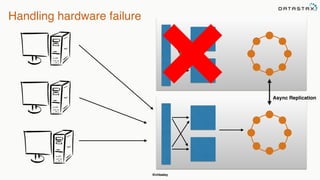
Handling hardware failure
Async Replication
@chbatey
Handling hardware failure
Async Replication
@chbatey
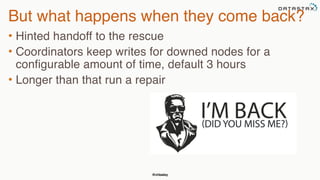
But what happens when they come back?
• Hinted handoff to the rescue
• Coordinators keep writes for downed nodes for a
configurable amount of time, default 3 hours
• Longer than that run a repair
@chbatey
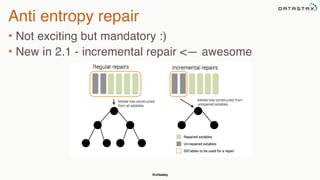
Anti entropy repair
• Not exciting but mandatory :)
• New in 2.1 - incremental repair <— awesome
@chbatey
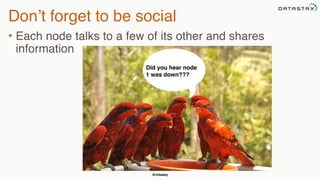
Don’t forget to be social
• Each node talks to a few of its other and shares
information
Did you hear node
1 was down???
@chbatey
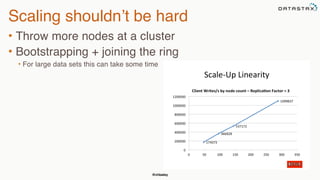
Scaling shouldn’t be hard
• Throw more nodes at a cluster
• Bootstrapping + joining the ring
• For large data sets this can take some time
@chbatey
Data modelling
@chbatey
You must denormalise
@chbatey
Your model should look like your queries
@chbatey
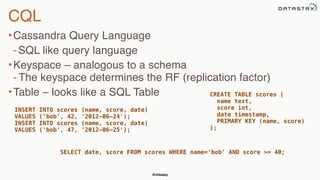
CQL
•Cassandra Query Language
-SQL like query language
•Keyspace – analogous to a schema
- The keyspace determines the RF (replication factor)
•Table – looks like a SQL Table CREATE TABLE scores (
name text,
score int,
date timestamp,
PRIMARY KEY (name, score)
);
INSERT INTO scores (name, score, date)
VALUES ('bob', 42, '2012-06-24');
INSERT INTO scores (name, score, date)
VALUES ('bob', 47, '2012-06-25');
SELECT date, score FROM scores WHERE name='bob' AND score >= 40;
@chbatey
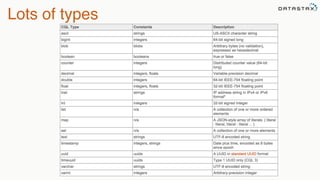
Lots of types
@chbatey
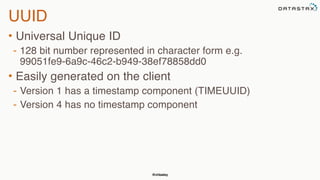
UUID
• Universal Unique ID
- 128 bit number represented in character form e.g.
99051fe9-6a9c-46c2-b949-38ef78858dd0
• Easily generated on the client
- Version 1 has a timestamp component (TIMEUUID)
- Version 4 has no timestamp component
@chbatey
Company Confidential
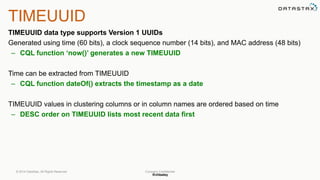
TIMEUUID
TIMEUUID data type supports Version 1 UUIDs
Generated using time (60 bits), a clock sequence number (14 bits), and MAC address (48 bits)
– CQL function ‘now()’ generates a new TIMEUUID
Time can be extracted from TIMEUUID
– CQL function dateOf() extracts the timestamp as a date
TIMEUUID values in clustering columns or in column names are ordered based on time
– DESC order on TIMEUUID lists most recent data first
© 2014 DataStax, All Rights Reserved.
@chbatey
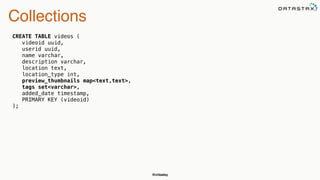
Collections
CREATE TABLE videos (
videoid uuid,
userid uuid,
name varchar,
description varchar,
location text,
location_type int,
preview_thumbnails map<text,text>,
tags set<varchar>,
added_date timestamp,
PRIMARY KEY (videoid)
);
@chbatey
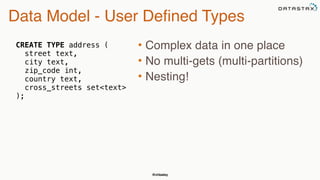
Data Model - User Defined Types
• Complex data in one place
• No multi-gets (multi-partitions)
• Nesting!
CREATE TYPE address (
street text,
city text,
zip_code int,
country text,
cross_streets set<text>
);
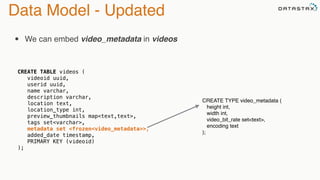
Data Model - Updated
• We can embed video_metadata in videos
CREATE TYPE video_metadata (
height int,
width int,
video_bit_rate set<text>,
encoding text
);
CREATE TABLE videos (
videoid uuid,
userid uuid,
name varchar,
description varchar,
location text,
location_type int,
preview_thumbnails map<text,text>,
tags set<varchar>,
metadata set <frozen<video_metadata>>,
added_date timestamp,
PRIMARY KEY (videoid)
);
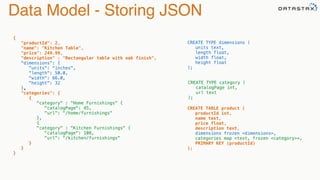
Data Model - Storing JSON
{
"productId": 2,
"name": "Kitchen Table",
"price": 249.99,
"description" : "Rectangular table with oak finish",
"dimensions": {
"units": "inches",
"length": 50.0,
"width": 66.0,
"height": 32
},
"categories": {
{
"category" : "Home Furnishings" {
"catalogPage": 45,
"url": "/home/furnishings"
},
{
"category" : "Kitchen Furnishings" {
"catalogPage": 108,
"url": "/kitchen/furnishings"
}
}
}
CREATE TYPE dimensions (
units text,
length float,
width float,
height float
);
CREATE TYPE category (
catalogPage int,
url text
);
CREATE TABLE product (
productId int,
name text,
price float,
description text,
dimensions frozen <dimensions>,
categories map <text, frozen <category>>,
PRIMARY KEY (productId)
);
@chbatey
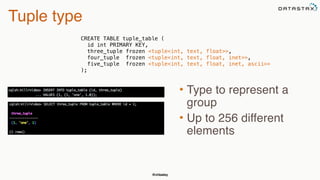
Tuple type
• Type to represent a
group
• Up to 256 different
elements
CREATE TABLE tuple_table (
id int PRIMARY KEY,
three_tuple frozen <tuple<int, text, float>>,
four_tuple frozen <tuple<int, text, float, inet>>,
five_tuple frozen <tuple<int, text, float, inet, ascii>>
);
@chbatey
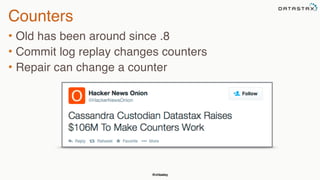
Counters
• Old has been around since .8
• Commit log replay changes counters
• Repair can change a counter
@chbatey
Time-to-Live (TTL)
TTL a row:
INSERT INTO users (id, first, last) VALUES (‘abc123’, ‘catherine’, ‘cachart’)
USING TTL 3600; // Expires data in one hour

TTL a column:
UPDATE users USING TTL 30 SET last = ‘miller’ WHERE id = ‘abc123’
– TTL in seconds
– Can also set default TTL at a table level
– Expired columns/values automatically deleted
– With no TTL specified, columns/values never expire
– TTL is useful for automatic deletion
– Re-inserting the same row before it expires will overwrite TTL
@chbatey
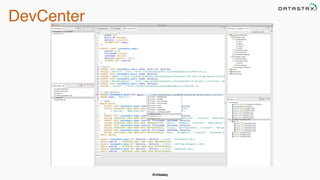
DevCenter
@chbatey
Example Time: Customer event store
@chbatey
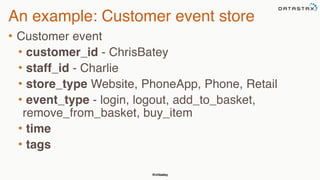
An example: Customer event store
• Customer event
• customer_id - ChrisBatey
• staff_id - Charlie
• store_type Website, PhoneApp, Phone, Retail
• event_type - login, logout, add_to_basket,
remove_from_basket, buy_item
• time
• tags
@chbatey
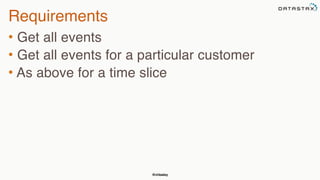
Requirements
• Get all events
• Get all events for a particular customer
• As above for a time slice
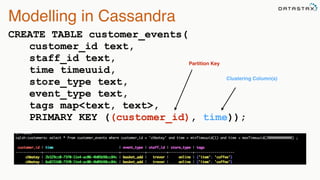
Modelling in Cassandra
CREATE TABLE customer_events(
customer_id text,
staff_id text,
time timeuuid,
store_type text,
event_type text,
tags map<text, text>,
PRIMARY KEY ((customer_id), time));
Partition Key
Clustering Column(s)
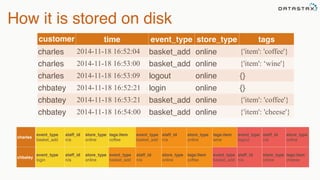
How it is stored on disk
customer
_id
time event_type store_type tags
charles 2014-11-18 16:52:04 basket_add online {'item': 'coffee'}
charles 2014-11-18 16:53:00 basket_add online {'item': ‘wine'}
charles 2014-11-18 16:53:09 logout online {}
chbatey 2014-11-18 16:52:21 login online {}
chbatey 2014-11-18 16:53:21 basket_add online {'item': 'coffee'}
chbatey 2014-11-18 16:54:00 basket_add online {'item': 'cheese'}
charles
event_type
basket_add
staff_id
n/a
store_type
online
tags:item
coffee
event_type
basket_add
staff_id
n/a
store_type
online
tags:item
wine
event_type
logout
staff_id
n/a
store_type
online
chbatey
event_type
login
staff_id
n/a
store_type
online
event_type
basket_add
staff_id
n/a
store_type
online
tags:item
coffee
event_type
basket_add
staff_id
n/a
store_type
online
tags:item
cheese
@chbatey
Drivers
@chbatey
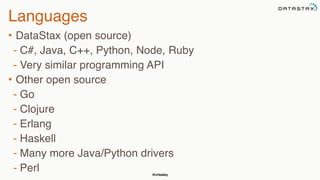
Languages
• DataStax (open source)
- C#, Java, C++, Python, Node, Ruby
- Very similar programming API
• Other open source
- Go
- Clojure
- Erlang
- Haskell
- Many more Java/Python drivers
- Perl
@chbatey
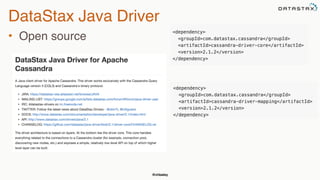
DataStax Java Driver
• Open source
@chbatey
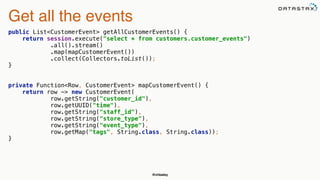
Get all the events
public List<CustomerEvent> getAllCustomerEvents() {

return session.execute("select * from customers.customer_events")

.all().stream()

.map(mapCustomerEvent())

.collect(Collectors.toList());

}
private Function<Row, CustomerEvent> mapCustomerEvent() {

return row -> new CustomerEvent(

row.getString("customer_id"),

row.getUUID("time"),

row.getString("staff_id"),

row.getString("store_type"),

row.getString("event_type"),

row.getMap("tags", String.class, String.class));

}
@chbatey
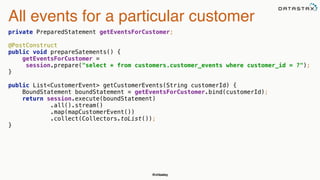
All events for a particular customer
private PreparedStatement getEventsForCustomer;


@PostConstruct

public void prepareSatements() {

getEventsForCustomer =
session.prepare("select * from customers.customer_events where customer_id = ?");

}


public List<CustomerEvent> getCustomerEvents(String customerId) {

BoundStatement boundStatement = getEventsForCustomer.bind(customerId);

return session.execute(boundStatement)
.all().stream()

.map(mapCustomerEvent())

.collect(Collectors.toList());

}
@chbatey
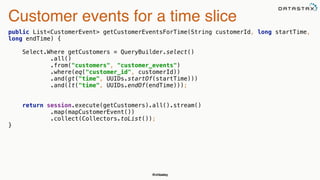
Customer events for a time slice
public List<CustomerEvent> getCustomerEventsForTime(String customerId, long startTime,
long endTime) {


Select.Where getCustomers = QueryBuilder.select()

.all()

.from("customers", "customer_events")

.where(eq("customer_id", customerId))

.and(gt("time", UUIDs.startOf(startTime)))

.and(lt("time", UUIDs.endOf(endTime)));


return session.execute(getCustomers).all().stream()

.map(mapCustomerEvent())

.collect(Collectors.toList());

}
@chbatey
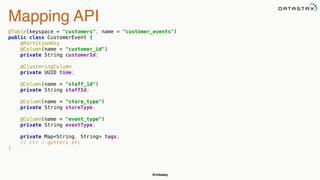
Mapping API
@Table(keyspace = "customers", name = "customer_events")

public class CustomerEvent {

@PartitionKey

@Column(name = "customer_id")

private String customerId;


@ClusteringColumn

private UUID time;


@Column(name = "staff_id")

private String staffId;


@Column(name = "store_type")

private String storeType;


@Column(name = "event_type")

private String eventType;


private Map<String, String> tags;
// ctr / getters etc
}

@chbatey
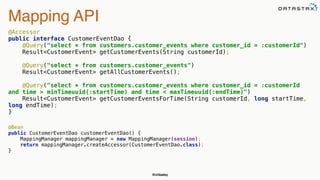
Mapping API
@Accessor

public interface CustomerEventDao {

@Query("select * from customers.customer_events where customer_id = :customerId")

Result<CustomerEvent> getCustomerEvents(String customerId);


@Query("select * from customers.customer_events")

Result<CustomerEvent> getAllCustomerEvents();


@Query("select * from customers.customer_events where customer_id = :customerId
and time > minTimeuuid(:startTime) and time < maxTimeuuid(:endTime)")

Result<CustomerEvent> getCustomerEventsForTime(String customerId, long startTime,
long endTime);

}


@Bean

public CustomerEventDao customerEventDao() {

MappingManager mappingManager = new MappingManager(session);

return mappingManager.createAccessor(CustomerEventDao.class);

}
@chbatey
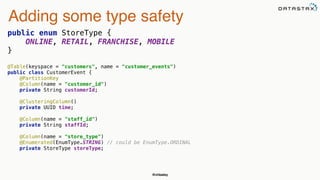
Adding some type safety
public enum StoreType {

ONLINE, RETAIL, FRANCHISE, MOBILE

}
@Table(keyspace = "customers", name = "customer_events")

public class CustomerEvent {

@PartitionKey

@Column(name = "customer_id")

private String customerId;


@ClusteringColumn()

private UUID time;


@Column(name = "staff_id")

private String staffId;


@Column(name = "store_type")

@Enumerated(EnumType.STRING) // could be EnumType.ORDINAL

private StoreType storeType;

@chbatey
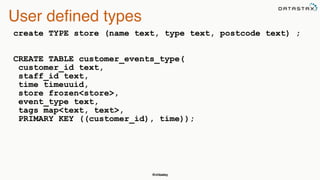
User defined types
create TYPE store (name text, type text, postcode text) ;


CREATE TABLE customer_events_type(
customer_id text,
staff_id text,
time timeuuid,
store frozen<store>,
event_type text,
tags map<text, text>,
PRIMARY KEY ((customer_id), time));

@chbatey
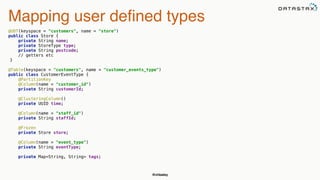
Mapping user defined types
@UDT(keyspace = "customers", name = "store")

public class Store {

private String name;

private StoreType type;

private String postcode;
// getters etc
}
@Table(keyspace = "customers", name = "customer_events_type")

public class CustomerEventType {

@PartitionKey

@Column(name = "customer_id")

private String customerId;


@ClusteringColumn()

private UUID time;


@Column(name = "staff_id")

private String staffId;


@Frozen

private Store store;


@Column(name = "event_type")

private String eventType;


private Map<String, String> tags;

@chbatey
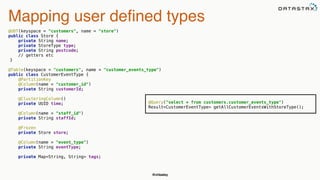
Mapping user defined types
@UDT(keyspace = "customers", name = "store")

public class Store {

private String name;

private StoreType type;

private String postcode;
// getters etc
}
@Table(keyspace = "customers", name = "customer_events_type")

public class CustomerEventType {

@PartitionKey

@Column(name = "customer_id")

private String customerId;


@ClusteringColumn()

private UUID time;


@Column(name = "staff_id")

private String staffId;


@Frozen

private Store store;


@Column(name = "event_type")

private String eventType;


private Map<String, String> tags;

@Query("select * from customers.customer_events_type")

Result<CustomerEventType> getAllCustomerEventsWithStoreType();
@chbatey
©2014 DataStax. Do not distribute without consent.
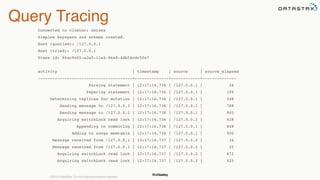
Query Tracing
Connected to cluster: xerxes
Simplex keyspace and schema created.
Host (queried): /127.0.0.1
Host (tried): /127.0.0.1
Trace id: 96ac9400-a3a5-11e2-96a9-4db56cdc5fe7
activity | timestamp | source | source_elapsed
---------------------------------------+--------------+------------+--------------
Parsing statement | 12:17:16.736 | /127.0.0.1 | 28
Peparing statement | 12:17:16.736 | /127.0.0.1 | 199
Determining replicas for mutation | 12:17:16.736 | /127.0.0.1 | 348
Sending message to /127.0.0.3 | 12:17:16.736 | /127.0.0.1 | 788
Sending message to /127.0.0.2 | 12:17:16.736 | /127.0.0.1 | 805
Acquiring switchLock read lock | 12:17:16.736 | /127.0.0.1 | 828
Appending to commitlog | 12:17:16.736 | /127.0.0.1 | 848
Adding to songs memtable | 12:17:16.736 | /127.0.0.1 | 900
Message received from /127.0.0.1 | 12:17:16.737 | /127.0.0.2 | 34
Message received from /127.0.0.1 | 12:17:16.737 | /127.0.0.3 | 25
Acquiring switchLock read lock | 12:17:16.737 | /127.0.0.2 | 672
Acquiring switchLock read lock | 12:17:16.737 | /127.0.0.3 | 525
@chbatey
Other features
@chbatey
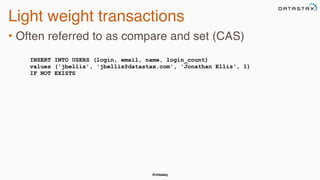
Light weight transactions
• Often referred to as compare and set (CAS)
INSERT INTO USERS (login, email, name, login_count)
values ('jbellis', 'jbellis@datastax.com', 'Jonathan Ellis', 1)
IF NOT EXISTS
@chbatey
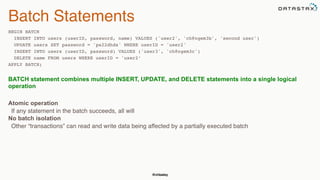
Batch Statements
BEGIN BATCH
INSERT INTO users (userID, password, name) VALUES ('user2', 'ch@ngem3b', 'second user')
UPDATE users SET password = 'ps22dhds' WHERE userID = 'user2'
INSERT INTO users (userID, password) VALUES ('user3', 'ch@ngem3c')
DELETE name FROM users WHERE userID = 'user2’
APPLY BATCH;

BATCH statement combines multiple INSERT, UPDATE, and DELETE statements into a single logical
operation


Atomic operation
If any statement in the batch succeeds, all will
No batch isolation
Other “transactions” can read and write data being affected by a partially executed batch
@chbatey
Company Confidential
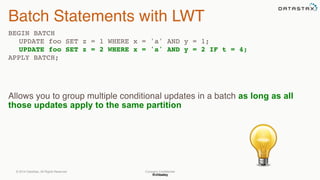
Batch Statements with LWT
BEGIN BATCH
UPDATE foo SET z = 1 WHERE x = 'a' AND y = 1;
UPDATE foo SET z = 2 WHERE x = 'a' AND y = 2 IF t = 4;
APPLY BATCH;
Allows you to group multiple conditional updates in a batch as long as all
those updates apply to the same partition

© 2014 DataStax, All Rights Reserved.
@chbatey
Summary
• Cassandra is a shared nothing masterless datastore
• Availability a.k.a up time is king
• Biggest hurdle is learning to model differently
• Modern drivers make it easy to work with
@chbatey
Thanks for listening
• Follow me on twitter @chbatey
• Cassandra + Fault tolerance posts a plenty:
• http://christopher-batey.blogspot.co.uk/
• Cassandra resources: http://planetcassandra.org/

Jan 2015 - Cassandra101 Manchester Meetup

  • 1.
    @chbatey Christopher Batey
 Technical Evangelistfor Apache Cassandra Apache Cassandra 101
  • 2.
    @chbatey Who am I? •Technical Evangelist for Apache Cassandra •Founder of Stubbed Cassandra •Help out Apache Cassandra users • DataStax •Builds enterprise ready version of Apache Cassandra • Previous: Cassandra backed apps at BSkyB
  • 3.
    @chbatey Overview • Distributed databases:What and why? • Cassandra use cases • Replication • Fault tolerance • Read and write path • Data modelling • Java Driver
  • 4.
  • 5.
    @chbatey It is abig world • Relational - Oracle, PostgreSQL • Graph databases - Neo4J, InfoGrid, Titan • Key value - DynamoDB • Document stores - MongoDB, Couchbase • Columnar aka wide row - Cassandra, HBase
  • 6.
  • 7.
  • 8.
  • 9.
  • 10.
  • 11.
    @chbatey Master/slave •Master serves allwrites •Read from master and optionally slaves
  • 12.
    @chbatey Peer-to-Peer • No master •Read/write to any • Consistency?
  • 13.
    @chbatey Decisions decisions… CAPtheorem Are these really that different?? Relational Database Mongo, Redis Highly Available Databases: Voldermort, Cassandra
  • 14.
    @chbatey PAC-ELC • If Partition:Trade off Availability vs Consistency • Else: Trade off Latency vs Consistency • http://dbmsmusings.blogspot.co.uk/2010/04/problems- with-cap-and-yahoos-little.html
  • 15.
  • 16.
  • 17.
    @chbatey Common use cases •Ordereddata such as time series -Event stores -Financial transactions -Sensor data e.g IoT
  • 18.
    @chbatey Common use cases •Ordereddata such as time series -Event stores -Financial transactions -Sensor data e.g IoT •Non functional requirements: -Linear scalability -High throughout durable writes -Multi datacenter including active-active -Analytics without ETL
  • 19.
    @chbatey Work loads • Highwrite and/or throughout • Many small queries • Distributed across the world (eventually consistent)
  • 20.
  • 21.
    @chbatey Cassandra Cassandra • Distributed masterless database(Dynamo) • Column family data model (Google BigTable)
  • 22.
    @chbatey Datacenter and rackaware Europe • Distributed master less database (Dynamo) • Column family data model (Google BigTable) • Multi data centre replication built in from the start USA
  • 23.
    @chbatey Cassandra Online • Distributed masterless database (Dynamo) • Column family data model (Google BigTable) • Multi data centre replication built in from the start • Analytics with Apache SparkAnalytics
  • 24.
  • 25.
    @chbatey Dynamo 101 • Theparts Cassandra took - Consistent hashing - Replication - Strategies for replication - Gossip - Hinted handoff - Anti-entropy repair • And the parts it left behind - Key/Value - Vector clocks
  • 26.
    @chbatey Picking the rightnodes • You don’t want a full table scan on a 1000 node cluster! • Dynamo to the rescue: Consistent Hashing • Then the replication strategy takes over: - Network topology - Simple
  • 27.
    @chbatey Murmer3 Example • Data: •Murmer3 Hash Values: jim age: 36 car: ford gender: M carol age: 37 car: bmw gender: F johnny age: 12 gender: M suzy: age: 10 gender: F Primary Key Murmur3 hash value jim -2245462676723223822 carol 7723358927203680754 johnny -6723372854036780875 suzy 1168604627387940318 Primary Key
  • 28.
    @chbatey Company Confidential Murmer3 Example Fournode cluster: © 2014 DataStax, All Rights Reserved. Node Murmur3 start range Murmur3 end range A -9223372036854775808 -4611686018427387903 B -4611686018427387904 -1 C 0 4611686018427387903 D 4611686018427387904 9223372036854775807
  • 29.
    @chbatey Pictures are better Hashrange: -9223372036854775808 to 9223372036854775807 A B C D -4611686018427387903 -1 4611686018427387903 -9223372036854775808 9223372036854775807 -4611686018427387904 0 4611686018427387904 B CD A
  • 30.
    @chbatey Murmer3 Example Data isdistributed as: Node Start range End range Primary key Hash value A -9223372036854775808 -4611686018427387903 johnny -67233728540367808 75 B -4611686018427387904 -1 jim -22454626767232238 22 C 0 4611686018427387903 suzy 116860462738794031 8 D 4611686018427387904 9223372036854775807 carol 772335892720368075 4
  • 31.
  • 32.
    @chbatey Replication strategy • Simple -Give it to the next node in the ring - Don’t use this in production • NetworkTopology - Every Cassandra node knows its DC and Rack - Replicas won’t be put on the same rack unless Replication Factor > # of racks - Unfortunately Cassandra can’t create servers and racks on the fly to fix this :(
  • 33.
  • 34.
    @chbatey Replication strategy • Simple -Give it to the next node in the ring - Don’t use this in production • NetworkTopology - Every Cassandra node knows its DC and Rack - Replicas won’t be put on the same rack unless Replication Factor > # of racks - Unfortunately Cassandra can’t create servers and racks on the fly to fix this :(
  • 35.
  • 36.
    @chbatey Tunable Consistency •Data isreplicated N times •Every query that you execute you give a consistency -ALL -QUORUM -LOCAL_QUORUM -ONE • Christos Kalantzis Eventual Consistency != Hopeful Consistency: http:// youtu.be/A6qzx_HE3EU?list=PLqcm6qE9lgKJzVvwHprow9h7KMpb5hcUU
  • 37.
  • 38.
    @chbatey Load balancing •Data centreaware policy •Token aware policy •Latency aware policy •Whitelist policy APP APP Async Replication DC1 DC2
  • 39.
  • 40.
  • 41.
  • 42.
    @chbatey But what happenswhen they come back? • Hinted handoff to the rescue • Coordinators keep writes for downed nodes for a configurable amount of time, default 3 hours • Longer than that run a repair
  • 43.
    @chbatey Anti entropy repair •Not exciting but mandatory :) • New in 2.1 - incremental repair <— awesome
  • 44.
    @chbatey Don’t forget tobe social • Each node talks to a few of its other and shares information Did you hear node 1 was down???
  • 45.
    @chbatey Scaling shouldn’t behard • Throw more nodes at a cluster • Bootstrapping + joining the ring • For large data sets this can take some time
  • 46.
  • 47.
  • 48.
    @chbatey Your model shouldlook like your queries
  • 49.
    @chbatey CQL •Cassandra Query Language -SQLlike query language •Keyspace – analogous to a schema - The keyspace determines the RF (replication factor) •Table – looks like a SQL Table CREATE TABLE scores ( name text, score int, date timestamp, PRIMARY KEY (name, score) ); INSERT INTO scores (name, score, date) VALUES ('bob', 42, '2012-06-24'); INSERT INTO scores (name, score, date) VALUES ('bob', 47, '2012-06-25'); SELECT date, score FROM scores WHERE name='bob' AND score >= 40;
  • 50.
  • 51.
    @chbatey UUID • Universal UniqueID - 128 bit number represented in character form e.g. 99051fe9-6a9c-46c2-b949-38ef78858dd0 • Easily generated on the client - Version 1 has a timestamp component (TIMEUUID) - Version 4 has no timestamp component
  • 52.
    @chbatey Company Confidential TIMEUUID TIMEUUID datatype supports Version 1 UUIDs Generated using time (60 bits), a clock sequence number (14 bits), and MAC address (48 bits) – CQL function ‘now()’ generates a new TIMEUUID Time can be extracted from TIMEUUID – CQL function dateOf() extracts the timestamp as a date TIMEUUID values in clustering columns or in column names are ordered based on time – DESC order on TIMEUUID lists most recent data first © 2014 DataStax, All Rights Reserved.
  • 53.
    @chbatey Collections CREATE TABLE videos( videoid uuid, userid uuid, name varchar, description varchar, location text, location_type int, preview_thumbnails map<text,text>, tags set<varchar>, added_date timestamp, PRIMARY KEY (videoid) );
  • 54.
    @chbatey Data Model -User Defined Types • Complex data in one place • No multi-gets (multi-partitions) • Nesting! CREATE TYPE address ( street text, city text, zip_code int, country text, cross_streets set<text> );
  • 55.
    Data Model -Updated • We can embed video_metadata in videos CREATE TYPE video_metadata ( height int, width int, video_bit_rate set<text>, encoding text ); CREATE TABLE videos ( videoid uuid, userid uuid, name varchar, description varchar, location text, location_type int, preview_thumbnails map<text,text>, tags set<varchar>, metadata set <frozen<video_metadata>>, added_date timestamp, PRIMARY KEY (videoid) );
  • 56.
    Data Model -Storing JSON { "productId": 2, "name": "Kitchen Table", "price": 249.99, "description" : "Rectangular table with oak finish", "dimensions": { "units": "inches", "length": 50.0, "width": 66.0, "height": 32 }, "categories": { { "category" : "Home Furnishings" { "catalogPage": 45, "url": "/home/furnishings" }, { "category" : "Kitchen Furnishings" { "catalogPage": 108, "url": "/kitchen/furnishings" } } } CREATE TYPE dimensions ( units text, length float, width float, height float ); CREATE TYPE category ( catalogPage int, url text ); CREATE TABLE product ( productId int, name text, price float, description text, dimensions frozen <dimensions>, categories map <text, frozen <category>>, PRIMARY KEY (productId) );
  • 57.
    @chbatey Tuple type • Typeto represent a group • Up to 256 different elements CREATE TABLE tuple_table ( id int PRIMARY KEY, three_tuple frozen <tuple<int, text, float>>, four_tuple frozen <tuple<int, text, float, inet>>, five_tuple frozen <tuple<int, text, float, inet, ascii>> );
  • 58.
    @chbatey Counters • Old hasbeen around since .8 • Commit log replay changes counters • Repair can change a counter
  • 59.
    @chbatey Time-to-Live (TTL) TTL arow: INSERT INTO users (id, first, last) VALUES (‘abc123’, ‘catherine’, ‘cachart’) USING TTL 3600; // Expires data in one hour
 TTL a column: UPDATE users USING TTL 30 SET last = ‘miller’ WHERE id = ‘abc123’ – TTL in seconds – Can also set default TTL at a table level – Expired columns/values automatically deleted – With no TTL specified, columns/values never expire – TTL is useful for automatic deletion – Re-inserting the same row before it expires will overwrite TTL
  • 60.
  • 61.
  • 62.
    @chbatey An example: Customerevent store • Customer event • customer_id - ChrisBatey • staff_id - Charlie • store_type Website, PhoneApp, Phone, Retail • event_type - login, logout, add_to_basket, remove_from_basket, buy_item • time • tags
  • 63.
    @chbatey Requirements • Get allevents • Get all events for a particular customer • As above for a time slice
  • 64.
    Modelling in Cassandra CREATETABLE customer_events( customer_id text, staff_id text, time timeuuid, store_type text, event_type text, tags map<text, text>, PRIMARY KEY ((customer_id), time)); Partition Key Clustering Column(s)
  • 65.
    How it isstored on disk customer _id time event_type store_type tags charles 2014-11-18 16:52:04 basket_add online {'item': 'coffee'} charles 2014-11-18 16:53:00 basket_add online {'item': ‘wine'} charles 2014-11-18 16:53:09 logout online {} chbatey 2014-11-18 16:52:21 login online {} chbatey 2014-11-18 16:53:21 basket_add online {'item': 'coffee'} chbatey 2014-11-18 16:54:00 basket_add online {'item': 'cheese'} charles event_type basket_add staff_id n/a store_type online tags:item coffee event_type basket_add staff_id n/a store_type online tags:item wine event_type logout staff_id n/a store_type online chbatey event_type login staff_id n/a store_type online event_type basket_add staff_id n/a store_type online tags:item coffee event_type basket_add staff_id n/a store_type online tags:item cheese
  • 66.
  • 67.
    @chbatey Languages • DataStax (opensource) - C#, Java, C++, Python, Node, Ruby - Very similar programming API • Other open source - Go - Clojure - Erlang - Haskell - Many more Java/Python drivers - Perl
  • 68.
  • 69.
    @chbatey Get all theevents public List<CustomerEvent> getAllCustomerEvents() {
 return session.execute("select * from customers.customer_events")
 .all().stream()
 .map(mapCustomerEvent())
 .collect(Collectors.toList());
 } private Function<Row, CustomerEvent> mapCustomerEvent() {
 return row -> new CustomerEvent(
 row.getString("customer_id"),
 row.getUUID("time"),
 row.getString("staff_id"),
 row.getString("store_type"),
 row.getString("event_type"),
 row.getMap("tags", String.class, String.class));
 }
  • 70.
    @chbatey All events fora particular customer private PreparedStatement getEventsForCustomer;
 
 @PostConstruct
 public void prepareSatements() {
 getEventsForCustomer = session.prepare("select * from customers.customer_events where customer_id = ?");
 }
 
 public List<CustomerEvent> getCustomerEvents(String customerId) {
 BoundStatement boundStatement = getEventsForCustomer.bind(customerId);
 return session.execute(boundStatement) .all().stream()
 .map(mapCustomerEvent())
 .collect(Collectors.toList());
 }
  • 71.
    @chbatey Customer events fora time slice public List<CustomerEvent> getCustomerEventsForTime(String customerId, long startTime, long endTime) { 
 Select.Where getCustomers = QueryBuilder.select()
 .all()
 .from("customers", "customer_events")
 .where(eq("customer_id", customerId))
 .and(gt("time", UUIDs.startOf(startTime)))
 .and(lt("time", UUIDs.endOf(endTime)));
 
 
 return session.execute(getCustomers).all().stream()
 .map(mapCustomerEvent())
 .collect(Collectors.toList());
 }
  • 72.
    @chbatey Mapping API @Table(keyspace ="customers", name = "customer_events")
 public class CustomerEvent {
 @PartitionKey
 @Column(name = "customer_id")
 private String customerId;
 
 @ClusteringColumn
 private UUID time;
 
 @Column(name = "staff_id")
 private String staffId;
 
 @Column(name = "store_type")
 private String storeType;
 
 @Column(name = "event_type")
 private String eventType;
 
 private Map<String, String> tags; // ctr / getters etc }

  • 73.
    @chbatey Mapping API @Accessor
 public interfaceCustomerEventDao {
 @Query("select * from customers.customer_events where customer_id = :customerId")
 Result<CustomerEvent> getCustomerEvents(String customerId);
 
 @Query("select * from customers.customer_events")
 Result<CustomerEvent> getAllCustomerEvents();
 
 @Query("select * from customers.customer_events where customer_id = :customerId and time > minTimeuuid(:startTime) and time < maxTimeuuid(:endTime)")
 Result<CustomerEvent> getCustomerEventsForTime(String customerId, long startTime, long endTime);
 } 
 @Bean
 public CustomerEventDao customerEventDao() {
 MappingManager mappingManager = new MappingManager(session);
 return mappingManager.createAccessor(CustomerEventDao.class);
 }
  • 74.
    @chbatey Adding some typesafety public enum StoreType {
 ONLINE, RETAIL, FRANCHISE, MOBILE
 } @Table(keyspace = "customers", name = "customer_events")
 public class CustomerEvent {
 @PartitionKey
 @Column(name = "customer_id")
 private String customerId;
 
 @ClusteringColumn()
 private UUID time;
 
 @Column(name = "staff_id")
 private String staffId;
 
 @Column(name = "store_type")
 @Enumerated(EnumType.STRING) // could be EnumType.ORDINAL
 private StoreType storeType;

  • 75.
    @chbatey User defined types createTYPE store (name text, type text, postcode text) ;
 
 
 CREATE TABLE customer_events_type( customer_id text, staff_id text, time timeuuid, store frozen<store>, event_type text, tags map<text, text>, PRIMARY KEY ((customer_id), time));

  • 76.
    @chbatey Mapping user definedtypes @UDT(keyspace = "customers", name = "store")
 public class Store {
 private String name;
 private StoreType type;
 private String postcode; // getters etc } @Table(keyspace = "customers", name = "customer_events_type")
 public class CustomerEventType {
 @PartitionKey
 @Column(name = "customer_id")
 private String customerId;
 
 @ClusteringColumn()
 private UUID time;
 
 @Column(name = "staff_id")
 private String staffId;
 
 @Frozen
 private Store store;
 
 @Column(name = "event_type")
 private String eventType;
 
 private Map<String, String> tags;

  • 77.
    @chbatey Mapping user definedtypes @UDT(keyspace = "customers", name = "store")
 public class Store {
 private String name;
 private StoreType type;
 private String postcode; // getters etc } @Table(keyspace = "customers", name = "customer_events_type")
 public class CustomerEventType {
 @PartitionKey
 @Column(name = "customer_id")
 private String customerId;
 
 @ClusteringColumn()
 private UUID time;
 
 @Column(name = "staff_id")
 private String staffId;
 
 @Frozen
 private Store store;
 
 @Column(name = "event_type")
 private String eventType;
 
 private Map<String, String> tags;
 @Query("select * from customers.customer_events_type")
 Result<CustomerEventType> getAllCustomerEventsWithStoreType();
  • 78.
    @chbatey ©2014 DataStax. Donot distribute without consent. Query Tracing Connected to cluster: xerxes Simplex keyspace and schema created. Host (queried): /127.0.0.1 Host (tried): /127.0.0.1 Trace id: 96ac9400-a3a5-11e2-96a9-4db56cdc5fe7 activity | timestamp | source | source_elapsed ---------------------------------------+--------------+------------+-------------- Parsing statement | 12:17:16.736 | /127.0.0.1 | 28 Peparing statement | 12:17:16.736 | /127.0.0.1 | 199 Determining replicas for mutation | 12:17:16.736 | /127.0.0.1 | 348 Sending message to /127.0.0.3 | 12:17:16.736 | /127.0.0.1 | 788 Sending message to /127.0.0.2 | 12:17:16.736 | /127.0.0.1 | 805 Acquiring switchLock read lock | 12:17:16.736 | /127.0.0.1 | 828 Appending to commitlog | 12:17:16.736 | /127.0.0.1 | 848 Adding to songs memtable | 12:17:16.736 | /127.0.0.1 | 900 Message received from /127.0.0.1 | 12:17:16.737 | /127.0.0.2 | 34 Message received from /127.0.0.1 | 12:17:16.737 | /127.0.0.3 | 25 Acquiring switchLock read lock | 12:17:16.737 | /127.0.0.2 | 672 Acquiring switchLock read lock | 12:17:16.737 | /127.0.0.3 | 525
  • 79.
  • 80.
    @chbatey Light weight transactions •Often referred to as compare and set (CAS) INSERT INTO USERS (login, email, name, login_count) values ('jbellis', 'jbellis@datastax.com', 'Jonathan Ellis', 1) IF NOT EXISTS
  • 81.
    @chbatey Batch Statements BEGIN BATCH INSERTINTO users (userID, password, name) VALUES ('user2', 'ch@ngem3b', 'second user') UPDATE users SET password = 'ps22dhds' WHERE userID = 'user2' INSERT INTO users (userID, password) VALUES ('user3', 'ch@ngem3c') DELETE name FROM users WHERE userID = 'user2’ APPLY BATCH;
 BATCH statement combines multiple INSERT, UPDATE, and DELETE statements into a single logical operation 
 Atomic operation If any statement in the batch succeeds, all will No batch isolation Other “transactions” can read and write data being affected by a partially executed batch
  • 82.
    @chbatey Company Confidential Batch Statementswith LWT BEGIN BATCH UPDATE foo SET z = 1 WHERE x = 'a' AND y = 1; UPDATE foo SET z = 2 WHERE x = 'a' AND y = 2 IF t = 4; APPLY BATCH; Allows you to group multiple conditional updates in a batch as long as all those updates apply to the same partition
 © 2014 DataStax, All Rights Reserved.
  • 83.
    @chbatey Summary • Cassandra isa shared nothing masterless datastore • Availability a.k.a up time is king • Biggest hurdle is learning to model differently • Modern drivers make it easy to work with
  • 84.
    @chbatey Thanks for listening •Follow me on twitter @chbatey • Cassandra + Fault tolerance posts a plenty: • http://christopher-batey.blogspot.co.uk/ • Cassandra resources: http://planetcassandra.org/