BETA LACTAM & OTHER CELL WALL- & MEMBRANE ACTIVE ANTIBIOTICS MA. LENY ALDA G. JUSAYAN, MD DEPARTMENT OF PHARMACOLOGY
Introduction The penicillins constitute one of the most important groups of antibiotics. Although numerous other antimicrobial agents have been produced since the first penicillin became available, these still are widely used, major antibiotics, and new derivatives of the basic penicillin nucleus still are being produced. Many of these have unique advantages, such that members of this group of antibiotics are presently the drugs of choice for a large number of infectious diseases.
History The penicillins were the first antibiotics discovered as natural products from the mold Penicillium.  1928 - Sir Alexander Fleming, professor of bacteriology at St. Mary's Hospital in London, was culturing Staphylococcus aureus. He noticed zones of inhibition where mold spores were growing. He named the mold  Penicillium rubrum . It was determined that a secretion of the mold was effective against Gram-positive bacteria.
1928 - Alexander Fleming  Bread mold ( Penicillin notatum ) growing on petri dish 1939 - Florey, Chain, and Associates Began work on isolating and synthizing large amounts of Penicillin. 1944 - Used in WWII to treat infections Late 1940’s - available for general use in US
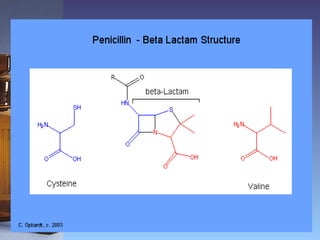
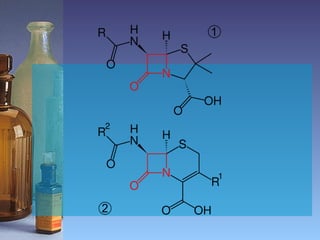
Structure Penicillins as well as cephalosporins are called beta-lactam antibiotics and are characterized by  three  fundamental structural requirements:  the fused beta-lactam structure  a free carboxyl acid group  one or more substituted amino acid side chains  The lactam structure can also be viewed as the covalent bonding of pieces of two amino acids - cysteine  and valine
 
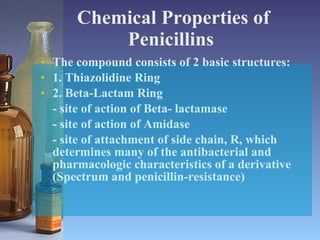
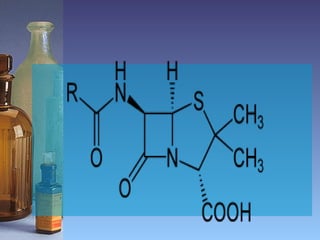
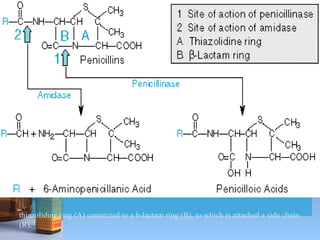
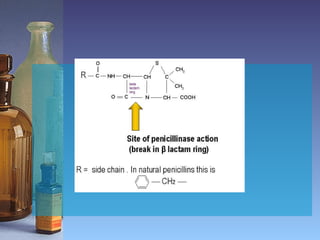
Chemical Properties of Penicillins   The compound consists of 2 basic structures: 1. Thiazolidine Ring 2. Beta-Lactam Ring - site of action of Beta- lactamase - site of action of Amidase - site of attachment of side chain, R, which determines many of the antibacterial and pharmacologic characteristics of a derivative (Spectrum and penicillin-resistance)
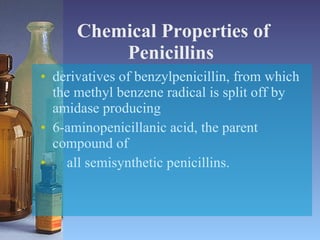
Chemical Properties of Penicillins   derivatives of benzylpenicillin, from which the methyl benzene radical is split off by amidase producing  6-aminopenicillanic acid, the parent compound of  all semisynthetic penicillins.
 
 
thiazolidine ring (A) connected to a b-lactam ring (B), to which is attached a side chain (R).
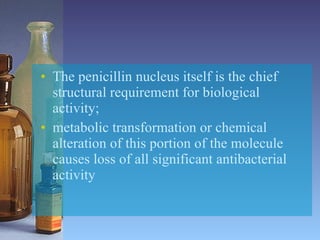
The penicillin nucleus itself is the chief structural requirement for biological activity;  metabolic transformation or chemical alteration of this portion of the molecule causes loss of all significant antibacterial activity
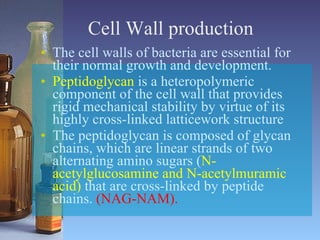
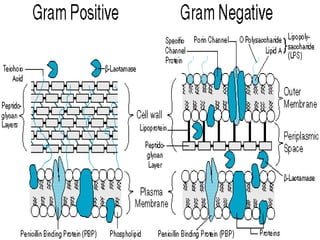
Cell Wall production The cell walls of bacteria are essential for their normal growth and development.  Peptidoglycan  is a heteropolymeric component of the cell wall that provides rigid mechanical stability by virtue of its highly cross-linked latticework structure  The peptidoglycan is composed of glycan chains, which are linear strands of two alternating amino sugars ( N-acetylglucosamine and N-acetylmuramic acid)  that are cross-linked by peptide chains.  (NAG-NAM).
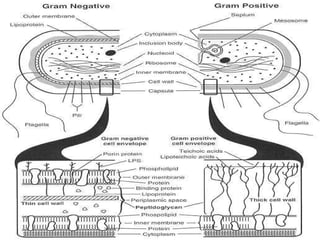
In gram-positive microorganisms, the cell wall is 50 to 100 molecules thick, but it is only 1 or 2 molecules thick in gram-negative bacteria
The biosynthesis of the peptidoglycan involves about 30 bacterial enzymes and may be considered in three stages.  The first stage,  precursor formation , takes place in the cytoplasm. The product,  uridine diphosphate (UDP)-acetylmuramyl-pentapeptide , called a " Park nucleotide " accumulates in cells when subsequent synthetic stages are inhibited. The last reaction in the synthesis of this compound is the addition of a dipeptide,  D-alanyl-D-alanine . Synthesis of the dipeptide involves prior racemization of L-alanine and condensation catalyzed by D-alanyl-D-alanine synthetase.
The second stage, UDP-acetylmuramyl-pentapeptide and UDP-acetylglucosamine are linked (with the release of the uridine nucleotides) to form a long polymer.
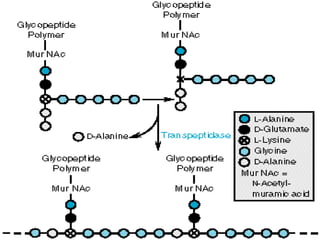
The third and final stage involves the completion of the cross-link. This is accomplished by a transpeptidation reaction that occurs outside the cell membrane. The transpeptidase itself is membrane bound.)
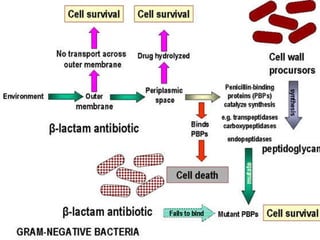
Last step in peptidoglycan synthesis that is inhibited by the beta-lactam antibiotics .  Penicillin binds at the active site of the transpeptidase enzyme that cross-links the peptidoglycan strands It mimicks D-alanyl-D-alanine residues that would normally bind to this site. Penicillin irreversibly inhibits the enzyme transpeptidase by reacting with a serine residue in the transpeptidase. This reaction is irreversible and so the growth of the bacterial cell wall is inhibited.
Binding to PBPs results in: Inhibition of transpeptidase:  transpeptidase catalyzes the cross-linking of the pentaglycine bridge with the fourth residue (D-Ala) of the pentapeptide. The fifth residue (also D-Ala) is released during this reaction. Spheroblasts are formed. Structural irregularities:  binding to PBPs may result in abnormal elongation, abnormal shape, cell wall defects.


Beta Lactam Antibiotics  &  Other Cell Wall Synthesis Inhibitors PENICILLINS CEPHALOSPORINS BETA LACTAMASE INHIBITORS CARBAPENEMS OTHER CELL WALL SYNTHESIS INHIBITORS
Classification Penicillins (penicillin G) – greatest activity against gram+, gram-cocci, non-beta-lactamase-producing anaerobes Antistaphylococcal penicillins (nafcillin) – resistant to staphylococcal beta-lactamases, active to staphylococci and streptococci Extended-spectrum penicillins (ampicillin) – retain antibacterial spectrum of penicillin with improved activity against gram- organisms, but are destroyed by beta-lactamases
PENICILLINS CLASSIFICATION Penicillinase Resistant  (Antistaphylococcal Penicillins) 1.  Methicillin (Staphcillin) 2. Nafcillin ( Unipen, Nafcil, Nallpen) 3. Isoxazolyl penicillins i.  Oxacillin iii.  Dicloxacillin ii.  Cloxacillin iv.  Flucloxacillin
PENICILLINS CLASSIFICATION Penicillinase Resistant   resistant to staphylococcal beta-lactamases active against staphylococci and streptococci but  inactive against enterococci & anaerobic bacteria, and gram-negative cocci & rods.
Penicillinase Susceptible A.Narrow Spectrum 1.  Benzylpenicillin – Penicillin G 2.  Phenoxymethyl penicillin- Penicillin V - greatest activity against gram-positive organisms, gram negative cocci, and non-beta lactamase producing anaerobes and little activity against gram-negative rods. -  Susceptible to hydrolysis by beta-lactamases
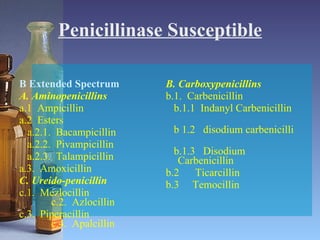
Penicillinase Susceptible B Extended Spectrum A. Aminopenicillins   a.1  Ampicillin  a.2  Esters    a.2.1.  Bacampicillin  a.2.2.  Pivampicillin  a.2.3.  Talampicillin  a.3.  Amoxicillin  C. Ureido-penicillin c.1.  Mezlocillin c.2.  Azlocillin c.3.  Piperacillin c.4.  Apalcillin B. Carboxypenicillins   b.1.  Carbenicillin  b.1.1  Indanyl Carbenicillin  b 1.2  disodium carbenicilli  b.1.3  Disodium Carbenicillin  b.2  Ticarcillin b.3  Temocillin
Penicillinase Susceptible retain the antibacterial spectrum of penicillin  improved activity against gram (-) organisms destroyed by beta-lactamases
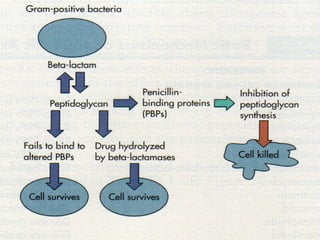
Mechanisms of Action: inhibit the last step in the peptidoglycan synthesis of the cell wall Underlying: = inhibition of transpeptidase enzymes = activation of penicillin binding proteins (PBPs) = activation of autolysins (murein hydrolases)
 
Mechanisms of Drug Actions by Enzyme Inhibition:   All penicillin derivatives produce their bacteriocidal effects by inhibition of bacterial cell wall synthesis. Specifically, the cross linking of peptides on the mucosaccharide chains is prevented. If cell walls are improperly made cell walls allow water to flow into the cell causing it to burst.
:Mechanisms of Resistance: inactivation of antibiotic by Beta lactamases - modification of PBPs - impaired penetration of drug to target PBPs - presence of an efflux pump
 
Resistance to β-Lactams – Gram pos.
PHARMACOKINETICS ABSORPTION:   vary with the preparation  Impaired by food and drugs  parenteral – complete and rapid Nafcillin – not suitable for oral administration Dicloxacillin, Amoxicillin, Ampicillin – acid stable
Gastric juice at pH 2 rapidly destroys the antibiotic. The decrease in gastric acid production with aging accounts for better absorption of penicillin G from the gastrointestinal tract of older individuals. Absorption is rapid, and maximal concentrations in blood are attained in 30 to 60 minutes. The peak value is approximately 0.5 unit/ml (0.3 mg/ml) after an oral dose of 400,000 units (about 250 mg) in an adult.
Oral Administration of Penicillin V .  The sole virtue of penicillin V in comparison with penicillin G is that it is more stable in an acidic medium, and therefore is better absorbed from the gastrointestinal tract
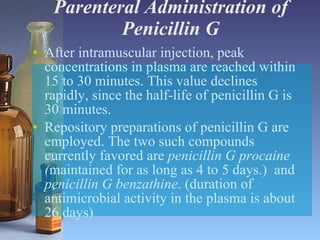
Parenteral Administration of Penicillin G After intramuscular injection, peak concentrations in plasma are reached within 15 to 30 minutes. This value declines rapidly, since the half-life of penicillin G is 30 minutes. Repository preparations of penicillin G are employed. The two such compounds currently favored are  penicillin G   procaine ( maintained for as long as 4 to 5 days.)  and  penicillin G benzathine . (duration of antimicrobial activity in the plasma is about 26 days)
Such agents release penicillin G slowly from the area in which they are injected and produce relatively low but persistent concentrations of antibiotic in the blood. Intrathecal administration is inadvisable particularly with  benzylpenicillin  as it can cause  convulsions.
DISTRIBUTION: cannot penetrate the blood brain barrier Probenecid and certain organic acids can inhibit transfer from CSF to blood stream Bacterial meningitis: 1-5 mcg/ml = 18-24 M units/day
PHARMACOKINETICS METABOLIZED: by the liver to penicillanic/penicillenic acid; penicillamine, penicilloid acid  & other penicilloyl derivatives (  allergenic metabolites ) EXCRETION:  kidneys  renal excretion inhibited by probenecid Nafcillin – biliary excretion Oxacillin, dicloxacillin, cloxacillin- kidney & biliary excretion
ADVERSE EFFECTS: 1.  Hypersensitivity reactions -  most common major antigenic determinant –  penicilloyl polylysine (PPL) 2.  Gastrointestinal disturbances after oral administration 3.  Convulsions following rapid IV injection
ADVERSE EFFECTS: 4.  Accidental injection into the sciatic nerve-severe pain and nerve dysfunction - persisting for weeks 5.  Chronic use may cause: - hepatitis - overgrowth of minor/atypical organisms following use of broad spectrum preparations
Specific toxicities  Procaine Penicillin G after accidental IV injection: - pulmonary embolism - acute psychotic reactions Oxacillin and Nafcillin: - hepatitis -  granulocytopenia, bone marrow depression Disodium Carbenicillin and high dose Penicillin G Na -  hypernatremia
Specific toxicities  Penicillin G Potassium  - hyperkalemia with high doses Penicillin G Sodium  - Jarisch-herxheimer reaction  Carbenicillin and Ticarcillin  - bleeding diathesis Methicillin  -  interstitial nephritis Ampicillin - pseudomembranous colitis
Unitage of Penicillin The international unit of penicillin is the specific penicillin activity contained in 0.6 mg of the crystalline sodium salt of penicillin G. One milligram of pure penicillin G sodium thus equals 1667 units; 1.0 mg of pure penicillin G potassium represents 1595 units. The dosage and the antibacterial potency of the semisynthetic penicillins are expressed in terms of weight. The minimum inhibitory concentration(MIC) of any penicillin is usually given in ug/ml Most penicillins ae dispensed as the sodium or potassium salt of the free acid.
Penicillin G Antimicrobial spectrum: Streptococci, meningococci, enterococci, penicillin-susceptible pneumococci, non-beta- lactamase producing staphylococci, treponema pallidum & many other spirochetes, Bacillus anthracis, Clostridium species, actinomyces & other gram (+) rods & non-beta-lactamase-producing gram (-) anaerobic organisms.
Penicillin G Antimicrobial spectrum: effective doses : 4 - 24 million units/ day IV  in 4 -6  div doses depending upon the organisms, the site and severity of infections inhibitory for enterococci  at 18 -24 mil units with an aminoglycoside
B. Procaine Penicillin G – IM Peak in 1-3 hrs;  T ½ - 12 hrs. uncomplicated pneumococcal pneumonia or gonorrhea
C. Benzathine Penicillin G mean duration of antimicrobial activity – 26 days a single  IM inj, 1.2 mil units  for Beta-hemolytic streptococcal pharyngitis IM once q 3-4 weeks – prophylaxis against reinfection  with beta-hemolytic streptococci 2.4 Mil units IM once a week for 1-3 weeks- syphilis
D. Penicillin V oral form  in minor infections relative poor bioavailability;  dosing 4x a day Gram (+) aerobic activities similar to Penicillin G 5-10x less active against gram (-) microbes, esp. Neisseria and certain  anaerobes  better absorbed from the GIT
E. Ampicillin  and Amoxicillin same spectrum of activity  oral  for UTI, sinusitis, otitis and lower  resp inf most active of the oral beta lactams vs pen resistant pneumococci s Ampicillin but not amoxicillin is effective for shigellosis
E. Ampicillin  and Amoxicillin not  used to treat uncomplicated salmonella gastroenteritis somewhat less active than Pen G vs gram (+) cocci enterococcal grp. D and viridans grp of streptococci Listeria monocytogenes H. influenza. And E. coli
Ampicillin doses:  Mild infections:    Adults  -  1 - 4 gm/day Severe infections :  Adult -  6 - 12 gm/day
F. ESTERS OF AMPICILLIN No inherent antimicrobial activity as esters, but pharmacologically active following hydrolysis to ampicillin 50% higher blood concentration than Ampicillin and Amoxicillin
G.  CARBOXYPENICILLINS  and UREIDOPENICILLINS Gram (-) aerobes Pseudomonas aeruginosa Bacteroides fragilis; but in higher amount/dose Carboxypenicillins – certain indole (-) Proteus Ureidopenicillins  -  Klebsiella
H. PENICILLINASE RESISTANT indication is infection by beta lactamase producing staphylococci,  streptococci and pneumococci  also susceptible Isoxazolyl penicillins .25 - 0.5 g orally every 4-6 hrs  15 - 25mg/kg/d for children – mild localized staphylococcal infections
H. PENICILLINASE RESISTANT relatively acid stable and well absorbed, food interferes with absorption Oxacillin or Nafcillin, 8-12 g/d given by intermittent IV infusion of 1-2 g every 4-6 hours  serious systemic staphylococcal Infxns Methicillin no longer used bec. of its nephrotoxicity
Drug-drug Interactions Penicillins bind to and inactivate aminoglycosides. This is a form of chemical antagonism. If an aminoglycoside and a penicillin are combined. they MUST NOT be administered simultaneously through the same I.V. line or through the same syringe. They will crystallize and precipitate in the line or in the vessels!  When an aminoglycoside and a penicillin are administered, the infusions should be staggered by about 1 to 2 hours.
Classification of the Penicillins and Summary of Their Pharmacological Properties .   Penicillin G and its close congener penicillin V are highly active against sensitive strains of gram-positive cocci, but they are readily hydrolyzed by penicillinase. Thus, they are ineffective against most strains of Staphylococcus aureus.
2.   The penicillinase-resistant penicillins (methicillin, nafcillin, oxacillin, cloxacillin, and dicloxacillin) have less potent antimicrobial activity against microorganisms that are sensitive to penicillin G, but they are effective against penicillinase-producing Staph. aureus.
3.   Ampicillin, amoxicillin, bacampicillin, and others comprise a group of penicillins whose antimicrobial activity is extended to include such gram-negative microorganisms as Haemophilus influenzae, E. coli, and Proteus mirabilis. Unfortunately, these drugs and the others listed below are hydrolyzed readily by broad-spectrum b-lactamases that are found with increasing frequency in clinical isolates of these gram-negative bacteria.
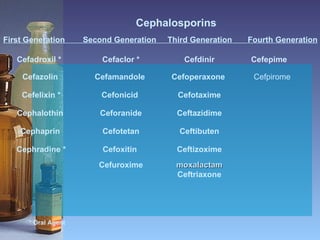
Cephalosporins      First Generation        Second Generation     Third Generation       Fourth Generation                         * Oral Agent   Cefadroxil *    Cefaclor * Cefdinir Cefepime    Cefazolin     Cefamandole  Cefoperaxone     Cefpirome    Cefelixin *    Cefonicid  Cefotaxime      Cephalothin     Ceforanide Ceftazidime      Cephaprin     Cefotetan Ceftibuten      Cephradine *    Cefoxitin  Ceftizoxime        Cefuroxime moxalactam Ceftriaxone
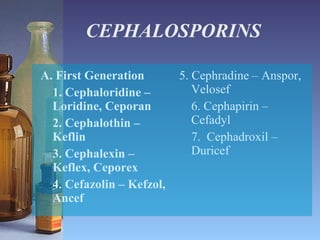
CEPHALOSPORINS A. First Generation 1. Cephaloridine – Loridine, Ceporan 2. Cephalothin – Keflin 3. Cephalexin – Keflex, Ceporex 4. Cefazolin – Kefzol, Ancef 5. Cephradine – Anspor, Velosef 6. Cephapirin – Cefadyl 7.  Cephadroxil – Duricef
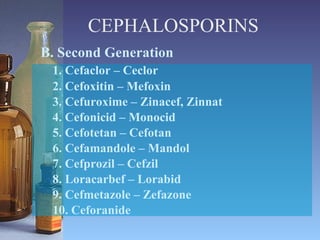
CEPHALOSPORINS B. Second Generation 1. Cefaclor – Ceclor 2. Cefoxitin – Mefoxin 3. Cefuroxime – Zinacef, Zinnat 4. Cefonicid – Monocid 5. Cefotetan – Cefotan 6. Cefamandole – Mandol 7. Cefprozil – Cefzil 8. Loracarbef – Lorabid 9. Cefmetazole – Zefazone 10. Ceforanide
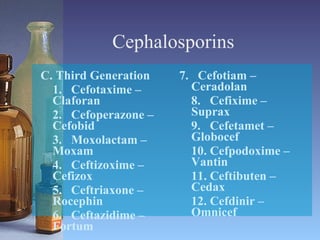
Cephalosporins C. Third Generation 1.  Cefotaxime – Claforan 2.  Cefoperazone – Cefobid 3.  Moxolactam – Moxam 4.  Ceftizoxime – Cefizox 5.  Ceftriaxone – Rocephin 6.  Ceftazidime – Fortum 7.  Cefotiam – Ceradolan 8.  Cefixime – Suprax 9.  Cefetamet – Globocef 10. Cefpodoxime – Vantin 11. Ceftibuten – Cedax 12. Cefdinir – Omnicef
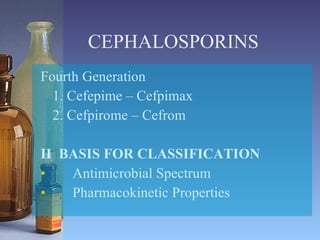
CEPHALOSPORINS Fourth Generation 1. Cefepime – Cefpimax 2. Cefpirome – Cefrom II  BASIS FOR CLASSIFICATION Antimicrobial Spectrum Pharmacokinetic Properties
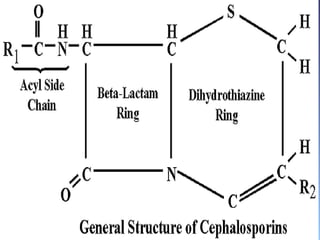
GENERAL PROPERTIES OF CEPHALOSPORINS 7 amino-cephalosporanic acid –parent compound Substitutions at R1 & R2 produce named compounds - contains an R2 that makes the compound stable in dilute acid and highly penicillinase resistant - MW 400-450 - Soluble to water and relatively stable to ph and temperature changes - Mechanisms of Action and Resistance similar to penicillins
 
GENERAL PROPERTIES OF CEPHALOSPORINS Antimicrobial Spectrum - generally broader spectrum than Penicillins - generally more effective than Penicillins against B-lactamase-producing microbes  ( except enterococci, Methicillin-resistant Staph. Aureus and Staph epidermidis )
CEPHALOSPORINS FIRST GENERATION Good actvity vs gm (+) & modest vs gm  (-) microbes Penetration to the CSF is inadequate Oral drugs used for the treatment of UTI, for minor staphylococcal lesions, or for minor polymicrobial infections such as cellulitis or soft tissue abscess.
CEPHALOSPORINS FIRST GENERATION not used in serious systemic infections Cefazolin penetrates well into most tissues- the drug of choice for surgical prophylaxis Cefazolin – only first generation parenteral cephalosphorin
CEPHALOSPORINS SECOND GENERATION Better activity vs anaerobes first gen drugs actv but with extended gm (-)  coverage Cefamandole, cefuroxime, cefonicid, ceforanide & cefaclor – H. influenzae
CEPHALOSPORINS SECOND GENERATION Cefoxitin, cefmetazole and cefotetan – B. fragilis and some serratia strains Oral dosage for adults is 10-15 mg/kg/d in two to four divided doses;  Children 20-40 mg/kg/day up to a maximum of 1 g /day.
CEPHALOSPORINS SECOND GENERATION Oral second generations are active vs  beta-lactamase-producing  H. influenzae or Branhamela catarrhalis and have been primarily used  to treat sinusitis, otitis, or lower respiratory tract infections
CEPHALOSPORINS SECOND GENERATION Cefoxitin, Cefotetan or Cefmetazole – mixed anaerobic infections as peritonitis or diverticulitis Cefuroxime – crosses the BBB &  for  community-acquired pneumonia
THIRD GENERATION less  active than the first generation vs gm (+) cocci but most active against gram (-) including B-lactamase- producing strains Cefoperazone, Ceftazidime – more active against Pseudomonas Cefoperazone, Cefotaxime – active against anaerobes
THIRD GENERATION Ceftizoxime, Moxolactam – B. fragilis Cross BBB except Cefoperazone, Cefixime, Ceftibuten and Cefpodoxime proxetil Excretion – Cefoperazone and Ceftriaxone: bile;  Probenecid does  not affect renal excretion
THIRD GENERATION Ceftriaxone, 125 mg inj., Cefixime, single 400 mg  - N. gonorrhea Cefoperazone 25- 100 mg/kg/d injected q 8-12 hrs. Cefixime 200 mg orally twice a day or 400 mg OD Cefpodoxime proxetil & Ceftibuten – 200 mg 2x/day
THIRD GENERATION Meningitis caused by pneumococci, meningococci, H. influenza & susceptible  enteric  gm (-) rods but not by L. monocytogenes;  used in combn  with aminoglycosides for Rx  of meningitis caused by P. aeruginosa
CEPHALOSPORINS FOURTH GENERATION - More resistant to hydrolysis by chromosomal beta lactamases  (eg. Those produced by enterobacter) Good activity against P. aeruginosa, enterobacteriaceae, Staph aureus,  S. pneumoniae
CEPHALOSPORINS FOURTH GENERATION Highly active against Haemophilus & Neisseria Penetrates well into CSF Cleared by kidneys T ½  - 2 hrs. Good activity against most penicillin resistant strains of streptococci
ADVERSE EFFECTS of Cephalosporins 1. Allergy 2. Toxicity: > Renal toxicity – interstitial nephritis and even tubular necrosis > Cephalosporin that contains a methyl thiotetrazole group ( Cefamandole, Moxolactam, Cefmetazole, Cefoteta, Cefoperazone)  – cause disulfiram like reactions, hypoprothrombinemia and bleeding disorders – Antidote:  Vit. K 10 mg 2x/ week
ADVERSE EFFECTS of Cephalosporins Toxicity: (Con’t…) > Moxolactam – interferes with platelet function, severe bleeding 3. Superinfection
MONOBACTAMS Monocyclin beta lactam ring Resistant to beta-lactamases and active against gram negative rods including Pseudomonas and Serratia No activity against gram positive bacteria or anaerobes
Monobactam Aztreonam :  This drug is a monocyclic beta-lactam (a monobactam). Mechanism of action : Aztreonam interacts with penicillin binding proteins and induces the formation of long filamentous bacteria.
Antimicrobial spectrum :  The antimicrobial spectrum of aztreonam differs from that of other beta-lactams.  It more closely resembles the spectrum of the aminoglycosides. Gram positive and anaerobic bacteria are resistant. Susceptible organisms include:  ( It has an unusual spectrum being active only against Gram-negative aerobic rods)  Enterobacteriaceae, Pseudomonas, Hemophillus and Neisseria. Aztreonam is resistant to the beta-lactamase produced by gram negative organisms
Side effects:   Generally, the drug is well tolerated.  Patients who are allergic to penicillins do not exhibit cross-reactions with aztreonam.
MONOBACTAMS Aztreonam – resembles aminoglycosides in spectrum of activity Given 1-2 g IV every 8 hrs. T1/2 – 1-2 hrs.
BETA LACTAMASE INHIBITORS Resemble B-lactam molecules but themselves have very weak antibacterial action Bind to Beta-lactamase, inactivate them and prevent the destruction Synergistic with other beta-lactams
BETA LACTAMASE INHIBITORS Available only in fixed combinations with specific penicillins A.  Clavulanic Acid – combined with Amoxicillin (Augmentin)  - combined with Ticarcillin  (Timentin) B.  Sulbactam Pivoxil and Ampicillin (Unasyn) C.  Tazobactam and Piperacillin (Tazocin)
Carbapenems Carbepenems are a new class of drugs which are structurallv similar to the penicillins. These drugs were developed to deal with beta‑lactamase producing Gram-negative organisms, which were resistant to broad spectrum and extended spectrum penicillins. Carbapenems are derived from  Streptomyces  species and one example is the semisynthetic  imipenem  which acts in the same way as the other beta-lactams. The most extensively studied drug is imipenem.
Imipenem: Mechanism of action:  Imipenem, like other b-lactams, binds to penicillin binding proteins. Hence it  disrupts cell wall synethesis and is bactericidal. Antimicrobial spectrum:  Imipenem differs from the penicillins in its antimicrobial spectrum. It is a  broad-spectrum  antibiotic with excellent activity against a variety of gram positive and gram negative organism (both aerobic and anaerobic).
It is resistant to most forms of b-lactamase, including that produced by staphylococcus.  However,  methicillin-resistant staphylococcus is usually resistant to imipenem .  Susceptible organisms include: Streptococci, Enterococci. Staphylococci, Lister, Enterobacteriaceae, Pseudomonas, Bacteroides, and Clostridium.
Metabolism:   Imipenem is rapidly hydrolyzed by the enzyme, dihydropeptidase, which is found in the brush border of the proximal renal tubule . It is always administered with  cilastatin,  an inhibitor of dipeptidase. Side efects:   Individuals who are allergic to the penicillins may demonstrate cross-reactivity with imipenem.  Imipemem may produce nausea and vomiting. Seizures have been reported with high doses, particularly in patients with renal failure.
Meropenem It is similar to imipenem. It is not degraded by dehydropeptidase, thus no cilastatin is needed. Excessive levels in kidney failure can cause seizures with imipenem but not with meropenem.
CARBAPENEMS Imipenem  – gram (-) rods, gram- positive organisms and anaerobes > inactivated by dehydropeptidases in renal tubules resulting in low urinary concentrations. combined with Cilastatin (dehydropeptidase inhibitor) to reduce inactivation > penetrates body tissues and fluids well including the CSF
CARBAPENEMS Imipenem: 0.25 – 0.5 g IV q 6-8 hrs. > adverse effects include nausea, vomiting, diarrhea, reactions to infusion site, excessive in renal failure – seizures Meropenem – slightly greater activity against gram (-) aerobes; does not require an inhibitor > penetrates CSF;  1 g q 8 hrs.
A. VANCOMYCIN - gram (+) staph MOA – binds firmly to D-Ala-D-Ala terminus of nascent peptidoglycan pentapeptide Resistance – modification of the D-Ala-D-Ala binding site of the peptidoglycan building block in which the terminal D-Ala is replaced by D-lactate resulting to loss of a critical H bond that facilitates high affinity binding of vancomycin to its target and loss of activity
A. VANCOMYCIN Poorly absorbed from the intestinal tract but  oral for the Rx of antibiotic asst enterocolitis caused by C. difficile 99% excreted by glomerular filtration t½:  6-10 days  -  not removed by dialysis
A. VANCOMYCIN Rx for parenteral vancomycin: sepsis or endocarditis caused by meth-resistant staph plus Cefotaxime, Ceftriaxone or Rifampicin for Rx of meningitis of  pen resistant strain of pneumococcus.  Dose:  30 mg/kg/day in 2 -3 div doses Causes phlebitis, chills and fever, ototoxicity, nephrotoxicity,  red man or red neck syndrome
B. FOSFOMYCIN inhibits cytoplasmic enzyme enol pyruvate transferase by covalently binding to the cysteine  residue of the active site and blocking the phosphoenolpyruvate to UDP-N-  acetylglucosamine –  1st step in the formation of UDP-N-acetylmuramic acid, the precursor of acetylmuramic acid -  Transported into the cell by glycerophosphate or glucose 6 phosphate transport systems
B. FOSFOMYCIN Resistance is due to inadequate transport of drug into the cell Active against both Gram (+) and  Gram (-) In vitro synergism with beta-lactams, animoglycosides or fluoroquinolones Available orally (2-4 g, single dose in uncomplicated UTI) and parenterally Excreted through the kidneys Safe in pregnancy
C. BACITRACIN active against Gram (+) organisms inhibits cell wall formation by interfering with dephosphorylation in cycling of the lipid carrier that  transfers peptidoglycan subunits to the growing cell wall nephrotoxic poorly absorbed; limited to topical use 500 units/g ointment + polymyxin B or Neomycin
D. CYCLOSERINE widely distributed into tissues excreted through the urine 0.5 – 1 g / d in 2-3 divided doses causes dose related CNS toxicity, headaches, tremors, acute psychosis, convulsions
 
POST-TEST PARENT COMPOUND OF CEPHALOSPHORIN PARENT COMPOUND OF PENICILLIN 3-6: composition of the beta lactam structure of the beta lactam antibiotics 7. ENZYME PRODUCED BY BACTERIA THAT HYDROLYSIS PENICILLIN
8. ANTIBIOTIC OF CHOICE AGAINST STAPH INFECTION 9. 2 ND  GENERATION CEPHALOSPHORIN THAT CAN ENTER THE BBB 10. ORAL FORM OF PENICILLIN

Antimicrobials 1 Lec

  • 1.
    BETA LACTAM &OTHER CELL WALL- & MEMBRANE ACTIVE ANTIBIOTICS MA. LENY ALDA G. JUSAYAN, MD DEPARTMENT OF PHARMACOLOGY
  • 2.
    Introduction The penicillinsconstitute one of the most important groups of antibiotics. Although numerous other antimicrobial agents have been produced since the first penicillin became available, these still are widely used, major antibiotics, and new derivatives of the basic penicillin nucleus still are being produced. Many of these have unique advantages, such that members of this group of antibiotics are presently the drugs of choice for a large number of infectious diseases.
  • 3.
    History The penicillinswere the first antibiotics discovered as natural products from the mold Penicillium. 1928 - Sir Alexander Fleming, professor of bacteriology at St. Mary's Hospital in London, was culturing Staphylococcus aureus. He noticed zones of inhibition where mold spores were growing. He named the mold Penicillium rubrum . It was determined that a secretion of the mold was effective against Gram-positive bacteria.
  • 4.
    1928 - AlexanderFleming Bread mold ( Penicillin notatum ) growing on petri dish 1939 - Florey, Chain, and Associates Began work on isolating and synthizing large amounts of Penicillin. 1944 - Used in WWII to treat infections Late 1940’s - available for general use in US
  • 5.
    Structure Penicillins aswell as cephalosporins are called beta-lactam antibiotics and are characterized by three fundamental structural requirements: the fused beta-lactam structure a free carboxyl acid group one or more substituted amino acid side chains The lactam structure can also be viewed as the covalent bonding of pieces of two amino acids - cysteine and valine
  • 6.
  • 7.
    Chemical Properties ofPenicillins The compound consists of 2 basic structures: 1. Thiazolidine Ring 2. Beta-Lactam Ring - site of action of Beta- lactamase - site of action of Amidase - site of attachment of side chain, R, which determines many of the antibacterial and pharmacologic characteristics of a derivative (Spectrum and penicillin-resistance)
  • 8.
    Chemical Properties ofPenicillins derivatives of benzylpenicillin, from which the methyl benzene radical is split off by amidase producing 6-aminopenicillanic acid, the parent compound of all semisynthetic penicillins.
  • 9.
  • 10.
  • 11.
    thiazolidine ring (A)connected to a b-lactam ring (B), to which is attached a side chain (R).
  • 12.
    The penicillin nucleusitself is the chief structural requirement for biological activity; metabolic transformation or chemical alteration of this portion of the molecule causes loss of all significant antibacterial activity
  • 13.
    Cell Wall productionThe cell walls of bacteria are essential for their normal growth and development. Peptidoglycan is a heteropolymeric component of the cell wall that provides rigid mechanical stability by virtue of its highly cross-linked latticework structure The peptidoglycan is composed of glycan chains, which are linear strands of two alternating amino sugars ( N-acetylglucosamine and N-acetylmuramic acid) that are cross-linked by peptide chains. (NAG-NAM).
  • 14.
    In gram-positive microorganisms,the cell wall is 50 to 100 molecules thick, but it is only 1 or 2 molecules thick in gram-negative bacteria
  • 15.
    The biosynthesis ofthe peptidoglycan involves about 30 bacterial enzymes and may be considered in three stages. The first stage, precursor formation , takes place in the cytoplasm. The product, uridine diphosphate (UDP)-acetylmuramyl-pentapeptide , called a " Park nucleotide " accumulates in cells when subsequent synthetic stages are inhibited. The last reaction in the synthesis of this compound is the addition of a dipeptide, D-alanyl-D-alanine . Synthesis of the dipeptide involves prior racemization of L-alanine and condensation catalyzed by D-alanyl-D-alanine synthetase.
  • 16.
    The second stage,UDP-acetylmuramyl-pentapeptide and UDP-acetylglucosamine are linked (with the release of the uridine nucleotides) to form a long polymer.
  • 17.
    The third andfinal stage involves the completion of the cross-link. This is accomplished by a transpeptidation reaction that occurs outside the cell membrane. The transpeptidase itself is membrane bound.)
  • 18.
    Last step inpeptidoglycan synthesis that is inhibited by the beta-lactam antibiotics . Penicillin binds at the active site of the transpeptidase enzyme that cross-links the peptidoglycan strands It mimicks D-alanyl-D-alanine residues that would normally bind to this site. Penicillin irreversibly inhibits the enzyme transpeptidase by reacting with a serine residue in the transpeptidase. This reaction is irreversible and so the growth of the bacterial cell wall is inhibited.
  • 19.
    Binding to PBPsresults in: Inhibition of transpeptidase: transpeptidase catalyzes the cross-linking of the pentaglycine bridge with the fourth residue (D-Ala) of the pentapeptide. The fifth residue (also D-Ala) is released during this reaction. Spheroblasts are formed. Structural irregularities: binding to PBPs may result in abnormal elongation, abnormal shape, cell wall defects.
  • 20.
  • 21.
  • 22.
  • 23.
    Beta Lactam Antibiotics & Other Cell Wall Synthesis Inhibitors PENICILLINS CEPHALOSPORINS BETA LACTAMASE INHIBITORS CARBAPENEMS OTHER CELL WALL SYNTHESIS INHIBITORS
  • 24.
    Classification Penicillins (penicillinG) – greatest activity against gram+, gram-cocci, non-beta-lactamase-producing anaerobes Antistaphylococcal penicillins (nafcillin) – resistant to staphylococcal beta-lactamases, active to staphylococci and streptococci Extended-spectrum penicillins (ampicillin) – retain antibacterial spectrum of penicillin with improved activity against gram- organisms, but are destroyed by beta-lactamases
  • 25.
    PENICILLINS CLASSIFICATION PenicillinaseResistant (Antistaphylococcal Penicillins) 1. Methicillin (Staphcillin) 2. Nafcillin ( Unipen, Nafcil, Nallpen) 3. Isoxazolyl penicillins i. Oxacillin iii. Dicloxacillin ii. Cloxacillin iv. Flucloxacillin
  • 26.
    PENICILLINS CLASSIFICATION PenicillinaseResistant resistant to staphylococcal beta-lactamases active against staphylococci and streptococci but inactive against enterococci & anaerobic bacteria, and gram-negative cocci & rods.
  • 27.
    Penicillinase Susceptible A.NarrowSpectrum 1. Benzylpenicillin – Penicillin G 2. Phenoxymethyl penicillin- Penicillin V - greatest activity against gram-positive organisms, gram negative cocci, and non-beta lactamase producing anaerobes and little activity against gram-negative rods. - Susceptible to hydrolysis by beta-lactamases
  • 28.
    Penicillinase Susceptible BExtended Spectrum A. Aminopenicillins a.1 Ampicillin a.2 Esters a.2.1. Bacampicillin a.2.2. Pivampicillin a.2.3. Talampicillin a.3. Amoxicillin C. Ureido-penicillin c.1. Mezlocillin c.2. Azlocillin c.3. Piperacillin c.4. Apalcillin B. Carboxypenicillins b.1. Carbenicillin b.1.1 Indanyl Carbenicillin b 1.2 disodium carbenicilli b.1.3 Disodium Carbenicillin b.2 Ticarcillin b.3 Temocillin
  • 29.
    Penicillinase Susceptible retainthe antibacterial spectrum of penicillin improved activity against gram (-) organisms destroyed by beta-lactamases
  • 30.
    Mechanisms of Action:inhibit the last step in the peptidoglycan synthesis of the cell wall Underlying: = inhibition of transpeptidase enzymes = activation of penicillin binding proteins (PBPs) = activation of autolysins (murein hydrolases)
  • 31.
  • 32.
    Mechanisms of DrugActions by Enzyme Inhibition: All penicillin derivatives produce their bacteriocidal effects by inhibition of bacterial cell wall synthesis. Specifically, the cross linking of peptides on the mucosaccharide chains is prevented. If cell walls are improperly made cell walls allow water to flow into the cell causing it to burst.
  • 33.
    :Mechanisms of Resistance:inactivation of antibiotic by Beta lactamases - modification of PBPs - impaired penetration of drug to target PBPs - presence of an efflux pump
  • 34.
  • 35.
  • 36.
    PHARMACOKINETICS ABSORPTION: vary with the preparation Impaired by food and drugs parenteral – complete and rapid Nafcillin – not suitable for oral administration Dicloxacillin, Amoxicillin, Ampicillin – acid stable
  • 37.
    Gastric juice atpH 2 rapidly destroys the antibiotic. The decrease in gastric acid production with aging accounts for better absorption of penicillin G from the gastrointestinal tract of older individuals. Absorption is rapid, and maximal concentrations in blood are attained in 30 to 60 minutes. The peak value is approximately 0.5 unit/ml (0.3 mg/ml) after an oral dose of 400,000 units (about 250 mg) in an adult.
  • 38.
    Oral Administration ofPenicillin V . The sole virtue of penicillin V in comparison with penicillin G is that it is more stable in an acidic medium, and therefore is better absorbed from the gastrointestinal tract
  • 39.
    Parenteral Administration ofPenicillin G After intramuscular injection, peak concentrations in plasma are reached within 15 to 30 minutes. This value declines rapidly, since the half-life of penicillin G is 30 minutes. Repository preparations of penicillin G are employed. The two such compounds currently favored are penicillin G procaine ( maintained for as long as 4 to 5 days.) and penicillin G benzathine . (duration of antimicrobial activity in the plasma is about 26 days)
  • 40.
    Such agents releasepenicillin G slowly from the area in which they are injected and produce relatively low but persistent concentrations of antibiotic in the blood. Intrathecal administration is inadvisable particularly with benzylpenicillin as it can cause convulsions.
  • 41.
    DISTRIBUTION: cannot penetratethe blood brain barrier Probenecid and certain organic acids can inhibit transfer from CSF to blood stream Bacterial meningitis: 1-5 mcg/ml = 18-24 M units/day
  • 42.
    PHARMACOKINETICS METABOLIZED: bythe liver to penicillanic/penicillenic acid; penicillamine, penicilloid acid & other penicilloyl derivatives ( allergenic metabolites ) EXCRETION: kidneys renal excretion inhibited by probenecid Nafcillin – biliary excretion Oxacillin, dicloxacillin, cloxacillin- kidney & biliary excretion
  • 43.
    ADVERSE EFFECTS: 1. Hypersensitivity reactions - most common major antigenic determinant – penicilloyl polylysine (PPL) 2. Gastrointestinal disturbances after oral administration 3. Convulsions following rapid IV injection
  • 44.
    ADVERSE EFFECTS: 4. Accidental injection into the sciatic nerve-severe pain and nerve dysfunction - persisting for weeks 5. Chronic use may cause: - hepatitis - overgrowth of minor/atypical organisms following use of broad spectrum preparations
  • 45.
    Specific toxicities Procaine Penicillin G after accidental IV injection: - pulmonary embolism - acute psychotic reactions Oxacillin and Nafcillin: - hepatitis - granulocytopenia, bone marrow depression Disodium Carbenicillin and high dose Penicillin G Na - hypernatremia
  • 46.
    Specific toxicities Penicillin G Potassium - hyperkalemia with high doses Penicillin G Sodium - Jarisch-herxheimer reaction Carbenicillin and Ticarcillin - bleeding diathesis Methicillin - interstitial nephritis Ampicillin - pseudomembranous colitis
  • 47.
    Unitage of PenicillinThe international unit of penicillin is the specific penicillin activity contained in 0.6 mg of the crystalline sodium salt of penicillin G. One milligram of pure penicillin G sodium thus equals 1667 units; 1.0 mg of pure penicillin G potassium represents 1595 units. The dosage and the antibacterial potency of the semisynthetic penicillins are expressed in terms of weight. The minimum inhibitory concentration(MIC) of any penicillin is usually given in ug/ml Most penicillins ae dispensed as the sodium or potassium salt of the free acid.
  • 48.
    Penicillin G Antimicrobialspectrum: Streptococci, meningococci, enterococci, penicillin-susceptible pneumococci, non-beta- lactamase producing staphylococci, treponema pallidum & many other spirochetes, Bacillus anthracis, Clostridium species, actinomyces & other gram (+) rods & non-beta-lactamase-producing gram (-) anaerobic organisms.
  • 49.
    Penicillin G Antimicrobialspectrum: effective doses : 4 - 24 million units/ day IV in 4 -6 div doses depending upon the organisms, the site and severity of infections inhibitory for enterococci at 18 -24 mil units with an aminoglycoside
  • 50.
    B. Procaine PenicillinG – IM Peak in 1-3 hrs; T ½ - 12 hrs. uncomplicated pneumococcal pneumonia or gonorrhea
  • 51.
    C. Benzathine PenicillinG mean duration of antimicrobial activity – 26 days a single IM inj, 1.2 mil units for Beta-hemolytic streptococcal pharyngitis IM once q 3-4 weeks – prophylaxis against reinfection with beta-hemolytic streptococci 2.4 Mil units IM once a week for 1-3 weeks- syphilis
  • 52.
    D. Penicillin Voral form in minor infections relative poor bioavailability; dosing 4x a day Gram (+) aerobic activities similar to Penicillin G 5-10x less active against gram (-) microbes, esp. Neisseria and certain anaerobes better absorbed from the GIT
  • 53.
    E. Ampicillin and Amoxicillin same spectrum of activity oral for UTI, sinusitis, otitis and lower resp inf most active of the oral beta lactams vs pen resistant pneumococci s Ampicillin but not amoxicillin is effective for shigellosis
  • 54.
    E. Ampicillin and Amoxicillin not used to treat uncomplicated salmonella gastroenteritis somewhat less active than Pen G vs gram (+) cocci enterococcal grp. D and viridans grp of streptococci Listeria monocytogenes H. influenza. And E. coli
  • 55.
    Ampicillin doses: Mild infections: Adults - 1 - 4 gm/day Severe infections : Adult - 6 - 12 gm/day
  • 56.
    F. ESTERS OFAMPICILLIN No inherent antimicrobial activity as esters, but pharmacologically active following hydrolysis to ampicillin 50% higher blood concentration than Ampicillin and Amoxicillin
  • 57.
    G. CARBOXYPENICILLINS and UREIDOPENICILLINS Gram (-) aerobes Pseudomonas aeruginosa Bacteroides fragilis; but in higher amount/dose Carboxypenicillins – certain indole (-) Proteus Ureidopenicillins - Klebsiella
  • 58.
    H. PENICILLINASE RESISTANTindication is infection by beta lactamase producing staphylococci, streptococci and pneumococci also susceptible Isoxazolyl penicillins .25 - 0.5 g orally every 4-6 hrs 15 - 25mg/kg/d for children – mild localized staphylococcal infections
  • 59.
    H. PENICILLINASE RESISTANTrelatively acid stable and well absorbed, food interferes with absorption Oxacillin or Nafcillin, 8-12 g/d given by intermittent IV infusion of 1-2 g every 4-6 hours serious systemic staphylococcal Infxns Methicillin no longer used bec. of its nephrotoxicity
  • 60.
    Drug-drug Interactions Penicillinsbind to and inactivate aminoglycosides. This is a form of chemical antagonism. If an aminoglycoside and a penicillin are combined. they MUST NOT be administered simultaneously through the same I.V. line or through the same syringe. They will crystallize and precipitate in the line or in the vessels! When an aminoglycoside and a penicillin are administered, the infusions should be staggered by about 1 to 2 hours.
  • 61.
    Classification of thePenicillins and Summary of Their Pharmacological Properties . Penicillin G and its close congener penicillin V are highly active against sensitive strains of gram-positive cocci, but they are readily hydrolyzed by penicillinase. Thus, they are ineffective against most strains of Staphylococcus aureus.
  • 62.
    2. The penicillinase-resistant penicillins (methicillin, nafcillin, oxacillin, cloxacillin, and dicloxacillin) have less potent antimicrobial activity against microorganisms that are sensitive to penicillin G, but they are effective against penicillinase-producing Staph. aureus.
  • 63.
    3. Ampicillin, amoxicillin, bacampicillin, and others comprise a group of penicillins whose antimicrobial activity is extended to include such gram-negative microorganisms as Haemophilus influenzae, E. coli, and Proteus mirabilis. Unfortunately, these drugs and the others listed below are hydrolyzed readily by broad-spectrum b-lactamases that are found with increasing frequency in clinical isolates of these gram-negative bacteria.
  • 64.
    Cephalosporins   First Generation        Second Generation     Third Generation       Fourth Generation                      * Oral Agent Cefadroxil *   Cefaclor * Cefdinir Cefepime   Cefazolin    Cefamandole  Cefoperaxone    Cefpirome   Cefelixin *   Cefonicid  Cefotaxime     Cephalothin    Ceforanide Ceftazidime     Cephaprin    Cefotetan Ceftibuten     Cephradine *   Cefoxitin  Ceftizoxime       Cefuroxime moxalactam Ceftriaxone
  • 65.
    CEPHALOSPORINS A. FirstGeneration 1. Cephaloridine – Loridine, Ceporan 2. Cephalothin – Keflin 3. Cephalexin – Keflex, Ceporex 4. Cefazolin – Kefzol, Ancef 5. Cephradine – Anspor, Velosef 6. Cephapirin – Cefadyl 7. Cephadroxil – Duricef
  • 66.
    CEPHALOSPORINS B. SecondGeneration 1. Cefaclor – Ceclor 2. Cefoxitin – Mefoxin 3. Cefuroxime – Zinacef, Zinnat 4. Cefonicid – Monocid 5. Cefotetan – Cefotan 6. Cefamandole – Mandol 7. Cefprozil – Cefzil 8. Loracarbef – Lorabid 9. Cefmetazole – Zefazone 10. Ceforanide
  • 67.
    Cephalosporins C. ThirdGeneration 1. Cefotaxime – Claforan 2. Cefoperazone – Cefobid 3. Moxolactam – Moxam 4. Ceftizoxime – Cefizox 5. Ceftriaxone – Rocephin 6. Ceftazidime – Fortum 7. Cefotiam – Ceradolan 8. Cefixime – Suprax 9. Cefetamet – Globocef 10. Cefpodoxime – Vantin 11. Ceftibuten – Cedax 12. Cefdinir – Omnicef
  • 68.
    CEPHALOSPORINS Fourth Generation1. Cefepime – Cefpimax 2. Cefpirome – Cefrom II BASIS FOR CLASSIFICATION Antimicrobial Spectrum Pharmacokinetic Properties
  • 69.
    GENERAL PROPERTIES OFCEPHALOSPORINS 7 amino-cephalosporanic acid –parent compound Substitutions at R1 & R2 produce named compounds - contains an R2 that makes the compound stable in dilute acid and highly penicillinase resistant - MW 400-450 - Soluble to water and relatively stable to ph and temperature changes - Mechanisms of Action and Resistance similar to penicillins
  • 70.
  • 71.
    GENERAL PROPERTIES OFCEPHALOSPORINS Antimicrobial Spectrum - generally broader spectrum than Penicillins - generally more effective than Penicillins against B-lactamase-producing microbes ( except enterococci, Methicillin-resistant Staph. Aureus and Staph epidermidis )
  • 72.
    CEPHALOSPORINS FIRST GENERATIONGood actvity vs gm (+) & modest vs gm (-) microbes Penetration to the CSF is inadequate Oral drugs used for the treatment of UTI, for minor staphylococcal lesions, or for minor polymicrobial infections such as cellulitis or soft tissue abscess.
  • 73.
    CEPHALOSPORINS FIRST GENERATIONnot used in serious systemic infections Cefazolin penetrates well into most tissues- the drug of choice for surgical prophylaxis Cefazolin – only first generation parenteral cephalosphorin
  • 74.
    CEPHALOSPORINS SECOND GENERATIONBetter activity vs anaerobes first gen drugs actv but with extended gm (-) coverage Cefamandole, cefuroxime, cefonicid, ceforanide & cefaclor – H. influenzae
  • 75.
    CEPHALOSPORINS SECOND GENERATIONCefoxitin, cefmetazole and cefotetan – B. fragilis and some serratia strains Oral dosage for adults is 10-15 mg/kg/d in two to four divided doses; Children 20-40 mg/kg/day up to a maximum of 1 g /day.
  • 76.
    CEPHALOSPORINS SECOND GENERATIONOral second generations are active vs beta-lactamase-producing H. influenzae or Branhamela catarrhalis and have been primarily used to treat sinusitis, otitis, or lower respiratory tract infections
  • 77.
    CEPHALOSPORINS SECOND GENERATIONCefoxitin, Cefotetan or Cefmetazole – mixed anaerobic infections as peritonitis or diverticulitis Cefuroxime – crosses the BBB & for community-acquired pneumonia
  • 78.
    THIRD GENERATION less active than the first generation vs gm (+) cocci but most active against gram (-) including B-lactamase- producing strains Cefoperazone, Ceftazidime – more active against Pseudomonas Cefoperazone, Cefotaxime – active against anaerobes
  • 79.
    THIRD GENERATION Ceftizoxime,Moxolactam – B. fragilis Cross BBB except Cefoperazone, Cefixime, Ceftibuten and Cefpodoxime proxetil Excretion – Cefoperazone and Ceftriaxone: bile; Probenecid does not affect renal excretion
  • 80.
    THIRD GENERATION Ceftriaxone,125 mg inj., Cefixime, single 400 mg - N. gonorrhea Cefoperazone 25- 100 mg/kg/d injected q 8-12 hrs. Cefixime 200 mg orally twice a day or 400 mg OD Cefpodoxime proxetil & Ceftibuten – 200 mg 2x/day
  • 81.
    THIRD GENERATION Meningitiscaused by pneumococci, meningococci, H. influenza & susceptible enteric gm (-) rods but not by L. monocytogenes; used in combn with aminoglycosides for Rx of meningitis caused by P. aeruginosa
  • 82.
    CEPHALOSPORINS FOURTH GENERATION- More resistant to hydrolysis by chromosomal beta lactamases (eg. Those produced by enterobacter) Good activity against P. aeruginosa, enterobacteriaceae, Staph aureus, S. pneumoniae
  • 83.
    CEPHALOSPORINS FOURTH GENERATIONHighly active against Haemophilus & Neisseria Penetrates well into CSF Cleared by kidneys T ½ - 2 hrs. Good activity against most penicillin resistant strains of streptococci
  • 84.
    ADVERSE EFFECTS ofCephalosporins 1. Allergy 2. Toxicity: > Renal toxicity – interstitial nephritis and even tubular necrosis > Cephalosporin that contains a methyl thiotetrazole group ( Cefamandole, Moxolactam, Cefmetazole, Cefoteta, Cefoperazone) – cause disulfiram like reactions, hypoprothrombinemia and bleeding disorders – Antidote: Vit. K 10 mg 2x/ week
  • 85.
    ADVERSE EFFECTS ofCephalosporins Toxicity: (Con’t…) > Moxolactam – interferes with platelet function, severe bleeding 3. Superinfection
  • 86.
    MONOBACTAMS Monocyclin betalactam ring Resistant to beta-lactamases and active against gram negative rods including Pseudomonas and Serratia No activity against gram positive bacteria or anaerobes
  • 87.
    Monobactam Aztreonam : This drug is a monocyclic beta-lactam (a monobactam). Mechanism of action : Aztreonam interacts with penicillin binding proteins and induces the formation of long filamentous bacteria.
  • 88.
    Antimicrobial spectrum : The antimicrobial spectrum of aztreonam differs from that of other beta-lactams. It more closely resembles the spectrum of the aminoglycosides. Gram positive and anaerobic bacteria are resistant. Susceptible organisms include: ( It has an unusual spectrum being active only against Gram-negative aerobic rods) Enterobacteriaceae, Pseudomonas, Hemophillus and Neisseria. Aztreonam is resistant to the beta-lactamase produced by gram negative organisms
  • 89.
    Side effects: Generally, the drug is well tolerated. Patients who are allergic to penicillins do not exhibit cross-reactions with aztreonam.
  • 90.
    MONOBACTAMS Aztreonam –resembles aminoglycosides in spectrum of activity Given 1-2 g IV every 8 hrs. T1/2 – 1-2 hrs.
  • 91.
    BETA LACTAMASE INHIBITORSResemble B-lactam molecules but themselves have very weak antibacterial action Bind to Beta-lactamase, inactivate them and prevent the destruction Synergistic with other beta-lactams
  • 92.
    BETA LACTAMASE INHIBITORSAvailable only in fixed combinations with specific penicillins A. Clavulanic Acid – combined with Amoxicillin (Augmentin) - combined with Ticarcillin (Timentin) B. Sulbactam Pivoxil and Ampicillin (Unasyn) C. Tazobactam and Piperacillin (Tazocin)
  • 93.
    Carbapenems Carbepenems area new class of drugs which are structurallv similar to the penicillins. These drugs were developed to deal with beta‑lactamase producing Gram-negative organisms, which were resistant to broad spectrum and extended spectrum penicillins. Carbapenems are derived from Streptomyces species and one example is the semisynthetic imipenem which acts in the same way as the other beta-lactams. The most extensively studied drug is imipenem.
  • 94.
    Imipenem: Mechanism ofaction: Imipenem, like other b-lactams, binds to penicillin binding proteins. Hence it disrupts cell wall synethesis and is bactericidal. Antimicrobial spectrum: Imipenem differs from the penicillins in its antimicrobial spectrum. It is a broad-spectrum antibiotic with excellent activity against a variety of gram positive and gram negative organism (both aerobic and anaerobic).
  • 95.
    It is resistantto most forms of b-lactamase, including that produced by staphylococcus. However, methicillin-resistant staphylococcus is usually resistant to imipenem . Susceptible organisms include: Streptococci, Enterococci. Staphylococci, Lister, Enterobacteriaceae, Pseudomonas, Bacteroides, and Clostridium.
  • 96.
    Metabolism: Imipenem is rapidly hydrolyzed by the enzyme, dihydropeptidase, which is found in the brush border of the proximal renal tubule . It is always administered with cilastatin, an inhibitor of dipeptidase. Side efects: Individuals who are allergic to the penicillins may demonstrate cross-reactivity with imipenem. Imipemem may produce nausea and vomiting. Seizures have been reported with high doses, particularly in patients with renal failure.
  • 97.
    Meropenem It issimilar to imipenem. It is not degraded by dehydropeptidase, thus no cilastatin is needed. Excessive levels in kidney failure can cause seizures with imipenem but not with meropenem.
  • 98.
    CARBAPENEMS Imipenem – gram (-) rods, gram- positive organisms and anaerobes > inactivated by dehydropeptidases in renal tubules resulting in low urinary concentrations. combined with Cilastatin (dehydropeptidase inhibitor) to reduce inactivation > penetrates body tissues and fluids well including the CSF
  • 99.
    CARBAPENEMS Imipenem: 0.25– 0.5 g IV q 6-8 hrs. > adverse effects include nausea, vomiting, diarrhea, reactions to infusion site, excessive in renal failure – seizures Meropenem – slightly greater activity against gram (-) aerobes; does not require an inhibitor > penetrates CSF; 1 g q 8 hrs.
  • 100.
    A. VANCOMYCIN -gram (+) staph MOA – binds firmly to D-Ala-D-Ala terminus of nascent peptidoglycan pentapeptide Resistance – modification of the D-Ala-D-Ala binding site of the peptidoglycan building block in which the terminal D-Ala is replaced by D-lactate resulting to loss of a critical H bond that facilitates high affinity binding of vancomycin to its target and loss of activity
  • 101.
    A. VANCOMYCIN Poorlyabsorbed from the intestinal tract but oral for the Rx of antibiotic asst enterocolitis caused by C. difficile 99% excreted by glomerular filtration t½: 6-10 days - not removed by dialysis
  • 102.
    A. VANCOMYCIN Rxfor parenteral vancomycin: sepsis or endocarditis caused by meth-resistant staph plus Cefotaxime, Ceftriaxone or Rifampicin for Rx of meningitis of pen resistant strain of pneumococcus. Dose: 30 mg/kg/day in 2 -3 div doses Causes phlebitis, chills and fever, ototoxicity, nephrotoxicity, red man or red neck syndrome
  • 103.
    B. FOSFOMYCIN inhibitscytoplasmic enzyme enol pyruvate transferase by covalently binding to the cysteine residue of the active site and blocking the phosphoenolpyruvate to UDP-N- acetylglucosamine – 1st step in the formation of UDP-N-acetylmuramic acid, the precursor of acetylmuramic acid - Transported into the cell by glycerophosphate or glucose 6 phosphate transport systems
  • 104.
    B. FOSFOMYCIN Resistanceis due to inadequate transport of drug into the cell Active against both Gram (+) and Gram (-) In vitro synergism with beta-lactams, animoglycosides or fluoroquinolones Available orally (2-4 g, single dose in uncomplicated UTI) and parenterally Excreted through the kidneys Safe in pregnancy
  • 105.
    C. BACITRACIN activeagainst Gram (+) organisms inhibits cell wall formation by interfering with dephosphorylation in cycling of the lipid carrier that transfers peptidoglycan subunits to the growing cell wall nephrotoxic poorly absorbed; limited to topical use 500 units/g ointment + polymyxin B or Neomycin
  • 106.
    D. CYCLOSERINE widelydistributed into tissues excreted through the urine 0.5 – 1 g / d in 2-3 divided doses causes dose related CNS toxicity, headaches, tremors, acute psychosis, convulsions
  • 107.
  • 108.
    POST-TEST PARENT COMPOUNDOF CEPHALOSPHORIN PARENT COMPOUND OF PENICILLIN 3-6: composition of the beta lactam structure of the beta lactam antibiotics 7. ENZYME PRODUCED BY BACTERIA THAT HYDROLYSIS PENICILLIN
  • 109.
    8. ANTIBIOTIC OFCHOICE AGAINST STAPH INFECTION 9. 2 ND GENERATION CEPHALOSPHORIN THAT CAN ENTER THE BBB 10. ORAL FORM OF PENICILLIN