Measurements of
Bioavailability
Presented by
Naga Chandrika Pallam,
Department of Pharmaceutics
Geethanjali College of Pharmacy,
Cheeryal, Hyd.
1
Bioavailability
Bioequivalence
Bioavailability means the rate
and extent of drug, which
reaches the systemic circulation
unchanged following the
administration of dosage form.
Bioequivalence is a relative term,
which denotes that the drug
substance in two or more identical
dosage forms reaches the systemic
circulation at the same relative
rate and to same relative extent.
DEFINITIONS
2
3
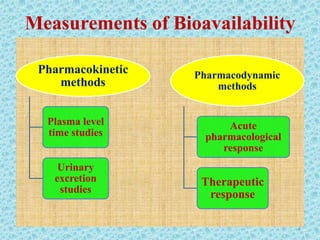
Measurements of Bioavailability
Pharmacokinetic
methods
Plasma level
time studies
Urinary
excretion
studies
Pharmacodynamic
methods
Acute
pharmacological
response
Therapeutic
response
4
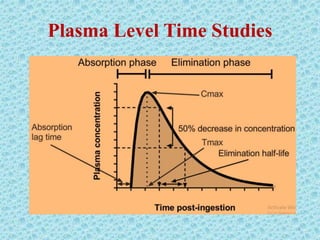
Plasma Level Time Studies
5
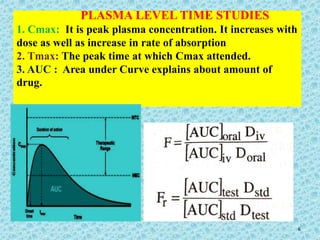
PLASMA LEVEL TIME STUDIES
1. Cmax: It is peak plasma concentration. It increases with
dose as well as increase in rate of absorption
2. Tmax: The peak time at which Cmax attended.
3. AUC : Area under Curve explains about amount of
drug.
6
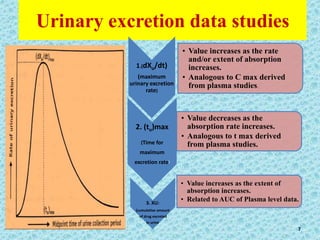
Urinary excretion data studies
1.(dXu/dt)
(maximum
urinary excretion
rate)
• Value increases as the rate
and/or extent of absorption
increases.
• Analogous to C max derived
from plasma studies.
2. (tu)max
(Time for
maximum
excretion rate)
• Value decreases as the
absorption rate increases.
• Analogous to t max derived
from plasma studies.
3. XU:
(cumulative amount
of drug excreted
in urine
• Value increases as the extent of
absorption increases.
• Related to AUC of Plasma level data.
7
PHARMACODYNAMIC
METHODS
1. ACUTE PHARMACOLOGICAL
RESPONSE:
• When bioavailability measurement by pharmacokinetic
methods is difficult, inaccurate or non-reproducible this
method is used. Such as ECG, EEG, pupil diameter.
• It can be determined by dose response graphs.
• DISADVANTAGES:
• Pharmacological response is variable and accurate
correlation drug and formulation is difficult.
• Observed response may be due to active metabolites.
8
2. THERAPEUTIC RESPONSES
• This method is based on observing clinical response in
patients.
• Demerits:
• Quantitative of observed response is too improper.
• Physiological variations maybe present between
patients.
• If multiple dose protocols are not involved. Patient
receive only single dose for few days or a weak.
• The patients receiving more than one drug treatment
may be compromised due to drug-drug interactions.
9
REFERENCES
• Biopharmaceutics and pharmacokinetics A treatise by
D.M. Brahmankar, Sunil B. Jaiswal, second edition,
Vallabh Prakash, pg. no. 315-363.
• Basics of pharmacokinetics, Leon Shargel, fifth
edition, willey publications, pp- 453-490.
• www.google.com
10
11

Measurements of bioavailability

  • 1.
    Measurements of Bioavailability Presented by NagaChandrika Pallam, Department of Pharmaceutics Geethanjali College of Pharmacy, Cheeryal, Hyd. 1
  • 2.
    Bioavailability Bioequivalence Bioavailability means therate and extent of drug, which reaches the systemic circulation unchanged following the administration of dosage form. Bioequivalence is a relative term, which denotes that the drug substance in two or more identical dosage forms reaches the systemic circulation at the same relative rate and to same relative extent. DEFINITIONS 2
  • 3.
  • 4.
    Measurements of Bioavailability Pharmacokinetic methods Plasmalevel time studies Urinary excretion studies Pharmacodynamic methods Acute pharmacological response Therapeutic response 4
  • 5.
  • 6.
    PLASMA LEVEL TIMESTUDIES 1. Cmax: It is peak plasma concentration. It increases with dose as well as increase in rate of absorption 2. Tmax: The peak time at which Cmax attended. 3. AUC : Area under Curve explains about amount of drug. 6
  • 7.
    Urinary excretion datastudies 1.(dXu/dt) (maximum urinary excretion rate) • Value increases as the rate and/or extent of absorption increases. • Analogous to C max derived from plasma studies. 2. (tu)max (Time for maximum excretion rate) • Value decreases as the absorption rate increases. • Analogous to t max derived from plasma studies. 3. XU: (cumulative amount of drug excreted in urine • Value increases as the extent of absorption increases. • Related to AUC of Plasma level data. 7
  • 8.
    PHARMACODYNAMIC METHODS 1. ACUTE PHARMACOLOGICAL RESPONSE: •When bioavailability measurement by pharmacokinetic methods is difficult, inaccurate or non-reproducible this method is used. Such as ECG, EEG, pupil diameter. • It can be determined by dose response graphs. • DISADVANTAGES: • Pharmacological response is variable and accurate correlation drug and formulation is difficult. • Observed response may be due to active metabolites. 8
  • 9.
    2. THERAPEUTIC RESPONSES •This method is based on observing clinical response in patients. • Demerits: • Quantitative of observed response is too improper. • Physiological variations maybe present between patients. • If multiple dose protocols are not involved. Patient receive only single dose for few days or a weak. • The patients receiving more than one drug treatment may be compromised due to drug-drug interactions. 9
  • 10.
    REFERENCES • Biopharmaceutics andpharmacokinetics A treatise by D.M. Brahmankar, Sunil B. Jaiswal, second edition, Vallabh Prakash, pg. no. 315-363. • Basics of pharmacokinetics, Leon Shargel, fifth edition, willey publications, pp- 453-490. • www.google.com 10
  • 11.