Expectorants
(Mucokinetics)
"Expectorants are oral drugs that are increase bronchial
secretion or reduce its viscosity, facilitating its removal by
coughing simply they enhance the clearance of mucus."
Classification of Expectorants
1. Bronchial secretion
enhancers:
• Sodium or Potassium citrate,
• Potassium iodide.
• Guaiphenesin(Glyceryl guaiacolate).
• balsum of Tolu & Vasaka,
• Ammonium chloride.
2. Mucolytics:
• Ex- Bromhexine.
• Ambroxol.
• Acetyl cysteine.
• Carbocisteine
Bronchial secretion enhancers
• Potassium iodide secreted by bronchial glands and can irritate the airway mucosa are
considered to increase bronchial secretion by salt action If potassium iodide given
externally for prolong use can affect thyroid function and produce iodism.
• Guaiphenesin, vasaka, tolu balsum are plant products enhance bronchial secretion
and mucociliary function.
• Ammonium salts are nauseating - reflex increase respiratory secretions so US-FDA
has stopped marketing of all expectorants, except guaiphenesin.
• Now a days steam inhalation and proper hydration may be more helpful in clearing
airway mucus
Mucolytics
• Several agents can reduce the viscosity of sputum in vitro but clinical studies in
chronic bronchitis, asthma, and bronchiectasis not showing much activity.
• Mucolytic drugs (ex-derivatives of cysteine) reduce the disulphide bridges that bind
glycoproteins to other proteins such as albumin and secretory IgA.
• These drugs also act as antioxidants and may therefore reduce airway inflammation.
• Only N-acetylcysteine (MUCOMYST. others) is available in the U.S.; carbocysteine,
methyl cysteine, erdosteine, and bromhexine are available elsewhere.
Antitussives
"These are drugs that act in the CNS to raise the threshold of
cough center or act peripherally in the respiratory tract to
reduce tussal impulses, or both these actions."
Introduction
• Actually cough is a common symptom of airway disease, but its mechanisms are
poorly understood. Viral infections of the upper respiratory tract are the most
common cause of cough; post-viral cough is usually self-limiting and commonly
patient-medicated.
• Antitussives should be used only for dry nonproductive cough or if cough is unduly
tiring, disturbs sleep or is hazardous (hernia, piles. cardiac disease, ocular surgery).
• Before treatment with antitussives, it is important to identify underlying causal
mechanisms that may require therapy.
Classification of Antitussives
1. Opioids: Ex- Codeine, Ethyl morphine, Pholcodine.
2. Nonopioids: Ex- Noscapine, Dextromethorphan, Chlophedianol.
3. Antihistamines: Ex- Chlorpheniramine, Diphenhydramine, Promethazine.
4. Peripherally acting: Ex- Prenoxdiazine.
5. Adjuvant antitussives/ Bronchodilators: Ex- Salbutamol, Terbutalin.
Opioids
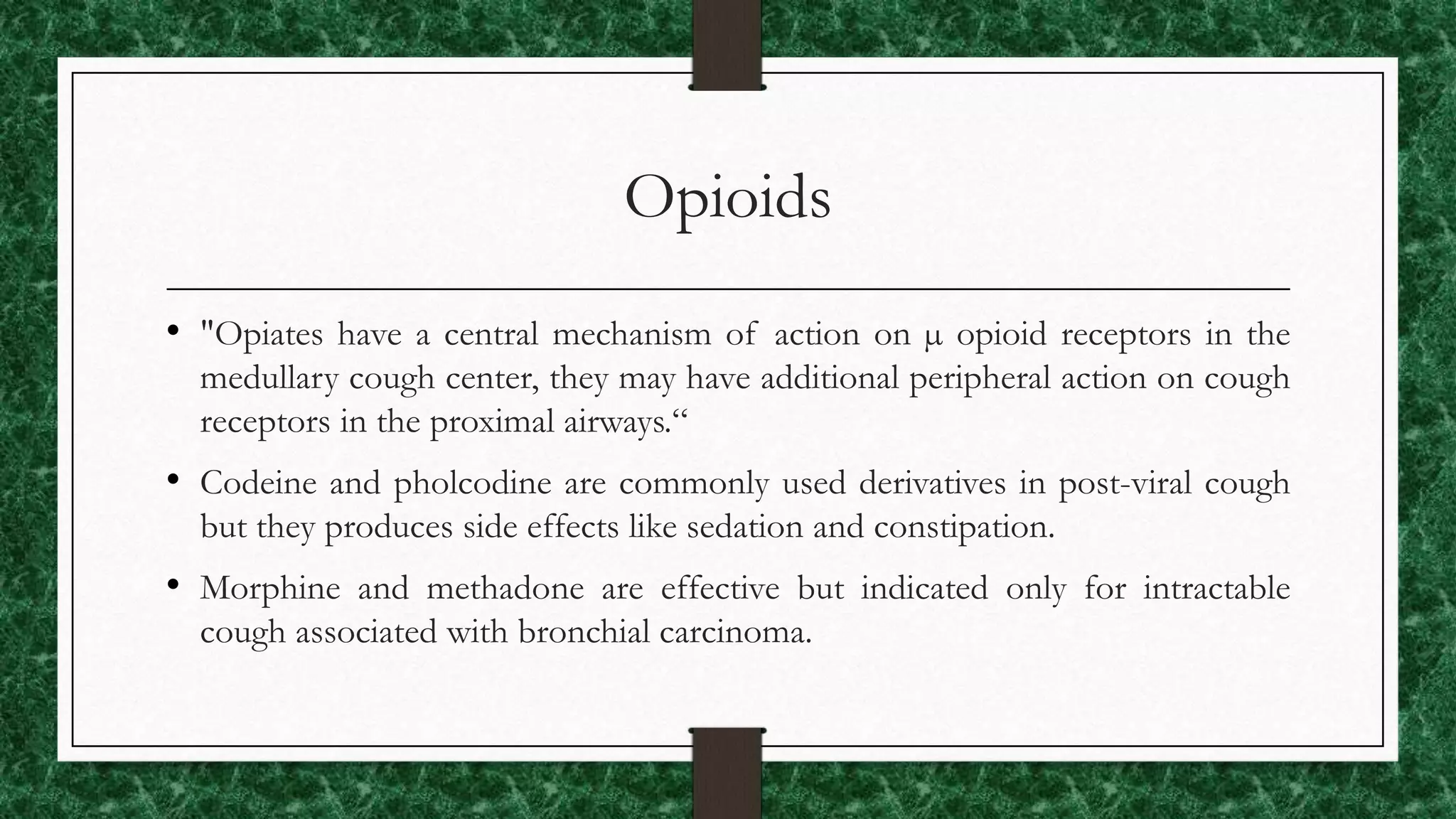
• "Opiates have a central mechanism of action on µ opioid receptors in the
medullary cough center, they may have additional peripheral action on cough
receptors in the proximal airways.“
• Codeine and pholcodine are commonly used derivatives in post-viral cough
but they produces side effects like sedation and constipation.
• Morphine and methadone are effective but indicated only for intractable
cough associated with bronchial carcinoma.
Nonopioids derivatives:
• "These are the agents used in reducing cough without causing any
hallucinations or narcotic action it less abuse potential.“
 Noscapine,
 Dextromethorphan,
 Chlophedianol.
Antihistamines
• Many H1 antihistamines have been conventionally added to antitussive/
expectorant formulations.
• They relieves cough due to their sedative and anticholinergic actions, but lack
selectivity for the cough centre.
• They have no expectorant property, may even reduce secretions by
anticholinergic action.
• They have been specially promoted for cough in respiratory allergic states,
though their lack of efficacy in asthmatic conditions.
Antihistamines
• Chlorpheniramine (2-5 mg).
• Diphenhydramine (15-25 mg) and
• Promethazine (15-25 mg:
• PHENERGAN 5 mg/5 ml elixir)
• Second generation antihistamines like fexofenadine, loratadine, etc. are
ineffective.
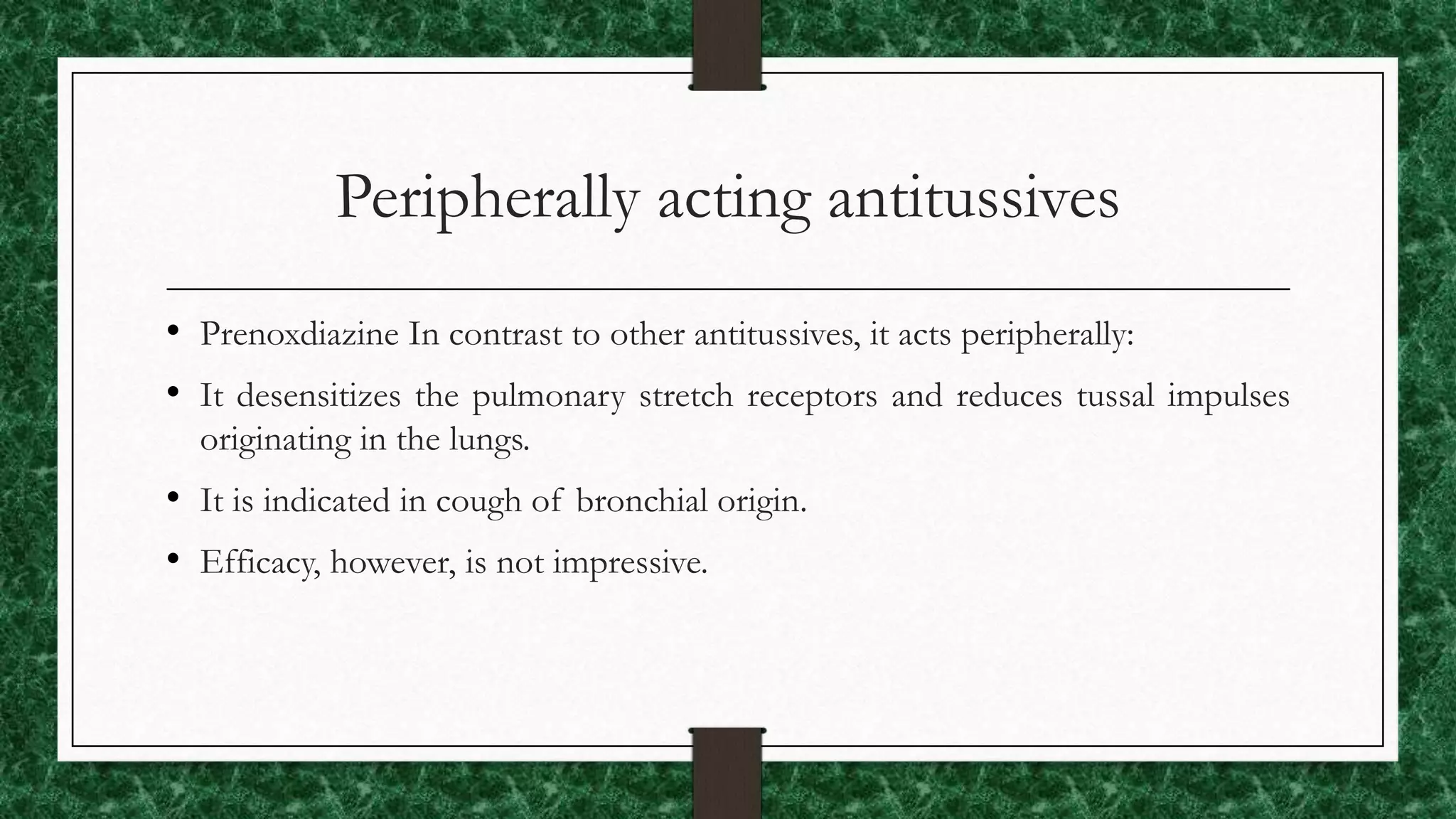
Peripherally acting antitussives
• Prenoxdiazine In contrast to other antitussives, it acts peripherally:
• It desensitizes the pulmonary stretch receptors and reduces tussal impulses
originating in the lungs.
• It is indicated in cough of bronchial origin.
• Efficacy, however, is not impressive.
Bronchodilators
• Bronchospasm can induce or aggravate cough. Stimulation of pulmonary
receptors can trigger both cough and bronchoconstriction, especially in
individuals with bronchial hyperreactivity.
• Bronchodilators relieve cough in such individuals and improve the
effectiveness of cough in clearing secretions by increasing surface velocity of
airflow during the act of coughing.
• Fixed dose combinations of a centrally acting antitussive with a
bronchodilator or with an antihistaminic having high atropinic activity.
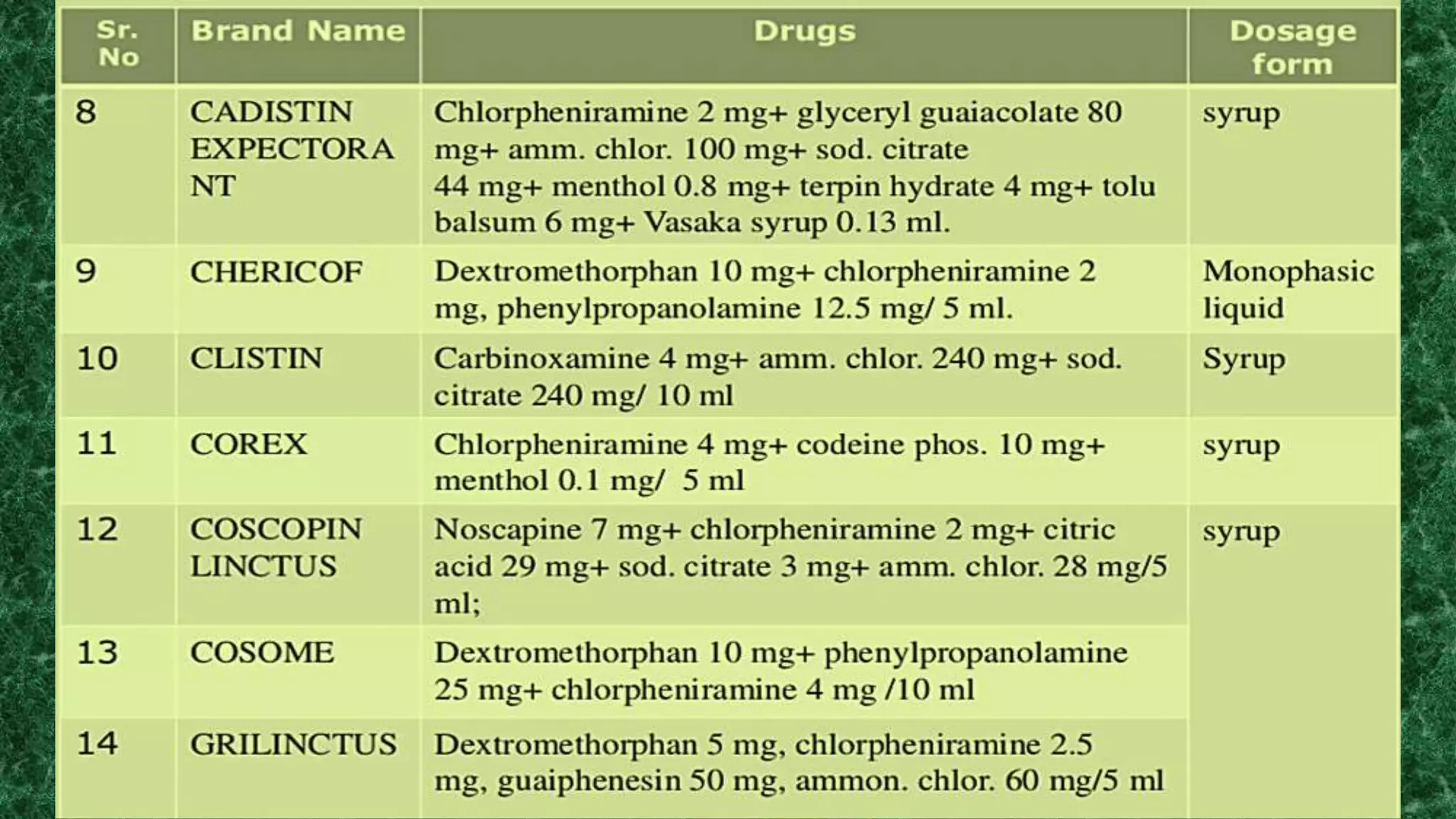
Some Expectorants and antitussive
combinations
Thank
You

Expectorants and anti tussives

  • 1.
    Expectorants (Mucokinetics) "Expectorants are oraldrugs that are increase bronchial secretion or reduce its viscosity, facilitating its removal by coughing simply they enhance the clearance of mucus."
  • 2.
    Classification of Expectorants 1.Bronchial secretion enhancers: • Sodium or Potassium citrate, • Potassium iodide. • Guaiphenesin(Glyceryl guaiacolate). • balsum of Tolu & Vasaka, • Ammonium chloride. 2. Mucolytics: • Ex- Bromhexine. • Ambroxol. • Acetyl cysteine. • Carbocisteine
  • 3.
    Bronchial secretion enhancers •Potassium iodide secreted by bronchial glands and can irritate the airway mucosa are considered to increase bronchial secretion by salt action If potassium iodide given externally for prolong use can affect thyroid function and produce iodism. • Guaiphenesin, vasaka, tolu balsum are plant products enhance bronchial secretion and mucociliary function. • Ammonium salts are nauseating - reflex increase respiratory secretions so US-FDA has stopped marketing of all expectorants, except guaiphenesin. • Now a days steam inhalation and proper hydration may be more helpful in clearing airway mucus
  • 4.
    Mucolytics • Several agentscan reduce the viscosity of sputum in vitro but clinical studies in chronic bronchitis, asthma, and bronchiectasis not showing much activity. • Mucolytic drugs (ex-derivatives of cysteine) reduce the disulphide bridges that bind glycoproteins to other proteins such as albumin and secretory IgA. • These drugs also act as antioxidants and may therefore reduce airway inflammation. • Only N-acetylcysteine (MUCOMYST. others) is available in the U.S.; carbocysteine, methyl cysteine, erdosteine, and bromhexine are available elsewhere.
  • 6.
    Antitussives "These are drugsthat act in the CNS to raise the threshold of cough center or act peripherally in the respiratory tract to reduce tussal impulses, or both these actions."
  • 7.
    Introduction • Actually coughis a common symptom of airway disease, but its mechanisms are poorly understood. Viral infections of the upper respiratory tract are the most common cause of cough; post-viral cough is usually self-limiting and commonly patient-medicated. • Antitussives should be used only for dry nonproductive cough or if cough is unduly tiring, disturbs sleep or is hazardous (hernia, piles. cardiac disease, ocular surgery). • Before treatment with antitussives, it is important to identify underlying causal mechanisms that may require therapy.
  • 8.
    Classification of Antitussives 1.Opioids: Ex- Codeine, Ethyl morphine, Pholcodine. 2. Nonopioids: Ex- Noscapine, Dextromethorphan, Chlophedianol. 3. Antihistamines: Ex- Chlorpheniramine, Diphenhydramine, Promethazine. 4. Peripherally acting: Ex- Prenoxdiazine. 5. Adjuvant antitussives/ Bronchodilators: Ex- Salbutamol, Terbutalin.
  • 9.
    Opioids • "Opiates havea central mechanism of action on µ opioid receptors in the medullary cough center, they may have additional peripheral action on cough receptors in the proximal airways.“ • Codeine and pholcodine are commonly used derivatives in post-viral cough but they produces side effects like sedation and constipation. • Morphine and methadone are effective but indicated only for intractable cough associated with bronchial carcinoma.
  • 11.
    Nonopioids derivatives: • "Theseare the agents used in reducing cough without causing any hallucinations or narcotic action it less abuse potential.“  Noscapine,  Dextromethorphan,  Chlophedianol.
  • 13.
    Antihistamines • Many H1antihistamines have been conventionally added to antitussive/ expectorant formulations. • They relieves cough due to their sedative and anticholinergic actions, but lack selectivity for the cough centre. • They have no expectorant property, may even reduce secretions by anticholinergic action. • They have been specially promoted for cough in respiratory allergic states, though their lack of efficacy in asthmatic conditions.
  • 14.
    Antihistamines • Chlorpheniramine (2-5mg). • Diphenhydramine (15-25 mg) and • Promethazine (15-25 mg: • PHENERGAN 5 mg/5 ml elixir) • Second generation antihistamines like fexofenadine, loratadine, etc. are ineffective.
  • 15.
    Peripherally acting antitussives •Prenoxdiazine In contrast to other antitussives, it acts peripherally: • It desensitizes the pulmonary stretch receptors and reduces tussal impulses originating in the lungs. • It is indicated in cough of bronchial origin. • Efficacy, however, is not impressive.
  • 16.
    Bronchodilators • Bronchospasm caninduce or aggravate cough. Stimulation of pulmonary receptors can trigger both cough and bronchoconstriction, especially in individuals with bronchial hyperreactivity. • Bronchodilators relieve cough in such individuals and improve the effectiveness of cough in clearing secretions by increasing surface velocity of airflow during the act of coughing. • Fixed dose combinations of a centrally acting antitussive with a bronchodilator or with an antihistaminic having high atropinic activity.
  • 17.
    Some Expectorants andantitussive combinations
  • 21.