• Sandwich ELISA is a less common variant of ELISA, but is
highly efficient in sample antigen detection. Moreover,
many commercial ELISA pair sets are built on this
sandwich ELISA.
• The sandwich ELISA quantify antigens between two layers
of antibodies.
• The antigen to be measured must contain at least two
antigenic epitope capable of binding to antibody, since at
least two antibodies act in the sandwich.
• Either monoclonal or polyclonal antibodies can be used as
the capture and detection antibodies in Sandwich ELISA
systems.
• Monoclonal antibodies recognize a single
epitope that allows fine detection and
quantification of small differences in antigen.
• A polyclonal is often used as the capture
antibody to pull down as much of the antigen
as possible. In Sandwich ELISA ,the sample
does not have to be purified before analysis,
and the assay can be very sensitive, but lower
than ELISpot.
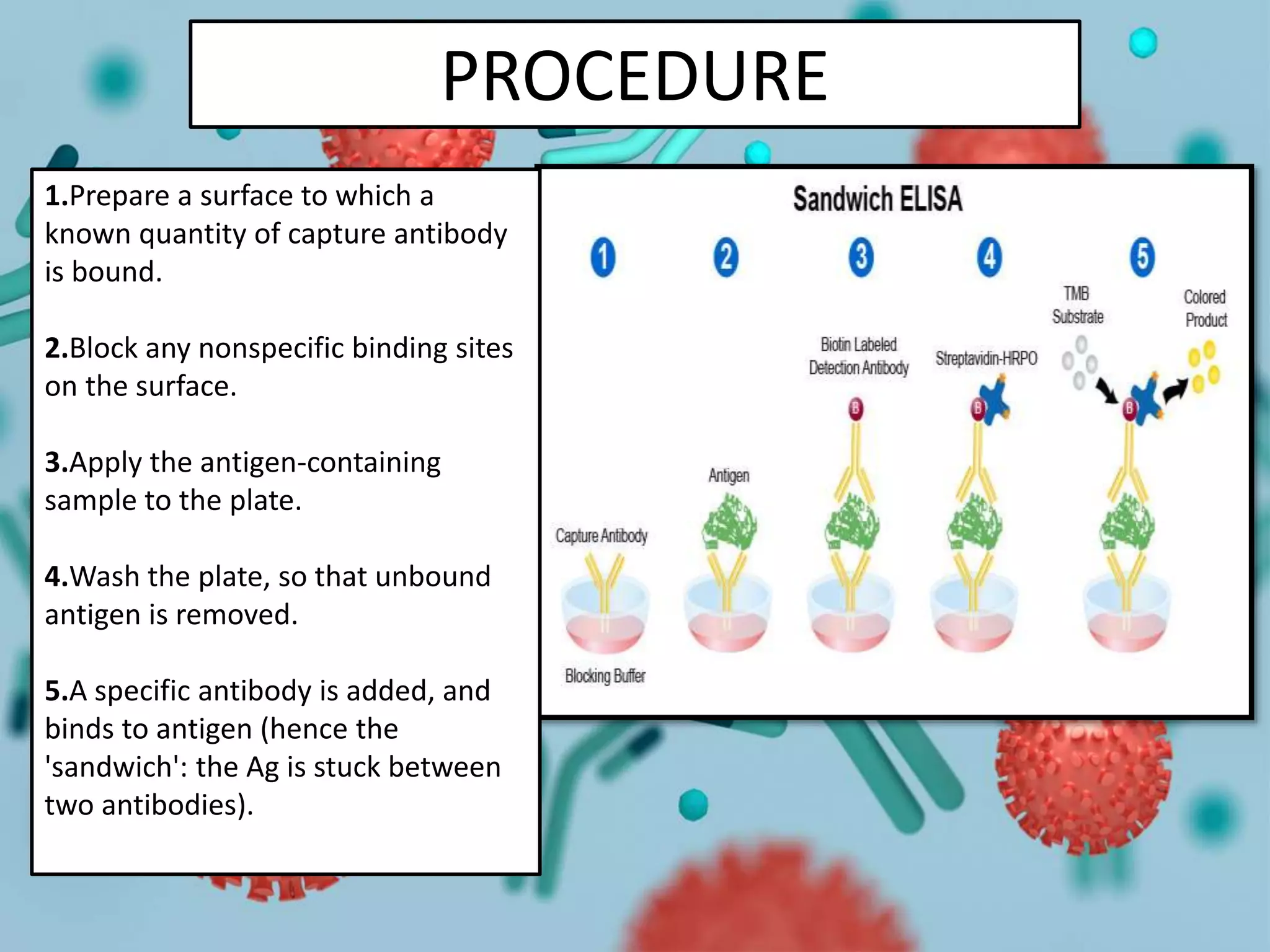
PRINCIPLE
• The principle is as follows:
• (1) Plate is coated with a capture antibody;
• (2) sample is added, and any antigen present binds
to capture antibody;
• (3) detecting antibody is added, and binds to
antigen;
• (4) enzyme-linked secondary antibody is added, and
binds to detecting antibody;
• (5) substrate is added, and is converted by enzyme to
detectable form.
PROCEDURE
1.Prepare a surface to which a
known quantity of capture antibody
is bound.
2.Block any nonspecific binding sites
on the surface.
3.Apply the antigen-containing
sample to the plate.
4.Wash the plate, so that unbound
antigen is removed.
5.A specific antibody is added, and
binds to antigen (hence the
'sandwich': the Ag is stuck between
two antibodies).
• 6.Apply enzyme-linked secondary antibodies as
detection antibodies that also bind specifically to
the antibody's Fc region (non-specific).
• 7.Wash the plate, so that the unbound antibody-
enzyme conjugates are removed.
• 8.Apply a chemical that is converted by the
enzyme into a color or fluorescent or
electrochemical signal.
• 9.Measure the absorbency or fluorescence or
electrochemical signal (e.g., current) of the plate
wells to determine the presence and quantity of
antigen.
APPLICATIONS
• From cancer screening to drug and pregnancy
testing
• Detection of platelet antibodies
• Food allergens
• Detecting viruses using viruses
• 1-HIV
• 2-West Nile Virus
• 3-Newcastle Disease Virus (NDV)
ADVANTAGES
• Reagents are cheap and have a long shelf life.
• Highly sensitive and specific in nature.
• No radiation hazard occurs during labelling or disposal of
waste.
• Easy to perform and quick procedure
• It has high specificity since two antibodies are used and
antigen/analyte is specifically captured and detected.
• It is suitable for complex samples as antigen does not
require purification prior to measurement.
• Has good flexibility and sensitivity, since both direct and
indirect detection methods can be used.
DISADVANTAGES
• The one disadvantage with sandwich ELISA is
that antibody optimization can be difficult. It’s
essential each antibody reacts with a specific
epitope on the target protein and does not
cross-react with its partner, and so only
products specifically tested for sandwich ELISA
should be used.
Sandwich elisa

Sandwich elisa

  • 2.
    • Sandwich ELISAis a less common variant of ELISA, but is highly efficient in sample antigen detection. Moreover, many commercial ELISA pair sets are built on this sandwich ELISA. • The sandwich ELISA quantify antigens between two layers of antibodies. • The antigen to be measured must contain at least two antigenic epitope capable of binding to antibody, since at least two antibodies act in the sandwich. • Either monoclonal or polyclonal antibodies can be used as the capture and detection antibodies in Sandwich ELISA systems.
  • 3.
    • Monoclonal antibodiesrecognize a single epitope that allows fine detection and quantification of small differences in antigen. • A polyclonal is often used as the capture antibody to pull down as much of the antigen as possible. In Sandwich ELISA ,the sample does not have to be purified before analysis, and the assay can be very sensitive, but lower than ELISpot.
  • 4.
    PRINCIPLE • The principleis as follows: • (1) Plate is coated with a capture antibody; • (2) sample is added, and any antigen present binds to capture antibody; • (3) detecting antibody is added, and binds to antigen; • (4) enzyme-linked secondary antibody is added, and binds to detecting antibody; • (5) substrate is added, and is converted by enzyme to detectable form.
  • 5.
    PROCEDURE 1.Prepare a surfaceto which a known quantity of capture antibody is bound. 2.Block any nonspecific binding sites on the surface. 3.Apply the antigen-containing sample to the plate. 4.Wash the plate, so that unbound antigen is removed. 5.A specific antibody is added, and binds to antigen (hence the 'sandwich': the Ag is stuck between two antibodies).
  • 6.
    • 6.Apply enzyme-linkedsecondary antibodies as detection antibodies that also bind specifically to the antibody's Fc region (non-specific). • 7.Wash the plate, so that the unbound antibody- enzyme conjugates are removed. • 8.Apply a chemical that is converted by the enzyme into a color or fluorescent or electrochemical signal. • 9.Measure the absorbency or fluorescence or electrochemical signal (e.g., current) of the plate wells to determine the presence and quantity of antigen.
  • 7.
    APPLICATIONS • From cancerscreening to drug and pregnancy testing • Detection of platelet antibodies • Food allergens • Detecting viruses using viruses • 1-HIV • 2-West Nile Virus • 3-Newcastle Disease Virus (NDV)
  • 8.
    ADVANTAGES • Reagents arecheap and have a long shelf life. • Highly sensitive and specific in nature. • No radiation hazard occurs during labelling or disposal of waste. • Easy to perform and quick procedure • It has high specificity since two antibodies are used and antigen/analyte is specifically captured and detected. • It is suitable for complex samples as antigen does not require purification prior to measurement. • Has good flexibility and sensitivity, since both direct and indirect detection methods can be used.
  • 9.
    DISADVANTAGES • The onedisadvantage with sandwich ELISA is that antibody optimization can be difficult. It’s essential each antibody reacts with a specific epitope on the target protein and does not cross-react with its partner, and so only products specifically tested for sandwich ELISA should be used.