AGGLUTINATION
AGGLUTINATION REACTIONS
 The interaction between antibody and a particulate antigen results in visible clumping called
agglutination.
 Antibodies that produce such reactions are called agglutinins. Better agglutination takes place with
IgM antibody than with IgG antibodies.
 Excess of an antibody also inhibits agglutination reaction; this inhibition is called prozone
phenomenon.
 Agglutination is more sensitive than precipitation for the detection of antibodies.
 Agglutination occurs optimally when antigens and antibodies react in equivalent proportions.
PRINCIPLE OF AGGLUTINATION REACTION
 The principle of agglutination reaction is based on the “Clumping of antigen and antibody”.
 Like precipitation reaction, it also involves the binding of antigen and antibody at the zone of
equivalence, where both are present in equal proportion.
 As the antibodies are y-shaped structure and there are two Fab sites made of “Hypervariable
region” will target the specific antigenic determinants or epitopes of an antigen.
 The binding of antigen and antibody is similar to the “Lock-key model”.
 Therefore, the epitopes of an antigen are the key which fits into the cleft of the Fab sites of the
antibody that works as a lock.
STEPS OF
AGGLUTINATION
 Sensitization: It can define as the
primary stage where binding of antigen
and antibody takes place. Temperature,
pH, ionic strength and incubation period
influence the efficiency of sensitization or
binding. Sensitization is not a visible
reaction.
 Lattice formation: It can define as the
secondary stage where the antibody and
multivalent antigen forms a Stable
network refers as “Lattice”. A lattice is a
net-like configuration which consists of a
network between sensitized antigen and
antibody. It takes much time to occur than
that of sensitization. Lattice is a visible
reaction.
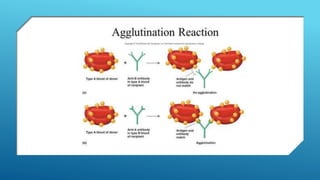
Agglutination

Agglutination

  • 1.
  • 2.
    AGGLUTINATION REACTIONS  Theinteraction between antibody and a particulate antigen results in visible clumping called agglutination.  Antibodies that produce such reactions are called agglutinins. Better agglutination takes place with IgM antibody than with IgG antibodies.  Excess of an antibody also inhibits agglutination reaction; this inhibition is called prozone phenomenon.  Agglutination is more sensitive than precipitation for the detection of antibodies.  Agglutination occurs optimally when antigens and antibodies react in equivalent proportions.
  • 3.
    PRINCIPLE OF AGGLUTINATIONREACTION  The principle of agglutination reaction is based on the “Clumping of antigen and antibody”.  Like precipitation reaction, it also involves the binding of antigen and antibody at the zone of equivalence, where both are present in equal proportion.  As the antibodies are y-shaped structure and there are two Fab sites made of “Hypervariable region” will target the specific antigenic determinants or epitopes of an antigen.  The binding of antigen and antibody is similar to the “Lock-key model”.  Therefore, the epitopes of an antigen are the key which fits into the cleft of the Fab sites of the antibody that works as a lock.
  • 5.
    STEPS OF AGGLUTINATION  Sensitization:It can define as the primary stage where binding of antigen and antibody takes place. Temperature, pH, ionic strength and incubation period influence the efficiency of sensitization or binding. Sensitization is not a visible reaction.  Lattice formation: It can define as the secondary stage where the antibody and multivalent antigen forms a Stable network refers as “Lattice”. A lattice is a net-like configuration which consists of a network between sensitized antigen and antibody. It takes much time to occur than that of sensitization. Lattice is a visible reaction.